Jonathan Miles

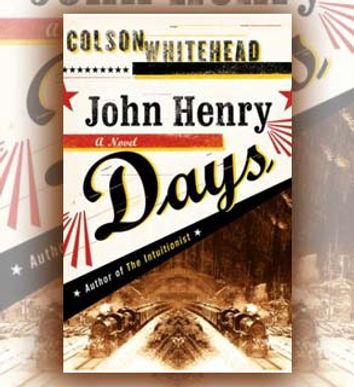
“John Henry Days”

In Colson Whitehead's dazzling follow-up to "The Intuitionist," a junketeering journalist pursues an American legend in an epic tale of man, machine and free drinks.

Colson Whitehead’s “John Henry Days,” the follow-up to his much — and quite rightly — acclaimed 1999 debut, “The Intuitionist,” is, by every standard, a big book. For one, there’s Whitehead’s hulking talent, the potential of which buzzed through “The Intuitionist” with the voltage of a city power line; for another, there’s the novel’s outsize subject matter, which is more or less America, the epic idea of which Whitehead chases with the dogged ambition of a Lawrence or DeLillo. And, on the simplest level, there’s the novel’s overstuffed, 389-page girth. Writers tend to shrink back with their sophomore efforts, having thrown kitchen sink and all into their long-gestated debuts, but with “John Henry Days” Whitehead took the opposite tack — there’s enough debris for seven or eight lesser novels whirling ’round Whitehead’s funnel cloud.

At the novel’s vortex, with hammer in hand, stands John Henry, the semi-mythical 19th-century black railway worker whose triumphant race against a steam-powered drill cost him his life but transformed him into American folklore’s lushest metaphor — that of mankind’s noble if futile struggle against the soullessness of machinery. Orbiting John Henry’s story — thinly but marvelously told — are a panoply of others, the most essential of which concerns J. Sutter, a black freelance journalist too jaded “to pretend that there is anything but publicity,” who’s been reduced to covering, for a cheesy travel Web site, the cheesier unveiling of a commemorative postage stamp in a small West Virginia town.

Like John Henry, who the postage stamp honors, J. is engaged in a race of his own: He’s trying to smash a dubious record for attending press junkets, having made it to at least one per day for the last three months, a jag he is “too unwilling or too scared to break.” Not unlike blasting railroad tracks through mountains, this line of work entails its own physical hazards — one of J.’s fellow junketeers, for instance, lost an eye to a finger, Stooge-style, while leaping for a free cocktail, and J. himself comes perilously close to a very real if also metaphorical end when he chokes on a “stern and vengeful” plug of gratis prime rib.

These contrapuntal narratives, with their chafing together of the Industrial and Information Ages, are almost always pitch-perfect. Whitehead, a former television critic for the Village Voice, brings a serrated wit to his depiction of the junketeering life; his wickedly precise portrayal of a Manhattan publishing party — with its clinking glasses and banal, disjointed chatter — shudders with a grandly satiric frisson. But Whitehead, pendulating between John Henry’s feats and J.’s, never once settles for an easy, false nostalgia; hero and hack walk side by side through their paralleled worlds, equals in their fight against their respective mountains. As another character puts it: “We make our own machines and devise our own contests in which to engage them.”

Less perfect — and what fainter criticism there is I do not know — are the stories festooning the novel’s periphery: stories of briefly glimpsed bluesmen, folklorists, songsters, stamp collectors, hoteliers, even Paul Robeson; stories of lives touched, however softly, by John Henry’s legacy. Darting in and out of the novel, these flyaway tales alternately rev and sputter the narrative engine. The oblique light they shed on Whitehead’s central metaphor isn’t always revelatory, but then the metaphor itself isn’t exactly revelatory, either. As a young J., upon first hearing about John Henry in grade school, longs to ask his teacher: “Mrs. Goodwin, if he beat the steam engine, why did he have to die? Did he win or lose?” In Whitehead’s extraordinary hands, a nation is contained in that question.

“The Rights of Desire” by Andre Brink

A May-December romance in a post-apartheid South Africa where violence is always ready to erupt.

He seems an unlikely candidate for operatic passion, this Ruben Olivier: He’s 65, a widower with mild memories, a former librarian and inveterate reader whose sole joy in life arises from the “reassurance of words,” the “wild and sacred space” of books “where meanings are manageable precisely because they aren’t binding,” where “illusion is comfortingly real.” That Olivier lives in post-apartheid South Africa, amidst the bitter recriminations and confused violence outside the very doorstep of his Cape Town manse, infuses that last line with a kind of dark naivete; Olivier’s life, both public and private, is a study in shelter. And “one day it will be mercifully over,” Olivier broods, “but it seems you never really get there.”

Olivier’s sons, worried for their father’s safety after the random murder of his best pal and chess-opponent, are committed to spiriting him out of South Africa, but Olivier won’t submit. After all, he argues, he has Magrieta, his petulant black housekeeper, to look after him, and also Antje of Bengal, the ghost of a 17th century slave executed for the poisoning of her master and lover’s wife. To appease his children, nonetheless, Olivier agrees to take in a lodger. Enter Tessa Butler: 29, caustic and carnal, “with dirty feet and a smudge on her cheek,” and “nowhere else to go.”

“I won’t cook, I won’t keep house, I won’t sleep with you,” she tells him. “But I can be around.”

From their first conversation — “the large easy loops, the repetitions and variations and divagations, the sudden changes of direction” — Olivier is in love: madly, deeply, as if all the illusions and allusions in his books had shuddered to life in one blinding instant. His father, Oliver recalls, “in one of his more exuberant or desperate moods,” would “go out in the veld and sprinkle brandy on the daisies to make them drunk so that they wouldn’t feel the pain of shriveling up and dying,” and, for Olivier, Tessa becomes the brandy, the final drunk pleasure. Tessa allows him all this, even revels in it, though her motives are never quite clear, perhaps not even to herself.

Like every great novel, “The Rights of Desire” teeters occasionally on the cusp of sentimentality, but there is also comedy here — after a botched attempt to navigate a condom, in heady (if vain) anticipation, Olivier tries to flush it down the toilet only to have it keep returning to the surface “like the corpse of a saint” — and no small measure of genuine poignancy. When the harsher realities of the outside world — and the very literal ghost of South Africa’s dusky past — invade Olivier’s geriatric amour, he is forced to step from the flat, sheltered world of his books and memories into a world made round by blood and desire. It is a world rendered brilliantly, ambitiously and humanely by Brink; this novel, chiseled and rigorous, feels as durable as desire.

Continue Reading Close

“Rides of the Midway” by Lee Durkee

With this full-tilt novel of youthful catastrophe and hellbent debauchery, a bartender kicks in the door of Southern literature.

No reason to mince words here: With this eruptive debut novel, Lee Durkee, a Mississippian who has tended bar in Vermont for the past 15 years, has just kicked in the door of Southern literature. Or maybe that splintered door belongs to American lit; it’s getting harder and harder to tell them apart these days, what with the great Cormac gone cowboy and the rest of Faulkner’s chillen fumbling around the strip malls. Durkee’s publisher is likening him to John Irving, and while that comparison is understandable — for one, the novel features a fatal baseball snafu reminiscent of Irving’s “A Prayer for Owen Meany” — it is by far too epidermal. Durkee writes with the verve of a young Philip Roth or Thomas McGuane:

Dangerously thin, dressed in a pleated black dancer’s skirt with black leotards below and tight black ribbed shirt above, Amber appeared torn between death and disco.

The cop was squinting at the Polaroids so intently that it appeared the developing process was of telepathic origin.

But, even more than these, Durkee calls to mind the early Barry Hannah — rattling his lingual sabers, jitterbugging on the edge of absurdity, lobbing lit firecrackers at his startled audience. “Rides of the Midway” is a manic, sloshed, whiny, fizzy, horny, noisome and wondrous novel.

Set in the ’70s in the skankier, preacher-riddled portions of south Mississippi, the action begins when 10-year-old Noel Weatherspoon, playing Little League ball for the Standard Oil Red Sox, shatters the collarbone of the opposing catcher and sends the poor tyke into a coma. This collision, however haphazard and incidental, launches the decade-long spiritual unraveling that constitutes the bulk of Durkee’s story: Noel plunges headlong into drugs, pornography, voyeurism, sex with a watermelon (leading, it begs mention, to a family supper worthy of the Portnoys), mercy killing, more drugs, vandalism, adultery and so on.

It’s an extravagantly hedonistic spiral, to be sure, but not one wholly nihilistic; underpinning the novel’s deft and toothsome hilarity is Noel’s hopped-up and half-witted grab for theological autonomy, a Baudelairean effort to escape the prepackaged salvation championed by his Billy Graham look-alike stepfather and church-soaked community and to find God — or, less concretely, whatever designer propels this “darkly spinning” world — on none but his own terms. Noel’s effort is a vital, almost-involuntary one, as vital and involuntary as this coarsely graceful novel feels — as vital and involuntary, that is, as the truest art.

Continue Reading Close

“The Law of Averages” by Frederick Barthelme

The confessed minimalist's new book proves that the much-reviled genre can still break your heart.

At some point, in the mid- to late ’80s, you were forced to take a side: You were either for or against minimalism, that listless mode of fictioneering said to reflect, with its stripped-down rhetoric and its slo-mo portrayal of the quotidian, the flatness and the anomie of American existence. (One hesitates to say “life.”) The minimalists themselves, unanimously hating the label, skirmished with their detractors in the pages of magazines and book reviews: Less is more, said one side; less is … less, said the other. And not only was less less, the latter charged, minimalism was dehumanizing, they claimed, and amoral, and trivial, and linguistically soulless. “‘Around the house and in the yard’ fiction,” as the maxi-minded Don DeLillo described it, about “marriages and separations and trips to Tanglewood.” And on some counts, this reviewer must weigh in, the detractors were right. Minimalism wrought fiction that seemed, at its worst, little more than Dick-and-Jane stories for grown-ups: See Dick watch TV. See Jane frown. See Dick eat baked chicken. The end. It was literature with a message that could fit inside a fortune cookie: Nothing happens and nobody cares.

Chief counsel for the defense was Frederick Barthelme, or Barthelme the Younger, as John Updike is fond of referring to him, who laid out minimalism’s merits in a 1988 New York Times Book Review essay titled “On Being Wrong: Convicted Minimalist Spills Beans.” He passed along this advice to his fellow pecked-at minimalists:

Tell them [the naysayers] that you prefer to think you’re leaving room for the readers, at least for the ones who like to use their imaginations; that you hope those readers hear the whispers, catch the feints and shadows, gather the traces, sense the pressures, and that meanwhile the prose tricks them into the drama, and the drama breaks their hearts. Just like old times.

By now, of course, 1988 seems like old times; and while these sorts of aesthetic wars are never actually won, so to speak, it’s safe to say that the bells have indeed tolled for minimalism’s reign over American fiction. Thus, the publication of “The Law of Averages,” a mostly retrospective anthology of Barthelme’s short fiction, presents us with a grand opportunity to peer backward, with the slight cushion of history and without aesthetic rancor, at what Barthelme — and by extension the minimalist ethos — was able to do: that is, whether the prose does the trick, whether it can still, two decades later, break our hearts.

In the spirit of things, the minimalist answer is this: Yes. Barthelme’s stories, it’s true, travel negligible distances — emotionally, geographically and physically — and never so much begin and end as start and stop. At times they suggest Philip Glass’ opera “Einstein on the Beach,” during which the audience was encouraged to wander about; one could step out into the lobby for coffee and a cigarette and return confident that nothing much had happened in the meantime. Because, in Barthelme’s world, nothing much does happen: A middle-aged white man almost, but not quite, makes a connection with one of life’s mysteries — or at least with a woman, who often, for Barthelme, embodies life’s mystery. The “almost” is important here, because Barthelme’s characters aren’t awarded those connections, no matter how often they’re glimpsed, even, in fact, when such connections are more or less forced upon them. In Barthelme’s stories (“Pupil,” “Instructor,” “Violet”) women are always dropping their clothes in front of startled men, or teen runaways or female college students are knocking on the apartment door; the men, in response, shrivel.

That Barthelme’s hapless souls are aware — keenly aware — of their missed or nonexistent opportunities casts a gloomy, half-tragic shadow over these stories. Barthelme’s characters were conditioned to expect more of life. “What am I cooking?” the narrator of “Cooker” asks his wife. The answer is lamb chops. “This makes me feel better,” he says dryly. “Lamb chops, and suddenly the world is new, a place of mystery and possibility.” The only epiphany, then, is that there are no epiphanies. “I stood for a minute there on the blacktop,” says another narrator, “arms crossed, scanning townhouses across the street for a clue, a movement, anything out of the ordinary. There was nothing.”

This sounds, of course, like the grousing of one of Barthelme’s detractors, bemoaning the lack of clues, or movement, or anything extraordinary. But I’d like to return to Glass’ “Einstein on the Beach” for a moment, because I think there’s a corollary here. Andrew Porter, reviewing Glass’ opera for the New Yorker, wrote that “Glass’ score may be incantatory, but it is not lulling … a listener to his music usually reaches a point, quite early on, of rebellion at the ‘needle stuck in the groove’ quality, but a minute or two later he realizes that the needle has not stuck; something has happened. Once that point has passed, Glass’ music becomes easy to listen to for hours on end — or so I find. The mind may wander now and again, but it wanders within a new sound world that the composer has created.” Change a few words and Porter could be reviewing Barthelme.

Nothing much happens in Barthelme’s stories, yes; but something happens in the reader’s mind and, more important, keeps happening. In that respect, Barthelme’s stories aren’t so much stories as they are moods. A newspaper or hamburger wrapper skitters across a deserted intersection and your heart starts to crack. At times the effect is inscrutable; as one narrator says, speaking of the Dallas skyline: “I couldn’t tell whether the lights were strange or it was fabulous architecture,” which mirrors the bewilderment these stories can foment. The effect can even be irksome — the weight of these seemingly weightless stories has the power to cloud the sunniest of days, even to wound, in a way reminiscent of Dostoevski or Kafka. Is this really the world I inhabit? you wonder, peering up from the page. And the answer leaves you desperate.

Continue Reading Close

“The Beast God Forgot to Invent” by Jim Harrison

Imbued with all the gravelly melancholy of a Tom Waits ballad, the new book by the author of "Legends of the Fall" presents a cast of prickly, coarse and utterly lovable antiheroes.

The novella is a strange and stubborn beast. It dwells along literature’s brambly edges, somewhere between the shadow-strewn forests of the novel and the tidy, fenced-in pastures of the short story. Little wonder, then, that Jim Harrison should be drawn to the novella form. Harrison has been prowling the literary edges for four decades now, stubbornly eluding the snares of critical reduction — including such dim taggings as “macho” and “regional” — while producing a body of work so lushly idiosyncratic as to thwart even the gentlest efforts at classification.

The novella suits Harrison. Not for him the constricted focus and pinprick epiphanies of the short story; even his sentences, with their roundabout subjunctive clauses and hydra-headed coils of thought, cry out against containment. And though he’s penned his share of novels, most recently 1998′s “The Road Home,” Harrison’s glibly wounded narrative voices seem better suited to the unbroken intensity that the novella form can provide. Not surprisingly, then, his three previous collections of novellas — “Legends of the Fall,” “The Woman Lit by Fireflies,” and “Julip” — are considered by many to be the brightest stars in Harrison’s galaxy of work.

With the publication of “The Beast God Forgot to Invent,” those stars gain dazzling new company. The title novella, set in Harrison’s native Michigan, takes the guise of a written report to the Alger County coroner — a report that, like the life (or rather death) it purports to describe, goes beautifully haywire. The narrator, Norman Arnz, a 67-year-old commercial real estate broker and rare-book dealer, is the quintessential Harrison narrator: Overbrimming with prickly opinions and runaway anecdotes, Arnz presents less a narrative of his pal’s drowning death than a cranky treatise on the pitfalls of civilization. His pal’s drowning followed a motorcycle accident that served to decivilize him. For one, the injuries had turned him weirdly primal, prompting him to flee society for something resembling a cave man’s rough-hewn life. For another, he’d lost his capacity for visual memory. (As Arnz explains, “Joe’s very least problem was boredom because everything he saw he saw for the first time, over and over.”) As a daily explorer in terra incognita, then, Joe had taken it upon himself to “re-map the world” before his disappearance one night into Lake Superior. For Harrison, this is slightly less than terra incognita, recalling as it does past thematic forays, but my noting this shouldn’t be construed as carping; Harrison approaches his ideas like a sculptor chipping away at an unseen ideal.

Other familiar territory is visited in “Westward Ho,” the collection’s second novella. Harrison’s Brown Dog, a ne’er-do-well Michigan Indian, first appeared in an eponymous novella in “The Woman Lit by Fireflies.” Brown Dog is Harrison at his comic best: A hapless, rambling, vulgar antihero, Brown Dog is nothing less than the Don Quixote of the Upper Peninsula. In this latest episode, Brown Dog trails a stolen bearskin to Los Angeles and falls headlong into that city’s skanky stew of screenwriting rummies, plasticky starlets and lecherous bigwigs. Harrison’s wit — caustic, coarse and utterly charming, like that of a crazy old goat of an uncle spouting stories from afar — is as whetted here as ever; you hardly notice the fervid intelligence clicking away in the background.

Yet the collection’s final entry, “I Forgot to Go to Spain,” glows brighter than even these two novellas combined. “I Forgot to Go to Spain” recounts the impromptu effort of a well-heeled, 55-year-old author of “Bioprobes” — “those hundred-page intrusive biographies that fairly litter bookstores, newsstands, [and] novelty counters in airports” — to reunite with a woman to whom he was once married for nine youthful days; along the way it occurs to him that he’s never fulfilled an early ambition to see Spain. But banal summary won’t suffice here. To crib a line from the narrator: It’s “our dreams and visions that own true significance, not our petty … details.”

The novella all but boils over with dreams — dreams of literature, love, loss, of all those epic L-words that too few writers seem brave enough, in these chilly times, to address on anything but ironic terms. “I Forgot to Go to Spain” is imbued with all the gravelly melancholy of a Tom Waits ballad, but it never once, despite that swarm of L-words, forces sentiment; the autumnal passion that drives the tale is never less than tactile. I could go on — about the casual lack of geometry and astounding texture of Harrison’s prose, about the delicacy of his characterizations — but why? “I Forgot to Go to Spain” is above my twerpy praise. It’s simply thrilling to see a writer reach for the sky and actually grab it.

Continue Reading Close

“Noodling for Flatheads” by Burkhard Bilger

A tribute to moonshiners, squirrel-brain eaters, cockfighters and other Southern holdouts against a bland and uniform national culture.

It is doubtful that this reviewer, sitting midst my hounds in one of Mississippi’s woollier rural corners, can fully grasp the awe bound to gape the jaws of most readers of Burkhard Bilger’s “Noodling for Flatheads.” Few people outside the South, for instance, have even heard of catfish grabbing (the “noodling” of the title being an Okie variation), the peculiar and treacherous practice wherein barehanded folk wrestle up giant flathead catfish from their underwater lairs. And while most members of the bookish public are vaguely aware of activities like cockfighting, coon hunting and moonshining, they tend to associate them with an America long past — when presidents were nicknamed Old Hickory, coonskin caps were all the rage and men and bears shared the same roadways, at about the same speed.

Not so hereabouts: My local saloon is strewn with men happy to show off the scars on their forearms from belligerent catfish; lost coon hounds wander into my yard every autumn; and moonshine goes for a dollar a shot at a juke joint one county over (and is best drunk, I’ve found, mixed weakly with Mello Yello). But hereabouts, as I’m ever reminded, isn’t America proper, or properly American. Having written my share of magazine articles on topics similar to those included in this book, I know the weird glee that befalls Manhattan editors when apprised of such arcana. “That’s so … bizarre,” comes the inevitable response. Perhaps, but then what’s toting a bag full of dogshit while walking your pup through the city? The South, I’ll contend, has no exclusive license on the bizarre.

Though it does, admittedly, bear its share of it. Top-tier science reporter Bilger documents eight of the region’s more outlandish bizarreries: catfish grabbling, cockfighting, moonshining, squirrel-brain eating, frog farming, coon hunting, chitlin eating and rolley holing (a mutation of the game of marbles native to Tennessee’s Cumberland River area). Yet bizarreries might be too strong a term — squirrel and coon hunting, after all, once made perfect sense (that being meat and fur); moonshining was once no less sensible a chore than soap making; and the eating of chitlins — that’s pig intestines — was an essential if unpleasant condition of slave life. What’s bizarre about these practices, then, isn’t necessarily inherent to them; it’s their continuation in the face of their modern inutility, rather, that gives them the stamp of oddity. (Coon hunters, for instance, don’t actually kill raccoons these days; they award their dogs points for tracking a coon to a tree, and then promptly strike another trail.) The why of these pursuits is at the center of any meaningful intrigue they hold; the details of how may beguile, but without the why they’re merely spectacle.

Thankfully, this isn’t lost upon Bilger. “‘Noodling for Flatheads,’” he writes in the introduction, “is less about the traditions themselves than the hardy, tenacious communities that have come to entangle them, like wild vines around an underground spring.” He approaches his subjects with a guarded enthusiasm, self-consciously determined not to trip into New York-y distaste or disapproval. And he’s often surprised at how “normal” his subjects come across: the cozy, familial air of a Louisiana cockfighting pit, the market-savvy business acumen of a Virginia moonshiner and the sizable investment coon hunters often drop into their sport (coon hounds can run upward of $20,000), which tends to smash the sharecropper stereotype. “I felt like some South Sea explorer,” he writes at one juncture, “making my way past spooky totems and grim palisades only to find a few peaceable villagers inside, eating roots and swatting at flies.”

Yet Bilger doesn’t indulge in the kind of romanticizing so epidemic in our universities’ American studies and folklore departments — that condescending, preserve-at-all-costs mentality that specialists seem intent to apply to every Southern folkway save lynching. Bilger doesn’t shy away from unsavory detail, and his judgments, though infrequent, carry the sting of moral rationality, as when he brings his gavel down upon an overcommercialized cockfighting event: “Elsewhere [the gamecocks] might be symbols of sin or sexuality, courage or betrayal, stand-ins for their owners or for the devil himself. But [here] a gamecock was just another form of disposable culture.”

If there’s an ore holding all these glossy fragments together, it’s contained in the following passage: “After half a century of television, it’s easy to mistake our sitcoms for ourselves — to imagine that there’s no more to popular culture than Barbie dolls and TV theme songs. But forgotten folkways still inhabit our back roads,” floating through the history of a place, as he later writes, “like dandelion seed — wispy, windblown, barely alive.”

This is reasonable stuff, to be sure, and a splendid enough excuse for pith-helmeted reportage. But, alas, Bilger’s ore doesn’t always quite bind: At times the book feels like an assemblage of majestic magazine pieces — on subjects chosen, it can seem, by measuring their distance from the commercial mainstream — fused together every which way. (To be fair, Bilger admits this: “I won’t pretend,” he writes in the introduction, “that [this] is a comprehensive portrait, or even an internally consistent one.”) Nonetheless, there’s an America peeking out from between these pages, a clandestine subnation of people clinging to what they know — call it heritage or regional signification or whatever you please — despite the ever-clicking acceleration of cultural homogeneity.

One might argue that the people in “Noodling for Flatheads” have simply been left behind, orphans of progress cleaving to their outmoded ways for sad lack of knowing better. But Bilger doesn’t think so, and neither do I. The men at my saloon — the ones with the scars on their forearms from sticking their hands into the maws of catfish and pulling them up by their gills — know damn well what a hook and line are. They just choose to ignore them, and to do it their way — which, God bless ‘em, is about as American as it gets.

Continue Reading Close

Page 1 of 5 in Jonathan Miles