For most of the 20th century, the struggle of the Palestinian people was to prove themselves to the world as a “nation,” something more than a collection of unaffiliated Arab squatters who happened to make their home on a particularly hot parcel of holy land. But the invisible process by which peoples graduate to nationhood is shrouded in mystery. A nation, as a rule, possesses an illusory timelessness. Its inhabitants are tied to one another, and to their land, by prehistoric bonds that stir the hearts of patriots yet elude definition. Nations are not created in the present, they emerge from the past, like Athena from the forehead of Zeus — fully grown, and armed — appearing to all the world to have existed forever. A nation makes its home in a state, with sovereignty over its people on its “ancestral” lands. Nations that have persisted without their own states should, according to the logic of self-determination, have statehood bestowed upon them. But those peoples who have failed history’s test do not get states and never will.
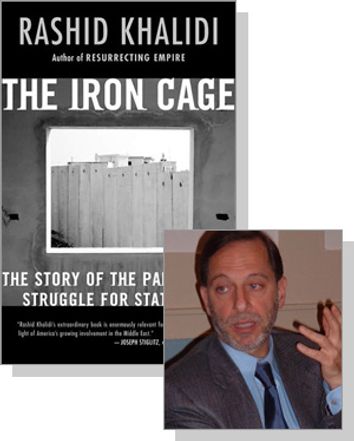
Reading “The Iron Cage,” Rashid Khalidi’s elegant history of failures and disappointments in the Palestinian quest for statehood, it is impossible not to conclude that the above puzzle encapsulates the terms of the Palestinian dilemma, one that has been dramatized by the astounding success of a competing national project in the territory both Palestinians and Israelis claim as their home.
Though one still hears, from certain disreputable quarters, the claim that the Palestinians are merely Arabs, and therefore should content themselves with residence in one of “the other 22 Arab states,” most of the world now acknowledges that the Palestinians are a nation, entitled to self-determination, presumably within a state of their own. The question that remains is why they have not achieved it.
“Palestinian Identity,” Khalidi’s landmark 1997 study of the formation of Palestinian national consciousness before World War I, deftly untangled the mesh of overlaying identities shared by the residents of Palestine — Arab, Ottoman, Muslim or Christian, and Palestinian — to demonstrate authoritatively that, 50 years before Golda Meir’s infamous declaration that “there are no Palestinians,” Arab residents of Palestine spoke of a “Palestinian nation.”
Khalidi’s “The Iron Cage” picks up where “Palestinian Identity” left off, considering the situation of the Palestinians beginning after the war, when the British took possession of Palestine under a League of Nations mandate and issued the Balfour Declaration, whose stated intention was to preserve for the Jewish people a national home in Palestine. As Khalidi notes, the very structure of the mandate conferred a proto-state legitimacy on the Zionist project and extended no such rights to the Palestinians; this distinction, in his telling, would prove to have baleful consequences for the Palestinians, under the mandate and long thereafter. In considering this situation, “The Iron Cage” attempts to answer a question left over from the prior book, in which Khalidi noted that explaining the “failure thus far to achieve statehood and sovereignty … is a central problem of modern Palestinian historiography.” “If the Palestinians had such a strong sense of identity before 1920,” he explained to me, “why did it all go so wrong for them?”
In a refreshing contrast to the yammering bazaar of complaint and allegation that has dominated American public discussion of the Middle East since Sept. 11, 2001, “The Iron Cage” is a patient and eloquent work, ranging over the whole of modern Palestinian history from World War I to the death of Yasser Arafat. Reorienting the Palestinian narrative around the attitudes and tactics of the Palestinians themselves, Khalidi lends a remarkable illumination to a story so wearily familiar it is often hard to believe anything new can be found within.
He spoke to Salon at his office at Columbia, where he heads the university’s Middle East Institute.
This book begins during the British Mandate, but your depiction of that era departs from the conventional narrative.
This book is an attempt to talk specifically about Palestinian history, not the history of the conflict or the history of Israel or Zionism. And there are, as you suggest, many versions of the Palestinian story in this era. One says, essentially, that the Palestinians entirely deserved what they got; they missed a number of opportunities, and were mired in backwardness by comparison with the Yishuv [the Zionist community in Palestine] and later with Israel. That version, both in scholarly work and in popular understanding, is quite widespread. There is another Palestinian and Arab version of the story, which has it that the Palestinians were overwhelmed by forces beyond their control, were helpless victims and had no agency — they could have done nothing else. They were overwhelmed by a tragic fate. I am actually trying to deal more with the latter than the former. The former … whatever. I address it in the book; I don’t think it’s grounded in historical reality.
My focus is on the Palestinians, and on an issue that I was surprised to discover had not really been addressed, which is the Palestinian view of statehood, the idea of state power and governance. No one, it seems to me, has asked, Why did the Palestinians not establish a state before 1948? Why have they failed since to do so? Implicit in both of the narratives that I reject are answers to these questions. The first one says, Because they were backward and stupid, and the second, Because they were overwhelmed by a superior force. But I don’t think either of those answers is sufficient.
You quote a French diplomat in Syria who described the mandate’s restrictions on the Palestinians as “the height of illogic.”
The British saw the Jews as more or less like themselves: a people, a national group. There was anti-Semitism — there was profound anti-Semitism in the British mandatory administration of Palestine — but officially, institutionally, in the terms of the Balfour Declaration, the mandate and the League of Nations, the Jews were a national group. The Arabs were not seen in those terms; they were not a national group and did not exist as such. The words Arab and Palestinian are not in the mandate. There are more articles about antiquities and archaeology than about Arabs or Palestinians.
From the beginning, the British assumed that they could finesse the issue of the Arabs; they gave them institutions, religious institutions, primarily, which the British hoped would keep them busy, divert them, distract them, give them a certain degree of status. The Jews were a people, and the Jewish Agency was given prerogatives and rights according to the terms of the mandate. There wasn’t an Arab Agency because the Arabs, in the British view, were not equal to the Jews. Even at a time when the Jewish population of Palestine was rather small, they had diplomatic representation, the ability to take issues before the League of Nations and so on. The Arabs, during the entire period of the mandate, never achieved this because of the way the British saw them. Over time, the British were forced to modify this view, and by the late 1930s the Palestinians were able to come to the table. But it was two decades too late.
This seems to embody the paradox: You depict a kind of Catch-22, in which the failure to become a state can be explained by the failure to have already been a state.
Given the way the game was loaded in the mandate period, it would have been very difficult, if not impossible, for the Palestinians to achieve any form of sovereign statehood in Palestine — even when they were an overwhelming majority of the population. But there might have been ways for them to change the rules of the game or go outside of the game, and they failed to do that.
The might-have-beens of history are a sort of foolish exercise, but I do suggest that the Palestinians could have done such a thing. The Palestinians had more agency than one version of Palestinian history would suggest — nothing was entirely inevitable, certainly not before Hitler came to power. Up to a certain point, had the Palestinians managed to change the rules of the game, adopt a different approach, things might have been different. But in the context of the mandate rules, at least, there was no way that any other outcome was likely.
The religious institutions that were ostensibly at the head of the Palestinian community, as you observe, were essentially created by the British.
I’m not sure anyone has ever fully teased out and pulled together the degree to which these institutions were completely new and artificial, created by the British for the Muslim community. Consider the Supreme Muslim Council, and the grand mufti of Palestine, institutions and positions that had never existed in the history of the country, which the British created on the basis of patterns of indirect control they had employed elsewhere — Egypt, especially, but also in Ireland and India.
There’s an overtone here of Orientalist benevolence: Let’s give these people what they know.
You see this in Iraq as well. There’s a terrible denigration of the political level of these populations prior to British rule. The British come in thinking they are purveyors of civilization, while the natives are basically barbaric savages at the head of whom are a few semieducated urban effendis, who pretend to speak for the people but in fact are ignorant. But in fact the British came in and destroyed institutions of democratic governance and parliamentary representation that had developed, with great difficulty, during many decades of Ottoman rule. I quote one Palestinian deputy, who exclaims, in 1930, “We had a government of our own in which we participated. We had parliaments.” But now they had nothing.
There is surely an irony here, with the Palestinians, not a particularly pious people, led by a pretend religious figurehead created by the British.
Anybody who looks at the history will say, no, not a particularly pious people. Quite the contrary, in fact, a particularly secular people, in this period and for decades thereafter. The mufti himself was not a pious character — he was a secular figure until he was anointed by the British.
I don’t often quote Mahmoud Ahmadinejad. But he said a wonderful thing the other day, in a vitriolic and obnoxious attack on secular intellectuals in Iran. He said something like, “For a hundred and fifty years, these people have controlled the universities, they have taken over, they have dominated the country.” This is a thesis that I only wish some people in this country would pay a little attention to. There was, in the Arab world, what Albert Hourani called a “Liberal Age.” In the Arab world, in Turkey, in Iran as well. The Islamic revolution in Iran, among other things, was a reaction to the dominance of secular ideas in this part of the world.
Anyone who ignores the first two decades of the mandate and just looks at what happens in the late 1930s is missing a great deal, and the mufti’s role in helping the British keep control of Palestine in the first few decades of their occupation is crucial, just as the role of the British in establishing Zionism in Palestine is indispensable. You would not have had a successful Zionist project without everything the British did between 1917 and 1939. The individual figure of the mufti is less important, historically, but the British would not have been able to control Palestine as they did had they not been able to co-opt an important segment of Palestinian notables through the religious institutions they created.
You write of the mufti that his would not be the last time the Palestinians suffered “from the damaging conflation of the national cause with the personality of an overweening leader.”
Well, that’s my judgment of both the mufti and Arafat. The mufti was an old-style notable politician who could play both sides of the street, doing deals in backrooms, just as Arafat was able to navigate the shark-infested waters of Arab politics — which is where he made his career. Arafat did not make his career fighting Israelis. He made his career by reestablishing the Palestinian national movement, and fending off attempts by Arab governments to control the Palestinians.
In the book we see a kind of division between two eras of Palestinian history: There is the British Mandate era, until 1948, and then a post-1964 Palestine Liberation Organization era, with a sort of Dark Ages in between. Is there a difference?
In both of these eras, there is a major element of continuity: the limited degree to which the Palestinians focus on the question of the state and state power right up to the present. I don’t think that explains everything, but it is an important point, and one of the main focal points of the book.
The Dark Ages, as you describe them, in fact begin during the Arab revolt [from 1936 to 1939] and continue until the 1960s. The Palestinians lost agency, and their effort in those years was to regain that agency, to become actors in their own drama, which they were not, for decades.
So the revolt, although it brought about a slight change in British policy, was a pyrrhic victory?
Absolutely. It was a disaster, just like the second intifada. An utter disaster. This view of the revolt, in fact, is actually novel in Palestinian historiography. The revolt has generally been viewed as a heroic chapter in Palestinian history. Almost everybody, I suppose, realizes that it was a defeat in one way or another, but the extent to which it was a catastrophic defeat, the extent to which it brought about all kinds of other disasters, I don’t think has ever been fully recognized.
In the present moment, are the Palestinians at the start of another Dark Age, comparable to the post-1948 period?
I’m a historian and I try not to speculate about the future. It’s very hard to look at the present the way one looks at the past. But one of the things I suggest in the book is that it is not necessarily the fate of every people to end up with a state, and that might be what’s going to happen to the Palestinians. Certainly it has been what has happened to them in the entirety of their modern history up to this point. And it does not look like we’re moving toward a state — quite the contrary. I finished the book before the latest episode in Gaza. But what seems to me to be happening — at least to the Palestinian society in Gaza and, to some extent, to the entirety of Palestinian society under occupation — is the systematic destruction of the society. Not of people’s will. There is still a remarkable degree of social solidarity and mutual support; this has so far kept people alive. But there is a grinding process going on.
So maybe statehood is impossible?
Well, expulsion, or people just fleeing, is not likely, either. Expulsion, even if it were attempted, is not likely to be successful, and it probably can’t even be attempted. You know, you can deny visas to all the Palestinian-Americans in the world, you can deny residency, you can force anyone who has the means to leave. But you still have the highest population growth in the world, and you still have this extraordinarily stubborn people that’s clinging to its land and whose will is clearly indomitable — and who so far have had the social networks to enable them to survive.
The book contains a brief but very lucid account of various “one-state” ideas that have received a lot of attention in recent years, particularly as the emergence of a sovereign Palestinian state appears less and less likely; you note, critically, that those who foresee a single-state resolution “render no value judgments about it” and “do not advocate such a result; rather they perceive it as inevitable if present trends continue.” What are those present trends?
Irrespective of whatever international consensus exists, if current processes continue, there’s no possibility of two states. I don’t think it’s even contestable, frankly. If you keep the settlement blocs attached to Israel, and you keep the mechanisms of control, then you don’t have Palestinian sovereignty, and you don’t have statehood. I see nothing — nothing! — that should lead us to believe that there will be even the slightest relaxation of this suffocating and comprehensive regime of control. Look at how Gaza has been treated since the evacuation of settlements; Israeli control over Gaza is in some ways even more complete. The settlements are gone, true, and Israel doesn’t administer some aspects of life. But it still controls entry, exit, the economy, death, movement, everything.
In Gershom Gorenberg’s recent book about the first decade of the settlements, he depicts an essential paradox of the Israeli occupation, in which policymakers felt they could not keep the occupied territories, but they couldn’t leave them either. From this perspective, the withdrawal from Gaza is a bit like a magic trick —
Leaving and not leaving. It is a magic trick. I mean, it was a magic trick, but I think we’re seeing the screen lifted and the Wizard of Oz mechanics revealed. In fact, they never left. They’re getting away with murder in the sense that there’s no international opprobrium. But that doesn’t mean that the situation is not going to come back and haunt everybody.
The Israeli withdrawal from Gaza was negotiated with the United States, which, in exchange, consented for the first time to formally acknowledge the “facts on the ground” in the West Bank, the Israeli settlement blocs. What do you say to those who contend that “George W. Bush is the best friend the Palestinians have ever had, because he’s the first American president to call for a Palestinian state.”
In terms of the Palestine issue, Bush has been, I think, by far the worst friend possible to the peoples of this region. I think he has done an enormous disservice to the Palestinians and the Israelis by advocating a policy of force — throughout the region and the world, but in particular in Iraq, Palestine and Lebanon. He has reinforced the worst tendencies in the region. He has pushed us farther away from what was already a very distant possibility of a just, equitable, lasting resolution, and he has guaranteed boundless problems for the United States.
When [Ariel] Sharon came to the United States before the Gaza withdrawal, he was trying to get the United States to change a long-standing policy, which was its refusal to accept large-scale annexations. He succeeded. The president fundamentally modified the American position by saying that most Israeli settlements must now be seen as realities, which means that when the moment comes — if it ever does — for negotiations, the United States is committed to the Israeli position, which is that much of what’s left of Palestine has to be annexed to Israel. This is a major shift, and it may have lasting consequences. You can’t have a two-state solution if most of the settlements are annexed to Israel. You can have a “many-Bantustan solution,” a “multiple-prison-camp solution,” but you can’t have two states.
In the book’s last pages, you write that the Palestinians “must take the initiative and devise new forms and conceptions for the future,” which will be “more imaginative, more comprehensive, and more effective than those that have gone before.” What do you have in mind here?
There’s an expression in Arabic, “a situation where everybody does exactly what they please.” This is what you saw during the second intifada, and now, to some extent in Gaza — where all the major forces don’t seem in favor of a particular course, and yet the whole society is dragged in that direction by the actions of a limited few. I don’t think the Palestinians can afford that anymore. It’s a much graver situation than any I can recall, and the margin for maneuver that the PLO had at some points in its history, that even the Palestinian Authority might have had, simply doesn’t exist anymore. So I would ask, had I gone further in the book on this subject, to what extent can the Palestinians afford the complete lack of focus on their real national objectives? Is the structure of the Palestinian Authority of more harm than use to the Palestinians? And finally, to what extent is the continued use of violence just playing into the hands of the other side? I’m not suggesting it would be easy to stop the violence right now, but this is a debate that is going on among Palestinians, and has been for a while. These people firing rockets out of Gaza, they are bringing a rain of death down on Gaza. There is already the most awful campaign going on inside of Gaza, and maybe that would continue if there were no rockets, because you have a Hamas government, and there is an American-Israeli attempt to prevent elected political movements they don’t like — whether Hamas or Hezbollah — from continuing to exist.
A final question. You talk, in the mandate era, of the successful recourse to international diplomacy by the Zionist movement. Why, even half a century later, has the Palestinian diaspora not been such a force?
I’m not an American historian. But in American politics, it usually takes several generations for a community to cease to feel marginal, to learn English, to understand the way the levers of power work. And if you look at the Arab-American diaspora in the United States, it’s composed of two waves. The first came before the 1920s. But the second, more recent, and much larger, wave has come since the immigration laws were changed in 1965. Most of these recent immigrants — among which are the majority of Palestinians in this country — are by no means fully assimilated.
I think that the comparison to be made is to the complete ineffectiveness of the American Jewish community in the 1930s, after the rise of Hitler. Here you had a community that was large and apparently possessed all of the prerequisites of political power, but that had absolutely no ability to affect anything — immigration law, American policy toward Nazi Germany — in a friendly Democratic administration. Why? For the same reasons that the Arab-American community, which appears to be many millions strong, has been ineffective. First of all, there’s bigotry, racism and discrimination; in the 1930s it was anti-Semitism, and today it is anti-Arab and anti-Muslim. And second, they speak with funny accents and live in ghettos. It’s not Yiddish and it’s not the Lower East Side, but it’s still true for a large proportion of that population. Go to Paterson [N.J.]! They don’t speak English without an accent. They don’t know about the Constitution. They come from countries where you can’t be involved in politics or the secret police will drag you away. Most Arab-Americans are not the people you meet at Columbia or NYU. Now, you can look at kids in law school, at professionals, at rich people in the Arab-American community, and you can see that over time, the situation will change. But it’s not going to change in the short term.
As far as international diplomacy goes, there has not, to this day, been a full understanding of the international factor by any Palestinian leadership. To this day. This was, of course, not the case with the Zionist movement, which at its inception was a European movement. So of course they understood Europe — they were Europeans!
There was no Palestinian Chaim Weizmann.
No, no. Because Weizmann was not in Palestine. He eventually became president, but he was quintessentially a European. The shift in power to [David] Ben-Gurion takes place after the successful establishment of the Zionist movement, its implantation in Palestine. By this time you had a diplomatic effort, as well as a para-state structure, with a critical mass of population in Palestine. The two peoples are in completely different situations — it’s apples and oranges, and you just can’t compare them.
The PLO, to its credit, did a considerably better job of representing the Palestinians abroad — in Europe, in the Third World, in China — than the Arab Higher Committee ever did in the mandate era. But where [the PLO] utterly failed was with the centers of international power; with the United States, they failed. I don’t think they ever fully understood what had to be done — in the 20s and 30s with Britain, and from the 40s onward with the United States. Whereas Ben-Gurion was visiting New York, even before the United States was a global power. It shows how smart Ben-Gurion was. He was far ahead of Weizmann, and far ahead of most people in the Arab world. Except [Saudi King] Ibn Saud. He was close behind.
“The essence of a nation,” the French historian Ernest Renan said in 1882, is that its citizens have much in common, but “that they have forgotten many things.” The Germans, it could be said, have forgotten things that most nations never knew. No single country has struggled so openly to reckon with its history, and the process has not been a short one. Germany has spent decades coming to terms with the atrocities perpetuated by the Nazi regime, but the penumbra of shame around these crimes also obscured the suffering visited on German civilians, 600,000 of whom were killed by Allied firebombing of cities like Dresden and Hamburg.
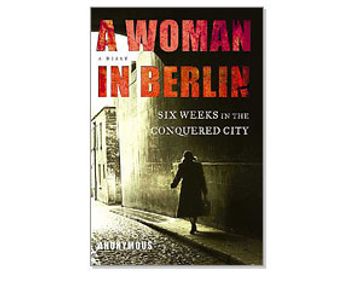
The publication of “A Woman in Berlin: Eight Weeks in the Conquered City,” then, shines considerable light on a hidden history of the war. The writer, an anonymous 34-year-old journalist who recorded in her diary the events of the fall of Berlin in the spring of 1945, does not fashion herself a victim. But her diary, released by a German publisher for the first time 60 years after the war, meets the challenge that novelist W.G. Sebald put to Germans in his lectures on “Air War and Literature”: “to try recording what [they] actually saw as plainly as possible.” In unsparing prose that brooks no pity and assigns no blame, the diarist calmly describes the disintegration of the German capital. Her diary begins less than a week before the Soviets entered the city, hastily scrawled by candlelight in a basement shelter: “My fingers are shaking as I write this.”
What makes the book an essential document is its frank and unself-conscious record of the physical and moral devastation that accompanied the war. Sebald extols the virtue of “authentic documents, before which all fiction pales,” and what is most remarkable about “A Woman in Berlin” is what is most ordinary — or rather, the desperate measures rendered ordinary in a city under occupation. The diarist spends her days scrounging for coal, picking nettles for food, and searching out what little clean water may still be had. Berliners queue for pathetic rations in the streets onto which the Russians fired almost 2 million shells in the last two weeks of the war; when a mortar explodes outside a local meat market, killing three, the women “use their sleeves to wipe the blood off their meat coupons” and line up all over again.
Before the Nazis came to power in 1933, Berlin had the smallest proportion of National Socialist voters of any German city. By the time the Red Army arrived, most Berliners, with the exception of the deluded Nazi faithful, appeared all too eager to shed the enthusiasm they had since developed for Adolf Hitler, whom they had taken to calling “that man” — a turn in public opinion that seems not to have begun in earnest until long after it was apparent the war would be lost. Many have repurposed Nazi literature into fuel; if people keep burning it, the diarist quips, “Mein Kampf will go back to being a rare book, a collector’s item.” The discarded mottos of Nazi propaganda are no more than grist for gallows humor: “For all this,” people incant, turning around a wartime mantra, “we thank the Fuhrer.”
What little strength the regime still possessed was devoted to upholding the Nazi commitment to senseless brutality: “If the war is lost, the people will also be lost,” Hitler explained to Albert Speer in March 1945. “It is not necessary to worry about their needs for elemental survival.” In Berlin, the Nazis pressed prisoners of war into constructing useless barricades instead of building water pumps; 80,000 men were sent to their deaths on the western front in the failed Ardennes offensive while the eastern front crumbled. Concentration camps in the path of advancing troops were evacuated, with prisoners marched to their deaths or simply executed. The Nazi program of civil defense consisted of making the meaningless declaration that a city was a “Fortress,” and then attempting to terrify its inhabitants with tales of “Asiatic” barbarity. The Nazis rushed newsreel cameras to East Prussia, the site of the earliest Soviet atrocities, solely to terrify the remaining Germans into holding their ground. “Are they supposed to spur the men of Berlin to protect and defend us women?” the diarist wonders skeptically; “their only effect is to send thousands more helpless women and children running out of town.”
The diarist and her neighbors sweat out waves of air raids, knowing all too well that the respite from American and British bombers will only come with the Soviet occupation: “Better a Russki on top,” they joke nervously, “than a Yank overhead.” “Our fate is rolling in from the east,” the diarist laments, and early reports leave little room for optimism: “Let’s be honest,” one woman in the cellar ventures, “none of us is still a virgin, right?”
In a fateful gesture of incompetence and betrayal, German military authorities left oceans of alcohol in the path of the Russian army in the hope that drunkenness might impair their fighting prowess. (It is hard to say if this decision reflects a Nazi faith in Russian stereotypes or a rank ignorance of them.) “That’s something only men could cook up for other men,” the diarest laments archly. “If they just thought about it it for two minutes they’d realize that liquor greatly intensifies the sexual urge. If the Russians hadn’t found so much alcohol all over, half as many rapes would have take place.”
The first rapes in East Prussia were an eruption of pure rage, bloody revenge for Wehrmacht atrocities on Soviet soil in the march to Stalingrad; soldiers destroyed homes, raped women — some as young as 12 — and killed children. But revenge could not have been the sole motive, for even Soviet prisoners of war and Jewish survivors were not safe; some, as young as 16, were raped by the soldiers who set them free. By the time the first libidinous Soviet wandered into the diarist’s cellar a few months later — pointing menacingly to a teenage girl and asking “How many year?” — German women appeared to the Red Army simply as rightful spoils of war.
Though the precise statistics will never be known, existing estimates are breathtaking: 2 million women were raped in Germany, many of them more than once. In Berlin alone, hospital statistics indicate between 95,000 and 130,000 rape victims. Many women killed themselves rather than “concede” — as some women put it — to the Soviets; some men killed themselves and their wives rather than suffer the indignity of rape.
The diarist, who worked before the war as a journalist and editor and traveled to “a dozen or so countries,” speaks “very basic” Russian and is quickly drawn into mediating between the Germans and their unwelcome guests. After she helps to chase two would-be rapists out of the basement the first night after the Russians arrive, she peeks outside to ensure the coast is clear and the men, lying in wait, force her to the ground while those inside the shelter, ever the good Germans, bolt the door and abandon the diarist to her fate:
“He’s simply torn off my garter, ripping it in two. When I struggle to come up, the second one throws himself on me as well, forcing me back on the ground with his fists and knees … The door opens, two, three Russians come in, the last a woman in uniform. And they laugh.”
Later that night she is raped again, with a kind of perverse consent: when four men set upon her in her apartment, she begs for only one to stay. Thus the chaos begins: having been raped once, sadly, is no guarantee against further assaults. “Every minute of life comes at a high price,” the diarist observes. The next day she is raped again, by an older man “reeking of brandy and horses,” who rips apart her underwear — “the last untorn ones I had.” She writes: “Suddenly his finger is on my mouth, stinking of horse and tobacco. I open my eyes. A stranger’s hands expertly pulling apart my jaws. Eye to eye. Then with great deliberation he drops a gob of gathered spit into my mouth.”
- – - – - – - – - – - -
The proliferation of tales of individual atrocities often takes on the numb character of pornography: an endless litany of crimes against dignity, the same scenarios of cruelty replayed again and again; anyone who has pored over human rights reports soon finds that the accumulated evidence begins to dull as the brutalities mount. Yet here the opposite is true. The stories from those around her only multiply the disgust: a friend raped four times; a Jewish woman raped while her husband, shot by the Russians, bleeds to death; a woman whose three rapists smear marmalade and coffee grounds in her hair, just for kicks; the rape of “a twelve-year old girl … who was tall for her age”; the soldiers who “took the sixteen-year-old on the chaise longue in the kitchen”; one woman raped by “at least twenty men,” with “her breasts, all bruised and bitten.”
The diarist’s emotional register remains unfailingly calm. Her dispassionate chronicle of the disasters of war suggests a kind of stoic heroism, though she is quick to point out that her own travails have been minor by comparison: “It sounds like the absolute worst, the end of everything — but it’s not.” The diarist resolves after her third rape to take refuge with a senior officer, “a single wolf to keep away the pack.” But this gambit is not entirely successful; after her first benevolent rapist disappears, she is forced to take up with another one. Berlin’s men can do little, it seems, to protect its women.
In fact, German men are largely absent from “A Woman in Berlin,” and the ones who do pass across its pages do little to earn our esteem; those who refrain from expressing their ridiculous faith in the regime in the midst of Soviet artillery bombardments are busy surrendering their wives to marauding Russians. “I think our men must feel dirtier than we do,” the diarist observes, and goes on to recount the story of one German man who berates his neighbor as she’s about to be raped: “Well, why don’t you just go with them, you’re putting all of us in danger!” Even before the Soviets arrive, the diarist perceives in the failure of the German Reich the irreparable decline of the male archetypes it venerated: “The Nazi world — ruled by men, glorifying the strong man — is beginning to crumble, and with it the myth of ‘Man.’ … Among the many defeats at the end of this war is the defeat of the male sex.”
Indeed, what is perhaps the book’s most chilling insult comes not at the hands of a Russian rapist but from the diarist’s partner, Gerd, who returns from the front in June, casts his eyes on the diary that our heroine has been dutifully keeping for him, declares that she and the other women have “all turned into a bunch of shameless bitches” and disappears, presumably forever.
After the war there was clearly no shortage of rape stories. Though one Russian commandant dismissively assures the diarist that “our men are all healthy,” the spread of sexually transmitted disease — as well as the pregnancies that resulted — forced the Germans to take action. The Nazi authorities, for all their neglect of the civilian population, were sufficiently alarmed to relax eugenicist laws prohibiting abortion as an act of “sabotage against Germany’s racial future,” although women had to submit to what was surely a humiliating police interrogation to prove they had been raped. It has been estimated that 90 percent of those women who became pregnant had abortions; many of the children who were born were put up for adoption.
The diarist at first refuses to acknowledge that she might be pregnant — “no grass grows on the well-trodden path,” she suggests hopefully. Later, when her period is two weeks late, she heads to a female doctor who has hung out a shingle among the ruins (“she’d replaced the [broken] windowpanes with old x-rays of unidentified chests”). After being reassured that she is not pregnant, the diarist ventures to ask the doctor “whether there were indeed lots of women who’d been raped by the Russians” coming in search of abortions. But the doctor wants no part of such talk: “It’s better not to speak of such things,” she replies curtly. Though the diarist expresses her hope that women might “overcome collectively,” no such public reckoning would be possible in postwar Germany, as she anticipates ruefully: “We … will have to keep politely mum; each one of us will have to act as if she in particular was spared.”
After the war, a friend of the diarist, Kurt Marek, read the manuscript and attempted to have it published. Perhaps it should come as no surprise that “A Woman in Berlin” was first released outside Germany, when Harcourt, Brace published an English edition in 1954. The New York Times judged it “profoundly relevant,” but the reception in Germany, when a Swiss publisher released the book five years later, was precisely the opposite; the prevailing sentiment among the very few notices that did appear was expressed by a critic who excoriated the author’s “shameless immorality.” Clearly the diary broached what Sebald would later describe as “a tacit agreement … that the true state of material and moral ruin in which the country found itself was not to be described.”
Though the diary at first fell on fallow ground, it enjoyed a samizdat second life, circulating among leftists and a growing women’s movement after 1968. But what was once unspeakable out of shame was now prohibited by politics: Accounts of Soviet atrocities in the east, like attention to Allied bombing in the west, had become the sole province of the German far right. Where one taboo had lifted another settled: Helke Sander, a German feminist whose 1992 film “Liberators Take Liberties: Rape, War, and Children” chronicled the rapes and their aftereffects, was pilloried in some quarters as a revisionist. The woman in Berlin, still guarding her anonymity against the disgrace of rape, would not allow her diary to see the light of day again so long as she lived. But by the time of her death in 2001, a seismic shift in German consciousness had transpired, and the book, published in 2003, quickly became a sensation and shot onto bestseller lists; last summer the film rights were sold for an undisclosed amount.
The conventional narrative holds that in the first decades after the war, Germans struggled fitfully with the Nazi years, embracing a kind of blanket guilt yet indicting no one in particular, taking psychic refuge in the triumph of West Germany’s “miraculous” economic recovery. 1945, “zero hour,” marked an irreparable boundary between present and past that few Germans cared to cross. But it is a convenient myth that Germans have only now recognized their own suffering: Instead of forgetting the war in the years that followed, Germans remembered it selectively, with great attention to certain of their own victims, particularly prisoners of war and expellees driven from their homes in the east.
Still, during an era when it was common to decry the Soviet “rape” of eastern Germany, the very real rape of German women remained a forbidden topic — despite the number of women who suffered. “None of the victims will be able to wear their suffering like a crown of thorns,” the diarist told Marek. “I for one am convinced that what happened to me balanced an account.” Such self-effacement testifies to our diarist’s ethical fortitude, but that German women should have endured such pain on behalf of German men should satisfy no one’s sense of justice.
Pity for the German people was in short supply after World War II, and for good reason. But the prevalent understanding of Nazi barbarities as an evil beyond human comprehension is nevertheless a cunning absolution of the rest of us, a self-exoneration that the diarist, to her credit, vehemently refuses. To see Germany’s descent into madness as an incomprehensible anomaly outside the bounds of humanity is to forget the evils of which the rest of us remain capable. “We learn nothing by blaming them,” I.F. Stone wrote in 1961 as Adolf Eichmann went to trial. “We all marched with Eichmann … whether it was the human incinerator or the H-bomb, we built it.” The ensuing half-century of human brutality has illustrated this all too well, and those fateful place names that have joined Auschwitz in our atlas of evil — Phnom Penh, Cambodia; Halabja, Iraq; Srebrenica, Bosnia; Kigali, Rwanda — are a painful reminder that “never again” was a wish and not a binding vow on mankind. It has taken that half-century to allow the recognition that, in Germany as elsewhere, among perpetrators there are also victims; “A Woman in Berlin” reminds us that the exclusivity of these categories is little more than a fable.
Continue Reading
Close
Matt Taibbi is a natural provocateur. He has an uncanny knack for kicking up storms of indignation, and occasionally stumbles into an uproar he didn’t even mean to stoke. This happened most recently when he made light of Pope John Paul II’s imminent death — and the saturation coverage sure to accompany it — in a New York Press cover story titled “The 52 Funniest Things About the Upcoming Death of the Pope.” His piece infuriated what seemed to be more people than the paper has readers, and provoked a storm of humorless condemnation from a panoply of local pols like Sen. Chuck Schumer and Rep. Anthony Weiner, the mayoral longshot who urged New Yorkers to gather up bundles of the free paper and throw them in the trash.
That Taibbi found himself embroiled in such a brouhaha was no surprise to anyone familiar with his work. When I met him, in 2001, I mentioned that I liked the newspaper he published in Moscow, the eXile, which I had read online. Precisely the sort of operation that libel law and common decency disallow in the United States, the eXile, an English-language weekly, was an unstable concoction, equal parts uproarious and offensive. A newspaper on amphetamines, it ran serious press criticism salted with vicious personal attacks on reporters — as in an NCAA-style tournament held to crown “Moscow’s Worst Journalist” — and its lengthy reported pieces shared space with nightclub listings designed to guide the discerning Western businessman to Moscow’s finest sex retailers.
After I told Taibbi I read the paper, he excitedly pulled from his bag a foul-looking photograph of a man with pie all over his face. The pie-faced fellow in the snapshot was the “winner” of the tournament of journalists, and Taibbi had thrown the offending dessert that was splattered all over him. “The pie,” Taibbi calmly explained, “is made of horse sperm.”
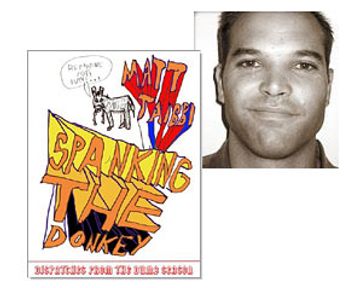
After a decade of Moscow troublemaking, Taibbi returned to the States in 2002 to settle down in Buffalo, N.Y., where he started an alternative newspaper, the Beast. But Taibbi, whose fans and enemies alike have a habit of comparing him to Hunter S. Thompson, soon found himself on the presidential campaign trail, filing dispatches for Rolling Stone, the Nation, and the New York Press, where he writes a weekly column — trying to do for 2004 what Thompson did for 1972. He insists that he failed, and indeed, “Spanking the Donkey,” his campaign diary, is a riotously funny account of that failure. It’s a kind of “Network” by way of Kafka, with our furious protagonist trapped in the bowels of a campaign he loathes and cannot comprehend, trying to make sense of what he calls a “tour de force of lies” in which, to his horror, he can find not a shred of humor.
Frequently touted as the most important election of our lives, the ugly Bush-Kerry clash was an episode many of us would now prefer to forget. But “Spanking the Donkey” is all the more necessary in the aftermath of an election that harnessed enough liberal outrage to light the Vegas strip, cost more than a billion dollars, absorbed hundreds of hours we will never get back, and achieved absolutely nothing. Nothing, that is, except to convince thousands of media types that, just as the right has long alleged, they are “out of touch” with the values of Middle America, thus enshrining forever in our political discourse the idiotic construct of a country depicted in two Crayola camps. “When one hundred million people don’t vote,” Taibbi quips, “the nation is not bitterly divided. The nation mostly doesn’t give a shit.”
With the country peacefully restored to its natural state of apathy, Taibbi’s scabrous complaints about the 2004 race — “one of the greatest and most prolonged insults to human dignity the world has ever seen” — are not only a hysterical catharsis, a kind of laughing cure, they are essential reading for anyone who’s been wondering where John Kerry’s vaunted electability got us. Taibbi took a moment to speak with Salon about his inimitable approach to media criticism, Soviet America, and whether anyone got laid on the Kerry press plane.
Your writing is unlike typical campaign journalism, which is often a bit formulaic — you’re playing pranks, and working in barbs and jokes alongside your reporting. How did you fit in on the plane with all the straight-laced Times and Post types?
All the reporters on the trail kind of go through the same thing. When you first show up, it really is like the first day of school. On the campaign trail, the popular kids are the reporters who have been on the trail the longest, and they literally sit at the front of the plane, all together. The further back on the plane you are, the bigger a loser you are. It’s so much like high school, because the big hitters don’t want to talk to you, they don’t want to be seen talking to you, and so you have to work your way up just to be able to socialize. And, of course, because I worked for sort of a disreputable organization at the beginning — the New York Press — nobody even thought about talking to me. Of course, as soon as I started working for Rolling Stone, it was different.
You set out to report on the press as much as on the candidates. Was that a reasonable goal? Did asking questions of other reporters set you apart from the rest of the press corps?
Everybody was so conscious of “The Boys on the Bus” [Tim Crouse's book about the reporters covering the 1972 election] — it’s a clichi that people talk about constantly. I was asked, again and again, “Are you doing a ‘Boys on the Bus’ thing?” It was on everybody’s mind all the time. I tried to ask some questions of the reporters on the record. But as soon as one journalist starts asking another journalist questions about how they’re doing their job — forget it, you’re a pariah. Many days passed before anybody would talk to me after that. The news traveled so fast that when we went from Wisconsin to Las Vegas, I was in the middle of the plane, and then the next morning, when we got back on the plane, I had been reassigned to the rear. Maybe I’m being paranoid, but it sure seemed to me that somebody talked to the Kerry people and said, put this fucking guy in the back.
At the time of “The Boys on the Bus,” that kind of reporting hadn’t been done before: Nobody was worried about what Crouse was going to write, so they had their guard down. The modern press corps is a lot of company men, and I think back then there were more, well, unwieldy individuals. You would never have had a phenomenon like McGovern’s Zoo Plane on today’s campaign — that’s what they called the plane they put the press on. Legendary wild parties went on in there, drugs, sex acts. I would doubt that so much as one sex act occurred during the entire Kerry campaign.
Not even a hand job?
Well, maybe a hand job. I don’t know. It certainly wasn’t a fun gig.
It seems like everyone these days is a press critic, but you take what we might call a more activist approach. The book contains your Wimblehack series from the New York Press, which attempted to determine who was the worst journalist on the campaign trail. [Elisabeth Bumiller of the New York Times, who recently filed a dispatch about the songs on Bush's iPod, was the eventual winner.] Did that make people angry?
There was one guy from the Times who actually asked me to step outside. He complained that I had insulted Jodi Wilgoren because I said she looked like Ernest Borgnine, and he sent me an e-mail basically saying, “Let’s fight.”
I think that normal press criticism is great: It makes people aware of the media to a degree that they never were before, but it doesn’t have a whole lot of practical effect. FAIR will issue a press release pointing out an error, or some unethical practice, or some pattern in press coverage. So what? It’s not going to change anything. My thinking, going back to the eXile, is that reporters are people too; they’re sensitive and they’re vain, and if you make it personally painful for them, it can have a bit of a prophylactic effect. That’s not the reason I do it; mostly I do it because I’m just a little bit of an aggressive person.
Did you see any results with this approach?
I have to be honest, no. But when I was in Russia, we certainly had an effect on the American press corps in Moscow. When we threw a pie made of horse sperm into the face of the New York Times Moscow bureau chief, who had won our “Worst Journalist in Moscow” tournament, that was something that all the journalists in Moscow noticed.
There used to be different kinds of people who were journalists. There were real cynics, there were drunks, there were hardened smokers, and now there’s this glamour and glow that goes along with being a part of the press corps. I guess what I’m trying to do is take away some of that glow and make it clear it’s not quite as cool as they make it out to be. I don’t know if that has an effect or not, but that’s sort of the strategy.
You often make reference to Russia in your writing about American politics — is that a lens through which you see things?
I was there for 10 years — I basically grew up in Russia, considering that I went in my early 20s. When I came back I was a little shocked to find that what I saw looked a lot like Russia, particularly the lingering Soviet aspects of Russia: the celebration of stupid ideas as though they were new and original, the dumb patriotism — the style of the patriotism. You can go to any town in America today, and you see the same Blockbuster Video, Wal-Mart, McDonald’s, or Jack in the Box — every place looks the same, they all have the same strip malls, and so on. This is how it was in communist Russia: You could go to any city in the country, and you saw the same Meat and Fish Store No. 6 or Gastronome No. 4 that was in your hometown; even the street names were the same.
The Bush scene on the aircraft carrier was straight out of Soviet Russia: the sailors in their colored sweaters rushing out to greet the leader who himself hasn’t served in the military. It made me think of Brezhnev, who wore a zillion fucking medals and was probably the only person in Russia who didn’t know how to put together a Kalashnikov.
The genius of the Russian system was its appeal to people’s laziness. They said, “Look, get drunk, don’t do any work at all, we’ll give you just enough money to live, and we’ll take care of everything else.” That’s what Soviet Russia was all about: Live in your shitty village, we’ll give you cheap vodka, and we’ll take care of your medical bills, and you don’t have to worry about all that other stuff. They counted on the fact that Russians would rather wallow in their own shit than organize and protest anything that’s actually happening in their country. It is really kind of similar to what’s going on here. People bitch and moan, but basically all they really want to do is sit in front of their televisions and watch the football game. Even people on the left who complain about Bush, when it comes right down to it, they don’t really want to do anything. If they do go to protests, they go, and then they come home, and it’s all over.
You mention that in Russia you could take things less seriously because it wasn’t your country. Were you surprised to find yourself affected by what you were covering on the campaign?
Being on the plane, it was just nuts to me. It seemed like absolute madness that the candidate gets up, mouths a lot of platitudes, and everybody just sits there and reports it, doesn’t even think what’s happening. As a citizen, I want people to be saying, “What the hell are we doing here?”
The biggest problem with the campaign was that it was so condescending. John Kerry is not a stupid guy. He’s been in the Senate for 20 years, sitting on important committees. But then all he does is get up on stage and say, “John Kerry, reporting for duty.” It’s just condescending. This is a conscious choice on his part — the ethos of the campaign is that you have to talk down to people, you have to appeal to the basest instincts of voters, their laziness — their intellectual laziness. An important thing about the candidates is that they don’t tell you anything: All they want to do is hit those dial survey words they know are going to impress voters. Change. Leadership. Strength. These are literally infantile concepts that they want to communicate to you.
The kind of journalism I do is supposed to be funny, but in kind of a horrifying way. I figured the presidential election would be a great subject. But I had never covered a story where I couldn’t find a way to express how bad it was. In Russia, I would see these horrible, ridiculous things, and at some level I was actually amused by them. I was able to find them funny but also horrible. In America I didn’t really find it amusing; it was just horrible.
Your piece in the New York Press about the impending death of Pope John Paul II — and the predictable torrent of round-the-clock death-watch coverage in the media — seems to have attracted a lot of attention. I even saw [NY Press editor] Jeff Koyen on MSNBC, battling it out with Catholic League honcho William Donohue, who called the paper home to “male and female perverts, ACDC, switch-hitting, pineapple, upside-down cake, fruity-tooty people.”
The pope article was a one-off, a little tiny spoof that I wrote in a Vicodin haze. It was put on the cover of the paper, which made a big difference — if it had just been my column, I don’t think it would have been a big deal. What I thought was interesting was that Matt Drudge put up a link to it, and within an hour, every elected official in New York was saluting. The whole thing was absurd.
Obviously it was just a joke — I talk in the piece about how my own head is going to be chopped off. If there was a point, it was like, the pope is a man, he dies and he rots like the rest of us. That’s the joke.
Are you afraid that people are going to know you for the rest of your life as “the guy who mocked the pope dying”?
If that’s what people are going to remember me for — if that’s the only thing that I produce between now and the end of my life — then I deserve it. But I’m not worried about that.
Going back to the campaign, what was the atmosphere like inside the Democratic machine?
When you hang around a Democratic campaign office, you feel like you’ve walked into an episode of M*A*S*H or something, with an ensemble cast witticizing all the time. There were actually some funny people in the Kerry campaign, but most of the aides I talked to on all the campaigns were really, really interested in things that had nothing to do with what their candidate allegedly stood for. One guy would be rhapsodizing about how well his town halls went as opposed to somebody else’s town halls. I mean, meaningless bullshit, like the plastic grass in Howard Dean’s “Grassroots Express” plane. Somebody thought that up and they were really pleased with themselves about it. It’s just like a big frat prank for these people running for president. I have to really give credit to the Bush people; for them it was really about the politics, the candidate, “values,” all those things. Among the Democrats, it was like, are we going to get over? Are we doing enough to get over?
You got to spend some time with the Bush people — what was that like?
Rolling Stone sent me to be a campaign operative for George Bush. I moved to Orlando, Fla., and I volunteered for the Bush campaign. In fact, I arrived in town early enough in the campaign that I ended up as a manager in one of the Orlando offices. I was a fairly important person in the Bush campaign in Florida, and I’m proud of this — we did very well. The I-4 corridor [which includes the Tampa and Orlando metropolitan areas] really turned out for Bush, so I like to think I did my part to help him win. I definitely worked very hard.
What was your cover?
I was under a fake name; my story was that I was a New York City schoolteacher who had a girlfriend in Orlando, so I was down there for the summer. I told them all sorts of horror stories about how the New York City schools were overrun with perverts and faggots. Everybody loved that.
Did you notice a difference between Democrats and Republicans? A personal difference?
The Republicans were a lot nicer than I expected. A contrast between being with the Democrats and with the Republicans is that being around the Democrats was so much like high school — you had to be cool all the time. In Orlando, you could just walk into a Bush office, and so long as you were committed to the president, it didn’t matter if you were a total fucking loser, they’d love you for it.
Did you hear from the Orlando office after the article was published?
Oh yeah. I got plenty of calls. I didn’t pick up the phone if I saw a call was from the Orlando area code, but I did get a lot of angry e-mail. My immediate boss at the campaign office called me up after Bush won the election and left a message that said something like, “Mr. Taibbi, the God that you do not believe in has blessed our president with victory.” She kept leaving messages like that for a few days. They were mad. I don’t think I’ll be going back to Orlando anytime soon.
What did you do on election night?
I was in Mexico, stoned.
Did you watch on television?
I did. But I was surprised at how depressed I was. I was sure Bush was going to win, and I really hate Kerry. But when Kerry lost, I was a little bit bummed out. As were you, I’m sure.
After Kerry lost, I had this feeling of great shame — I thought, I can’t believe I bought into this, I should have known better than to put any hope in this guy.
I couldn’t believe that they picked Kerry. When I was in Florida volunteering for Bush, this came up quite a bit. Everybody there was so glad Kerry was the nominee. They all said the same thing: Thank God it wasn’t Howard Dean. They felt Dean would have turned out the kids. It was clear even people who were going to vote for Kerry weren’t enthusiastic about him. I traveled with Dean, and I could see, from a horse race perspective, his electoral weaknesses. But this guy was turning out crowds of 10,000 people in the summer of 2003. If you went to a Kerry rally late in the primaries — after he was already the nominee, basically — you’d be lucky to find 300 or 400 people.
In New Hampshire, I saw Kerry, many times, just go up to anybody who had on an Army outfit and start talking about Vietnam — he had such a hard-on for his Vietnam past that he was always looking for any pretext to bring it up. So I started showing up at campaign events with POW-MIA shirts on, stuff like that, hoping that I would fall into his line of fire long enough for him to pull that stunt with me. I did it four or five times, but he never talked to me.
I did see him go up to another guy — I had my POW-MIA costume on, but there was another guy in a hunting outfit, all orange, big orange hat, vest, everything. Kerry went up to that guy and said, “Were you in the service?” “No,” the guy replied, “I’m a fucking hunter.”
What did you discover out traveling with the candidates? Did the reality of the campaign match your expectations?
I thought I was going to really see America — travel around the country, meet different kinds of voters, and really get a sense of what people are thinking. But in fact, the campaign is so totally isolated that you never actually talk to anyone who isn’t on the plane, or attending a campaign event — people who’ve been recruited by the campaign to be in the audience. So you can travel with a candidate for weeks at a time and never encounter anyone who isn’t connected to the campaign in some way. The whole thing could easily be done in a movie studio.
If you look at the campaign, it’s not an interaction between the candidate and the voters. The media is selling the campaign to its audience. It’s a top-down process. The only time the public even appears is through poll numbers. It really is a giant commercial, and I spent most of my time trying to figure out what it was a commercial for.
Continue Reading
Close