Jose Klein

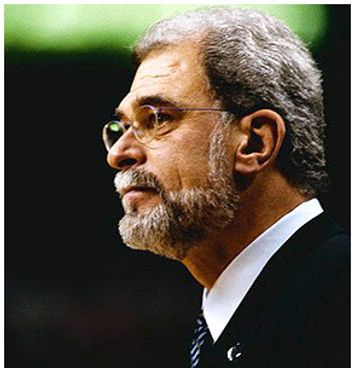
Phil Jackson

The Zen-iest coach in basketball has a cruel streak. He's weird and it works.

  • more
    • All Share Services

Phil Jackson

I’m sure there have been many moments. But the one I’m thinking of happened late in a meaningless regular season game against the muddiest of doormats, the 1998 edition of the Dallas Mavericks. Phil Jackson’s mighty Bulls were mailing it in — imitating basketball in a game they would eventually lose. It was then that he entered what can only be called a State of Phil. Rather than resort to the usual motivational exhortations of superego figures, Jackson did something unprecedented in professional athletics: He started clipping his nails. When Jackson achieves Phil, he stands at a universal meeting point where parts become indistinguishable from their whole. He is at once in your face and removed, as if surveying multitudes of you across space and time. The art of Phil is such that even the losses seem by design.

But Jackson seldom loses. This year, Jackson will complete his 11th season as an NBA coach. He spent his first nine with the Chicago Bulls, where he garnered six championships. He took the 1998-99 season off, then returned to lead the Los Angeles Lakers to glory in 2000. If his Lakers go on to win this year, it will be Jackson’s eighth championship. Only Red Auerbach has more with nine — a record that Jackson may very well break if he decides to stick around that long. Jackson has achieved his success with a uniquely New Age approach: a blend of Eastern and Western ideas heretofore foreign to professional sports. He has been known to regale players with tales of the sacred white buffalo of the plains, coach them in meditation techniques and burn sage to reverse a losing streak.

Perhaps because of his bizarre methodology, Jackson is not without his critics. They point to the great players he has always had on his side — first Michael Jordan and Scottie Pippen, and now Shaquille O’Neal and Kobe Bryant. It stands to reason, they argue, that Jackson wins — the deck is always stacked in his favor. And they have a point. Jackson knows when to hold ‘em and when to fold ‘em. When the Bulls broke up, he walked away from the game until he found a sure bet with the Lakers.

But there is another side to the story. Jordan and Shaq played a combined 13 years without Jackson and never won a championship. Meanwhile Jackson has known success at every level — first as a player with the 1970 and 1973 Knicks, then in the lowly Continental Basketball Association, where he won a title with the Albany Patroons.

The CBA is where Jackson earned his stripes. Not only did Jackson coach, he drove the van. Late at night he took his band of malcontents and might-have-beens from one basketball outpost to the next, each light-years away from the NBA and anybody who might care about their accomplishments.

While at Albany Jackson persuaded his team to divide salaries and playing time equally. Married guys got a $25-a-week bonus. This type of egalitarianism is without precedent in professional sports — you find it on a few scattered T-ball teams. Generally speaking, these are the teams that sink to the bottom of the standings and a parent-inspired mutiny follows. Not so with Jackson’s Patroons. In 1984, they took the CBA title.

And this is the magic of Phil. Somehow, he manages to be at once himself and whatever his players need him to be. In an era when everyone wants to be an emcee, in an environment where the limelight’s wattage determines self-worth, Jackson opts for a lower profile. Winning or losing, on the bench his demeanor never strays. At times, it seems as though the game played before him simply distracts him from other, more important mental activities. Like the Wizard of Oz, his machinations remain hidden.

Born to Pentecostal missionaries in North Dakota, Phil Jackson learned the art of manipulation early in life. As a player, his mental grasp of the game far outstretched his physical capabilities. Jackson was oafish and often injured, and opponents feared his sharp elbows more than his sharp shot. Red Holzman, his coach on the New York Knickerbockers, barred him from dribbling the ball.

Nonetheless it was clear that Jackson was operating on levels foreign to the linear minds of professional athletes. Former Knicks teammate Walt Frazier recalls, “He could have been a better player if he had applied himself to it more, as much as he applied himself to his books. He read those weird books. They were weird to us anyway. No one else ever read them anyway.”

Relating to players through books would later become one of the hallmarks of his unique approach to coaching. He has assigned “To Kill a Mockingbird” to Horace Grant and Nietzsche to Shaq.

And it was a book that nearly put the kibosh on Jackson’s coaching career before it even began. In 1975 he wrote “Maverick,” a memoir about his days playing in the NBA. Among other things, Jackson spoke frankly about marijuana use and experimentation with LSD. It was a critical success, but the book cemented a loose-cannon reputation that would alienate him from the NBA establishment for years.

It took another pariah, Bulls general manager Jerry Krause, to rescue Jackson from anonymity. Krause, widely disliked even then, had scouted him when Jackson was a Barry Goldwater supporter at the University of North Dakota. Decades later, Jackson was coaching in a Puerto Rican summer league, and had all but vanished from the basketball map. Krause persuaded then coach Doug Collins to bring Jackson in for an interview. The two liked each other and Jackson got a job as an assistant. Three years later, Collins no longer with the team, Jackson directed the Bulls to their first of six championships.

Immediately, Jackson set a tone distinct to that of the Draconian Collins. He operated with a subtle hand, using devices like movie clips to convey messages that words would flatten. During the Bulls’ first championship run, he intercut sequences of the team with scenes from “The Wizard of Oz.” Like the Wizard, Jackson was making his subjects realize the heart, courage and brains latent within them.

Jackson’s use of movie clips isn’t always touchy-feely, as was the case last year when he used scenes from “American History X” to prepare his Lakers for a playoff series against the Sacramento Kings. Primarily, he used the film and its underlying message of the brotherhood of man to unite his feuding stars, Kobe and Shaq. But he also took things in an altogether different direction by cutting back and forth between the film’s Edward Norton character, who has a bald head and a tattoo of a swastika, and Sacramento’s white, shaved-headed and tattooed point guard, Jason Williams. Then, according to the Washington Post, Jackson made comparisons between Sacramento coach Rick Adelman — who has a mustache and distinctly German features — and Adolf Hitler.

Indeed, for all the talk of Native American spirituality and Zen, Jackson often displays devilish cruelty. Cruelty is the yin to his New Age yang. Often it comes at the very moment of kindness, as was the case the day before a 1994 playoff game in New York. Jordan had taken his famous baseball sabbatical and Jackson sensed that his team was showing signs of buckling without him. To remedy the situation Jackson redirected the team bus as it made its way to the practice gym at the southern tip of Manhattan. Rather than practice that day, the team would take a ride on the Staten Island Ferry. However, before it got to its destination, Jackson had the bus stop and he ordered a longtime publicity assistant — and the only female riding with the team — off of the bus. According to Roland Lazenby, author of the Jackson biography “Mindgames,” “the woman was devastated by the move and has never forgiven Jackson for an unexplained and seemingly unnecessary humiliation.”

Such is Jackson’s way. He demonizes those on the outside to tighten the inner circle. Coldly and without affect, he alienates the extraneous, and for much of this year the strategy seemed as if it might backfire. From the moment he arrived in L.A., Jackson had fostered a special bond with O’Neal. Often this connection came at the expense of the coach’s ties to the younger — and more independent — star, Bryant. When the New York Times reported that Shaq was giving his teammates secret hand signals to not give Kobe the ball, the struggle between the team’s two stars seemed set to consume the group.

Jackson tried to rectify the situation, telling him to turn down his individual game, to which Kobe replied, “I haven’t even turned it up yet.” Jackson even tried giving Kobe a book, “Corelli’s Mandolin.” When Kobe wasn’t impressed by the story of a soldier who must sacrifice individual accomplishments for the good of his comrades, the coach’s mean streak returned. He ripped Kobe in the media, accusing him of deliberately making his high school basketball games close so that he could provide last-minute heroics.

At last, it seemed that Jackson had lost his cool. If his behavior had not been directly detrimental to the team, it had failed to heal the rift between its two great players. But then, just when the media was ready to write the team off altogether, the magic returned. The Lakers won their last eight regular season games, and then dominated each series in the playoffs, sweeping all three opponents. Once again, Jackson has his team peaking at just the right time. If the Lakers sweep the NBA finals they will be the first team in history to run the entire playoff table.

On May 21, Jackson once again transgressed the laws of common sense to spectacular effect. Late in the third quarter of their second playoff game against the San Antonio Spurs, the Lakers trailed by seven. For the first time in 17 outings they seemed poised to lose. Out of what appeared to be frustration, Jackson picked a fight with a referee. First he got a technical foul for arguing a call. Then minutes later a ref told him to move off the edge of the court. When Jackson back-talked, the ref gave him a second technical, which carries with it automatic ejection. This type of distraction would unhinge most teams; for the Lakers it was a panacea. They rattled off the next seven points and went on to win comfortably.

It is the uncarved stone, the river ever constant and yet always changing. It is the Way of Phil. You cannot understand it — you can only hope to contain it.

Unlucky 13

At a Clippers basketball game my innocence got ejected.

  • more
    • All Share Services

For my 13th birthday, my father gets us a pair of great seats for the Clippers. It’s a big night for me and I dress accordingly: zebra skin shoes, white lab technician’s coat and the authentic rock-watch that my father has brought back from Switzerland. The watch means that I am en route to adulthood. I wear it like I wear my Cyclops hairdo: with pride.

The 1987-88 Clippers are a ship of fools. They are too uncoordinated to play their way out of a paper bag, much less to the top of the Western Conference of the National Basketball Association. But it’s OK — their ineptitude makes them approachable in ways that other professional teams in Los Angeles are not. For one, we can afford to see them play. But more important, they remind me of me. Like me, they are young and out of shape. Like me, they will grow into their bodies. We are the day after tomorrow — the future’s future.

The 1987 draft has been especially fruitful. Three first-round picks — all of them masters of the college game, and its national tournament. We picked up the athletic Reggie Williams, the “court-sagacious” (read: white) Joe Wolfe and the yeomanlike Ken Norman. Mixing these guys with the Big Man, Benoit Benjamin, and All Star-ish Larry Nance will undoubtedly lead to electrifying results. In the meantime, while the youngsters develop, management generates a little buzz by offering toiletry kits to paying customers.

Entering this, my first NBA game, I am not untouched by the gesture. However, what impresses me is the black people. Blacks sit behind, next to and in front of us. To the facile allegorizing of a prepubescent liberal, this is a harbinger of the greatest good, the antidote to racial tension that seems to linger unmentioned, a silent fart in a crowded elevator.

As soon as the game begins, the Clippers fall behind. My attention wanes. I turn to the toiletry kit, which looks suspiciously like a purse. The party line for me is that purses are repulsive, but secretly I find them fascinating. Sometimes my mother makes me hold hers when she goes into the bathroom and I protest perhaps a bit too vociferously.

While the Clippers dribble basketballs off their sneakers, I empty out the contents of the toiletry kit and lay each item across my knees. Then, with my hand, I investigate the inner walls of the canvas bag. The investigation bears fruit, as folded into the seam lies a secret compartment with its own private zipper. With one hand still in the bag, for reasons that go far beyond reason, I know I must put something precious in the secret compartment. And what better seed to sew than that token of impending manhood, the watch? Money’s been tighter than usual, but my father gave it to me nonetheless, and with my free hand I unfasten the band. I slip it into the bag and seal it inside. I repack the purse and wait for my beloved Clipper ship to sail in.

It doesn’t. Over the next few years, Joe Wolfe, Reggie Williams and Ken Norman will fade into anonymity, and others will replace them on the Clippers’ leaky decks: the high draft pick who will defect to the Italian league; the local product who will insist on shooting the first free throw of each game with the wrong hand; the African center who will refuse to wear deodorant. But mostly there will be losing. Enough to reform the devout optimism of youth.

But for now I am young and blissfully without a clue. I still believe that ethnic strife, my awkward physique and the collection of 10 left feet that the Clippers bring to the floor will somehow resolve themselves, if for no other reason than fairness.

“Don’t you want to take your bag?” my father asks before we make the halftime exodus to the bathroom and concession stands.

I don’t. Strangers already ask me if I am a boy or a girl, and the last thing I want to do is walk around with something purselike.

When we return with our nachos and our hotdogs, the black man in the seat behind us hands me my toiletry kit. “It fell off your chair,” he says. The gesture reinforces the notion of the de facto racial harmony that the Clippers and their affordable seats inspire. The second half starts and the Clippers begin to exhibit their latent promise. As they put together a rally, the fans stop making derisive comments about Benoit Benjamin’s body type, and instead sprinkle the players with tepid cheers.

The Clippers manage to get within a couple of possessions of the lead, and something clicks within me. I remember the watch, and go limp with doom. My stomach aches. I reach my hand inside the purse to discover what I already know — that the jewel has been taken.

More painful than losing the watch is the prospect of telling my father. After some deliberation, I decide that I cannot shield him from the truth. Between the third and fourth quarters, I stage a reenactment. I unzip first the purse’s big hole and then the private one within. “Oh my God, Dad. The watch is gone. I put it into the pouch and now it’s gone.”

True to form, my father is furious. “For Chrissakes!” he says. But then he does something that to me seems incomprehensible. He confronts the black guy behind us.

Not long before, a distant associate — a neighbor’s neighbor — had her car taken at gunpoint while waiting at a stoplight. It is a new social phenomenon. Carjacking, they call it. Now, watching my father, I know that we are no longer all fans in the same Clipper boat. Instead the world has reduced itself to its basest contrasts.

There will be a fight and this black guy will have a gun. He will shoot my dad and it will be my fault because I planted the watch in the belly of a purse. This is white fright. In the coming years, I will experience it a handful of times in various circumstances.

“You took my son’s watch,” he says.

But there is no fight. Instead the man plays dumb. When my father continues to press him about the watch, he says that some other guy picked up the bag and he remembers that the other guy said something about a watch, but he isn’t exactly sure what.

Dad lets it go. He’s disgusted. With the guy behind him, and with that guy’s alleged guy, but mostly with me. “A watch is something you’re supposed to wear on special occasions,” he hisses.

The Clippers keep things interesting, but in the end, of course, they lose. We don’t say anything until we are back in the car, stuck in a bottleneck at the Sports Arena parking lot. At last my father buries the hatchet. “Well, at least the Clippers made it close.”

“Yeah,” I say, talking through the invisible chokehold, “we almost did it.”

Continue Reading Close

Bird's-eye view

On the way to film school, I spent a week in the former Yugoslavia. Amid the rubble, I found that movies provide a strange entree to real-life devastation.

  • more
    • All Share Services

Bird's-eye view

In 1991, just two years after the fall of the Berlin Wall, confusion fell over the area formerly known as Yugoslavia. It was Babel revisited, as a nation found itself no longer able to speak the same tongue.

A famous photo shows Yugoslav President Josip Broz Tito, for 35 years the nation’s mighty hunter, with his foot on the head of a freshly killed bear. Long after his death in 1980, one still finds it in bars and homes, framed above the TV.

For my friends Maple and Nicole, this is their text. On their own and together, the two aspiring academics have invested a great deal of time moving through it. They are excavating the remains of a monolith, and in many ways, it is the linchpin of their relationship. Since meeting two years ago in Zagreb, Croatia, they have co-written articles and lectured together on the subject of Balkan identity. While Nicole completes research for her Ph.D. dissertation, the two live in Ljubljana, Slovenia. On my way to Amsterdam to get an M.A. in cinema studies, I visit them. It is my intention to see what it is that they see in there.

A week into my tour, we drive to Mostar, Bosnia, for lunch. We get into the coupe that Maple and Nicole have rented for the trip, and drive over the mountains of the Croatian coast into Mostar’s valley. By now, I have adjusted to the windy one-lane highways and breakneck passing. Maple drives and I resign myself to the constructs of the guided tour. I am no longer the chief arbiter of my own well-being, but rather a passenger, a spectator situated to receive the data that enters my field. Nicole reads from “Yugoslavia: Death of a Nation” by Laura Silber and Allan Little, and like a good little moviegoer, I lap it up.

We cross the border into Bosnia-Herzegovina. Traffic stops at a guardhouse. Two soldiers sit under an umbrella at a table. A third, during short breaks in their conversation, peruses the papers of passing motorists. He takes our passports from Maple’s hand, doesn’t look at them and then hands them back to Maple.

That it feels more like a checkpoint than a border, I learn, is not accidental. Rather, nationalists in Croatia feel that, as most of those who live there claim Croatian heritage, southern Bosnia should rightfully belong to them. At stake here is much more than land. For nationalist Croatians, the border, in all its ripeness for overdetermination, marks where the Balkans begin.

Abandoning these brothers and sisters to Bosnian rule is to let them become Balkan, which is to let the family become Balkan, which is something akin to having a son marry the maid. For now, however, nearby United Nations troops make any attempt at military advancement impossible, and so the temporary border stands. The U.N., however, halts no commerce. We drive on and see Croatian banks and post offices.

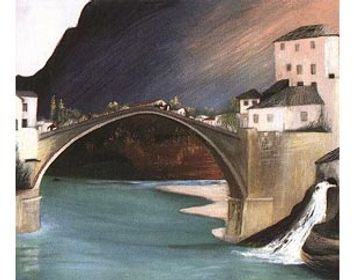
In both Serbian and Croatian, as well as the recently deceased language of Serbo-Croatian, the word “most” means bridge. The bridge of Mostar, built in 1566 on orders of the Turkish sultan, spanned the Neretva River. For hundreds of years, Mostar was the city of the bridge, a city that grew around it on both banks. Connecting Muslim, Orthodox and Catholic parts of the same city, the bridge symbolized the hopes for Bosnia: a nation of different ethnicities living out distinct traditions with mutual tolerance.

On Nov. 7, 1993, almost four years to the day after the dismantling of the Berlin Wall, the bridge of Mostar was bombed. Now Mostar is a mess. There are two cities on two sides of a river — one Croatian, the other Muslim. Despite the existence of other bridges, there is no contact between the two.

The mayor is a German diplomat. Troops from SFOR, the U.N.’s “multinational stabilization force,” police the streets. It is, by and large, a ghost town. In the beginning of the war, Croatians and Muslims formed an alliance against their Serbian aggressors. But as refugees of both ethnic groups flooded into Mostar, tensions rose until things finally erupted. For months Muslims and Croatians waged full-scale war in the streets while Serbs bombed them both from the outskirts.

We drive first through the Croatian side. I roll down the window and stare dumbly at what I guess one could call sights. For the most part they are nothing compared to what will come a few blocks later — pockmarks on facades from the shelling, a few buildings destroyed.

One building, a classic example of Eastern bloc aestheticless architecture, still stands. It takes up a small city block in the center of the Croatian side, like a hollowed and charred loaf of bread. We walk to Muslim Mostar. Comparatively, the damage on the Croatian side seems like acne. Here, whole neighborhoods are rubble. Through holes in the walls of one side of a building, I can see not only that the back of the building has been ground into its ingredients but that the building across the street has been destroyed as well. And it looks like this block after block.

I keep having the same thought: Here is a place where every code registers in the encyclopedia of news media. Because I don’t really know how to respond, I do like the news and look through the viewfinder of my camera. I snap shots. I try to capture the most Mostar can offer in a single image.

We eat lunch in view of the renovation of the bridge. While a Croat minister once boasted that, after the war, Croatia would build a better and older bridge, the job has been left to a Hungarian team. Using the original plans on loan from the Turkish government, they pull up each piece from the river below, and work to re-create the bridge exactly. We feast on grilled meats and watch adolescent boys swan-dive off the temporary span next to the construction.

There isn’t much to say. Nicole mentions that when she was here last, before the war, boys dove off the old bridge. Maple and I nod. We eat more grilled meat until there is no room for even thought. It is not the only time on this trip that I have found myself overcome with the urge not to think. Indeed, for me, the perversity of the situation here often negates the pleasures I might otherwise get from analyzing it.

Two days after the trip to Mostar, we drive through the Croatian Krijina, a mountainous region between Zagreb and the coast. Here we see the story of southern Bosnia transcribed onto a slightly different tableau. For generations, the majority of the population in the Croatian Krijina was Serbian. When Croatia declared itself independent from Yugoslavia, these Serbs wanted to remain under Serbian rule. The result was what we know as ethnic cleansing, where one army would eradicate entire villages of the other ethnicity. Nearly all of the Serbs in the Krijina are gone now. Those who weren’t murdered left. The few who remain are elderly, living out their days under persecution and the possibility of murder. Those who left were sent by Slobodan Milosevic to Serbian Kosovo, where again they were asked to fight for the Serbian fatherland. And now, following the most recent warring, they have been relocated again.

Nicole explains all this to me as we drive through sour weather. Rain slaps our windshield. Maple’s nerves seem torched by sudden stops on cheap, wet pavement and constant weaving through an endless string of traffic. When we break to relieve ourselves, Maple tells me not to stray too far from the road. “Land mines,” he says.

By this point, I miss my life and the movie watching that tends to structure it. The cinema offers a unique brand of privacy. As the reflections dance on the cave’s wall before us, we tune in and out. Our imaginations run along a band of incalculable frequencies, and no one else can perceive what we think or how we may or may not be feeling. By the end of the trip, I miss it. I suffer from withdrawals of mediated reality.

I find it difficult to understand why Maple and Nicole decided to study this area. I’ve seen enough and no longer want to understand the horrible things that have happened here. In a wine bar on an empty island — more former residents have moved to San Pedro, Calif., than remain — I made the mistake of mentioning my incomprehension of the “whole war thing.” Nicole sympathized, but Maple made no effort to conceal his disgust. As he sees it, and here I paraphrase with trepidation, pleading an inability to understand is to tacitly put yourself above those who fought, to exempt yourself from the possibility of ever acting the same way.

When former Secretary of State James Baker said, “We don’t have a dog in that fight,” about the war in Bosnia-Herzegovina, he passed the same judgments Maple feels I pass. Baker and I agree: It’s a Balkan thing; we are too evolved to understand. What I lack in heart, or possibly will, to express is a vague sense that the opposite is not without its own pitfalls. Side effects and symptoms arise from the subject of who studies the area formerly known as Yugoslavia. Some time later, at a computer center in Amsterdam, the most progressive city on earth, I will fail again to make the argument. Indeed, I will find myself too cowardly to invoke the conceits of hardened souls and basic human benevolence that the argument requires.

But for now, we return to our trip. On my last day, we go for a hike in the Slovenian Alps. Maple and I, I think, look to each other for confirmation that the fabric of our friendship remains intact. We want my stay to end on a note of triumph. It works — Alpine air somehow breathes new life into our jangled nerves. For a minute it even allows me to transcend a certain kind of fatalism that, in the previous couple of days, had descended upon me. However, when we miss the trail that leads to the mountain lodge with the delicious gruel, I return to my pathetic sourness.

I see a great divide etched into the respective discourses of our studies. That I choose to study the movies and he this place, the various names for which invariably position their speaker into some ideological camp, begins to speak volumes to me. The movies, as theorists tell us time and again, are the locus of spectatorship and passive voyeurism. Poised at cliff’s edge, on a mountain trail, I see it oh-so-clearly: I watch this world with mesmerization and dread, while he, on the other hand, participates. And in so doing, he accepts all the complicity and dirty-handedness that action necessitates.

My theory feels confirmed on the drive back down the mountain. Maple uses the emergency brake to send the car fishtailing in a controlled skid around a couple of turns. Nicole tells him to cut it out, and I try to keep my mouth shut. But, during one particularly hairy turn, Nicole and I both freak out. Once the wheels regain their traction, Maple immediately realizes his error — that for those who have no control over the car, skidding on a mountain road can be a very unpleasant experience. But to me, in this Balkan moment, it’s too late. We exist at irreconcilable ends of a sliding scale of passive and active, observation and participation.

It’s not until I spend a couple of weeks in Amsterdam that my fatalism begins to fade. Humans are more pliable than their ideas. What had, against a landscape of war and destruction, seemed irreconcilable, begins to bleed together into the platitudes of taste. From the calm of my private life, with movies plotting their course through my veins like so much junk, I can safely see the differences between us as the spice of life.

Continue Reading Close

Who killed literature?

An aging professor offers his last pleas to help his expiring vocation.

  • more
    • All Share Services

As anyone who’s ever had a parent can attest, advice annoys. Even when we know we should take heed, there is something about the lofty heights from which pearls of wisdom drop that make them feel like hail. In a similar way, Carl Woodring’s latest book, “Literature: An Embattled Profession,” abounds with sound advice for the endangered world of higher learning in the humanities, even though it’s all too likely to fall on deaf ears.

Woodring, a professor emeritus in English at Columbia University,
has spent some 50-plus years in the fray of the culture wars. And now,
just a stone’s throw from octogenarianhood, he reports back to tell us what
he has learned along the way. The central lesson he wishes to impart is the value of
literature — its power to enrich lives and elevate the soul. Worried that
this lesson is increasingly lost on a general public that by and large feels
alienated from the ivory tower, he has written “Literature” as a plea to
practitioners of literary criticism to lower the drawbridge for the intelligent layperson.

He mounts a two-pronged case, first against current literary critics and
theorists and then against the institutions that house them. In well-wrought and engaging prose he sketches the last three centuries of American
literary study — from etymological studies firmly grounded in Greek and Latin to the New Critics of the early 20th century who opened the door
to contextual interpretation. Finally, he arrives at the current moment, when
Post-Structural criticism has, in his eyes, taken a wrong turn and
abandoned the recreational reader’s concerns. In short, he blames the
ascent of theory for encouraging professional students of literature to
look down on the ordinary readers’ desires for plot and character, beauty and meaning.

It is here that Woodring is at his best. Clear-eyed and witty, he
articulates feelings that have been welling up in a literate public for
years. He shows how jargon serves as a means for academics to sequester
themselves from the general reading public, so that readers who had once “found the literary scholars unutterably dull now can protest additionally
– and they can quote — comically unintelligible.”

The book then assails the administrative wing of higher learning.
Displaying exceptional polish as a researcher, Woodring demonstrates how
universities have become grotesquely top-heavy with management. Citing one
example of administrative excess after another, he paints a vivid picture
of universities that hire more vice-presidents, who in turn need more
deans, support staff, office space and equipment, all of which raise
tuition, swallow grant money and squeeze academic departments. Woodring
succinctly summarizes the bureaucratic logjam: “Employees numbering twenty thousand
will consider themselves collectively vital to twenty-three hundred faculty
and forty thousand students, but many of them are vital only to each
other.” Consequently, universities have created a glut of jobless Ph.D.s, and
increasingly resorted to the cost-cutting practices of hiring student assistants and adjunct
lecturers to replace professors.

In the final two chapters of the book, Woodring doffs his
diagnostic cap for a prescriptive hard hat, and quickly the book unravels
into moralistic hodgepodge. It becomes easy to imagine the entire project
springing from one of those if-I-ran-the-world conversations in the
teachers’ lounge. He has a lot of ideas for fixing the bugaboos that have irked him not only at university but also primary and
secondary levels of education. Many of his rants pertain to the art of teaching freshman composition. Leaving no stone unturned, he
covers such dire topics as the neutered suffix (“Spokespersons yes,
waitpersons maybe; fireman is a nuisance, with firefighter available;
airman can die of neglect”) and e-mail discussion groups. Although his detailed prescriptions are meant to weave a tapestry that molds writers of “clarity and vigor,” these chapters — reminiscent of college course
descriptions — go down like a Wasa cracker.

Guidance in the observation of detail should come early. Have each student
describe, for example, the similarities and differences of two houses near
the classroom (affluent teachers have been known to pass out tokens for
transportation to distant houses), and then assign to classmates X, Y, and Z
the task of rewriting the descriptions by A, B, and C for greater accuracy
and detail. For fairness and other advantages, a further step adapted from
interactive core programs would have the descriptions and evaluations further evaluated in class discussion.”

Just reading about it makes me want to bolt to the nearest registrar’s office and hand in a drop slip. Imagine having to actually perform the
assignment.

Toward the end of the book, Woodring takes time out to sing the praises of
the core program at Columbia College, a series of mandatory courses covering seminal humanities texts spreading from Homer to Camus. This program became
the subject of controversy first during the canon debates, over the number of
female and non-white authors on their syllabuses, then later as featured in David Denby’s 1996 “Great Books: My Adventures With Homer, Rousseau, Woolf, and Other Indestructible Writers of the Western World,” in which Denby — then a reviewer for New York magazine — returned to Columbia to read great books and muse about the culture wars.

Yet for Woodring, the core seems to be about a more enlightened form of elbow-rubbing. “A Manhattan or Albany lawyer,” he states, “who hears another in the firm allude to idols of the cave with reference simultaneously to Bacon and Plato recognizes a fellow graduate of Columbia College.” Sure: They’re at the water cooler. They exchange a couple of secret handshakes and a laugh about
“The Golden Ass.” Meanwhile the rest of us can’t get a cup of water without
being subjected to their insufferable erudition. I don’t mean to suggest to that the world wouldn’t be a better place if all college graduates had, as
Woodring puts it, “read carefully under tutelage the same epics, dramas, satires, and philosophic and political essays,” but rather to illustrate
how easily literariness morphs into pretension.

What is strangest about this book is that while cobbling such a passionate
argument for a new inclusive spirit in literary studies, Woodring has written a book with such obviously limited appeal. Even he himself says in
the introduction that the book would address issues most pertinent to those whom “might choose to attend an annual meeting of the Modern Language
Association.” Choose to go to the MLA conference? I didn’t know people did that.

And yet, I hesitate to dismiss the book out of hand. No one can doubt that he has thought an awful lot about the meaning of literature. And many of his conclusions and suggestions are apt and admirable — though in the end, I wonder what they add to the debate.

Continue Reading Close

I think therefore I tickle

In his new book, "The Ticklish Subject," renegade philosopher Slavoj Zizek offers a mind-searing, polyvalent glimpse into the heart of modern freedom.

  • more
    • All Share Services

As I learned from a recent review in the Nation, there are two ways to plot a slasher movie: “Either you organize a movie around nine decapitations … spacing them at 10-minute intervals, or else you work up to a single big decapitation at the end.” And although philosophy does not follow the same generic guidelines per se, Slavoj Zizek’s “The Ticklish Subject” falls into the latter camp. The steps are slow, but Zizek moves the book steadily toward its coup de grbce, a model for the decapitation of global capital.

Zizek’s hatchet man is the Cartesian subject, the embodiment of Rene Descartes’ notion that rational thought defines human existence. Zizek’s championing of Mr. Cogito Ergo Sum seems peculiar, given how many currently fashionable philosophical schools have declared him already dead. Multiculturalism, for instance, argues that no one seminal criterion can explain what it is to be alive, but that the condition of being human depends on the culture from which the person comes. Consequently, the logic of Descartes’ “I think therefore I am” may reflect only a narrow, Occidental mode of being.

In his introduction, Zizek acknowledges a laundry list of other schools “united in the rejection of the Cartesian subject”: the New Age obscurantist, the postmodern deconstructionist, the Habermasian, the Heideggerian, the cognitive scientist, the Deep Ecologist, the critical (post-)Marxist, and the feminist. Zizek concludes that it’s high time for someone to defend the view that so many scholars argue vehemently against. He sets out to do this by positing a universal selfhood, seen through the scrim of leftist political theory. What he drafts, however, is not the typical cold-blooded, rational Cartesian subject; rather he formulates an original reading of the self, one that with all its contingency still possesses a paradoxical freedom to move us “from subjection to subjective destitution.” That is to say, from enslavement by our circumstance to self-determination, albeit limited.

Right, sure, but just what does Zizek’s search to define the universal self have to do with you? Everything. If you have ever wondered to what extent your life lies within your own power, or to what extent your experience is determined by influences — culture, class, sex, class, history — hopelessly beyond your control, you are none other than the ticklish subject.

What’s amazing about Zizek is that he paints such a broad canvas. He divides the book into three parts, gradually building a dialectical portrait of the individual dwelling within a politicized world. The first presents us with the solitary individual — rather akin to the atomized psychological self — whose imagination naturally breaks apart totalities into a horrific multitude of shattered images. He quotes from Hegel: “Here shoots a bloody head — there another white ghastly apparition, suddenly here before it, and just so disappears.” In the second part, he places the individual back in a sociopolitical context. In the third part, we return to the reflective consciousness of the single individual, who must think and act in the complexity of the world. Through this journey from self to other and then on to a new self, Zizek sets out to measure the scope of our personal and political agency, and the hopes, fears and limitations that define that scope.

Zizek’s notion of individual freedom harbors little of the mythological hype so prevalent in America’s stalwart individualism. There are no parables of bootstraps and new frontiers. Instead, the individual acts within a rather narrow space in which he or she can offer or deny consent to a context far beyond individual control. More simply, we can decide what we think about the world, and this may or may not have a great effect upon the world itself.

For Zizek, freedom is the power “which the soul has, to suspend or to give its consent to motives, which naturally follow interesting perceptions.” Zizek’s concept is not unlike Monty Hall’s “Let’s Make a Deal.” After all, we do have a choice: we can either accept the stack of bills that Monty has placed in our hand, or we can hold out for what lies behind Door No. 3. However, neither in “Let’s Make a Deal,” nor in life can we determine what it is that lies beyond the doors of withheld consent until the choice has been made.

What separates Zizek from so much of philosophy that seems to cloak medium-sized ideas in large words is his ability to locate his theories in the madness of our depoliticized cultural moment. The breadth of Zizek’s ken never ceases to amaze. Not only does he move freely between subjects as disparate as Viagra and Alain Badiou’s reading of St. Paul’s reading of the crucifixion, but such acrobatic intellectual leaps nearly always feel germane to his project. Through unexpected connections, tapestries of very complicated ideas gradually come into focus. Movie mogul Sam Goldwyn at one point illustrates Hegel; Hegel, at another, provides the key to understanding Pat Buchanan and the radical right. Constellations develop and shapes are given to those ineffable anxieties that keep us tossing and turning while our partners sleep soundly.

Some of Zizek’s keenest insights arise out of contemporary cinema. In a very moving passage, he draws a surprising conclusion from the comparison of two British films, “Brassed Off” and “The Full Monty.” Both, in Zizek’s words, tell the story of “the traumatic disintegration of old-style, working-class identity.”"Brassed Off” portrays the “political struggle (the miners’ struggle against threatened pit closures legitimized in terms of technological progress) [with] the idealized symbolic expression of the miners’ community, their brass band.” When the miners lose their political struggle, what remains is the empty symbolism of the brass band — “as one of them puts it, when there is no hope, there are only principles to follow … ” As the miners continue to play in the brass band, it becomes the locus of a political struggle that continues despite the fact that what they were struggling for has already been lost.

In “The Full Monty,” five unemployed guys find a way to make a buck by stripping. Zizek points out that their act finally signifies the same thing as the miners’ brass band: the acceptance of a passing way of life. Nonetheless, one critical difference between the two films remains: “The heroism of the final gesture of “The Full Monty” is not that of persisting in the symbolic form (playing in the band) when its social substance disintegrates but, on the contrary, of accepting what, from the perspective of the male working-class ethic, cannot but appear as the ultimate humiliation: readily giving away false male dignity.”

Characteristically, Zizek broadens his scope so that what first seemed to be, at best, nifty cultural criticism takes on deeper meaning:

So, in today’s leftist politics, we seem in effect to be reduced to the choice between the “solid” orthodox attitude of proudly out of principle, sticking to the old (Communist or Social Democratic) tune, although we know its time has passed, and the New Labour “radical centre” attitude of going the “full Monty” in stripping, the last vestiges of proper leftist discourse …

What springs from this and so many other moments in “The Ticklish Subject” is a passionate search for what Zizek aptly calls a “miracle” — the political act that undermines the structures of global capitalism. For Zizek, miracles occur at the moment when multitudes of individual Cartesian wills come together to achieve what had seemed like a political impossibility. For example, in Italy in the 1970s, a referendum on divorce was held. Members of the left, who supported the freedom to choose divorce, thought that people weren’t “mature enough, that they would be frightened by the intense Catholic propaganda.” And yet, inexplicably, when the moment came, over 60 percent of the country voted for the right to divorce.

Occasionally, the fecundity of Zizek’s imagination can be a bit too much. For instance, in a footnote on the “ultimate horror” of the personal computer, he goes on and on about the uncanny ability of computers to both lose enormous amounts of information in a single instant and yet — with the help of retrieve commands — make it well-nigh impossible to ever really delete anything permanently. “A simple PC then contains a kind of ‘undead’ spectral domain of deleted texts which nevertheless continue to lead a shadowy existence, ‘between the two deaths’, officially deleted but still there, waiting to be recovered,” he concludes rather melodramatically. “This is the ultimate horror of the digital universe: in it everything remains forever inscribed; it is practically impossible to get rid of, to erase a text … “

One gets the sense here that Zizek is enjoying a private little joke. We can picture him writing the footnote. The green squiggly line of a grammar program has spewed out its judgment from somewhere deep within the machine. It tells him, “Long Sentence (no suggestions).” He playfully deletes the text and then hits the undo icon … No doubt Zizek has a big, big brain, but must we be privy to all its minor digressions?

But perhaps I’m nitpicking. In many ways, the power of the book arises from just this type of refusal to censor the imagination. It doesn’t, however, make for an easy read. Zizek’s playfulness makes him nearly impossible to pin down. Even after parsing through jargon that frankly leaves me cold, I still can never be sure just how sincere he’s being at any given moment. Nonetheless, I think it’s all part of Zizek’s point. Irony, here, becomes crucial to his political argument. For just as irony transforms the literal into something radically different, our imagination contains the power to sneak new narratives into the political universe of global capitalism. Moreover, if what he seeks to illustrate is a new type of agency inhering in human selfhood, one that is ticklish rather than rigidly heroic, then shouldn’t he tickle us into understanding, too?

Zizek concludes his book with the story of Mary Kay Letourneau, the 36-year-old schoolteacher who had an affair with one of her sixth-grade pupils. In the public debate over the incident, two ideological camps formed. The first condemned her as evil. The other, which included Mary Kay’s own defense team, diagnosed her with bipolar disorder. They claimed that the manic states, which the illness induces, suspended her ability to use proper judgment. Rather than be punished, they argued, she should be treated medically. This leads Zizek to ask, “Is not such a suspension [of good judgment], however, one of the constituents of the notion of the authentic act of being in love?” The mania they describe, then, is love itself. And so, confronted by a society that sees love as a mental illness which medication can cure, Zizek offers his own prescription. Like a sublime, intellectual self-help guru, he “exhorts you to dare,” to discover the freedom that can only come from obeying your deepest desires.

In theory, such exhortations have the ring of utopia. But in the real world, freedom exercised with such abandon can be dangerous. I imagine the hatchet man from bygone slasher flicks. Perhaps he’s that sixth-grader now grown up, his deepest desires informed by poor modeling from elders and boundaries blurred. As he raises his axe, I wonder how Zizek might distinguish the freedom we are meant to act upon from that which is better left in the realm of nightmares and horror films.

Continue Reading Close