Joseph Romm

Daddy, could we have our planet back now?

As they bask in the appreciation of their children today, fathers should think about the world they'll leave behind

  • more
    • All Share Services

Daddy, could we have our planet back now?

As parents, we constantly admonish our children to share with others. The joke is that as adults, we hardly like to share anything at all. Who likes to lend out their car? Or their tools or books? We’re so worried they won’t come back in the same condition — or won’t be returned at all.

But the truth is that the people we like to share the least with are our own children. “We do not inherit the Earth from our parents, we borrow it from our children,” the saying goes. Right now, though, we’ve borrowed the entire Earth, trashed much of it, and don’t plan to give back the rest of it.

We are plundering the world’s “renewable resources” — arable land and tropical forests and fisheries and fresh water. And we are using an ever-greater fraction of nonrenewable energy resources, especially hydrocarbons, with devastating consequences that will far exceed what we are now witnessing in the Gulf of Mexico.

As one example, our carbon pollution is acidifying all of the oceans simultaneously, while heating them up to record levels, threatening mass extinction of aquatic life. Australian marine science professor Ove Hoegh-Guldberg, the lead author of a major new study in Science, says the result is that “we are entering a period in which the very ocean services upon which humanity depends are undergoing massive change and in some cases beginning to fail.” He adds: “It’s as if the Earth has been smoking two packs of cigarettes a day” — except, of course, the smoke comes from our addiction to fossil fuels, not the Earth’s.

The website RealClimate points out that the amount of dangerous carbon dioxide we spew into the air each day from burning fossil fuels and deforestation is roughly equivalent to “five thousand spills like in the Gulf of Mexico, all going at once … every day for decades and centuries on end.”

And if we listen much longer to those anti-science disinformers who have been counseling inaction, we won’t just be trashing the climate for our children — we will be destroying a livable climate for countless future generations. A 2009 study led by the National Oceanic and Atmospheric Administration found that “the climate change that is taking place because of increases in carbon dioxide concentration is largely irreversible for 1,000 years after emissions stop.” What kind of changes? Well, besides destroying the oceans, the study warns of “irreversible dry-season rainfall reductions in several regions comparable to those of the ‘dust bowl’ era and inexorable sea level rise.”

The dust bowl that will hit the American Southwest and a half-dozen other heavily populated regions around the Earth will likely last far, far longer than the one that devastated the Great Plains in the 1930s. And the sea level rise could hit 4 to 6 feet by century’s end and then continue rising a foot or more a decade, until all the land-based ice on the planet is gone and seas are more than 200 feet higher. How will our children’s children and their descendants adapt to that?

The big debate in the Senate this summer will be whether to pass an energy and climate bill that finally puts a price on carbon pollution. Conservatives have demagogued even the most moderate, business-friendly proposal to put a price on carbon, falsely labeling it and “energy tax.” In his big speech last week, President Obama praised the House bill, which would establish a shrinking cap on carbon and a rising price, but he himself never mentioned the threat posed by unrestricted greenhouse gas emissions, or the urgent need to make polluters pay for emitting carbon dioxide. As a result, the prospects have dimmed for serious climate legislation this year.

To refuse to place a price on carbon dioxide pollution is to ignore the damage your actions today will inevitably have on the health and well-being of your children and everyone else’s children. Something to think about on Father’s Day.

It’ll always be “British Petroleum” to me

Memo to Brits: Quit whining about the name. Americans are incredibly pissed about what BP has done in the Gulf

  • more
    • All Share Services

It'll always be A BP logo is seen at a petrol station in Birmingham, England, Thursday, June 10, 2010. Shares in BP PLC are falling sharply at the start of trading in London after a huge sell-off in New York amid fears about the rising costs facing the company over the Gulf of Mexico oil spill. . (AP Photo/Simon Dawson)(Credit: Simon Dawson)

The British are now unhappy that Americans are calling BP “British Petroleum.” Fraser Nelson, the editor of the Spectator, blogged last week that “BP has not — for many years — stood for British Petroleum — you won’t find the two words anywhere in its annual report.”

Nelson said calling BP by its original name was “anti-British rhetoric.” He actually pined for the days of the previous president:

“It’s hard to imagine Bush using the rhetoric that Obama has so quickly resorted to. It does make you wonder: is there still a ‘special relationship’ or is America just not that into us?”

Yeah, Bush did wonders for the special relationship. He really respected you Brits in the morning — just ask Tony Blair, aka “Bush’s lapdog.” In fact, President Obama has already phoned the new British prime minister, David Cameron, to make clear that “he had no interest in undermining BP’s value.” Duh. We need BP solvent since it’s not like we’re made of money on the polluted side of the pond.

But I thought the Brits were the ones with the long history and stiff upper lip. Now it turns out they have short memories and a glass jaw. Or at least an oily one.

It was not even two years ago that Gordon Brown, then Britain’s prime minister, used America as an excuse for British economic problems. On the BBC in November 2008, an interviewer asked Brown “how precarious is the position of the UK economy? Are we on the edge of a precipice?” He replied:

“No. But the global economy is in great difficulty. I mean what’s happened is we’ve had a banking crisis which started in America; makes me incredibly angry about what happened, the irresponsibility of risk taking and the irresponsibility of not disclosing things.”

Memo to Brits: Americans are incredibly angry about what happened, the irresponsibility of risk-taking and the irresponsibility of not disclosing things — by British Petroleum. Tell you what: We’ll take the blame for Goldman Sachs (or GS, as I’m sure it’ll soon be renamed), if you acknowledge BP as one of yours.

Heck, just read BP Magazine — yes, it has its own magazine; there’s so much we don’t know about this misunderstood petro-giant. A 2007 article begins, “With its distinct British heritage, BP is as much a part of the UK landscape as football, tea drinking and the Royal Family.”

So are the Brits really saying that calling their veddy, veddy British company “British Petroleum” is somehow an insult, a threat to our “special” relationship? Does that mean we must stop using the word entirely, rewrite our whole history, starting with, say, the Revolutionary War. “The B’s are coming. The B’s are coming.”

Let’s remember that BP changed its name from British Petroleum in large part to push the phony rebranding of “Beyond Petroleum.” As it turns out, though, they just can’t quit oil. It runs through their veins … and onto our shores.

But here’s something I bet even most Brits didn’t know, even though it’s right there on BP’s website:

Despite its name, the British Petroleum brand was originally created by a German firm as a way of marketing its products in Britain. During the war, the British government seized the company’s assets, and the Public Trustee sold them to Anglo-Persian in 1917.

Hmm. Seizing the company’s assets. What a novel idea. But I digress. The Anglo-Persian Oil Co. didn’t go for the German propaganda name right away. First, as those droll Brits at BP put it: “Persia changed its name to Iran in 1935, and to stay modern the company followed suit. But the good times wouldn’t last much longer.”

No, they wouldn’t. First there was that whole world war thing. But what led the Anglo-Iranian Oil Co. to rename itself British Petroleum was that 1953 kerfuffle in which the CIA teamed with the Brits to overthrow the Iranian government and install the shah in a coup. Talk about your special relationship!

Ah, but the bromance is gone. Last week, the mayor of London asserted that BP was a victim of “anti-British rhetoric that seems to be permeating from America.” Yes, BP is the victim here.

Here’s what I have to say to the Brits: We tied your arses in soccer, yes, soccer — football is a game where people get seriously hurt and tournament games don’t end in ties! But it still doesn’t make up for what the reckless blokes running your big oil company did to us. Never have so few done so much to so many.

As the fake BP Public Relations twitter site put it:

England vs. USA recap: “Football”: England 1 – USA 1 : “Crapping in the other’s Gulf”: England 54 – USA 0

We never thought of you as whiners until the CEO of your big oil company started saying stuff like “I’d like my life back” and “What the hell did we do to deserve this?” and even “I’m a Brit. Sticks and stones may break my bones but words will never hurt me.” Well, let me tell you, we’d greatly prefer sticks and stones to 100 million gallons of oil and a million gallons of toxic dispersants.

So, man up. We’re gonna keep calling it British Petroleum. And if you keep complaining, we might start calling it the Anglo-Iranian Oil Co. Let’s see what that does for business.

Continue Reading Close

The dumbing down of Carly Fiorina

Apparently, you have to pretend to be ignorant of science to win a Republican primary these days

  • more
    • All Share Services

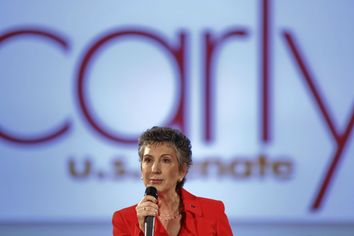
The dumbing down of Carly FiorinaCalifornia Republican candidate for U.S. Senate Carly Fiorina, speaks during the state Republican convention in Santa Clara, Calif., Saturday, March 13, 2010. Fiorina, the former CEO of Hewlett Packard, is running to challenge incumbent Sen. Barbara Boxer, D-Calif. Her two opponents in the Republican primary are former congressman Tom Campbell and state Assemblyman Chuck DeVore. (AP Photo/Tony Avelar)(Credit: Tony Avelar)

Presumably, the former CEO of one of America’s leading technology companies knows the difference between long-term worldwide profitability and product sales on one day in one store.

But apparently to win the Republican nomination for Senate in California these days, even a woman whose brain-power might have been a campaign asset has to pretend she doesn’t know the difference between long-term global climate trends and the daily, local weather.

An unintentionally revealing new ad by former Carly Fiorina, the former Hewlett-Packard chief who is favored to win next Tuesday’s GOP primary, quotes Democratic Sen. Barbara Boxer saying in 2007, “One of the very important national security issues we face, frankly, is climate change.”

Carly then leaps in with this: “Terrorism kills, and Barbara Boxer is worried about the weather. I’m Carly Fiorina. I ran Hewlett-Packard. I chaired the external advisory board for the CIA. We’ve had enough of her politics. I’ll work to keep you safe.”

Fiorina’s first sentence — willfully pretending that being concerned about the threat of global warming is the same as being worried about whether it’s going to rain today — should disqualify anyone for higher office, especially in California.

Last year, Energy Secretary and Nobel laureate Steven Chu, who ran a major national laboratory in California, warned that if we keep on our current path of unrestricted greenhouse gas emissions, it could be devastating to California’s climate: “You’re looking at a scenario where there’s no more agriculture in California.”

No worries for Carly, though. She has a bigger concern than her state’s future — her own political future. She wanted an endorsement in her GOP primary contest from the leading anti-climate dis-informer in the Senate, James Inhofe, Boxer’s bête noire on the Environment and Public Works Committee and a man once described by the Washington Post as “the last flat-earther.” When she won Inhofe’s backing, Fiorina was asked whether she believes in global warming. Her reply: “I think we should have the courage to examine the science on an ongoing basis.”

Fiorina’s race-to-the-intellectual-bottom ad is especially embarrassing because of the credentials she touts. After all, she ran HP — and HP has been unequivocal about climate science. This is from their Global Citizenship Report 2008:

Our planet’s climate is changing, and scientific consensus is that greenhouse gas (GHG) emissions are the main culprit. The effects are forecasted to be far-reaching and substantial. The IPCC Fourth Assessment Report, published in 2007, warned that unmitigated climate change would likely trigger a range of environmental problems threatening agriculture, natural habitats and communities in low-lying coastal areas.

With the threat of such dangerous impacts, it’s not surprising that our military and intelligence leaders worry it could lead to conflict. Last September, the CIA opened its Center on Climate Change and National Security, saying:

“Its charter is not the science of climate change, but the national security impact of phenomena such as desertification, rising sea levels, population shifts, and heightened competition for natural resources.”

As David Corn notes, “If Fiorina had paid attention to the CIA’s actual work, she would know this.” Apparently smart, science-oriented candidates can’t win Republican primaries, so they have to pretend to be dumb.

Ask John McCain, a one-time conservative leader on climate science and climate action, who, faced with a tough primary of his own in Arizona, absurdly claimed this year that he has “never favored” capping global warming pollution “at a certain level.” Fiorina, who endorsed strong climate action when she was a John McCain surrogate during the presidential campaign, has also flip-flopped and now opposes it.

I suppose the good news for Fiorina is that pretty much the whole Republican Party is dumbing itself down on this issue, so perhaps nobody will notice her IQ drop. Just consider Charles Baker, the Republican candidate for governor of Massachusetts and a man who the Boston Globe has said “has a reputation as a smart guy.” But asked in February whether he agrees with scientists that humans are changing the climate, Baker replied: “I absolutely am not smart enough to believe I know the answer to that question.”

Perhaps that should be the bumper sticker of every GOP candidate for higher office: “I absolutely am not smart enough.’’

Continue Reading Close

Jindal and the right on oil spill: Shill, baby, shill!

Faced with a devastating oil spill, Louisiana's governor demands ... more drilling?

  • more
    • All Share Services

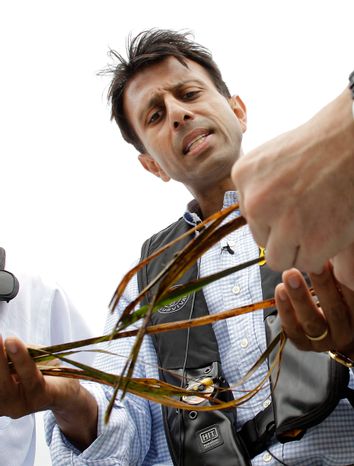
Jindal and the right on oil spill: Shill, baby, shill!Louisiana Gov. Bobby Jindal looks at oiled marsh grass as he tours an area impacted by the Deepwater Horizon oil spill at Northeast Pass, La. Wednesday, June 2, 2010. (AP Photo/Charlie Riedel)(Credit: Charlie Riedel)

A stunning new letter by the oil-addicted governor of Louisiana gives the lie to right-wing claims that environmentalists are to blame for the BP oil disaster.

On Wednesday, Bobby Jindal, who blames everybody but himself for the environmental disaster hitting his state, wrote to President Obama and Interior Secretary Ken Salazar pleading with them to end the deep water drilling moratorium immediately.

He expresses “grave concerns” for the “economic impact of a six-month (or longer) suspension of activity” at 33 Gulf rigs — “including and in particular the 22 deepwater drilling rigs currently in operation off the Louisiana coast.” Jindal warns that the “announced moratorium of deepwater drilling activity creates a significant risk that many of these drilling platforms would be relocated to other countries — along with the hundreds of high-paying jobs that they each create.”

Jindal seems oblivious to the “significant risk” and potentially devastating economic impact posed by the drilling itself — risk that will be present until we figure out all of the causes of the spill and how to make sure it never happens again.

Amazingly, Jindal writes:

I fully understand the need for strict oversight of deepwater drilling. However, I would ask that the federal government move quickly to ensure that all deepwater drilling is in proper compliance with federal regulation and is conducted safely….

Jindal omnisciently — and mistakenly — asserts here that current federal regulations are sufficient to avoid another blowout disaster. He has no way of knowing if this is true, whereas we have every reason to believe it is false.

Under the Cheney-Bush administration, efforts to strengthen regulation were blocked and the industry demanded and achieved essentially voluntary, “trust us” self-regulation and self-certification. For instance, when the Minerals Management Service considered requiring an acoustic backup system to shut off the blowout preventer in the event of a disaster, as Brazil and Norway require, lobbying by BP and other oil companies persuaded them not to.

The Wall Street Journal reported that “the safety record of U.S. offshore drilling compares unfavorably, in terms of deaths and serious accidents, to other major oil-producing countries. Over the past five years, an offshore oil worker in the U.S. was more than four times as likely to be killed than a worker in European waters, and 23% more likely to sustain an injury.” A 2007 MMS study of 39 blowouts from 1992 to 2006 found, “Nearly all the blowouts examined occurred in the Gulf of Mexico.” Big Oil clearly can’t be trusted to regulate itself.

That’s why some are calling this disaster “Cheney’s Katrina.” And that’s why Obama set up a commission to figure out exactly why this disaster occurred. Until we know all the causes, we can’t be sure we are taking every possible step to make sure it doesn’t happen again. And that’s why the president put in place the moratorium for six months, to wait until the findings from the commission are in. That’s also why the president on Tuesday called the disaster a wakeup call that should lead us to once and for all end our addiction to oil.

Jindal has every right to be concerned about the economic impact on his state and region. But rather than recklessly open the Gulf to another potential disaster, the prudent thing would be to support a short-term economic support measure for the region. But that isn’t the approach Big Oil wants to take.

In fact, some shameless industry shills and pro-pollution right-wingers have been spinning the most amazing argument about the origins of the spill.

First, Washington Post columnist Charles Krauthammer blamed the extreme deep-water drilling that led to the spill in part on those who care about the environment, “Environmental chic has driven us out there.”

Sarah Palin posted a message to “extreme” environmentalists on her Facebook page:

“Extreme Enviros: Drill, Baby, Drill in ANWR – Now Do You Get It?”:

Extreme deep water drilling is not the preferred choice to meet our country’s energy needs, but your protests and lawsuits and lies about onshore and shallow water drilling have locked up safer areas. It’s catching up with you. The tragic, unprecedented deep water Gulf oil spill proves it.

Yes, the recklessness of one of the world’s biggest oil company — one that played a key role in the failed effort to protect her state after the Exxon Valdez disaster — “proves” to Palin that we should let them all into a pristine national refuge.

But the larger point is that environmentalists aren’t the reason we’re drilling out in the deep water of the Gulf. If it were up to enviros, we wouldn’t be drilling anywhere off the Gulf Coast. No, there are three reasons we are drilling in the dangerous deep waters of the Gulf: 1) industry assurances that new technology made oil disasters impossible and “inconceivable,” as BP put it; 2) “Drill, baby, drill” demagoguing by anti-environment right-wingers; and 3) decades of opposition by conservatives to slash our dependence on oil, such as tougher fuel economy standards.

And the clearest evidence of that is Jindal’s crazy call to quickly restart deep-water drilling now, even in the face of the environmental and economic devastation to his state from such drilling. What do they say about addicts? No matter what terrible thing happens as a consequence of their addiction, they still demand another fix.

Continue Reading Close

Obama’s daughter asked the wrong question

There's not much that Obama himself can do to "plug the hole." But he could be honest about why the spill happened

  • more
    • All Share Services

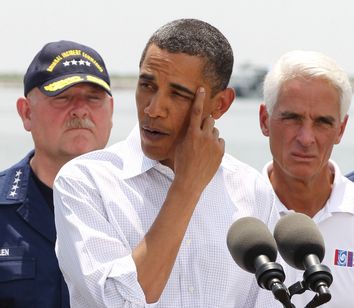
Obama's daughter asked the wrong questionU.S. President Barack Obama speaks after a briefing on the damage along the Louisiana coastline caused after a BP oil line ruptured in the Gulf of Mexico, May 28, 2010. (From L-R) National Incident Commander U.S. Coast Guard Adm. Thad Allen , Obama, and Florida Gov. Charlie Crist. REUTERS/Larry Downing (UNITED STATES - Tags: POLITICS)(Credit: © Larry Downing / Reuters)

When I was shaving this morning, my daughter came up to me and asked, “Daddy, when is President Obama going to develop a coherent narrative for his administration?” OK, maybe not. She’s only 3, and her typical question is more along the lines of, “Can we play hide and seek?”

The president isn’t hiding, but I’m not certain that he is seeking, either. At the end of his buck-stops-here press conference on Thursday, he told a story about how he’d been shaving that morning when his 11-year-old daughter asked, “Did you plug the hole yet, Daddy?”

It’s an odd question, since of all the things the most powerful man in the world has control over, plugging the oil leak in the Gulf isn’t one of them. The federal government simply lacks the relevant equipment to address a volcano of oil one mile below the ocean. I would have thought that the president might have explained that to his daughter at some point. Apparently not.

Sure, no father wants to tell his child that he can’t solve the biggest problem around, but the fact is that the oil companies are the only ones who do this kind of risky drilling — and the only ones who have the technology to stop it.

But it’s also true that Big Oil has spent years deluding itself and others into thinking that this kind of spill was impossible and that preparing for one wasn’t necessary. Indeed, BP once called a blowout disaster “inconceivable.” Certainly, if you can’t conceive of a disaster, you’ll become more and more lax, more and more reckless, until one happens. You’ll cut corners on backup systems and testing. And you certainly won’t pre-build and pre-position any relevant equipment for staunching the flow. Since a disaster can’t happen, you and your allies in Congress will block all serious safeguards and demagogue all efforts to oversee the industry as “Big Government interference in the marketplace that will raise the price of gasoline for average Americans.”

The administration has made some efforts to push back against Big Oil. In February 2009, Interior Secretary Ken Salazar canceled 77 oil and gas lease sales on Western lands that had been approved in the last days of the Bush administration as a final gift to Big Oil. The leases were for land near pristine places like Arches National Park and Dinosaur National Monument. As a result, Sens. Bob Bennett, R-Utah, and Lisa Murkowski, R-Alaska, blocked the confirmation of David Hayes, Obama’s choice to be deputy interior secretary, for two months. Hayes was on the scene on the second day of the Gulf disaster and has been a key figure helping to oversee the effort.

I suppose one can construct a scenario where the administration managed to prevent BP from drilling this well in the first place — a mere two months after taking office and while Republicans were scheming to obstruct and block its moves. Short of that, though, it’s clear that the blame for the disaster rests with BP, Big Oil, the Bush-Cheney administration (which larded the government with Big Oil stooges), and the industry’s strong-arm supporters in Congress (which enacted the voluntary, “trust us,” self-regulation we have today).

The president has failed to explain to the public how unbridled greed and self-regulation allowed the Goldman Sachses of the world to destroy the financial system, and with it the economy. Instead, people are angry at government for how it tried (and succeeded at) fixing the problem. He has failed in the same way when it comes to Big Oil.

As president, Obama bought into Big Oil’s story that new technology meant that a big blowout disaster was impossible. And so he embraced offshore drilling a few months ago and even now has been slow to stop defending it. Thus, the questions that all Americans should be asking their president isn’t whether he’s plugged the leak yet. It’s, “Why did you believe Big Oil and its right-wing allies?”

I guess the president has never told his daughter the story of how conservatives keep weakening all government regulation, how they demagogue any effort to oversee the private sector, and how when the inevitable disasters come, they blame the victim and demand to be put in charge.

But I can see why he wouldn’t tell that story to his daughter. It doesn’t end happily ever after.

Continue Reading Close

Will eco-disasters destroy Obama’s legacy?

There's a clear link between the BP spill and the global warming bill. Obama needs to explain it to Americans

  • more
    • All Share Services

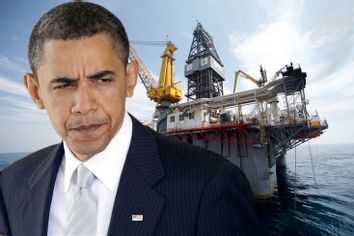
Will eco-disasters destroy Obama's legacy?The Development Driller III, which is drilling the relief well, is seen at the site of the Deepwater Horizon oil spill in the Gulf of Mexico, off the coast of Louisiana, May 11, 2010. REUTERS/Gerald Herbert/Pool (UNITED STATES - Tags: DISASTER ENVIRONMENT ENERGY)(Credit: © Pool New / Reuters)

The truth is that there’s not much more that President Obama can do to stop the eco-disaster now hitting the Gulf of Mexico. But his response to our fossil fuel-driven crises — so far — can still be deemed grossly inadequate.

That’s because the Gulf spill is actually one of two environmental catastrophes now unfolding, and Obama doesn’t seem to understand how they are related.

The milder but more imminent of the two is the BP disaster. It’s now clear that the Gulf Coast will be ravaged, that the impact will be felt for at least a generation, and that we will probably be testing seafood from the area for decades. If the Loop Current entrains a significant amount of the oil and dispersants to the Florida Keys, America’s great coral reef might suffer irreparable damage.

Most of the blame rests with BP — and with Big Oil’s powerful supporters in Congress, who have created the voluntary, “trust us” self-regulation we now have. Some of the blame also resides with the Minerals Management Service, which became absurdly cozy with the industry under the Cheney-Bush administration.

Because BP and Big Oil deluded themselves (and everyone else) into believing that such a disaster was unthinkable, nobody was prepared for it. The Rube Goldberg contraptions that BP is slapping together now is proof of this. If a single major oil company had thought that any of BP’s jury-rigged solutions made sense, they would have pre-built and prepositioned them a long time ago.

With its reckless cost- and corner-cutting and efforts to hide the magnitude of the gusher, BP has proven itself completely untrustworthy. As millions of gallons of oil and hundreds of thousand of gallons of dispersants cause their inevitable damage to sensitive coastal wetlands, fish, fowl and wildlife, frustration will boil over, a process that has already begun.

The right is out for Obama’s head because that’s what they do. The media is out for Obama’s head because that’s what they do. And, of course, the left is out for Obama’s head because that’s what they do. Many environmentalists are angry over Obama’s too-clever-by-half embrace of drilling earlier this year and eager to say I told you so.

Unfortunately for Obama, Congress established the principle that the oil companies are responsible for dealing with major spills after the Exxon Valdez disaster two decades ago. The oil companies pay for the cleanup and the federal agencies oversee the process.

But even more unfortunate for Obama is that in spite of BP’s incompetence, nobody really knows how to stop the mile-deep undersea volcano (other than drilling a relief well, which takes many weeks). And nobody knows how to clean it up. Independent experts calculate that BP may be spewing the equivalent of the Exxon Valdez disaster every few days. As Robert Brulle, a professor of Public Health at Drexel University and 20-year Coast Guard veteran, has noted, “With a spill of this magnitude and complexity, there is no such thing as an effective response.”

Buried at the end of a piece on how Louisiana Gov. Bobby Jindal and others are criticizing the administration for various failings, the Washington Post has this quote from Byron W. King, an energy analyst: “But really, Uncle Sam has almost no institutional ability to control the oil spill. For that, you need people with technical authority, technical skill and firms with industrial capabilities.”

As of Monday, the Coast Guard, which is overseeing BP’s cleanup efforts, has no plans to take over. Adm.Thad Allen said, “To push BP out of the way would raise the question: to replace them with what? They’re exhausting every technical means possible to deal with that leak.”

On Monday, Sen. Bill Nelson, D-Fla., issued a seemingly compelling call that others have made: “The military ought to take charge. The military can organize it and be the head of the rescue operation. Otherwise we have a situation that’s going out of control.” But the Navy is already providing technical assistance in plugging the leak and the Coast Guard is coordinating and overseeing the cleanup effort by BP. Even Nelson couldn’t explain how the military was better positioned to deal with the disaster.

If I were Obama, I’d put Jindal in charge of the Louisiana response. In the unlikely event Jindal can accomplish much, everybody wins. In the likely event he can’t, well …

Obama’s problem is that the situation is virtually uncontrollable. And this is characteristic of big environmental disasters — particularly so with the biggest catastrophe that is now unfolding: human-caused global warming. Indeed, the impact of unrestricted emissions of greenhouse gases — from sea level rise to desertification to ocean acidification — will likely be irreversible for centuries.

And that’s why Obama’s legacy — and indeed the legacy of all 21st century presidents, starting with George W. Bush — will be determined primarily by whether we avert catastrophic climate change. If not, then Obama — and all of us — will be seen as a failure, and rightfully so.

There would be no other way to judge all of us if we (and the rest of the world) stay on our current greenhouse gas emissions path, which risks warming most of the inland United States by nine degrees or more by century’s end and which could lead to sea levels 3 to 6 feet higher (rising perhaps an inch or two a year), cause the Southwest — from Kansas to California — to become a permanent dust bowl, and transform much of the ocean into a hot, acidic dead zone. All of this would make the BP oil disaster fade into distant memory.

By the end of the third decade of this century, all of American life — politics, international relations, our homes, our jobs, our industries, the kind of cars we drive — will be forever transformed by the climate and energy challenge.

Obama is the first president in history to articulate in stark terms both the why and how of the sustainable clean energy vision. Last April, he said, “The choice we face is not between saving our environment and saving our economy. The choice we face is between prosperity and decline.” In October, he said at MIT, “There are those who will suggest that moving toward clean energy will destroy our economy — when it’s the system we currently have that endangers our prosperity and prevents us from creating millions of new jobs.”

But while Obama is a great speechmaker, he is not yet a great communicator — like, say, Ronald Reagan or Winston Churchill. He lacks Reagan’s overarching, consistent ideology and he lacks Churchill’s laser focus on the imminent threat and the consequences of inaction.

Obama needs to take charge of the spill response, yes. But more important, he needs to communicate to Americans that the disaster was ultimately caused by our addiction to fossil fuel — and to make it clear that we face a far greater disaster if we don’t start working toward ending that addiction. In short, it’s time to move away from the dirty, unsafe fuels of the 19th century and to embrace the clean safe fuels of the 21st century that never run out.

He needs to devote himself to passing comprehensive climate and clean energy legislation this year, the best chance he’ll have during his presidency to do so — and thus to preserve the health and well-being of future generations of Americans (not to mention his legacy). And this means more than just saying all the right things. What Obama must do is lead the Senate to a solution that many are too fearful to devise themselves.

There may not be much more Obama can do about the eco-disaster in the Gulf. But he absolutely can — and must — do much more to stop the eco-disaster hitting our climate.

Continue Reading Close

Page 1 of 7 in Joseph Romm