Joseph Wilson

Spanish PM defends cuts day after massive protests

  • more
    • All Share Services

Spanish PM defends cuts day after massive protestsA demonstrator is led away by police officers as he an others are evicted during the early hours from Puerta del Sol square in Madrid, Spain, Sunday, May 13, 2012. Spaniards angered by increasingly grim economic prospects and unemployment hitting one out of every four citizens protested in droves Saturday in the nation's largest cities, marking the one-year anniversary of a spontaneous movement that inspired similar anti-authority demonstrations across the planet.. (AP Photo/Alberto Di Lolli)(Credit: Alberto Di Lolli)

MADRID (AP) — Prime Minister Mariano Rajoy on Sunday defended his government’s harsh austerity measures aimed at correcting Spain’s grim economic forecast, one day after tens of thousands of Spaniards took to the streets in protest of his handling of the country’s worst crisis in decades.

Rajoy said the measures were “necessary” given Spain’s dire situation, which includes a staggering unemployment rate of almost 25 percent.

“We are doing what is needed and that means taking difficult decisions,” said Rajoy. “We are doing things that were not in our campaign platform, but we have to do them.

“There are decisions that we don’t like, but I can tell you that we will continue to take the decisions necessary to see Spain through this situation.”

The government’s cuts brought waves of Spaniards out on the streets of various cities Saturday to mark the one-year anniversary of the birth of the “Indignant Movement” — a spontaneous movement that inspired similar anti-authority demonstrations across the planet.

A total of 72,000 people protested across Spain, according to the police, with 30,000 in Barcelona and 22,000 in Madrid.

On Sunday, police said they arrested 18 protesters who spent all night in the Spanish capital’s Puerta del Sol area, clamoring for an end to what they consider to be hardline measures by the government

A police spokeswoman, speaking under customary condition of anonymity due to police policy, told The Associated Press that two officers were injured early Sunday morning in Madrid when they tried to evict hundreds of protesters from the large public square. Local media have reported that they were not seriously hurt.

“The night passed without major incidents. The square is completely cleared,” the spokeswoman said.

Spanish media reported that police also evicted protesters early Sunday morning from public spaces in other cities, including Valencia, Zaragoza, Cadiz and Palma de Mallorca.

Protests are expected to continue until Tuesday.

Last year similar protests beginning May 15 led to “indignant” Spaniards establishing camps in squares in cities such as Madrid and Barcelona that stood for weeks.

Authorities want to avoid a repeat of those tent cities. Madrid has established a curfew in the Puerta del Sol from midnight to 10:00 AM.

Spain has entered recession for the second time since the global economic downturn, and its unemployment rate is the highest among the 17 countries using the euro.

Hammered by surging interest rates on government bonds, Rajoy’s conservative government has introduced a series of cuts to social services, health and education since taking power this year.

On Friday, the government told Spanish banks that they must allocate another euro30 billion ($40 billion) to cover potential losses on toxic real estate holdings and ordered an independent audit of their debt in an effort to restore confidence in the nation’s beleaguered banking sector.

“This is about solving this situation for once and all,” Rajoy said Sunday. “This is about erasing all the doubts regarding our banking sector. We are doing what should have been done four years ago and wasn’t done.”

Region in Spain bans bullfighting

Many see the vote as a political statement rather than an expression of concern over animal cruelty

  • more
    • All Share Services

Lawmakers in the region of Catalonia thrust a sword deep into Spain’s centuries-old tradition of bullfighting, banning the blood-soaked pageant that has fascinated artists and writers from Goya to Hemingway.

Wednesday’s vote in the Catalan parliament prohibits bullfighting starting in 2012 in the northeastern region that centers on Barcelona. Although animal rights activists want to extend the ban, there is no significant national movement to do away with bullfighting in the rest of Spain.

Many see the vote as a political statement by a wealthy and powerful region that likes to assert how different it is from the rest of Spain, rather than an expression of concern over cruelty to the half-ton beasts by sword-wielding matadors.

The center-right Popular Party, which is fervent about the idea of a unified Spain run from Madrid, said it will fight the ban — the first by a major region in the country. It will press the national Parliament to pass a law giving protected status to bullfighting and bar regions from outlawing it, said Alicia Sanchez-Camacho, president of the party’s Catalan branch.

Still, animal rights activists rejoiced and cheers broke out in Catalonia’s 135-seat legislature when the speaker announced the ban had passed 68-55 with nine abstentions.

“We are euphoric with the banning of bullfighting in Catalonia. It’s the beginning of the end,” said Nacho Paunero, president of the animal rights group Refuge, which collected 50,000 signatures in a bid to force a similar vote in the Madrid regional parliament. “We want debate in Madrid now.”

The practical effect of the ban is limited: Catalonia has only one functioning bullring, in Barcelona, while another little used one is being turned into a shopping mall. It stages 15 fights a year that are rarely sold out, out of a nationwide total of roughly 1,000 bouts per season.

Still, bullfighting fans — who count King Juan Carlos in their number — and Spanish conservatives have taken the drama over the “fiesta nacional” very seriously, seeing a stinging rebuke in the grass roots drive that started in the region last year.

“I’m not particularly a fan of bullfighting, but there’s a long tradition of it in Spain, especially in Barcelona. I am pretty much against banning anything. I would have voted against it,” said Juan Antonio Samaranch Jr., son of the late former head of the International Olympic Committee.

“On such a decisive issue I think the safer response is not to ban anything. We should show respect for the tradition. It’s part of our culture,” said Samaranch, a Barcelona native and IOC member who added that he does not attend bullfights.

Joan Puigcercos, a lawmaker from a Catalan pro-independence party, insisted the ban was not about politics or national identity but rather “the suffering of the animal. That is the question, nothing more.”

Even though attendance at bullfighting is declining, the lawmakers needed to assert their moral authority, Puigcercos said, rather than just allow it to die on its own.

But Catalan regional president Jose Montilla said the legislators should have let bullfighting vanish on its own, rather than legislate an end to it and deny the people’s right to choose whether to go the ring.

Ernest Hemingway wrote about bullfighting and the running of the bulls in Spain’s annual San Fermin Festival in his 1924 novel, “The Sun Also Rises,” and about the traditions of the sport in his later nonfiction book, “Death in the Afternoon.”

Bullfighting is also popular in Mexico, parts of South America, southern France and Portugal.

Animal rights groups seeking bans in other parts of Spain or abroad were energized by the vote.

“The suffering of animals in the Catalan bullrings has been abolished once and for all. It has created a precedent we hope will be replicated by other democratic parliaments internationally, in those regions and countries where such cruel bullfights are still allowed,” said Leonardo Anselmi of PROU, the animal rights group whose signature-collecting campaign last year forced Catalonian lawmakers to debate and vote.

In the Madrid area, the Refuge group recently presented more than 50,000 signatures to force a similar vote, but it faces a tougher battle because the regional parliament is controlled by conservatives. Two other regions also controlled by conservatives — Valencia and Murcia — have granted protected status to bullfighting.

Fernando Sanchez, a 61-year-old Madrid grocer who goes to bullfights occasionally, said his shop was buzzing about the ban, with most people opposing it.

Sanchez called it a slap at free choice and blamed it on “a handful of guys who want to break away because it is called the ‘fiesta nacional.’ If it were called the ‘Catalan fiesta,’ they would not mind.”

Victoriano del Rio, a Madrid-area bull breeder whose family has been in the business since the 18th century, called the ban a pointless act by “mediocre” politicians seeking attention. He predicted it could backfire because “banning things makes people want them more.”

The first Spanish region to outlaw bullfighting was the Canary Islands in 1991, but the fights were never popular there.

——

Woolls reported from Madrid. Associated Press writers Ciaran Giles in Madrid and Paul Logothetis in Barcelona contributed to this report.

Continue Reading Close

A strange encounter with Robert Novak

Just days before he revealed that my wife was a CIA operative, a friend had a weird run-in with the right-wing columnist. An excerpt from "The Politics of Truth."

  • more
    • All Share Services

A strange encounter with Robert Novak

Late on Tuesday afternoon, July 8, six days before Robert Novak’s article about Valerie and me, a friend showed up at my office with a strange and disturbing tale. He had been walking down Pennsylvania Avenue toward my office near the White House when he came upon Novak, who, my friend assumed, was en route to the George Washington University auditorium for the daily taping of CNN’s “Crossfire.” He asked Novak if he could walk a block or two with him, as they were headed in the same direction; Novak acquiesced. Striking up a conversation, my friend, without revealing that he knew me, asked Novak about the uranium controversy. It was a minor problem, Novak replied, and opined that the administration should have dealt with it weeks before. My friend then asked Novak what he thought about me, and Novak answered: “Wilson’s an asshole. The CIA sent him. His wife, Valerie, works for the CIA. She’s a weapons of mass destruction specialist. She sent him.” At that point, my friend and Novak went their separate ways. My friend headed straight for my office a couple of blocks away.

Once he related this unsettling story to me, I asked him to immediately write down the details of the conversation and afterwards ushered him out of my office. Next, I contacted the head of the news division at CNN, Eason Jordan, Novak’s titular boss, whom I had known for a number of years. It took several calls, but I finally tracked him down on his cell phone. I related to him the details of my friend’s encounter with Novak and pointed out that whatever my wife might or might not be, it was the height of irresponsibility for Novak to share such information with an absolute stranger on a Washington street. I asked him to speak to Novak for me, but he demurred — he said he did not know him very well — and suggested that I speak to Novak myself. I arranged for him to have Novak call me and hung up.

Novak called the next morning, but I was out, and then so was he. We did not connect until the following day, July 10. He listened quietly as I repeated to him my friend’s account of their conversation. I told him I couldn’t imagine what had possessed him to blurt out to a complete stranger what he had thought he knew about my wife.

Novak apologized, and then asked if I would confirm what he had heard from a CIA source: that my wife worked at the Agency. I told him that I didn’t answer questions about my wife. I told him that my story was not about my wife or even about me; it was about sixteen words in the State of the Union address.

I then read to him three sentences from a 1990 news story about the evacuation of Baghdad: “The chief American diplomat, Joe Wilson, shepherds his flock of some 800 known Americans like a village priest. At 4:30 Sunday morning, he was helping 55 wives and children of U.S. diplomats from Kuwait load themselves and their few remaining possessions on transport for the long haul on the desert to Jordan. He shows the stuff of heroism.” The reporters who had written this, I pointed out, were Robert Novak and Rowland Evans. I suggested to Novak that he might want to check his files before writing about me. I also offered to send him all the articles I had written in the past year on policy toward Iraq so that he could educate himself on the positions I had taken. He would learn, if he took the time, that I was hardly antiwar, just anti-dumb war. Before I hung up, Novak apologized again for having spoken about Valerie to a complete stranger.

The following Monday, July 14, 2003, I read Novak’s syndicated column in the Washington Post. The sixth paragraph of the ten-paragraph story leapt out at me: “Wilson never worked for the CIA, but his wife, Valerie Plame, is an Agency operative on weapons of mass destruction. Two senior administration officials told me Wilson’s wife suggested sending him to Niger to investigate the Italian report.”

When I showed it to Valerie, she was stoic in her manner but I could see she was crestfallen. Twenty years of loyal service down the drain, and for what, she asked after she had read it. What was Novak trying to say? What did blowing her cover have to do with the story? It was nothing but a hatchet job. She immediately began to prepare a checklist of things she needed to do to minimize the fallout to projects she was working on. Ever efficient, she jotted down reminders to mask the emotions swirling through her body. Finally, as the enormity of what Novak had done now settled on her, she sat in the corner and wondered aloud if she would still have any friends left after they found out that the person they knew was not her at all but a lie that she lived very convincingly.

Amid the welter of emotions I felt that morning, I tried to understand a particular element of Novak’s story.

He cited not a CIA source, as he had indicated on the phone four days earlier, but rather two senior administration sources; I called him for a clarification. He asked if I was very displeased with the article, and I replied that I did not see what the mention of my wife had added to it but that the reason for my call was to question his sources. When we first spoke, he had cited to me a CIA source, yet his published story cited two senior administration sources. He replied: “I misspoke the first time we talked.”

A couple of days before Novak’s article was published, but after my friend’s strange encounter with him, I had received a call from Post reporter Walter Pincus, who alerted me that “they are coming after you.” Since I already knew what Novak had learned about Valerie, I was increasingly concerned over what else might be put out about her. I assumed, though, that the CIA would itself quash any article that made reference to Valerie. While not yet familiar with the specifics of the Intelligence Identities Protection Act, I knew that protection of the identity of agents in our clandestine service was the highest priority, and well understood by the experienced press corps in Washington. Novak had still been trolling for sources when we spoke on the telephone, so I assumed that he did not have the confirmations he would need from the CIA to publish the story. I told Valerie, who alerted the press liaison at the CIA, and we were left with the reasonable expectation that any reference to her would be dropped, since he would have no way of confirming the information — unless, of course, he got confirmations from another part of the government, such as the White House.

Quite apart from the matter of her employment, the assertion that Valerie had played any substantive role in the decision to ask me to go to Niger was false on the face of it. Anyone who knows anything about the government bureaucracy knows that public servants go to great lengths to avoid nepotism or any appearance of it. Family members are expressly forbidden from accepting employment that places them in any direct professional relationship, even once or twice removed. Absurd as these lengths may seem, a supervisor literally cannot even supervise the supervisor of the supervisor of another family member without high-level approval. Valerie could not have stood in the chain of command had she tried to. Dick Cheney might be able to find a way to appoint one of his daughters to a key decision-making position in the State Department’s Middle East Bureau, as he did; but Valerie could not — and would not if she could — have had anything to do with the CIA decision to ask me to travel to Niamey.

The publication of the article marked a turning point in our lives. There was no possibility of Valerie recovering her former life. She would never be able to regain the anonymity and secrecy that her professional life had required; she would not be able to return to her discreet work on some of the most sensitive threats to our society in the foreseeable future, and perhaps ever.

I had many questions for Novak: What did the inclusion of Valerie’s name add to his article? So what if she worked on intelligence related to weapons of mass destruction? There was nothing nefarious about that. All this had happened because Novak chose not to heed the entreaties of government officials to whom he spoke and who, by Novak’s own admission, asked that he not publish her name or employment. While Novak has since downplayed the request of the CIA that he not publish her name, I wondered which part of “NO” he didn’t understand.

Lamely attempting to shirk responsibility, Novak claimed that the CIA no was “a soft no, not a hard no.” On the wings of that ludicrous defense, he soared to new heights of journalistic irresponsibility. But Novak has long since demonstrated that he is not so much a scrupulous journalist as he is a confirmed purveyor of the right-wing party line, whether it’s touting the truth or — as it all too often is, unfortunately — promoting the big lie. In this instance, in addition to buying into the big lie, Novak was slavishly doing the bidding of the cowards in the administration who had decided that the only way to discredit me was to betray national security. I will defend his First Amendment rights as a journalist, but I don’t have to like what he did. In fact, watching Valerie’s face fall as she realized that her life had been so irreparably altered, I felt that punching the man in the nose would not have been an unreasonable response.

I decided that I would not rise to Novak’s bait or dignify his article with a published response, and that I would not speak about Valerie other than hypothetically. It was not up to me to confirm or deny her employment; it was up to the CIA. A few days later, Newsday reporter Timothy Phelps, whom I had met in Iraq twelve years earlier, informed me that he had heard from the CIA that what Novak had reported vis-à-vis Valerie’s employment was not incorrect. I declined to be drawn into a confirmation even then.

That same week, on Thursday, July 17, David Corn called to alert me that what Novak had done, or at least what the person who had leaked Valerie’s name to him had done, was possibly a crime, in that it might represent a violation of the Intelligence Identities Protection Act of 1982. Corn then published a detailed explanation of the law to ensure that other journalists, as well as regular readers of the Nation, understood all the legalities involved.

Toward the end of that week, network producers and television correspondents were calling with rapidly mounting frequency. We had clearly entered a new phase. The questions were no longer about whether or not Valerie was CIA; rather, they sought to uncover some supposedly as-yet-unexplained link between the two of us and the trip to Niger.

Over the weekend, the calls became more insistent and more pointed. And the sources being cited by the reporters were consistently “White House officials or senior White House officials,” so I could only conclude that the decision to push the story had been made at a high level in the administration. At that point, I knew that I would have to address the issue more publicly.

NBC’s Andrea Mitchell, who had been guest-hosting “Meet the Press” when I’d been on the show two weeks earlier, reached me at home on the Sunday night after Novak’s article appeared to ask for my reaction to “what White House sources were telling her about the real story being not the sixteen words but Wilson and his wife.” I agreed to do an interview with her the following day in my office. Although I had planned not to appear on any television shows prior to Thursday, July 24, when I was scheduled to do “The Daily Show” with Jon Stewart, I felt I had no choice but to try to stop the White House from continuing to push this canard.

The principal question remained unanswered: Who had so badly served the president? Who Valerie was and what she did, or who I was and what I did, were merely the administration’s means of obfuscating the real issue and confusing the public. The White House was trying to fling dust into the eyes of the press and public while descending into what a Republican staffer on the Hill later called a “slime-and-defend” mode.

On Monday morning, July 21, I sat down with Andrea and answered her questions. I was scrupulous in speaking about Valerie only hypothetically; I was careful to qualify my statements and to use the subjunctive: “If she were as Novak alleged, then…” In response to Andrea’s questions regarding statements made by White House officials about Valerie’s professional life and its connection to me, I noted that the sources of the original leaks from the administration to Novak might have violated the law.

When the interview aired on the Monday evening news, NBC had systematically edited out every one of my qualifiers regarding Valerie’s status, no doubt because of time constraints. They thus substantively changed the tenor of the interview and gave CIA lawyers cause to briefly consider whether or not I myself might have been in violation of the same law as the senior administration officials who had originally leaked the information about Valerie to Novak. I later called Andrea to request a copy of the full interview, so as to be able to defend myself, but NBC policy disallows providing transcripts of interviews in their unedited versions. I asked Andrea therefore to make sure that the full interview was preserved on tape in the event legal questions arose in the future. She agreed to do so.

That afternoon I received the call from Chris Matthews tersely informing me that Karl Rove had entered the fray with the comment that my wife was “fair game.” To make a political point, to defend a political agenda, to blur the truth that one of the president’s own staffers had scripted a lie into the president’s mouth, one of the administration’s most senior officials found it perfectly acceptable to push a story that exposed a national security asset. It was appalling.

The next morning I appeared on the “Today” show. Katie Couric was the interviewer. Unfortunately, I was on remote location, in Washington — my one chance to sit face-to-face with “America’s sweetheart,” and all I could see was the unblinking eye of the camera in front of me. At least the spot was televised live, so the hypotheticals that I used to qualify what I said about Valerie were not edited out. Again I made the point that the leak might well have been a violation of the law.

Although I received hundreds of phone calls from the national and international press in subsequent days, not once did I again hear a reporter cite White House sources in relation to that particular story. In the weeks ahead, the attacks from the White House reverted to more typical forms of character assassination.

Continue Reading Close

The cult that’s running the country

Joseph Wilson blasts the secretive neoconservative cabal that plunged America into a disastrous war, in this excerpt from his new book.

  • more
    • All Share Services

The cult that's running the country

Editor’s note: In July 2003, former ambassador Joseph Wilson revealed in a New York Times piece that President Bush’s assertion that Saddam Hussein was seeking to acquire uranium from the African nation of Niger was false and should have been known by the Bush administration to be false. Wilson was in a position to know: He himself had been sent by the CIA (acting at the behest of Vice President Dick Cheney) to Niger to investigate the claims, which he reported were baseless. Coming on top of other reports that the Bush White House had cherry-picked intelligence to make a distorted case for war, Wilson’s piece caused major political damage to the Bush administration. It reacted by attempting to discredit and punish Wilson. On July 14, 2003, syndicated columnist Robert Novak dutifully revealed that Wilson’s wife was an undercover CIA operative, writing that “two senior administration officials told me Wilson’s wife suggested sending him to Niger to investigate the Italian report.”

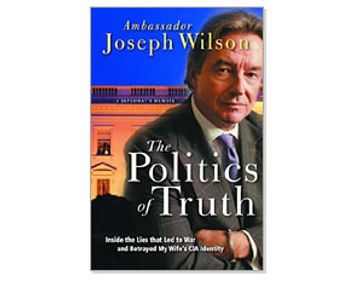
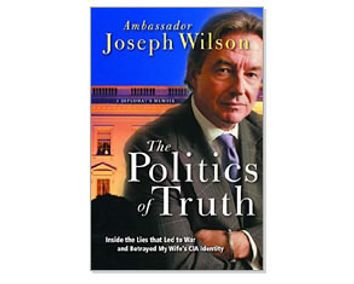
This article, the first of two excerpts from Wilson’s new book, “The Politics of Truth: Inside the Lies That Led to War and Betrayed My Wife’s CIA Identity,” begins as Wilson confronts the media and political firestorm that erupted after Novak’s column appeared.

- – - – - – - – - – - -
By Joseph Wilson

May 3, 2004  |  After making the Sunday rites of passage on the big television news shows, I began cutting back such appearances. I had answered all the questions that were being asked and had nothing else to offer on the subject. It did not matter, as the Right renewed its attack: I was a publicity seeker. The president lied and the White House had attacked my wife, but I was a publicity seeker. Of course, if it was publicity I was after, my campaign was a flop. Prior to Novak’s article, I was still known as the last American diplomat to have met with Saddam Hussein. Now I had become Mr. Valerie Plame. “Welcome to the Dennis Thatcher club,” a husband of a well-known woman said to me, a reference to British Prime Minister Margaret Thatcher’s spouse.

The press coverage was very positive toward Valerie and me. So was the outpouring of support from across the political spectrum, from Pat Buchanan on the right to Jesse Jackson on the left. Serious people understood what had happened. It was only a small cadre of right-wing zealots and the White House itself that continued trying to spin the story and make of it something it was not. I was particularly offended when President Bush, asked about the leak on October 7, claimed, “I want to know the truth.” However, eager to place the responsibility upon journalists rather than shoulder it himself, he added, “You tell me: How many sources have you had that’s leaked information, that you’ve exposed or had been exposed?” He added, “Probably none,” making it clear that his question had been only a rhetorical one. Bush capped off his comments that day with a statement that infuriated me, and many people whom I later heard from: “This is a large administration and there’s a lot of senior officials … I have no idea whether we’ll find out who the leaker is, partially because, in all due respect to your profession, you do a very good job of protecting the leakers.” His lack of genuine concern stunned and disappointed me.

More than four years earlier, on April 26, 1999, the president’s father, not only a former president but also former Director of CIA, spoke at the ceremonial rededication of CIA headquarters in Langley, Virginia, which would be known henceforth as the George Bush Center for Intelligence. Referring to those who would expose clandestine officers, he said, “I have nothing but contempt and anger for those who betray the trust by exposing the name of our sources. They are, in my view, the most insidious of traitors.” For his son to pretend he was a mere onlooker in his own administration was dishonorable.

As of this writing, in February 2004, two years have passed since I traveled to Niger. Who could have imagined that journey would lead through such a maze of intrigue, so much deceit on the part of a presidential administration, and such enormous harm to my wife? It has been an existential rollercoaster ride, and the wheels have not yet come to rest. Even so, there are lessons the experience has taught me, and some lessons that I believe the country can learn, from this tragic war of choice that should never have been undertaken, and from the unprecedented disclosure that my wife was an undercover CIA officer.

When in May 2002 I entered the debate on how the United States should confront Iraq, I did so with a mounting sense of unease about the direction in which America was being led by the Bush administration. I began to speak out because I believed that our armed forces would be exposed to unnecessary risk if the administration insisted on marching in to war with the phony coalition then being assembled. I also feared that our credibility and international reputation would suffer greatly and that our position as the global superpower would be undermined, threatening much of the good our foreign policy had achieved since World War II.

Moreover, the suspect rationales being articulated by the administration — weapons of mass destruction, ties to international terrorism with a global reach, and the possibility that Saddam might provide al Qaeda with WMD — just didn’t, in my estimation, add up to a legitimate imminent threat or even a grave and gathering danger.

For thirteen months, I never mentioned my trip to Niger in public appearances, in the newspaper commentaries I published, or even in private conversations, until the State Department spokesman claimed that the United States had been fooled by the forged documents. The findings from the Niger mission had not altered the fact that disarmament was a legitimate goal for the international community to pursue, even if force was required to achieve it. It was only when it became clear to me that the claim in the president’s State of the Union address referred to Niger, and therefore was untrue, that I had no choice but to insist that my government correct the record.

It was not an act of courage, as some have generously suggested; nor was it a partisan act, as critics have howled. It was a civic duty, pure and simple. If there ever are occasions when our government is justified in lying to its citizens, this was not one of them. Our democracy required that the administration be called to account.

I resisted going public for several months, however, in the futile hope that after it became apparent there was no truth to the Niger uranium claim, and once serious questions were raised in the media, somebody in the administration would come forward and take responsibility for the falsehood. I had no interest in attaching my name and face publicly to any such revelation; I had seen the harm done to bearers of bad tidings in Washington. Even after Condoleezza Rice falsely asserted on “Meet the Press” that “maybe someone knew down in the bowels of the Agency” that the evidence cited in the State of the Union address was suspect, I still hesitated to set the record straight publicly, although I was becoming more determined that the lies be corrected somehow.

A few days after Rice’s interview, the House and Senate Intelligence Committees announced that they were going to look into the prewar intelligence, including the uranium claim. I called the staffs of both committees and volunteered to brief them about my trip and findings. I ended up briefing them separately within a few days of each other in mid-June, disclosing what I knew to the appropriate oversight bodies.

A week after those briefings, I learned from a journalist that my name was soon to be made public. I finally decided to write the story myself, and called back David Shipley at the New York Times to accept his offer of space on their op-ed page.

I knew that my credibility would be challenged the moment I went public, and I made preparations to defend it. I was not going to let the rabid ankle-biters of the right deny me a voice in the debate or impugn my integrity. I had earned the right to be heard, the same right enjoyed by other responsible citizens. I spoke out confident in the belief that our democracy remains strong precisely because we have a long and proud tradition of citizens challenging our government when it lies to the people.

However, for all the insults I knew I would suffer, I never expected the White House itself to do anything like what it did: come after my wife.

The disclosure of her identity was unprecedented, and the Grand Jury will decide if it was a criminal act. Whether convictions are obtained or not, it was unquestionably beneath the standards of conduct that we have every right to demand from our public servants. But in their attacks on us, the administration was firing at the wrong targets. I had not put the sixteen words in the president’s mouth; somebody on his staff had, and that is where he should have been taking aim; Valerie had not done anything wrong. And when somebody leaked the fact she was undercover, thereby putting a national security asset out of commission at a time of war, the president should have demanded swift action to remove the offender from his post. Yet, as in the case of the sixteen words, the president once again demonstrated more loyalty to his staff than they had shown to him. To this day, no one at the White House has apologized for the unwarranted attacks on Valerie and me. And to this day, the person who leaked her name evidently remains in a position where he enjoys the trust of President Bush.

An example of the administration’s shifting rationales for the war is evident in the varying importance officials placed on the allegation that Iraq had purchased uranium, or tried to. In sharp contrast to the president’s dire warnings in his September 2002 speech to the U.N., in which he stated, “Should Iraq acquire fissile material, it would be able to build a nuclear weapon within a year,” and the subsequent charge that Iraq was actively seeking to purchase uranium from Africa, Condoleezza Rice tried to downplay the importance of the Niger allegation after it came out that it was false. “It is ludicrous to suggest that the president of the United States went to war on the question of whether Saddam Hussein sought uranium from Africa,” Dr. Rice said on FOX News Sunday on July 13, 2003. “This was part of a very broad case that the president laid out in the State of the Union and other places.” But the Niger fabrication was the only allegation of an Iraqi attempt to secure uranium that the administration ever put forward to substantiate the president’s charge.

As it turned out, Rice was actually right — if not for the reason she meant — that the Niger allegation was unimportant, because this war was never really about WMD. Paul Wolfowitz, in an interview with Vanity Fair, acknowledged as much when he said, “The truth is that for reasons that have a lot to do with the U.S. government bureaucracy we settled on the one issue that everyone could agree on which was weapons of mass destruction as the core reason.” (The Pentagon released its own transcript of the interview after they were unhappy with news coverage of the revelations in the published article, but the two versions do not differ on this point.)

This enterprise in Iraq was always about a larger neoconservative agenda of projecting force as the means of imposing solutions. It was about shaking up the Middle East in the hope that democracy might emerge — what I had heard Charles Krauthammer call “the coming ashore in Arabia.” Whatever one may conclude about the desirability of using our military to bring democracy to the Arab world, the fact is that we went to war without first testing the thesis in serious national debate.

Democratization is a noble goal. I was involved in democratization efforts for most of my diplomatic career. It is a long and hard road that requires institution-building and a significant investment on the part of the local population in a new and different system of governance that is often at odds with tradition. The best description I have heard for the process is that it is like a fine English lawn: you must seed it, you must water it, and if you want it to look really good, you must roll it — for six hundred years. It is not a task that comes naturally to our military, however excellent that institution is.

In perhaps the most eloquent and scathing critique of the consequence of the administration’s having lied about why it believed it needed to go to war, Zbigniew Brzezinski observed in an October 2003 speech that during the Cuban missile crisis, Secretary of State Dean Acheson offered to show French President Charles de Gaulle satellite photos of Soviet nuclear missile installations in Cuba to support President Kennedy’s request for support in the event we had to go to war. De Gaulle replied that he did not need to see the photographs, as President Kennedy had given his word and his word was good. Who would now ever take an American president at his word, in the way that de Gaulle once did?

So we find ourselves in a disastrous quagmire in a distant land, with our troops suffering fatal wounds and disabling injuries every week, even as we employ ever greater force to subdue an increasingly disgruntled people. And just when we think the numbers of casualties may finally be starting to subside, with our uniformed commanders assuring us that the corner has been turned, that the number of insurgent attacks is at last decreasing, the very lethality of the attacks may in actuality be increasing.

The neoconservatives who have taken us down this path are actually very few in number. It is a small pack of zealots whose dedication has spanned decades, and that through years of selective recruitment has become a government cult with cells in most of the national security system. Among those cells are the secretive Office of Special Plans in the Department of Defense (reportedly now disbanded) and a similar operation in the State Department that is managed in the office of Under Secretary for Disarmament John Bolton.

Pat Lang — with whom I had frequently exchanged views on Iraq policy — served his country first as an army officer, rising to the rank of colonel, then as an intelligence officer in the Defense Intelligence Agency in charge of the Middle East before retiring. He once told me about when he was recruited for possible membership in the group.

He described to me a visit, during the administration of the first George Bush, from an elderly couple who dropped in on him unannounced one afternoon at his Pentagon office. They had come, they said, at the suggestion of Paul Wolfowitz, then the Under Secretary of Defense for Policy, who had told them that Colonel Lang was a bright fellow. They introduced themselves as Albert and Roberta Wohlstetter, professors from the University of Chicago, and they made themselves at home for a brief chat.

Albert Wohlstetter, one of the most influential strategists of nuclear weapons policy in the second half of the twentieth century until his death in 1997, was a mentor to Wolfowitz and Richard Perle. In the 1970s he had been an architect of the first effort to bring outside analysts into traditional institutions like the CIA to “reassess” the Soviet threat. This “Team B” effort resulted in the Reagan administration’s use of wildly exaggerated claims about Soviet rearmament to justify huge American defense spending increases. By the end of the decade, Wohlstetter had expanded his definition of America’s strategic role to include the Middle East. He advocated that the U.S. extend its security umbrella to the Persian Gulf on the grounds that even if no Soviet hand could be seen behind the Islamic revolution in Iran of 1979, the situation there still represented a threat to American interests in the Middle East and Pakistan.

During the Wohlstetters’ conversation with Lang, they began to probe the colonel for his views and beliefs. Mrs. Wohlstetter, partner to her husband in academia and in political philosophy as well as in life, pointed out sections in books they had written and asked Lang for his views on the theories espoused in them.

It became apparent to Lang that he was being auditioned — though, as it happened, not to the satisfaction of the Wohlstetters. They soon packed up their books and left.

Lang said that in later conversations with a number of uniformed officers, he learned that many of them had been auditioned as well and, like him, had been found wanting. However, one who did pass the test was former Navy Captain William J. Luti. In the Bush administration he holds the post of Deputy Under Secretary of Defense for Near Eastern and South Asian Affairs. Luti also supervised the Office of Special Plans, described in a seminal 2003 New Yorker article by Seymour Hersh as “a separate intelligence unit … in the Pentagon’s policy office.”

It was through these special offices that so many of the rumors, gossip, and unsubstantiated intelligence about Iraq were passed directly to senior White House officials, notably Vice President Cheney, and were accepted without first being subjected to the rigorous analysis of the $30-billion-a-year intelligence community. American intelligence, which routinely sees and sifts thousands of bits of information daily, has had years of experience developing an analytical capability that can assess precisely whether the information we are receiving is fact or fiction. Short-circuiting this process — or, in the vivid term Hersh adopted for the title of his disturbing article, “stovepiping” information directly into policy-makers’ hands — is dangerous. Addressing his investigation directly to Luti’s enterprise, Hersh added: “This office, which circumvented the usual procedures of vetting and transparency, stovepiped many of its findings to the highest-ranking officials” in the administration.

President Bush could fundamentally change the direction of his administration by firing fewer than fifteen senior officials, beginning with those signatories of the Project for the New American Century and those currently holding government posts who signed a 1998 letter that urged President Clinton to wage war on Iraq. They are clustered at the National Security Council (NSC), in the Defense and State Departments, and within Vice President Cheney’s own parallel national security office. That particular little-known organization — not accountable to Congress and virtually unknown to the American people — should be completely dismantled. Never in the history of our democracy has there been established such an influential and pervasive center of power with the ability to circumvent longstanding and accepted reporting structures and to skew decisionmaking practices. It has been described to me chillingly by a former senior government official as a coup d’etat within the State. That’s all it would take — firing fewer than fifteen officials, and the scuttling of Cheney’s questionable office — to alter this administration’s radical course.

But President Bush would have to want to make these changes. The fact that he has utterly failed to do so suggests that one popular notion about this president — that he has delegated foreign policy to his “prime minister,” Dick Cheney, and that the president is somehow manipulated by him — is doubtful. Even as the criticism mounts and the failure of the war policy becomes ever more evident with every attack on American interests in Iraq, the president refuses to make changes in his lineup. In fact, as one former intelligence officer suggested to me, President Bush may himself be a neoconservative “recruit,” and now an active leader of the radical movement rather than a passive follower unable to block it.

The president is not powerless and does not need to demonstrate, as Senator Richard Lugar pleaded on Meet the Press in October 2003: “The president has to be president. That means the president over the vice president and over these secretaries [of State and Defense].” On the contrary, he is the president and he is directing his vice president and his cabinet secretaries to do his bidding. He is responsible for what has been wrought in his name.

In recent months I have tried to piece together the truth about the attacks on myself and the disclosure of Valerie’s employment by carefully studying all the coverage and by speaking confidentially with members of the press who have been following the story. A number of them have been candid with me in our private conversations but unwilling to speak publicly with the same candor. When I have asked why the reporting on the story has not been more aggressive, I have received responses that are very disturbing. A reporter told me that one of the six newspeople who had received the leak stated flatly that the pressure he had come under from the administration in the past several months to remain silent made him fear that if he did his job and reported on the leak story, he would “end up in Guantanamo” — a dark metaphor for the career isolation he would suffer at the hands of the administration. Another confided that she had heard from reporters that “with kids in private school and a mortgage on the house,” they were unwilling to cross the administration.

In the halcyon days of an aggressive investigative press corps, journalists saw it as their job “to afflict the comfortable and comfort the afflicted,” as the great Chicago journalist Finley Peter Dunne put it early in the twentieth century. What does it say for the health of our democracy — or our media — when fear of the administration’s reaction preempts the search for truth? Mark Fineman, the late Los Angeles Times foreign correspondent who did a profile on me in Baghdad in 1990, used to call his passion for the truth the search for the “dirtball” stories — the stories that lay in the soft underbelly of the public pronouncements, the stories behind the story. Clearly, many stories lie behind the story of the attacks on my family, but they have prompted very little “dirtball” reporting. I am disappointed by the reluctance of the press to make waves and get to the very bottom of the real story.

From everything I have heard, the truth may be found at the nexus between policy and politics in the White House. Whoever made the decision to disclose Valerie’s undercover status occupies a position where he — and I believe it is a “he” because Robert Novak’s own statements employ the male pronoun exclusively — has access to the most sensitive secrets in our government, and a political agenda to advance or defend. In gumshoe parlance, he’s got the means and he’s got the motive. Only a few administration officials meet both of these criteria, and they are clustered in the upper reaches of the National Security Council, the Office of the Vice President, and the Office of the President.

After my appearance on CNN in early March 2003, when I first asserted that the U.S. government knew more about the Niger uranium matter than it was letting on, I am told by a source close to the House Judiciary Committee that the Office of the Vice President — either the vice president himself or, more likely, his chief of staff, Lewis (“Scooter”) Libby — chaired a meeting at which a decision was made to do a “workup” on me. As I understand it, this meant they were going to take a close look at who I was and what my agenda might be.

The meeting did not include discussion of how the president or his senior staff might address the indisputable, if inconvenient, fact that the allegation I had made was true. In other words, from the very beginning, the strategy of the White House was to confront the issue as a “Wilson” problem rather than as an issue of the lie that was in the State of the Union address. That time frame, from my CNN appearance in early March, after the administration claimed they “fell for” the forged documents, to the first week in July, makes sense, as it allows time for all the necessary sleuthing to have been done on us, including the discovery of Valerie’s name and employment.

The immediate effect of the workup, I am told by a member of the press, citing White House sources, was a long harangue against the two of us within the White House walls. Over a period of several months, Libby evidently seized opportunities to rail openly against me as an “asshole playboy” who went on a boondoggle “arranged by his CIA wife” — and was a Democratic Gore supporter to boot.

So what if I’d contributed to the Gore campaign? I had also contributed to the Bush campaign. So what if I’d sat on a Gore foreign policy committee? I had had no political role whatsoever in the campaign. Moreover, my trip to Niger was taken more than two years after the GoreBush election, and I had not even been involved in any partisan activities during the campaign. And it was not until the spring of 2003, several months after the president’s State of the Union address, that I contributed to the Kerry campaign and began to work with his foreign policy committee.

Would a staunch Republican have disregarded the facts and offered findings from Niger that were different than mine? Intelligence collection is not party-specific. Perhaps a Republican would have allowed the lie to pass without comment, but if so, that is a Republican problem. The national security question is always the same: Did we go to war under false pretenses? I am not prepared to argue that Republicans per se endorse the practice of government officials lying and distorting the facts, but it may be that Vice President Cheney and his chief of staff do.

The man attacking my integrity and reputation — and, I believe, quite possibly the person who exposed my wife’s identity — was the same Scooter Libby who, before he came into the new administration, was one of the principal attorneys for Marc Rich, ex-fugitive. Rich is the commodities trader who was convicted of having traded petroleum with Iran in violation of sanctions imposed on that country by the United States after the seizure of the American Embassy in Tehran and the taking of more than a hundred American hostages by supporters of Ayatollah Khomeini. Libby is a consummate Republican insider who has bounced back and forth between government posts and his international law practice. He first worked on the Rich case in the mid-1980s, after a stint in the State Department. From 1989 to 1993, Libby worked for Paul Wolfowitz in the Pentagon, before returning to the task of trying to obtain a legal settlement for his fugitive client.

In the late nineties, Libby also participated in the preparation of the Project for the New American Century’s seminal document, “Rebuilding American Defenses,” which became the neoconservative blueprint for national security policy, much of which has been implemented in the aftermath of 9/11. This ardent neoconservative is a leading participant in the network of hidden cells that funneled so much disinformation to our political decision makers outside normal channels. He is one of a handful of senior officials in the administration with both the means and the motive to conduct the covert inquiry that allowed some in the White House to learn my wife’s name and status, and then disclose that information to the press.

The other name that has most often been repeated to me in connection with the inquiry and disclosure into my background and Valerie’s is that of Elliott Abrams, who gained infamy in the IranContra scandal during the first Bush administration. Abrams had been convicted in 1991 on two charges of lying to Congress about illegal government support of the Nicaraguan contra rebels. He was pardoned in 1992 by President George H. W. Bush. How unsurprising it would be if Abrams, an admitted perjurer and a charter member of the neoconservative movement, has engaged in unethical or criminal behavior in yet another presidential administration.

According to my sources, between March 2003 and the appearance of my article in July, the workup on me that turned up the information on Valerie was shared with Karl Rove, who then circulated it in administration and neoconservative circles. That would explain the assertion later advanced by Clifford May, the neocon fellow traveler, who wrote that Valerie’s employment was supposedly widely known. Oh, really? I am not reassured by his statement. Indeed, if what May wrote was accurate, it is a damning admission, because it could have been widely known only by virtue of leaks among his own crowd.

After the appearance of Novak’s article, the subsequent “pushing” of the story by the White House communications office — and by Karl Rove — guaranteed that the allegation would at some point take center stage in the press and would sweep the story behind the sixteen words into the wings. Rove’s strategy appears to have been simple — change the subject and focus attention on Valerie and me instead of the White House — but it proved to be seriously flawed. A week after Novak reported the story that the administration pushed to him, David Corn reported that a federal crime might have been committed, and I conveyed that opinion on the Today show. I am absolutely certain that Rove and company would have continued trying to convince the public that Valerie and I were motivated by partisanship and somehow responsible for the president’s error — ridiculous as that seems — had it not been for the fact that they discovered the outing was quite possibly illegal. Apparently, according to two journalist sources of mine, when Rove learned that he might have violated the law, he turned on Cheney and Libby and made it clear that he held them responsible for the problem they had created for the administration. The protracted silence on this topic from the White House masks considerable tension between the Office of the President and the Office of the Vice President.

The rumors swirling around Rove, Libby, and Abrams were so pervasive in Washington that the White House press secretary, Scott McClellan, was obliged to address them in an October 2003 briefing, saying of Rove: “The president knows he wasn’t involved. . . . It’s simply not true.” McClellan refused to be drawn into a similar direct denial of Libby’s or Abrams’s possible involvement, however. Later interpretations of the line being taken by the White House spokesman, according to members of the press who have spoken with me, indicate that the administration’s defense is extremely narrow: the leakers and pushers of the story did not know the undercover status of Valerie Plame, and therefore, though they may have disclosed her name, they did not commit a crime.

Time will tell if that defense — which strikes me as sophistry and a legal refuge for scoundrels — holds up. Indeed, if the administration has no firm knowledge as to who might have leaked Valerie’s name, why would McClellan, and whoever drafted his talking points, address the matter so precisely and try to stay so strictly within the letter of the Intelligence Identities Protection Act? Ignorance of my wife’s undercover status may exculpate the leakers and pushers from violations under that act, but as a congressional letter of January 26 to the General Accounting Office makes clear, other laws may have been broken, including statutes relating to the handling of classified material. Even the Patriot Act may have been violated, if Sam Dash’s interpretation of that law is correct.

In fact, senior advisers close to the president may well have been clever enough to have used others to do the actual leaking, in order to keep their fingerprints off the crime. John Hannah and David Wurmser, mid-level political appointees in the vice president’s office, have both been suggested as sources of the leaks. I don’t know either, though at the time of the leak, Wurmser, a prominent neoconservative, was working as a special assistant to John Bolton at the State Department. Mid-level officials, however, do not leak information without authority from a higher level. They would have been instruments, not the makers, of decisions.

Whether the motivation behind the leak was to discredit me or to discourage intelligence officials from coming forward, or both, is immaterial at this stage. What matters is that, as of this writing, the senior administration officials who took it upon themselves to protect a political agenda by exposing a national security asset are still in place. They still occupy positions of trust; they continue to hold full national security clearances. The breach of trust between the administration and its clandestine service will not be healed until they are exposed and appropriately punished.

That no real outrage has been expressed by either the president or Republicans in Congress raises the question of whether our secrets are safe in this administration’s hands. By the end of February 2004, efforts to launch congressional inquiries had been voted down in three House committees. Henry Hyde, Republican chairman of the International Relations panel, claimed, “It would be irresponsible for the committee to … jeopardize an ongoing criminal investigation.” On the contrary, according to congressional sources of mine, Republicans, pressured by the White House, have simply refused to exercise oversight responsibility on this national security matter.

It’s a far cry from the days when the House Government Reform committee, chaired by Indiana congressman Dan Burton, held frequent hearings on alleged Clinton administration misdeeds. At a time when all experts on national security agree that we need to strengthen our ability to collect human intelligence, the unwillingness of some to seriously address this act of betrayal is surely damaging that effort.

But as with all cover-ups, such as Watergate and Iran-Contra, the revelation of the whole truth in this matter will likely be a long time coming, and have repercussions none of us can anticipate.

Continue Reading Close