Joshua B. Freeman

21st century chain gangs

The rebirth of prison labor foretells a disturbing future for America's "free market" capitalism

  • more
    • All Share Services

21st century chain gangs (Credit: AP/Matt York)
This piece originally appeared on TomDispatch. It is an adaptation of an “In the Rearview Mirror” column that will be published in a forthcoming issue of the magazine New Labor Forum.

Sweatshop labor is back with a vengeance. It can be found across broad stretches of the American economy and around the world.  Penitentiaries have become a niche market for such work.  The privatization of prisons in recent years has meant the creation of a small army of workers too coerced and right-less to complain.

Prisoners, whose ranks increasingly consist of those for whom the legitimate economy has found no use, now make up a virtual brigade within the reserve army of the unemployed whose ranks have ballooned along with the U.S. incarceration rate.  The Corrections Corporation of America and G4S (formerly Wackenhut), two prison privatizers, sell inmate labor at subminimum wages to Fortune 500 corporations like Chevron, Bank of America, AT&T and IBM.

These companies can, in most states, lease factories in prisons or prisoners to work on the outside.  All told, nearly a million prisoners are now making office furniture, working in call centers, fabricating body armor, taking hotel reservations, working in slaughterhouses or manufacturing textiles, shoes and clothing, while getting paid somewhere between 93 cents and $4.73 per day.

Rarely can you find workers so pliable, easy to control, stripped of political rights and subject to martial discipline at the first sign of recalcitrance — unless, that is, you traveled back to the 19th century when convict labor was commonplace nationwide.  Indeed, a sentence of “confinement at hard labor” was then the essence of the American penal system.  More than that, it was one vital way the United States became a modern industrial capitalist economy — at a moment, eerily like our own, when the mechanisms of capital accumulation were in crisis.

A Yankee Invention

What some historians call “the long Depression” of the 19th century, which lasted from the mid-1870s through the mid-1890s, was marked by frequent panics and slumps, mass bankruptcies, deflation and self-destructive competition among businesses designed to depress costs, especially labor costs.  So, too, we are living through a 21st century age of panics and austerity with similar pressures to shrink the social wage.

Convict labor has been and once again is an appealing way for business to address these dilemmas.  Penal servitude now strikes us as a barbaric throwback to some long-lost moment that preceded the industrial revolution, but in that we’re wrong.  From its first appearance in this country, it has been associated with modern capitalist industry and large-scale agriculture.

And that is only the first of many misconceptions about this peculiar institution.  Infamous for the brutality with which prison laborers were once treated, indelibly linked in popular memory (and popular culture) with images of the black chain gang in the American South, it is usually assumed to be a Southern invention.  So apparently atavistic, it seems to fit naturally with the retrograde nature of Southern life and labor, its economic and cultural underdevelopment, its racial caste system and its desperate attachment to the “lost cause.”

As it happens, penal servitude — the leasing out of prisoners to private enterprise, either within prison walls or in outside workshops, factories and fields — was originally known as a “Yankee invention.”

First used at Auburn prison in New York State in the 1820s, the system spread widely and quickly throughout the North, the Midwest and later the West.  It developed alongside state-run prison workshops that produced goods for the public sector and sometimes the open market.

A few Southern states also used it.  Prisoners there, as elsewhere, however, were mainly white men, since slave masters, with a free hand to deal with the “infractions” of their chattel, had little need for prison.  The Thirteenth Amendment abolishing slavery would, in fact, make an exception for penal servitude precisely because it had become the dominant form of punishment throughout the free states.

Nor were those sentenced to “confinement at hard labor” restricted to digging ditches or other unskilled work; nor were they only men.  Prisoners were employed at an enormous range of tasks from rope- and wagon-making to carpet, hat and clothing manufacturing (where women prisoners were sometimes put to work), as well coal mining, carpentry, barrel-making, shoe production, house-building and even the manufacture of rifles.  The range of petty and larger workshops into which the felons were integrated made up the heart of the new American economy.

Observing a free-labor textile mill and a convict-labor one on a visit to the United States, novelist Charles Dickens couldn’t tell the difference.  State governments used the rental revenue garnered from their prisoners to meet budget needs, while entrepreneurs made outsized profits either by working the prisoners themselves or subleasing them to other businessmen.

Convict Labor in the “New South”

After the Civil War, the convict-lease system metamorphosed.  In the South, it became ubiquitous, one of several grim methods — including the black codes, debt peonage, the crop-lien system, lifetime labor contracts and vigilante terror — used to control and fix in place the newly emancipated slave.  Those “freedmen” were eager to pursue their new liberty either by setting up as small farmers or by exercising the right to move out of the region at will or from job to job as “free wage labor” was supposed to be able to do.

If you assumed, however, that the convict-lease system was solely the brainchild of the apartheid all-white “Redeemer” governments that overthrew the Radical Republican regimes (which first ran the defeated Confederacy during Reconstruction) and used their power to introduce Jim Crow to Dixie, you would be wrong again.  In Georgia, for instance, the Radical Republican state government took the initiative soon after the war ended.  And this was because the convict-lease system was tied to the modernizing sectors of the post-war economy, no matter where in Dixie it was introduced or by whom.

So convicts were leased to coal-mining, iron-forging, steel-making and railroad companies, including Tennessee Coal and Iron (TC&I), a major producer across the South, especially in the booming region around Birmingham, Alabama.  More than a quarter of the coal coming out of Birmingham’s pits was then mined by prisoners.  By the turn of the century, TC&I had been folded into J.P. Morgan’s United States Steel complex, which also relied heavily on prison laborers.

All the main extractive industries of the South were, in fact, wedded to the system.  Turpentine and lumber camps deep in the fetid swamps and forest vastnesses of Georgia, Florida and Louisiana commonly worked their convicts until they dropped dead from overwork or disease.  The region’s plantation monocultures in cotton and sugar made regular use of imprisoned former slaves, including women.  Among the leading families of Atlanta, Birmingham and other “New South” metropolises were businessmen whose fortunes originated in the dank coal pits, malarial marshes, isolated forests and squalid barracks in which their unfree peons worked, lived and died.

Because it tended to grant absolute authority to private commercial interests and because its racial make-up in the post-slavery era was overwhelmingly African-American, the South’s convict-lease system was distinctive.  Its caste nature is not only impossible to forget, but should remind us of the unbalanced racial profile of America’s bloated prison population today.

Moreover, this totalitarian-style control invited appalling brutalities in response to any sign of resistance: whippings, water torture, isolation in “dark cells,” dehydration, starvation, ice-baths, shackling with metal spurs riveted to the feet, and “tricing” (an excruciatingly painful process in which recalcitrant prisoners were strung up by the thumbs with fishing line attached to overhead pulleys).  Even women in a hosiery mill in Tennessee were flogged, hung by the wrists and placed in solitary confinement.

Living quarters for prisoner-workers were usually rat-infested and disease-ridden.  Work lasted at least from sunup to sundown and well past the point of exhaustion.  Death came often enough and bodies were cast off in unmarked graves by the side of the road or by incineration in coke ovens.  Injury rates averaged one per worker per month, including respiratory failure, burnings, disfigurement and the loss of limbs.  Prison mines were called “nurseries of death.”  Among Southern convict laborers, the mortality rate (not even including high levels of suicides) was eight times that among similar workers in the North — and it was extraordinarily high there.

The Southern system also stood out for the intimate collusion among industrial, commercial and agricultural enterprises and every level of Southern law enforcement as well as the judicial system.  Sheriffs, local justices of the peace, state police, judges and state governments conspired to keep the convict-lease business humming.  Indeed, local law officers depended on the leasing system for a substantial part of their income.  (They pocketed the fines and fees associated with the “convictions,” a repayable sum that would be added on to the amount of time at “hard labor” demanded of the prisoner.)

The arrest cycle was synchronized with the business cycle, timed to the rise and fall of the demand for fresh labor.  County and state treasuries similarly counted on such revenues, since the post-war South was so capital-starved that only renting out convicts assured that prisons could be built and maintained.

There was, then, every incentive to concoct charges or send people to jail for the most trivial offenses: vagrancy, gambling, drinking, partying, hopping a freight car, tarrying too long in town.  A “pig law” in Mississippi assured you of five years as a prison laborer if you stole a farm animal worth more than $10. Theft of a fence rail could result in the same.

Penal Servitude in the Gilded Age North

All of this was only different in degree from prevailing practices everywhere else: the sale of prison labor power to private interests, corporal punishment and the absence of all rights including civil liberties, the vote and the right to protest or organize against terrible conditions.

In the North, where 80 percent of all U.S. prison labor was employed after the Civil War and which accounted for over $35 billion in output (in current dollars), the system was reconfigured to meet the needs of modern industry and the pressures of “the long Depression.”  Convict labor was increasingly leased out only to a handful of major manufacturers in each state.  These textile mills, oven makers, mining operations, hat and shoe factories — one in Wisconsin leased that state’s entire population of convicted felons — were then installing the kind of mass production methods becoming standard in much of American industry.  As organized markets for prison labor grew increasingly oligopolistic (like the rest of the economy), the Depression of 1873 and subsequent depressions in the following decades wiped out many smaller businesses that had once gone trawling for convicts.

Today, we talk about a newly “flexible economy,” often a euphemism for the geometric growth of a precariously positioned, insecure workforce.  The convict labor system of the 19th century offered an original specimen of perfect flexibility.

Companies leasing convicts enjoyed authority to dispose of their rented labor power as they saw fit.  Workers were compelled to labor in total silence.  Even hand gestures and eye contact were prohibited for the purpose of creating “silent and insulated working machines.”

Supervision of prison labor was ostensibly shared by employers and the prison authorities.  In fact, many businesses did continue to conduct their operations within prison walls where they supplied the materials, power and machinery, while the state provided guards, workshops, food, clothing and what passed for medical care.  As a matter of practice though, the foremen of the businesses called the shots.  And there were certain states, including Nebraska, Washington and New Mexico, that, like their Southern counterparts, ceded complete control to the lessee.  As one observer put it, “Felons are mere machines held to labor by the dark cell and the scourge.”

Free market industrial capitalism, then and now, invariably draws on the aid of the state.  In that system’s formative phases, the state has regularly used its coercive powers of taxation, expropriation and in this case incarceration to free up natural and human resources lying outside the orbit of capitalism proper.

In both the North and the South, the contracting out of convict labor was one way in which that state-assisted mechanism of capital accumulation arose.  Contracts with the government assured employers that their labor force would be replenished anytime a worker got sick, was disabled, died or simply became too worn out to continue.

The Kansas Wagon Company, for example, signed a five-year contract in 1877 that prevented the state from raising the rental price of labor or renting to other employers.  The company also got an option to renew the lease for 10 more years, while the government was obliged to pay for new machinery, larger workshops, a power supply and even the building of a switching track that connected to the trunk line of the Pacific Railway and so ensured that the product could be moved effectively to market.

Penal institutions all over the country became auxiliary arms of capitalist industry and commerce.  Two-thirds of all prisoners worked for private enterprise.

Today, strikingly enough, government is again providing subsidies and tax incentives as well as facilities, utilities and free space for corporations making use of this same category of abjectly dependent labor.

The New Abolitionism

Dependency and flexibility naturally assumed no resistance, but there was plenty of that all through the 19th century from workers, farmers and even prisoners.  Indeed, a principal objective in using prison labor was to undermine efforts to unionize, but from the standpoint of mobilized working people far more was at stake.

Opposition to convict labor arose from workingmen’s associations, labor-oriented political parties, journeymen unions and other groups which considered the system an insult to the moral codes of egalitarian republicanism nurtured by the American Revolution.  The specter of proletarian dependency haunted the lives of the country’s self-reliant handicraftsmen who watched apprehensively as shops employing wage labor began popping up across the country.  Much of the earliest of this agitation was aimed at the use of prisoners to replace skilled workers (while unskilled prison labor was initially largely ignored).

It was bad enough for craftsmen to see their own livelihoods and standards of living put in jeopardy by “free” wage labor.  Worse still was to watch unfree labor do the same thing.  At the time, employers were turning to that captive prison population to combat attempts by aggrieved workers to organize and defend themselves.  On the eve of the Civil War, for example, an iron-molding contractor in Spuyten Duyvil, north of Manhattan in the Bronx, locked out his unionized workers and then moved his operation to Sing Sing penitentiary, where a laborer cost 40 cents, $2.60 less than the going day rate.  It worked, and Local 11 of the Union of Iron Workers quickly died away.

Worst of all was to imagine this debased form of work as a model for the proletarian future to come.  The workingman’s movement of the Jacksonian era was deeply alarmed by the prospect of “wage slavery,” a condition inimical to their sense of themselves as citizens of a republic of independent producers.  Prison labor was a sub-species of that dreaded “slavery,” a caricature of it perhaps, and intolerable to a movement often as much about emancipation as unionization.

All the way through the Gilded Age of the 1890s, convict labor continued to serve as a magnet for emancipatory desires.  In addition, prisoners’ rebellions became ever more common — in the North particularly, where many prisoners turned out to be Civil War veterans and dispossessed working people who already knew something about fighting for freedom and fighting back.  Major penitentiaries like Sing Sing became sites of repeated strikes and riots; a strike in 1877 even took on the transplanted Spuyten Duyvil iron-molding company.

Above and below the Mason Dixon line, political platforms, protest rallies, petition campaigns, legislative investigations, union strikes and boycotts by farm organizations like the Farmers Alliance and Grange cried out for the abolition of the convict-lease system, or at least for its rigorous regulation.  Over the century’s last two decades, more than 20 coal-mine strikes broke out because of the use of convict miners.

The Knights of Labor, that era’s most audacious labor movement, was particularly exercised.  During the Coal Creek Wars in eastern Tennessee in the early 1890s, for instance, TC&I tried to use prisoners to break a miners’ strike.  The company’s vice president noted that it was “an effective club to hold over the heads of free laborers.”

Strikers and their allies affiliated with the Knights, the United Mine Workers and the Farmers Alliance launched guerilla attacks on the prisoner stockade, sending the convicts they freed to Knoxville.  When the governor insisted on shipping them back, the workers released them into the surrounding hills and countryside.  Gun battles followed.

The Death of Convict Leasing

In the North, the prison abolition movement went viral, embracing not only workers’ organizations, sympathetic rural insurgents and prisoners, but also widening circles of middle-class reformers.  The newly created American Federation of Labor denounced the system as “contract slavery.”  It also demanded the banning of any imports from abroad made with convict labor and the exclusion from the open market of goods produced domestically by prisoners, whether in state-run or private workshops.  In Chicago, the construction unions refused to work with materials made by prisoners.

By the latter part of the century, in state after state penal servitude was on its way to extinction.  New York, where the “industry” was born and was largest, killed it by the late 1880s.  The tariff of 1890 prohibited the sale of convict-made wares from abroad.  Private leasing continued in the North, but under increasingly restrictive conditions, including Federal legislation passed during the New Deal.  By World War II, it was virtually extinct (although government-run prison workshops continued as they always had).

At least officially, even in the South it was at an end by the turn of the century in Tennessee, Louisiana, Georgia and Mississippi.  Higher political calculations were at work in these states.  Established elites were eager to break the inter-racial alliances that had formed over abolishing convict leasing by abolishing the hated system itself.  Often enough, however, it ended in name only.

What replaced it was the state-run chain gang (although some Southern states like Alabama and Florida continued private leasing well into the 1920s). Inmates were set to work building roads and other infrastructure projects vital to the flourishing of a mature market economy and so to the continuing process of capital accumulation.  In the North, the system of “hard labor” was replaced by a system of “hard time,” that numbing, brutalizing idleness where masses of people extruded from the mainstream economy are pooled into mass penal colonies.  The historic link between labor, punishment and economic development was severed, and remained so… until now.

Convict Leasing Rises Again

“Now,” means our second Gilded Age and its aftermath.  In these years, the system of leasing out convicts to private enterprise was reborn.  This was a perverse triumph for the law of supply and demand in an era infatuated with the charms of the free market.  On the supply side, the U.S. holds captive 25 percent of all the prisoners on the planet: 2.3 million people.  It has the highest incarceration rate in the world as well, a figure that began skyrocketing in 1980 as Ronald Reagan became president.  As for the demand for labor, since the 1970s American industrial corporations have found it increasingly unprofitable to invest in domestic production.  Instead, they have sought out the hundreds of millions of people abroad who are willing to, or can be pressed into, working for far less than American workers.

As a consequence, those back home — disproportionately African-American workers — who found themselves living in economic exile, scrabbling to get by,  began showing up in similarly disproportionate numbers in the country’s rapidly expanding prison archipelago. It didn’t take long for corporate America to come to view this as another potential foreign country, full of cheap and subservient labor — and better yet, close by.

What began in the 1970s as an end run around the laws prohibiting convict leasing by private interests has now become an industrial sector in its own right, employing more people than any Fortune 500 corporation and operating in 37 states.  And here’s the ultimate irony: Our ancestors found convict labor obnoxious in part because it seemed to prefigure a new and more universal form of enslavement.  Could its rebirth foreshadow a future ever more unnervingly like those past nightmares?

Today, we are being reassured by the president, the mainstream media and economic experts that the Great Recession is over, that we are in “recovery” even though most of the recovering patients haven’t actually noticed significant improvement in their condition.  For those announcing its arrival, “recovery” means that the mega-banks are no longer on the brink of bankruptcy, the stock market has made up lost ground, corporate profits are improving, and notoriously unreliable employment numbers have improved by several tenths of a percent.

What accounts for that peculiarly narrow view of recovery, however, is that the general costs of doing business are falling off a cliff as the economy eats itself alive.  The recovery being celebrated owes thanks to local, state and federal austerity budgets, the starving of the social welfare system and public services, rampant anti-union campaigns in the public and private sector, the spread of sweatshop labor, the coercion of desperate unemployed or underemployed workers to accept lower wages, part-time work and temporary work, as well as the relinquishing of healthcare benefits and a financially secure retirement — in short, to surrender the hope that is supposed to come with the American franchise.

Such a recovery, resting on the stripping away of the hard won material and cultural achievements of the past century, suggests a new world in which the prison-labor archipelago could indeed become a vast gulag of the downwardly mobile.

To stay on top of important articles like these, sign up to receive the latest updates from TomDispatch.com here.

The strange history of Tea Party populism

The resentment fueling today's Tea Party movement is as old as America

  • more
    • All Share Services

The strange history of Tea Party populism

This article originally appeared at TomDispatch:

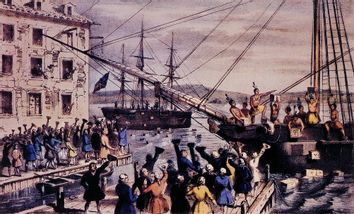
On a winter’s day in Boston in 1773, a rally of thousands at Faneuil Hall to protest a new British colonial tax levied on tea turned into an iconic moment in the pre-history of the American Revolution. Some of the demonstrators — Sons of Liberty, they called themselves — left the hall and boarded the Dartmouth, a ship carrying tea, and dumped it overboard.

One of the oddest features of the Boston Tea Party, from which our current crop of Tea Party populists draw their inspiration, is that a number of those long-ago guerilla activists dressed up as Mohawk Indians, venting their anger by emitting Indian war cries, and carrying tomahawks to slice open the bags of tea. This masquerade captured a fundamental ambivalence that has characterized populist risings ever since. After all, if in late eighteenth century America, the Indian already functioned as a symbol of an oppressed people and so proved suitable for use by others who felt themselves put upon, it was also the case that the ancestors of those Boston patriots had managed to exterminate a goodly portion of the region’s Native American population in pursuit of their own self-aggrandizement.

Today’s Tea Party movement, like so many of its “populist” predecessors, is a house of contradiction, a bewildering network of crosscutting political emotions, ideas, and institutions. What connects it powerfully to a populist past stretching all the way back to Boston Harbor is, however, a sense of violation: “Don’t Tread on Me.”

Despite a recurring resistance to the impositions of powerful outside forces — anti-elitism has been axiomatic for all such insurgencies — populist movements have differed greatly on just what those forces were and what needed to be done to free people from their yoke. It’s worth noting, for instance, that an earlier invocation of the Boston Tea Party took place at a 1973 rally on a replica of the Dartmouth — a rally called to promote the impeachment of President Richard Nixon.

From the Know-Nothings to the People’s Party

Over the course of American history, the populist instinct, now resurgent in the Tea Party movement, has oscillated between a desire to transform, and so create a new order of things, and a desire to restore a yearned-for (or imagined) old order.

Before the Civil War, one such movement that caught both these urges was colloquially dubbed the “Know-Nothings” (not for any anti-intellectualism, but because its members deliberately conducted much of their business in secret — hence, if questioned, were instructed to say, “I know nothing”). Know-nothing-ism exuded the desire to move forward and backward at the same time. During the 1840s and 1850s, it swept across much of the country, North and South. There were “know-nothing” candies, “know-nothing” toothpicks, and “know-nothing” stagecoaches.

Soon enough, the movement evolved into a national political party, the American Party, that appealed to small farmers, small businessmen, and working people. Its attraction was two-fold. The party vociferously opposed Irish and German Catholic immigration to the U.S. (as well as that of Chinese and Chilean immigrants working in the gold fields of California). Yet, in the North, it also denounced slavery. As planks in a political program, nativism and anti-slavery might seem like an odd couple, but in the minds of the party’s followers they were joined at the hip. As Know-Nothings saw it, the Papacy and the South’s slave-owning planter elite were both conspiring to undermine a democratic society of masterless men.

Keep in mind that conspiratorial thinking has long been deeply embedded in American populist movements (as in the Tea Party today). In nineteenth century protestant America, alleged plots by Vatican hierarchs were a recurrent feature of political life. In the North, a wave of crime and the rise of “poor relief” and other forms of dependency — including wage labor, which accompanied the arrival of a flood of impoverished Catholic immigrants — seemed to threaten an American promise of a society of free, equal, and self-reliant individuals (supposedly so noxious to the priestly elite of the Catholic Church). In the slave South, where the master class was believed to be hard at work subverting the Constitution, conspiratorial machinations were self-evidently afoot. By the mid-1850s, most “Know-Nothings” in the North had found their way into the newborn Republican Party which combined hostility to slavery with a milder form of anti-Catholicism.

Populism with a capital “P,” the great economic and political insurgency of the last third of the nineteenth century that blanketed rural America from the cotton South to the grain-growing Great Plains and the Rocky Mountain West, would bear its own distinctive ambivalence. The People’s Party indicted corporate and finance capitalism for destroying the livelihoods and lives of independent farmers and handicraftsmen. It also attacked big business for subverting the foundations of democracy by capturing all three branches of government and transforming them into coercive instruments of rule by a new plutocracy. Populists sometimes attributed what they termed an American “counterrevolution” to the conspiratorial plots of the “great Devil Fish of Wall Street,” suspected of colluding with Great Britain’s elite to undo the American Revolution.

The remedies proposed, however, were hardly those of Luddites. These instead anticipated many of the fundamental reforms of the next century, including government subsidies for farmers, the graduated income tax, direct election of the Senate, the eight-hour day, and even the public ownership of railroads and public utilities. A tragic movement of the dispossessed, the Populists yearned to restore a society of independent producers, a world without a proletariat and without corporate trusts. Yet they also envisioned something new and transformative, a “cooperative commonwealth” that would escape the barbaric competitiveness and exploitation of free market capitalism.

The Great Plains of Resentment

For the next four decades, populism remained emphatically against corporate capitalism and held on tightly to its resentment of powerful outsiders as well as a penchant for conspiracy mongering. During the 1930s, however, the location of Conspiracy Central began to shift from Wall Street and the City of London to Moscow — and even New Deal Washington. Anti-communism added a new ingredient to an already roiling American politics of fear and paranoia, a toxic element which still inflames the Tea Party imagination two decades after the Berlin Wall was torn down.

During the 1936 presidential campaign, in the midst of the Great Depression, three populist movements — Louisiana Senator Huey Long’s “Share Our Wealth” clubs, the Union for Social Justice formed by the charismatic “radio priest” Father Charles E. Coughlin, and Francis Townsend’s campaign for government pensions for the elderly — coalesced, albeit briefly and uneasily, to form the Union Party. It ran from the left against President Franklin Roosevelt, nominating as its presidential candidate North Dakota Congressman William Lemke, a one-time spokesman for radical farmers. (The vice-presidential candidate was a labor lawyer from Boston.)

The Union Party expressed a broad dissatisfaction with the failure of Roosevelt’s New Deal to relieve economic distress and injustice. Senator Long, the latest in a long line of Southern populist demagogues, had been decrying the power of land barons, “moneycrats,” and big oil since his days as Louisiana’s governor. His “Share Our Wealth” plan called for pensions and public education for all, as well as confiscatory taxes on incomes over $1 million, a minimum wage, and public works projects to give jobs to the unemployed. Townsend’s scheme was designed to solve unemployment and the penury of old age by offering monthly government pensions of $200, financed by taxes on business, to everyone over the age of 60. Coughlin, an early supporter of Roosevelt, trained his fire on finance capitalism, inveighing against its usurious, unchristian “parasitism.”

But Long and especially Coughlin were at pains to distinguish their form of radicalism from the collectivism and atheism of the Red menace. Father Coughlin expressed support for labor unions and a just wage. He was, however, an inveterate foe of the left-leaning United Automobile Workers union, and roundly condemned the sit-down strikes which spread like a prairie fire following Roosevelt’s triumphal landslide victory in the 1936 presidential election, as workers across the country occupied everything from auto plants to department stores demanding union recognition.

Indeed, in his radio addresses and his newspaper, Social Justice, the priest ranted about an incongruous conspiracy of Bolsheviks and bankers whose aim was to betray America. He would eventually add a tincture of anti-Semitism to his warnings about a Wall Street cabal. His growing sympathy for Nazism was not so shocking. Fascism, after all, had its roots in a European version of populism that conveyed a post-World War I disgust with the selfishness and incompetence of cosmopolitan ruling elites, a virulent racial nationalism, and a hatred of bankers and especially Bolsheviks.

Followers of Long and Coughlin loathed big business and big government, even though big government — back then anyway — was taking on big business. For them, “Don’t Tread on Me” meant a defense of local economies, traditional moral codes, and established ways of life that seemed increasingly endangered by national corporations as well as the state bureaucracies that began to proliferate under the New Deal. Union Party campaign oratory was filled with references to the “forgotten man,” an image first invoked by Roosevelt on behalf of the working poor.

In the years ahead, kindred images would resurface during a time of turmoil in the late 1960s in Nixon’s appeals to the “silent majority” of “Middle America,” and more recently in the Tea Party’s wounded sense of exclusion. “Forgotten man” populism conveyed the irate politics of resentment of precariously positioned Americans against the organized power blocs of modern industrial society: Big Business, Big Labor, and Big Government.

Race, Resentment, and the Rise of Conservative Populism

Over the last half century populism has drifted steadily rightward, becoming ever more restorationist and ever less transformative, ever more anti-collectivist and ever less anti-capitalist. What were subordinate themes in the older style populism — religious orthodoxy, national chauvinism, phobic racism, and the politics of fear and paranoia — have come to the fore in our time. At least in broad terms, both the Barry Goldwater and the George Wallace insurgencies of the 1960s displayed this trajectory.

Goldwater, the Arizona senator and 1964 Republican candidate for president, an “insurgent”? Yes, if you keep in mind his condemnation of the too-liberal elite running the Republican Party, who, in his eyes, represented a clubby world of Ivy League bankers, corrupt politicians, media lords, and “one-worlders.” Or consider the way he flirted with the freakish John Birch Society (which called President Dwight Eisenhower a “dedicated, conscious agent of the Communist Party” and warned of a Red plot to weaken the minds of Americans by fluoridating the water supply). Or the Senator’s alarming readiness to threaten to push the nuclear button in defense of “freedom,” which could be thought of as the Cold War version of “Don’t Tread on Me.”

Above all, Goldwater was the avatar of today’s politics of limited government. In his opposition to civil rights legislation, he might be called the original “tenther” — that is, a serial quoter of the Tenth Amendment to the Constitution, which reserves for the states all powers not expressly granted to the Federal government, with which he justified hamstringing all efforts by Washington to rectify social or economic injustice. For Goldwater the outlawing of Jim Crow was an infringement of constitutionally protected states’ rights. Moreover, he was an inveterate enemy of all forms of collectivism, including of course unions and the welfare state.

As the Goldwater opposition sank its grassroots into the lush soil of the Sunbelt, its desire to restore an older order of things was palpable. At a time when New Deal liberalism was the reigning orthodoxy, the senator’s reactionary impulses seemed startlingly adrift from the mainstream, and so strange indeed.

Goldwater’s rebellious constituents were an oddly positioned band of rebels. Unlike the declining middling sorts attracted to the Union Party, they came mainly from a rising Sunbelt stratum, a new middle class significantly nourished by the mushrooming military-industrial complex: technicians and engineers, real-estate developers, middle managers, and mid-level entrepreneurs who resented the intrusion of Big Government while in fact being remarkably dependent on it.

They could be described as reactionary modernists for whom liberalism had become the new communism. How shocking when this Arizona “maverick” — he deserved the label far more than John McCain ever did (if he ever did) — won the Republican nomination in a knock-down brawl with the presidium, led by New York Governor Nelson Rockefeller, that had run the party until then. Might the Tea Party accomplish something similar today?

Think of Alabama Governor George Wallace as the other missing link between the economic populism of yesteryear and the cultural populism of the late twentieth century. He was all at once an anti-elitist, a populist, a racist, a chauvinist, and a tribune of the politics of revenge and resentment. “Segregation now, segregation tomorrow, segregation forever”: a line spoken at his inauguration as governor in 1963 that would be his signature defiance of the civil rights revolution and its alliance with the federal government. In no uncertain terms, it signaled the militant racism of his bed-rock supporters.

His appeal, however, ran far deeper than that. The whole tenor of his politicking involved a down-home defense of blue-collar America. Like Huey Long, he was sensitive to the economic predicament of his lower-class constituents. As governor he favored expanded state spending on education and public health, pay raises for school teachers, and free textbooks. When he ran for president as a third party candidate in 1968, he called for increases in social security and Medicare. As late as 1972, Wallace increased retirement pensions and unemployment compensation in Alabama.

Yet he championed the hard-hat American heartland by hailing its ethos of hard work and what today would be known as “family values” far more than by proposing concrete measures to assure its economic well-being. Wallace railed against the know-it-all arrogance of “pointy-headed” Washington bureaucrats, the indolence of “welfare queens,” and the impiety, moral decadence, and disloyalty of privileged long-haired, pot-smoking, anti-war college students.

Bellicose calls for law and order, states’ rights, and a muscular patriotism fueled the revanchist emotions that made Wallace into more than a regional figure. When he ran in the Democratic primaries in 1964 (with the support of the John Birch Society and the White Citizens Council), he won significant numbers of votes not only in the Deep South, but in states like Indiana, Wisconsin, and Maryland, a sign of the Southernization of American politics at a time when the spread of NASCAR, country music, and the blues were Southernizing its culture as well.

Wallace’s venture into third-party politics (on the predictably named American Independent Party ticket) terrified the Democrats, who feared the loss of part of their blue-collar base. He called Vice President Hubert Humphrey, then running for president against Richard Nixon, as well as Northern liberals generally, a “group of god-damned, mealy-mouthed sissy-britches” — shades of Senator Joe McCarthy and the 1950s — and he promised to take the gloves off, if elected, and bomb North Vietnam back to the Stone Age.

Wallace’s popularity revealed a possibility to Nixon and the Republicans denied them since the end of Reconstruction: that, on the road to an Electoral College victory, they might begin to develop a “southern strategy.” In the meantime, his populist cry that there “was not a dime’s worth of difference between the Democratic and Republican parties” won him 10 million votes, 13.5% of the total and 46 votes in the Electoral College. And remember this: a crowd of 20,000 attended a Wallace rally in 1968 at a sold-out Madison Square Garden in New York City.

Don’t Tread on My Taxes

So what does this episodic and checkered history of American populism have to do with the Tea Party?

As a start, the Tea Party movement reminds us that the moral self-righteousness, sense of dispossession, anti-elitism, revanchist patriotism, racial purity, and “Don’t Tread on Me” militancy that were always at least a part of the populist admixture are alive and well. For all the fantastical paranoia that often accompanies such emotional stances, they speak to real experiences — for some, of economic anxiety, insecurity, and loss; for others, of deeper fears of personal, cultural, political, or even national decline and moral disorientation.

Though such fears and feelings are, in part, legacies of the corporate liberal order — one of the dark sides of “progress” under capitalism — in this new populist moment, anti-capitalism itself barely lingers on. Though outrage at the bank bailout did help propel the Tea Party explosion, anti-big-business sentiment is now a pale shadow of its former self, a muted sub-theme in the movement when compared to the Wallace moment, not to mention those of Huey Long or the Populists.

This is hardly surprising since, at least economically, capitalism has, according to recent surveys of Tea Party membership, served many of them reasonably well. Like Goldwater supporters of the 1960s, those who identify with the Tea Party movement are generally wealthier than the population as a whole, and more likely to be employed. They are also apparently better educated, so their fondness for Sarah Palin’s intellectual debilities may be more a case of resentment of bicoastal cultural snobbery than eye-popping ignorance.

Alongside an exalted rhetoric about threats to liberty lies a sour, narrow-minded defensiveness against any possible threat of income redistribution that might creep into the body politic… and so into their pockets. “Don’t Tread on Me,” once a rebel war cry, has morphed into: “I’ve got mine. Don’t dare tax it.” The state, not the corporation, is now the enemy of choice.

Tea Party populism should also be thought of as a kind of identity politics of the right. Almost entirely white, and disproportionately male and older, Tea Party advocates express a visceral anger at the cultural and, to some extent, political eclipse of an America in which people who looked and thought like them were dominant (an echo, in its own way, of the anguish of the Know-Nothings). A black President, a female Speaker of the House, and a gay head of the House Financial Services Committee are evidently almost too much to bear. Though the anti-immigration and Tea Party movements so far have remained largely distinct (even if with growing ties), they share an emotional grammar: the fear of displacement.

But identity politics aside, Tea Party anger reaches far beyond the ranks of the modest Tea Party movement. It resonates with other Americans who understandably feel that political and economic elites, serving themselves at the expense of everyone else, have failed Americans. The big question is just exactly how (or even if) that private and personal rage gets transformed into moral and political outrage. If the heirs of George Wallace and Barry Goldwater, or the Sarah Palins of today, have their way, the outcome won’t be a tea party.

Steve Fraser is editor-at large of New Labor Forum, co-founder of the American Empire Project, a writer, TomDispatch contributor, and an historian. His latest book is Wall Street: America’s Dream Palace.

Joshua B. Freeman teaches history at the City University of New York. He is currently completing a history of the United States since World War II as part of the Penguin History of the U.S.

This piece is an adaptation of an article that will be published in the Fall 2010 issue of the magazine New Labor Forum.

Continue Reading Close