Over the weekend, Liz Phair put out her first album in nearly five years. Like many artists fed up with the record label system, she self-released “Funstyle” on her website, offering the track “Bollywood” (posted below) as a free sample. When I listened to the song for the first time, my reaction was similar to Hortense Smith’s at Jezebel: WTF? Against a backbeat of schlocky, broad-strokes Indian pop, Phair (kind of) raps the story of how she got roped into writing music for cable TV. The result is every bit as strange and unnerving as it sounds. I immediately wrote the song off as a desperate attempt to regain relevance in a post-M.I.A. pop-music world and resolved to ignore the career death rattle of a musician I once respected. Better just to listen to “Exile in Guyville” and pretend that 21st-century Liz Phair was all a bad dream.
Smith and I were far from the only writers to have that reaction. At Entertainment Weekly, Leah Greenblatt writes that “girl done straight-up lost her mind” and declares that the “Liz Phair we once knew and loved has officially left the building.” In a positively cringe-worthy pun, Yahoo! calls “Bollywood” “phairly terrible” and laments that “Liz has effectively scrapped the last shred of cred she may have had left.” Seattle Weekly feels the need to remind us that “Phair is 43 years old. And a mom. What a cool mom,” as though it’s age and motherhood that make the song so awkward. And the gloves-off critiques just keep coming. Does no one have something nice to say about “Funstyle”?
Thankfully, Ann Powers actually bothered to listen to the entire album and stepped in with a smart defense. Citing Laurie Anderson and Dr. Demento as points of reference, she argues that there’s more to “Funstyle” than “Bollywood.” The record turns out to be a fairly even split between “joke songs” full of “broad, homemade humor [that] attains a kind of warmth that counteracts the bitterness beneath it” and more heartfelt fare that Powers is sure will “satisfy any fan who puts down her preconceptions and takes the time to find them.” The bottom line: “Funstyle” isn’t a mistake, it’s a reboot. And, at the very least, it’s not boring like Phair’s last two albums, made with fancy songwriters and producers on major-label budgets.
Convinced to at least give it a try, I listened to “Funstyle” and found myself largely agreeing with Powers. It isn’t “Exile,” but it is funny and entertaining — and it boasts many more explicitly feminist moments than anything Phair’s done since 1998′s whitechocolatespaceegg. “And He Slayed Her,” a track that splits the difference between serious and jokey, looks fondly back on “Buffy the Vampire Slayer” in this age of abstinence-only vampire fiction. “U Hate It” sends up self-satisfied record execs, embodied by two dudes who trash “the new Liz track” (“I hated it!”) as Phair defends her work in colorful shades of Motown and dance-pop. Of course, they quickly change their tune when her music proves successful. In a sped-up Chipmunk voice, Phair gives a cheesy award acceptance speech, after which the guys dub her an “artist” and proceed to take all the credit: “The demographic that we chose, I think, had a lot to do with it.”
It’s a funny moment on an album that is packed with cathartic jabs at the entertainment industry: On the opening track, “Smoke,” Phair attempts to get into a club and is rudely denied. ”Which list do I have to be on?” she asks. “If you have to ask, you’re not on it,” a deep voice retorts. Later in the song, she helplessly deadpans, “I don’t know John Mayer. I met him …” Although there are somber moments, “Funstyle” is best understood as a novelty album — the kind of just-for-fun trifle that we see too rarely these days. Perhaps the reason it isn’t coming across as such is that novelty music — like comedy in general — has always been a male-dominated realm. When, on the occasion of Dr. Demento’s death, Salon’s Sam Adams counted down the 10 greatest novelty tracks of all time, nary a woman (or lady-fronted band) made the canon.
Rather than seeing “Funstyle” as a quirky experiment or a new beginning or simply a knee-slapper of an Independence Day weekend joke, critics will likely continue to peg it as a 43-year-old mom’s clueless stab at keeping up with Ke$ha and Christina. And it’s true: If you take “Bollywood” out of context, you’ll hear it as a cheap, perhaps pathetic M.I.A. knockoff. If, however, you give the entire album a spin and realize it’s more like a gentle, Weird Al-style M.I.A. parody, you may just end up laughing with Phair instead of at her.
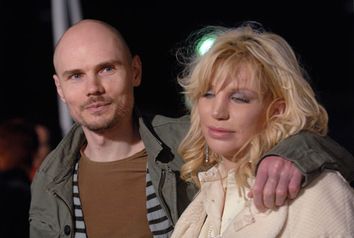
Musicians Billy Corgan and Courtney Love attend the Los Angeles premiere of "Freedom Writers" in January 2007.
Today’s big-name Twitter battle is a celebrity death match straight out of “I Love the ’90s.” In one corner, we have Courtney Love, who has recently made headlines for losing custody of her daughter, (maybe) temporarily changing her name, and putting out a surprisingly fantastic new album. In the other, Smashing Pumpkins main man Billy Corgan, who’s been connected romantically to the likes of Jessica Simpson and Tila Tequila, is in the process of releasing his latest 11-EP magnum opus and has some frighteningly nutty thoughts about the origins of swine flu. Love and Corgan have been friends, lovers and collaborators on and off for about 20 years — and this is far from the first time they’ve fought in public. Considering the history and personalities involved, this Twitter matchup has all the makings of a crazy-fest that could put Scott Baio, John Mayer and Ice-T to shame.
Corgan vs. Love round 859 started Monday, when the Great Pumpkin (whose Twitter contributions usually have more to do with praising God and capitalizing words like “star” and “sky,” Emily Dickinson-style) tweeted a six-point list of his “thoughts” about the Hole singer. Making reference to her recent custody troubles, Corgan wrote, “the world is aware of your lack of responsibility, as seen in the gov’t taking away your parental right … Only u could abandon such a beautiful, incredible child who is smarter than u, cooler than u, and better than u. Oops, did I say too much?” He also suggested that he deserved more credit than he was given for co-writing songs on Hole’s new album, “Nobody’s Daughter,” twisting the knife with a particularly cruel jab: “maybe you should go someone [sic] nice+live off your husband’s money, u know the money he made for writing all those great songs.” In conclusion, Corgan opined (in words that wouldn’t be out of place in a Smashing Pumpkins song), “so have your moment, burn up in the sun that laughs at u as equally as it appears to celebrate u+sleep knowing u have no honor.”
Corgan, it seems, was responding not only to Love’s chat with Howard Stern Monday (in which she may have made some disparaging comments about Corgan’s sexual prowess) but also to a public apology she offered him last month on Facebook. (Sample sentence: “We have again created beauty from the agony between us, all the buried and unburied anguish, all that is true, that is gold, that is meant to be is within this endless and somehow eternal cycle of Billy & Courtney.”) So, shouldn’t Courtney — who, God bless her, has never been known for her Twitter restraint — be responding with some kind of angry/sad/insane meltdown about now?
As it turns out, Ms. Love may really be making a sincere effort to get a handle on the “Courtney monster” Amy Benfer describes in her review of “Nobody’s Daughter.” She isn’t ignoring Corgan’s comments or keeping mum about a supposed affair with former Bush frontman/current Gwen Stefani husband Gavin Rossdale (and I, for one, am glad she hasn’t changed that much), but she is certainly doing some self-policing. On Twitter Tuesday afternoon, Love fired off a few quips wondering why Corgan was so obsessed with her daughter, Frances Bean Cobain, and agreeing that she really is an awesome kid. Then there was the following laugh-out-loud funny tweet: ”@Billy you remind me of Bette Davis in ‘Whatever Happened to Baby Jane.’” Minutes after her initial messages, she started retweeting fans’ suggestions that she ignore Billy or that they take their argument out of the public eye. (Let it never be said that Love doesn’t interact with or appreciate her fans.) Soon after, she reeled herself in and addressed her followers: ”thank you so much for the support and my apologies for even responding a little bit i deleted most of it but the kid? my kid? really? creepy.”
I don’t want to debate Love’s parenting ability or who actually wrote most of “Nobody’s Daughter.” Perhaps Corgan really does have a reasonable complaint (although I have to wonder: If he can write a great album for Hole, why haven’t we seen any compelling Smashing Pumpkins material since the mid-’90s?). But for now, I just want to celebrate Love’s newfound self-control and retain my hope — for her and her fans alike — that it lasts long enough for her to give some career-defining performances and promote the hell out of the hard-won success that is “Nobody’s Daughter.”
Courtney is all out of Love. That’s right: One of the most recognizable women in music is changing her iconic pseudonym. Now, the Hole frontwoman and pop-culture whipping girl only wants us to call her “Courtney Michelle.” In an interview with the NME, she explained her reasons for chucking “Love” and replacing it with her given middle name: ”The name Courtney Love is a way to oppress me,” she said. “We’ve all decided we don’t like her any more … We love her when she goes onstage, but I don’t need her in the rest of my life.”
The name change is certainly a bombshell, and given that Love/Michelle broke the news less than a week before the release of Hole’s new album, “Nobody’s Daughter,” it’s easy to paint it as nothing more than a publicity move. But it also speaks loudly to what has always fascinated me about Love — what has, in fact, made it totally impossible for me to join the swelling ranks of those who would vilify or ridicule her.
For the nearly 20 years that Courtney Love has been in the public eye (and, if her biographers are to be trusted, long before that), she has been obsessed with reinvention. Her lyrics — from “Doll Parts’” immortal “I want to be the girl with the most cake” to “Celebrity Skin’s” thesis statement, “Oh, make me over,” to “How Dirty Girls Get Clean,” a track from “Nobody’s Daughter” that was also the album’s working title — are full of ambitious avowals to start fresh, to finally shed her vices and become perfect. In her (very) public life, she never stops oscillating between debauched, destructive, embarrassingly outspoken rocker/drug addict/widow and cleaned-up, Versace-clad pop star with a fondness for Buddhist chanting. She gains weight and loses it; she can’t decide whether she loves her anger or hates it; she goes on Twitter rampages and then openly chastises herself for losing her cool. But none of her radical changes or prudent reforms ever seem to stick.
And perhaps this is why she and her music have always been most attractive to young women. What are (most) girls’ teen years if not a struggle to reconcile the person we are with the person we want so badly to be? To hate her or poke fun at her is to hate or poke fun at our own young, vulnerable selves.
Like so many of us, no matter how hard she tries to invent and inhabit new and superior identities, she always remains the same, old Courtney Love, with all the weaknesses and excesses that implies. And it’s this tragic inability to tame her own personality that makes her unique: In a music industry full of smooth-operating Madonna clones, constantly transforming into new, compelling but never quite authentic versions of themselves, Courtney Love will always be Courtney Love, no matter what she wants us to call her. And don’t be surprised if she’s back to “Love” before the week is out.
This morning, when music critic and “The Girls Guide to Rocking” author Jessica Hopper tweeted, “Venus’ new publisher sez feminism ‘isn’t relevant’ to the new version of the mag, hires ed from Martha Stewart,” I wanted to believe she was joking. But then I followed her link to a Chicago Reader article that confirmed it: The magazine that began in 1995 as a one-woman, college-dorm-room project with the mission of covering “women in music, art, film, fashion, and DIY culture because not a lot of other publications do” is so over feminism.
Don’t blame Venus’ founder, Amy Schroeder: Although she doesn’t object to this new direction, she’s been out of the picture since September 2008, having stayed on as editor after selling the magazine in 2006. Now, Venus is once again under new ownership, and its new publisher is 47-year-old business consultant and former MCI V.P. Sarah Beardsley. (Full disclosure: I contributed to the last issue before the magazine changed hands — but, in case you’re wondering, don’t anticipate writing for it again.) When asked for her take on feminism, Beardsley tells the Reader’s Michael Miner, “That’s such a word fraught with interpretation and meaning.” (Oh, jeez, anything but meaning!) “We don’t use that particular F word around here. It just doesn’t seem relevant.” According to Beardsley, feminism is “an old-fashioned concept” — this from a woman who, Miner points out, is still 13 years older than Schroeder and well outside Venus’ 18-to-34-year-old demographic.
This is the detail that caught the eyes of the Broadsheet e-mail list: That Beardsley thinks feminism is irrelevant to young women. As Rebecca Traister (who has just finished writing a book about feminism) wrote in an e-mail, “The people who are the most afraid of the word ‘feminism’ are actually older women — and by that I mean women in their thirties and forties and early fifties — who were so forged by backlash bias that they still think of feminism as a scary word. People who have almost no connection to the blogosphere or to the youthful world in which feminism is bandied about like crazy (albeit with different ideology and spirit than it used to be, sure).” As Traister observes, feminism is all over the Internet, on popular blogs like Jezebel, Feministing, Double X and, of course, Broadsheet. It’s on TV and in the movies, where celebrities who identify as feminists include not only the usual suspects (Fey! Poehler! Sedaris!) but also dudes like Andy Samberg and Adrien Grenier and cover girls like Katherine Heigl and Eliza Dushku. It literally has never been easier (or more fun) for teens and 20-somethings to access feminist media.
And yet, it’s not difficult to understand why Beardsley may not see that. It’s true that reading Jezebel (whose tag line “celebrity, sex, fashion for women,” it should be noted, is not an explicit statement of politics) or watching “30 Rock” doesn’t look much like going to a protest march or volunteering at Planned Parenthood. But they all represent potentially meaningful encounters with feminist consciousness and prove that young women are anything but allergic to it.
That’s why it seems foolish for Beardsley to waste so much breath distancing herself from “the F word.” Like Jezebel, Broadsheet and any number of other women-oriented publications, Venus’ feminism was always somewhat implicit. The magazine didn’t hit you over the head with ”girl power!” or “fight the patriarchy” — it profiled women (and even a few men) who were doing interesting things in music and the arts. I don’t imagine that, unless Venus plans to entirely overhaul its content (in which case maybe it should also look into changing its name and demographic and — why not? — start courting Axe body spray ads), its focus will change much.
So, if the magazine isn’t doing a total 180, then it must be the perception of Venus as a feminist publication that Beardsley wants to shake. How will that work out for her? As Kate Harding puts it, the thinking goes something like this: “Well, there’s obviously a pretty big market out there that either self-identifies as feminist or isn’t offended by the implication that they might, so talking about powerful women and stuff is good — but just think how much BIGGER the market could be if we did the same basic stuff without using that off-putting F-word!” Except, as Salon TV critic Heather Havrilesky points out, it would be hard to do that without rendering Venus somewhat meaningless: “The active distancing feels like the product of a larger cultural/economic initiative to make sure to attract EVERYONE to your product, even when that only renders it toothless and devoid of charm or a strong voice. It’s interesting how economic pressures can create this constant search for broad appeal, even in the very corners that are attractive because they represent the antithesis of that.”
With that in mind, it’s hard not to wonder: By repackaging a pro-woman magazine as something much blander and more common (and, in the process, alienating the hell out of its loyal supporters) because she believes that feminism is “old-fashioned,” will Beardsley end up with any audience at all?
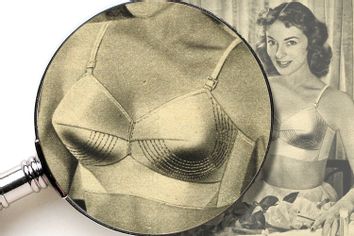
Earlier this week, Women’s Wear Daily gave “breast men” (and women) everywhere something to celebrate: Bra sizes are up! Way up! While the median size just 10 years ago was 36C, the median American rack now fills a porn-ready 36DD!
But don’t throw a party yet: As basically everyone who’s covered the spike so far has pointed out, this is not a good thing. In fact, the consensus is that we’re buying larger bras because — you guessed it — we’re fat. Amy Odell at The Cut is so sure of this that she treats it as a foregone conclusion: “Our boobs are bigger because we are more obese, of course.” Of course! Wendy Atterberry at The Frisky spins the news as a silver lining to the puffy cloud that is our national weight problem: “It’s no secret that Americans are getting fatter each decade (obesity rates have doubled since 1980), but the news isn’t all bad. The upside to our bigger waistlines? Bigger bustlines to go with them!” At least Margaret at Jezebel is onto something when she points out that obesity alone is unlikely to have caused a “sudden 7.7 percent increase in sales last year.”
Huh. Could it be that obesity isn’t the sole — or even the primary — factor here? Considering that in the past decade, cup sizes have ballooned while band sizes have stayed static at 36, it seems likely that this isn’t just about weight gain. Sure, when we put on a few pounds, we’re liable to store some of that fat in our breasts. But doesn’t it stand to reason that bulking up would also make us at least a bit bigger all the way around?
Thankfully, British tabloid the Telegraph actually asked an expert when a similar stat arose across the pond earlier this month in conjunction with a piece on London stores beginning to stock size-K bras. That’s right: It’s not just U.S. fatties who are busting out of their undergarments. The most common U.K. bra size has jumped from — brace yourselves — 34B to 36D in only 10 years. That’s two cup sizes and a band size! British women must be gaining weight even more rapidly than American women!
Except that they’re probably not. As Dr. Joanna Scurr, a biomechanics lecturer at the University of Portsmouth tells the Telegraph, “Breasts are getting bigger but it’s not just because we are getting heavier.” In fact, in a four-year study of 300 women, the university discovered that ladies’ breasts are, on average, increasing independent of weight gain. “We don’t yet know the reason but it has certainly made women much more aware of the need for correct support,” says Dr. Scurr.
So, there you have it. Bustlines are increasing, but not necessarily as a result of fat. But could there be other, non-biological reasons behind the upswing? To their credit, WWD and the other publications who picked up their story did look at one other factor in the bra size increase: The Oprah effect. Odell explains: “Oprah brought full-figured bras into the spotlight when she introduced Bra Fit Interventions to explain the joys of properly fitted bras to women across the nation, and began highlighting Bra Fit Tips for fuller-figured women on her website.”
While I’m sure Oprah has had no smalleffect on women’s bra-buying habits, I don’t think her audience merely suffered from a lack of information. For one thing, it’s much easier to buy a non-standard-size bra online now than it was at the turn of the millennium. Plus, all the media attention may also have had the effect of normalizing something that once felt freakish and shameful: Who knew there were so many other women out there who truly should be wearing a 34F or 32H? It’s much easier to admit to ourselves that our chests cannot be contained within the 32A-36D universe when we realize that our predicament isn’t so rare, after all.
Everyone has a story about a bride who went over the edge. You know, the one who made her bridesmaids starve themselves so as not to ruin the wedding pictures or the lady who wouldn’t stop calling the florist in the wee hours of the morning, mid-panic attack, unable to choose between peonies and lilies. But no matter what horror story you have to bring to the table, here’s one that’ll be hard to beat: The bride who incited an all-out brawl after an exasperated shop owner wouldn’t alter her wedding dress.
The scene took place last week at First Lady Bridal Shop in Lathrup Village, a small city outside Detroit, when a frustrated bride and her posse “entered the store … made demands for alterations and began verbally abusing employees.” When they didn’t get any satisfaction, they called in some male members of the family, who burst into the store and began beating the shop owner, his wife and their son. (Watch security footage of the sad and ridiculous spectacle below.)
Of course, there’s nothing about this incident that isn’t crazy. No matter what the extenuating circumstances, you have to be pretty off your rocker to resort to heavy physical violence over the alteration of a garment. And yet, the only thing that surprises me about this “bridezilla rampage” is that it doesn’t happen more often.
Weddings have always attracted their own particular brand of insanity. But in the past few years, that nuttiness has reached a new level. Think, for a moment, about all the wedding-fantasy movies and TV shows we’ve had to endure recently: There’s “Bride Wars,”“Say Yes to the Dress,”“Four Weddings,”“Sex and the City” … and that’s just off the top of my head. The portmanteau bridezilla has, in the past decade, spawned everything from a TV show to an online hub for ladies who actually embrace and identify with the term. What began as a pejorative may now, in some circles, be a desirable trait — the sign of a bride who knows what she wants for her big day and gets it, no matter what.
So, when the bat-shit bride becomes an ambivalent mainstream spectacle, glorified, derided and, most important, normalized, is what happened at First Lady any wonder? Mix an apparently unstable family with the culturally ingrained need for a flawless wedding and it’s easy to see how a small disagreement escalated to violence. Now, before I leave you, notice that I didn’t say “woman” or “women” but “family”: Let’s not forget that, despite the “bridezilla” headlines, it was the bride’s male relatives who did the shoving, spitting and punching. I guess ladies aren’t the only ones willing to crack skulls in service of the fairy-tale wedding myth.