Judy Mandelbaum

Sex researchers: “Size” does matter

Study shows that fatter men last longer in bed. Should Americans rejoice?

  • more
    • All Share Services

Sex researchers:

Fat is fun! At least, that’s the word from Turkey this week. Researchers at Erciyes University in Kayseri have just completed a yearlong study correlating body mass index (BMI) and male sexual performance. Their findings: Men with excess body fat last longer in bed. In fact, heavier men were able to make love for an average of 7.3 minutes, while slender men could count themselves lucky if they held on for a mere 108 seconds. 

The reason? Female hormones. Men with excess fat showed higher levels of the female estradiol sex hormone. This substance apparently disrupted their bodies’ natural “male” neurotransmitter chemicals and slowed their progression towards orgasm. Ironically, the less masculine their bodies appeared, the better lovers they proved to be.   

The scientists compared the BMI and sexual performance of over 100 men who were being treated for sexual dysfunction with 100 other males who lasted longer during sex. They found that men suffering from premature ejaculation were on the whole thinner and fitter than their “better endowed” brethren.   

Using the researchers’ logic, you might think that American men, living in what the World Health Organization has identified as the world’s third fattest country with an estimated 66.7 percent of the population living well over the line, would be the world’s most exquisite lovers. Unfortunately, the study does not take a stand on this issue. Nor is there any scientific or anecdotal evidence to suggest that it is true. In fact, last year the global research website Onepoll.com conducted a survey of 15,000 women from 20 countries on the subject, and Americans showed up fifth from the bottom for being “too rough.” (Spaniards, Brazilians and Italians took top honors.)  But as Benjamin Disraeli supposedly said, “There are lies, damn lies, and statistics.”   

This is not to deny that, when it comes to overweight lovers, there may also be an issue of “quality vs. quantity” involved, not to mention aesthetic and cardiological issues etc., but why spoil a good story? For now, make sure your next love banquet includes plenty of chips and beer, bratwursts and pecan pies. Nowadays, when it comes to sex, fat is the new thin.

The female victims of Pakistan’s flood

Women face starvation, disease and sexual assault. They're also not supposed to get aid from male relief workers

  • more
    • All Share Services

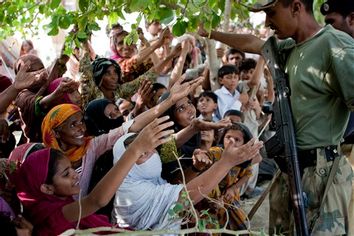
The female victims of Pakistan's floodPakistani flood survivors demand help from a soldier in Jampur near Dera Ghazi Khan in Pakistan on Thursday, Aug. 19, 2010. Islamist terrorists may exploit the chaos and misery caused by the floods in Pakistan to gain new recruits, the country's president said Thursday. Asif Ali Zardari's remarks were echoed by U.S. Sen. John Kerry, who toured some of the worst hit areas and visited a relief camp alongside the president. (AP Photo/B.K.Bangash)(Credit: AP)

Just when you thought the “ground zero mosque” was our most pressing concern, the floodwaters of Pakistan arrived to create “probably the biggest emergency on the planet today,” as UNICEF puts it. It is a disaster that contains the germ of many others: starvation, epidemics, climate change, political instability and future violence. Heavy rainfalls have placed some 20 percent of Pakistani territory underwater, an area greater than Italy, killing more than 2,000 persons and displacing and destroying the livelihoods of around 20 million more. Six million require immediate assistance. As always in disasters of this kind, it is women and the children they care for who tend to suffer the most — both in the immediate disaster and in the long, uncertain aftermath. This suffering manifests itself in ways that raw statistics cannot measure.  

According to the RHRC (Reproductive Health Response in Crises Consortium), 85 percent of persons displaced by the flood are women and children. As the floodwaters rise, they are at acute risk from starvation, exposure, sexual assault and water-borne diseases. However, providing them with assistance is more difficult than these basic facts suggest. In traditional Pakistani society, it is taboo for women to receive aid or medical care from male relief workers, preventing many of them from seeking such aid in the first place. 

This particularly applies to pregnant women surprised by the flood. Pakistan already had a high maternal morality rate before the flood, with 320 women dying per 100,000 live births. This rate has undoubtedly increased due to the disaster. While the Pakistani government and NGOs have sent female aid workers into the affected areas, their numbers are not always sufficient to meet the crushing demand for help. In addition, women are increasingly cut off from a supply of birth control pills and condoms (before the flood, 30 percent of fertile women were using some form of contraception). A wave of unwanted pregnancies, with all the complications that will bring, is certain.

An OCHA report from Aug. 16 states that “the large numbers of children and pregnant and lactating women without access to food and the rising trend of diarrhea point towards a clear risk of malnutrition among the affected population.” But even where food aid is available, fair distribution to those who need it most is almost impossible to ensure. As 12-year-old Shahid Muhammed told IRIN News, “When food is distributed the strongest young men grab it for their own families and push us children aside.”

The dislocation caused by the flood could be particularly upsetting for women in Pakistan’s traditionally conservative rural areas. Shmyalla Jawad, the gender advisor for Plan Pakistan, described what she saw to the BBC:

What emerged for me to be the most worrying thing was how women and young girls are being affected by this. Health and sanitation is a big issue. One camp set up in a government building had no bathing facility. Whereas the men and young children can take baths outside on the school lawn, women don’t have that option. Many people didn’t have a chance to pick up their belongings when the floods hit their village so they have no change of clothes. Many are wearing what they left home in and without being able to wash and women’s hygiene in particular has deteriorated. The situation is even worse for menstruating and pregnant women.

Moreover, Jawad explained:

The camps are also culturally shocking for women and girls. Many have never been around a man who isn’t a member of their family. Now they are amongst hundreds of men who are complete strangers. In some sectors of Pakistan society, apart from the religious notions of covering up and not mingling with males outside one’s family, women are considered to be the custodians of male and family honor. This notion of honor is linked with women’s sexual behavior so their sexuality is considered to be a potential threat to the honor of family. Therefore, the systems of sex segregation known as purdah are used by the society to protect the honor of the family. But in the camps there are no provisions for purdah. Young boys and girls have to sleep in the same room, at times next to each other, most mothers and families do not feel it’s safe for their daughters, especially in the current circumstances.

Now it could be that the disaster and the world’s response will “shock” Muslim women into adopting a more “modern” and “Western” outlook on life (as Naomi Klein might put it). But this is surely an untested and utterly heartless notion. The opposite result is just as likely. In any case, as government and Western aid takes its time in arriving, Islamist groups more in tune with local proprieties have been filling the gap, clearly jockeying for a more visible role in the reconstruction. British-Pakistani journalist Ahmed Rashid believes that the destruction of crops and infrastructure will lead to food riots. He believes that “joblessness and helplessness will lead to more young men joining the militants, who are propagating the idea that the floods are God’s wrath against the government … All of this will dramatically loosen the state’s control over outlying areas, in particular those bordering Afghanistan, which could be captured quickly by local Taliban,” leaving Pakistan as “a failed state with nuclear weapons.”

Where do Pakistani women fit into this view of the future? Let’s look at their past first. While they are better off than many in the Muslim world and have benefited from progressive gender policies over recent decades, they still have at best a 36 percent literacy rate. The International Labor Force Survey of 1991-92 reported that only about 16 percent of women age 10 form part of the official workforce, a figure that may have doubled since then. In rural areas, it is estimated that around 80 percent of women are engaged in farming. Twenty-four percent of the population lives below the poverty level, including the majority of families headed by women.

More rain may be on the way. But when the floodwaters recede, what is next for already unstable, nuclear-armed Pakistan? It is hard to identify any silver lining in the storm clouds darkening the Hindu Kush. Peter Walker, head of the Feinstein International Centre at Tufts University and founder of the World Disasters Report, says:

The immediate flooding has wiped out the asset base of millions of people, so they face a future where they have to refinance and build homes, clear debris-covered land (assuming it has not been washed away), restock shops and market stalls, re-equip small businesses, etc, etc. And all this in towns where the schools, clinics, courts, police stations all need rehabilitating. We know that Pakistan is likely to lose at least one year’s good production, and may see food-production levels lowered for the next few years because of the combined effects of soil erosion, destroyed irrigation, and contaminated soil. Then we have the army as the only really effective state institution, and an insurgency, and foreign interest in Pakistan’s politics. So, will the floods lead to a possible famine like situation next year? Will this be enough to topple the government, and will they be replaced by a military government? It is this complexity and propensity for one crisis to tip into another that makes Pakistan today one of the most devastating disasters.

So who will come out the winner in the coming power struggle? One thing is for certain already: It won’t be Pakistani women.

Continue Reading Close

The problem with fellatio

More young women report performing oral sex, and it's often without protection

  • more
    • All Share Services

The problem with fellatio

When President Bill Clinton told a White House press conference with a straight face that “I did not have sex with that woman,” he may really have believed it. Since those days, the word has gotten around to nearly everyone that oral sex isn’t really sex. Should it surprise us that young women and girls think so too?

A new report from the University of Alberta released last week reveals that oral sex represents part of “the sexual revolution of the twenty-first century” and that both sex educators and the safe sex industry have a lot of catching up to do. According to researcher Brea Malacad, “Both intercourse and oral sex were associated with mostly positive emotions overall, which suggests that most young women are engaging in these activities because they enjoy them. Based on the results of my study, there is a percentage of women (just over 30 percent) who feel powerful when performing fellatio. Apparently some women find it empowering and believe that it can wield a lot of power.”

Malacad’s study showed that 50 percent of the 181 young Canadian women she surveyed viewed oral sex as less intimate than intercourse, whereas 41 percent thought it was equally intimate, and 9 percent thought it was even more intimate than “getting it on.”

But press reports about the “objectification” of young women, combined with the Oprah-spawned urban legend of suburban “rainbow parties” where girls wearing different shades of lipstick allegedly take turns administering blow jobs to their male guests (thus endowing them with colorful “rainbows”) are a vast distortion of young women’s reality. Malacad found that many of the women she surveyed only had one partner since becoming sexually active, and 25 percent had never had sex at all. Young women, she found, have highly ambivalent feelings about sex. This is a result of conflicting media images, where having a lot of sex is alternately glamorized and condemned as “cheap.” She says, “I guess, depending on the perspective, young women’s sexuality can be seen as a positive, empowering thing for women or a very negative thing.”

In Malacad’s view, the real impact of the survey has to do with disease prevention. “Eighty-two per cent of respondents said that they never used protection when engaging in oral sex, compared to only seven per cent for intercourse; it’s almost like it didn’t occur to them to protect themselves when having oral sex,” Malacad says. “I don’t think young people are aware that infections can be spread this way and there are options in terms of protecting oneself.”

Malacad’s findings match those of a major survey by the Guttmacher Institute earlier this year. After surveying 477 American college students, the Institute found that “the majority of respondents indicated that penile-vaginal intercourse and penile-anal intercourse constitute sex (98 percent and 78 percent, respectively), but only about 20 percent believed the same was true of oral-genital contact. The proportion classifying oral-genital contact as sex in 2007 was about half that in 1991. This difference was consistent for both sexes and for both giving and receiving oral-genital stimulation. Responses did not vary by respondents’ sexual experience or demographic characteristics.”

Rates of oral sex appear to be fairly balanced between the sexes: The Guttmacher survey revealed that 89.3 female college students had given oral sex and 88.6 percent of male students had received it. By the same token, 77.9 percent of college men had performed cunnilingus and 89.9 percent of women had received it.

Oral-genital contact can lead to the transmission of syphilis, gonorrhea, herpes, human papillomavirus, internal parasites, hepatitis A and HIV. While this is no secret, approximately 20 percent of adolescents and 10 percent of young adults are unaware of this danger, which is mostly likely due to the way existing sex ed programs focus entirely on penile-vaginal intercourse and essentially pretend that other practices do not exist. What can be done about this? The solution can only come from more intense – and more intimate – enlightenment regarding the “facts of life,” including frank discussions about all the many ways people make love to each other. Whether or not the schools are willing to give oral sex the attention the topic demands — and whether parents are willing to let their children learn the entire, rainbow-colored truth — is another question altogether. 

Continue Reading Close

Suicide: Afghan women’s other plight

The West debates its role in the country -- meanwhile, 23,000 women try to kill themselves each year

  • more
    • All Share Services

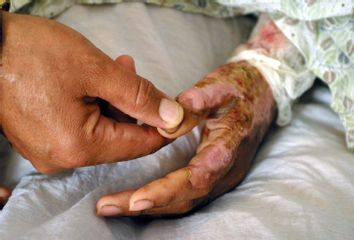
Suicide: Afghan women's other plightThe mother of nineteen-year-old Zahara holds her hand while she lies in her hospital bed in Herat, Afghanistan April 7, 2004. Zahara, trapped in an unhappy marriage, attempted to commit suicide by burning herself with petrol. The Afghan Independent Human Rights Commission has recorded at least 110 cases of self-immolation by women in five parts of the country in the past year. Photo taken April 7. TO ACCOMPANY FEATURE AFGHAN-WOMEN-SUICIDE REUTERS/Farzana Wahidy AL/FA(Credit: © Reuters Photographer / Reuters)

Time magazine’s recent depiction of a mutilated woman on its cover to illustrate “what happens if we leave Afghanistan” (without a question mark, mind you) has heated tempers on all sides of the debate over the American occupation of that nation. As Antiwar.com’s Jeff Huber put it today, “If [Time editor Richard] Stengel wanted to show us what is really happening, why didn’t he run images of Taliban leaders receiving bribe money that came from the United States? Why not show pictures of President Hamid Karzai’s political machine stealing the most recent election?  Why not show the heroin crop our military has been ordered not to destroy? Let’s see the innocent women and children that we have maimed and killed in the course of pursuing a war that weakens our nation’s security and is counter to our best interests.” 

The list is endless, but another candidate for the next Time cover could be an image of one of the growing number of Afghan women who are taking their own lives. According to a report that former Afghan Health Minister Faizullah Kakar, who now works as a health adviser to President Hamid Karzai, submitted on July 31, more and more women aged between fifteen and forty are attempting suicide. Based on health ministry and hospital records, some 23,000 women and girls are trying to kill themselves each year, “a several-fold increase on three decades ago.”

Kakar blames the suicide epidemic on untreated mental illness and health issues, social disorder, loss of loved ones, poverty, rape, domestic violence, the general hopelessness of a country engulfed in permanent war, as well as the socio-economic hardships Afghan women are forced to endure every day. 1.8 million women and girls suffer from “severe depression,” Kakar says. 

Included in these figures is the country’s epidemic of self-immolation. In the Herat City Hospital alone, there have been over 100 cases of women and girls setting fire to themselves over the past 15 months, and 76 of them have died. The women who commit this desperate act in an attempt to escape forced marriages, domestic abuse, oppressive mothers-in-law, crushing poverty, and a host of other ills at home — and live to tell the tale — regularly claim it was an accident. But as Dr. Mohammed Jalili told the BBC last year, “the cases are often easy to detect. Apart from the extent of burns, one tell-tale sign of an act of self-immolation is that there are no burns on the arm used to pour the petrol.” 

According to UNIFEM, the United Nations Development Fund for Women, 65 percent of Afghanistan’s 50,000 war widows regard suicide as the only way out of their desperate situation. 16 percent of these women may already have ended their lives. In any case, their life expectancy is approximately twenty years lower than that of women living in other parts of the world.

Ironically, there is some evidence that the increase in suicides, including self-immolation, may be connected with an increase in geographic mobility and social expectations brought about by the American invasion and occupation. In Herat province, for example, “former refugees who experienced a more open culture across the border are often blamed for demanding too much freedom on their return home. This, added to a growing awareness about basic human rights and the sudden influx of foreign music, television and fashion that accompanied the US-led invasion in 2001, has caused huge ruptures in the traditional fabric of society.”

Maria Bashir, a public prosecutor in the province and the first woman to hold this office in Afghanistan, says: “I have seen a woman whose husband cut her nose and ears off, a woman whose husband shaved her hair off so she would not go outside, a woman beaten with a heavy cooking pot until one of her ears was smashed into her skull, and a woman beaten with the handle of a shovel.” All on our watch, I might add. So, are these tragedies our fault or that of “the Taliban”? Are they a reason for the US military to stay or to go? Will there be more or fewer such cases if we pack up and leave? Hurry up and decide – it’s time for the next news story. 

By now it should be obvious to everyone who has seen the Time image that using “the plight of women” to justify military adventure X, Y or Z is the oldest trick in the propagandist’s playbook. By all means, let’s talk about “what happens to Afghanistan if we leave,” but please, let’s leave in the question mark.  

Continue Reading Close

Iranian website denies Holocaust

Holocartoons.com features an offensive set of anti-Semitic caricatures. Should we really be worried?

  • more
    • All Share Services

Iranian website denies Holocaust

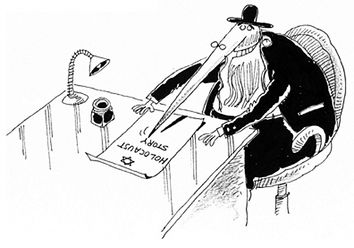
News services are abuzz with word that Iran has launched a new website challenging the historicity of the Holocaust. According to a report by Iran’s Fars News Agency today (published only in Farsi), a non-governmental cultural institution calling itself the “Bulwark of Faith and Thought” has just unveiled an elaborate platform called Holocartoons.com, featuring a set of anti-Jewish caricatures already published in book form by artist Maziar B. in 2008. 

The site, which one can only view with the help of high-speed Internet, comes in Farsi, Arabic, and English, and is counterintuitively accompanied by Henry Mancini’s “Pink Panther” theme. A note at the beginning claims that Holocartoons is “dedicated to all those who have been killed under the pretext of the Holocaust.” It goes on to claim that “the killing of 6 million Jews in the Second World War known as the Holocaust was a sheer lie.” It depicts Hitler as a joke, gas chambers as a farce, and claims there were never more than 5.4 million Jews living in Europe in the first place. The murder of the Jews, it explains, was merely a concoction of Zionists to seize control of the Middle East and its resources.

Cartoons challenging the supposedly sacrosanct character of the Holocaust have been around for years, and multiplied after the Danish Mohammed cartoon controversy of 2005. The new website clearly fits into President Ahmadinejad’s policy of delegitimizing the Jewish state by challenging one of its key justifications: providing a safe homeland for threatened Jews. As Ahmadinejad stated in a 2009 speech, “the issue of holocaust is an excuse by the war winners, particularly the US and Britain, for domination over the world … After the war a political and power-seeking system which claimed to be defendants of some war victims said the survivors of these victims need to receive a blood-money and establishment of Zionist regime in Palestine is a part of the compensation … If the reality of holocaust issue becomes clear, the Zionist regime will be fully collapsed.” 

Terrified yet? Normally you’d now expect the author of a piece like this to get all upset about those dastardly Holocaust-denying Iranians and start calling for some sort of retaliation. But I’m going to call their bluff and recommend that you do the same and actually read the thing. If you can endure the excruciating loading times and then commit to slogging your way through all the primitive, intellectually insulting drawings and boneheaded texts without nodding off, then maybe, Houston, we really do have a problem. But let me suggest that if this is the best Tehran can throw at the supposedly defenseless West, we can leave Houston to its own devices for some time to come. I mean, is this website really the 21st century equivalent of the Protocolls of the Elders of Zion or “Mein Kampf”? Sorry, I’m just not buying it.

So here’s the site. Don’t forget your pillow!

Continue Reading Close

Israeli students plan “Kurdish freedom flotilla”

The self-righteous effort to counteract the negative global backlash may backfire

  • more
    • All Share Services

O Jerusalem! Perhaps it’s something in the water, but it looks as if Israeli society, so often accused by its critics of moral myopia and cultural narcissism, is suddenly turning righteous and discovering a soft spot for downtrodden peoples of Muslim background. Does this mean the Messiah is at the gates?

Just one week following Israel’s bloody raid on the “Free Gaza Flotilla,” which ended in the deaths of nine Turkish activists, Israel’s National Student Union announced that it was forming its own “freedom flotilla” that it would fill with humanitarian items and steer in the opposite direction. Boaz Toporovsky, the organisation’s chairman, told the press yesterday that “we thought of an idea of sailing to Turkey or to the northern part of Cyprus, or to southern Turkey, where there is a concentration of Kurds.” The mission already has a captain: Israeli navy veteran and businessman Arik Ofir. The group is looking for an appropriate ship and plans to sail for Turkey as soon as it has found one and organized a crew.

Toporovsky is planning his Kurdish flotilla as a direct response to the global public’s negative response to the Free Gaza fiasco. “The whole world saw the flotilla and thought Israel is a terrible state, which comes to shoot people who call themselves peace activists,” he said. “It’s absurd that they always put the Israeli occupation in the headlines and don’t talk about extreme Islamic terror. There’s a lot of hypocrisy in the world. Turkey, which leads the campaign against Israel and makes all sorts of threats, is the same Turkey that carried out a holocaust and murdered an entire nation of Armenians, and oppresses a minority larger than the Palestinians — the Kurds — who deserve a state, who have demanded a state for longer than the State of Israel has existed.”

Toporovsky sees no barriers to his mission. “For the flotilla to work, we need three elements: Money, logistics and balls,” he said. “We’re bringing the balls and some of the logistics, but we need lots of money.”

What sounds like a diabolically clever public relations coup starts sounding too clever by half when you listen to people in the region. As one reader remarked to the Israeli news source Ynet, “Israeli ignorance is hilarious. Kurds are the most extreme Islamists in Turkey. Most of the Erdogan cabinet are Kurdish. Most of Erdogan’s voters are Kurds. Kurdish mosques are full of Hamas and Hezbollah posters. I really want to watch Israelis meeting the Kurds, that will be a scene to watch.” An exaggeration, perhaps, but there is no doubt the operation will hit one or the other snag. For one thing, no one seems to have informed poor Toporovsky that Kurdistan — unlike Gaza — is not only free of naval blockades but does not even possess a seaport.

The Student Union is also planning another “peace fleet” that could be ready to go in two weeks. This time, a vast fleet of small ships would head into the Mediterranean to intercept the next Free Gaza mission. “Our wish is to talk with the members of the [Gaza] flotilla, to see if they want to talk to us, and to ask them why the problems of Israel, in Gaza and Palestine, are disturbing them,” Toporovsky told Haaretz yesterday. “We would ask why they are not talking about the Kurdish minority or the Armenians that were murdered or many other problems? We want to expose the truth, this hypocrisy and the absurdity.” 400 Israeli yacht owners have already expressed interest in taking part.

It seems the waters of the eastern Mediterranean will be awash in self-righteous flotillas this summer. Generous Israelis are shipping humanitarian aid to oppressed Muslim and Christian communities — everywhere except to Gaza. According to the Jerusalem Post, yet another ship — packed to the gunwales with humanitarian supplies — is about to head from Israel to Cyprus. On board will be Pinchas Har-Zahav of the progressive Meretz Party and his son Haim. Mr. Haim Har-Zahav told the newspaper yesterday that the goal of the voyage was to “remind the world that Turkey is not innocent. If Uruguay or Iceland were the ones criticizing us so harshly, it might be a different story,” he said. “But we’re talking about a country that only seven years after [the Six Day War and the beginning of Israeli control of the Gaza Strip and the West Bank] began occupying Cyprus,” he said. “We’re talking about a country that has systematically killed the Kurds and refuses to acknowledge their role in the Armenian Genocide. And so no, we will not accept this. The hypocrisy has to stop here.”

“We feel that it’s important for us to show and remind the world that Turkey is not a righteous country, but a near-rogue state, and that we, the Israeli people, are not suckers.”

So now the truth is out: Israel hearts Muslims. But if I were a Gazan, I wouldn’t start celebrating quite yet.

Continue Reading Close

Page 1 of 3 in Judy Mandelbaum