
Juliana Barbassa

Brazil passes information access law

RIO DE JANEIRO (AP) — A freedom of information law has taken effect in Brazil, challenging an embedded culture of secrecy and bureaucracy.

Proponents, including President Dilma Rousseff, said the measure is nothing short of a revolution for a system that has kept tight control over information for decades.

But even as the president hailed the potential of the law that went into effect Wednesday, experts cautioned that it will take more than a piece of paper and political goodwill at the top to change attitudes about the flow of information. Most citizens, even journalists, are unfamiliar with the concept of free access to public information.

Experts say a lack of transparency has allowed corruption, inefficiency and wastefulness to go unchecked in the public realm. Last year, five of Rousseff’s ministers were sacked or stepped down following public allegations of corruption and misuse of public money.

“From now on, transparency is obligatory, under law, and will function as an efficient inhibitor of all the bad uses of public money, and of violations of human rights,” Rousseff said on Wednesday, a day that also marked the inauguration of a truth commission that will investigate human rights abuses committed during the military dictatorship from 1964 to 1985.

The president, who as a leftist guerrilla was imprisoned and tortured in the early 1970s under a military regime, acknowledged that both developments are the result of decades of work toward democratic ideals.

Brazil’s 1988 constitution enshrined the right to access information, but the new measure gives citizens a legal tool to enforce that right in a court. Its scope is broad: Unlike the U.S. Freedom of Information Act, which applies to the executive branch at the federal level, Brazil’s law covers all branches of government at all levels. However, there is still no set of regulations detailing how citizens can ask for data, and what municipal, state or federal officials must do to comply.

The sweep of the measure poses a significant challenge to the country, said Brazil-based researcher Greg Michener, who specializes in transparency and freedom of information laws. If civilians and the media demand compliance, the law could be a real force for positive change, he said. But Brazilians might also just throw up their hands at the enormity of the job, and abandon the idea. This is a country where some laws simply “don’t take,” he said, and there is a danger this one could fall by the wayside if Brazilians don’t push for compliance.

“These laws are sophisticated instruments, and depend on an informed populace,” he said. “You’d think the media would be most interested, that they’d want better information. But there isn’t really an awareness of what the law is in the Brazilian press.”

Michener compared Brazil to Mexico, which passed its own information access law in 2002. It was implemented a year later at the federal level, but it took five years to include it in the constitution, extending it to other levels and branches of government, where it is still being implemented. Mexico also created an autonomous institution to govern the law’s application. The Brazilian law allowed six months for preparation, and will be overseen by an existing government oversight body which also has other responsibilities, said Michener.

Groups that pushed for the bill say they are trying to ensure it doesn’t end up on the dustbin of well-intentioned laws that never took hold. The nonprofit watchdog group Contas Abertas, “Open Accounts,” celebrated the law’s enactment by shooting out 100 requests for information all over the country, to all branches of government. Brazil’s federal comptroller’s office said there were just over 700 requests in total on the law’s first day.

“It was a fight for us to get to this point,” said Gil Castello Branco, founder of Contas Abertas. “But I always remember what Thomas Jefferson said, that the execution of the law is more important than the making of them. This is particularly true in Brazil, where some laws are never followed.”

Brazil: truth commission members named

RIO DE JANEIRO (AP) — The names of those who will make up a Truth Commission charged with investigating human rights abuses under Brazil’s 1964-1985 dictatorship were published Friday, taking the country a step closer to accountability for the past crimes.

The seven appointees include the attorney who represented President Dilma Rousseff when she was a leftist guerrilla detained and tortured by the military in the early-1970s. It will have two years to investigate abuses committed under military rule.

The commission’s report won’t result in prosecutions because of a 1979 law granting amnesty for political crimes committed during that era. The commission does, however, have subpoena powers, and public servants and military personnel are legally obligated to cooperate.

Advocates say that investigating who was involved in torture, murders and disappearances is essential if the country is to move forward. Other South American countries that had repressive regimes, including Argentina, Chile and Uruguay, have punished those involved in abuses.

The November law authorizing the commission’s creation met with great resistance from conservative segments of the military, who expressed concern the current left-leaning government would use it as an instrument of revenge.

Rousseff invited all of Brazil’s living presidents since the end of military rule to take part in the commission’s seating on Wednesday, a gesture to make clear that its mission is sanctioned by the state, and is not a project espoused only by the president and her Workers’ Party. A statement from the president’s press office said all the former living presidents had accepted the invitation.

Continue Reading Close

Brazil: Land fights up, but fewer activists dead

A man prepares his shack in a area occupied by Members of the Brazil's Landless Movement (MST) in Embu das Artes, outskirt of Sao Paulo, Brazil, Monday, May 7, 2012. According to the Landless Movement, there are about 8,000 people living in over 3,000 tents in Embu, an area with three natural springs and 4.7 million square feet of native forest that has grown into the country’s largest landless occupation.Conflicts over land in Brazil increased last year, and there are at least two that could turn into violent conflagrations at any moment, although the number of rural activists killed nationally went down slightly, according to a report released Monday by a watchdog group that has long kept a tally of threats and murders. (AP Photo/Andre Penner)(Credit: AP)

RIO DE JANEIRO (AP) — Conflicts over land issues in Brazil increased last year, although the number of rural activists killed nationally went down slightly, according to a report released Monday by a watchdog group that tallies land-related threats and murders. The report found that at least two ongoing conflicts could turn into violent conflagrations.

The Catholic Land Pastoral ‘s survey showed murders connected to land disputes fell from 34 in 2010 to 29 in 2011. Murder attempts also fell, from 55 to 38. In spite of the trend, the number of conflicts nationwide rose from 1,186 to 1,363, and the number of death threats grew from 125 to 347.

In Brazil, killings over land are common and seldom punished, as powerful landowners clash with farmers and others for control of lucrative farming and logging land.

More than 1,150 rural activists have been slain in Brazil over the past 20 years, but fewer than 100 cases have gone to court since 1988, the land pastoral said. Out of those cases, the courts have only found guilty 15 of the men who ordered the killings, and the only one serving time in prison was responsible for the much-publicized 2005 murder of U.S. nun and environmental activist Dorothy Stang.

Loggers, ranchers and farmers are responsible for most of the killings targeting protests over illegal logging and land rights. Most of the killings happen in the Amazon region, but also occur in most other Brazilian states. In nearly three-quarters of the cases, the victims come from traditional communities such as indigenous villages and settlements of slave descendants known in Brazil as quilombos, the report showed.

The CPT report said efforts to develop Brazil’s countryside and the powerful economic interests involved were behind the rise in conflicts over land.

“A battle has been declared that is expressed in the violence against those considered obstacles to development and progress, because their projects run counter to the prevailing development models,” the CPT said in a press release.

Brazil is a global export leader in products that the CPT and others say are most responsible for conflicts and deforestation in Brazil’s countryside — soy from massive farms, beef raised on ranches that dot the rainforest and iron ore from mining projects. Hundreds of conflicts over who had rights to land mushroomed last year when ranchers, farmers and miners clashed with subsistence farmers and Indians living on reserves set aside by the government.

Brazilian President Dilma Rousseff is a proponent of developing rural areas including the Amazon, though in a manner her government argues is responsible and balances protecting the environment with the desire to expand the nation’s economy on the back of commodity production.

It’s a battle of economic will that’s been persistent in Brazil since Portuguese explorers arrived 500 years ago, said Antonio Brand, a historian and professor at the Catholic University of Dom Bosco.

“The argument of colonization that was used to justify the murder of so many indigenous people has been substituted by the argument of the country’s development,” Brand said. “It allows, as was the case in the past, the violation of rights and the continuation of violence.”

Just last month a man was shot to death and another injured in the northeastern state of Bahia in a 30-year-old land dispute between farmers and the pataxo indigenous group. Brazilians first learned about the case in 1997, when an indigenous man known by his first name, Galdino, went to the country’s capital to plead his tribe’s cause. He ended up burned to death by well-to-do teenagers who found him sleeping in a Brasilia bus stop.

Last week, Brazil’s Supreme Court finally ruled on the issue the victim had been championing and found that the land titles of farms operating within the 54,000-acre indigenous reserve were not valid, and that the farmers had to leave. This case was not on the Supreme Court’s schedule, but had to be resolved because it was a situation of “extreme conflict,” according to judge Carmen Lucia Antunes Rocha.

The 25 tomes that made up the law suit were full of “suffering, tears, blood and death,” the judge said in court.

Another potentially violent case involves Embu das Artes, a small town near Sao Paulo, Brazil’s most populous metropolis. According to the Landless Peasants Movement, about 8,000 people live in over 3,000 tents in Embu, an area with three natural springs and 4.7 million square feet of native forest that’s grown into the country’s largest landless occupation.

The land in this case officially belongs to a developer, which had planned to build homes for 1,200 families on the spot. In 2006, however, Sao Paulo environmentalists went to court and won an injunction forbidding any construction within the forest.

With legal case dragging on, the landless workers occupied the land in March with the support of the local mayor. Their settlement grew as more families joined in, clearing trees and erecting tents in the forested hillside.

___

Associated Press writer Marco Sibaja contributed to this report from Brasilia.

___

Follow Juliana Barbassa at —http://twitter.com/jbarbassa

Continue Reading Close

Brazil protests counter military coup celebration

Flanked by military club security guards, a retired officer shouts threats at activists protesting outside the club in downtown Rio de Janeiro, Brazil, Thursday March 29, 2012. A club of retired military officers held its annual celebration of Brazil's 1964 military coup as usual, but faced protestors as members arrived for the event. Unlike its Latin American neighbors, Brazil never had a formal investigation into its 20-year dictatorship. (AP Photo/Victor R. Caivano)(Credit: AP)

RIO DE JANEIRO (AP) — Riot police used pepper spray and tear gas Thursday to chase protesters away from a celebration by retired soldiers marking the 1964 coup that established Brazil’s long military dictatorship.

Former officers have gathered every year to mark the occasion, but now they’re facing a growing tide of opposition and had to push through about 200 people screaming “murderer” and holding up photos of those killed during the regime.

Unlike Argentina, Chile and Uruguay, which also had repressive military regimes, Brazil has never had a formal investigation into human rights abuses during its 1964-85 dictatorship. A 1979 amnesty law barred prosecutions for politically motivated crimes committed during the regime.

“Brazil is so far behind on this. This is our history, and it’s not told,” said protester Maria Auxiliadora Santa Cruz Coelho, the sister of a young student activist who was detained in 1974 by the military and never seen again.

Those who lived it won’t forget, she said. “My mother is 98 years old, and she doesn’t want to die without knowing what happened to her son. This has been her life.”

The emotional crowd outside the Military Club contrasted starkly with the aging officers in dark suits who filed into the high-ceilinged hall to hear speakers extoll the growth of Brazil during the military years and deride the accusations of demonstrators.

“They want to discuss police matters,” one speaker, Aristoteles Drummond said of the critics. “There must have been excesses on both sides. We know theirs. They’re so insistent that there must have been some on our side as well, but they were marginal.”

In the audience, a former army general, Gilberto Serra, waved aside the idea of government responsibility for any murders. The armed forces, he said, had an important job to do: “They were the ones who blocked the implementation of a communist government here in Brazil.”

A recent study by the Brazilian government said 475 people were killed or “disappeared” by agents of the military regime. It said many more were tortured.

Thursday’s protest was the latest of several recent efforts seeking to push Brazilians to face their past. Across the country, groups of civilians denounced former torturers in six cities Monday, spray-painting messages such as “A torturer lives here” in front of their homes and using whistles in noisy demonstrations to draw attention to their targets.

“We have a right to our history, and the only way that’s going to happen is if the people take charge,” university student leader Esteban Crescente said outside the Military Club. “We have to go to the streets to drive this process.”

Federal prosecutors are looking for ways around the amnesty law.

Earlier this month, they filed kidnapping charges against retired army Col. Sebastiao de Moura trying him to the junta era disappearance of 62 communists, arguing that cases of forced disappearances don’t fall under the amnesty law. A federal judge dismissed the charges, but prosecutors said they would appeal.

Brazilians also have been debating the creation of a truth commission to investigate crimes committed under the dictatorship. The bill was signed into law in November by President Dilma Rousseff, who herself was jailed and tortured by the junta, but it still faces resistance from conservative groups, including retired military personnel.

Jose Miguel Vivanco, who heads the Americas division of Human Rights Watch, applauds the protests and a truth commission, but says they are ultimately no substitute for the justice that Brazil should provide for the junta’s victims.

“Brazil has a duty under international human rights law to bring to justice those individuals who committed atrocities and to provide a remedy for the victims,” he said. “Taking seriously the right of victims to a remedy is also key to strengthen the rule of law in Brazil and make clear that everybody has the same legal duties and protections, whether civilian or military.”

Continue Reading Close

Deadly Rains, Scant Preparation In Brazil

Rescue personnel carry the body of a mudslide victim in Jamapara, Rio de Janeiro state, Brazil, Tuesday, Jan. 10, 2012. Heavy rains caused mudslides that killed at least eight people in Rio de Janeiro state Monday, raising the number of dead in Rio and neighboring Minas Gerais state to 23 so far this year, civil defense officials said. (AP Photo/Victor R. Caivano)(Credit: AP)

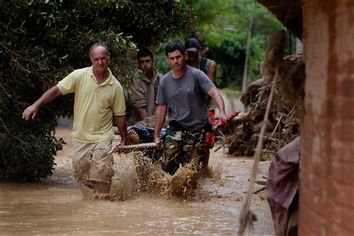
RIO DE JANEIRO (AP) — Brazil’s tropical storms bring death every summer as torrential rains unleash floods and mudslides that can bury whole communities in minutes. A single storm killed nearly 1,000 people last year.

This season was going to be different. Government officials promised money would flow to prevent these catastrophes. But with the rains and deaths already starting, the government’s own figures show funds are not going where officials say they are needed.

Brazil’s Congress set aside $282 million last year for the federal disaster-prevention program, a jump from the $236 allotted in 2010. On orders of President Dilma Rousseff, government geologists drew up a list of cities at greatest risk for a natural disaster.

That came in response to torrential rains at this time last year that dissolved hillsides and turned creeks into rampaging rivers in the mountains near Rio de Janeiro, burying or ripping away entire neighborhoods. A total of 918 people died, and the bodies of 215 are still missing.

Yet only 30 percent of the new disaster money has been spent, and little of it has gone to the highest-risk areas, according to the independent group Contas Abertas — “Open Accounts” — which campaigns for transparency in government.

It found that so far, disaster-prevention funds have gone to only two of the 56 cities that the new survey listed as high risk. Sao Paulo obtained $86,000 and $171,000 went to Florianopolis, the capital of Santa Catarina state, where 135 people died in floods in 2008.

The Brazilian Geological Service survey found nearly 180,000 people living in dangerously fragile areas, mostly in southeastern states such Rio de Janeiro and Minas Gerais.

But the city awarded the most disaster prevention money from the 2011 budget is Recife, which got $14 million from the Ministry of National Integration. The northeastern city is not even on the new list of areas at risk, though it is the capital of Pernambuco, the home state of National Integration Minister Fernando Bezerra Coelho.

Pernambuco got more funding than any other state for disaster prevention this past year. Flood-devastated Rio de Janeiro was 10th.

Bezerra has denied improperly favoring his state, noting that the money will help build dams to control rivers that flooded and killed 20 people in 2010.

“You can’t discriminate against Pernambuco because it’s the state the minister comes from,” he told a news conference last week. “Any Brazilian citizen sitting in this chair would have done the same.”

While Rousseff has stood behind Bezerra, Congress has summoned him to answer questions about allegations of improper spending.

Meanwhile, dangerous hillsides are going without reinforcement and perilous rivers are undredged.

“The president doesn’t want more people to die, but more people will die. There will be more deaths,” said Eduardo Macedo, vice president of Brazil’s association of geologists. “We’re making advances, but we are not even close to having in place the structure we need.”

According to his group, officials have spent just about a quarter of the money the Congress has allocated to disaster relief each year from 2004 to 2011, following a pattern of under-spending that is common among federal ministries.

Small municipalities often don’t have the resources to draw up acceptable proposals for federal money, and Brazilian bureaucracy snarls projects even when funding has been granted, said Gil Castello Branco, founder of Contas Abertas.

He said the money that is paid often flows to areas with political ties to those disbursing the funds.

“The saddest part of this is seeing history repeat itself over the years: the disasters, and the poor use of public resources meant to prevent them,” said Gil said.

The small Rio de Janeiro town of Sapucaia, where 20 have died this week, has not gotten any federal help, although it suffered a flood two years ago, said Mayor Anderson Zanon. The municipal government doesn’t have the resources to take on major projects to contain denuded slopes and build new homes for people living in risky areas without federal funding, he said.

“We can’t continue having these tragedies,” he said. “This could have been prevented. We need to build, do containment work, so this doesn’t happen again next year.”

Minister Bezerra Coelho visited some of the flooded parts of Rio state this week and announced $12 million would sent to help victims there as part of a $244 million emergency response package announced by the president for the southeastern states.

To Rita de Cassia Mendes Morais, who lost four family members and “every brick” of her home in Sapucaia, the promise rings hollow.

“It’s not just about going on television and talking, and making promises,” she said. “They come here now, then they disappear, and the money too. I want the government to have more heart, to look out for us who have survived the worst.”

Continue Reading Close

Deadly Rains, Scant Preparation In Brazil

Rescue personnel carry the body of a mudslide victim in Jamapara, Rio de Janeiro state, Brazil, Tuesday, Jan. 10, 2012. Heavy rains caused mudslides that killed at least eight people in Rio de Janeiro state Monday, raising the number of dead in Rio and neighboring Minas Gerais state to 23 so far this year, civil defense officials said. (AP Photo/Victor R. Caivano)(Credit: AP)

RIO DE JANEIRO (AP) — Brazil’s tropical storms bring death every summer as torrential rains unleash floods and mudslides that can bury whole communities in minutes. A single storm killed nearly 1,000 people last year.

This season was going to be different. Government officials promised money would flow to prevent these catastrophes. But with the rains and deaths already starting, the government’s own figures show funds are not going where officials say they are needed.

Brazil’s Congress set aside $282 million last year for the federal disaster-prevention program, a jump from the $236 allotted in 2010. On orders of President Dilma Rousseff, government geologists drew up a list of cities at greatest risk for a natural disaster.

That came in response to torrential rains at this time last year that dissolved hillsides and turned creeks into rampaging rivers in the mountains near Rio de Janeiro, burying or ripping away entire neighborhoods. A total of 918 people died, and the bodies of 215 are still missing.

Yet only 30 percent of the new disaster money has been spent, and little of it has gone to the highest-risk areas, according to the independent group Contas Abertas — “Open Accounts” — which campaigns for transparency in government.

It found that so far, disaster-prevention funds have gone to only two of the 56 cities that the new survey listed as high risk. Sao Paulo obtained $86,000 and $171,000 went to Florianopolis, the capital of Santa Catarina state, where 135 people died in floods in 2008.

The Brazilian Geological Service survey found nearly 180,000 people living in dangerously fragile areas, mostly in southeastern states such Rio de Janeiro and Minas Gerais.

But the city awarded the most disaster prevention money from the 2011 budget is Recife, which got $14 million from the Ministry of National Integration. The northeastern city is not even on the new list of areas at risk, though it is the capital of Pernambuco, the home state of National Integration Minister Fernando Bezerra Coelho.

Pernambuco got more funding than any other state for disaster prevention this past year. Flood-devastated Rio de Janeiro was 10th.

Bezerra has denied improperly favoring his state, noting that the money will help build dams to control rivers that flooded and killed 20 people in 2010.

“You can’t discriminate against Pernambuco because it’s the state the minister comes from,” he told a news conference last week. “Any Brazilian citizen sitting in this chair would have done the same.”

While Rousseff has stood behind Bezerra, Congress has summoned him to answer questions about allegations of improper spending.

Meanwhile, dangerous hillsides are going without reinforcement and perilous rivers are undredged.

“The president doesn’t want more people to die, but more people will die. There will be more deaths,” said Eduardo Macedo, vice president of Brazil’s association of geologists. “We’re making advances, but we are not even close to having in place the structure we need.”

According to his group, officials have spent just about a quarter of the money the Congress has allocated to disaster relief each year from 2004 to 2011, following a pattern of under-spending that is common among federal ministries.

Small municipalities often don’t have the resources to draw up acceptable proposals for federal money, and Brazilian bureaucracy snarls projects even when funding has been granted, said Gil Castello Branco, founder of Contas Abertas.

He said the money that is paid often flows to areas with political ties to those disbursing the funds.

“The saddest part of this is seeing history repeat itself over the years: the disasters, and the poor use of public resources meant to prevent them,” said Gil said.

The small Rio de Janeiro town of Sapucaia, where 20 have died this week, has not gotten any federal help, although it suffered a flood two years ago, said Mayor Anderson Zanon. The municipal government doesn’t have the resources to take on major projects to contain denuded slopes and build new homes for people living in risky areas without federal funding, he said.

“We can’t continue having these tragedies,” he said. “This could have been prevented. We need to build, do containment work, so this doesn’t happen again next year.”

Minister Bezerra Coelho visited some of the flooded parts of Rio state this week and announced $12 million would sent to help victims there as part of a $244 million emergency response package announced by the president for the southeastern states.

To Rita de Cassia Mendes Morais, who lost four family members and “every brick” of her home in Sapucaia, the promise rings hollow.

“It’s not just about going on television and talking, and making promises,” she said. “They come here now, then they disappear, and the money too. I want the government to have more heart, to look out for us who have survived the worst.”

Continue Reading Close

Page 1 of 3 in Juliana Barbassa