Juliane von Mittelstaedt
Homophobia on the rise in the Muslim world

As recent incidents in Iraq show, in many Islamic countries, gays are ostracized, persecuted, even murdered

  • more
    • All Share Services

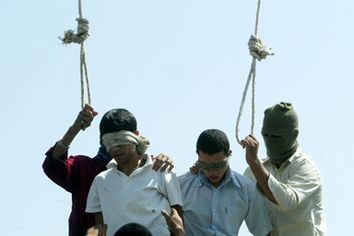
Homophobia on the rise in the Muslim worldBlindfolded Mahmoud Asgari, 16, left, and another unidentified teenager are set to be publicly hanged, in Mashhad, Iran, on charges of raping boys in this photo taken on July 19, 2005.

Bearded men kidnapped him in the center of Baghdad, threw him into a dark hole, chained him up, urinated on him, and beat him with an iron pipe. But the worst moment for Hisham, 40, came on the fourth day of his ordeal, when the kidnappers called his family. He was terrified they would tell his mother that he was gay and that this was the reason they had kidnapped him. If they did, he would never be able to see his family again. The shame would be unbearable for them.

“Do what you want to me, but don’t tell them,” he screamed.

Instead of humiliating him in the eyes of his family, the kidnappers demanded a ransom of $50,000, a huge sum for the average Iraqi family. His parents had to go into debt and sell all of their son’s possessions in order to raise the money required to secure his freedom. Shortly after they received the ransom, the kidnappers threw Hisham out of their car somewhere in the northern part of Baghdad. They had decided not to shoot him. But they sent him on his way with a warning: “This is your last chance. If we ever see you again, we’ll kill you.”

That was four months ago. Hisham has since moved to Lebanon. He told his family that he had decided to flee the violence and terror in Baghdad and that he had found work in Beirut. Needless to say, he didn’t disclose the fact that he is unable to live in Iraq because of the death squads who are out hunting for “effeminate-looking” men.

In Baghdad a new series of murders began early this year, perpetrated against men suspected of being gay. Often they are raped, their genitals cut off, and their anuses sealed with glue. Their bodies are left at landfills or dumped in the streets. The nonprofit organization Human Rights Watch, which has documented many of these crimes, has spoken of a systematic campaign of violence involving hundreds of murders.

Restoring “religious morals”
A video clip showing men dancing with each other at a party in Baghdad in the summer of 2008 is thought to have triggered this string of kidnappings, rapes and murders. Thousands of people have seen it on the Internet and on their cellphones. Islamic religious leaders began ranting about the growing presence of a “third sex,” which American soldiers were said to have brought in with them. The followers of radical Shiite leader Muqtada al-Sadr, in particular, felt the need to take action aimed at restoring “religious morals.”

In their stronghold, the part of Baghdad known as Sadr City, black-clad militiamen patrol the streets, on the lookout for anyone whose “unmanly appearance” or behavior would make it possible to identify them as being homosexual. Long hair, tight-fitting T-shirts and trousers, or a certain way of walking were often a death sentence for the persons in question. But it’s not just the Mahdi army who has been hunting down and killing gay men. Other groups such as Sunni militias close to al-Qaida and the Iraqi security services are also known to be involved.

Homosexuals in Iraq may be faced with an exceptionally dangerous situation, but they are ostracized almost everywhere in the Muslim world. Gay rights organizations estimate that more than 100,000 gay men and women are being discriminated against and threatened in Muslim countries. Thousands of them commit suicide, end up in prison, or go into hiding.

Egypt starts to clamp down
More than 30 Islamic countries have laws on the books that make homosexuality a criminal offense. In most cases punishment ranges from floggings to life imprisonment. In Mauritania, Bangladesh, Yemen, parts of Nigeria and Sudan, the United Arab Emirates, Saudi Arabia, and Iran, convicted homosexuals can also be sentenced to death.

In those Muslim countries where homosexuality is not against the law, gay men and women are nonetheless persecuted, arrested and in some cases murdered. Although long known for its open gay scene, Egypt has recently started to clamp down hard. The lives of homosexuals are monitored by a kind of vice squad that taps telephones and recruits informants. As soon as the police have accumulated the kind of evidence they need, they charge their victims with “debauchery.”

In Malaysia homosexuality has been used as a political weapon. In 2000 opposition leader Anwar Ibrahim was sentenced to nine years in prison for allegedly committing “sodomy” with his wife’s chauffeur as well as with a former speechwriter. In 2004 the conviction was overturned on appeal, and he was acquitted. In the summer of 2008, charges were filed against him in a similar case when a male aide accused him of sodomy. The case is still ongoing.

For a while Anwar Ibrahim was the favorite of former Prime Minister Mahathir Mohamad and was being groomed to succeed him in that office until they had a falling out in 1998. Ten years and some prison time later, on August 28, 2008, Anwar managed to be sworn in again as a member of the Malaysian Parliament. But that’s as far as he has got with his political comeback.

Even in liberal Lebanon homosexuals run the risk of being sentenced to a year in prison. On the other hand, Beirut has the only gay and lesbian organization in the Arab world (Helem, which means “dream” in Arabic). There are posters on the walls of the Helem office in downtown Beirut providing information on AIDS and tips on how to deal with homophobia. The existence of Helem is being tolerated for the time being, but the Interior Ministry has yet to grant it an official permit. “And it’s hard to imagine that we ever will be given one,” says Georges Azzi, the organization’s managing director.

Islamists are the dominant cultural force
In Istanbul there is a free gay scene, Christopher Street Day is celebrated, and even religious Muslims are among the fans of transsexual pop diva Bülent Ersoy and the late gay singer Zeki Müren. But outside the world of show business it is considered both a disgrace and an illness to be a götveren, or “queen.” In the Turkish army, homosexuality is cause for failing a medical test. To identify anyone trying to use homosexuality as an excuse to get out of military service, army doctors ask to see photos or videos showing the recruits engaging in sex with a man. And they have to be in the “passive” role. In Turkey being in the active role is considered manly enough not to be proof of homosexuality.

It looks as if a wave of homophobia has swept over the Islamic world, a place that was once widely known for its open-mindedness, where homoerotic literature was written and widely read, where gender roles were not so narrowly defined, and, as in the days of ancient Greece, where men often sought the companionship of youths.

Islamists are now a dominant cultural force in many of these countries. They include figures such as popular Egyptian television preacher Yussuf al-Qaradawi, who demonizes gays as perverse. Four years ago the Shiite grand ayatollah Ali al-Sistani issued a fatwa saying that gays are to be murdered in the most brutal way possible. These religious opinion leaders base their hatred for gays on the story of Lot in the Koran: “Do ye commit lewdness such as no people in creation [ever] committed before you? For ye practice your lusts on men in preference to women: ye are indeed a people transgressing beyond bounds.” Lot’s people suffered the destruction of the cities of Sodom and Gomorrah for their sins. The prophet Mohammed has a number of dicta in which he condemns these acts by Lot’s people, and in one of them he even goes as far as to call for punishment by death.

European prudery exported to the colonies
The story of Lot and related verses in the Koran were not interpreted as unambiguous references to homosexual sex until the 20th century, says Everett Rowson, professor of Islamic studies at New York University. This reinterpretation was the result of Western influences — its source was the prudery of European colonialists who introduced their conception of sexual morality to the newly conquered countries.

The fact of the matter is that half of the laws across the world that prohibit homosexuality today are derived from a single law that the British enacted in India in 1860. “Many attitudes with regard to sexual morality that are thought to be identical to Islam owe a lot more to Queen Victoria than to the Koran,” Rowson says.

More than anything, it is the politicization of Islam that has led to the persecution of gays today. Sexual morals are no longer a private matter. They are regulated and instrumentalized by governments.

“Regimes want to control the private lives of citizens”
“The most repressive are secular regimes such as those in Egypt or Morocco, which are under pressure from Islamists and so try to outdo them with regard to morals,” says Scott Long of Human Rights Watch. “In addition, the persecution of homosexuals shows that a regime has control over the private lives of its citizens — a sign of power and authority.” For several years now, a sense of “moral panic” has been systematically fomented in many Muslim countries.

Iran is a case in point, where homosexuals have been persecuted on a more or less regular basis since the Islamic revolution. Since President Mahmoud Ahmadinejad has been in office, there has definitely been an increase in this persecution despite the fact that Ahmadinejad never grows tired of emphasizing that there are no homosexuals in his country.

The mere suspicion that someone may have committed “unnatural acts” is enough for that person to be sentenced to a flogging in Iran. If caught more than once, the person in question can be sentenced to death. According to official statistics, 148 homosexuals have been given a death sentence and executed thus far. The true figure is doubtless much larger than this. The last case of this kind to attract public attention was that of 21-year-old Makwan Moludsade, who was hanged in December 2007. He was accused of having raped three boys several years earlier. Homosexuals are almost always charged with other crimes such as rape, fraud or robbery in order to better justify their execution.

“If I had stayed, they would have killed me”
As a result of this situation, thousands of gays and lesbians have fled Iran. For most of them the first port of call is Turkey. “I had no choice but to flee,” says Ali, a 32-year-old physician. “If I had stayed, they would have killed me.”

Ali was careful. He rarely went to parties, he used different Internet cafes for online chat sessions, and he didn’t let anyone in on his secret, not even the members of his family. Everything went well until one day his friend’s father caught them kissing. Two days later Ali lost his job at the hospital and then he was hit by a car, in what seemed to be a deliberate attack. Shortly after that he received a telephone call telling him: “We want to see you hang.”

What he hadn’t known was that his friend’s father was a high-ranking member of the Iranian Revolutionary Guard Corps.

Ali went to the bank, withdrew his savings, and took a train to Turkey, where he applied for asylum. Since then he has lived in a tiny apartment in Kayseri, Central Anatolia, one of 35 gay Iranian exiles in that city.

Arsham Parsi, 29, from Shiraz, fled Iran four years ago. A slight man with a fluffy beard and glasses, he was one of the most wanted men in Iran for several years after creating the country’s first gay network in 2001. Its members communicated with each other only by e-mail, and very few people knew his real name. But in the end his identity was revealed. Parsi managed to get away, but it was a close call. He got a visa for Canada, where he founded the Iranian Queer Organization, which now has 6,000 members in Iran. They include numerous transsexuals or persons who consider themselves to be transsexuals. Parsi estimates that “nearly half of all sex-change operations are requested by homosexuals.”

Sex-change operations booming in Iran
The persecution of gays has led to a boom in the demand for sex-change operations in Iran. More operations of this kind are carried out in the Islamic Republic than anywhere else in the world apart from Thailand. These procedures were approved by Ayatollah Khomeini himself in 1983. Khomeini defined transsexuality as a disease that can be healed by means of an operation. Since then thousands of people have requested this kind of treatment, and the Iranian government even covers part of the costs.

“Family members and physicians urge homosexuals to have operations to normalize their sexual orientation,” Parsi says. This way it was possible for a high-ranking Shiite religious scholar to finance his secretary’s physical transformation into a woman and then to marry him.

The archconservative kingdom of Saudi Arabia is the only Arab country where sharia law is the sole legal code, under which homosexuals are flogged and executed. “Homosexuals are freer here than they are in Iran,” says Afdhere Jama, who traveled through the Islamic world for seven years doing research for his book “Illegal Citizens.”

Gay men and women have a surprising amount of space in Saudi society. Newspapers print stories about lesbian sex in school lavatories, while it is an open secret that certain shopping centers, restaurants and bars in Jeddah and Riyadh are gay meeting points.

“There are numerous Saudi men who have sexual relationships with youths before they are married or when their wives are pregnant,” Jama says. In these cases, having sex with another male is often the only way of having sex at all. Extramarital affairs with women are nearly impossible. “In the West the men in question would be considered gay, but in countries like Saudi Arabia it is harder to categorize them,” Jama notes. Most Muslims have trouble understanding the Western concept of “gay identity.” In their countries there is no such thing as a gay lifestyle or a gay movement.

Cultural and political factors
Daayiee Abdullah, 55, is an imam. He wears a prayer cap, has a beard — and is gay. He is one of only two imams in the world who are openly gay. He voluntarily chose to follow the path of Islam. Raised as a Baptist in Detroit, he made friends with Chinese Muslims while studying in Beijing and then converted to Islam. “They told me it would be no problem for me as a gay man to be a good Muslim.”

Imam Abdullah and many others along with him have a somewhat different interpretation of the story of Lot. According to them, those whom God condemned were not homosexuals but rapists and robbers. It is not homosexuality that the Koran prohibits but rather rape. “The rejection of gays is a result of cultural and political factors,” he says. “Just like honor killings and arranged marriages. They’re not in the Koran either.”

Abdullah lives in Washington, the U.S. capital, and says prayers at the funerals of gay persons, particularly if they died of AIDS, something no other imam is willing to do. He officiates at same-sex marriages and, for the past 11 years, has provided religious advice in an online forum titled “Muslim Gay Men.”

He regularly receives death threats but now laughs them off, saying: “How can two loving men pose a threat to the foundations God has laid?”

Foreign investors snap up African farmland

With population set to skyrocket, food is the new oil

  • more
    • All Share Services

Foreign investors snap up African farmlandAfrican farmland, which is extremely fertile in some regions, is inexpensive on the impoverished continent. Many foreign investors are snapping up the land and some African leaders hope the result will be the development and modernization of their agricultural sectors.

Every crisis has its winners. A group of them is sitting in the Stuyvesant Room at the Marriott Hotel in New York. The conference room, where the shades are drawn and the lights are dimmed, is filled with men from Iowa, São Paulo and Sydney — corn farmers, big landowners and fund managers. Each of them has paid $1,995 to attend Global AgInvesting 2009, the first investors’ conference on the emerging worldwide market in farmland.

A man from the Organisation for Economic Co-operation and Development (OECD) gives the first presentation. Colorful graphs travel up and down his PowerPoint charts. Some are headed downward as the year 2050 approaches. They represent the farmland that is disappearing as a result of climate change, soil desolation, urbanization and the shortage of water. The other lines, which point sharply upward, represent demand for meat and biofuel, food prices and population growth. There is a growing gap between the two sets of lines. It represents hunger.

According to most prognoses, there could be 9.1 billion people living on Earth in 2050, about 2 billion more than today. In the coming 20 years alone, worldwide demand for food is expected to rise by 50 percent. “These are pessimistic prospects,” says the OECD man. He looks serious and even a little sad as he describes the future of the world.

But for the audience in the Stuyvesant Room, mostly men and a handful of women, all of this is good news and the mood is buoyant. How could it be any different? After all, hunger is their business. The combination of more people and less land makes food a safe investment, with annual returns of 20 to 30 percent, rare in the current economic climate.

These are not Wall Street experts, nor are they people who shoot money across the continents like billiard balls. On the contrary, these are extremely conservative investors who buy or lease land to grow wheat or raise cattle. But land is scarce and expensive in Europe and the United States. Solving the problem means developing new land, which is available only in Africa, Asia and South America. This combination of factors has triggered a high-stakes game of real-life Monopoly, in which investment funds, banks and governments are engaged in a race for access to the world’s arable land.

“The final frontier for finding alpha”
Susan Payne, a red-haired British woman, is the CEO of the largest land fund in southern Africa, which currently includes 150,000 hectares (370,000 acres), mainly in South Africa, Zambia and Mozambique. Payne hopes to raise half a billion euros from investors. She talks about fighting hunger, but the headings on her PowerPoint slides, embellished with photos of soybean fields at sunset, tell a different story. One such heading refers to “Africa — the last frontier for finding alpha.” The word “alpha” signifies an investment for which the return is greater than the risk. Africa is alpha country.

That’s because land, which is extremely fertile in some regions, is inexpensive on the impoverished continent. Payne’s land fund pays $350 to $500 per hectare ($140 to $200 per acre) in Zambia, about one-tenth the price of land in Argentina or the United States. For a small farmer in Africa, the average yield per hectare has remained unchanged in 40 years. With a little fertilizer and additional irrigation, yields could quadruple — and so could profits.

These are perfect conditions for investors. Payne sees it that way, and so do her investors. In fact, there has been so much demand for this type of investment that Payne recently had to establish a new sub-fund.

A great deal of capital is currently available. It is the second year of the global economic crisis, and investors are seeking sound and safe investments, which is why the audience in New York includes not only hedge fund managers and agriculture industry executives, but also the representatives of large pension funds and the chief financial officers of five universities, including Harvard.

Thousands of investment funds, from small to large, have recently begun applying the most basic formula in the world: People must eat.

The U.S. investment management company BlackRock, for example, has established a $200 million agriculture fund and has earmarked $30 million for the acquisition of farmland. Renaissance Capital, a Russian investment company, has acquired more than 100,000 hectares in Ukraine. Deutsche Bank and Goldman Sachs have invested their money in pig-breeding operations and chicken farms in China, investments that include the legal rights to farmland.

Food is becoming the new oil. Worldwide grain reserves dropped to a historic low at the beginning of 2008, and the ensuing price explosion marked a turning point, just as the oil crisis did in the 1970s. There were bread riots around the world, and 25 countries, including some of the biggest grain exporters, imposed restrictions on food exports.

Then came the second crisis of 2008, the economic crisis. Two fears — the fear of hunger and the fear of uncertainty — converged, triggering what some are already calling a second generation of colonialism.

A win-win situation?
What is different about this colonialism is that countries are readily allowing themselves to be conquered. The Ethiopian prime minister said that his government is “eager” to provide access to hundreds of thousands of hectares of farmland. The Turkish agriculture minister announced: “Choose and take what you want.” In the midst of a war against the Taliban, the Pakistani government staged a road show in Dubai, seeking to entice sheikhs with tax breaks and exemptions from labor laws.

All these efforts have two hopes in common. One is the hope of poor nations to achieve the development and modernization of their ailing agricultural sectors. The other is the world’s hope that foreign investors in Africa and Asia will be able to produce enough food for a planet soon to be populated by 9.1 billion people; that they will bring along all the things that poor countries have lacked until now, including technology, capital and knowledge, modern seed and fertilizer; and that these investors will be able to not only double crop yields but, in many parts of Africa, increase them 10-fold. Previous estimates had in fact forecast a decline in production capacity by 3 to 4 percent in 2080 compared with the year 2000.

If the investors are successful, they could achieve what development agencies have been unable to do in the past few decades: reduce the hunger that now afflicts more people than ever, namely 1 billion worldwide. In the best-case scenario this could be a win-win situation with profit for the investors and development for the poor.

It is not just bankers and speculators, but also governments that are acquiring land in other countries, seeking to reduce their dependence on the world market and imports. China is home to 20 percent of the world’s population, but it has only 9 percent of the world’s arable land. Japan is the world’s largest corn importer, and South Korea is the second-largest. The Persian Gulf states import 60 percent of their food, while their natural water reserves are sufficient to support only another 30 years of agriculture.

Modern-day land grab
But what happens in a globalized world when colonies arise once again? What if, for example, Saudi Arabia acquires parts of Pakistan’s Punjab region or Russian investors buy up half of Ukraine? And what happens when famine strikes these countries? Will the wealthy foreigners install electric fences around their fields, and will armed guards escort crop shipments out of the country? Pakistan has already announced plans to deploy 100,000 members of its security forces to protect foreign-owned fields.

Because of the political sensitivity of the modern-day land grab, it is often only the country’s head of state who knows the details. In some cases, however, provincial governors have already auctioned off land to the highest bidder, as in the case of Laos and Cambodia, where even the governments no longer know how much of their territory they still own.

No one is sure exactly how much land is at stake. The number cited by the International Food Policy Research Institute is 30 million hectares, but this estimate is impossible to verify. Even United Nations organizations have to resort to citing newspaper reports, while the World Bank is trying to persuade countries to pay closer attention to the fine print on agreements.

Klaus Deininger, an economist specializing in land policy at the World Bank, estimates that 10 to 30 percent of available arable land could be up for grabs, although only a fraction of the potential number of lease and sale agreements have been signed. “There was a huge jump in 2008, when plans and applications in many countries more than doubled, in some cases tripled,” Deininger says. In Mozambique, he says, foreign demand is more than double the existing cultivated farmland, and the government has already allocated 4 million hectares to investors, half of them from abroad.

The most spectacular deals are not being made by private investors, however, but by governments and the funds and conglomerates they promote:

  • The Sudanese government has leased 1.5 million hectares of prime farmland to the Gulf states, Egypt and South Korea for 99 years. Paradoxically, Sudan is also the world’s largest recipient of foreign aid, with 5.6 million of its citizens dependent on food deliveries.
  • Kuwait has leased 130,000 hectares of rice fields in Cambodia.
  • Egypt plans to grow wheat and corn on 840,000 hectares in Uganda.
  • The president of the Democratic Republic of Congo has offered to lease 10 million hectares to the South Africans.

Saudi Arabia is one of the biggest and most aggressive buyers of land. This spring, the king attended a ceremony where he took delivery of the first export rice harvest, produced exclusively for the kingdom in hunger-stricken Ethiopia. Saudi Arabia spends $800 million a year promoting foreign companies that cultivate “strategic field crops” like rice, wheat, barley and corn, which it then imports. Ironically, the country was the world’s sixth-largest wheat exporter in the 1990s. But water is scarce and the desert nation aims to preserve its reserves. Exporting food also means exporting water.

Part 2: “The investor needs a weak state”
Rich nations are exchanging money, oil and infrastructure for food, water and animal feed. At first glance, this seems to present a solution for many problems, says Jean-Philippe Audinet of the International Fund for Agricultural Development. In principle, he is pleased about the agricultural investments and says he fought for them for years: “What was bad was the period when markets were being flooded with cheap food products.”

But many of the countries where land is being snapped up — Kazakhstan and Pakistan, for example — suffer from water shortages. Sub-Saharan Africa has adequate natural water reserves, but the only country in the region currently producing a food surplus is South Africa. Most countries, on the other hand, are importers and, with rapidly growing populations, will likely be even more dependent on food imports in the future. Can such countries truly become important food producers?

Audinet knows the risks: “The way these agreements are structured can harm the country and the farmers in the long term, robbing them of their most important asset — land.” Olivier De Schutter, the U.N. Special Rapporteur on the right to food, warns: “Because the countries in Africa are competing for investors, they are undercutting each other.” Some contracts, says De Schutter, are barely three pages long — for hundreds of thousands of hectares of land. These types of agreements stipulate what products are to be cultivated, the location, and the purchase or lease price, but they include no environmental standards. They also lack the necessary investment regulations and the stipulation that jobs must be created, De Schutter says.

Some investors agree to build schools and pave roads, but even when they live up to their promises, the benefits to the host governments and local farmers are often short-lived. In the long term, however, they must suffer the consequences of over-fertilizing, deforestation, the overconsumption of water, a reduction of ecological diversity, and the loss of local species. To boost harvests and achieve annual returns of 20 percent or more, the foreign large landowners must operate their farms on an industrial scale. And when the soil becomes depleted after a few years, many investors simply move on. Land is so cheap that they are not forced to value sustainable farming practices.

Rejecting the old model
Because of these risks Audinet and De Schutter, like most other experts, favor contract farming instead of land acquisition. In other words, the foreign investors provide the technology and capital, while the local farmers own or lease the land and supply rice or wheat at fixed prices. This is the classic, tried-and-tested model, but it is not what the new investors want. They want control, ownership, high returns and, most of all, security — objectives rarely compatible with the interests of thousands of small farmers.

Senegal has decided in favor of contract farming and against large-scale land sales, but it happens to be a stable democracy. This cannot be said of many of the countries where land acquisition is taking place.

“When food becomes scarce, the investor needs a weak state that does not force him to abide by any rules,” says Philippe Heilberg, an American businessman. In other words, the investor needs a state that permits grain exports despite famines at home, that is consumed by corruption or deep in debt, ruled by a dictatorship, racked by civil war, or obliged to send millions of workers abroad and while being dependent on those workers receiving visas and jobs.

Heilberg has found such a nation: South Sudan, which is in fact a pre-nation, autonomous but not independent. The 44-year-old American, son of a coffee merchant and the founder of the investment firm Jarch Capital, is now the largest land leaseholder in South Sudan, where he leases 400,000 hectares of prime farmland in Mayom County.

The mere mention of the words “South Sudan” conjures up images of civil war, refugees and famine, not of a place where one would consider growing tomatoes. But Heilberg raves that his project will be more beneficial to people than the U.N., and that he will create jobs and produce food. And he is adamant that Paulino Matip, from whom he has leased the land for 50 years, not be referred to as a warlord, but as a “former warlord” or “deputy army chief.” Heilberg neglects to mention that the rebels led by Matip are suspected of having committed war crimes.

Instead of buying stocks, the former banker is now speculating on the political future of South Sudan, which he insists will be an independent country in 10 years, at which point land will be far more expensive than it is today.

Land acquisition is already a step further along in western Kenya, home to Erastas Dildo, 33, the kind of person the New York investors would probably characterize as a risk factor: a small farmer who owns three hectares of land. It is fertile land, where the corn turns bright green and grows 2 meters (6.5 feet) tall, where the cattle are as fat as hippos and the tomato plants bend under the weight of their fruit. The nearby Yala River flows into Lake Victoria. There are three small brick houses on the property. Erastas harvests his corn twice a year, and vegetables and tomatoes grow year-round. One hectare produces more than $5,000 worth of corn a year, a lot of money by Kenyan standards.

“They drove out 400 families”
But things changed when Erastas was contacted by Dominion Farms, a US agricultural producer that established a colony in the Yala delta, where it has leased 3,600 hectares of land for 45 years, at the ludicrous rate of €12,000 (almost $17,000) a year. Dominion, which plans to grow rice, vegetables and corn on the land, wants to include Erastas Dildo’s three hectares in its venture.

The Dominion representatives offered to pay him about 10 cents per square meter. Erastas turned them down, and now they are making life difficult for the farmer. Their most effective weapon is a dam they have built. When Erastas tried to harvest his corn last year, it was under water. “They are playing with the water level to get rid of us,” he says. And when that doesn’t work, Erastas says, Dominion sends in bulldozers, thugs and sometimes even the police.

Under its contract, Dominion has agreed to renovate “at least one school and one medical facility” in each of the two local districts. “They drove out 400 families instead,” says Gondi Olima of the organization Friends of the Yala Swamp. According to Olima, at first the Dominion venture created new jobs, as day laborers were hired to clear the site with machetes, but then the company brought in more and more equipment. “Now they have so many machines that workers are no longer needed,” Olima says.

Dominion Farms denies the farmers’ accusations and points out that it has already built eight classrooms, donated gateposts and awarded educational scholarships to 16 children, as well as providing beds and electricity for a hospital ward.

Perhaps Erastas and his family will be forced to make way for the development soon, as is already happening in many other places. The World Bank estimates that only 2 to 10 percent of the land in Africa is formally owned or leased, and most of that is in cities. A family may have lived on or occupied a piece of land for decades, but it often has no proof of ownership.

The hunt for land continues
Nevertheless, the land is almost never left unused. The poor, in particular, live off the land, where they collect fruits, herbs or firewood and graze their livestock. According to a joint study by several U.N. organizations, land grabs are often justified by defining the land as “fallow.” As a result, according to the report, land grabs have the potential to dispossess farmers on a large scale. In many countries, there may be enough arable land available for everyone, but the quality is not uniform — and the investors want the best land. That, as it happens, is the land where farmers usually live.

Because more than 50 percent of Africans are small farmers, large-scale land acquisition could be disastrous for the population. Those who lose their fields lose everything. The fact that the large investors can substantially improve harvests with their modern agricultural technology is of little use to Africans who, once they have lost their land and livelihood, cannot afford to buy the new farms’ products.

The World Bank and others are now developing a code of conduct for investors. A declaration of intent had been planned for the July G-8 summit in L’Aquila, Italy, but the heads of state in attendance could not agree on binding standards.

And so the hunt for land continues. Dominion has secured another 3,200 hectares, and Philippe Heilberg is in the process of leasing an additional 600,000 hectares in South Sudan. Back in New York, in the Stuyvesant Room, one of the speakers is reciting numbers to illustrate how fast the global population is growing: By 154 people per minute, 9,240 per hour or 221,760 per day. And each one of them wants to eat.

Translated from the German by Christopher Sultan

This article has been provided by Der Spiegel through a special arrangement with Salon. For more from Europe’s most-read newsmagazine, visit Spiegel Online or subscribe to the daily newsletter.

Continue Reading Close