Justin Pritchard
Fukushima’s tsunami plan was a single page
Document reveals TEPCO had ruled out the possibility of a tsunami large enough to knock the plant offline
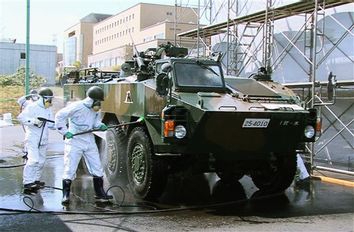
In this April 12, 2011 photo released by the Japan Defense Agency via Kyodo News, Japanese soldiers wash an armored vehicle to remove potential radiation contamination at J-Village, a soccer training complex now serving as an operation base for those battling Japan's worst nuclear disaster, northeastern Japan. The sports complex is about about 20 kilometers (12 miles) from the crippled Fukushima Dai-ichi nuclear plant. (AP Photo/Japan Defense Agency via Kyodo News) JAPAN OUT, MANDATORY CREDIT, NO LICENSING IN CHINA, HONG KONG, JAPAN, SOUTH KOREA AND FRANCE(Credit: AP) Japanese nuclear regulators trusted that the reactors at Fukushima Dai-ichi were safe from the worst waves an earthquake could muster based on a single-page memo from the plant operator nearly a decade ago.
In the Dec. 19, 2001 document — one double-sized page obtained by The Associated Press under Japan’s public records law — Tokyo Electric Power Co. rules out the possibility of a tsunami large enough to knock the plant offline and gives scant details to justify this conclusion, which proved to be wildly optimistic.
Regulators at the Nuclear and Industrial Safety Agency, or NISA, had asked plant operators for assessments of their earthquake and tsunami preparedness. They didn’t mind the brevity of TEPCO’s response, and apparently made no moves to verify its calculations or ask for supporting documents.
“This is all we saw,” said Masaru Kobayashi, who now heads NISA’s quake-safety section. “We did not look into the validity of the content.”
The memo has Japanese text, boxes and numbers. It also has a tiny map of Japan indicating where historical earthquakes are believed to have struck. TEPCO considered five quakes, ranging from 8.0 to 8.6 magnitude, in northeastern Japan, and a 9.5 magnitude across the Pacific near Chile, as examples of possible tsunami-causing temblors.
Over the next nine years, despite advances in earthquake and tsunami science, the document gathered dust and was never updated.
When TEPCO finally did revisit tsunami preparedness last year, it was the most cursory of checks. And the conclusion was the same: The facility would remain dry under every scenario the utility envisioned.
“There was an attitude of disrespecting nature,” said Kobe University professor emeritus Katsuhiko Ishibashi, who has sat on government nuclear safety advisory panels.
The towering waves unleashed by the magnitude-9.0 earthquake on March 11 destroyed backup generators for several reactors’ cooling systems, and nuclear fuel in three reactors melted in the worst such crisis since Chernobyl. Workers have yet to bring the plant under control more than two months later.
Ishibashi said the problem with the plant’s tsunami preparedness didn’t lie with the limitations of science back in 2001. The problem was that TEPCO and regulators didn’t look at risk factors more carefully.
“It is critical to be prepared for what might happen even if the possibilities are small,” he said.
NISA’s request for tsunami risk assessments did not have the force of law and thus the operators’ responses technically were voluntary, but in Japan’s often-informal regulatory structure, regulators would expect such a request to be obeyed.
TEPCO’s memo was entitled “The Assessment of Effects Related to the Japan Society of Civil Engineers’ ‘Guidelines on Tsunami Assessment for Nuclear Power Plants’ — Fukushima Dai-ichi and Daini Nuclear Power Plants.”
The company said it used measures for expected earthquakes and other “parameters” to calculate that water would not surpass 5.7 meters (18.7 feet) at Fukushima Dai-ichi.
The waters set off by the March tsunami reached 14 meters (46 feet) above sea level, according to TEPCO.
One big reason for the underestimate: TEPCO’s experts asserted that the biggest earthquake that the nearest fault could produce was 8.6 magnitude. At a 9.0 magnitude, the quake that struck was four times more powerful than that.
“The results of the study show the assessment for the maximum levels of tsunami at each site,” says one line in the report’s typically sparse, matter-of fact language.
The document relied on guidelines for tsunami assessments written by the Japan Society of Civil Engineers. Those guidelines were not published until 2002, but were made available in advance to TEPCO.
In the nearly 10 years since the memo, advances in science have exposed the potential — and precedent — for huge tsunamis hitting Japan’s northeast coast. Several studies showed that the Jogan tsunami of 869 A.D. went far inland in the area near Fukushima Dai-ichi. Other studies showed that the fault that erupted so violently was “stuck” and could produce the kind of truly massive quake it did.
Over the years, TEPCO never changed the maximum tsunami heights expected at Fukushima Dai-ichi.
“We assessed and confirmed the safety of the nuclear plants,” TEPCO civil engineer Makoto Takao asserted as recently as a November seismic safety conference in Japan.
Kobayashi, of NISA, said his agency began getting serious about scrutinizing tsunami dangers only late last year, but that this process was still in its infancy when the March 11 disaster struck.
Ishibashi noted that coastal nuclear plants need to be prepared for major typhoons and other potential disasters, and backup generators at Fukushima Dai-ichi should have been elevated and protected, not stored in basements prone to flooding, as most of them were.
The generators were critical for maintaining cooling systems for reactor cores during the power outages that followed the quake. The flood that swept through the plant grounds destroyed the generators. The cores, reaching up to 2,000 degree Celsius (3600 Fahrenheit) without power, melted, spewing radiation into the sea and air.
TEPCO spokesman Naoyuki Matsumoto defended the 2001 report as relying on what the company saw as the best data available, although he acknowledged that the March tsunami had been “outside the imagination.”
“We had done our utmost in designing the plant, using various historical data,” he said.
The utility now plans to build additional tsunami guards in waters near Fukushima Dai-ichi by the end of June, but has not decided how high they should be, he said.
Outrage is growing among the media, politicians and residents forced to evacuate from homes near the plant that regulators and TEPCO had not adequately assessed tsunami risks.
Some criticism has focused on how the civil engineers’ committee that wrote the guidelines was dominated by people with strong ties to the nuclear power industry, or 22 of the 35 committee members.
In a statement this month, the Japan Society of Civil Engineers defended the guidelines as objective and scientific, relying on experts for unbiased knowledge.
Nobuo Shuto, chief architect of the guidelines and the dean of tsunami research in Japan, acknowledged he did not check how exactly TEPCO applied the guidelines to Fukushima Dai-ichi. But he stuck by his work.
“It’s easy to complain that it was an underestimate,” Shuto, honorary professor at Tohoku University, said in a March telephone interview from Miyagi Prefecture, a disaster-struck area. “The honest truth is: We just don’t know.”
——
Pritchard reported from Los Angeles and can be reached at http://twitter.com/lalanewsman; Kageyama can be reached at http://twitter.com/yurikageyama
Loughner’s last night: Posed with glock, g-string
Police chronology reveals new information about the Tucson shooting suspect's final hours
Jared Loughner’s descent into violence took place on a furious all-night excursion through the dark streets of his hometown, meandering from one store to another as he prepared to take revenge on a world where he became progressively alienated.
He checked into a down-and-out motel. He picked up photos showing him holding a Glock 19 while wearing only a bright red G-string. He bought ammunition on one of three trips to two different Walmarts.
He called a high-school pot-smoking buddy, ran away from his father into a cactus-dotted desert and updated his MySpace profile to say, “Goodbye friends.”
Continue Reading CloseLoughner’s dad pursued him before shooting
Sheriff's investigators say Randy Loughner chased Jared, who had a mysterious black bag, into desert in his truck
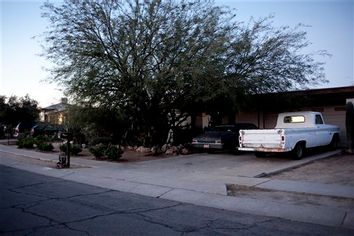
The home of Jared Loughner, at 7741 N Soledad Ave., Sunday, Jan. 9, 2011 in Tucson, Az. Loughner is accused of attempting to assassinate Rep. Gabrielle Giffords and killing six other people Saturday, Jan. 8, 2011 during a "Congress on your Corner" event at a mall in Tucson, Az. (AP Photo/The Arizona Republic, Mark Henle)(Credit: AP) Mysterious black bag in hand, Jared Loughner ran into the desert from his angry father, who was driving a truck on a futile pursuit.
Hours after Randy Loughner’s confrontation with his 22-year-old son Saturday morning, six people were shot dead and more than a dozen others wounded — and Jared Loughner was in custody.
The sheriff’s deputies who swarmed the Loughners’ house removed what they describe as evidence Jared Loughner was targeting Rep. Gabrielle Giffords, who doctors said Tuesday was breathing on her own for the first time after taking a bullet to the forehead. Among the handwritten notes was one with the words “Die, bitch,” which authorities told The Associated Press they believe was a reference to Giffords.
Continue Reading CloseOfficer stopped Loughner on day of shooting
Arizona Fish and Game says suspect was given a verbal warning after running a red light Saturday morning
The suspect in a deadly Arizona shooting ran a red light and was stopped by a wildlife officer less than three hours before the attack that wounded Rep. Gabrielle Giffords.
The Arizona Game and Fish Department says an officer stopped Jared Loughner at about 7:30 a.m. Saturday.
The officer took Loughner’s driver’s license and vehicle registration information. Dispatchers checked the information and found no outstanding warrants on Loughner or his vehicle. He was given a verbal warning and released.
Jared Loughner’s family breaks silence
Statement handed to reporters is the family of the Arizona shooting suspect's first public remark
The family of the 22-year-old suspect in the mass shooting in Arizona is expressing sorrow for what they called heinous events.
The family of Jared Loughner said in statement Tuesday that they care very deeply about the victims and their families and that there were no words that could express how they feel.
The statement handed to reporters outside the Loughners house is their first public remarks.
Jared Loughner is accused of killing six people and gravely injuring Rep. Gabrielle Giffords in a shooting at a grocery store Saturday.
BP’s shocking, spurious action “plan”
2009 strategy to handle potential spill lists dead experts, defunct Web pages and reams of faulty data
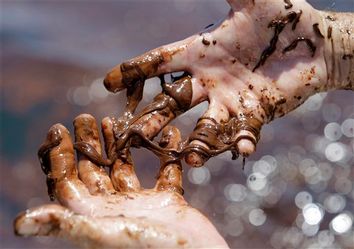
Marine reef ecologist Scott Porter works to remove oil from the Deepwater Horizon spill off his hands, Monday, June 7, 2010, in the Gulf of Mexico south of Venice, La.. (AP Photo/Eric Gay)(Credit: AP) Professor Peter Lutz is listed in BP’s 2009 response plan for a Gulf of Mexico oil spill as a national wildlife expert. He died in 2005.
Under the heading “sensitive biological resources,” the plan lists marine mammals including walruses, sea otters, sea lions and seals. None lives anywhere near the Gulf.
The names and phone numbers of several Texas A&M University marine life specialists are wrong. So are the numbers for marine mammal stranding network offices in Louisiana and Florida, which are no longer in service.
Continue Reading ClosePage 1 of 2 in Justin Pritchard