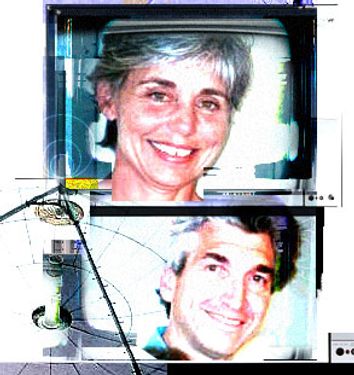
We tune in as Deborah Whitley, a Washington high school teacher, and Sima Daad, an English teacher in Tehran, Iran, meet via satellite videoconferencing. The two women chat about everything from the books they teach to the role of women in their countries; they introduce their families; and, more than once over the course of four days of dialogue, they politely suggest taking a break before a heated moment boils over. We’re privy to this conversation — an oddly intimate, public meeting that animates the deep-seated disagreements and mutual misperceptions of two nations — thanks to the efforts of Kim Spencer, who co-produced the program for PBS in 1998, and now airs it and similarly provocative programming on the American satellite station he founded, WorldLink TV.
Whitley eventually gets up her nerve to ask Daad about Salman Rushdie: “I would like you to explain how that death sentence was given to him.”
“We don’t allow some person pretending to be creative to insult and make fun of our principles.” says Daad. “He has to be punished because of the insult.”
Whitley grimaces. “I don’t understand how I can have a really horrible, terrible idea that I’ve expressed and I must be killed for it.”
“How does your country behave against a person who does a crime?” asks Daad. “For example, one person has killed another person. They send him to the electric chair; they take the life from him. This is only a physical crime, whereas people like Salman Rushdie do intellectual crimes, which are much, much more profound and much deeper than physical death and physical destruction. Don’t you believe so?”
“It frightens me,” Whitley answers, “because if this person’s free speech is interpreted as an insult, then everybody will be less confident to speak out for fear that their criticism will be interpreted as an insult. What’s the effect of that death sentence on free speech?”
“You needn’t worry about such things,” Daad responds. “Everyone with a little knowledge can understand the difference between criticism and insult.”
“I think I believe too much in the divinity of the individual,” Whitley says, “to understand how a person’s life can be taken for an idea even if I hate the idea.”
“This is the principle of my religion,” Daad replies.
Letting us in on this kind of cross-cultural tête-à-tête, focusing our eyes on people and places that are generally overlooked or dehumanized by politicians and the media, is a driving force behind the pioneering work of Spencer, 53, and Evelyn Messinger, 50. Husband and wife, the two independent television producers have spent decades grappling with rudimentary satellite technology and the bureaucratic rigmarole in foreign countries to, as Spencer puts it, “deliver on the promise of the picture phone.”
Two decades ago, when it took 2-ton satellites, big trucks and hundreds of thousands of dollars to let people converse via live TV, they managed to produce unimaginable conversations — like a 1983 link that allowed Soviet and American scientists to discuss the effects of a nuclear winter. The conversation resulted in unprecedented agreement; both sides admitted that a nuclear attack would have a devastating impact. “All of a sudden we realized we were not just making TV, we were shaping the relationships between these two countries,” Spencer says.
In 1988, with a bleak Cold War mentality dominating the Reagan administration and much of the United States, Spencer helped cajole members of the U.S. Congress and deputies of the Supreme Soviet to talk via satellite TV. The “Capital to Capital” series, co-produced with ABC News and Gosteleradio (the Soviet radio and TV committee), picked up two Emmy Awards and a Christopher Award.
As he continued arranging unlikely global conversations, Spencer’s documentaries continued collecting awards. The International Teleconferencing Association award went to “Vis à Vis: Cease Fire.” The show, conceived by Spencer, Messinger and their longtime partner, French TV producer Patrice Barrat, features a conversation between two teenage girls who grew up during war — one in Bosnia, the other in Ireland. Meanwhile, his work on “Vis à Vis: Beyond the Veil,” the Whitley-Daad conversation, made Spencer the first American TV producer to work independently in Iran after the 1979 Islamic revolution.
“I was doing interactive TV before they’d invented it,” says Spencer, a former “PrimeTime Live” producer who has directed or produced more than 50 hours of independent television programming. “Now the technologies are there to make it happen.”
Working out of a converted Victorian in San Rafael, Calif., and the WorldLink TV studio in San Francisco, Spencer and Messinger are looking to transform the boob tube into an audiovisual party line where people from all over the country, if not the world, can talk, hash out political differences and reveal experiences and perspectives that could change minds.
WorldLink, a 24-hour satellite channel broadcasting to 15 million American homes, is not a bad starting place. The channel launched in December 1999 to offer international and independent programming virtually unheard of on American TV. Spencer, WorldLink’s president, got on the air by taking advantage of a law that made a few channels on satellite cable providers DirecTV and EchoStar available free of charge to educational programmers.
Now WorldLink TV is home to “Karachi Cops,” a gritty series that follows the real-life dramas of a Pakistani police force apprehending criminals and coercing confessions, and “Black and Blue,” another cop series, which brings together two black officers, one in Soweto, South Africa, and one in Philadelphia, to talk about their jobs and the role race plays in their work. The channel airs foreign flicks like the Japanese hit “Tampopo” and documentaries about everything from the appalling conditions in a Jamaican hospital to the humiliation and depravation suffered by Nigerian widows. And WorldLink is the only place to find a daily two-hour world music block featuring Senegalese singers, Nigerian musicians and all manner of folks who don’t make the MTV rotation.
“We’ve always been interested in people telling their own story,” says Spencer. “We’ve focused not just on the movers and shakers but on the moved and shaken, which is really a way of thinking about who gets a chance to speak.”
Spencer’s vision for WorldLink TV clearly finds some influence in his years spent globe-trotting and living abroad. In 1982, Spencer and Messinger helped found the nonprofit Internews, which trains and supports independent journalists in emerging democracies — places like Azerbaijan, Uzbekistan and East Timor. In the 1990s, the couple lived in Paris, where Messinger worked as the electronic media director for the Soros Foundation. It sent her on extensive travels in Eastern Europe to help independent radio and TV stations establish themselves. Spencer spent that period working with Barrat, the French producer, traveling from Bosnia to South Africa to produce 13 “Vis à Vis” episodes for French television, each knitting together the personal and the political, and sometimes putting Spencer’s life at risk.
In 1992, months before U.S. troops arrived in Somalia, Spencer managed to get a two-and-a-half-ton satellite dish into the country to enable a video chat between a United Nations fieldworker confronting the hardships there and a U.N. official in New York who administered funds for such programs.
Says Spencer, “It was halfway through that the scariness overtook the journalist’s usual ‘Oh well, this is what the situation is and we’re going to be OK because we paid $100 a day for this jeep that was stolen from the U.S. Embassy that’s got a rocket launcher mounted on back and seven totally stoned Somalis ranging in age from 50 to 12 with various weapons.’ There was definitely beginning to be a breakdown in the system.
“The day that we hit a checkpoint and somebody yelled and the guy put a gun through the driver’s window and the bullet went out the passenger’s window and I was sitting in the front,” he continues, “it was at that point that it was, like, ‘This is getting a little out of hand.’ But by then we were there and we’d managed to get this satellite dish in and we were in the middle of doing the program.”
The crew got its tape, and then Spencer persuaded the United Nations to purchase the satellite dish, which became the communications hub of the country. “There was a sense of really being able to contribute something to a real situation,” he says.
“In the back of his mind,” says Spencer’s longtime friend and colleague Barrat, “he always has a secret agenda which has to do not with television but with the real life of the people around. And you realize that silently he has tried to achieve that too.”
Which is not to say that Spencer’s agenda for television isn’t lofty. Since his days at Reed College in the 1960s, Spencer has been out to change the world. His goal then, as now, is to find “the cracks in the monolith and find a way into American television to promote coverage of important issues that weren’t getting covered.”
“CNN gives you the world,” Spencer says, readily admitting that U.S. television now provides at least some international coverage. “The question is what are you seeing: You are basically getting a view of the world as packaged in Atlanta.”
On WorldLink the aim is to excise the mediator, so that the worldview presented changes with each hour of programming, with each independent voice whose story emanates from a culture or experience that’s likely to be vastly different from one’s own. “The real question about independent journalism is,” Spencer says, “are viewers getting the truth and what is the truth? The answer to that is in what we do, giving real people the opportunity to express themselves in a spontaneous and real and natural environment.”
You could argue that WorldLink’s independent documentaries, films and music videos are still framed by producers and editors who can’t help infusing the subjects with their own biases. But the channel intends to give people a true voice and has plans to create a platform for spontaneous viewer dialogue, through what Spencer and Messinger call two-way television.
Messinger, WorldLink’s director of interactive programming, is spearheading the project, which could ultimately involve viewers appearing live on TV through satellite video links set up in public places. Say you had just watched the “Vis à Vis” episode featuring a dialogue between an Israeli and a Palestinian and wanted to add your two cents’ worth. You might drive to a nearby mall and within minutes be linked to the channel by video to join a follow-up conversation. Instead of two talking heads in different TV studios à la “Nightline,” the channel would invite participation from people at a cafe or meeting hall — any place that can be wired for videoconferencing — and maybe some people linked from their homes or offices. Messinger believes this kind of public communication could revolutionize American politics.
“People are so used to being unimportant, to not having what they say matter,” she says, blaming the traditional media for drowning out the common person’s voice with a deluge of information and entertainment. “Particularly in the United States, this has completely disempowered people.”
To remedy that, she wants to give them a voice that carries just as much weight as that of their senator, a news anchor or any pundit on TV. Already Messinger’s done just that in pilot programs with several public television stations.
For example, in 1998, when the Minnesota governor’s race that brought us Jesse Ventura was on, Messinger helped the Minneapolis Star-Tribune, Minnesota Public Radio and the local KTCA-TV video-link people from four cities for a citizens forum on welfare reform. In outtakes shown on local TV, Mitch Pearlstein, president of the conservative think tank Center of the American Experiment, argued that any discussion of poverty must look at the issue of children born out of wedlock.
In front of another camera, placed in Minneapolis soul food restaurant Lucille’s Kitchen, Mahmoud el-Kati let Pearlstein have it. “How do people talk about these social problems without dealing with something like white supremacy and racism?” he asked. “We know that this is a socioeconomic problem that certain people cannot face and they continue indicting this whole group of people about their culture.”
Pearlstein tried to diffuse the anger, but those gathered for the citizens forum had already imbibed el-Kati’s perspective and were trying on a new awareness of the issue. As they broke into groups to think up questions for the gubernatorial candidates, a blond, blue-eyed man who surely came from Minnesota’s Nordic stock proposed one. “Do you think that poverty is a result of cultural or spiritual deficiency?” he asked. “That’ll say a lot about where [each candidate] is coming from and how he’ll address the problem.”
This is good stuff and Messinger knows it. But even with videoconferencing units now portable and pretty cheap (well under $10,000 for the Polycoms she and Spencer use), it takes money to create satellite links. And the fledgling WorldLink doesn’t yet have the cash to produce interactive shows.
So Messinger pursues her two-way TV vision as the president and director of the non-profit Internews Interactive. Recently the James Irvine Foundation gave Internews a grant to create interactive programming for PBS, and it is also busy bringing together, via private video links, soon-to-be-released prisoners from San Francisco jails with potential employers, as well as nonprofits and businesses wading through globalization issues after the disastrous Seattle WTO meeting. Eventually, Messinger hopes to transport more of her efforts to WorldLink. Many colleagues have no doubt she’ll make happen whatever she sets her mind to.
Larry Werner, the Minneapolis Star-Tribune’s reader involvement editor and one of Messinger’s partners in the Minnesota citizens forum, marvels at her ambition, even as he chuckles about her brazen approach. “She wants it all. She demands it all,” Werner says. She is “someone who illustrates that idiom that it’s far easier to ask forgiveness than permission … She’s like any really good creative person — it’s never good enough. The picture should be bigger, the camera should be at a different angle.”
Werner adds, “I think even the people who don’t particularly like Evelyn respect her passion and creativity.”
“Once you realize something could happen, you say why do some things happen and some things that could don’t?” Messinger asks. “Because somebody really kills themselves to make it happen. And I guess it’s me. I’m killing myself to make this happen.”
So is Spencer, who has had to trade in his cameras and flak jacket for a polished sales pitch. WorldLink operates on a bare-bones budget — $3 million last year to run a 24-hour channel. Spencer points out that Oxygen, the women’s cable channel that started at roughly the same time, burned through more than $300 million in its first year. But no matter how little he spends, Spencer must keep raising funds. WorldLink is commercial-free and must remain so under the terms of its license, so he must come up with nearly $10,000 a day, mostly from foundations.
Spencer admits that while he’s good at it, he’s not as thrilled by fundraising. “I miss being out there, being someplace like Kazakhstan, where the issues are life and death for a journalist, where if you actually get on the air and report the news freely, that’s going to change the whole country,” says Spencer. “That’s where there’s real leverage, where television really has meaning.”
He’s committed to the channel. “On the worst days at WorldLink, it’s like being part of this big business of American TV, just another channel, and struggling to finance it,” he admits. But he is buoyed by viewer response and optimistic about the future. “I remember where CNN was all those years ago, when people laughed at it, or Black Entertainment Television, which started out as two hours a week or something like that … The reality is that WorldLink TV is on the air.”
Isabel Allende may be a little in love with the risqué. She celebrated her 50th birthday by publishing a reverie on aphrodisiacs, complete with her mother’s erotic recipes. She confesses to a fantasy of swimming in rice pudding: “I dived in, and that delicious creaminess caressed my skin, slipped into all the crevices of my body, filled my mouth.” She tells me that she has read her daughter’s love letters and that they are “pornographic” and “wonderful.”
Certainly, the Chilean writer, who stormed onto the literary scene nearly two decades ago with the magic realist hit “The House of the Spirits,” does not stifle concupiscence. Her novels abound with secret basement love nests, illicit couples tiptoeing through snoring houses and aching for a hidden corner and the repeated rape of servant girls by a desirous patron. New York Times reviewer Michiko Kakutani derided Allende’s most recent novel, “Daughter of Fortune,” as a “bodice-ripper romance”; Allende says her readers were outraged that there wasn’t more action.
Going through her stream-of-consciousness, autobiographical writing, though, she’s really not a sensationalist; she’s just at ease with sexuality — playful, spirited, unabashed. Maybe she is the quintessential Latin lover. I see her at a book reading and find that her compact 5-foot frame is graciously buttressed by curves like those you’d find on a New Age fertility goddess; her jovial eyes captivate the almost all-female crowd.
She writes with abundance, never offering a quiet meal when a boisterous crowd can feast on “puff pastries, delicious vegetarian dishes, spongy tortillas and enormous cheeses from the countryside” (this while “fasting” during Holy Week). Common objects become animate beings, descriptions take on palpability; an aging boat, for example, is a ship “crisscrossed with ancient marine scars, a crust of mollusks on her matronly hips, exhausted joints moaned in the pounding seas.”
Allende tells me — as if you can read her work and not know — that she is a passionate person. Through her seven books (all of them bestsellers in at least one of the nearly 30 languages in which they are published), she suggests that some part of her psyche still inhabits a culture light-years removed from the liberal San Francisco Bay Area where she now lives. In that remembered place, there is brutal machismo, there is an entire language just for love and there is a power to sensuality and mystery that doesn’t coexist easily with the rational and pragmatic United States. In her writing, Allende chases that past with the gleeful determination of a child desperate to catch a miracle of color and life in a butterfly net. She is drawn inexorably to the years spent in Chile, between her childhood abroad as a diplomat’s daughter and her adulthood abroad, first as an exile in Venezuela during the dictatorship of Augusto Pinochet (who overthrew her uncle, Chilean President Salvador Allende), and now as an immigrant to California. Many of the seemingly tall tales wrapped into Allende’s impassioned love stories find roots, or at least inspiration, in her own familial legends.
She pulls the cover off some of these personal secrets in “Paula,” a family memoir written to her dying daughter, and in “Aphrodite: A Memoir of the Senses.” This ancestral lore is lush with humor and preposterousness. Allende’s grandmother is a clairvoyant, who uses her telepathy to send a sugar bowl skittering across the table. Her mother-in-law sits bare-bottomed in the living room, entertaining guests as she potty-trains Paula. Allende’s memories of this fantastical family have been steeped, no doubt, in her potent imagination, but not a word seems phony. Just the opposite. I fear Allende may be too truthful.
I find myself nervous for the friends and family who appear in her books: the ex-husband who must suffer her admission of cheating on him; the son, whose love life I surreptitiously track, meeting his wife in one book, and a new girlfriend in the next. I’m taken aback when Allende identifies by name those who’ve inspired characters in her novels, and even hints at one friend she’s saving for a future tale.
Allende may be a little in love with other people’s stories. No, it’s more than that. She is a top-notch, passionate story snitcher. And I find myself wondering if the people who know her best don’t demand immunity from fictionalization.
Is anything off limits?
You know, my mother and I write a letter every day. We keep in touch in a very intimate way, and we have an agreement that I will never tell her story, and that when she dies I will destroy her letters. I’m not going to comply with that part of the agreement though, so that after she dies I can open a letter a day for the rest of my life and always have the voice of my mother. I have 35 years of letters in a closet. But that’s off limits. I know that her stories, her privacy, the things that she has told me in those letters are something that I can’t touch.
When I wrote “Paula,” I didn’t have the intention of publishing the book, so I told the story in a totally candid way. When I showed the book to my mother and my stepfather and my son, they worried. They said, “Well, here we are with all of our names. Here’s Ernesto and Paula’s privacy, everything exposed.”
So, I made a copy of the manuscript and I sent it to every person who was mentioned, and everybody, including my former husband, got back to me saying it was fine with them. And then Ernesto, Paula’s husband, called. He was crying on the phone and said, “I think Paula would be happy to have this published. However, I think you have a very partial idea of who Paula was. You don’t know Paula the lover, Paula the friend, Paula the crazy, dependent, emotionally unstable little girl that I adored.”
And so he sent me a box with all the letters they had exchanged. They’re wonderful love letters, sexual letters, some of them really pornographic. It was shocking for me as a mother to read them, but it was also wonderful because I got to see a more complex person, the real Paula, not the one that I had invented or that I had raised and seen only from my angle. Parts of those letters I added to the book, verbatim.
In “Paula,” you depict your family as if it were the nectar of your soul, your very life force, which contrasts greatly with the way I think a lot of Americans feel about family. What do you think makes the idea of the “Latin family” so different from the American version?
The extended family in all of the third world is the only source of safety for a person. Your being exists in a community, in a family — if you are expelled, you’re lost. In the United States there is insurance, there is Social Security, there’s the government, there’s a lot of stuff. In other places, you know that if you are pregnant, if you are jobless, if you are sick, the only people who will be around you are your family. It’s a very symbiotic and, in many ways, pathological relationship, because you depend so much and you have to give so much back. It’s a heavy burden — a wonderful burden, but a very heavy one.
When I came to the United States, I had the feeling that I could invent a new life for myself, a new version of myself without anybody watching, without having to carry the sayings of my grandfather, the past of my mother — ahhh, free. It was a great feeling. Then as the years went by, I started to gather around me another extended family — people who are not even blood-related to me — because I can’t live without it.
It is the expatriate’s prerogative to change identities. How does that affect your writing?
I don’t think I would be a writer if I had stayed in Chile. I would be trapped in the chores, in the family, in the person that people expected me to be. I was not supposed to be in any way a liberated person. I was a female born in the ’40s in a patriarchal family; I was supposed to marry and make everyone around me happy.
The fact that I am a writer comes from the experience of being cut away from my roots and living in Venezuela, where I couldn’t find a place for myself, for years and years. And somehow I found a niche in the writing; I created a parallel world where I felt comfortable, a universe of my own. I tried to build or bring back all the losses — the country, the family, the memories, my grandfather, my grandmother, everything that I lost came back in the writing. That’s what I’ve been doing for the last 20 years, digging that unending well of memory.
What are you digging up now?
Right now I’m writing a book that started as a book for kids, well, young adults 12 years and up — and I have been flying. The writing is going quickly. Because it’s for kids I’m free to imagine whatever I want and I realize that the background of having lived in Latin America and having accepted since childhood the possibility of mystery, having understood that I know nothing, has helped me with this book a lot.
Can you tell me anything about this new book?
Well, it’s not done yet, but it’s the story of — no, I can’t tell you. [Laughs] Maybe you’ll read it.
You also have a book coming out in English this year.
Yes, “Portrait in Sepia.” It’ll be out in the fall.
You know, when I finished “Daughter of Fortune” — it is the gold rush seen from the eyes of a woman immigrant at a time when this was a male world of testosterone and violence and corruption and greed and a few women, most of them prostitutes. I didn’t want to write the story of a prostitute, so I wrote the story of this Chilean woman who comes looking for the man she’s in love with. She never finds the guy, and ends up with a Chinese doctor. When the book was finished, I thought that the ending was perfect for the story. It’s really about freedom, about a woman who was raised in a corset in Victorian times, in the most restrictive and repressive society in the world — that is, Chile — and she was able to discover the joy of freedom. So my ending was about freedom, not about love. But I started getting letters; the readers wanted to know why she and the Chinese guy never got in bed. Even my mother: “But what is this? I want them in bed, they don’t even kiss — what is this?”
I already had another book in mind. I wanted to write the story of Chile in the second half of the 19th century. It’s a fascinating time, a time of war, of very violent expansion for Chile; it was a very imperial and territorial country that took away a lot of territory from our neighbors. It’s a very important time because it shaped minds and it shaped a nation in a way, so when you see the brutalities that were committed in the ’70s by the dictatorship and everybody was so amazed that that could happen in Chile, well they shouldn’t have been. It had happened before; it was a matter of reading our history. So I was very interested in telling that story.
But because of all these letters, I decided to pick up a couple of the characters from “Daughter of Fortune” and bring them to the new book. I also picked up some characters from “The House of the Spirits,” so this new book “Portrait in Sepia” is like a bridge between “Daughter of Fortune” and “The House of the Spirits,” and my publishers are going to publish it like a trilogy.
What do you think about the arrest of Pinochet?
Finally the truth is coming out and it is more brutal than was ever expected. More people were killed and in more atrocious ways. There was a general on television explaining how they would pull out the eyes of the prisoners with knives, how they would chop the prisoners in pieces before they killed them — all this on television. For the families, it is good to finally know, on the one hand, that [their loved ones] are dead. But the suffering is just unbearable.
Pinochet has been under house arrest, and other generals as well. But no justice will be done. I mean it’s just impossible; no one will pay for these crimes and that is also painful. But I think the country needs to exorcise all the demons, open the graves, dig out everything and just expose the truth.
There is a percentage of the population — the extreme right — that denies everything with extreme arrogance, and when confronted with the facts says, “Well, they deserved it.” It’s a brutal experience for the rest of the people who suffered the repression.
There is also a refusal to accept the complicity, the fact that this happened because a large number of people allowed it to happen. And when a large number of people decided that it was not going to happen anymore it stopped. The Nazis wouldn’t have been able to get away with what they did without the complicity of the whole nation. And this can happen in any country — this can happen in the United States. The brutalities that whites inflicted on African-Americans wouldn’t have happened without the complicity of the whole nation — burning people alive, flogging them, branding them, bringing them in chains to this country. So no one is free, no nation is free of that capacity for brutality.
You say that when you write, you spend 12 hours in a room. Do you spend all of that time writing?
Most of it is spent writing. The writing is slow, but also it’s like going into another world in which I am the characters, I am every scene, I can smell it, I can look at it from different angles, I am totally immersed in it. Then, I go to bed at night and it stays with me and all my body is with the story and I start dreaming. I have a notebook next to my bed, and in the darkness I can write down a dream or something I think might help — most of it doesn’t, but sometimes it does. I’m tuned to the story completely, completely. Fortunately, it takes only a few months; otherwise I would be crazy, in an asylum. I really would. It’s hard for me to go out for a walk, to go to the movies. I don’t want to see anybody.
I try to let go of the intellect and just tell the story. I only read the page I have in front of me on the screen. Then when the whole story is told, I print it, wait a week and read it. I look at it for the first time on paper and with some distance and I know then what should be enlarged, what should be eliminated, what is repeated. And after that first reading, I write a second draft and then usually a third one in which I correct only language, and then I send it to my mother. And that’s the first time I confront the book with somebody else, and talk about it. It’s a very solitary pursuit.
In Spain, I send the book to my agent, who gives the book to my publishers. Nobody ever gets back to me saying, “You know what, I don’t like this part on Page 40″ or “Why don’t you change the ending?” Nobody. I have no editing.
“Daughter of Fortune” was an Oprah book —
I’m fascinated that this woman has the country reading. I’m a very good friend of Elaine [Petrocelli, owner of Book Passage] and she says every month people come to the bookstore and say, “Give me Oprah’s book.” They don’t know what the book is and they don’t care; they just want the book that Oprah selected because they trust her. I was fascinated by her personality and this airtight empire that she controls. She’s extremely powerful and charismatic and she’s herself. There’s nothing fake about her.
It must’ve been great for your book sales.
When they published “Daughter of Fortune” in the United States, they did 120,000 of the hardcover, which is a lot, and then when Oprah announced the book in her show, they printed 600,000 copies more. That’s the power of that woman.
How many of your books have been bestsellers?
All of them, and they’ve been long sellers. All of them are still in print. I’ve been extremely lucky. They’ve been translated into almost 30 languages now. It means that I can make a living writing, which is very important. Most writers spend most of their time teaching, doing seminars, journalism, other things, because they can’t make a living writing. It’s very hard.
I never expected this to happen. Never.
Continue Reading
Close
As of Friday at midnight PDT, Napster must shut down — or find some way to prevent its 20 million users from trading any songs copyrighted by the 18 record companies suing the MP3-swapping service for copyright infringement. This was the order of U.S. District Judge Marilyn Hall Patel, who on Wednesday granted the recording industry the preliminary injunction it was looking for, after poking holes in Napster’s arguments throughout a tense two-hour hearing.
“It’s pretty much acknowledged by Napster that this is infringement, because of the users’ agreement which implies infringement and by statements made in their own documents,” Patel said, in explaining her ruling — which, barring last-minute legal maneuvering or reversal between now and Friday, will remain in effect until she reaches a final decision in the case. The “statements” she refers to are early e-mail messages written by Napster’s teenage founder Shawn Fanning and others who helped build the business, touting their software as a way to get your favorite songs.
Patel’s decision was an instant defeat for Napster, the wildly popular tune-swapping service that has threatened to dethrone the record companies by helping music lovers find digital files on the hard drives of other music fans. And it was a harsh blow to David Boies, Napster’s lead lawyer — who is hardly finished celebrating the victory he won against Microsoft as the Justice Department’s counsel in the antitrust case.
Soon after taking on $15 million in venture capital and an attorney as its new CEO in May, Napster hired the high-profile Boies — an act widely seen as one of the first smart moves made by the revenue-less company. Basically, CEO Hank Barry felt the company’s legal defense should take precedence over figuring out a business plan — and he was right. But if Judge Patel sticks to the path she’s started down in this case, Barry may never need a spreadsheet.
Boies based his defense largely on two precedents. In the Sony vs. Universal Studios case, also known as the Betamax case, the Supreme Court held that VCRs were not illegal, because in addition to letting users make copies of copyrighted films, they were “capable of substantial non-infringing uses” such as recording television programs for later enjoyment, an idea the court called “time-shifting.” In the RIAA vs. Diamond Multimedia Systems case, an appeals court held that Diamond had a right to make Rio portable MP3 players because consumers have the right to create and transfer — “space shift” — digital music for non-commercial uses.
Boies and Daniel Johnson Jr., another attorney for Napster, argued that, like Sony’s Betamax, Napster could be used for “non-infringing” purposes — in this case, sampling new music before buying CDs or searching out unknown artists.
But Patel would have none of that argument, and sided with the record companies that say 87 percent of the songs found on Napster are copyrighted material. “While it may be capable of other things, these seem to pale in comparison to what Napster was created for, promoted for and how it’s used today,” she said. Napster’s claim that it was built for David not Goliath, small artists as opposed to big, looked like an afterthought, she added, something “that’s come lately to the table, after the suit started.”
And then she threw out the Rio argument. In her view, Napster is a whole different beast than a portable MP3 player or a VCR, in part because it takes advantage of the vastness of the Internet to connect a great number of people to each other’s music collections: “It’s not just a sharing among friends, not the typical kind of personal use.”
It was clear from early on in the Wednesday afternoon hearing that Judge Patel was not to be easily swayed by Boies. Less than halfway into the 20 minutes she had allotted him to present his case, Patel cut Boies off and gave him a minor tongue-lashing. As Boies explained that Napster is capable of substantial non-infringing uses, she interrupted to ask why, if people are using Napster for non-copyright infringing purposes, an injunction would put Napster out of business. “Isn’t that inconsistent with your argument?” she queried.
After Patel issuing her ruling, Boies stood up to ask for some leeway. The tan-faced attorney argued that by demanding that Napster prevent users from trading copyrighted songs, the judge was in essence asking Napster to shut down. Napster, he argued, can’t separate the copyrighted songs from everything else without listening to every file, in its entirety. “We don’t even have a list of songs that plaintiffs claim have been copyrighted,” he said.
But Patel would have none of it: “That’s their problem. They’ve created the monster and this is the consequence they face,” she said, adding, “They can have their chat rooms. They can have their new artists.”
Boies’ cohort Johnson also failed to woo the judge with his argument that the record industry created its own problem and that Napster shouldn’t be held responsible for it. “The ripping software [used to copy music from CDs to MP3 format] isn’t created by Napster, it’s created by Sony,” he told the court. “They have created their own monster and the monster is MP3.” The record industry, he argued, could have created an encryption system for music as early as 1988, but failed to do so and now — no matter what happens in court — MP3 files will exist and people will likely trade them. “It’s not my fault, it’s not Napster’s fault, it’s their fault,” he exclaimed.
But Patel found the arguments of Russell Frackman, an attorney for the record industry, far more compelling. In his opening remarks, he suggested that Napster’s wild popularity should be considered a black mark against it and estimated that within the few minutes it took for people to find their seats in the courtroom, 30,000 songs — the vast majority of which would be copyrighted — were downloaded using the service. “This is just the beginning,” he prophesied, “and your honor has the ability to nip this in the bud.”
Even after the injunction, his words ring true. Anything could happen. The full trial has not yet even begun. But it now seems even more unlikely that Napster will slip out of its tangle with the recording industry. Judge Patel has now ruled twice: once against Napster’s attempt to have the case thrown out, and now against Napster’s ability to continue unhindered while the RIAA’s copyright infringement case snakes its way through court. All evidence suggests she will remain a tough customer for Napster to win over.
Continue Reading
Close
Over dinner the other night, we were confronted by the craziest outbreak of dot-com mania yet — the menu. Akamai Chicken Pineapple Fried Rice? Inktomi Asia Burger? Business 2.0 Bok Choy?
Yep. It’s not exactly New York’s Carnegie Deli, which honors the Great White Way with monster sandwiches like “The Egg and Oy!” (chicken salad and boiled egg), “Fifty Ways to Love Your Liver (try chopped!),” “Nova on Sunday” or the “Woody Allen” (“lotsa corned beef, plus lotsa pastrami”). But the new Venture Frogs Restaurant, tucked into a corner of what was once an ornately tiled Cadillac showroom in San Francisco, may be the only place where tourists can actually bite into Silicon Valley culture.
“Each menu item pays tribute to a company that we believe has helped shape the Internet start-up world to what it is today,” says the reverential menu — written by a pair of Netheads who sold their first start-up to Microsoft for $250 million in 1998. Tony Hsieh, 26, and Alfred Lin, 27, two of the founders of LinkExchange, left Microsoft to start Venture Frogs, an investment firm and Internet incubator.
But how did these two high-tech entrepreneurs go from investing in Net start-ups like BBQ.com to serving up pan-Asian plates? “We run an incubator in the building,” says Hsieh. “We wanted to provide a place for all the people working at the incubator to eat — so they would basically never have to leave the building, and would work all the time,” he jokes. He and Lin also live in the building, which now houses a movie megaplex, a gym, offices and apartments. “It’s now pretty much its own little world in this building.” They eat in the restaurant almost every day, but you won’t find them wielding paring knives; they’ve delegated the daily operations to food service professionals, and Hsieh’s parents.
The entrepreneurs have plans to hold a monthly dot-com mixer, but the noisy Van Ness Avenue location is a long way from South Park — and just down the street from the Hard Rock Cafe. In fact, with its bar made of crushed bottles, computer chips and motherboard fragments, Venture Frogs has more of a theme park appeal than any of the pricey bistros trying to lighten the wallets of the dot-com set. You can just hear some wide-eyed Silicon Valley pilgrim eagerly ordering the eBay Eggplant, Cisco Chicken Salad and the Softbank Satay — and dreaming of the day he finds his own start-up on the menu.
The Microsoft Minced Chicken in Lettuce is, the waitress told us, the most popular dish. We tried it, but actually found the WebTV Korean Pancake much tastier. Apparently, there’s no correlation between the company’s performance and the quality of the dish. (Though this would be a great idea for an amusement park — we’d love to take our chances on the Amazon Roller Coaster, the Toysmart DropZone and the Microsoft It’s a Small World Cruise.)
Hseih says that alliteration was one of the guiding factors in names like Sequoia Springrolls and Palm Pad Thai, but that there wasn’t much rhyme or reason to naming the Little Dragon Dumplings after Excite or the oysters on the half shell after Kleiner Perkins. Only the true Net biz trivia buffs will get the references to Perkins Coie Pork Chops, named after a law firm, or the Series A Soy Beans, Series B Peanuts and Series C Roasted Peas, honoring rounds of investment, of course.
Like any new Internet company, the Venture Frogs Restaurant has a grand mission statement, and in this case it’s printed right on the menu: “The mission of the Venture Frogs Restaurant today is to embrace and embody the Internet start-up culture as reflected in the restaurant’s cuisine, design and attitude: fresh, modern, upbeat, informal and fun.”
Despite the menu’s sycophantic tribute to Internet greats, the food’s not bad. Gotta love those Wilson Sonsini Dry-Fried Beans! But there’s nothing less appetizing than finding an ad on your dinner table. Open your white linen napkin and you’ll find chopsticks sheathed in the standard white paper, printed with the URL of Zappos.com. Never heard of it? We hadn’t, but it declares itself to be “the Web’s most popular shoe store!” Fortunately, the disposable wrapper is the only place we spotted those creeping dot-com ads — unless you count the fact that the Zappos.com Crhme Brulie only made it onto the menu because it’s one of the firms funded by the Venture Frogs.
Of course, Hseih says, in the month since the place opened, several companies have already tried to buy placement as menu items. The Venture Frogs haven’t agreed to such a deal yet, but they’ll consider it “if there’s enough demand.” Coming soon to your plate: the sponsored meal.
Continue Reading
Close