Katharine Mieszkowski
Dolphins are dying to amuse us
SeaWorld and aquariums, implicated in the shocking new documentary about dolphin slaughter, "The Cove," strike back
The riveting new documentary “The Cove,” which opens in theaters nationwide Friday, exposes the annual slaughter of more than 2,000 dolphins in Taiji, Japan. The dolphins are among the more than 20,000 cetaceans, including whales and porpoises, annually killed in Japan.
In Taiji’s so-called drive fishery, fishermen in a menacing flotilla of boats herd wild dolphins, who are sensitive to noise, by banging pipes underwater. Fleeing this cacophonous wall of sound, the dolphins are corralled into a hidden cove and speared, clubbed and stabbed to death. By morning the entire cove is red with blood.
Salon film critic Andrew O’Hehir says the beautifully filmed and highly entertaining “The Cove” is “one of the most wrenching movies you’ll ever see. It raises troubling questions about how badly we have befouled the 70 percent of our planet that’s covered with water, and about why we have treated the species closest to us in intelligence with such cruelty and contempt.”
While the mass slaughter is horrific enough, “The Cove” raises another troubling question that hits closer to home. The documentary stresses that “dolphinariums” — performing dolphin shows, aquariums and swim-with-the-dolphin programs — have bought live dolphins from the Japanese fishermen, making them complicit in the marine mammal carnage.
“The Cove” has kicked spin departments at American dolphinariums into high gear. “We think we’re being unfairly criticized for something we’re opposed to, haven’t been involved with in 20 years, and when we were involved with it, it was for very good reasons,” says Fred Jacobs, a spokesperson for SeaWorld.
Adds Marilee Menard, executive director of the Alliance of Marine Mammal Parks and Aquariums, which has 50 member organizations in 10 countries, the filmmakers are “misrepresenting that the majority of zoos and aquariums with dolphins around the world are taking these animals.” The truth is not quite so simple.
According to “The Cove,” on the international market, a single live dolphin can sell for more than $150,000, while a dead one is worth only about $600 for its meat. The film argues that it’s the trade in live dolphins that creates the real economic incentive for the whole cruel hunt.
“All of these captures help create the largest slaughter of dolphins on the planet,” says activist Ric O’Barry in the film, who is the campaign director for Earth Island Institute’s Save Japan Dolphins.
O’Barry, who is the protagonist of “The Cove,” was the original dolphin trainer for “Flipper,” the hit TV show. He has spent the past several decades as an activist working to free the world’s captive dolphins. “I feel somewhat responsible because it was the ‘Flipper’ TV series that created this multibillion-dollar industry,” he says. “It created this desire to swim with them and to kiss them and hold them and hug them and love them to death, and it created all these captures.” He adds: “I spent 10 years building that industry up, and I spent the last 35 trying to tear it down.”
It’s now illegal to import a dolphin caught in Taiji, or any similar drive around the world, into the United States. “NOAA [National Oceanic and Atmospheric Administration] does not and would not issue permits to import animals from the Japanese drive fisheries. It doesn’t meet the humane collection requirement of the Marine Mammal Protection Act,” explains Tom Eagle, a fishery biologist for the National Marine Fisheries Service, which is a part of NOAA.
But that wasn’t always the case. While the Marine Mammal Protection Act was passed in the early ’70s, as recently as the ’80s, marine theme parks, including SeaWorld, aquariums and even the U.S. Navy imported dolphins captured in Japan in slaughter drives.
“There was a time in our history when we took animals from this hunt, and of course we viewed it in a defensible way; they were the only animals that were going to survive,” says Jacobs of SeaWorld. “If you could ask these animals: ‘Who wants to volunteer to go to an aquarium?’ I think that you’d have quite a few animals that would volunteer.” (In this hypothetical human-marine mammal conversation, the reply might be: “If it’s all the same to you, I’d rather just go back to the ocean, thanks.”)
In 1993, environmentalists at Earth Island Institute threatened to sue the federal government if it allowed the importation of four live Pacific false killer whales (which despite the name are actually a type of dolphin) caught in a drive in Japan. NOAA did not issue the permits, and hasn’t allowed the importation of dolphins from such barbaric captures since.
Bottlenose dolphins, like the ones made famous in “Flipper,” haven’t been captured in U.S. waters since 1989. The last capture of any live dolphin in U.S. waters was in 1993 for the Shedd Aquarium in Chicago. It’s a point that Steve Feldman, a spokesperson for the Association of Zoos and Aquariums, wants to make clear. “We don’t have these animals. We wouldn’t take these animals,” he says, adding that AZA supports a petition denouncing the dolphin killings in Taiji, which has so far collected 124,000 signatures.
So, where do the jumping, splashing, performing dolphins in the U.S. come from today? They’re mostly bred in captivity. “Over 65 percent of bottlenose dolphins in our collections right now were born there,” says Menard. What about the other 35 percent? Dolphins can live to be 30 or 40 years old, so some of those in captivity were indeed once wild. The others are their descendants.
Among the 218 zoos and aquariums that are members of the AZA, there are about 200 dolphins living in captivity. More than 75 percent of those were born in captivity, according to Feldman.
Yet every year, wild dolphins captured in Taiji continue to be sold in Japan and internationally to the captivity industry. O’Barry estimates that about two dozen live dolphins are sold from Taiji every year, with buyers including aquariums and swim-with-dolphin operations in China, Dubai, Turkey, Mexico and the Philippines. In an e-mail statement, the Japan Embassy in the United States confirmed that from Taiji, “live animals go to domestic aquariums as well as foreign ones, but we don’t have a specific number.”
Yet even in countries where dolphins captured in this cruel manner are no longer being displayed, activists argue that the industry has an obligation to do a better job policing its own. Lending support to an online petition and officially denouncing the practice is not enough.
While the World Association of Zoos and Aquariums has joined groups like the AZA in officially denouncing the Taiji drive fishery, it has not expelled its members who continue to trade in the dolphins captured there.
“Members of the World Association of Zoos and Aquariums should be taken out of that membership organization until they end the use of these drive fisheries as a source of dolphins,” says Mark Berman, associate director of Earth Island Institute. He argues that the AZA should also publicly condemn American citizens operating in other countries, who trade in the dolphins captured this way.
And aquariums and marine parks, who profit from marine mammals, could be doing more to educate their visitors about the horrors taking place in Taiji. “They could at least tell their millions of visitors that this is going on,” says O’Barry. “How can it be really educational if you don’t give them the information?”
It’s O’Barry’s conviction that no dolphin can thrive in captivity, regardless of whether it was bred there, or caught in the wild in a drive. “You’re talking about a creature that’s primary sense is sonar,” he says. “You have a sonic creature in a concrete box. There are generations of dolphins born in a concrete tank who have never seen the ocean, have never seen a live fish, and have never experienced the tides or the current. They’ve lived in a concrete box. They were born there. These are freaks that we have inbred for our amusement.”
The dolphinariums disagree. “Based on objective science, dolphins in AZA-accredited facilities are healthy, long-lived and thriving,” writes the AZA’s Feldman in an e-mail. “Not only do these dolphins receive great care, they play an important role in science-based education programs that inspire millions to care more and do more for ocean conservation.”
Whether “The Cove” will shame Japan into ending the killing of dolphins in Taiji rests on whether the Japanese people get to see the film. The Tokyo International Film Festival recently decided not to screen the film, despite the fact that the theme of this year’s festival is ecology, and rolling out a “green carpet.”
O’Barry is asking Americans to boycott dolphin shows to protest the slaughter in Japan. And in September when the dolphin drive begins in Taiji, he will return to the cove to try to bring more attention to the bloodshed. This year, he says he’ll have actor Ben Stiller in tow.
Pregnant women hit hard by swine flu
Expectant moms may be among first eligible to receive vaccine for influenza A H1N1
The first American to die of swine flu was a 33-year-old schoolteacher named Judy Trunnell of Harlingen, TX. She died on May 5, after slipping into a coma, and giving birth to a healthy baby girl by C-section. Now, American epidemiologists are finding that Trunnell’s experience was not a tragic anomaly, since pregnant women infected with this flu appear more likely to suffer serious illness and even die from it.
Since April, the Centers for Disease Control and Prevention believe that the virus formerly known as swine flu, now called influenza A H1N1, has infected one million Americans. Of 302 deaths in the United States to date that have been attributed to this flu, the CDC has detailed information on 266 of them, according to the Associated Press. The CDC has found that 15 of the 266 were pregnant women — or about 6 percent. That doesn’t sound like that many, but pregnant women only make up about one percent of the United States population.
Continue Reading CloseSushi to die for
Will bluefin tuna survive our insatiable appetite for status and taste?
This environmental crisis has everything: world-renowned chefs and Hollywood celebrities in an intercontinental food fight over the fate of one of the world’s great predators, the bluefin tuna.
Pound-for-pound, bluefin is the most valuable fish in the world, prized as a delicacy at the finest sushi bars. But after decades of overfishing, this magnificent fish, which can grow to weigh three-quarters of a ton, has been so severely depleted that it swims on the brink of oblivion. Yet its prized buttery flesh is still on the menu at Nobu, the celebrated high-end sushi chain, which is co-owned by Robert De Niro, and has 24 restaurants in 13 countries.
Continue Reading CloseBorn too soon
Vicki Forman's twins weighed only a pound at birth. She thought they should be allowed to die. Doctors disagreed
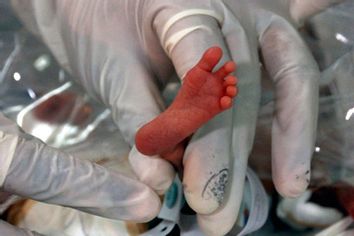
Above: A nurse holds the foot of Milagros Pimentel, a baby girl born at 20 weeks in a Colombia hospital. After years of trying to conceive, writer Vicki Forman’s twins were finally coming. Way too early.
Evan and Ellie were only 23 weeks gestation when Forman went into labor. They were so premature Forman thought she was having a miscarriage. At birth, each baby weighed only about a pound.
“One of life’s great illusions is the notion that we can want — and get — things on our own terms, no matter what. It’s human nature to seek pleasure and avoid suffering, but what happens when suffering finds you?” Forman writes in her harrowing new book “This Lovely Life: A Memoir of Premature Motherhood.” “My husband and I had tried for two long years to conceive these twins, had lived through miscarriages and fertility treatments to bear them. When I learned they were coming so early and so fragile, I had only one wish: to let them go.”
Continue Reading CloseNew York Times crazy with puppy love!
Why is one of the most powerful women in American journalism writing about her dog?
The most emailed story on the New York Times Web site right now is the debut of Jill Abramson’s new weekly series called “The Puppy Diaries,” about the first year of her new pooch’s life. Abramson is the Times managing editor for news, who can more typically be found fielding questions from readers on such weighty matters as the state of investigative journalism and Times’ coverage of the Israeli-Palestinian conflict.
Continue Reading CloseWhat’s the baby sitter up to?
She's the source of fear, frustration and sexual fantasy. A new social history looks at girls who care for our kids
The specter of the bad baby sitter has long haunted parents.
In the ’20s, a parenting guide cautioned Mom that a sitter might trundle her tender charge out on the town, so she could flirt on street corners. In the ’40s, Newsweek reported that one veteran and his wife had hired a girl who turned out to be a dance-crazed “bobby-soxer” inviting friends over to party, while the toddler in her care teethed on marbles.
Since then, the bad baby sitter’s renown has only grown, as she’s come to play a prominent role in urban legends, horror movies, pornography and even pop music, according to Miriam Forman-Brunell’s new book “Babysitter: An American History.”
Continue Reading ClosePage 1 of 142 in Katharine Mieszkowski