Katherine Ellison

Shopping for carbon credits

An environmentally conscious mom discovers carbon offsets are not always a smart buy -- especially from green-washing utility companies like PG&E.

  • more
    • All Share Services

Shopping for carbon credits

Like so many people I know these days, I’ve been feeling bad about my energy splurges: the four-block drive to my son’s school on rainy days, the kilowatts frittered away recharging the new latte frother.

I’ve got two young kids, so in my darker moments, I fear these sprees may add to the risk they’ll reach adulthood in a hotter, stormier world. Anyone who hasn’t just returned from a long silent retreat knows that Americans are among the world’s leading energy hogs in billowing emissions of carbon dioxide, the leading greenhouse gas. The United Nations calculates our yearly per capita average at roughly 20 tons per capita, about six times the world’s average. Unless we make deep cuts, soon, we’re in deep trouble, scientists warn.

On the other hand, it’s a drag to bike in the rain, and the frother keeps me out of Starbucks.

So when I realized I could make up for my household’s entire impact on the climate for the price of about half a dozen double lattes per month, I wanted to know more. Apparently, all I’d have to do is buy “carbon credits,” available by clicking a mouse online or by signing up on my monthly utility bill. My money would pay for projects billed as reducing greenhouse gas emissions, theoretically, at least, removing — or “offsetting” — as many tons out of the atmosphere as we’d put in. Somewhere in the world, trees would be planted; methane would be captured from cow poop, solar panels would be installed. Presto, we’d be “carbon neutral.” And I could froth in peace.

America’s embrace of the $100 million global “voluntary carbon credit market” — the estimate comes from the World Bank — reflects our singular moment in history. It’s a moment marked by the gulf between our first wide national recognition of the hugeness of our global warming fix and of our readiness to really take it seriously. With lots of talk, but still no federal law limiting CO2, well-intentioned individuals like me are increasingly shouldering the burden to act. Yet we’re easily overwhelmed by this burgeoning and utterly unregulated industry of carbon claim stakers. Go Zero. Drive Neutral. My Climate. Where on earth to start?

The dawn of the carbon market came in 1989, the year after NASA’s James Hansen made headlines by telling the U.S. Senate that the “greenhouse effect” was already changing our climate. Back then, the global power firm AES invested $2 million in a forestry project in Guatemala, specifically to acquire “carbon credits.” The rationale: Forests take carbon out of the air through photosynthesis and store it as they grow. “Carbon credits” had no legal value anywhere at that point, but AES managers figured they would soon enough. One day, they predicted, laws would limit greenhouse gas emissions but also give companies struggling to cut them at the source the option of “offsetting” them elsewhere.

That day has come for most of the world’s industrialized nations, which have ratified the Kyoto Protocol on climate change, but not for the United States, which hasn’t. Yet while petro-dollar-powered Republican legislators continue to filibuster against the mildest greenhouse-gas-cutting laws — such as one that would have required large electric utilities to obtain at least 15 percent of their electricity from renewable energy sources by 2022 — the voluntary U.S. carbon market has grown at a startling rate, leading to some wacky extremes, like the Hummer I spotted recently with the bumper sticker reading: “My Vehicle Is Carbon Neutral. What About Yours?”

Democratic Party stars like Hillary Clinton and Nancy Pelosi, and cutting-edge corporations like Whole Foods and Yahoo have jumped on the carbon-credit bandwagon, together with Al Gore, who, according to a blogathan of reports this year, offsets the energy used at his 10,000-foot Tennessee mansion. Gore subscribes to a plan offered by his utility company, the Nashville Electric Service, allowing him to pay more each month to subsidize renewable energy. He has also recently retrofitted his home with geothermal energy and relies on a popular American-Indian owned concern called Native Energy to offset some of his travel.

Stanford’s Steve Schneider, a trusted voice on climate issues, told me he’s also a fan of offsets as a “consciousness raising” device — “a way to get people under the tent.” I knew I didn’t want to be left outside that tent. So I ended up devoting a few days to checking out whether buying carbon credits made sense for my family.

The traditional first step for the serious seeker of neutrality is to calculate your household’s “carbon footprint.” I felt pretty smug about how we’d compare with the average U.S. gas guzzler. After all, we live in a small, well-insulated house. I telecommute, mostly, while my husband drives a Prius. I just bought an energy-efficient washing machine. And, yep, we’ve switched some light bulbs to compact fluorescents.

Googling “carbon calculator” filled my screen with dozens of options. I chose a site sponsored by the prestigious World Resources Institute, and filled in the blanks for our monthly gas and electricity usage and the number of miles my family members drive and fly per month.

To my distress, our total came to 24 tons per year — a result accompanied by a gloomy cartoon scene of a green figure enveloped in smog, with what looked like a dying bird flying by. I’d temporarily forgotten that rather major splurge of carbon and finances, a family vacation on Hawaii’s Big Island. Airplane travel is a huge source of fossil-fuel emissions. A single trip to Europe can add three to four tons to your footprint, according to the Tufts Climate Initiative.

Our total in fact ranked “average” on the WRI calculator. “Above average” gets you blue skies and a halo for your green guy; rank below and the sky turns black, a nearby tree loses its leaves, and the figure has a gas mask. (Note to Michael Pollan: The calculator left out the greenhouse gases involved in raising our food.)

Now of course the next ethical step would be to reduce our emissions at their source. And there’s so much we could do, from changing more light bulbs to installing solar panels. But frankly, like most other Americans, we’re not up to that level of sacrifice. So on to the purchase of offsets to atone for those 24 tons.

How much would I have to pay? That turned out to depend on what I wanted to spend. A recent survey of carbon-offset prices found the price of a ton, or “credit,” at anywhere from $5 to $50. I entered my 24 tons on the calculator of Native Energy, figuring if it’s good enough for Gore, it’s good enough for me. It said I could absolve my carbon sins for just $12 a ton, in payments of $24 per month.

On the other hand, I’d recently heard of an even cheaper and more convenient offset project offered by my utility, Pacific Gas & Electric. Starting June 28, through its new Climate Smart program, I could sign up to pay between $4 and $5 a month to offset my family’s electricity use.

I was really curious about this one. It’s the first utility-sponsored, customer-conscience-cleaning offset program, with an all-but-captive audience of about 5 million customers. And it has gotten such good reception — including an EPA award for its director — that other power companies might well follow suit, making them the biggest offset market of all.

But was it just green washing? PG&E, after all, is under heavy pressure in its eco-savvy headquarters city, San Francisco, for not moving fast enough to switch to renewable energy. Elsewhere, power firms are also under the gun. Nationally, they’re responsible for 40 percent of the nation’s greenhouse gas emissions. And, now, through their billing systems, they can get out the word to scores of millions of Americans about the best ways to reduce them.

That’s an instant edge in a highly competitive industry, and PG&E is making the most of it. The company expects to collect $20 million, over three years, from the 5 percent of clients it predicts will sign up to buy the offsets, says PG&E’s director of environmental policy, Wendy Pulling. In the meantime, it will spend another $16 million to administer and market the program. That extra money will come from a rate increase, averaging 2 to 3 cents a month, approved by California regulators. Which means even PG&E’s customers who won’t buy offsets will pay to advertise them.

The P.R. to date has been quite dramatic. The program’s stated goal is to take “two million tons of carbon dioxide from the air … the equivalent of taking 350,000 cars off the road for one year.”

How will it do that? The short answer is no one knows. PG&E is requiring that its offsets be registered and certified with a nonprofit agency called the California Climate Action Registry. The registry in turn requires projects to meet detailed standards and to be certified by a third-party agency. So far not one project had qualified.

Last December, however, PG&E spokesman Keely Wachs announced that customers’ dollars would initially be invested in California forests. Indeed, the project closest to meeting the registry’s standard involves selling credits from the 2,100-acre van Eck Forest in Northern California’s Humboldt County. Laurie Wayburn, president of the Pacific Forest Trust, which is managing that project, predicted it will be certified in August. (Pelosi and California Gov. Arnold Schwarzenegger have already purchased credits from the van Eck Forest, trusting the certification will come.)

As Wayburn explained, the van Eck Forest, unlike many others in the area, is managed in a sustainable manner, with only selective cutting of trees for timber. Foresters have calculated how many tons of carbon are stored through this management style, compared with what would have happened with more aggressive logging. Each of these tons, and thousands more tons the trust predicts will be stored in the future, can be represented as credits and sold. Wachs said that PG&E customers will “own” credits they buy from the utility. On paper, customers are buying into a project — a sustainable forest — that prevents carbon emissions.

This sounds good. But I decided to give it a closer look. I tracked down Charles Michler, an advisor to the Fred M. van Eck Forest Foundation, based at Purdue University in Indiana. Michler told me the forest’s current sustainable management is owed to a conservation easement placed on the property back in 2001.

A conservation easement means that a property’s owners have been paid for their agreement not to develop the land, a stipulation that stays with the land title, forever. But this easement went further, Michler said, including what he called “very strict” guidelines for conservation. In other words, my payments to PG&E for carbon credits weren’t going to plant or protect any trees in the van Eck Forest; that had all already been arranged. Indeed, the foundation board was still deciding what to do with the PG&E money if it came through. One possible use, Michler speculated, might be to fund another building for the forestry department at Purdue — a likely disappointment for PG&E customers who think their money will be used to plant redwoods.

I went back to Wayburn, in charge of the forest’s carbon-selling program, to ask what gives. She spun an analogy for me, comparing buying carbon credits from the van Eck trees to buying organic fruit. The farmer has already taken the risk of using organic methods, she said, hoping that enough buyers will support his choice. You, as the buyer, are not paying for the actual methods as much as sending a signal that you support the organic market.

On the other hand, if you buy organic fruit, you also presumably get something you can eat. And how, I was left wondering, could this equal taking 350,000 cars off the road? I decided not to sign up for the PG&E program.

Planting and preserving trees remains the most familiar offset strategy. Forests capture the imagination, after all. Andrea Tuttle, the former director of California’s Department of Forestry and Fire Protection, used to boast of the Golden State redwoods’ “charismatic carbon.” The popular affection for forests helps explain why at least half of the voluntary carbon-credit market has been devoted to them.

And, as a rule, preventing deforestation does indeed help protect the climate. As trees are cut and burned throughout the world, they release the carbon they’ve stored back into the atmosphere. Deforestation is currently one of the biggest sources of CO2 emissions, accounting for one-fifth of the global sum each year — almost equal to all of the U.S. emissions.

Moreover, carbon benefits aside, forests offer many other basic life supports. They control erosion and flooding, offer habitat to pollinators, and give humans spiritual comfort. None of these values, however, are incorporated into a gross national product — and until they are, forests will be valued only for their timber, which means, of course, they’ll be cut down.

That’s why the carbon-credit movement has stirred profound enthusiasm among embattled forest defenders all over the world, especially in the Amazon, where deforestation is proceeding at a rapid rate. By 2050, recent trends in chain-sawing could eliminate 40 percent of Amazon forests, according to a study published in the journal Nature last year. A big pool of carbon-credit dollars could fix that GNP problem once and for all, perhaps even making the Amazon forest competitive with encroaching soy farms.

That’s part of the hope of a new British eco-philanthropy, Cool Earth, which was launched to a passionate global reception, including an endorsement from Tony Blair. It’s selling protection of Amazon rain forest in Brazil and Ecuador for roughly $140 an acre to customers who sign up on the Internet, with a potential for carbon credits accruing to buyers all over the world. Credits for preventing deforestation are not recognized under Kyoto, but Cool Earth’s founders are betting that will change.

The odd-couple founders, U.K. Conservative Party member Johan Eliasch and former Labour Party minister Frank Field, have had their setbacks, including issues with the legality of titles to some 400,000 acres already purchased by Eliasch. But they’ve doggedly been working with Brazilian government officials to involve local residents in conservation efforts, and to offer an unprecedented solution to the nagging lack of transparency that has plagued similar efforts in the past. Buy one of their Amazon acres and you can monitor it on Google Earth. By the end of the year, Field has said, Cool Earth intends to have microchips placed in trees, allowing ever closer views.

When I last visited the site, 27,034 acres had been sold — testimony to the global zeal to stem the Amazon’s loss.

All this said, forestry carbon credits remain the most controversial part of a controversial industry. Major nongovernmental organizations, including the Tufts Climate Initiative, Friends of the Earth and Greenpeace are staunchly opposed. Forests are temporary, argue these critics. Even if stewards prevent them from being logged, they can’t guarantee against fires or diseases killing trees which would then release all the CO2 they’ve stored. So if you’ve planted trees with a mind to storing extra CO2, you then release extra CO2 into the world.

At a June 28 conference, PG&E’s Pulling suggested the company had focused on forests because of their popularity, but said it didn’t intend to invest in them exclusively. The Climate Registry plans to certify a range of nonforestry projects, including investments in methane digesters on farms (to capture those cow poop emissions).

Even so, some environmental groups are increasingly worried that corporate-sponsored programs such as Climate Smart ultimately undermine substantive climate solutions. A recent declaration by Friends of the Earth, which is opposed to carbon offsetting of all types, states the practice “is being used as a smoke-screen to ward off legislation and delay the urgent action needed to cut emissions and develop alternative low-carbon solutions.”

I returned to Stanford’s Schneider to ask what kinds of offsets he might buy. “It’s legitimate to put windmills in if you displace fossil-fuel power,” he said. “It’s legitimate to put coal emissions underground if you could figure out how to make that permanent. Financing a gas plant in India if they were going to put in coal would also be good.” The key with all of these is they reduce carbon emissions at their source.

Offsets along these lines do exist, in particular by four carbon-credit groups recommended by the Tufts Climate Initiative: My Climate, Atmosfair, Climate Friendly, and Native Energy. My Climate, based in Switzerland, sells credits for projects such as solar energy in Eritrea and biomass in India. Atmosfair, in Germany, underwrites solar power in South Africa and water recycling in a Thai palm oil factory. These projects have an eco-philanthropic appeal; they cut carbon and sometimes create jobs.

But has Schneider invested in any of them? No, he told me, in part because of how much time it would take to figure out which ones are on the level. As we spoke further, he acknowledged some serious ambivalence about the whole industry. “Volunteerism doesn’t work,” he said. “I’ve said this about 85,000 times. It’s about as effective as voluntary speed limits. No cops, no judges: road carnage. No rules, no fines: greenhouse gases. We’re going to triple or quadruple the CO2 in the atmosphere with no policy. I don’t believe offsets are just a distraction. But we’ll have failed if that’s all we do.”

I hung up the phone and made a decision. I certainly agree with Schneider that volunteerism won’t get us out of our fix. But not volunteering leaves me outside that trendy tent.

So here’s what I’m planning to do. After I pay off that washing machine, I’m saving up for double-paned windows, which I can monitor from my living room. I may even buy an acre of the Amazon. Although Cool Earth still looks like a big leap of faith, the situation is urgent, and my kids might find monitoring their piece of the tropics more educational than Runescape. But that’s pure eco-philanthropy. My climate offset strategy will be to budget the $4-$5 a month I would have sent to PG&E to support federal electoral reform. If we can uproot the petroleum lobby, perhaps we can replant Washington with politicians truly committed to legislating our way out of our global-warming fix.

Gone with the wind

The rich may be moaning about wind turbines ruining their coastal views on Cape Cod, but in Delaware, citizens are ardently battling politicians -- and the coal industry -- to build the nation's largest offshore wind park.

  • more
    • All Share Services

Gone with the wind

Peter Mandelstam says he can power 130,000 Delaware homes without adding to the greenhouse gas emissions dangerously heating our planet. His proposed 600-megawatt offshore wind park — the biggest such project yet unveiled in the United States — could supply that power over 20 years cheaper than coal or gas, he vows.

The tireless founder of Bluewater Wind, a wind energy developer, Mandelstam has been right before, having built a wind farm in Montana that provides power to more than 45,000 homes. And Delaware is no Cape Cod, where an offshore wind plan has stalled amid bitter controversy for the past six years. Polls show that offshore wind is overwhelmingly popular in this state, graded F for air pollution by the American Lung Association, whose coastal residents aren’t griping about their ocean views being ruined.

Yet Mandelstam still faces a gale force in persuading Delaware officials, lashed to coal and gas industries, to go along with his plan. “The chief obstacle is the newness of offshore wind,” he says enthusiastically. “It’s not new in the world, but it’s new in this country. So my challenge is simply to educate people.”

Delaware offers offshore wind the first ever chance to compete directly with fossil fuels, and it’s a relatively fair competition at that. Normally new energy sources must go head to head with fossil fuel plants already in operation, putting the new developer — who has to find a way to pass construction costs on to consumers — at a tremendous disadvantage.

But Delaware lawmakers last year declared they needed a brand-new source of power. Deregulation had led to a 59 percent power rate increase, and they wanted to make sure that wouldn’t happen again so soon. So last April, Delaware’s legislators called for competitive bids for a new, long-term contract with the state’s utility, Delmarva. Four state agencies are expected by June 15 to choose between Mandelstam’s wind-turbine project and competing bids from coal and gas.

“This is the front line on climate change,” says Willett Kempton, an associate professor of marine policy at the University of Delaware and an ardent lobbyist for renewable energy. “This is one thing we can do right now, at large scale, with no CO2 emissions, and at about the same cost as dirty power.”

Indeed, offshore wind could take us to a new energy future, free of carbon dioxide, or CO2 greenhouse gas emissions, faster than any other power source, say industry experts. Bye-bye, Saudi Arabia. So long, global-warming paralysis.

In the United States, wind represents less than 1 percent of all electric power generation, but that’s still enough to power 2.9 million homes. The industry is growing fast — wind-power production shot up 160 percent between 2000 and 2005, rising 27 percent just last year. For the past two years, wind has been the second-largest source of new power, after natural gas.

Today the most promising, and least known, source of wind power is that generated by offshore wind turbines. A newly released study by Stanford and University of Delaware researchers, including Kempton, says mid-Atlantic offshore wind could power the entire Eastern Seaboard, including transportation, with enough extra energy to meet a 50 percent growth in demand. Rapid advances in energy storage put this dream tantalizingly within reach.

So far, however, most U.S. politicians just aren’t reaching — in contrast with Europe, which already has 15 years of offshore wind experience and is racing to further exploit it. In Washington, Congress continues to bicker over greenhouse-gas laws with policy changes so incremental as to be all but useless — leaving wind evangelists like Mandelstam, combining missionary and monetary motives, as the country’s best hope to reach a crucial tipping point.

Yet Mandelstam faces daunting opponents in Delaware. Last June, six months before power-plant bids were officially due, Gov. Ruth Ann Minner and NRG Energy, based in New Jersey, released a joint statement announcing NRG would “move forward” with a “state of the art” 630-megawatt coal plant for approximately $1.5 billion. The plant would use “clean coal” technology, also known as IGCC, or integrated gasification combined cycle, which converts coal to gas before burning it. “I heard the NRG guys were already lighting up their cigars at that point,” Kempton says.

Minner, a Democrat, is on record as being convinced that human-caused carbon emissions are contributing to climate change. Under her leadership, Delaware in 2005 joined a multistate effort to reduce greenhouse gas emissions. What makes her embrace of “clean coal” rather odd is that her own administration calculates that the IGCC plant would emit 475 tons an hour of carbon dioxide, a major greenhouse gas.

Two other factors make it less odd. First, NRG already owns a coal plant on southern Delaware’s Indian River — a facility, dating back to the 1950s, that is one of the state’s leading sources of pollution, belching acid-rain-causing sulfur dioxide and mercury emissions. NRG has been fighting state regulators’ recent orders to clean it up, but as part of the deal with Minner, it has promised to patch things up and close the oldest part of the plant. Nor, most likely, did it hurt that NRG’s lobbyist, Mike Houghton, has been a major fundraiser for Minner and other state Democrats — so major that he was given a special award at the party’s annual dinner last year.

Minner, by the way, appoints the heads of three of the four commissions that will be making the energy decision. Her press department and chief of staff declined or ignored repeated requests for an interview. Houghton also declined comment, other than to say he saw no conflict in his dual role.

Minner isn’t alone in paving the way for coal. Also in June, Delaware’s two U.S. senators, Joe Biden and Tom Carper — both Democrats, and Rep. Mike Castle, a Republican, wrote to the U.S. Department of Energy to support federal tax breaks for the proposed new coal plant.

Like Minner, all three pols are on record as concerned about climate change. But it took Kempton — who bristles with impatience over what he calls “a lack of policy response wildly out of sync with what scientists are saying” — to do something to make climate change an issue in the state’s choice of power. Last summer, he and his university colleague, Jeremy Firestone, took the unusual step of personally calling offshore wind developers to invite them to compete.

Among a half dozen entrepreneurs they called, Mandelstam alone took up the challenge, rushing to prepare his bid in time for the December deadline. He’s been “educating” ever since.

On a recent afternoon, Mandelstam is gamely lugging the largest briefcase I’ve ever seen — a 2-by-3-foot carrier enclosing $60,000 worth of photographic simulations he’d commissioned to prove what little impact his turbines would have on the view from Delaware’s Rehoboth Beach. “Look at this!” he urges, spreading the enormous layouts on a coffee table. “On a clear day, with the sun directly on them, they’re less than half the size of your thumbnail. Does this destroy the beach experience?”

A heart-on-his-sleeve vegetarian who dresses like Gordon Gekko, Mandelstam, 45, came to Delaware from New Jersey anticipating view-related hostility, which he says has been a leading bugaboo of wind power. Not far away, in Cape Cod, aesthetics have all but defeated another bold wind-warrior, Jim Gordon, CEO of Cape Wind. Gordon has sunk six years and $25 million of investors’ funds into a 130-windmill project that still has no permit but plenty of opposition from such distinguished local property owners as Sen. Edward Kennedy.

The Web site of the Alliance to Protect Nantucket Sound, formed specifically to thwart Gordon’s project, stresses the potential view impingement, while also emphasizing that “newness” problem — arguing the Cape Wind project could turn a treasured seashore into an “industrial experiment.” Contacted recently, Gordon characterized the Nantucket alliance as a “small group of very wealthy waterfront homeowners who’ve spent millions of dollars fueling a campaign of fear mongering and misinformation.”

In Delaware, however, residents seem less concerned about their views than by the quality of their air and by scientists’ predictions that one-third of their state could be under water if Greenland melts. More than 90 percent of respondents in a University of Delaware opinion survey, said they preferred offshore wind to fossil fuels, even if they’d have to pay more.

“We’ve never had an alternative until now,” says Nancy Feichtl, a retired school principal particularly outraged by the steady climb of “ozone alert” days and the number of kids with asthma in her district. The daughter of a former manager of the Indian River coal plant, Feichtl herself suffers from asthma, as does her sister. Her only brother died of the same illness.

In January, Feichtl and a half dozen other wind advocates meet over coffee and muffins at the home of Bill and Kit Zak, founders of a local group called Citizens for Clean Power. The Zaks live just a 10-minute drive from the Indian River plant. Kempton has driven down from Wilmington to join them.

The group reflects Delaware’s changing demographics, which provides hope for Mandelstam’s bid. Besides Feichtl, the attendees include a doctor, a lawyer, an accountant and a former EPA regulator, most of them in their 60s. They are particularly health-conscious: Three of the women are cancer survivors. They are also fighting mad. In the Zaks’ driveway, parked cars sport bumper stickers saying, “What Would Jesus Bomb?” and “What This Country Needs Is a Buddhist President.”

Southern Delaware has long been known as “lower, slower Delaware,” an epithet quickly becoming outmoded by a flood of well-educated retired immigrants from nearby urban hubs like New Jersey and Washington, D.C. They came for the more relaxed lifestyle, lower cost-of-living and access to popular beaches, but few were warned by their real estate agents about the scourge of lower Delaware, the Indian River coal plant. A number of them now devote their newly expanded leisure time to civic activism. The Zaks’ group and others help keep pressure on state regulators, who finally last year cracked down on the coal plant’s pollution.

The group at the muffin meeting divvy up responsibilities, pledging to target local legislators and civic groups who might influence Minner or the commissions. Kempton says he’ll call the Unitarians and the League of Women Voters. Bill Zak scribbles a note reminding himself to contact the American Lung Association and the AARP. Everyone attending promises to write a letter to Delaware newspapers and to show up at public hearings. “We could wear those little beanies with propellers!” someone suggests.

The beanie demonstration has yet to take place, but the popular sentiment in favor of wind has clearly helped level Delaware’s playing field. The state agencies that had been geared up to make a decision in February took the contract off the fast track, postponing it until June. Meanwhile, NRG, under siege, has been forced to clarify its stance on greenhouse gas emissions.

In January, NRG was running newspaper ads promising to “capture” its CO2 pollution — leaving unanswered the obvious question of what it would do with that pollution thereafter. In weeks since, an answer has gradually emerged. Ray Long, NRG’s regional president, tells me the company could capture 65 percent of those emissions and plans to sequester, or store, them in underground saline aquifers.

“We’ve been working with a national geology company to help us look at the geology around the Indian River plant,” Long says. He declines to provide the name of the company, but says it assures NRG that sequestration is possible.

That’s taking a big leap of faith — and expecting Delaware to leap along. As Long acknowledges, the technology to sequester CO2 from a large power plant is still in the works and has yet to be tested anywhere. “This is all cutting-edge, essentially the wave of the future,” he says.

The greenhouse-gas issue, worrisome as it is, has been less damaging to NRG’s “clean coal” bid than, surprisingly, simple economics. In February, a state-hired consultant (one more product of Delaware’s belatedly democratic process) rated the offshore wind plan as less expensive than “clean coal.”

The new cost-competitiveness of wind power is in fact a landmark development, and one that knocks down a major barrier. It is the result of improved technology, a double-digit growth rate for the wind industry, and the rising costs of coal and other fossil fuels.

In Delaware, Mandelstam plans to use 200 giant 3-megawatt wind turbines, with 160-foot long blades. The larger the turbine, the more power it generates, bringing down average costs. Furthermore, he points out, once the turbines are built, wind power won’t depend on a commodity, like coal, that has recently jumped up in price.

Mandelstam and other renewable-energy leaders also make the point that costs of fossil fuels are bound to rise as the new Democratic congressional majority pushes for the regulation of greenhouse gases. A price on greenhouse gas emissions — in the form of a carbon tax or other regulatory measure — would more truly reflect the health and cleanup costs that have been long subsidized by society.

“What we have to offer is stable price power with no hidden cost, every hour for 20 years,” Mandelstam says. “If people look at that, they’ll see it’s a sensationally terrific deal, strictly on a business basis.”

So what about the birds? While the toll on birds flying into turbines has long been a grisly problem for wind buffs, it hasn’t influenced Delaware’s debate for some good reasons. A lot has changed since wind’s first huge bird-related fiasco: California’s ill-conceived Altamont Pass wind farm. Built in 1982 as one of the first U.S. commercial wind plants, its turbines were placed along a major raptor migration corridor, in the heart of the highest concentration of golden eagles in America. A report by the Arizona-based Center for Biological Diversity says the project has killed as many as 1,300 birds of prey each year.

Three things have happened in the past quarter-century, however. Strict avian-impact studies are now required for wind development. Wind technologies have become less lethal, with slower-moving blades and warning systems. And perhaps most important, as predictions of global-warming risks have become steadily more alarming, bird lovers are getting a grip. Last winter even the National Audubon Society went on record as supporting wind. Its president, John Flicker, pointed out that while bird kills by windmills may be grisly, the toll is far lower than that exacted by coal power, via air and water pollution and climate change, which are hastening the extinction of entire species.

In the end, as Mandelstam predicted, the “newness” of offshore wind may be the biggest hurdle here in Delaware. “You may not want to be the last state to put up a coal plant, but you don’t necessarily want to be the first state to put up an offshore wind plant,” state representative Joe Booth told me at a public meeting.

NRG has capitalized on this apprehension, running ads characterizing wind power as “intermittent,” raising the fear that Delawareans could be left in the dark. That simply isn’t warranted, explains Joe Kerecman, a vice president of PJM, the world’s largest electricity market, stretching from New Jersey to parts of Illinois. Kerecman says introducing offshore wind wouldn’t lead to any unreliability in power supplies. “We’ve got the power to handle it,” he says. At times of intermittency, Delmarva, the utility, would simply buy power from the grid.

Moreover, as Mandelstam points out, offshore wind is significantly more constant than onshore wind. He said he could provide power 87 percent of the time, which he maintained was similar to a coal plant, which must close periodically due to maintenance and other technical issues.

If governments finally commit to ramping up this resource, it wouldn’t be a hard fix to guarantee even more reliability, according to Mark Z. Jacobson, director of Stanford University’s Atmosphere/Energy Program, who says turbines could be sited to complement each other. “With this huge resource offshore, it’s just stupid to build new fossil power plants anymore in this region,” Jacobson says.

Kempton isn’t making any predictions of how things will shake out in June. He says wind’s toughest competitor at this point may be “no bid”: a decision to do nothing and simply buy more power from PJM. If the wind boosters prevail, however, and offshore wind gets its first foothold in Delaware, that big contract could help the entire industry ramp up, sending signals all the way to China that offshore wind is a good bet.

Mandelstam remains optimistic. In the post- “Inconvenient Truth” era, public opinion is demanding stronger action on global warming. More than a dozen states have set mandatory requirements for renewable energy. And in the wake of Cape Wind’s pioneering plan, offshore projects are now being proposed not just in Delaware but also in Long Island and Texas. “I take the long view,” he says. “Eventually renewables — biofuels, wind, geothermal — will provide all the power on the U.S. grid.”

Mandelstam is also diplomatic. His experience in Delaware, he says, has shown that “democracy works. Fairness and competition work. It has just taken a lot of focus and effort this time.”

Continue Reading Close

The agony and the ecotourism

Two progressive resorts in Chile exemplify the baby-boomer shift from bare-bones backpacking to pampered adventure.

  • more
    • All Share Services

The agony and the ecotourism

Deep at the bottom of a red-walled canyon,
half a dozen travelers soaking in a meticulously landscaped hot spring
watched a tray of sun-struck Pisco Sours floating their way.

It was one of the most decadent things I’ve ever seen. And to my
guilty dismay, all I could think was: These people really know
how to camp.

Only later did it strike me that my sympathy for this scene, arranged
by thoughtful minders from the luxurious new explora hotel in Chile’s
stunning Atacama desert, showed not just how much I have changed, but
how much tourism has changed in my lifetime.

For me, like many of my baby boom peers, the 1970s and ’80s were years
of cheap and easy exploration. I rode a battered jeep through African
plains, camped on Asian beaches, even followed a ragged band of Huichol
Indians in Mexico on their annual peyote pilgrimage.

Now, at 42, I’ve got a lot more baggage: a husband, two babies and editors who have kept me on a tight leash. No longer do I — if, frankly, I ever did — look forward to long bus rides or sleeping on the ground. Yet while I have grown rather less carefree and brave, my hunger for nature has become more intense as pristine wilderness has turned into a scarce commodity.

I’m not alone, of course. My generation of travelers is distinguished
by both our surplus of cash over free time and our nostalgia for the
plentiful open spaces of youth; clean lakes and clear skies are now
a kind of luxury good, as exotic as Asian temples. We’ll travel farther
for our nature and pay more to enjoy it, supporting the kind of
$2,441-a-week “ecotourist” binges offered by Chile’s quirkily elegant
explora firm (which insists on its lower-case e), as well as the increasing array of similarly priced, carefully catered ventures offered by U.S. firms –
such as the Tierra del Fuego sea-kayaking tours advertised by Berkeley’s
Wilderness Travel.

Just how did we get here? It’s been a long, strange trip. Until the
middle of this century, long-distance travel was an elite pursuit,
engaged in by scholars, soldiers and the then-tiny group
referred to as the leisure class. But with World War II’s end, global
tourism began taking off; and in the 1960s and ’70s, more and more middle-class travelers ventured to Europe and beyond, while backpackers clogged the Asian overland trail. By the 1990s, tourism had become the planet’s biggest business.

In 1997, international tourists took an estimated 595 million trips,
spending $425 billion, according to the World Tourism Organization. Those numbers are expected to grow by an average of
4.3 percent a year over the next two decades. Already in 1994, Richard
Barnet and John Cavanagh were reporting in their book, “Global Dreams,” that one in 15 workers worldwide was employed “transporting,
feeding, housing, herding, cosseting or amusing tourists.”

Traditional tourist haunts have long been showing the resulting wear and tear. Bali’s beaches are packed with inebriated Australians. Yosemite National Park is a human stampede. Trekking in Nepal increased 255 percent from 1980-91. “There isn’t a rock between Bangkok and the beaches of Hispaniola that does not recoil from suntan oil, and the gurgle of Coca-Cola,” Noel Coward was lamenting even 30 years ago.

But in the late 1980s, the advent of “ecotourism” promised a conscientious enjoyment of the earth’s last wild, clean corners.
Environmentalists championed it; even international bankers extolled its
potential for drawing hard currency to developing countries, the
traditional supplier of raw materials to industrialized yuppies.

Still, the concept has been liberally interpreted. Having lived in Mexico and Brazil for the past 12 years, I’ve watched the
wave of hype, as ECOTURISMO! signs have beckoned travelers to anything from a simple nature walk to an air-conditioned stay in a 200-room hotel. Off the coast of Florianopolis, an island in southern Brazil, I once, by awful accident, took an “ecotourist” trip on a boat full of
dancing young women in penguin-print bikinis; our tour involved chasing dolphins while blasting loud AM-radio hits.

This made me all the more grateful when, in 1996, I got a chance to visit explora’s first hotel, in the middle of Chile’s Torres del Paine park.

My husband and I had always wanted to see Patagonia, the southern, windswept region famously described by Bruce Chatwin as the “last place on earth.” And when we heard of the comforts of the new hotel, we figured we might as well bring along our 14-month-old son, Joe. Given the reception we’d been promised — with hot baths, three generous meals and a crib — this certainly wouldn’t amount to child abuse, we told ourselves. Joe simply had to endure the three-hour flight from Santiago to Punta Arenas and a six-hour van ride to the park.

We had some second thoughts, of course, after watching our little
bundle of love throw up four times on the windy, storm-swept
roads, to the endless tune of the “Sesame Street” theme song on
his miniature, Bert-and-Ernie tape player. But by then it
was too late. When we pulled up at the strange wooden 30-room inn,
perched on a wild and empty cliff, we were bedraggled and worn out
and guilty and smelly as only new parents can be, and were wondering if we had made a terrible mistake.

Inside the hotel, a huge fire was burning in the grate and white-jacketed waiters were scurrying back and forth with plates of lamb,
salmon and ceviche and carafes of fine Chilean red wine. One paused to
place a gleaming champagne bucket under a small leak in the roof. The
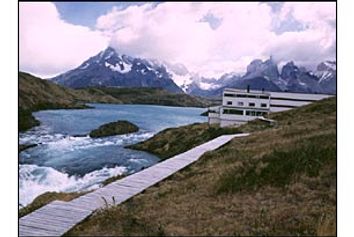
huge picture windows in the dining room looked out on Lake Pehoe and
the snowcapped, 6,300-foot “horns,” or Cuernos del Paine, above it. Not
a single other man-made structure — or man, for that matter — was in view.
Later that evening, bilingual guides assembled to describe the hikes and horseback rides we might take the next day, to visit spectacular glacier
fields and valleys full of wildflowers. Joe napped, and we all began to
feel better.

Other guests must be feeling pretty good as well. Recently, I heard that the Patagonia explora is almost completely booked into 2001.

The setting for the larger explora hotel, which opened just last year, is equally striking. It sits on an 8,000-foot-high plane in the Atacama desert, the driest place on earth, surrounded by active volcanoes. The resort is
within easy traveling distance of a Diane Arbus gallery of freaks of nature,
including the Crying Grandpa geysers, the Valley of the Moon’s
craggy lunar rock formations, and a warm, dead lake with a freezing cold
surface, surrounded by squawking flamingos and so full of minerals that
you float. Yet it’s also just an hour’s drive from the nearest
airport, which was good news for Joe.

Until he quit the company in a design dispute this year, German del Sol,
now in his early 50s, was explora’s chief architect, and he
still serves as an unofficial spokesman for its concept. His exuberantly
romantic style, with its affection for sweeping staircases, enormous
windows and splashy colors, has won international praise.

Del Sol also bears primary responsibility for explora’s pampering style. He fervently believes, along with the Wallace Shawn character in “My Dinner with Andre,” that life in general is “abrasive,” and that
nature offers an antidote, as long as one takes care to soften nature’s
rough edges. (At the firm’s two hotels, this includes heated pools,
Belgian chocolates on the pillow and van drivers who rush to place a
little stool under the toes of descending guests.)

“Backpackers have told me this is not the true experience of
wilderness,” del Sol told me, without a trace of irony, in his airy
studio in a hydrangea garden in Santiago. “Only if you have to pick up
your tent and fix your own meals can you have the full experience. But I say, to the contrary: If you are worried all day about surviving, you don’t have time to just be. With explora, you can go out in the rain all day
and not care because you know you can be in a Jacuzzi in the evening.”

Of course, there are travel options available between bare-bones backpacking and the explora’s extreme-luxury approach. Even in the Atacama desert and Patagonia, one can find modest and reasonably comfortable three-star hotels — if you don’t mind a little mildew smell and some disappointing meals.
But del Sol understands that my generation loves its SUVs and gourmet olive oils.

During my stay at the Atacama hotel, I ran into a tour group of a couple
dozen U.S. travel agents. They predicted the resort would be a major hit with harried but adventurous North Americans of a certain age.

“Boomers want the class, the comfort, the Jacuzzi and the wine –
especially the wine — and they also want to be outside,” said Betsy
Donley, a Phoenix-based adventure travel specialist, who was still a bit
breathless from her gallop over sand dunes in the Valley of Death.

Explora journeys, to be sure, aren’t risk-free. Visitors to Atacama
must sign away any intention to sue for accidental injury or death, after reading a warning presented in del Sol’s quaint English style: “As you may have already notice, or will become aware shortly, you are in the remote, in the “finis terrae” of all explorations. Everything you shall see and
experience is the real matter of things. Nothing has been altered,
domesticated of softened. This is it, in itself.”

At least three tourists (apparently none from explora) have died in the area, either by standing too close to geysers or slipping while
climbing volcanoes. As del Sol noted, Chile’s nature isn’t
“domesticated.” The tall, steaming geysers, which would surely be fenced
and patrolled were they in the United States, simply appear after a turn
in the road on a vast plain a couple hours’ drive from the hotel, with nary a warning sign.

Even so, with their sharp eyes, extra jackets and gloves and little
stools, our guides made us feel they would pamper away our most
unreasonable anxiety. When a middle-aged German insurance agent suddenly panicked at climbing down a steep, 5-foot-high rock path, for instance, during a long walk through the Valley of the Moon, one of the two guides assigned to our six-person group led him and his wife back to our starting point, two hours away, so that the van could later swing back and take them home.

Such treatment only stoked my own fear that a lightning bolt would hit
me any minute for so completely renouncing the hardy travel codes of my
youth. All I could do was remind myself of the bright side of
ecotourism, which at its best meets the definition of the
the Ecotourism Society in Vermont — “responsible travel …which
conserves the environment and sustains the well-being of local people.”

Most mainstream environmentalists today are indeed convinced that
“responsible” travel is the best hope of protecting remote areas. And
there’s no question the pursuit has imported hope to corners of Africa,
Asia and Latin America that have little to offer besides natural beauty.

Del Sol emphasizes his own responsibility when he discusses the
design of the exploras, especially the one in Torres del Paine. That
hotel, long and narrow, resembling a beached ship on its mountainside,
was designed with its own unique waste-treatment
system so as to avoid dumping into the lake. It processes the sewage not
with chemicals but with a complex system of chambers, filters,
ultraviolet light and two kinds of beneficial bacteria.

The relatively small hotel also uses some solar power, burns dead wood
bought outside the park and, in general, avoids the overall impact of your
average Sheraton.

Del Sol insists he also hired as many locals as possible in both
hotels, although all his guides are well-educated young urban Chileans and
Europeans. And in San Pedro de Atacama, the promise of gentrification
has clearly raised the spirits of local merchants, depressed by the
stream of penny-pinching backpackers — mostly U.S. and European kids with more free time than cash — who have made up the standard tourist fare for decades. Local and national archaeologists also hope the trend may help
help them win protection for the area’s many important ancient sites, long
neglected by government officials who have yet to recognize them as
significant tourist attractions.

Still, the backpackers, who haven’t yet been priced out of the
Atacama market, continue to enjoy it. They hang out in the numerous
pizza and pancake joints or art shops in San Pedro de Atacama’s center.
I chatted with one of them, a blond young woman from Denver
wearing a bandana and blissful look, in the late afternoon shade of the
town plaza’s pepper trees. She told me that she and her friends had
pooled their funds to take a couple of van trips to see the geysers and the
Valley of the Moon. “But the best thing I’ve done here,” she added, “is just walk out in the desert with my boyfriend and listen to the silence.”

I tried that the next day, during a rare childless moment at the rim of a salt lake. Beneath a deep blue, cloudless sky, the peace was uninterrupted but for the sudden babble of a flamingo and loud buzz of a fly.

Yet as the explora’s air-conditioned bus led us gently out of the
desert two days later, I thought again of the backpacker — and realized that, between the explora’s scheduled meals and tours, lectures, films and happy
hours, I really hadn’t gotten quite enough of that silence.

Which was too bad. It would have been priceless.

Continue Reading Close

Baby on board

A seasoned foreign reporter suddenly finds she can't compete on equal terms with men.

  • more
    • All Share Services

I didn’t travel to the ends of the Earth so I could breast-feed my babies. It just turned out that way. I was working in Rio de Janeiro in 1995, as South America bureau chief for the Miami Herald, when my first son, Joe, was born. Like other members of the midlife mothers’ cult, I’d read reams of literature on infant care long before my baby’s birth, so I never doubted he’d nurse for his first year. Everything I’d learned about breast milk’s superiority over formula convinced me I’d be failing him by doing anything less. Besides, nursing mothers are such a common sight in Latin America, where I’ve lived for the past decade, that I assumed they were common back home.

Of course, I was wrong.

In my own mother’s day, most women didn’t breast-feed because it seemed confining, unnecessary, even revolting — and doctors advised against it. Today, despite the doctors’ turnabout, most women don’t do it because of their jobs. Only 12.5 percent of full-time working mothers manage to keep nursing even for their baby’s first five months, according to the American Academy of Pediatrics.

It’s not hard to understand why. Few can imagine the difficult discipline of what Italian journalist Oriana Fallaci once called “the torture of breast-feeding” until they embark on its obstacle course of hazards, from cracked nipples to engorgement to choosing among the world’s ugliest bras to low milk supply to teething. Add to that the burden of either managing to find work that somehow allows you to be with your baby for half an hour every three hours or so during the day (good luck) or expressing milk so someone else can give it to your child — while you’re pumping away, feeling like a pervert, in an office bathroom stall.

But I had some rare advantages. My job makes it possible for me to do most of my work at home or in hotel rooms. I live in what has been called “the nanny belt.” And my bosses at the Herald were surprisingly supportive enough to pay for a baby sitter to travel with me for Joe’s first six months. Copacetic, I told myself. The only real challenge would be managing the travel logistics, since covering my turf of six South American countries normally means taking two or three trips a month from my base in Rio. But I felt up to that. So I registered the baby sitter on a frequent flier program and embarked on the experiment.

During Joe’s first year, he came with me on flights to Bolivia, Paraguay, Chile, Argentina and the edge of Brazil’s Amazon forest. I worked out the details as I went along, since I had few role models. While the number of foreign correspondents who are also mothers is increasing, there are still so few of us that at the Herald I was the first to try to combine the two. Doing so gave me new insight about why I’d had so few predecessors. Foreign correspondence naturally demands great amounts of freedom and aloofness — “keeping in touch from far away,” as my psychiatrist brother once described it — while the essence of motherhood, and especially nursing, is sitting in one place, taking care of someone else.

At 38, I knew I wanted less of the former and more of the latter. Yet even as I eventually shelled out the price of a new Toyota Camry on tickets for Joe and his sitter, I guiltily second-guessed my choice. Was I being a fanatic in having Joe breast-feed exclusively for his first six months? Would it have been better to have left him at home with formula once in a while? Would he catch some rare disease from the noxious vapors circulating within crowded planes on long trips? Would he get jumpy from the occasional squeal of my laptop modem as he nursed?

My normal stock of paranoia bloomed at the chance to include someone else. I worried that Joe would be nabbed by the baby-selling racket I was reporting on in Asuncisn or permanently traumatized by watching, from our hotel window in Santiago, mounted police thrashing protesters with clubs. I also worried about the toll on me, and there, my fears were more well-founded. From someone who used to dash around Latin capitals in a black miniskirt, Walkman and Coach bag, I morphed into a woman dragging a diaper bag, in an ankle-length Motherwear dress with a nursing bra strap exposed. Joe also detracted from my professional image, showing up at disaster scenes in his jammies and mouse-eared hat.

But I anguished most of all about the impact on my work. Just a few years before Joe’s birth, I’d won a shared Pulitzer Prize for a complicated probe into Ferdinand and Imelda Marcos’ illegal fortune. I’d interviewed presidents in Spanish and Portuguese, covered wars and economic havoc. But during my first few weeks with Joe on the road — after one particularly bad night when his hunger seemed insatiable — I awoke from dreaming that I’d heard space aliens had landed in Brasilia, Brazil’s capital, and couldn’t decide if it was worth covering. It wasn’t only lack of sleep that was messing with my synapses. The very act of nursing every two to three hours — slipping into that decaffeinated (when I was disciplined) alpha state — blurred my focus. Imagine stopping work to make love three times a day — or simply switching from conversing in Portuguese about the effect of high interest rates on the automotive industry to ask, “Where’s that little burpie?” and back again — and you get the idea.

Continue Reading Close

The city of lost children

Is a brazilian judge stealing babies for American Families?

  • more
    • All Share Services

| JUNDIAM, Brazil — Rita de Cassia lost her 2-year-old son in May 1997. Unwed, unemployed and just 18 years old, she had despaired when the boy’s father abandoned her. In need of help to care for him, the shy, black-haired teen sought help from the chief of the local minors court, Judge Luiz Beethoven Giffoni Ferreira. The judge, who is most commonly referred to as Judge Beethoven, agreed to let the boy stay in a shelter until de Cassia found work — or at least that’s what she thought as she signed the papers he gave her. But when she came back to his office two months later, newly employed, de Cassia says she realized her child had been taken away.

“I got a lawyer who looked in my court file, and he told me it said I was a prostitute,” de Cassia recalls with quiet indignation. “But that’s a lie. No one ever came to interview me or talk to my neighbors. I don’t know how they can say that.”

Among the several dozen mothers who gather weekly in the plaza of Jundiam, a town of 450,000 about 40 miles outside of Sao Paulo, de Cassia is regarded as lucky. She knows where her son is today, and it’s not far: He was adopted by a local family. Many of the other women here are still trying to find out what happened to their children. They have named their group the Mothers of the Courthouse Plaza, inspired by Argentina’s Mothers of the Plaza de Mayo, whose children disappeared, presumably murdered, during that country’s Dirty War between the government and suspected rebels. But no one believes the Jundiam mothers’ children are dead. The suspicion is that they were illegally and secretly placed in adoptive homes in Europe or the United States. Every Monday for nearly a year, the mothers have held protests outside the second-story window of the office of Judge Beethoven, to whom many say they went for help only to have their children stolen from them.

The Brazilian mothers’ nightmare is a bitter result of the dream of adoptive parents from industrialized nations, who have flocked to the developing world in recent years in hopes of building families. As the number of U.S. babies available for adoption declines, due in part to wider use of birth control and legalized abortions, more and more Americans are traveling abroad in search of children. In the past eight years, the number of U.S. visas issued for children adopted internationally has nearly doubled, from 7,093 to 13,620.

As overseas adoptions have become more numerous, however, so have the legal and ethical complications involved for first worlders delving into unfamiliar cultures for the most intimate and serious of transactions. Once a mecca for U.S. adoptions, Latin America in particular has become the source of increasing tales of children being stolen or bought from destitute women to fill the growing demand from the North. Since the 1960s, whispers of gangs trafficking in babies or even baby organs for transplants have made their way into the Latin American press. While the persistent baby-organ rumor has never been substantiated, police throughout the region have gathered increasing evidence of a great many illegal adoptions.

It’s no coincidence these problems are coming to light only now. When many Latin American nations were run by right-wing dictatorships, local newspapers weren’t as free to investigate charges of child-stealing, particularly by authority figures like attorneys and judges. And the victims, mostly impoverished mothers, were either scared to come forward with their complaints or skeptical that anything would be done if they did.

That has allowed judges like Beethoven virtually free reign in deciding the fate of their children. A tall, imperious man whose name derives from his father’s love of classical music, Beethoven has worked in minors courts in several Sao Paulo state cities for the past 20 years — the first six of them during the 1964-85 military rule. For most of this decade, he has been a rare friend to Americans and Europeans whose search for a baby led them to his sunny courthouse office. Unlike most Latin American bureaucrats, famed for sloth, the judge is brisk, efficient and decisive — as well as a passionate advocate of foreign adoptions. And he has been a notably prolific advocate, placing more than 200 children in foreign homes in the last six years, triple the average placed by other courts in Sao Paulo state, even as Brazil has tightened its adoption laws.

Now, however, Judge Beethoven has a formidable adversary in the mothers, who wear green scarves to symbolize hope and raise placards and photos of their babies and toddlers beneath his window. Aided by a relentless, publicity-wise local lawyer named Marcos Antonio Colagrossi, their campaign has become the most organized protest against illegal adoption in Latin America to date and has resulted in federal and state investigations of the judge. Outside Brazil, there are new, painful questions for adoptive parents — particularly the families, from Boston to Berlin, who have received children from Beethoven’s court.

“For years, he has taken children from parents who are poor and uneducated and haven’t been able to fight back until now,” the graying Colagrossi told me shortly after he became involved in the mothers’ cause. The attorney, who specializes in child-welfare cases, first took issue with Beethoven about a year ago, when the Bar Association of Jundiam asked him to investigate Beethoven’s attempt to remove an 8-year-old from his mother’s custody on the grounds that she had beaten him. When Colagrossi managed to get the case dropped, it made news, and other mothers began calling him with their stories.

“Pretty soon, they began meeting together in the plaza — at first 10 of them, then 15, then 20, then 30,” he said. “Other lawyers told me I was exaggerating, that this would go nowhere. But we managed to make the first popular protest against a Brazilian judge.”

It is about an hour’s drive from the smoggy, crowded streets of Sao Paulo, through rolling green hills, to Jundiam, where favelas, or slums, with cramped rows of small homes of exposed red brick and tin lay on the perimeter of the city. When I went to the plaza last year, several dozen mothers were making their weekly vigil. They ranged from teenagers to women in their 50s and 60s; most were light-skinned and all looked poor and frazzled. One by one, they told me complicated tales, some stretching over several years, of their battles with Beethoven. A common theme quickly emerged: The judge had taken their children under false pretenses, in many cases claiming without evidence that they had been abused or abandoned. Some of the women charged that court officials actually went out looking for children to steal, prowling city streets in a car known as the cata-crianca — the child hunter — and paying informants in slum neighborhoods and hospitals.

“I never beat my children, as he claimed,” said a stocky, sad-eyed woman
named Silvana Barbosa Pereira, 34, holding a poster of four smiling and well-groomed children. She has not seen her children since 1994, when all four, aged 11 months to 6 years, were taken from her. The cata-crianca stopped at her door after someone made an anonymous complaint, she said she was later told. She has no idea where the children are today. “The only thing wrong with my family is that we’re poor,” said Pereira, “but that doesn’t give him the right to decide what’s best for us.”

An unemployed nurse’s aide, Maria Aparecida Salles, 39,
told me that she also lost her three children, aged 5 through 9, five years ago, when she went to Beethoven for help in getting their father to pay support
payments. She recalls signing a document that in her understanding gave permission for the children to be housed in a temporary shelter. That was the last time she saw them. “I have gone to his office once a month ever since then, and each time I ask, as politely as I can, that if they can’t give my children back to me, for the love of God, just give me news of them,” she said. Finally, last year, one of Beethoven’s assistants took pity on her and told her that her children had been adopted by an Italian family. Salles said she was even given a photograph of three healthy and smiling children against a pleasant background of trees — although, for reasons neither she nor any Jundiam court officials can explain, the children’s blond hair was now black and all three were wearing glasses.

“A welfare worker told me it would be a pity if I got them
back,” Salles said. “She said it’s like they’ve won the lottery.”

To be sure, reports of stolen children are often murkier than they first
sound. Sometimes Latin American mothers willingly give up their babies, for
cash or the simple hope of a better future, and then change their minds,
as do birth mothers in the United States. Widespread and deep poverty
can corrode even maternal bonds, and in destitute rural villages and some
city slums, one often hears of mothers abandoning their children at the
hospital or even in the street, or turning them over to others more
willing to raise them. In “Death Without Weeping,” her 1992 study of the impoverished Bahia slums of Bom Jesus da Mata, anthropologist Nancy Scheper-Hughes wrote that “the abandonment of newborns by their overwrought mothers is so common in the maternity wing of the local hospital that a copybook is kept hanging on a cord just outside the nursery in which the data on abandonments and informal adoptions are recorded.”

But illegally arranged foreign adoptions have become a big enough political issue in recent years that Bolivia, Chile and Peru have toughened laws and cracked down on corrupt lawyers and judges. Paraguay, which sent 1,900 adopted babies to the United States from 1990 to 1995, banned international adoptions altogether in 1996. In Guatemala, where more than 2,600 foreign adoptions took place between 1992 and 1995, the attorney general recently called for a suspension of all foreign adoptions until authorities can be better regulated.

The irony of the Jundiam scandal is that Brazil’s international adoption requirements are already some of the strictest in the world. In the 1970s and 1980s, nearly 19,000 infants and children were legally adopted from Brazil, while federal police believe thousands more left the country by means of illegal child-trafficking. By a law approved in 1990, adoptive parents must now live in Brazil with their new child for 30 days if the child is 2 or older, or 15 days for younger babies. The law also puts Brazilian parents first in line for the most sought-after babies: light-skinned newborns. Since 1990, most foreign applicants dealing with reputable agencies have adopted older children with darker skin or physical handicaps.

Despite the crackdown, however, plenty of Brazilians are willing to help foreigners arrange illegal adoptions. When I began reporting on this issue a couple of years ago, I spoke off the record to a charming Rio obstetrician who had forged birth certificates for adoptive parents who were her patients. I also tracked down a man named Luiz, a former taxi driver who sported a large Rolex. He told me he had friends among the federal police and offered to get me a newborn girl with a complete set of documents and no questions asked for $20,000.

The cottage industry of swindlers exists because of the number of foreigners still willing to try to skirt the system in order to obtain a light-skinned baby. Few get caught, yet five years ago Israeli model Sapirit Friedman spent three weeks in jail in Rio de Janeiro after police caught her at the airport with a lawyer handing off a newborn girl and a forged birth certificate. Friedman protested she had erred in good faith, misunderstanding the rules — even though it was her second adoption in Brazil — and went on to write a book about her ordeal titled “A Mother’s Love.”

On the margins of the bidding wars for pale newborns are the less sought-after children — older, handicapped or dark-skinned. These days, some Brazilian judges complain that many such children are languishing in orphanages, victims of overzealous bureaucrats. They have been lobbying to reduce Brazil’s
required waiting period, arguing that it imposes an unfair financial burden on foreign families who would be willing to take the children Brazilians reject. But as pressure mounts on Beethoven, it may encourage those who argue the rules should be even more strict.

The plight of abandoned children naturally tugs at the heartstrings of well-off
but childless developed-world adults, who dream of opening their homes to
such a baby. Yet Latin America’s baby scandals have increasingly tainted a
choice that in the overwhelming majority of cases is motivated by love and
altruism. “It saddens me that women who have fertility problems in the United States go to so much trouble and expense to have a baby of their own when there
are so many babies elsewhere who need homes,” says Emily Graham, a staff
lawyer for the California Supreme Court who adopted a Guatemalan
infant five years ago. Still, some parents confide that an added attraction
of adopting internationally is that it is obviously much more difficult for a biological mother with second thoughts in Beijing or Rio de Janeiro to come looking for her baby months or years later than it is for an “open adoption” participant in a nearby U.S. city.

Recently, I spoke by telephone to an eastern Massachusetts man who adopted two Afro-Brazilian sisters, aged 3 and 7, from Beethoven’s court in 1994 through Limiar, a U.S. agency. He chose his words carefully, speaking on condition that neither his name nor his city be mentioned, to protect his daughters. When I asked why he had decided to adopt in Brazil, he said he and his wife were both over 50 and supposed that would have made it more difficult for them to be accepted by an agency in the United States. But the distance was also a definite plus.

“We had heard enough horror stories about biological relatives turning
up, long after the adoptions, that it was part of the context that made us
look to Brazil,” he said. “These people were devastated. We didn’t want
to face that.” Although the man told me he has since heard the rumors about Beethoven, he calmly added that he felt sure the judge had acted correctly in his case, and that no relatives of the two girls would have preferred to raise
them. “We don’t have a lot of factual information as to the backgrounds
of the girls, but there was no sign that anything was done improperly,” he
said, adding that he and his wife have kept up contact with their family and had received pictures and letters. “We haven’t gotten any indication that anyone has objected to the adoption.”

But the mothers of Jundiam gave poignant testimony that, at least in their cases, Judge Beethoven made no effort to place their children with relatives, as required by law. According to Rita de Cassia, the 18-year-old mother who thought her boy was safe in a shelter while she sought work, the judge paid no attention to her brother’s offer to help support her blond toddler. “He asked, ‘Is he the father?’ And when I said no, he said, ‘Then he’s not the immediate family.’”

Leaving the mothers in the plaza, I walked into Beethoven’s courtroom and requested an interview. To my surprise, since the judge rarely talks to reporters, he agreed because, he said, he admires the United States, where I’m from. I was ushered upstairs to his spacious, cheery office. Canaries twittered in two hanging cages, and on one wall hung a huge poster for the 1992 film “Beethoven,” about an American father who is talked into adopting an orphan St. Bernard puppy of that name — a slobbering and unruly, but lovable, dog.

Judge Beethoven strode in brusquely, his long black robe flapping. I took a chair near his desk, which is on a raised platform, giving a guest the strange illusion of kneeling before him. As we spoke, he rarely looked my way, instead flipping through a small stack of documents on his desk, which he scanned and signed impatiently. It brought to mind something one of the mothers of the
plaza had said — that he’d responded to her pleas for an appeal of her
case by saying, “Above me, only God.”

Beethoven declined to address the individual mothers’ complaints, except to
say that they were all unsubstantiated. The mothers had all given away their children willingly, he argued, and then had second thoughts. Glaring out his window, he then compared his plight to that of President Clinton, besieged by political enemies. “Clinton brought your country the greatest era of prosperity in modern times,” he said. “And I made Jundiam a city without street kids. We have lower rates of juvenile crime here than in New York.”

I had heard rumors that Beethoven’s motives were not purely altruistic. “The natural suspicion is that he has been paid,” Colagrossi, the mothers’ lawyer, told me — although he added that he has found no evidence of that, despite months of searching. Beethoven, a practicing Catholic who has taught law for the past 15 years, denies he has received any payments other than his salary.

But Colagrossi and other investigators are suspicious of the judge’s close work with prosecutor Ines Makowski de Oliveira, who has also worked for the Jundiam Children’s Orientation Center (COMEJ), where Beethoven is a citizen commissioner. Though de Oliveira turned down a request for an interview, the Brazilian investigative magazine Istoi, which has pursued Beethoven relentlessly for nearly a year, reported last November that COMEJ has received at least one grant from a Rome organization called AMI that arranges international adoptions and supports groups working with needy children in developing countries. And last year, a letter from Beethoven appeared on AMI’s Web site. Addressed to an unnamed child, presumed to be reading it some years in the future, the letter explains why Beethoven and his assistants arranged for the boy or girl to be adopted by foreign parents. “You were born in Brazil, a beautiful country that unhappily has great/immense problems about which, in this letter of Love, we won’t speak,” it begins. “The important thing is that you were conceived by
people who loved you very much and who did everything so that you would be
happy, even to the point of giving you up for Love.”

Like the imaginary birth family of his letter, the 47-year-old judge — who is married and the father of two teenagers — implied to me that he also acted out of love for the large number of local children he has sent to foreign homes and scoffs at the notion that those numbers are suspicious. “They call me a thief because I act fast,” he said, adding that Brazilian critics of international adoptions are nationalists. “They are protective of our misery, our poverty. They want to keep it here at home.” Yet according to Beethoven, Brazilians discriminate when it comes to adoption: “They only want the white babies. Americans, Italians — they take the kids that no one here wants.” Beethoven told me he has sent such children to Denver, Boston, New York. “I’m in the middle of placing a child in a family from Washington, D.C., right now,” he added, suddenly facing me directly. “You have friends who want to adopt? Send them my way!”

- – - – - – - – - – - – - – - – - – - –
-

The day after my visit to Beethoven, I spoke with Nancy Cameron, president of Limiar, a Portuguese word for “threshold,” signifying new beginnings. The San Antonio agency began arranging Brazilian adoptions in 1981 and has earned a good reputation in Brazil. These days, however, it arranges only about 40 U.S. adoptions each year — much less than it used to, Cameron says, in part because the stricter Brazilian laws have dissuaded many Americans who can’t afford the required long stays. In addition, despite what Beethoven argues, it’s a rare adoptive parent of any nationality who will choose the kind of children legally available to foreigners in Brazil.

Cameron said she takes pride in finding homes for “the children nobody
wants, the ones I have no doubt would end up institutionalized for years or
out on the street.” In recent years, her agency has found U.S. homes for about 20 hard-to-place children from Beethoven’s court, she said.

Cameron admitted that she had heard about the judge’s troubles, but maintained, “We have faith in his legal processes. If not, we wouldn’t be dealing with him.” Still, she acknowledged that her agency’s oversight is limited: “We’re not lawyers. We don’t pick over his legal decisions.” Like
other adoption agencies in Brazil, Limiar does not independently
investigate the circumstances under which children become available; it simply receives and reviews the necessary court certificates. In fact, U.S. embassies in Latin America usually do not even try to guarantee that birth mothers have given up children of their own free will. While policies vary from country to country — U.S. diplomats have conducted DNA tests in a few disputed cases in Guatemala, for example — U.S. consular officials in Brazil limit themselves to confirming that adoptive parents have worked with a reputable judge and that court papers are in order.

“I know there are a lot of angry mothers,” Cameron sighed. “I would hope that if these mothers had been to court and said, ‘Hey, I have relatives who could take the child,’ they would have been heard. It may be there was a lack of counseling, I don’t know. I trust the Brazilian system to work through the ramifications.”

Finally, those “angry mothers” are being heard. Last year, Brazilian Justice Minister Renan Calheiros denounced Beethoven’s alleged excessive haste in sending children abroad as “hateful” and ordered a federal police investigation of agencies involved in international adoptions. Calheiros also asked the foreign ministry to help track down the missing children. Indeed, Beethoven’s past decisions are currently being scrutinized by both the federal justice department and a watchdog agency for the state justice court.

One of the questions investigators are now considering is why, despite scores of charges by the judge that mothers have mistreated their children, there have
been so few criminal prosecutions, as the law requires. According to state public defender Maria Dolores Macano, Beethoven filed charges of mistreatment against mothers in only two cases and both were dropped. The Sao Paulo State Assembly’s Human Rights Commission, meanwhile, has examined 14 cases of foreign adoptions from Beethoven’s court and determined that in none of them did he make efforts to find relatives who might have taken custody.

In December, in a precedent-setting ruling, the Sao Paulo state court reversed the adoption through Judge Beethoven’s court of the two children of Elizangela Cordeiro Rodrigues, Evelyn and Lucas, who are now living with a family in Germany. The court ruled that the evidence backing up the judge’s allegations of mistreatment of the children was “fragile.” The adoptive parents reportedly are now trying to get the mother to come live with them.

By last month, according to Colagrossi, at least six Jundiam children who
were being housed in local shelters had also been returned to their mothers. De Cassia, the 18-year-old mother, is now able to visit her child, and Colagrossi says it’s likely she will eventually get him back. But the attorney admits he has no such hopes for most of the other mothers. In Brazil’s fragile democracy, the justice system remains inefficient and often inattentive to citizens’ demands. “Most of the mothers will never see their kids again,” he admits, adding that he is now working to create a nonprofit group that would care for the town’s truly homeless children, with the childless mothers in charge.

I spoke with Beethoven one last time on a recent Saturday afternoon, after the press reported that a judicial panel had voted to relieve him of authority in juvenile cases. He told me that he had volunteered to give the cases up. “I figured my work had finished,” the judge said, refusing to elaborate. While the probe into the workings of his court continues, in this land of many investigations and few convictions, especially of authority figures, even Colagrossi doubts that Beethoven will ever be found guilty.

This has not deterred the mothers, however, who now number more than 90 and who continue their protests outside Beethoven’s window, even though the judge may not be there much longer to look down on them. The sad reality is that most will be left to wonder for the rest of their lives how and where their children are. At the same time, parents in other parts of the world will be left wondering as well. In San Francisco, Emily Graham says that baby-trafficking scandals weren’t big news when she adopted in 1993, so she never had reason to doubt the legitimacy of the procedures in her case. Nonetheless, the more she hears of stories such as those of the Mothers of the Courthouse Plaza, the more she looks at her daughter and wonders if she
knows the whole truth about how she came to her home. She tells herself sadly, “You can never really be 100 percent sure.”

Continue Reading Close