Katie Ryder

Filmmakers respond to Greenwald article

Morgan Spurlock, Alex Gibney and others release a letter to protest U.S. government harassment of Laura Poitras

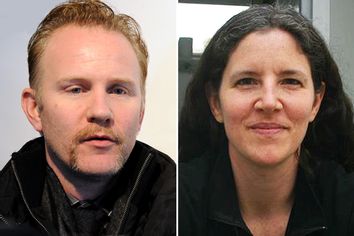
Morgan Spurlock and Laura Poitras (Credit: AP)

On Sunday, Glenn Greenwald reported that Laura Poitras – the Oscar- and Emmy-nominated filmmaker behind “My Country, My Country” and ”The Oath” – has been subject to extraordinary and deeply troubling scrutiny by American officials. Poitras has been detained by the U.S. government 36 times in the last six years – almost every time she’s returned to the country from work abroad. The filmmaker has repeatedly been subject to harassment, intimidation and unwarranted, invasive searches, while her phone, laptop, reporter’s notebook and other materials have been confiscated and copied.  Last week, she was prohibited from taking notes on her own interrogation because her pen “could be used as a weapon.”

As Greenwald pointed out, Poitras’ case is a glaring example of the government’s continued disregard of Fourth Amendment rights as they apply to journalists and documentary filmmakers working on subject matter related to U.S. military operations, American foreign policy and any other domain claimed by the Department of Homeland Security.

Now, nonfiction filmmakers are speaking out.  Yesterday, the Cinema Eye organization released an open letter and petition in protest of DHS actions, calling on the Obama administration to investigate this “chronic abuse of power” and to put an end to violations of “America’s bedrock principle of a free press.” The letter was signed by the Cinema Eye Executive Board and their Filmmaker Advisory Board, including well-known nonfiction filmmakers Alex Gibney, Albert Maysles, Morgan Spurlock and many others. The full letter is reproduced below:

April 9, 2012 – New York, New York – Cinema Eye, the film organization that hosts the Cinema Eye Honors and advocates for artistry and craft in nonfiction filmmaking, is releasing a statement today to vigorously protest the Department of Homeland Security’s treatment of our valued colleague, Laura Poitras.

The letter is signed by the full Cinema Eye Executive Board as well as our Filmmaker Advisory Board, of which Poitras serves as Chair. The letter is also signed by 25 Cinema Eye nominated filmmakers, including five Academy Award winners.

Statement from Cinema Eye on Laura Poitras:

As members of the nonfiction filmmaking community, we want to express our outrage over the ongoing harassment of our colleague Laura Poitras by the US government and the Department of Homeland Security. We call on the Obama administration to investigate this abuse of power and to bring an end to this persistent violation of America’s bedrock principle of a free press.

Laura Poitras is one of America’s most important nonfiction filmmakers, the recipient of the 2011 Cinema Eye Honor for Outstanding Achievement in Direction for her landmark film, The Oath, and the chair of our Filmmaker Advisory Board. She was nominated for a Best Documentary Feature Oscar and twice has been nominated for an Independent Spirit Award for her work. Her long list of credits, awards and impeccable credentials would be easy for anyone to verify.

Over the course of the last several years, as Laura has been working to chronicle the post-9/11 world and the effect of American policies here and abroad, she has been repeatedly harassed, detained, interrogated and has had her cameras and computers seized by Homeland Security officials as she attempts to re-enter her home country.

Not once in more than three dozen detentions and interrogations has Homeland Security found anything to justify this chronic abuse of power.

Within the last week, as Laura was returning from a recent trip abroad, she was once again detained. This time, however, she was also threatened with being handcuffed for attempting to take notes during her interrogation.

Nonfiction filmmakers perform a vital role in a democratic society, serving as observers and investigators of the world around us. It is unacceptable for any American nonfiction filmmaker or journalist to be treated in this manner. They must be able to return to their own country without fear of arrest or fear that their work product will be seized, solely because they are investigating or chronicling subject matter that may be sensitive or controversial.

We ask other members of the nonfiction film and journalism communities to protest this affront to a free press and we reiterate our call on the Obama administration to end these draconian and un-American policies once and for all.

Sincerely,

Sean Farnel
Andrea Meditch
Esther Robinson
AJ Schnack
Nathan Truesdell
Cinema Eye Honors Executive Board

Mila Aung-Thwin
R.J. Cutler
Sam Green
Steve James
Ellen Kuras
Audrey Marrs
James Marsh
Morgan Spurlock
Jennifer Venditti
Cinema Eye Honors Filmmaker Advisory Board

Clio Barnard
Joe Berlinger
Michael Collins
Alex Gibney
Davis Guggenheim
Lixin Fan
Alma Har’el
Asif Kapadia
Lise Lense-Møller
Tia Lessin
Kim Longinotto
Jeff Malmberg
Darius Marder
Albert Maysles
Donal Mosher
Michael Palmieri
Louie Psihoyos
Bill Ross
Turner Ross
Chris Shellen
Bruce Sinofsky
Geoffrey Smith
Ricki Stern
Paul Taylor
Marina Zenovich


Kinkade’s world of parody

The Painter of Light's work is quaint, nostalgic and trite -- and an inspiration for satirists everywhere SLIDE SHOW

View the slide show

Thomas Kinkade, the self-anointed Painter of Light™, and artist behind the once-profitable later-fraudulent Thomas Kinkade Signature Galleries enterprise, died unexpectedly on Friday of natural causes.  Kinkade’s appeal to his fans, as Laura Miller wrote on Salon today, is in its “aura of harmless coziness, of modest domestic beauty and comfort” – the same things that make his work a giant, glaring bull’s-eye for parody. On dozens of websites, artists and Photoshop dabblers have taken Kinkade’s images of glowing, pastoral peace and added … we’ll call them contradictory splashes. We’ve put together a slide show of some of the most memorable.

View the slide show

Secrets of creation

From Tommy Wiseau's "The Room" to Werner Herzog, what makes people want to make art? Tom Bissell explains

Tom Bissell

In his new book of collected essays, “Magic Hours,” Tom Bissell writes that literary and artistic success have always been, overwhelmingly, a matter of luck.  The works of Herman Melville, Walt Whitman and Emily Dickinson, though great, are known today as classics because of the slightest, fortuitous turns of circumstance – turns entirely beyond the authors’ control. “Moby-Dick” was met with near universal scorn, until it was found by a sympathetic critic in a used bookstore in 1916, 25 years after Melville’s death. A remaindered copy of “Leaves of Grass” was also happened upon – this time bought from a book peddler and given to a critic as a gift.

For some ambitious writers and creators, this can be reason for panic, as it was for Bissell as a young man. But over the course of “Magic Hours’” sharply observed, lushly descriptive and often extremely funny pages, Bissell (a former Salon writer and the author of “Extra Lives: Why Video Games Matter”) presents a case for art-for-art’s-sake, regardless of what may come.  And, though Bissell has no aspirations to be included in the “how-to” genre of nonfiction, “Magic Hours” subtly discloses a type of directive for new and young artists making their way.  Quite simply and hopefully, it seems to be: tell the truth about yourself and everything else, and pay attention.

Salon spoke to him over the phone about Tommy Wiseau’s “The Room,” the key to creative success and how the Internet has transformed writing.

In the book you write about director Tommy Wiseau and his movie “The Room.” You address our inability to assess our own talents, and the fact that we imagine ourselves, as you wrote, as “superlatively gifted.” That’s something that is discussed frequently now as a problem particular to our time. Do you agree with that idea that that is a product of our current culture?

I do. Tommy Wiseau is a fascinatingly American character in that he seems to have inherited every kind of bad assumption we have today – that not only will everyone have 15 minutes of fame, but everyone should have 15 minutes of fame. The only things that we Americans seem to make, or that anyone wants from us anymore, are entertainment products. We are basically living in the entertainment age. There was the Iron Age, and there was the Stone Age, and we’re in the Entertainment Age. It’s strange to me that someone like Tommy Wiseau really believes the single best use of his time – and emotional energy – is to make a film, despite being completely unversed in filmmaking and being startlingly devoid of talent. I have a hard time imagining any other culture that could welcome and accommodate someone like Tommy Wiseau.

And he’s not at all American. [Ed note: Wiseau is, in fact, an American citizen]

No, but he’s drunk the American Kool-Aid and had seconds. And thirds.

There are two different things happening there. One is that if he can just be an entertainment machine, then he’ll be that. But the original problem was that he really believed that his movie, which has been widely acknowledged as incompetent and utterly terrible, was high art, right?  

Yes. He still does. He thinks his film is one of the best films ever made.

What are your feelings about nonfiction writers who take liberties with facts?

I think this is the single most interesting question facing nonfiction writers today. All description – all literary description of real events – is a distortion. Always. Something can be factually accurate and be less representatively true than something that somewhat distorts the facts. For example, if you ignore the truly representative details about a person, but describe them in other ways, you can distort the picture of them more intensely than if you were to make up a detail about them that more clearly demonstrates who they are.

I’m also concerned with the motive behind the distortion; it matters what the writer is trying to do.  It also matters who is being written about and what information is being distorted.  For example, I wrote a book about a trip I took to Vietnam with my father, and there are some discussions between my father and me in the book, that are said to have happened in one city, but they really happened in another. And I could do that, I think, because that’s my material and it’s my dad’s material, and I told him I would be doing this and he agreed. I think that is my material to shape.  The conversations happened, they’re real, but I’m putting them in a context that is accurate to our relationship and accurate to our experience but is not factually accurate. And I totally stand by having done that.  I don’t think I committed any grave sin.

When I’m writing about people – about Chuck Lorre or Jim Harrison or Werner Herzog – I’m dealing with people I don’t know well, whose lives and reputations are at stake.  In that case, the writer needs to have a totally different standard of factual accuracy. When you can sort of play faster and looser with facts is a very different question depending on your relationship to the person you’re writing about. Personal essayists have a much, much wider range of veracity to play around in, because they’re writing about their own experience, their own memories.  The way you remember your own life is often not the way other people would say it really happened, but those memories are yours, and there’s a difference between lying about yourself and representing yourself in a way that feels true to you.

We can tie ourselves in knots over what are actually pretty basic questions of intent and effect. In my career writing nonfiction, I’m sure I’ve slipped in details – nothing big, nothing that anyone would ever call an outright lie – but something I’ve adjusted. I’m sure every nonfiction writer does things like that. It’s a natural product of your memory. The really weird thing that I’ve noticed is when you write about an experience, the version you write actually becomes your memory: It replaces the memory. What this suggests is that detail tends to trump the reality of what happened. For these reasons, nonfiction fundamentalists, I call them, kind of drive me nuts.

It seems to be that sometimes these disputes are about actually problems of titles and categorization. When you have someone like John D’Agata, who’s saying repeatedly that he’s not a journalist, it can be a frustrating conversation to watch. If he says a story isn’t fact-checkable, how is it salable to publish a book about how that story isn’t fact-checkable?

Yeah, it’s strange. He’s very open about it.  But, at the same time, it gets difficult when he’s writing about a poor kid who jumped off a building and killed himself, as he does in his book “About a Mountain.”  But, I taught that book last year, and he very wonderfully and very intelligently takes us through the public argument about how long radiation will remain deadly to human beings, and he just goes through and finds all these lies. Outright lies people in positions of real authority had put out there about how long it takes radiation to stop killing us. And we’re getting upset about details of how long the kid fell?  The book makes its own point, internally, really elegantly, which is about the kinds of lies we let ourselves be told by people in positions of power versus the kinds of lies an artist will tell for better effect.  And the lies we get mad about are the latter?  That seems nuts. That’s what I love about that book.  The book is a much better argument for his position than anything he says outside of it.

You’re very interested in discussing what an incredible amount of luck is involved in artistic success. 

Well, the thing I would say is that luck is the single most important quality – even more important than talent.  Because not everyone that’s talented is lucky, and not everyone that’s lucky is talented. I tried to explain in “Unflowered Aloes” [one of the book’s essays, about a plant that may live as long as 100 years without flowering, or might never flower at all] that I’d always assumed the opposite: I thought good stuff does eventually break out and bring success. I’m old enough now that a number of people that I came up with as a writer – some of them much more talented than I was – have just sort of stopped writing, and I find that really haunting.  It’s actually very hard to deal with sometimes because it just makes your own relative success seem that much more tenuous and that much more inexplicable. And you actually have a kind weird sort of survivor’s guilt: Why do I get to keep going?  And, if you really let that stuff get on you, you can completely freak yourself out and shut yourself down.

I stress luck as often as I do when I’m talking to students and in “Magic Hours” because it’s the ultimate form of egalitarian reassurance.  Luck can basically hit anyone. It’s not quite like buying a scratch-off lotto ticket because you do have to work really hard to get lucky as an artist, but at the same time, our lives are subject to so many freak accidents and so many completely random occurrences that to be lucky enough to be able to work as a professional writer and get paid for it, and to think that you got there just because you’re so wonderful, that confidence will eventually just make you lazy and uninteresting.  And it’s unreasonable arrogance.

Reading about poor Herman Melville was so heartbreaking: to think that the one of the two or three people who invented the modern novelistic form spent the last 25 years of his life thinking he was a total failure, and thinking that no one would ever read his books again.  If that doesn’t keep every writer alive up at night, both with a kind of optimism about what is possible, but also with a kind of very stern reality check, I don’t know what could. Getting an internship at Harper’s magazine when I was a Peace Corps dropout, having gone to a kind of middle-tier American university, not having had any great accomplishments in life, and lucking into this literary world that I fantasized being a part of, that experience just really made my life.  I’m constantly mindful of that. And I think that knowledge keeps you from getting lazy and it keeps you from getting complacent.  And those are the two biggest dangers, other than alcohol, facing a writer.

In writing about Melville you mention that in his day there was also, as there is in the New York Times Book Review today, what you call a “single, inexplicably important organ of criticism.” (In his time it was Athenaeum.) There is now so much online criticism and there are pockets of the Internet where you can have your own community.  Does that change how publications can affect a career? 

Yes, definitely.  I write in my essay on the poet and novelist Jim Harrison that I caught the very tail end of the kind of traditional literary world that was even around when Harrison was coming up in his career. The New York Times Book Review is still, obviously, a hugely important magazine, but the path that was there to being a writer as recently as 15 years ago just doesn’t exist anymore.  It’s all torn up.  I have no idea what’s coming, I have no idea what a viable path for a young writer really even is today. I struggled with that constantly talking to my students; I just didn’t know what to tell them they should do. But people like Blake Butler of HTMLGiant (Blake was my student, by the way) are making new vehicles for the work.  I think that’s really healthy and I hope there’s more of it.

It’s true that writers are not going to make as much money as they used to. Is that going to mean there are fewer good books, that there are fewer writers?  That I don’t know. But John Updike said, later in his life, that maybe it was just an accident that his generation got to make a living being artists at all. But I have to believe that as much as things change, something really cool and interesting will rise up.  I never want to be the kind of person that assumes that just because the way I’m used to things stops, that life now sucks.  I never want to be one of those people.

Continue Reading Close

After the climax

New science offers tantalizing insights into the meaning of what we do post-sex, from sleeping to cuddling

(Credit: Fenia via Shutterstock/Salon)

We’ve learned in sultry old romances and indie films about ill-advised affairs that we like to smoke between the sheets. People like to fix late night sandwiches, cuddle, talk about the future, take a shower. Every sitcom ever made posits that men don’t want women to talk after sex. And everyone seems to think it matters who falls asleep first.

But does it really? In recent years, a small number of researchers have been working to develop the science of post-coitus — a field that’s barely been touched.

I spoke with Daniel Kruger and Susan Hughes, evolutionary psychologists at the University of Michigan and Albright College in Pennsylvania who have been working on uncovering the secrets of post-sex behavior. “There is so much attention, in the popular literature in psychology and even in evolutionary research, looking at everything leading up to the act of sex,” said Kruger. “But then there isn’t anything about what happens after.  It’s as if the attitude is, ‘oh, of course sex is the end goal, right?’ We’re making the point that the time that couples spend together after sex is an important part of healthy sexual relationships.”

Counter to popular opinion, a dated study, and the great wisdom of many lady mags, researchers have not found that men fall asleep faster than women after sex. In fact, according to a recent study of heterosexual pairings by Kruger and Hughes, a woman is just as likely as a man to be out first. But — and here’s the interesting part — regardless of gender, the partner who stayed awake longer reported that they weren’t getting enough post-sex hugging, kissing or talking – what evolutionary psychologists call “pair bonding” activities. (Somehow, Marie Claire got this exactly, 100 percent wrong.)

Both Kruger and Hughes are interested in what the post-sex sleep study says about male behavior. “This shows that men are concerned about partner bonding too,” said Kruger. “Human males are notable among primates for their high levels of paternal investment, so men may have a lot to lose as well if their partner leaves them.”

And what about the other activities people move on to after sex, like hanging out in bed, ordering Chinese food, or smoking a cigarette? Earlier in 2011 Kruger and Hughes published a report in the Journal of Sex Research, considering a wider range of after-sex impulses. In that case they found that our post-coital behaviors – again considering only heterosexual sex – tend to split along gender lines. Eating, fixing yourself a drink, smoking and asking your partner for favors – all activities that sound pretty good to me – were more likely to be taken on by the men. The women, in this case, placed greater importance on behaviors related to intimacy, like cuddling and “professing their love.”

The researchers interpret these results as related to the women’s need for “pair bonding.” Men in the survey were said to be more interested in gaining “extrinsic rewards” after sex – getting a new high from food, alcohol, cigarettes or some other non-sexual activity – or, in trying to have more sex.

These findings may suggest that men are better “adapted” to manage casual sex – not exactly a challenge to cultural lore. But there is a possible explanation for the men’s “hasty post-copulatory departure” that this research doesn’t address.

Our bodies release a mix of hormones following orgasm, including oxytocin, prolactin and endorphins. While contributing to feelings of contentment, high levels of oxytocin can put you to sleep. Post-orgasmic prolactin seems to be an even more critical factor in our post-sex behavior. It’s been shown to decrease sexual arousal and offset the dopamine effects of an orgasm. Essentially, prolactin brings your body and your brain back to baseline “Stop petting me I’m reading” mode. It has even been shown to make you temporarily less attracted to your partner.

Putting aside hormones, it seems intuitive that a so-called orgasm discrepancy could affect how we interact with our partners and could leave one person reaching for more attention. According to the Kinsey Institute, 75 percent of men always have orgasms in heterosexual sex, while only 29 percent of women can say the same. This would seem to have real bearing on studies that find gender differences in our post-sex impulses.

Kruger theorized, “For people who don’t orgasm during sex, maybe having their partner fall asleep first or move on to a new activity will be even more adversive.” Hughes agreed and said that orgasm differences might be “like adding salt to the wound.” (Of course, the orgasm discrepancy could be a sources of people’s divergent feelings and behavior in the first place.) The physiological effects of a prolactin reset, the pleasant influence of feeling like you’ve had harmonious or equitable sex, and the contentment of intense physical pleasure all seem rather critical to our post-sex impulses, and these are variables that should be squared away before we can jump to conclusions about gender differences and post-coitus.

After-sex research raises a number of questions. Wanting more attention after sex could very well be an expression of unresolved arousal, for example. And while the men in the post-sex activities study said they continue to “grope” their partner when they want a rematch, some women might ask for more sex in less obvious ways. Other women might reach out for some good-old fashioned togetherness as an alternative. Rather than cuddling because they want to shore up the evolutionary “protection” of their partner, or because they are naturally more prone to cling, partners who want to loll around in bed after sex might just be working up a dopamine fix – or contentment – of a different kind.

Continue Reading Close

The Girl Scout haters’ biggest mistake

Ignore the backlash: GSUSA represents exactly the kind of community-based organization conservatives should love

(Credit: sagasan via Shutterstock)

Last week Indiana State Rep. Bob Morris claimed, in an open letter magnificently disdainful of facts, that Girls Scouts of the USA financially supports Planned Parenthood and is a force of pro-sex, pro-abortion, pro-homo indoctrination, determined to reach our American daughters.  Since his original refusal to sign an Indiana statehouse resolution honoring the 100th anniversary of the GSUSA, Morris has made a nonsensical apology, saying that he “should never have written the letter,” while holding to the counterfactual argument that the GSUSA is partnered with Planned Parenthood.

Now, a Catholic church in Virginia has banned Girl Scout meetings and Girl Scout uniforms from the church and its affiliated school, and in January the Family Research Council’s president and resident, dedicated witch hunter called for a boycott of Girl Scout cookies.  These aren’t the first instances of conservative anti-Girl Scout hysteria based in misinformation, and, unfortunately, they’re unlikely to be the last. Past its false premises, condemnation of the Girl Scouts shows a fundamental misunderstanding of how the organization works.  Most important, it betrays an ideological hypocrisy on the right – one that conservatives seem to be leaning on with ever greater zeal.

Rep. Morris’ concern was with an organization that is “quickly becoming a tactical arm of Planned Parenthood.”  The anti-Girl Scouts website Speak Now is based on the idea that unwitting parents and girls across the country are being brainwashed from above.  The site’s author describes the “eye-opening” experiences that led her to accept that she “had unknowingly been promoting and supporting a group that stands for the opposite of [her] beliefs…”

The Girl Scouts are portrayed as an indoctrinating, monolithic, top-down liberal organization: Conservatives took the Girl Scouts’ inclusion of a transgender girl in Colorado as the creation of a national policy that could be imposed on their local troops. But, the truth is, the Girl Scouts doesn’t function top-down. It’s run from the ground up, and that’s what makes this controversy so ludicrous. It’s run by the parents of girls in the troops, by teachers, by community leaders, and by aunts, uncles and big sisters. It’s run by the same “regular” people Republicans rely on each and every time they create a fictional portrait of the “true Americans” that support their social policies.

GSUSA Headquarters doesn’t, and by policy can’t, push a political or “lifestyle” agenda on local troops through national decisions. Leaders and parents have a huge amount of flexibility in all of their lessons and activities. Even the “badges” pursued, marking the achievements of the little, uniformed, flag-saluting ladies, are chosen by local leaders and the Scouts themselves. It takes about three minutes of rooting around on the GSUSA’s National Program Portfolio page to give up on your ability to track how many different ways a Girl Scout could be spending her time (and to be mildly creeped out by the silent animated elf-girls in the “Girl Scouts GPS,” an interactive feature designed to help kids choose their activities). An example of just how rigid the Girl Scouts’ agenda is? How about the badge category “Make Your Own,” described as “Whatever a girl is interested in!”   

The GSUSA also has something neat called a Statement of Trust.  It states directly that local communities should decide how to run their organizations.  Here is a portion of it:

“At Girl Scouts of the USA, we know that not every example or suggestion we provide will work for every girl, family, volunteer, or community.

In partnership with those who assist you with your Girl Scout group, including parents, faith groups, schools, and community organizations, we trust you to choose ‘real life topic experts’ from your community, as well as movies, books, music, websites and other opportunities that are most appropriate for the girls in your area and that will enrich their Girl Scout activities.”

Since Rep. Morris’ little spell of hysterics, GSUSA has made it as clear as possible to all those that can read that their organization does not impose beliefs, but in fact does the opposite: It allows room for them.

In attacking values they perceive to be held by the Girl Scouts, conservatives actually attack the autonomous decisions and values of local communities. These are, by definition, the American values Republicans love singing about. If the “True America” and the “Real America” don’t live in towns and cities in the United States, I am shit out of ideas for where to look. And as in the fight over contraception, a unified push against the effectively libertarian but open-minded GSUSA would show the right battling against local and individual choice, while screaming at the top of their lungs for greater personal liberty. As in so many cases, conservatism becomes the intrusion.

While Rep. Morris has had to apologize for the vehemence of his remarks against the Girl Scouts, other right-wing politicians will certainly ride the coattails of this hot topic. But the “free America” Republicans champion would in theory be one that allows communities to choose how to raise their daughters. While Rick Santorum babbles on in confused religious imagery about how he’s going to create jobs so that “people can remake their children into their [own] image, not his,” (i.e., Obama’s image), the right could at least pretend to allow the rest of us the same liberty: the liberty to raise our own kids, with the help of our own community organizations.

Continue Reading Close

Inside the new hate

Right-wing rhetoric seems to have reached new heights of xenophobia. But is that true? An expert explains

Newt Gingrich, Rick Santorum, Ron Paul (Credit: AP/Reuters)

It’s easy to interpret the verbal bile of recent American politics as a new height in prejudiced and conspiracist thinking: a new hate. In the last few years, Sarah Palin has created the concept of Obama’s “death panels,” Glenn Beck has argued that George Soros was a collaborator with the Nazis during WWII — even though Soros is Jewish — and Donald Trump staked his presidential campaign on the idea that our president, black as he is and Muslim as his name seems to be, had not sufficiently proven his rights to citizenship in our country. More recently, Newt has taken to calling Obama the “food stamp president,” a title that is as racially charged as it is inaccurate.

But Arthur Goldwag, author of the new book “The New Hate: A History of Fear and Loathing on the Populist Right,” argues that the racist and conspiracist approach of today’s far-right pundits is largely the same as it was 50 years ago.  Their language and theories are taken (sometimes verbatim) from right-wing populist vitriol at early times in American and European history, dealing in tropes well-worn by pre-WWII American Nazis, Joe McCarthy and fanatical anti-Catholic and anti-Masonic Protestant preachers of the 19th century.

Salon spoke with Goldwag — who has worked at Random House and the New York Review of Books and is the author, previously, of “Cults, Conspiracies and Secret Societies” — over the phone about today’s hate, the persistence and remarkable uniformity of American prejudice, and our potential for change.

Why is this resurgence of the “old hate” happening now? 

We’re going through a historic shift in this country.  We were on an incredible run of prosperity in the 1950s, ’60s and ’70s, thanks to the New Deal social compact, thanks to big unions, thanks to very strong regulation – thanks to all the things that Glenn Beck’s followers think are the most evil things in the world.  Fairly unskilled, uneducated people were able to earn a good living, and send their children to college.  And that’s changed.  Income inequality is growing.  If you look at American history, the bottom has dropped out of rural people’s lives every five years, but there used to also be a manufacturing class that made a decent living.  There used to be a route for people that weren’t well educated to make a decent living.  There isn’t anymore.  There’s a lot of anxiety about our individual positions in our society, and our country’s position in the world. If you’re not educated to be able to understand it, and you’re trapped in a disadvantaged life, you might become really, really angry. 

So these resurgences of hatred, and conspiratorial narratives, are related to a basic type of class-consciousness – a stripped-down awareness of unfairness.

Yes.  It’s an old stereotype (it’s also a true stereotype) that rich Southerners drove wedges between poor whites and poor blacks so that they wouldn’t see that they were all in the same place.  That’s very connected to the anger people have today. One of the most infuriating things about Obama to people is that he walks into the White House like he belongs there. But their anger is not really about him.  It’s about them: their place in the world. Because he does belong there.  But their kids will never go there, because they’re poor and feel they’re without open avenues.

What can we learn from the idea that the new hate is largely the same as the old?  Is there a lesson there that can help political discourse move forward with more tolerance and rationality, or is this an endless cycle depending on where the political pendulum is? Or, is it a reminder not to panic, we’ve seen this before?

I’m going to say all of the above. I think it is reassuring to recognize that the scary fringe people that are cropping on the margins of the Internet now really aren’t that much more horrible than people that were cropping up in the past.  It was harder to read them before, but they were there. A propaganda novel called “The Turner Diaries was written by a white supremacist named William Luther Pierce in 1978.  It was self-published, he broadcast his speeches over a short-wave radio, and the book was passed from hand to hand. People at Christian identity compounds read it to each other, and it had a kind of talismanic quality. Now you can just download it on the Internet. And you can see pictures of him and you can watch him giving speeches on YouTube. One of the tricky things about the new hate is that you have access to all of the historic material at once. You can see Robert Welch giving a speech, then you can see Louis Farrakhan giving a speech, then you can see Hitler giving a speech. It’s all instantly available and reinforces each other.

But the types of people who espouse hatred on a broad scale have always been there, and won’t be going away. I look at that like psychology. You’re never going to cure a neurotic. But if you get the neurotic to recognize that some of the things that scare them and agitate them are things that they construct themselves, then maybe they can move forward.

In this case, that means calling out hatred for what it is, and not allowing it to “hide in plain sight,” as you say in the book. 

Yes. A useful example is that Ron Paul was a figure in the John Birch Society.  It’s no secret.  He was a local leader, and he had real associations with white nationalists and very marginal people 20 years ago. But he’s been exposed for that past behavior, and now he can’t rely on it as a type of base appeal – he can’t go too near racism because it’s too dangerous for him. The New Republic brought it to light four years ago, and it became a third rail for him. And that’s a very salutary thing. Once you’ve shown a light on these types of things, they can’t be used anymore. As long as somebody’s pretending that their appeal isn’t racist, they can keep saying, “I’m just terribly concerned because I think you need to be a natural-born citizen to be the president of the United States.”  But that’s bullshit and it’s racism and xenophobia and nativism. And once you name it, you can’t go there anymore and still be in the mainstream. If you’re David Duke, you can’t pretend to not be David Duke.

You also say in the book that mainstream discussion has moved farther toward the radical right, and that the new hate is in some ways more accepted than the old.  So there seems to be a sweet spot where people in the public eye can avoid the really unacceptable activities – like membership in the John Birch Society – and can still make appeals to racist impulses in their base.  But how is it that racist conspiratorial thinking could be more mainstream now than it was at time periods when we, as a country, were more xenophobic and more nativist, as a whole? 

Well, I’m not sure that it is.  But Ryan Lizza, the other week in the New Yorker, wrote about a study showing that in recent years the mainstream right has moved much farther to the right than the left has moved to the left.  You have mainstream people pandering to the base by picking up some of these memes and some of these archetypes from 40 years ago – and much older.  It was really horrifying when it first seemed like anti-Islamic sentiment was becoming mainstream. 

As far as the snarky racist things that mainstream pundits are able to say about Obama – using the word “ghetto” and so on – that’s just pandering to the lowest common denominator.  There’s crappy racism in American society, but every year there is a little bit less of it. Political correctness creates a burden, and coded messages and dog whistles become more of the main operating mode. 

But sometimes open discrimination works.  Pamela Geller had a tremendous amount of traction in 2010 when she led the charge against the Islamic community center near ground zero. She had the New York Post covering her, and even Harry Reid got scared about the “ground zero mosque.” Newt Gingrich jumped right in and talked about banning Shariah. Anti-Islamic sentiment is so vile. And as a Jewish person, I find it appalling that there are Jewish activists and politicians who don’t see that it is exactly the same thing that was said against us. If you’re Jewish, you know what it is to be completely demonized. It was appalling when the Anti-Defamation League didn’t condemn the attacks on the community center.

How does it work for a publication like Newsweek to take seriously a question like “Is Obama the Antichrist?” as they did? How are they able to do that without being shamed by all serious publications?

Some of it is that they don’t even realize how real that question is to some people. They think, “Oh, this is a funny little item, and we’ll talk to Matt Staver,” the guy they interviewed with that question. Well, Matt Staver’s a real, intense religious fanatic. But people in the mainstream don’t know a lot about that world. The worst thing that most people hear is a few seconds of Glenn Beck or Rush Limbaugh when they’re in a taxicab. But if you spend time at Media Matters or the Southern Poverty Law Center’s “Hate Watch” blog, and so on, or, if, God help you, you go to a white nationalist conference as I did in Washington in September, you know that these ideas have real currency.

My worry isn’t that Newsweek would approach some right-wing guy and get a quote from him, but that they would do it without knowing just how right-wing he is.

Paranoid and fear-based politics tend to rise up at times of national uncertainty – economic distress, political turmoil, and changing social norms all seem to contribute.  You pointed out that there are striking similarities between the type of irrational anger faced by John F. Kennedy and the type now faced by Barack Obama.  But you say that today, this hatred is “hiding in plain sight.” 

Yes, it’s the obvious elephant in the room. For example, the “birther” issue. I couldn’t have imagined it before it began. There’s a judge in Georgia right now who’s demanded that Obama come and explain why he should be in the Democratic primary. A Republican judge said, “I want the president of the United States to come here and make a case for himself.” This is so intensely racist.

One of the most interesting parts of reading your book was learning how anti-communism, anti-Masonry, anti-Catholicism and raced-based discrimination are all tied together, and almost always have been linked to anti-Semitism. The existence or successes of other minority groups were blamed on Jewish people, or these groups were called out as Jews – even the Jesuits. It seems like the only group associated with evil conspiracies to take over the world and not linked to Judaism is Muslims. Is that true?

It’s true, and it’s weird. God knows most Jews were not bankers, and God knows most Jews were not rich. Jews were really poor people. But there were enough rich Jews to make the stereotypes stick, and rich Jews, like others, used the power of finance. You can find writings in the ancient world about the horrors of usury. As many people understand it, usury is a terrible form of magic: you’re making something out of nothing. The Templars were bankers, and all of the things that were said about Jews were said about them too, and they were also associated with the devil. There are mysteries that are just as profound as theological mysteries. People actually get through their lives without being personally affected by the mystery of the trinity, but if you buy a house for the first time and you discover that this $300,000 house is going to cost you $1.5 million, that’s pretty startling, and people think, “How is the bank making so much money out of money?” It makes sense to me that a rural populace in the mid-18thcentury would have latched onto anti-banker, anti-Semitic ideas. They were told to hate Jews anyway, for purely religious reasons. What’s crazy is that 100 years later, these ideas have the same power.

You point out cases in which prejudiced public figures on the left and the right meet at the point of their hatred or paranoia, as with neo-Nazis and Louis Farrakhan.  Are there notable newer examples of this today?

Well, you can find that with 9/11 Truthers, and also if you hang around with Ron Paul people. I went to a John Birch Society meeting a month ago, and the people there were surprising. They were all people living off the grid, and they were pot smokers and Ron Paul people. I don’t even know that they would have identified themselves as conservatives. The John Birch Society recruiter there clearly had a lot of experience doing outreach to these types of people.

It seems that people may not even really understand where they are in that case.  They may not know what the JBS is in a historical sense – they just know that it’s “alternative.”

I think that’s true. Extremely ideological organizations rely on the fact that you don’t know the whole story.  They feed you political talking points and emotional talking points, and you don’t know the rest. I think that’s part of the Ron Paul phenomenon.

It seems there can be a tendency to latch onto a politician whose identity is “alternative” rather than one whose identity is more politically clear. 

I think that’s true, and I think that’s a product of resentment and anxiety.  It’s a way of individuating yourself.  It’s also a not very successful way of escaping from cant that you know is cant.  “Oh, the Democrats promised this, the Republicans promised that, but this guy’s a real outsider.”  People say they are the true insurgent, and they turn out not to be much of an insurgent, or their insurgency has little to do with what you want from them.

In the book you discuss how right-wing populism has historically demonized academic scholars, and also how it has used selective “scholarship” – misappropriating information and repeating widely discredited ideas. This is, of course, something we can see clearly in characters like Glenn Beck who performed whole episodes of his show writing on a chalkboard and has developed his own recommended canon. How does it work to disparage “experts” and the “elite,” but also rely on this type of pseudo-academia?

Richard Hofstadter discusses this in “The Paranoid Style in American Politics.”  There is a whole world of alternative scholarship, and for fanatics it functions like a fantasy world where they can only be right. That’s a psychological phenomenon rather than a political phenomenon to me. People do this in other parts of their lives as well.  It’s called denial.  You create an alternative reality where you don’t have to believe what you don’t want to.  But we can believe Glenn Beck because he has footnotes! They always have footnotes.  And Beck’s footnotes refer to Eustace Mullins.  Eustace Mullins is one of the most vile, racist writers that you can imagine. I think Hitler would have been ashamed of a lot of what he wrote, but Glenn Beck’s “scholarship” relies on him.

Why doesn’t it matter that radical right-wing sources have been discredited over and over again?  As you point out, “The Protocols of the Elders of Zion” – a known forgery – still informs endless right-wing conspiracies – including Beck’s infamous episodes on George Soros.  Maybe this information is just too far removed from the original source.  But what about Sarah Palin’s creation of Obama’s “death panels”?  The correct information was available, but many people didn’t care.  Is it all willful ignorance?

Yes. There is a quote from a New York Times Magazine article [“Faith, Certainty, and the Presidency of George W. Bush”] quoting an aid to the president who said that writers were in the “reality-based community,” but that the world didn’t run on reality anymore.  There are people who believe they can push through “facts.”

And in surprising ways, that seems to work.  If I want to say that person X is wrong, and there is a base of people that will come along with me on whatever trip I have to take to get there, then I’ll do that.

Because that person isn’t just wrong; they’re evil, they’re satanic. Take Newt Gingrich, for example. I truly don’t know what his agenda is, other than that it’s about bringing power to Newt Gingrich. And in order to get power, he will demonize whoever is against him.

Running in the back current of your book, is the distinction between genuine populist interests – improving the lives of working people – and hateful, populist rhetoric.

Yes. As Richard Hofstadter made clear, there is a difference between moral politics and ends-based politics.  He said that positivist historians – those who assume that people are voting their economic interests – miss out on something. It’s a fallacy to say that people think economically all the time. Human behavior is not based on maxima. People are superstitious, and people are moral.  And sometimes when you feel that your values are not being followed, you get angry.

Another interesting difference between the old hate and the new is that today’s right-wing racists make apologies for language that is too overt. A great example of this that you cite is from the man who runs a website called Jewwatch.com. He said, “It has never been my intent to defame the Jews” – a wild thing for him to say. Why do openly anti-Semitic or racist groups talk this way now? How does this work with their base supporters?

White supremacists repeatedly use a tactic where they claim that they are really just conservative, white-loving, white people.  They say: “I don’t hate black people, I love my own kind.  What’s wrong with loving your own?”  And one of the things that comes with loving your own is obsessing over dark races moving into America and the low white birthrate.  It’s about “blood and soil.” Millions and millions of people died because of “blood and soil”.

Another thing that these groups go out of their way to say is that it would be “absolutely wrong” to say terrible things about people that weren’t true.  But, if I say that Jewish people are greedy and criminal and are trying to destroy the world, and if it’s true, then there’s nothing anti-Semitic about it. Beyond that, people really have a hard time being mean to people’s faces. If you meet one of these people, or they’re publicly confronted, they sometimes bend over backward to be polite to you. It’s really terribly inconsistent and weird.

What people “really” believe in is an implicit and explicit theme of the book.  At the end, you say that leaders of these various hate and conspiracy movements did not really believe the theories they put forth.  With entertainer-type pundits – Glenn Beck, Ann Coulter – this seems to make most sense.  They profit regardless of their true beliefs. But what about their followers, who don’t necessarily stand to gain anything?

In some cases, people know that something isn’t true, but they “know” that it’s morally true. They may know there aren’t really going to be death panels, but socialism is evil and it will kill people, and so there might as well be death panels. I really don’t think that people believe most of these theories. It’s a type of pornography. There is a sadomasochistic element to the level of hatred found with many of these groups and on their websites. In the book I write about the story of Maria Monk, who claimed to have escaped from a sex den in a Catholic monastery. Her story was false, but at the time it was a real turn-on for people. In “Mein Kampf,” Hitler writes about the Jew waiting to rape the Aryan maiden. People don’t believe these things, but the ideas are so upsetting that they are appealing, and they also have a level of spiritual truth.

You discuss the connection between hateful language and real violence – whether it be JFK’s assassination in 1963 or the Tucson/Gabrielle Giffords shooting of 2011.  Do you believe politicians have a responsibility to speak out against rhetoric that can encourage violence?  

I think it’s demagoguery to blame the politicians when some crazy person shoots somebody, but politicians are culpable. And no, it’s not nice when some lunatic shoots some nice Jewish congresswoman in Arizona and all of the sudden you’re up in Alaska and you’re being blamed for it. It feels terrible. But, if you’re a politician don’t be a demagogue, encouraging hatred. If you’re Glenn Beck then it’s your job, and you’ve got to tough it out when someone gets killed. You can’t pretend you didn’t say this awful stuff. There was just a politician in Kansas who quoted a Psalm in relation to Obama saying “and may his wife be a widow.” When he was called out on it, he said that he only meant, “may his term be short.” That’s so disingenuous and it’s so wrong, and we shouldn’t be doing it. If you say, “Gee, I wish that person would die,” and they die, you should feel guilty.

Do you think there is a possibility to move away from this type of language?  You say at one point that hatred is a Pavlovian response – implying that it comes about as a result of training, and that perhaps we can be trained out of it.  It seems that on the mainstream level, maybe we have been trained away from hatred. 

I was born in 1957, and I lived in Virginia, and there were colored-only water fountains. I can barely imagine that, but I saw them with my own eyes. If we move away from race and consider gay rights, it’s all happening very fast. Gay marriage is almost mainstream.  There will be people who go to their graves screaming about it, but it’s a fact. We can change.  People who learn in church that it’s wrong will change when a relative or friend comes out to them, because it’s very hard to hate people you know. The cure for racism is exactly what the Southerners were so terrified of 50 years ago: race mixing. When our families are multiracial – or mixed in religion, or include gay people – the same type of hatred can’t go on.

But there will always be haters, and there will always be fanatics, and it’s the role of the press and the role of writers and the role of thoughtful people to call it out. It’s our job to remind people that even though you’re angry and somebody’s appealing to your worst instincts, you do have better instincts too. You can be better than that. That’s my hope anyway.

Continue Reading Close
www.salon.com/writer/katie_ryder/index.html