Keith Moore

Down in the trenches

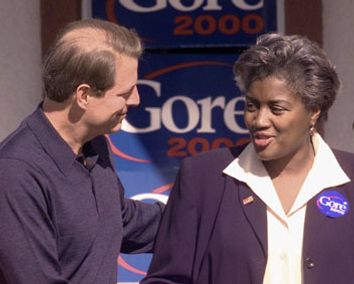
Donna Brazile, the new manager of Al Gore's presidential campaign, has a reputation as a tenacious political attack dog.

  • more
    • All Share Services

Down in the trenches

As Vice President Al Gore’s campaign workers get to know their new Nashville digs, the press is getting reacquainted with Gore’s new campaign manager, Donna Brazile. The former Dukakis operative was promoted as part of the veep’s effort to shake things up and inject new life into his lagging presidential campaign.

Gore campaign spokeswoman Kiki Moore was vague about Brazile’s day-to-day responsibilities. “The vice president wants to take the campaign in a certain direction and Donna fits in perfectly with what we are trying to do,” she said.

But according to Robert Borosage, a former campaign staffer for Jesse Jackson who heads the Campaign for America’s Future, Brazile has been called in to help the trains run on time. “The vice president’s schedule is completely out of sync with the campaign schedule. It will be up to Donna to work that whole thing out,” he said. Brazile has to get the campaign in gear and “energize the troops so that they go into Iowa prepared,” he said.

The pairing of Gore and Brazile is a contrast in styles, pitting Gore, the self-acknowledged “stiff,” against Brazile, who is loose, charismatic, chatty and vibrant. Gore speaks in cautious and measured tones; Brazile is driven and brash, given to speaking in a slew of four-letter words that do not stop in the presence of the press.

“I don’t know about him,” she said of her new boss, “but I feel opposites attract and together we can make good music, if he lets it happen.”

Known as a talented field operative and grass-roots organizer, the first black woman to head a major contender’s presidential campaign will not report to Gore directly but to forceful campaign chairman Tony Coehlo. Friends of Brazile like Borosage say she sought direct access to Gore. “She’s tough,” Borosage said. “I am sure one of the first things she asked [after being appointed] is if she could report directly to Gore.” But Gore turned her down.

Brazile said she has no problems reporting to Coehlo, and chastised members of the press corps for pushing the issue of the Gore campaign organizational chart. “Why is it men always want to know who you report to?” she said.

The question has drawn attention, however, because of lingering doubts about her “maturity” that date from her notorious 1988 comment about whose bed Barbara Bush sleeps in. She was working as a deputy field operator on Michael Dukakis’ presidential bid amid rumors that GOP nominee George Bush was having an affair with a woman named Jennifer Fitzgerald. The press was reluctant to publish the story. So she said, “The American people have every right to know if Barbara Bush will share that bed with him in the White House.”

Her remarks were a major embarrassment for the Dukakis campaign and Brazile was forced to resign. It may be for that reason that Gore decided to take full advantage of her organizational skills while distancing himself from her personally.

Oddly enough, the last time Gore ran for president, in 1987, Brazile made belittling remarks about him. Serving as director of field operations for Richard Gephardt’s presidential campaign, she said, “Gore just hasn’t captured their imagination. You don’t hear party chairmen going around saying ‘Gore, Gore, Gore.’”

It is still unclear whether in the Barbara Bush statement Brazile was following orders or acting on her own. Friends insist she made her comments only after discussing them with superiors. Others have doubts. They say she was acting on her own and cite this as evidence of her “immaturity.”

For her part, Brazile wishes the whole matter would go away. “That’s all in the past,” she said. “That was 10 years ago. I’ve come a long way from that. Let’s move on.”

Brazile is the third of nine children born to Lionel and Jean Brazile. Her father was a janitor and her mother a domestic worker. “We grew up poor,” she said, literally on the wrong side of the tracks. After graduating from Louisiana State University, Brazile took an offer from Coretta Scott King to help organize the 20th anniversary of the historic March on Washington. A year later, she joined Jesse Jackson’s 1984 presidential campaign as an advance person.

After being forced to leave the Dukakis campaign, Brazile called her mother and headed home to Kenner, La., near New Orleans. A Roman Catholic, she said she later did “penance” by spending nine months in a Washington homeless shelter with homeless advocate Mitch Snyder. She went on to run the successful campaign of Eleanor Holmes Norton for the District of Columbia’s at-large seat in Congress, and served with Norton as chief of staff before joining the Gore campaign.

Those who know her say she is more than qualified for her new assignment. Frank Watkins, communications director for Rep. Jesse Jackson, Jr., D-Ill., worked with her on Jesse Jackson Sr.’s initial presidential run. He pointed out that there is only so much she can do. “She’s not a doctor. She can’t fix what’s wrong with him. The candidate will have to do that himself,” he said.

Brazile belongs to an informal club of four black women who meet periodically in Washington to exchange political views and chat about strategy. One member of that club is Mignon Moore, Brazile’s closest friend and assistant for political affairs for President Clinton. Moore said she gave Brazile one short piece of advice: “Stay focused and do what you do best.”

What she does best, according to Bill Lynch Jr. of the Democratic National Committee, is grass-roots organizing and field operations. But, added Lynch, “That’s a misnomer, because I think Donna has got the complete package and can do anything in a political campaign.”

Rick Lazio: Is he or isn’t he? And who the heck is he?

He's the man who might have been the next senator from New York. If he were a candidate. If he could beat Hillary. If Rudy weren't around.

  • more
    • All Share Services

Rick Lazio is destined to be either the next U.S. senator from the state of New York, or the next trivia question. At the moment, the latter seems more likely than the former.

Lazio, a four-term congressman from Suffolk County, on Long Island, told reporters on Wednesday that he would hold off announcing his candidacy for the senatorial seat being vacated next year by Daniel Patrick Moynihan until New York Mayor Rudy Giuliani makes his intentions known. Lazio postponed the official Aug. 16 announcement of his entry into the race, but left the door of possibility open just a smidgen.

In the unlikely event that Lazio does run, and beats expected Democratic nominee Hillary Rodham Clinton in the general election, the Long Island lawmaker would of course be crowned king, at least by Republicans. And certainly he’d deserve the coronation — because against tremendous odds he would have defeated Hillary Rodham Clinton, a major Democratic symbol who elicits mixed feelings in the electorate. But oddsmakers and seasoned politicians believe in a less spectacular scenario. Unless the Republicans can cease their infighting, observers see Lazio as the fall guy, the man
who will be blamed for losing a probably unwinnable contest.

Until fairly recently, the election, which is about a year and a half away, was supposed to be a showdown between the high profile, crime-busting, no-nonsense mayor and the even higher profile first lady: Hillary vs. Rudy, as the tabloids are fond of putting it. The baby-face smile of the 41-year-old Lazio was hardly in the picture. And actually, none of the three have officially announced a run. But as Giuliani and Clinton announced the formation of exploratory committees earlier this year, Lazio’s name kept popping up with increasing frequency.

Who is he? Political insiders say he is crafty, ambitious and politically astute. At home in his district, for example, Lazio is known as a moderate because of his anti-gun-control and anti-abortion stances. But Barney Frank, Lazio’s liberal congressional colleague from Massachusetts, once put it this way: “He personally says he is moderate, but as a guy trying to get ahead in the Republican Party he makes peace with very right-wing elements.”

Lazio and his wife, Patricia, live with their daughters, Mollie and Kelsey, in Brightwaters, on
Long Island. The son of an auto repair shop dealer, the congressman (baptized Enrico Lazio) went to local schools on Long Island before graduating from Vassar College in Poughkeepsie, N.Y.

After law school he became a prosecutor and then did two stints in the Legislature before challenging 18-year incumbent Tom Downey, then a political rising star, for his congressional seat.

Compared to Downey, a member of the powerful Ways and Means Committee, Lazio was a political nobody. But his usual smile turned to a snarl the minute the race began. Lazio quickly portrayed Downey as a junket-loving liberal luxuriating in the Caribbean. One flyer featured a photo of Downey tossing a football on a beach in Barbados, with a caption that read, “Tom Downey’s limousine liberal’s guide to surviving the recession.” Then Downey’s wife was attacked for her role in the House check-bouncing scandal a few years back. Before Downey realized what had happened, he was an unemployed lawmaker.

“I relish the role of the underdog,” Lazio said. “I was down by 25 points to Downey one month before the election and I won.” He also surprised some by voting for the impeachment of President Clinton. A few days before the impeachment vote in the House of Representatives, Lazio accompanied the president and several other politicians on Air Force One to Israel. Most of those close to the situation interpreted the move as a sure sign the president had Lazio’s vote locked up. But following the trip, Lazio thanked the president for the ride, told him how impressed he was with Air Force One and then all but called Clinton a liar in a scathing op-ed article in Newsday.

Next, of course, came the impeachment vote. But he defends all his actions in the matter with no apparent remorse. “My decision on impeachment was one of the hardest decisions I’ve ever made,” he said. “But it was the right decision and I stand by it.”

Lazio also appears willing to exploit a long-standing feud between Giuliani and New York Gov. George Pataki. Giuliani endorsed Pataki’s Democratic opponent, Mario Cuomo, when Pataki first ran for the office in 1994. Giuliani’s reasoning at the time was expressed in typically blunt terms: He told reporters he thought Pataki was a “puppet” of then-Sen. Al D’Amato. For this and other reasons, Pataki has been egging on Lazio from behind the scenes, urging him to challenge Giuliani in a primary. But when the governor, under mounting pressure from Republicans, decided on Aug. 6 to give Giuliani his rather tepid endorsement, he asked Lazio to await Giuliani’s decision about running before formally declaring. Lazio complied with the governor’s wishes in his press conference on Wednesday.

Most political insiders concede that the mayor has no real interest in being a senator. Republicans think Giuliani’s feisty nature, ability to raise money and national reputation make him the best man to run against Clinton; but the mayor’s real interest is in running for governor in 2002, say political pundits and others close to him.

Still, when Lazio suggested just that in an interview with the weekly Observer newspaper, it galled Giuliani backers. Lazio was quoted as saying, “The people of New York deserve to have somebody who isn’t just seeking the Senate seat for personal power, for a temporary perch.” “The nerve of that man,” said one woman supporter of Giuliani who spoke on the condition she not be named.

Lazio, on the other hand, first expressed an interest in running about a year ago, reasoning that Moynihan was in his 70s and close to retirement. Lazio subsequently visited Giuliani to make his feelings known, realizing that Giuliani was a two-term official and perhaps also had an interest in the senator’s position.

“I said to him that I was going to be traveling around the state and exploring the possibility of a run,” Lazio said. He reported that Giuliani responded, “I have no problem with that.”

Insiders believe Lazio was acting at the governor’s behest, in order to smoke the mayor out about his real political intentions. But thus far he has not succeeded.

After Lazio’s press conference, reactions were mixed. Lazio said he would wait until Aug. 31 for the mayor’s decision — which was taken by a Giuliani supporter, Staten Island borough President Guy Molinari, as “an ultimatum.” Others, however, like Conservative Party Chairman Michael Long, argued that Lazio “did what was best for himself.” (If Lazio wins the Conservative Party nomination he could run as a third-party candidate.) Still others, like Republican fund-raiser and Giuliani backer Georgette Mosbacher, seemed frustrated, “I just want him out of the race.” she said.

Lazio, on the other hand, seemed energized this week. He repeated his oft-mentioned contention that “Once I announce, I cannot imagine a scenario in which I will then drop out.”

His familiar, baby-face smile was intact.

Continue Reading Close

Bill Bradley: The next black president?

His campaign purports to make race a central issue, but so far it's more style than substance.

  • more
    • All Share Services

Has Bill Bradley bought the notion that Bill Clinton is indeed the “first black president,” as Toni Morrison said last year? That would account for his strange candidacy, which purports to make race a central issue, but offers few details about how he’d close the black-white economic and social divide. If Clinton got to be the first black president by dint of his cultural closeness with African-Americans, Bradley perhaps reasons, he can succeed him with a campaign that emphasizes his affinity for black people, and remains vague about what he’d actually do for them.

Coming from Morrison, a Nobel and Pulitzer Prize winner in literature, the “first black president” seemed to be a term of endearment, a way of summarizing the cultural echoes, symbolic gestures and actual achievements by Clinton that won him the support of the black community. The characterization, coming as it did in the middle of the president’s impeachment proceedings, was no small boost for him at the time.

But the Clinton legacy, shared by Al Gore, is not without its problems for African-American voters. Bradley could conceivably use Clinton’s abandonment of African-American appointees like Lani Guinier and Joycelyn Elders, his rush to execute retarded black death row inmate Rickey Ray Rector when he was running for president, his delay in defending affirmative action, his signing of the controversial welfare reform bill and his failure to frontally attack the remaining embarrassment of black urban poverty to tarnish Gore with black voters and endear himself to them.

But with the exception of criticizing Clinton’s welfare reform bill, which Bradley voted against in the Senate, he has not. Bradley has made much of the way his relationships with black people — a family employee, his black teammates on the New York Knicks — changed his racial perceptions. But he hasn’t described how that’s led to a changed agenda for political and racial change (though it should be noted that Bradley says he’s not going to issue big policy pronouncements until the fall). Mostly he talks about how the nation’s racial problems don’t lend themselves to easy answers, rails against separatism of any stripe and preaches good old-fashioned conversation, letting blacks and whites share their views. That’s roughly what he told the NAACP convention in New York and a minority journalists convention in Seattle last month.

Bradley blew a golden opportunity to make himself better known among blacks when he made a speech at New York’s Cooper Union in April. It was billed as a major address, but again Bradley seemed satisfied with the same old racial homilies about unity and harmony. He could have done something dramatic like joining those peaceably demonstrating in front of police headquarters in lower Manhattan to protest the shooting of Amadou Diallo. An innocent, unarmed African street vendor, Diallo was shot by police who mistook him for a suspected rapist. Bradley mentioned the Diallo incident during the course of his speech, but that’s as far as it went. Rather feebly, he said those wishing to please him when he becomes president can do so by showing how their department or agency “furthered tolerance and racial understanding.”

The former New Jersey senator was much more animated speaking before the Rev. Jesse Jackson’s Rainbow Coalition/Operation PUSH convention this past weekend in Chicago. He challenged Gore to do more than speak out against racial profiling; he suggested that Gore push Clinton to issue an executive order banning the practice. He also made his most energetic call to date to marshal American resources to reduce child poverty, which afflicts up to a third of African-American children. “Reducing the number of children in poverty should be the North Star for saving our society,” he said. The crowd responded warmly, but not nearly as energetically as for Gore.

Oddly enough, Bradley has avoided any discussion of affirmative action, a subject on which the Clinton-Gore team is vulnerable. They spent a good bit of time during their first term in office waffling on the hot-button issue, until Jesse Jackson threatened to embarrass the president with a primary challenge in 1996. Since then, Clinton and Gore have embraced affirmative action, if tepidly.

Likewise, Clinton has repeatedly made a big display of his familiarity with black culture, whether it be black music, black churches, black icons or having black friends. And yet the president’s embrace of black people and black issues was never as prominent as during the impeachment scandal. Jackson was transformed from Clinton nemesis to spiritual advisor only after he had gotten in trouble over the Monica Lewinsky matter. He made a vaunted trip to Africa and apologized for America’s role in slavery, to applause from many blacks, but again the trip was taken at a time when his political fortunes were sagging in the face of impeachment. And the fact that his personal secretary, Betty Currie, is black, and so is his best friend and confidante, Vernon Jordan, didn’t seem like great news for black people when both became starring players in the impeachment drama.

Still, the combination of comfort with black cultural trappings, his many black appointments to cabinet-level or sub-level positions and the roaring economy has won Clinton plaudits from most of black America. It doesn’t render Gore unassailable, but wresting black support from the vice president will be an uphill battle for Bradley. Fifty-one percent of black voters say they are better off now than they have ever been, and they thank President Clinton for that.

The polls reflect his popularity, which is rubbing off on Gore. They show Bradley to be no more than a blip on the black radar screen. A June poll taken for the Joint Center For Political and Economic Studies, a black-politics think-tank, showed that 42 percent of the black electorate does not know anything about Bradley. That same poll shows that blacks who have heard of Bradley don’t think he’s such a bad fellow (40 percent). But that’s the extent of the good news for Dollar Bill.

It seems the major black constituency Bradley is courting is retired basketball stars, from Michael Jordan to Bradley’s former Knicks teammates Willis Reed and Walt Frazier. White former players like Bob Cousy and Phil Jackson, now the Los Angeles Lakers’ coach, also give him financial support. So does Spike Lee, maybe because Bradley once played for his beloved Knickerbockers. But the vast majority of blacks and black leaders are with Gore, according to David Bositis, a senior analyst with the Joint Center.

Bositis acknowledged that Clinton was not very well known by blacks, either, when he started out in 1992. But he noted that Clinton had a key base of support in the South, and the South is Bradley’s weakest region. His strongest base of support among blacks is in places like New York, Chicago and California. According to Bositis, Bradley must make inroads among rural blacks as well as those who live in Memphis, Atlanta and New Orleans.

“California and New York may be high-profile, but that’s not where the black vote is,” Bositis said. The majority of that vote (55 percent) is in the South.

It’s not too late for Bradley to win the black vote, but with well-meaning speeches that make no promises, it could be a challenge.

When Bositis is asked how he measures Al Gore’s support among blacks compared to Bill Bradley’s, he says the phrase that comes to mind “is the sound of one hand clapping.”

Continue Reading Close

From red-line to renaissance

Things are looking up in Harlem, but some poor black families are being driven out by the neighborhood renewal.

  • more
    • All Share Services

The news last week that New York political leaders finally resolved their differences and came up with a way to spend another $35 million of the $300 million in federal empowerment zone dollars allotted for Harlem and the South Bronx was more than welcome in those neighborhoods. The zone’s board approved 13 projects, including $1 million to move a meat-processing plant from lower Manhattan to the South Bronx, $800,000 for an east Harlem museum and roughly $200,000 for the Highbridge Community Life Center in the Bronx.

But even without the new empowerment-zone spending, Harlem is clearly experiencing what some have called a second renaissance, referring to the area’s legendary artistic and cultural flowering in the 1920s. Starbucks recently had a grand opening on West 125th Street and Lenox Avenue, and a new Pathmark supermarket, perhaps the first in a generation, has opened a few blocks away on Lexington Avenue. Harlem’s first mall, featuring the Disney Store, HMV Records and a Magic Johnson-sponsored nine-screen movie theater, is scheduled to open at year’s end.

A little over $1 billion has been pumped into Harlem housing in five years and has helped trigger a fledgling retail revolution, with outlets such as Blockbuster Video, Rite Aid and Duane Reade now becoming part of the West 125th Street main thoroughfare. That, together with a 60 percent lower crime rate, soaring rentals and upscale families pursuing reduced-priced brownstones, has led to high but wary optimism among Harlemites accustomed to having their hopes dashed.

“This is a Cinderella story about how to rehabilitate a neglected part of the city with a combination of public and private funding,” said William Shanahan of Cushman Wakefield, a realty concern. Benjamin Fox, a partner in New Spectrum Realty, said, “Corporate executives are looking at Harlem in economic terms these days, not in racial terms.”

“Harlem is hot and it’s good for business,” said Vie Wilson, a real estate broker with the upscale Corcoran Group. The neighborhood is about 25 minutes by subway to Wall Street, and although the two areas aren’t ordinarily thought to share much, they are developing common ground, according to Spencer Means, a fellow Corcoran Group agent who says he’s selling property to many Wall Streeters. His pitch is simple: Harlem is cheaper than other communities and it offers easy access to transportation.

But how long bargain basement townhouses will last is questionable. A townhouse that was $160,000 two years ago is now about $450,000, according to Wilson and other brokers in the area. Those rapidly escalating prices thrill realtors, of course, but worry locals who have lived in Harlem for years. Some acknowledge that while it’s good to see improvement in the community, the pace of redevelopment frightens them.

“It’s a double-edged sword,” said Haskell Gray, 42, a corrections officer who was born in Harlem and has lived there all his life. Gray said he and his wife, Nina, a nurse, couldn’t buy a brownstone in the 1980s because of red-lining by banks. Now loans for townhouses are readily available, but he can’t afford the prices that are being asked. “What are you supposed to do? It’s frustrating as all hell. It’s good we’re making improvement but I’m not sure most of us can afford it,” Gray added.

The fact that some corporate leaders say Harlem is no longer being viewed in racial terms alarms some residents, who see Harlem being taken over by major developers and worry that there is little room for the small investor. “We should have a vehicle for investing in the community, but we don’t,” said David Givens, 41, who was born and raised in Harlem. “The way the system is working, either you are a major developer or you’re not, and most of us are not. This is our community but we are not players.”

The empowerment zone could provide ways for local businesspeople to compete, by providing low-cost loans, grants and technical assistance to Harlem and South Bronx entrepreneurs. But it has been shackled by politics since its inception. Halfway through the 10-year program, New York has spent a little over $26 million of the $300 million it is alloted until 2004.

Harlem was beginning its comeback before the empowerment zone legislation, of course, and even before the recent burst of investment by private businesses. In the late 1980s, artists began to move to the neighborhood, attracted by cheap rents. Some African-American middle-class and professional people began to return, too, attracted by lower housing costs as well as a desire for community. A refurbished Apollo Theater brought a sense of tradition restored, and helped improve the area’s night life.

Then came the empowerment zones, the largest new anti-poverty initiative funded by the Clinton administration to date. Although empowerment and enterprise zones had previously been championed by Republicans, the Clinton-Gore team championed a modified version requiring community participation, and vastly expanded the funding.

There were signs of trouble from the very beginning, however. Rep. Charles Rangel, D-N.Y., who wrote the empowerment-zone legislation, did so while the city, state and federal government were being run by Democrats, from President Clinton to Gov. Mario Cuomo to Mayor David Dinkins. But by the time the legislation was enacted in late 1994, both Dinkins and Cuomo had been defeated and replaced by Republicans Rudy Giuliani and George Pataki.

Federal rules about how the money was spent required unanimity among major decision makers, to avoid the mistakes of previous urban renewal experiments, which have tacked between too much community control and too little, resulting in billions of public dollars being spent badly. “We didn’t want any one person deciding the fate of funds that later would disappear down some deep, dark hole,” one official, who spoke on condition of anonymity, said.

But Giuliani and Pataki are two Republicans who don’t agree with one other, much less with local Democrats. Agreement has been impossible given the political differences between community folks, Giuliani and Pataki representatives and federal officials. The mayor’s office, in particular, was tough on spending proposals. “Look at it from their perspective,” said a neutral insider. “Why should the Giuliani administration approve millions of dollars for neighborhoods that give him little or no political support? They repeatedly vote against him, so why should he give them more ammunition to beat up on him.”

The result has been gridlock. The Highbridge Community Life Center in the South Bronx is an example of a program that has been stymied by politics for months, waiting for a $500,000 grant to continue its counseling and job training for welfare recipients and high school dropouts. “All you can do is try to wait them out,” says Brother Ed Phalen, who runs the center. There are scores of programs and small businesses in the Harlem/South Bronx zone with similar complaints.

Another worry is about whether the zone will slow gentrification or hasten it. This historically black, low-income community takes pride in its status as capital of black America. But the proud Harlem of the Cotton Club and Connie’s Inn, of Langston Hughes and Duke Ellington, Zora Neale Hurston and Louis Armstrong, was the same place where, in the 1920s, poverty, crime and tuberculosis rates were high. In the 1980s a Harlem hospital study concluded that a man born in poverty-wracked Bangladesh had a higher life expectancy than one from Harlem. From a peak of nearly 500,000 residents in the 1920s, the population dropped to about half that in the 1980s.

Now the population is rising again, and Harlem is gradually diversifying, with more Latinos, Asians and whites moving in, and some poor black families being displaced by rising real estate prices. Some residents hope the empowerment zone will help black families and black businesses stay in Harlem, but so far the evidence is uneven. The zone’s largest investment to date, $11.9 million, is in the Harlem USA mall, which mostly houses white-owned businesses.

Zone boosters say that now that the first logjam has been broken, more diverse projects will get funding. The Clinton administration is working hard to ease the governance glitches, because the program will be the centerpiece of Vice President Al Gore’s urban policy during the presidential campaign.

Meanwhile, the program remains popular in Harlem, despite the red tape, political squabbling and worries about gentrification. The private sector likes it and so do many low-income Harlem residents, who stand a better chance of getting jobs thanks to the funding. And despite the hype, there isn’t a stampede of Wall Streeters north yet. As realtor Vie Wilson admitted when pressed on the subject: “Maybe Harlem isn’t for everybody.”

Continue Reading Close

You can call me Al

In her effort to line up political support, Hillary Clinton extends an olive branch, and a White House invite, to Rev. Al Sharpton.

  • more
    • All Share Services

The Rev. Al Sharpton and Hillary Rodham Clinton are an unlikely couple indeed. But as Clinton’s exploratory campaign for next year’s New York Senate race gets under way, the former boy preacher who carries heavy racial baggage — a pariah to some but a political prophet to others — could prove to be a pivotal force in the election.

Already the press and public are watching to see how Clinton masters the arcane details of New York politics. But how she deals with the controversial Sharpton could become an early defining moment in the campaign, far more important than whether she can find Elmira on a map, identify the mayor of Poughkeepsie or figure out a politically correct vacation spot.

There is little doubt Sharpton will have some role in the campaign. Howard Wolfson, the exploratory committee spokesman, told Salon News, “If [Clinton] runs she will not be in the business of excluding people. We welcome the support of all New Yorkers.” Asked if Sharpton had been given an actual role in the campaign, Wolfson said simply, “We will cross that bridge when we come to it.”

In reality, Clinton’s kowtowing began last month, when she invited the reverend to a White House reception for the World Series champion New York Yankees. “I don’t think Al has ever been to a Yankee game in his life, but he was invited,” confides Wall Street businessman Frank Mercado Valdes, a longtime friend and advisor to the reverend.

But behind the scenes, controversy swirled around Sharpton’s presence at the event, foreshadowing a delicate balancing act Clinton must perform to rally and unify key New York Democratic constituencies — African-Americans and Jews.

William Rapfogel, a lifelong Yankees fan and director of the New York Metropolitan Coordinating Council on Jewish Poverty, was also invited to the White House event. Rapfogel has been to the White House at least 10 times during the Clinton administration, he says, but this visit was going to be special because he wanted to get Yankees autographs for his son. Then he got a “heads up” call from a Washington friend that changed everything.

The friend told him to be careful about his White House visit, because efforts were being made to create the impression that Sharpton and the Jewish community were united. So Rapfogel elected not to attend. “I did not want to be used,” he said, though he stressed that he was not a spokesman for the Jewish community and said that he might yet vote for Clinton. But he admitted that he wondered why Sharpton was given a front-row seat at the event, while Rep. Charles Rangel, the Harlem congressman who had first broached the idea of a Hillary for Senate campaign, got stuck in the third row. “Is Sharpton more important than Rangel?” Rapfogel asked.

While making overtures to Sharpton, Clinton has also reached out for Jewish support in this early stage of the campaign. This week, she affirmed her support for a united Jerusalem, a move aimed at quelling earlier protests from segments of the Jewish community who bristled at her support for a Palestinian state.

But the presence of Sharpton in the first lady’s campaign operation could alienate some Jewish voters and bring potential political peril for the first lady. In his two decades in the public eye, Sharpton has made his reputation as a notoriously ambitious loose cannon who specializes in orchestrating high-profile and often racially polarizing media spectacles. But Sharpton has a loyal following. He drew 26 percent of the vote when he ran for Senate against Sen. Daniel Patrick Moynihan in 1994, and followed that up in 1997 by winning a surprising 32 percent of the vote in the contest for mayor, almost forcing a runoff between himself and Democratic sacrificial lamb Ruth Messinger.

Sharpton has been onstage, or on the fringes of the stage, virtually all his life. Mentored by soul singer James Brown and boxing promoter Don King, he combines elements of Nation Of Islam leader Louis Farrakhan and Martin Luther King Jr. He is part political leader, part street hustler and part entertainer. He learned politics watching Harlem Rep. Adam Clayton Powell battle with the white establishment, and he founded the National Youth Movement in 1980. But he gained national notoriety in 1987, with the Tawana Brawley case.

Brawley, an African-American teenager, claimed she had been abducted and raped by six white men. The story shocked New York and the nation, but a grand jury later determined that the entire story was contrived. Last year Sharpton lost a defamation suit in connection with the case and was dinged for a $65,000 judgment.

He has also been blamed for fanning racial tensions that led to a riot in the Crown Heights section of Brooklyn in 1991 after a black child was killed by a car driven by an Orthodox Jew. Soon after, a young rabbinical student was murdered, allegedly in retaliation, and the neighborhood erupted into riots pitting Jews against blacks.

Sharpton was also instrumental in focusing the media spotlight on two racially motivated incidents involving blacks in the 1980s that almost tore New York City apart. In 1986, Sharpton intervened in the case of three black men who were attacked by a mob of whites after their car broke down in Howard Beach, Queens. One of the men, Michael Griffith, was severely beaten. Three years later, in 1989, Sharpton was in the forefront of demonstrations in Bensonhurst after the racially motivated murder of Yusuf Hawkins. Hawkins had gone into the neighborhood to purchase a used car when he was beaten by a white mob. During a demonstration in Bensonhurst, Sharpton himself was stabbed, and he later said that a near-death experience led to a personal transformation.

Some Democrats believe that despite his reputation, Sharpton is a proven vote getter among blacks, and his support could help Clinton galvanize a massive voter turnout in Democrat-rich New York City. Although Democrats outnumber Republicans 2-to-1 there, turnout is often low, and a surge to the polls by the city’s blacks and Latinos could be critical in securing a Clinton victory. “Sharpton is probably someone who can help get out the vote,” says former Mayor Ed Koch, who feuded with Sharpton while he was mayor and at one point had him jailed. He now believes the Clinton campaign should find a role for Sharpton, but adds, “He won’t be in the inner circle because Hillary doesn’t even know him.”

Koch has said he thinks Sharpton is a changed man from the days when he used to regularly picket City Hall. He has called him “another Jesse Jackson” and has predicted that if Sharpton would apologize for his actions in the Tawana Brawley case — he represented Brawley — and for statements that have offended Jews, then he would be readily accepted by all groups. Thus far Sharpton has made no effort to apologize.

But other Sharpton critics are less forgiving and say Clinton should distance herself from Sharpton by any means necessary.

“Charlie Rangel and [former New York Mayor] Dave Dinkins can get out the black vote, why do you need a Sharpton?” says Dick Morris, the former advisor to President Clinton-turned-pundit and critic, who left the team after his dalliance with a prostitute was revealed during the 1996 campaign. “Sharpton ought to be kept 50 miles from the campaign and from the candidate.”

Sharpton himself seems to be enjoying his new role as political power broker, and intimated he would not be content with a symbolic role in the campaign. “You’re not gonna give me a bus, some money and say, ‘Go register some black voters,’” Sharpton told Salon News. “I want to be involved in the policy questions too — education, police brutality, welfare reform.” Sharpton is fond of recalling that five years ago, when he ran against Moynihan for the very same Senate seat, he developed a full policy agenda that distinguished him from the incumbent. “I don’t want a Moynihan in a skirt representing New York,” he says.

This year Sharpton managed to widely improve his public image, through his leadership of massive public protests against the police killing of Amadou Diallo, the West African street vendor who was shot and killed by four officers who thought he resembled a rape suspect. The case was tailor-made for Sharpton and he played it to the hilt. But this time, there was no divisive language, no violence. Just a steady stream of orderly demonstrations in front of police headquarters in lower Manhattan until 1,200 people were arrested, including former Mayor Dinkins, actors Ossie Davis and Susan Sarandon, liberals and conservatives, whites and Christians, Jews and Muslims. The protests seriously damaged Mayor Rudy Giuliani, and helped propel the “Hillary for Senate” juggernaut.

“And guess what?” said Sharpton. Clinton “can’t afford to ignore me and I think she knows it. The Diallo trial will be coming up in the middle of the campaign.”

Still, Sharpton said he had not heard from the first lady’s advisors since he was last at the White House. And he said he might not get involved if the campaign does not formally invite him to participate before Clinton announces her assumed candidacy. “It is unhealthy to try to catch a moving train,” he said. “I’d rather catch the train in the station when it stops and the doors open. Once the train starts rolling, don’t tell me to catch up.”

He knows that many people consider him a loose cannon. But he has tried to use his reputation for unpredictability as an incentive for Hillary to embrace him. “I think they would be better off having me inside the tent than outside. Can you imagine what it would be like for Ms. Clinton to go looking for black votes and they say to her, ‘Where is Rev. Sharpton?’”

Not surprisingly, Sharpton’s allies agree. “Far from being a liability, he would be a plus to the campaign,” says former Mayor Dinkins.

Sharpton dismissed attacks from his critics who insist his presence on the campaign train will do Hillary more harm than good.

“That’s what they always say,” responded Sharpton. “The people who are not going to vote for you are not going to vote for you no matter what. And Al Sharpton does not have anything to do with it.” He noted that he had helped elect U.S. Sen. Charles Schumer and State Attorney General Elliot Spitzer, both of whom are Jewish. “There was no voter backlash there,” Sharpton said.

Continue Reading Close