Ken Kalfus

Destination: Russia

Alienation, the struggle for a decent life, really bad weather -- the universal themes of this vast nation's literature make us all feel Russian at one point or another.

  • more
    • All Share Services

Destination: Russia

If you savor wine, you probably like traveling in France. If you appreciate good food, especially good food involving cured pork products, you’re certainly drawn to Italy. If you love literature, however, the word-strewn, story-riddled, literary character-infested, continent-size country to which you most want to travel is probably Russia. It may be lazily regarded as “the East,” but Russia’s contributions are integral to the Western literary canon (as well as to the Western canons of music, dance and art). The universal themes of its greatest novels — alienation, the individual’s puniness against the forces of history, the struggle to invent a decent life, really bad weather — make every reader feel Russian at one time or another.

Oil-boom Russia has become a much easier, safer place to travel, or at least it’s hardly worse than the travel nightmare that the U.S. and Western Europe have become. After a recent flight from Philadelphia, where I was confounded by misleading signs, barked at by TSA goons and delayed by faulty airline equipment, I swore never to complain about Moscow’s Sheremetyevo Airport again. Inside Russia, the trains are cleaner and more dependable than they were only a few years ago. If your travel plans include Russia’s two major cities, I strongly recommend the five-hour Moscow-St. Petersburg Avrora (Dawn), where a $67 second-class ticket buys you a comfortable coach seat and sumptuous box lunch (even faster, more expensive trains have recently been added to the schedule). For the convenience of the reading traveler, the northern afternoon light falls softly on the printed page.

The Avrora may be a good place to start “War and Peace” “Dead Souls” or “The Brothers Karamazov,” hefty, involving novels whose narratives will complicate themselves with the story of your own adventures in Russia. But first, a word of advice before you pack: Choose your translations carefully. Get a recent edition that employs vivid, contemporary English to express the vigor and immediacy of the original Russian. Say “do svidaniya” to Constance Garnett, the classic British translator who was born in 1861, the year the serfs were freed. The best in contemporary Russian translation are the editions produced by Richard Pevear and Larissa Volokhonsky, who have done many of the major works.

My own preference when traveling anywhere is to carry lightweight, easy-reading paperbacks that I can stuff into the outside pocket of my carry-on and pick up while I’m (invariably) waiting on line. The baggy monsters may best be kept home with your liquids and gels, but plenty of 19th century Russian masters have contrived to produce great airport books. Ivan Turgenev’s “First Love” and “The Torrents of Spring,” love stories in which love is elusively evanescent and inevitably tragic, make for swift, romantic reading. Anton Chekhov’s short stories (there’s a comprehensive Pevear-Volokhonsky edition, “Stories of Anton Chekhov”) are gloomy, in a bluesy kind of way, except when they’re hilarious.

The translation of poetry is always problematic, but still, great English-language renderings of Russian verse are available. Charles Johnston’s Penguin version of Pushkin’s “Eugene Onegin,” a tale of seductions, dress balls and duels, captures the original Byronic verve and is fun to read; it’s even more so alongside Vladimir Nabokov’s idiosyncratic, purely Nabokovian version of the epic. For instance, Johnston’s Pushkin writes, “Nursed in the orient’s languid weakness, across our snow of northern bleakness…” Nabokov counters, unrhythmically, and with access to dictionaries beyond those of mortal men, “Fostered in Oriental mollitude, on the Northern sad snow…”

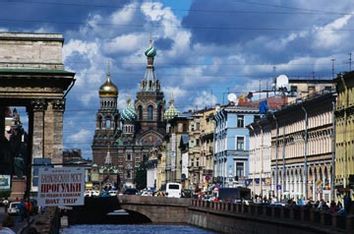
Nabokov was born in St. Petersburg in 1899, precisely a century after Pushkin, and this morning, I’d like to think, a child born in 1999 was muttering verses of genius to himself while strolling along the Fontanka Canal on the way to school. The heirs to Pushkin are legion. Another was Anna Akhmatova, the heroic poet who celebrated the exalted, transformative light of the city right before the onset of war and the Soviet regime, and then the resistance to darkness and forgetfulness afterward. In “Poems of Akhmatova,” the lovely, luminous edition translated by Stanley Kunitz and Max Hayward, she observes, in 1921: “Everything is plundered, betrayed, sold,/ Death’s great black wing scrapes the air,/ Misery gnaws to the bone./ Why then do we not despair?” The answer has something to do, persuasively, with distant, newborn galaxies and the summer scent of wild cherries.

During the Soviet era, literature was an occupation slightly less dangerous than coal mining, and its best output was done while Stalin was still consolidating his power in the late 1920s and 30s. Some of these works include Yevgeny Zamyatin’s futuristic dystopian novel “We,” Mikhail Bulgakov’s surrealistic Moscow adventure “The Master and Margarita,” and poetry by Vladimir Mayakovsky and Sergei Yesenin, who continue to enjoy a wide Russian readership: A nightclub prostitute once recited a Yesenin poem for me (without charge). “Red Cavalry,” by Isaac Babel, offers a compelling account, in slightly fictional form, of Babel’s time with pro-Bolshevik Cossacks during the 1920 Soviet campaign against Poland.

Of Babel’s stories, my favorites are those that are set in his native Odessa and involve the flamboyant Jewish crime boss Benya Krik, who likes to think of himself as a mensch. In “The King,” Benya and his crew terrorize an Odessa cattle yard owned by the merchant Eykhbaum, shooting pistols above the heads of the dairymaids and slaying cows left and right. The mayhem unfolds — “skewered cows bellowed and calves slipped on their mothers’ blood… torches danced like black maidens” — until Eykhbaum’s daughter, Tsilya, runs into the yard in a low-cut chemise. Benya withdraws his men, returns two days later wearing a diamond-studded bracelet and asks Eykhbaum for Tsilya’s hand in marriage. Babel reports dryly, “The old man suffered a slight stroke, but he got better.”

Russians revere great books to an extent unfathomable in America — that is, they actually read them. They further honor their authors, once they’ve passed away, by establishing “house-museums,” usually in the writer’s former residence, where the writer’s desk and work space are kept in an illustrative state of clutter. Photos from the writer’s life, artifacts, manuscripts and copies of the writer’s works are displayed around the house, which nevertheless often feels lived in, as if the author just stepped out to fight a duel or free a serf. Nearly every significant Russian writer has a house-museum dedicated to him somewhere.

The most engaging of these house-museums is Yasnaya Polyana, the estate where Count Tolstoy grew up, wrote his great novels, kept two sets of diaries (one of them secret and one for his wife, the Countess, to sneak peeks in), played tennis, taught the peasants to read, copulated with some of them, and from where he eventually fled in the dead of night. A visit to the scrupulously maintained estate deepens the reader’s understanding of one of the central struggles in Tolstoy’s life and work: the quest for simplicity of the soul in a world of affluent complication. As the tour guide will tell you, that quest for simplicity drove his wife nuts. Yasnaya Polyana is about a three-hour train trip from Moscow, time enough to read one of his great novellas, “The Death of Ivan Ilych,” “The Kreutzer Sonata” or “Master and Man.”

The recently established Vladimir Nabokov Museum is located on the first floor of the master’s childhood home in St. Petersburg, on Bolshaya Morskaya, not far off Nevsky Prospekt. The collection is small, with relatively few period artifacts, but the first editions, letters and sketches of butterflies richly evoke the writer’s early life and later passions. A compelling BBC interview with the man plays on video. Few of Nabokov’s novels specifically locate themselves to Russia; only his memoir, “Speak, Memory,” lingers there, in classrooms, the family dacha, the home library where his father took fencing lessons and within clouds of lepidoptera.

In his notes to “Anna Karenina,” collected in his “Lectures on Russian Literature,” Nabokov recalls that one day when he was a small boy, he and his father encountered an old man on a street in St. Petersburg. The elder Nabokov knew the man, chatted briefly with him and then, after they parted, told his son, “That was Tolstoy.” We don’t know which St. Petersburg street so briefly channeled this confluence of talent. Not knowing, we can stroll the streets of the city with the sense that literary genius has sluiced down every one of them.

“To my executors”

Witnessing the furor over posthumously published books by Ernest Hemingway and Ralph Ellison, a novelist engineers his own literary legacy.

  • more
    • All Share Services

August 20, 1999

1. The Big Book: If you look in the upstairs closet, behind where the storm windows are kept, you’ll find a large Hefty bag, stuffed with about 4,000 sheets of paper. Some are blank, but many others contain unconnected fragments of prose. All my life I struggled to beach this whale of a novel, which dramatizes the universal themes of loss and redemption in a distinctly radical way, but I was never satisfied with the characters, the plot, the setting or the point of view. Please tie together the most successful sections with whatever literary devices you find appropriate, adding story developments and protagonists only where strictly necessary, and publish. Set aside the extraneous material for future scholarship; relentlessly prohibit direct quotation.

2. Memoirs: I kept a journal every day of my adult life, through all these years of literary struggle and adventure. Regardless of whether I spent the day staring out the window or in line at the post office, I would turn every evening to my notebook and record my thoughts. The journal consists mostly of one-word summaries of the weather and what I had for dinner; an industrious redactor will integrate them with daily newspaper reports to create a portrait of a man and his times. I’ve deposited the 184 marbled composition books in the vault of a Swiss bank with an impossible-to-remember name. I seem also to have misplaced the account number. You can ask the Swiss government for help.

3. Screenplay: Although I’ve been interested in cinema my entire life, originating some provocative ideas about the interplay of form and shadow, I never got around to writing a screenplay. Perhaps this had to do with my principled distaste for Hollywood. In any event, I’ve composed a few notes for a film treatment on a file card, which I put in a steel strongbox and tossed in the poured cement of the foundation for the 88-story Petronas Towers in Kuala Lumpur. The public may be ready for it now, especially if the cast includes Tom Hanks and Nicole Kidman. Please recover and develop, and ensure that the director (a hot indie?) films the gunplay, knife fights and explosions in a thoughtful, balletic style. The Motion Picture Association of America may wish to devise a special rating to allow the widest possible audience.

4. The Collected Correspondence: I was never much of a letter-writer, but in the course of a long and varied literary life, I’ve left a lot of messages for people, mostly on their answering machines. Place a query in the New York Review of Books; certainly many of these answering machine tapes have been saved and my messages can be retrieved from them. Don’t edit the messages — please! I want posterity to “hear” me as I was. Also, although I never sent any personal e-mails, I did forward several “You Know You’re Getting Old …” lists to my friends. Check my hard drive and subpoena theirs: Publication of the jokes that I found humorous will provide insight into the more fey aspects of my character.

5. My Baseball Scorecards: Momentarily forgetting their terrestrial significance, I allowed these to be launched out of the solar system on board the Voyager 2 spacecraft. Recover them and you will find a fastidiously compiled record of every baseball game I ever attended. Most of these games seem to be 6-2 drubbings of the Mets. I suggest a facsimile edition with commentary on the games by, say, J.D. Salinger. By the way, the score-keeping notation is entirely my own invention, but I’m sure some semiotician (Eco?) will look forward to the challenge of its exegesis for the ordinary reader who may or may not be a baseball fan.

6. Juvenilia: There’s loads of this stuff — poems, limericks, school compositions, my summer camp newspaper (annotate! annotate!) — mostly in a Yoo-Hoo chocolate drink box in my parents’ basement, near the oil heater. A label, written in a 9-year-old’s scrawl, reads, “Juvenilia,” so it should be easy to find. Publish these pieces one at a time (with the suggestion that they’ve just been discovered) before bringing them out in a bound volume. The Library of America?

Continue Reading Close

Thirst

The title story from Ken Kalfus debut story collection, 'Thirst'

  • more
    • All Share Services

In hesitant, ungrammatical English occasionally swept clean by a gust of fluency, he told her that once while traveling across the desert, he had lost his way, and then his water. He nearly died, or perhaps he did die, and Paris was heaven. If so, he had first passed through hell, on the back of a rasping, worn-out camel. He told her that his lips had become puffy and cracked, his throat burned, he could hardly breathe. He was so dehydrated he had stopped perspiring. He passed in and out of delirium: He thought that he had entered a great but waterless city. Its people lined its unshaded boulevards, their stares reproaching him for his empty canteen. He rode further into the desert, no longer recalling his direction. When he dismounted he discovered that he could barely stand. He pulled his prayer mat from his pack, laid it on the baked sand in front of the animal, and wrapped his hand with a piece of cloth from his headdress. Then he shoved his fist between the camel’s jaws. As he pushed his fingers against the back of its tongue, the camel bucked and tried to bite, but he held on to the beast with all that was left of his life. Finally, throwing its long, mournful head forward and furiously stamping the ground with a strangled, almost human cry, the camel vomited. Henri drank the vomit off the mat.

“You’re revolting,” Nula said, jarred fully awake. She had been gazing through the skylight and had lost herself in the desolate afternoon sky. She turned to him and lifted her head onto the heel of her hand.

He said, “A day later I reached a wadi.”

They had met the day before at a bistro. His name was Henri, a French name, but his surname was Tatahouine. She had asked him to spell it. He was Moroccan. Nula didn’t tell Madame Reynourd that she had phoned him, nor that she was going to see him, but she left his name and the name of the bistro on a note pad in a prominent position on her dresser. Just in case.

Just in case what? That she’d be abducted? Attacked? What? All week the twenty-year-old au pair had been in a peculiar state of mind, some species of happy dread. She knew she would eventually sleep with the Arab, and thereby lose that nearly abstract quality, or condition, that had seemed to have become her most tangible characteristic, but she had expected Paris to be its undoing anyway, and the waiting was worse than anything that might in fact happen. The Arab was her fate; so be it. She was not afraid. She had already proved that by leaving Ireland. And even as she was made dizzy by the thought of what she was doing, she was telling herself she would keep her head. If he wanted her, he would have to court her. She had nearly rung off when he suggested that she come directly to his flat. No, it would have to be at a bistro.

Nula arrived early and took a window table that commanded every approach to the bistro. The place she had instructed him to meet her was in the fifteenth arrondissement, prudently close to home but far enough that if this meeting turned out unpleasantly, she would not often be reminded of it. She ordered an orange mineral water. Sipping from the tall, sweaty glass, she wondered where she’d be in a few hours, how she’d feel. She tried to see into the future, but what she found was hazier than the memory of a dream: shadows and inaudible murmurs too vague to warn her if she were about to make a terrible mistake.

A warm hand touched the back of her shoulder and lightly massaged it. She twisted away, spilling some of her drink. It was Henri, coming out of the kitchen. “Good day, is it not?” he said, grinning at the alarm he read on her face. “A fine day to fall in love, I think.”

“You work here?” she said, coloring.

He took the seat opposite her without removing his faded leather jacket or his cap. “My cousins,” he explained.

Another Arab, a busboy, passed by and winked. Nula glared at the youth.

“I am a student,” Henri reminded her.

“Yes.”

“I hope that you did not need to wait much time.”

“Only a few minutes,” she said, sopping up the pale little puddles of her drink with a tissue from her purse.

“No, I mean, wait much time to meet a fellow like me.”

“You’re a real charmer, do you know that?”

“Thank you.”

Elegantly raising his index finger, he summoned a waiter. Nula didn’t understand what Henri told him. Henri then said in English, “My girlfriend would like …” and turned to her with a solicitous smile.

“What I have now is fine thank you,” she said, though in fact there was hardly anything left to it.

Henri shrugged and grinned at the waiter but tried again when he quickly returned with an unrecognizable black liquid in a sherry glass.

“Terrack,” Henri said. “May I offer you some?”

“I’m not thirsty.”

“It is very tasty.”

“I prefer cold drinks.”

“Would you like a beer? Beers are cold. In Ireland, I know, there are many beers: Guinness, Smithwick’s, Murphy’s, Harp …” He added, “In America, the beer is very cold, so that it hurts the teeth. Budweiser. Miller.”

“Have you been to America?” she asked abruptly. It came out like a challenge.

He sipped his drink, washed it around in his mouth, grimaced, and wiped his face with his hand.

“Wouldn’t you like a glass?”

She shook her head.

“Not even a taste?” He again signalled the waiter.

“I won’t drink it!” Nula insisted, more vehemently than she intended. “I don’t want any.”

Henri looked hurt. “This is what we drink in my country.”

“We’re not in your country.”

“This is what we offer our neighbors, our family. This is how we begin friendships. It is an insult to turn down a drink.”

“I’m not thirsty,” she repeated. The waiter was bringing it anyway.

Henri laughed without smiling. “In my country,” he said, “we are always thirsty. Do you know the rainfall amount in Morocco per year?”

He waited for an answer, even after she shook her head. Finally she said, “I don’t know anything about Morocco.”

“What do you think? A meter? Do you think 20 centimeters? Is that possible? It is a very small amount, you know. Paris gets fifty-six centimeters. Twenty centimeters is not much at all. So what do you think?”

“All right, twenty centimeters then.”

Henri snorted and leaned over the table. “Twenty centimeters, hah! Not even half. The average rainfall, if you add the coast of the Atlantic and the north — there is more rain there than in the south — is less than a centimeter for the entire year. In the southern desert, nothing grows, except in the wadis, and there the grass is just clumps of weeds. And do you know that every year the desert is bigger than the year before? Yes, that is true. Advanced agriculture techniques from Europe, and still the desert grows. Morocco is a small country, much smaller than Algeria or Libya, but it is two times the land of Great Britain. And everywhere it is sand, except for a tiny village here and there around a spring or well, far apart from each other like the stars in space. In the villages the wells are guarded by police. And in the desert …”

Henri paused. For a moment he was distracted, as if he had just seen something terrible down the street behind her. When he spoke again, his voice was bitter. “In the desert there are bandits who take nothing but your water. If they are caught, they are hanged as murderers. Have you ever been thirsty?”

She shrugged and ran her hand against the wet side of her empty glass. Her terrack remained in the center of the table. “I suppose,” she said.

“No, no. I mean very thirsty. Let us say that you miss two meals. Then you are very hungry, yes. Your stomach hurts, you are faint. That is not so uncommon. You can remain many days without eating. But have you been so thirsty? So thirsty that you cannot take another step, you cannot even think. That is how thirsty you must be in the desert before you allow yourself the most tiny ration of water. Just a taste really, only enough amount to live and remind you that you remain thirsty. In Europe water runs from leaky faucets, washes streets, spills from fountains, am I right? Pools. Ice rinks. Water Piks. People take showers long enough to conduct sexual acts, do you know that? It is not francs that make this country rich, but its water.”

Morocco, Henri went on, was a poor country. Many of its people were either malnourished or starving. Even their clothes and possessions were frail; the nation was about to crumble to powder and blow away. Cattle died. Staple crops failed. A windstorm was the only possible change in the weather. As Henri talked, his face close to hers, Nula felt herself removed to her own country, but what she saw was a seared, barren Ireland imprisoned beneath a vacuous blue sky, tumbleweeds in Wicklow, the pubs all boarded up. My poor parents, she thought, as her tongue swelled against the roof of her mouth. She raised her glass of Fanta and turned it over, but the trickle died before it reached her lips. Meanwhile, Henri’s words came in a torrent. With such animation that he was levitated from his chair, he described his country’s history, its Islam, its bazaars, its marvels. But always the conversation came back to its water, and the lack of it.

“You know it is an impossibility to drink saltwater, am I right? But imagine yourself so thirsty that you think you can, that this impossibility is only a legality. In fact imagine that you are so thirsty that you will drink poison. No, you say, I never will, yet there it is, I place it before you in a clean glass, and you are so thirsty. A slow-acting poison. Aconite, rotenone, a concentrated solution of paraquat. You think: I will not drink it, but I am so thirsty, I will just touch my lips to the surface and wet them. I will dampen them only. And maybe you have that control. But maybe you do not. Maybe you say, then, as you wet your lips, I will take a small drink, that is all. A gulp, yes? Just one quick gulp does not harm me, you say. It is as if I pass my hand quick through a candle flame. Or you say if I do not even think about it, it will not affect me. You promise, I will never drink poison again — only this time, and only a small, small amount.”

“Well …” Nula began.

“And then the poison pours in your throat and you know you are lost. You even say to yourself, I have done it, I am poisoned, I might as well drink it all. The poison does not act yet, but you feel the liquid — at least the wetness — replenish your body, refill your cells, even as you die. And still you drink it.”

“Never,” she whispered through chapped lips.

Henri pulled away from her and sat back in his chair. He reached into the pocket of his jacket and, his hand cupped tenderly, removed several ounces of brilliant white sand. It was brighter than anything in the café, brighter than the day outside. It was not tainted by pocket lint, nor dirtied by small change. Although doing so hurt her eyes, Nula stared at it. He carefully deposited a little pile onto the table, next to the untouched glass of terrack.

“This is from the Sahara. I carry it around every day, so that I should know who I am, and what it means to be thirsty.”

Without thinking, nearly in a trance (she told herself she was in a trance, but in fact she knew exactly what she was doing), she brought the terrack to her lips.

The drink was sweet. It reminded her of Bailey’s.

“This isn’t so bad,” she admitted, but as she put the glass down she realized it had done nothing to satisfy her thirst. Instead, the syrupy liquid coating the inside of her mouth turned sour and then bitter, and then from bitter to caustic. She needed water. She twisted around in her seat. There weren’t any waiters in the dining room, only several busboys leaning against the far wall, ignoring her.

She couldn’t even spit it out. The only way to kill the taste was to drink more.

“Please, take leisure and finish it,” Henri said pleasantly, rising from the table. “But now I must leave.”

“You’re leaving?”

“You will telephone me.”

“Where are you going?” she asked, nearly choking. The gummy terrack was burning the back of her throat.

“To visit my mother. Every Sunday afternoon I bring to her newspapers, and a dessert, often a chocolate religieuse. She loves desserts.”

He extended his hand and, without thinking, she offered him hers. He swooped to it like a buzzard and kissed it. His lips were cool, moist.

“She lives in Paris?”

“Saint Denis,” he said. It sounded to Nula like sandy knee. “She comes when she is twelve, after the war, when life is very bad in my country. Of course, in my country life is worse now. Or so we sometimes hear, or read, or believe, or dream. She never thinks to return. All time I think to go. Thank you for a very pleasant appointment. You will come to my flat. It is a chambre de bonne, but very nice, I believe. The morning is the best time. The most romance.”

“But wait!” Nula cried.

Henri, however, just smiled and casually saluted her. Nula’s face was flushed, every membrane in her mouth and nose parched, her eyes shrunk into her sockets. She heard her pulse accelerate, tapping against the inside of her ears. She tried to return the smile, but her lips were too blistered. The Moroccan left the café and disappeared into the blazing midday sun.

Continue Reading Close