Ken Silverstein

Dictators rely on D.C. front men

Professors and lobbyists tout Central Asia's autocrats in Washington

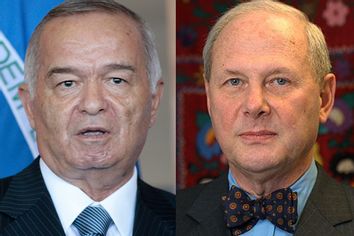
Uzbek president Islam Karimov and admirer professor Frederick Starr(Credit: AP)

Last week, the London-based Bureau of Investigative Journalism published a story about a sting against Bell Pottinger, a major British public relations and lobbying firm. Journalists working for the Bureau approached the firm in the guise of seeking PR help for Uzbekistan, the torture-loving former Soviet republic that has been known to boil prisoners to death. A Bell Pottinger representative told the undercover journalists it could introduce Uzbek officials “into political and media circles,” and help them “get better known by a lot of the key decision makers.”

In the course of their research, the Bureau met with lobbyists and PR agents who boasted of their ability to get think tanks to publish sympathetic reports about clients. They also talked about winning favorable media attention by setting up supposedly independent public events and hyping business opportunities for domestic companies.

In the United Kingdom, such international lobbying is virtually invisible.

“In the U.S. there is a measure of statutory transparency: lobbyists working for foreign governments have to publicly disclose their client contracts and state when and why they’ve been in contact with politicians and the media,” the Bureau noted. “In the UK, there’s no such obligation.”

While it’s true that U.S. lobbying and PR firms here are subject to disclosure laws, they and their clients have been able to skirt or even evade them. As I reported here last week, foreign governments and interests seeking influence in Washington use a host of tactics – some identical to what Bell Pottinger was proposing for Uzbekistan – that are largely unregulated and free of disclosure requirements. These include making contributions to think tanks, universities and non-profit groups, and setting up business associations that advocate for better political ties with the U.S. but aren’t legally defined as lobbying organizations.

The Uzbek regime of Islam Karimov, a Soviet-era hack in power since 1991 is a classic example. Uzbekistan does not have official lobbying representation in Washington, yet it has many American friends advocating on its behalf — and because they don’t register as lobbyists it’s hard to know exactly what they’re up to.

Chief among them is the American-Uzbekistan Chamber of Commerce (AUCC), whose board is made up of executives from U.S. companies with interests in Uzbekistan, such as Boeing, Honeywell and General Electric. The group’s stated purpose it to “promote trade and investment,” but it also pushes for “strong ties” between the two governments on the basis of its “excellent working relations” with both.

The AUCC is chaired by attorney Carolyn Lamm, a former head of the American Bar Association who in the past has lobbied for such authoritarian states as Libya and the former Zaire, ruled by strongman Mobutu Sese Seko.. Between 1997 and 2005 her law firm, White & Case, lobbied for the Karimov regime. Lamm has also served as legal counsel of Zeromax, a Swiss-registered holding company widely reported as controlled by Gulnara Karimova, the president’s powerful daughter. (A September 2005 WikiLeaks cable, written by a U.S. diplomat in Tashkent, described Gulnara as “the single most hated person in the country.”)

Following the 2005 Andijan massacre — in which Uzbek security forces slaughtered hundreds of unarmed protesters — the AUCC’s then-president, James Cornell, wrote to Secretary of State Condoleezza Rice urging her to “not rush to conclusion or ignore the thorough investigation carried out by the government of Uzbekistan,” and saying that downgrading relations with Karimov threatened “several vital interests of the United States.”

More recently, AUCC board members and the Uzbek ambassador to Washington held a briefing with House Foreign Affairs Committee staffers. During their meeting last August, they talked up “job creation” linked to American exports to Uzbekistan and “offered their help, expertise and knowledge” for future congressional visits to Uzbekistan.

Last September 28, the AUCC held its annual Business Forum in Washington, which was attended by representatives of “international financial organizations, think tanks and policy institutions” and featured speeches by Uzbek and U.S. government officials. AUCC President Tim McGraw of NUKEM – the aptly named company that serves as an intermediary between uranium producers and nuclear energy utilities — told the crowd that his group’s efforts sought to “fundamentally strengthen the overall bilateral relationship.”

The same day, in what was surely no coincidence, President Obama spoke with Karimov by phone and “pledged to continue working to build broad cooperation between our two countries.” This was just four days after a Senate committee, at Obama’s request, voted to waive Bush-era restrictions on military aid to the Karimov dictatorship in exchange for its help moving military supplies into Afghanistan.

All of which was surely gratifying to the dignitaries gathered at the AUCC forum.

My request for an interview with Lamm, made through the AUCC, was declined. Asked if the Chamber had advocated for the waiver on military aid to Uzbekistan, Elena Son, the organizations’ executive director, said by email, “The AUCC asked the U.S. Government about the waiver for informational and better awareness purposes.” The Chamber, she said, was “not a lobbying organization” and its “advocacy efforts aim to inform the American public and governing institutions about why better bilateral relations with the Republic of Uzbekistan matter to U.S. geopolitical and business interests.”

The teachings of “Starrmenbashi”

Among the speakers at the AUCC’s event was Professor S. Frederick Starr of the Central Asia-Caucasus Institute (CACI) at Johns Hopkins University, who has been a reliable champion of Karimov and other former East Bloc tyrants. Following the 2005 Andijan massacre, Starr went on NPR and echoed Karimov’s justification of the crackdown as necessary because Islamic militants were behind the demonstration. CACI later co-sponsored an event (along with the Hudson Institute) that debuted a short video offering the Karimov regime’s take on the Andijan crackdown. An account of the event at EurasiaNet.org said that Starr “sought to undermine” critical reports about Andijan by saying journalists “had an anti-government agenda” and “were lying.”

CACI refused to provide me with a current list of donors, but over the years they have included a number of U.S. oil companies active in the region; Newmont Mining, which has big interests in Uzbekistan; and the Joint Chiefs of Staff and the Defense Intelligence Agency. Caspian governments have funded individual scholars at CACI, which has also boasted in a brochure about the Institute of its “close contacts with the Washington embassies of the various countries in the region.”

In his approving comments about Caspian governments Starr — an advisor on Soviet affairs to Presidents Ronald Reagan and George H.W. Bush — sounds like one part old-line Soviet apparatchik and one part Borat. One former student of Starr’s told me that he became notorious in the classroom “for his predictable whitewashing of each and every central Asian despot” – even Saparmurat Niyazov — the former leader of Turkmenistan who built a cult of personality to rival Stalin’s and who named himself “Turkmenbashi the Great.” So ardent was Starr in talking up Niyazov that students took to calling him “Starrmenbashi.”

Starr has been just as big a fan of Turkmenistan’s new leader, Gurbanguly Berdymukhamedov, who won office in 2007 with 89 percent of the vote in an election following his predecessor’s death. “I am in complete amazement from everything I have seen here!” the State News Agency of Turkmenistan quoted Starr as saying while touring the country in November of 2010.

Last February, Starr gave a talk at CACI in which he lauded Berdymukhamedov’s commitment to openness and technology. This was less than two months after Turkmenistan had shut down the country’s largest mobile network. Starr also praised Berdymukhamedov’s books – which include a two-volume opus on medicinal plants — which he said had allowed him to “understand the logic of the current unprecedented successes of the Turkmen government.”

In a reply to a request for comment, Starr said that the purpose of his trip to Turkmenistan “was to conduct research on a book on the 8th to the 11th century, to visit archaeological sites connected with that work and to consult with several scholars who have conducted research on the period in question. My trip was paid for by CACI, which receives no money from Turkmenistan or any firm working there, and by me personally.”

Funding friendly commentary

Former Soviet interests have also made good use of other well-known Washington institutions to buff their images. Victor Pinchuk, the Ukrainian oligarch, sits on the board of the Peterson Institute for International Economics, and is one of its largest donors. Pinchuk grew rich by buying state-run firms privatized during the 1994 to 2005 reign of President Leonid Kuchma. It has frequently been alleged that Pinchuk was the beneficiary of sweetheart deals, a suspicion encouraged by the fact that he is married to Kuchma’s daughter.

Peterson Institute senior fellow Anders Aslund wrote a book, “How Ukraine Became a Market Economy and Democracy,” which included criticism of Kuchma but on balance presented a flattering portrait. One section, called “Kuchma Saved His Country,” included an interview with the former president, who replied to penetrating questions from Aslund such as, “What was your greatest deed?” and, “What else are you most proud of?”

Last May, the Washington Post ran an op-ed by Aslund that sharply criticized the “sinister” rule of the current government, which he said had used “the judicial system to repress opponents.” He noted in this regard that prosecutors had “surprisingly” charged Kuchma with involvement in the murder of journalist Georgy Gongadze in 2000.

Aslund’s general criticism of the current government of Ukraine is not without merit, but his byline identified him only as a senior fellow at Peterson. Nowhere was it disclosed that he and his think tank receive substantial funding from Pinchuk, whom he portrayed in the piece as a political martyr. Furthermore, Pinchuk’s father-in-law has long been suspected of ordering the journalist’s murder. Whether he is ultimately proved guilty or not, there was little “surprising” about Kuchma being charged in the case.

“In no way does [Pinchuk] try to influence the views expressed by me or other members of the Peterson Institute,” Aslund told me by email. “Obviously, before accepting grants from anybody, you make sure that it will not influence your views or cause any other conflict of interest.”

(Disclosure: Pinchuk has also contributed to programs funded by George Soros’s Open Society Foundations, which funds some of my work.)

Kazakhstan is yet another repressive former Soviet republic that has found strong advocates in Washington. In 2008, CACI published three upbeat reports on economic and political developments in the country without mentioning that the Kazakh government had paid for them through one of its Washington lobbying firms, APCO Worldwide.

Last April Kazakhstan held an election in which long-time ruler and de facto president-for-life Nursultan Nazarbayev won 95.5 percent of the vote. Observers from the Organization for Security and Co-operation in Europe noted “serious irregularities.” Two officials from Freedom House described the election, as “devoid of any real choice, much as in the days of Soviet rule.”

But Margarita Assenova, executive director of the U.S.-based Institute for New Democracies (IND), which describes itself as a “nonprofit organization dedicated to promoting good governance,” had a sharply different view.

“The people credit the wise leadership of Nazarbayev for peace, stability, economic development and ethnic harmony in Kazakhstan,” said Assenova of the outcome. The Kazakh government cited her statement as proof that the voting was fair.

Unmentioned in the statement was that the IND’s connections to the Kazakh government.  According to its most recent Internal Revenue Service filing, IND seeks to “strengthen U.S.-Kazakh relations.” The documents also show the Kazakh government had previously paid the Institute and the Center for Strategic and International Studies (CSIS) $290,000 to write reports about alleged democratic reforms under Nazarbayev.

The IND and CSIS also hosted a Washington conference on Kazakhstan that included a few critical voices but was stacked with pro-Nazarbayev viewpoints. The IND published a report on the conference that sanitized criticism of the Kazakh government. (Assenova did not reply to requests for comment.)

The credibility of Kazakhstan’s election was also vouched for by a group of observers sent by the International Tax and Investment Center (ITIC), which is headquartered in Washington and has offices in Kazakhstan. The group is headed by Daniel Witt, a former vice president of Citizens for a Sound Economy, the predecessor organization to Dick Armey’s conservative pro-business group FreedomWorks, which helped spur the Tea Party. The result of the balloting, he said, “bespeaks a yearning to maintain national stability and political continuity in Kazakhstan under the leadership that has delivered growing prosperity to all.”

Though it claims to be an “independent” research center, ITIC’s sponsors include numerous oil companies with stakes in Kazakhstan, as well as the Kazakhstan Petroleum Association. The group’s website even carries an endorsement from Nazarbayev. “ITIC has always insisted upon complete academic freedom for our observers,” Witt told Transitions Online Newsletter, which reported on the organization’s observer role. ITIC also whitewashed Kazakhstan’s 2004 parliamentary and 2005 presidential election.

Frederick Starr, the intrepid professor, served as an observer on both of those missions.

How Bahrain works Washington

In the latest twist on lobbying, Mideast autocracies repackage propaganda as "media awareness"

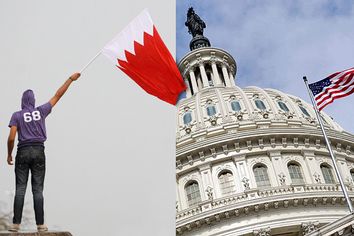
(Credit: Reuters/Hamad I Mohammed/AP/J. Scott Applewhite)

Ever since last February, when security forces in Bahrain brutally cracked down on demonstrators at the Pearl Monument, human rights groups have documented extensive violence by the government against pro-democracy protesters. In late  November, an independent commission hired by the country’s king released a report that said 35 people had been killed during the protests, including five detainees who were tortured to death, and that hundreds more had been injured and nearly 3,000 arrested.

But to judge from Tom Squitieri — the self-described “stargazer, Award winning reporter, communications crafter” who has tweeted and blogged about events in Bahrain for Huffington Post and the Foreign Policy Association — demonstrators are largely to blame for the violence. In one item he wrote about a girl named Zahra who “was attacked with an iron bar wielded by protestors” and a demonstrator named Ali who was killed “after being hit by a police car.” While Ali’s family claimed “he was deliberately run down” by the cops, Squitieri suggested it was more likely that “the police car swerved out of control after skidding on oil poured on the road by protestors.”

Squitieri states in his blog posts that he “works with the Bahrain government on media awareness and press freedom,” which is an odd way of describing work that amounts to propaganda. But unless you count his work at NewsMax, the right-wing media organization, Squitieri hasn’t been a journalist since 2005, when he resigned from USA Today for plagiarism. Nor does he mention anywhere that he is an employee of Qorvis Communications, a Washington firm that is registered to lobby for the government of Bahrain.

Traditionally, people think of foreign lobbyists as seeking to directly influence staffers on Capitol Hill and policymakers at the State or Defense Departments. But foreign governments have increasingly sought to augment this conventional mode of lobbying with other tactics that might be described as meta-lobbying.

Now lobbyists (for foreign and domestic clients) seek to advance their clients’ interests in Washington through other means: making contributions to think tanks and universities; arranging for allegedly independent pro-democracy groups to shill for their bogus elections, funding bilateral business associations that focus on trade issues while advocating, directly or indirectly, for enhanced political ties; and influencing the media and public opinion by hiring American opinion-makers to mouth their talking points.

U.S. laws on traditional lobbying are flimsy enough, but these new meta-lobbying tactics are largely unregulated and free of disclosure requirements — which of course makes them all the more effective and useful. As one Washington lobbyist told me, “Access lobbying is dead. Congress is gridlocked so meetings on the Hill are useless. Now it’s all about perception and molding public opinion. That’s why so many lobby firms have become integrated, and do so much work on the PR side.”

The Washington influence business has been in overdrive recently, as the Arab Spring erodes (Syria) or shakes (Egypt) or destroys (Libya) the U.S. government’s alliances in the Middle East. And even before foreign governments and their hired hands began scrambling to adapt to the region’s democratic awakening, they had begun seeking to shape perception by hiring former journalists or paying influential “opinion leaders” to support their regime or their cause.

The departed Libyan leader Moammar Gadhafi recruited prominent academics and former officials through the Monitor Group of Cambridge, Mass., which was charging his regime $250,000 per month to burnish its image. Among those the Monitor Group lined up — in exchange for big fees — were historian Francis Fukuyama, the Middle East scholar Bernard Lewis, neoconservative Richard Perle (who twice traveled to Libya for meetings with Gadhafi) and professor Joseph Nye of Harvard, who also visited Libya and wrote a favorable story afterward for the New Republic. Nye also offered advice to Saif Gadhafi, the colonel’s son, on the dissertation he wrote for the London School of Economics.

Gadhafi also counted on support from the Washington-based U.S.-Libya Business Association. It was founded and financed by U.S. oil companies that were unhappy about the pace at which the Washington-Tripoli relationship was developing after George W. Bush’s administration forged a rapprochement with Gadhafi’s regime in 2004. Despite the political thaw, there remained strong opposition in Congress to Gadhafi’s regime due to his past support of terrorism. Meanwhile, European governments had been far less squeamish about embracing the colonel, giving their oil companies a leg up on American firms in the race to win concessions in Libya.

To supplement their stable of K Street lobbyists dedicated to improving ties with Tripoli, Occidental, ConocoPhillips, ExxonMobil, Marathon Oil, Chevron and other companies set up the USLBA. According to its federal tax filings, the association sought to “educate the public on the importance of US-Libya trade and investment, and facilitate the commercial and diplomatic dialogue between the two countries.” At least seven of its eight directors were registered lobbyists for oil companies.

David Goldwyn — who had served at the Energy Department under Bill Clinton and who then ran a consulting firm that provided “political and business intelligence” to oil companies — was hired to head the group. The USLBA spent over $1 million between 2006 and 2009, of which more than $600,000 was used to pay Goldwyn’s firm.

In 2008, Gadhafi demanded that American oil companies help Libya win an exemption from a law signed by President Bush that allowed American victims of terrorism to seize assets of countries found liable for attacks. Libya was a specific target of the law. The USLBA was happy to help out. Working in close collaboration with official lobbyists for Libya and the oil companies, the association urged Secretary of State Condoleezza Rice to pursue a waiver for Libya, according to a recent Bloomberg story. Rice and three other Bush Cabinet members soon wrote congressional leaders saying that the exemption was needed or there would be “a chilling effect on potentially billions of dollars in investments by U.S. companies in Libya’s oil sector.”

Congress soon passed a measure that gave Libya the immunity it sought. Goldwyn, meanwhile, took a business delegation to Libya in December of 2008 and talked about the “fantastically warm reception” they received from senior government officials.

In 2009, Goldwyn joined the Obama administration as the State Department’s Coordinator for International Energy Affairs. He resigned earlier this year and returned to the private sector as an energy consultant. Goldwyn declined a request for comment about his work for Libya, other than to say, in response to a question about why he had never registered as a lobbyist for the USLBA, that he was not legally required to because he didn’t spend sufficient hours to trigger the disclosure rule.

The USLBA has seamlessly transitioned into the post-Gadhafi era. Its website bears no mention of the colonel and now carries news about the new government’s naming of an interim cabinet and the arrival in the U.S. for “urgent medical care” of two dozen wounded Libyan fighters. Never mind that they were wounded fighting the government of the association’s former pal Gadhafi.

Bahrain’s chief Washington lobbying organization is Qorvis, which also represents controversial autocratic clients such as Saudi Arabia and Equatorial Guinea. Qorvis doesn’t seem to do much for Bahrain (or its other clients) other than put out a steady stream of press releases at PR Newswire. For example, after Bahraini security forces in July raided the offices of Doctors Without Borders — human rights activists allege this was part of the government’s effort to deny medical services to injured protesters — Qorvis distributed a statement saying the medical group was to blame because it had failed to obtain the proper permit to operate in the country.

Such releases are not aimed directly at public opinion so much as at Google and other search engines. A steady stream of press releases serves to push news stories lower in search engine returns; when it comes to Qorvis’ clients, the news is almost invariably bad so burying it makes sense. “Qorvis’ releases are pure propaganda and it doesn’t even bother flogging them to journalists,” said the lobbyist cited above. “They just trot the stuff out so there’s something else to read on Google when one of their clients fucks up.”

Then there’s Squitieri, who has worked for a range of domestic and foreign clients through his own P.R. firm, TS Navigations. On the domestic front, he has helped — according to his list of “key accomplishments — “craft and lead the campaign to reposition Taser International from a severe crisis communication dilemma” and won an exemption for an unnamed tobacco processing company from “congressional legislation giving the FDA regulatory control over tobacco.”

On the foreign front he (like Qorvis) worked for the Kurdistan Regional Government, whose representatives he hooked up with journalists andprofessionals in the wider communications community” including “sign and banner makers” and “event planners.” He also wrote speeches for Kurdish officials, like one delivered to the World Affairs Council in West Palm Beach earlier this year that had his Kurdish client quoting ’60s Yippie Abbie Hoffman about the virtues of democracy.

For Bahrain, Squitieri tweets and blogs. He puts on airs of objectivity and impartiality yet his paymaster’s point of view, delivered in hackneyed prose, is obvious.

“As Bahrain wheezes and convulses in its uncertain steps,” he wrote for Huffington Post, in October, “the gray is slowly emerging more in the reports of those spending at least a little time letting all the senses embrace.” He described Bahraini protesters seeking a more democratic government as being driven by “anger without a purpose” and called them “foot soldiers for puppet masters with a greater agenda,” referring obliquely to Iran. (Incidentally, the newly commissioned Bahraini government report said it found no evidence that the Iranians were behind the protests.)

Even though he works for Qorvis, Bahrain’s registered lobbying firm, Squitieri insisted in an email that he does not “engage in any lobbying.” He describes his work for Bahrain as “media awareness, media training and helping to identify possible stories.”

Asked why Squitieri’s blog posts weren’t identified as paid product for Qorvis, Matt Lauer of the firm said by email, “Tom’s blogs are his own thoughts,  but he does disclose his affiliation with the government.”

Incidentally, the Independent of London reported this week  on a journalistic sting operation on Bell Pottinger, a major British P.R. firm that Qorvis works with on Bahrain. The sting — modeled on a similar piece I did for Harper’s several years ago — involved reporters posing as agents of the government of Uzbekistan, who contacted Bell Pottinger to see if the firm would run a P.R. campaign on behalf of that country’s dictatorial regime.

Bell Pottinger was keen to do so and gave a presentation to the undercover journalists during which it promised it would utilize the “dark arts” to influence public opinion for Uzbekistan. That included creating “third-party blogs” – which would look independent but be run by the P.R. firm — that would, along with other tactics, help bury bad news about the country on Internet searches. “The ambition obviously is to drown that negative content and make sure that you have positive content out there online,” a Bell Pottinger representative told the undercover reporters.

All of which appears to be the very model that Qorvis, with the help of Squitieri, employs on behalf of Bahrain.

Continue Reading Close

America’s fixer in Cambodia

In the post-communist kleptocracy, a former Reagan official is the man to see.

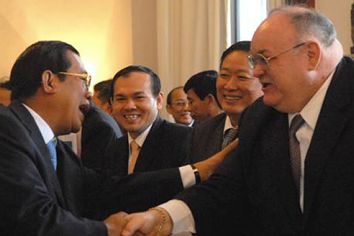
Bretton Sciaroni, right, shakes hands with Cambodian prime minister Hun Sen

PHNOM PENH — Bretton Sciaroni, an American expatriate and former ideologue of Ronald Reagan’s White House, makes a most unusual power broker in contemporary Cambodia. The portly Sciaroni is an official advisor to the government of Prime Minister Hun Sen, a one-time Khmer Rouge cadre. The Cambodian government has bestowed on Sciaroni the titles Minister Without Portfolio and His Excellency. From his office in an exclusive section of the city — neighbors include the president of the ruling party — he runs a consulting firm that brokers business deals on behalf of foreign investors — deals that often benefit well-connected companies and individuals like Sciaroni himself.

Sciaroni also appears to be a chief intermediary between the U.S. government and Cambodia, which has emerged in recent years as an unlikely American ally. The U.S. cut most assistance to Cambodia in 1997 after Hun Sen staged a coup but resumed aid a decade later. Competition with China for influence in the region and growing trade ties — the United States buys more than half of Cambodia’s apparel production, its primary export — are the primary factors behind the political warming. It probably didn’t hurt that Cambodia struck oil and Chevron got a stake in the most promising field. Today Cambodia is the third-largest recipient of U.S. aid in Southeast Asia, after Indonesia and the Philippines. And Brett Sciaroni is, at least politically, the biggest American in the country.

Earlier this year Sciaroni met me for drinks at the Elephant Bar of the Raffles Hotel. Wearing a light-colored jacket and yellow tie and sporting gold-rimmed glasses and a thick gold bracelet, Sciaroni offered an upbeat view of his adopted country.

“This is very much an emerging economy and democracy,” he said while sipping from a glass of Chateau Batailley, a French Bordeaux. “There’s been a lot of political progress. The ruling party no longer intimidates the opposition.” He describes his own work in Cambodia in altruistic fashion, saying, “This is a country where you can make a difference. If you make a suggestion to a government official and he likes it, it will happen.”

Most independent observers have a different view of Cambodia under Hun Sen, who has held power since a 1997 coup. Forty percent of the population lives on less than $1.25 a day, and groups like Human Rights Watch and Global Witness have documented large-scale corruption and political repression.

“Cambodia is run by a kleptocratic elite that generates much of its wealth via the seizure of public assets, particularly natural resources,” Global Witness said in a 2007 report. According to opposition parliamentarian Son Chhay, Sciaroni “covers up the government’s bad practices and uses his connections to convince the U.S. to keep [supporting] the government.” And Dana Rohrabacher, the conservative California congressman who says he personally likes Sciaroni, told me Hun Sen had no genuine legitimacy and that “Brett has become part and parcel of a clique of the Cambodian elite that is neither democratic nor honest.”

Reagan’s flimflam man

How did a fervent right-wing anti-communist and old pal of Ollie North’s end up in Cambodia as the chief foreign advocate for a man who fought as a Khmer Rouge guerrilla against a U.S.-backed government before becoming head of the Vietnamese puppet regime that overthrew it? That was a big ideological leap, but Sciaroni’s chief talent — performing intellectual acrobatics for his paymasters, whoever they might be — has served him equally well in Washington and Phnom Penh.

(I repeatedly sought comment from Sciaroni after our interview in Phnom Penh, but he declined to reply to questions about Iran/contra and his other political activities in the U.S, or his business or political activities in Cambodia.)

By 1984, just five years after he received a law degree from UCLA, the sky seemed the limit for young Bretton Sciaroni. Following short stints at two right-wing think tanks and as a Commerce Department political appointee under President Reagan, he was named chief counsel to the President’s Intelligence Oversight Board. During this period, he provided legal arguments needed to move forward with Reagan’s Star Wars scheme (on the specious grounds that it didn’t violate the Anti-Ballistic Missile Treaty) and with military aid to the Nicaraguan Contras, which Congress had flatly forbidden.

When Iran-Contra investigators subsequently asked him why the administration turned to him for advice instead of to more experienced staff lawyers at the White House or Justice Department, Sciaroni replied, “Frankly … that thought has crossed my mind as well. I don’t know why my opinion was the only one.”

The reason, however, was quite apparent. Like John Yoo and other conservatives on whom the Bush administration relied for the flimflam needed to justify torturing terrorism suspects in violation of the Geneva Convention, Sciaroni was a loyalist who the Reagan administration knew would reach the conclusions it wanted.

Indeed, compared with Sciaroni, Yoo looks like Oliver Wendell Holmes. In 1986, Sciaroni wrote a series of opinions, including a memo that said North’s aid to the Contras was legal even though Congress had flatly banned any training “that amounts to participation in the planning or execution of military or paramilitary operations in Nicaragua.” (Sciaroni determined that the ban didn’t cover “generic” military aid, which he expansively defined as including categories like marksmanship, intelligence reporting and the construction of fortifications.)

When he was later asked by a superior at the oversight board to investigate media accounts of illegal aid to the Contras, Sciaroni determined they were false, largely on the basis of a five-minute conversation with North. The latter denied everything, which was good enough for Sciaroni.

But Sciaroni soon crashed. During his 1987 testimony before the congressional committee investigating Iran-Contra, it emerged that he had passed the bar exam only on his fourth try (in three different states), and that he got the chief counsel’s position despite never having previously held a job in the legal profession. Before long he lost his government job and was scraping by as a fellow at the American Conservative Union and as a pro bono lobbyist for a group of right-wing Salvadorans close to that country’s murderous military-dominated regime.

When he learned in 1993 from Rohrabacher that Hun Sen was looking to hire an American attorney for a short-term assignment, Sciaroni was quick to seize the opportunity. He arrived right before the May 1993 elections, which were organized by the U.N. following the reign of the Khmer Rouge and years of civil war. The royalist party triumphed in the balloting but agreed to a power-sharing arrangement when Hun Sen threatened to lead an armed revolt.

“The funny thing is that if the CPP [Cambodian People’s Party] had won the election, I probably would have been back in the U.S. after two months,” Sciaroni told me at the Elephant Bar. “But they lost and they panicked. I had written up some things they liked, and they asked me to stay on.”

It seemed odd that the strongly conservative Rohrabacher, a strong critic of Hun Sen’s ever since the 1993 vote, would help Sciaroni get a job with the government, but the congressman confirmed the story during a phone conversation. It turned out that Rohrabacher and Sciaroni had known each other since their college days, when they were members of Young Americans for Freedom and Youth for Reagan.

“After the Iran-Contra scandal, all of Brett’s friends deserted him, which is typical of Washington,” Rohrabacher told me. “A Cambodian-American constituent told me that Hun Sen was going to hold free elections; he was looking for a lawyer to draw up an honest election code and was willing to pay top dollar. I knew Brett really needed the money and thought he’d be perfect for the job. And he did a good job — they did have a free and fair first-round vote. The only problem was that Hun Sen lost and didn’t abide by the results, and our government buckled. They should have told him, ‘You lost, get out,’ but instead they agreed to a compromise and Hun Sen became one of the two prime ministers.”

Rohrabacher was furious about the outcome, but Sciaroni continued to work for Hun Sen.

“He’s like a ‘Lord Jim’ character,” Rohrabacher told me of Sciaroni. “His own country abandoned him when Iran-Contra became a scandal. He became a destroyed human being who went overseas to start a new life.”

Spinning repression

Sciaroni’s close relationship with the regime became especially apparent after Hun Sen seized power in a bloody military coup in July 1997 that left at least 41 oppositionists dead. Enter Bretton Sciaroni, who assembled and directed a lobbying and public relations team that tried to spin the coup in Washington. The centerpiece of the campaign was a “white paper” that alleged that the royalist party had employed a “campaign of provocation” against the CPP and that the coup was therefore a legitimate preemptive measure by Hun Sen.

The Washington Times exposed the campaign, prompting outrage among Americans in Cambodia and some of Sciaroni’s right-wing comrades back home. When the Times asked him what help or advice he contributed to the white paper, “Sciaroni grimaced and responded, ‘No comment.’ ”

The following year, Sciaroni coordinated another P.R. campaign around an election that Hun Sen organized and handily won.

Rita Colorito, who worked on the campaign for an American lobbying firm recruited by Sciaroni, later wrote about her experience in an article called “Confessions of a Spin Doctor.” “The Cambodian People’s Party didn’t care about human rights progress,” she wrote. “It simply wanted favorable media coverage and renewed international aid.” Nonetheless, Hun Sen’s American spin team did its best to sell their client by “taking semantics to an absurdity,” Colorito wrote.

Sciaroni’s campaign misfired, though, when it persuaded Tina Rosenberg of the New York Times Magazine to come to Cambodia to report on Hun Sen’s inspired leadership. Rosenberg wasn’t impressed and wrote an article (under the headline “Hun Sen Stages an Election”) that said that since 1975, “Cambodia has suffered under an assortment of dreadful Governments, and Hun Sen has been in all of them.”

Petrified that Rosenberg’s story would cause them to lose their fat contract, the PR team held an “emergency phone conference” to spin the article to Hun Sen and convince him it wasn’t as bad as it looked.

Hun Sen apparently accepted the explanation. In 2002, his government granted Sciaroni Cambodian citizenship. Since then he has publicly lauded Sciaroni for “seeking justice for Khmers” and expressed hope that “he will continue to stay here with us.”

A bridge to U.S. business and government

Sciaroni’s success is based on a simple truth. Political contacts are the handmaiden of business operations the world over, but in a country like Cambodia — with its tiny intertwined political and economic elite — they are vital. “You get opportunities because you are close to the government,” a Westerner living in Phnom Penh told me. “You have to be in their good graces.” Sciaroni’s connections, this person said, run wide and deep: “Brett has been here since the early days, when things were very rough. There aren’t many [foreigners like that], and Brett is the only American.”

Numerous sources told me that Sciaroni’s closest contact in the regime is Sok An, the deputy prime minister and head of the council of ministers. Sciaroni has accompanied Sok An on international delegations and advised him during meetings with international agencies like the World Bank.

The State Department’s most recent annual report on human rights said that the CPP has “consolidated control of the three branches of government and other national institutions” and that the government “restricted freedom of speech and of the press … and at times interfered with freedom of assembly.” Sciaroni’s rosier assessment, which he offered when we met, is that “the electronic media is dominated by the government, but the print media is freewheeling and sometimes irresponsible. Elections are pretty good in a technical sense.”

During a speech at a 2007 investment conference in Cambodia he pitched Hun Sen’s authoritarian brand of government as a plus for business. “Investor confidence has been strengthened by the … stability in the officials you deal with,” he said. “You are not likely to see great swings in policy because of new officials coming on the scene.”

Sciaroni also pitched the regime during a 2009 visit to Cambodia by Virginia Sen. Jim Webb. “Sciaroni praised the Cambodian government’s regular dialogue with the private sector,” said a cable released by Wikileaks. “Sciaroni confidently asserted that no Amcham [American Chamber of Commerce] has as much influence on a government in Southeast Asia” as the one in Cambodia. (Sciaroni has headed the local American Chamber since it was founded in 1998.)

Son Chhay and other government critics I spoke with said they feared Sciaroni had played a role in softening American policy toward Cambodia, which until a few years ago placed a heavy emphasis on human rights. Nowadays, expanded trade and military cooperation get far higher billing. The United States has become “obsessed with the need for ‘dialogue’ with the government, and he is seen as a bridge for that,” one Cambodian activist, who asked not to identified, told me.

Sciaroni is not shy about what he can deliver for his customers. During his speech at the 2007 investment conference, Sciaroni explained how his firm had negotiated a major tax benefit for an American company that had balked at investing locally because the import of raw aluminum was taxed at a rate of 7 percent.

“In rapid succession we met various senior officials,” Sciaroni recounted. “[One of them] said ‘what would you like it [the rate] to be?’ and the company said ‘How about zero percent?’ And zero percent it was and is today.”

Sciaroni’s other clients have included Chevron and Mitsui, which hold stakes in Cambodia’s most promising oil field, and international mining firms like BHP Billiton, Mitsubishi and Oxiana. He has also worked with Raptor Forestry, which according to a business plan I obtained, is “investigating the potential” for large-scale timber and agricultural projects. Sciaroni, the plan says, received equity in the venture for providing legal services and his “network of local contacts.”

Sciaroni was listed on initial incorporation records as chairman of the board of a local subsidiary of another client, Paris-based CityStar for which he serves as legal counsel. CityStar set up shop in Cambodia in early 2007, almost precisely as the government was selling off for development public land near the coastal town of Sihanoukville. The process resulted in gorgeous beaches, islands and protected areas being purchased by well-connected companies on terms undisclosed to the public. CityStar, which plans to build luxury hotels and villas, won two concessions in a national park area as well as two other areas for development on separate islands off the coast of Sihanoukville.

And so it goes for Sciaroni, whose fleeting success in Ronald Reagan’s Washington served as a steppingstone for far bigger things in Cambodia. And with ties to the U.S. government warming and American firms like GE, DuPont and Microsoft setting up shop in Cambodia in recent years, the outlook for the future is bright.

“Opportunities abound,” Sciaroni told me of Cambodia, though he may as well have been describing his own good fortune in washing up here. “It’s a great environment.”

Continue Reading Close

Never mind who paid the bar bill

After I reported on journalists getting cozy with anti-Russian lobbyists, defensive tweets fill the air

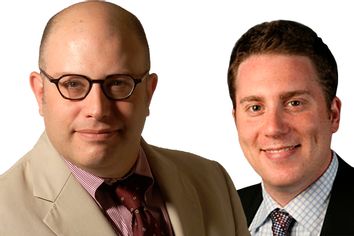
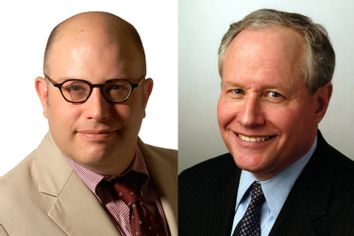
Eli Lake of the Daily Beast/Newsweek, and Ben Smith of Politico (Credit: MediaBistro/Politico)

On Wednesday Salon published my story reporting on the the extensive media contacts between lobbyists at Orion Strategies and Washington journalists who write a lot of favorable stories about the government of Georgia – a big client of Orion’s. They also write a lot of unfavorable stories about Russia, Georgia’s mortal enemy, and the alleged failure of “reset,” the Obama administration’s policy to improve ties to Moscow.

Some of the journalists had traveled to Georgia on Orion’s tab. Others had meals or drinks picked up by the lobby shop. All of them attended events on Georgia set up by the lobbyists, who also arranged interviews for them with Georgian government officials. Sometimes they wrote stories very soon after being contacted by Orion, which suggested their stories originated with pitches from Georgia’s lobbyists. What I was trying to get at was – in the words of reporter Laura Rozen of Yahoo! News, who tweeted about the story – “a creeping culture of soft influence buying where lines are not clear cut, and disclosure often insufficient.”

The writers I mentioned and their defenders responded with the self-critical perspective and independence of mind that journalists are famously known for: They circled the wagons and attacked me, via blogs and Twitter. I said in the piece that I felt uncomfortable writing about some of the journalists because I knew them personally and liked them. I don’t feel nearly as badly at this point.

At Politico, Ben Smith wrote my criticism of Newsweek/the Daily Beast’s Eli Lake was “so thin that I don’t understand why Silverstein went ahead with it at all.” (I didn’t mention Smith in the story but he was among the journalists whom Orion contacted and has had drinks with the crew I wrote about. He picked up his own tab.)

Mostly journalists launched their attacks on the story via Twitter and affected the tone that my story was much ado about nothing. Jamie Kirchick of the New Republic wrote, “In the @salon Georgia lobby story, there’s a photo of @elilake next to Bill Kristol. He must be guilty of something.”

John Noonan — who writes for the Weekly Standard and is also an advisor to the hawkish Foreign Policy Initiative, which Orion’s crew of journalists routinely cite in their Georgia stories – wrote, “Salon drops a grade-A hydrogen bomb of a story. As part of my foreign policy gig, I once went on a junket to Georgia.”  (Earlier this year Noonan, a media ethics guru, went to work as a spokesman and speechwriter to the House Armed Services Committee.)

Lake wrote, “I have sources and I meet with them sometimes for lunch. Ken Silverstein with the exclusive.”

While they are now dismissing the story in public, some of them acknowledged during interviews (off the record, of course) that I had a point. Several said they would not go on a junket, as some of their colleagues had. One reporter told me I would have a legitimate point if he were an opinion writer. An opinion writer told me that I would have had a point if he were a reporter.

Meanwhile, I learned today that Lake was the sole speaker this week at an event sponsored by the Heritage Foundation called “From Russia With Regret; The Myth of ‘Reset’ Policy.” The event invitation called for a “dire need of reassessment” of the U.S. relationship with Moscow and was advertised as a conversation between Lake and Peter Brookes of Heritage about the “floundering” of ties with Russia. Randy Scheunemann of Orion and the Georgian ambassador were in attendance. (Heritage said Orion had no role in the affair.)

I’m sure the wagon-circlers will also tweet this away as meaningless. After all, Lake, whose journalism has been facilitated by lobbyists for Georgia, was merely addressing an audience of journalists and Hill staffers on behalf of a right-wing think tank that is reflexively anti-Russian. What could possibly look wrong with that?

These writers now take me to task for reporting the less then sensational news that they socialize with lobbyists — as if that was I all I did. In fact, when I was reporting the story, I spoke with a number of them, on a not-for-attribution basis, about their friendship and dining habits with Michael Goldfarb of Orion. But they wouldn’t put these remarks on the record, which I found curious. If there is nothing problematic about having lobbyists pick up the tab for drinks and meals, and their relationships with him, why won’t they discuss it on the record?

Would these journalists find it at all troubling if Russian P.R. handlers did the same sort of work with the media as Orion does? Oh, right. Kirchick wrote a story denouncing Russian media influence peddling for the New Republic, called “Pravda on the Potomac; Russian Propaganda Descends on Washington.” A year later he went to Georgia on a trip arranged by and paid for by Orion.

Kirchick at least acknowledged that his ethics are situational. “Most governments lobby in Washington,” he told me. “The question it comes down to is how you view that government.”

This is the standard to which these journalists seem to be retreating. Lobbying and junkets and free drinks for journalists are OK when it’s paid for by the people you deem to be on the “right” side but not when it’s paid for by those on the “wrong” side.

The crisis of journalism is even worse than it seems.

Continue Reading Close

Neoconservatives hype a new Cold War

Lobbyists wine and dine eager Washington journalists in a campaign to undo Obama's "reset" on Russia

Eli Lake and Bill Kristol

Over the summer reporter Eli Lake of the Washington Times wrote a series of provocative stories about U.S.-Russia relations and the alleged failure of “reset,” the Obama administration’s policy to improve ties to Moscow. The most sensational ran on Page One of the Times on July 22 and led to several follow-ups. It alleged that a bomb blast near the U.S. Embassy in Tbilisi, Georgia, the previous September had been “traced to a plot run by a Russian military intelligence officer, according to an investigation by the Georgian Interior Ministry.” The Russia officer was identified as Yevgeny Borisov.

“If true, a Russian-sponsored attack on a U.S. Embassy would constitute the most serious crisis in U.S.-Russian relations since the Cold War and put to lie any ‘reset’ in bilateral relations,” Lake quoted GOP Sen. Mark Kirk as saying of his story. A few days later, Lake reported, Kirk and four other senators — Jon Kyl, Lindsey Graham, Joe Lieberman and John McCain —  sent a letter to Secretary of State Hillary Clinton demanding intelligence community briefings on the incident.

Lake’s original report on the bombing was sourced exclusively to government sources in Georgia, which fought a war in 2008 with Russia, its mortal foe. For “balance” he included a quote from the Russian embassy denying any official involvement. The story was highly favorable to the Georgian government’s interests, as are a number of other stories that Lake has written about Georgia in recent years. During that period the neoconservative lobbyists at the Washington firm of Orion Strategies, which has received more than $1 million in fees from Georgia’s government since 2004, have worked closely with Lake.

Orion is run by Randy Scheunemann, a former advisor to Donald Rumsfeld who helped set up the Committee for the Liberation of Iraq and was a leading advocate for the U.S. invasion in 2003. The committee in turn was created by the Project for the New American Century (PNAC), whose other leaders included Robert Kagan and Bill Kristol, founder and editor of the Weekly Standard. Scheunemann was John McCain’s foreign policy advisor during his 2008 presidential campaign, and later worked for Sarah Palin.

In 2010, Orion hired Michael Goldfarb, a McCain presidential spokesman who previously worked for PNAC and who was a contributing editor at the Weekly Standard (and who even as a lobbyist continues to periodically write for the magazine). Lake is also an ardent conservative whose reporting championed the Iraq war.

Orion seeks to create a media echo chamber on Georgia and Russia. Essentially it works like this: Tbilisi’s lobbyists generate contacts and information that they feed to sympathetic journalists. Orion frequently arranges interviews with Georgian officials and, not infrequently, stories centering on their charges magically appear soon afterward. Orion has wined and dined some reporters on its tab or picked up their travel expenses. There’s certainly nothing illegal about that but it’s worth noting that lobbyists are barred from maintaining these sorts of relationships with members of Congress because it so clearly presents, as we say in Washington, at least the appearance of impropriety.

Orion is friendly to and works with government officials and politicians who its reporter friends regularly cite (especially McCain). Orion also works very closely with experts and organizations cited by these reporters, like the Foreign Policy Initiative, whose board of directors includes William Kristol, Robert Kagan and other neocons from the PNAC and the Committee for the Liberation of Iraq.

The journalists pick up on and spread each other’s work and Goldfarb, naturally, hawks their stories at his Twitter feed. Just last week, he called a new Lake story a “must read.” The piece  at the Newsweek/Daily Beast, featured an exclusive interview with Georgian president Mikheil Saakashvili, who alleged that the bombing at the U.S. Embassy was “ordered at the most senior levels of the Russian government.” He was quoted as saying that Putin “is crazy about planning the individual details of special operations … I cannot imagine somebody touching a topic as sensitive as Georgia is for Russia, especially for Putin, without Putin having firsthand knowledge or command of it.”

Orion helps create a collective media reality that policymakers have to respond to. Other foreign governments  also play this game, as do liberal and conservative interest groups, but rarely as well or so brazenly.

Disclosure records filed by Orion show that between mid-2009 and mid-2011 it set up seven interviews with senior Georgian government officials for Lake, who quoted them prominently in stories that centered on their various allegations. Lake also attended 10 events in Washington with Georgian officials or Hill staffers and had three email or phone discussions with Goldfarb about Georgia. (Orion is more thorough than most lobby shops in recording its media outreach, but that number seems improbably low given all the other help it provided Lake.) And on seven different occasions Goldfarb billed his firm for meals or drinks with Lake, usually with other journalists along, and four times with Georgian officials as dining or drinking companions.

In May of 2011, Goldfarb paid $977.24 for a dinner at Morton’s steakhouse, attended by Georgia’s Minister for Reintegration Eka Tkeleshuili, Lake and several other journalists, including Dan Halper of the Weekly Standard. This was almost surely not the last contact between Orion and Lake before the embassy bombing story ran, but lobby disclosure records are filed biannually and Orion’s last disclosure covered the period only up through June 30.

Meanwhile, in September of 2010 alone Goldfarb billed Orion $300 for a dinner at Buck’s Fishing and Camping with Lake and another reporter; $172.62 for a tab at Heritage of India for Lake, Georgia’s deputy national security advisor, and Svante Cornell of the Central Asia-Caucasus Institute & Silk Road Studies Program; and another $460 bill for “refreshments” for the latter group that same night, at Morton’s. (The previous month Lake had quoted Cornell to buttress one of his anti-Russian pieces.)

Lake’s stories have had impact, especially the report on Russia’s alleged bombing of the U.S. embassy in Tbilisi, and they have been widely circulated in the mainstream media, and even more in the conservative media. Daniel Halper of the Weekly Standard called the story a “big scoop.” Jennifer Rubin of the Washington Post complained afterward that Moscow’s “human rights atrocities, campaign of intimidation and even violence haven’t caused the administration to rethink its policy of appeasement, dressed up as ‘reset’.”

Joshua Foust, a fellow at the American Security Project, concluded that while evidence for “Russian culpability in the incidents was compelling,”  it was unlikely that President Dmitry Medvedev or Prime Minister Vladimir Putin “would be so stupid as to order these small, nasty and counterproductive operations. These acts caused mercifully little damage in Georgia and a lot of political damage to Russia in Washington.”

Indeed, Lake, seeking to bolster his story, reported a few days later that “U.S. intelligence agencies concluded in a classified report late last year that Russia’s military intelligence was responsible for the bomb at the U.S. embassy.” He quoted an unnamed U.S. official on this classified report as saying, “It is written without hedges, and it confirms the Georgian account.”

Yet he soon filed another story  that quoted an administration official as saying there was “no consensus” on responsibility for the Tbilisi blast. And then on Aug. 4 he filed yet one more dispatch saying that the CIA concluded that Borisov, the Russian officer who allegedly coordinated the attack, was “acting on orders from Russian military intelligence headquarters” but that the State Department’s Bureau of Intelligence and Research “assessed that Mr. Borisov was acting as a rogue agent.”

In other words, Lake softened his big story, and while it might be true it was perhaps too thin to have initially run on the basis of Georgian government sources. A New York Times story that followed Lake’s reporting said the “intelligence community has apparently been unable to reach a clear consensus about who is responsible for the bombings, which has revived old differences in Washington about what the United States relationship with Russia should be.”

In an email, Lake said his reporting “speaks for itself.” He acknowledged dining and drinking with Goldfarb on the seven occasions cited but said he had paid for his share of the bills.

Lake is now the national security correspondent for Daily Beast/Newsweek. Goldfarb declined to comment

Orion’s belt

In addition to Georgia, Orion Strategies has represented Macedonia and Taiwan, and a few domestic clients.  Scheunemann is by all accounts an effective lobbyist. “He understands Washington well,” one of his competitors told me. “He’s good at persuading people and [his firm is] especially good with the media.” The latter is primarily due to Goldfarb, who has many reporter friends and regularly drinks with them, and a circle of conservative policy types, at Morton’s steakhouse.

Georgia and Russia fought a war in 2008 that was generally portrayed in the American media as a David vs. Goliath tale, with spunky little Georgia in the role of the former and longtime boogeyman Russia serving as the latter. Suffice it to say that the truth is more complicated than that. The fact that Georgia is strongly pro-U.S. and has sent troops to Iraq and Afghanistan has no doubt helped Tbilisi sell this fairy tale to the American media.

Georgia and its lobbyists, led by Orion, have also peddled stories supporting the need for American arms sales to Tbilisi and the utter failure of “reset.” Once again, the truth is messier. Vladimir Putin’s Russia is certainly corrupt and oppressive and anti-democratic, but Mikhail Saakashvili’s Georgia exhibits the same problems, if to a lesser degree. The State Department’s human rights report has “widespread allegations of intimidation and pressure, flawed vote-counting and tabulation processes,” and says that Georgia is “dominated by a single party.” It noted a “lack of due process, government pressure on the judiciary, and that individuals remained in prison politically motivated reasons.” Even the neocon-leaning Washington Post editorial page has said “that the Russian government’s repression and corruption “does not preclude cooperation” and that the Obama reset has “achieved gains.”

Jennifer Rubin, a writer for Commentary until late 2010, is another friend of Orion. She is one of a number of right-wing versifiers whose flimsy reporting — in her case little more than eager repetition of GOP talking points and unsubstantiated terror porn — have landed them jobs at the Washington Post. Orion’s lobbyists have briefed her and set up interviews for her, and she has attended their Washington events for Georgian officials. In February of 2010, when Rubin was still at Commentary, Goldfarb billed Orion  $321.88 for drinks at  the posh Ten Penh restuarant,  for her and several other journalists.

Rubin is a reliable mouthpiece for Georgia’s anti-Russian themes. During the week of Dec. 13, 2010, Goldfarb contacted Rubin to discuss Georgia. Eight days later, Rubin wrote an item saying that in regard to the Russia reset, “We need to examine what are we giving up and what are we getting.” She proposed the U.S. government consider “robust assistance to Georgia.” On Jan. 4 she published another item on Russia, citing a story by Lake and quoting Jamie Fly of the Foreign Policy Initiative (hear the echo?), who told her that, “Despite U.S. efforts to placate Russia in return for support on Iran, Russia has done little more than it did during the Bush administration to halt Tehran’s march toward a nuclear weapon.”

During the week of May 29 of this year, Goldfarb logged a conversation with Rubin about “Georgian security.” On June 3, she wrote a story for Washingtonpost.com that suggested it “might be an excellent time to explore” whether Russian reset was “all give and no get for the United States and the West.” Rubin’s story cited Senators Echo and Echo (McCain and Lieberman)  complaining that a ‘reset’ consists “largely of acceding to Russian demands with no corresponding progress in Russian human rights or conduct toward its neighbors.”

In an email reply Rubin wrote: “My views on Russia, human rights, Eastern Europe, Georgia, etc. are long standing and well known. I invariably take the side of democracies against tyrannies.”

(Incidentally, Rubin is one of many media junketeers who have trekked off to the Middle East on the tab of pro-Israeli organizations, the true masters at spinning and pampering journalists. Earlier this year she and a group of media colleagues attended the Herzliya Conference “With the region experiencing great upheaval and Israel facing a variety of domestic and international challenges, this is a particularly opportune time to hear from Israelis and listen to Israeli officials,” she wrote at the time. Airline and travel expenses, she disclosed, were picked up by the Emergency Committee for Israel whose board includes Kristol and whose chief advisers include Goldfarb.)

Goldfarb also logged multiple contacts with Matthew Continetti, an associate editor at the Weekly Standard, including five meals or drinks he paid for from his Orion expense account. In March of 2010, the Orion lobbyist had a “lunch discussion” on Georgia at the Blue Duck Tavern with Continetti and two others from the Weekly Standard. The same month he and Continetti dined –on Goldfarb’s tab, according to disclosure filings, for $209.68 –at Shelley’s Backroom.

Two months later, Orion paid for Continetti and several other journalists and John Noonan of the FPI to travel to Tbilisi and for their lodging there. Goldfarb accompanied them (as did Scheunemann) and reported spending $1,125.06 on drinks and meals for Continetti and other members of his posse. The following month Continetti wrote an embarrassing story (even by the promiscuous standards of the Weekly Standard) titled “In Russia’s Shadow: The surprising resilience of Georgian democracy.” It praised Saakashvili’s government for its policies on everything from electrification to economics.

“Right now the big domestic initiative is an economic freedom bill. If it passes, referendums will be required for all tax increases, and Georgia’s debt-to-GDP ratio will be capped at 60 percent. Mention these reforms to American libertarians, and their mouths water.”

Continenti’s byline acknowledged that he “visited Georgia on a trip sponsored by its government,” which doesn’t change the fact that this was more an exercise in public relations than journalism. Essentially, his story was a piece of propaganda bought and paid for by lobbyists for the Georgian government.

Continetti has written a number of other stories on Georgia that didn’t mention his ties to Orion, including an August 2010 story that cited Lake’s reporting and carried the headline of “Time to Reset ‘Reset’; Russian intransigence on every front.”

Continetti did not reply to a request for comment.

Loving Georgia

In February of 2009, James Kirchick, an assistant editor at the New Republic, wrote an article called “Pravda on the Potomac; Russian propaganda descends on Washington,” which criticized Moscow’s use of P.R. firms to manipulate the American media. In order to “whitewash its increasing authoritarianism,” Kirchick wrote, Russia’s public relations flunkies had spent “a lot of time trying to soften up the press” and sought to “wine, dine, and flatter” journalists and VIPs “into a certain sympathy for the Russian perspective.” Moscow’s handlers, especially Ketchum Inc., had scored “press coups” by setting up interviews with Russian government officials and had even capitalized on their personal relationships by reaching out to politicians they knew.

Orion does precisely the same sort of work with journalists that Ketchum does, yet Kirchik has worked  closely with its lobbyists on behalf of Georgia. He joined the Goldfarb-financed gatherings at Ten Penh and Buck’s Fishing and Camping mentioned above. Orion has arranged interviews for him with Georgian officials. Apparently the press is being educated by lobbyists who work for the side you’re on, but is being “softened up” when they work for the other side.

Kirchick also was one of the journalists along with Goldfarb and Continetti on the Georgia junket — which took place little more than a year after his “Pravda on the Potomac” article ran. His “Letter From Tbilisi: Russia on their Mind” hailed “the young and exuberantly pro-Western” Saakashvili. He described Georgia as “a small, embattled democracy in a tough neighborhood.” The piece said “government ministries in Tbilisi feel like the offices of McKinsey & Company.” (Which apparently is a good thing.)

Kirchick, who noted in the story that his trip was sponsored by Georgia, said in a phone conversation from Prague, where he is based:

Most governments lobby in Washington; the question it comes down to is how you view that government. I don’t think it’s hypocritical to write about Russian lobbying, which was new at the time, and then go on the trip to Georgia as long as I disclosed that it was sponsored by their government. I’m an opinion journalist and I’m obviously more partial to Georgia than to Russia. The suggestion that I wrote anything more supportive of Georgia because I went on the trip or Goldfarb bought me a drink doesn’t hold up.

Josh Rogin of Foreign Policy has had frequent contacts with Orion on Georgia as well; Goldfarb logged 12 discussions by phone or email, as well as three interviews with Georgian government officials, including the president and the prime minister. In March of 2010, according to disclosure filings, Goldfarb spent $884.95 on hockey tickets for a game at the Verizon Center that Rogin attended.

More than other reporters discussed here, Rogin has been fair-minded in his items on Georgia and he reaches out to all sides. Yet on balance his stories are broadly sympathetic to Tbilisi. These include one titled “Russia threatens to wreck the reset” and another in March of last year that was based on an “exclusive interview” with Saakashvili arranged by Orion. It was, predictably, a softball affair.

“I meet with a wide variety of officials and consultants as part of my regular reporting duties in a variety of settings, and I’m confident my stories reflect my commitment to objectivity and include the widest range of views available,” Rogin said in a reply by email. He said that the Georgian ambassador to the U.S. was supposed to attend the hockey game but didn’t turn up.

Hacks and reporters

In the end, I found it unpleasant to write this story. When I first heard the broad details about it — from a source that is pro-Russian but not a lobbyist and no one I knew previously — it sounded like a fast, simple slam dunk. It didn’t turn out that way and when I examined Orion’s disclosure records I discovered that I knew and liked a number of the journalists that Goldfarb worked with, especially Eli Lake, whose politics and journalistic conclusions I generally disagree with but who is a tireless reporter who breaks important stories. One of the magazines in question has commissioned my work. When Howard Kurtz attacked me for an undercover piece that exposed sleazy Washington lobbyists, Kirchick defended me. Orion also represents an organization affiliated with George Soros’ Open Society Foundations, which funds some of my current research (though not this article).

Which, in part, is exactly why working in Washington is so difficult. It’s a small town where politicians and lobbyists and P.R. specialists and journalists know each other and socialize together, and especially when they share a given political point of view. It frequently leads to groupthink and can be ethically challenging.

I’m not proposing here that journalists working with Orion are writing anything they don’t believe or that Goldfarb bought them off with a meal (or sometimes a few). But I also can’t buy Kirchick’s position that it all comes down to who’s doing the lobbying and how that jibes with your personal opinion. That may be true for hacks like Rubin. But those  reporting on and analyzing complex foreign policy issues for the public consumption should be more critical, not less, of points of view they are sympathetic to.

Essentially, the argument is that it’s OK to keep this sort of company with lobbyists because everyone else does. That doesn’t seem adequate, even if true. Other explanations I heard (often on a not-for-attribution basis and sometimes from journalists not cited here but familiar with Orion’s work) also seemed unconvincing: They said they were friends of Goldfarb, sometimes pre-dating their Georgia reporting, and so they alternated picking up the check or thought it was OK for him to pay their bill.

The point here that it isn’t that Russia is the good guy and Georgia is the bad guy. It’s that the situation is more complicated than it often appears in the American media, which stems in part from the outsize influence of Orion. The government of Georgia is well served by that relationship, the American public not so much.

Continue Reading Close

Gadhafi’s Hollywood ending

How the government and media transformed the Libyan leader's image from repentant bad boy to evil tyrant

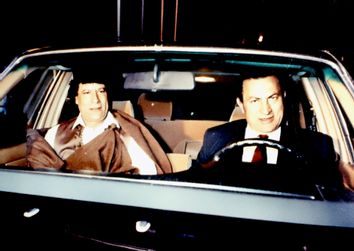
FILE - In this August 1990 file photo, during an emergency Arab League summit, Libyan leader Moammar Gadhafi, left, is driven by Egyptian President Hosni Mubarak, in Tahrir Square in Cairo. As rebels swarmed into Tripoli, Libya, late Sunday, Aug. 21, 2011, and Gadhafi's son and one-time heir apparent Seif al-Islam was arrested, Gadhafi's rule was all but over, even though some loyalists continued to resist. (AP Photo/Farouk Ibrahim, File)(Credit: AP)

Poor Moammar Gadhafi. Libya’s longtime leader, dubbed “the Mad Dog of the Middle East” by President Ronald Reagan over his support for terrorism, came in from the cold after Sept. 11 by collaborating with the CIA in the fight against al-Qaida and offering American firms access to his oil fields. Look what he got for his good behavior: the enmity of his people and uninvited strangers visiting his seaside villa.

Gadhafi had warmed American hearts in 2004 by normalizing relations with George W. Bush’s administration and falling hard for Condoleezza Rice. The colonel was still an SOB, but now he was our SOB.

Then along came the Arab Spring and the colonel’s security forces started cracking heads and killing protesters. Nothing fundamental about Gadhafi had changed — anyone familiar with his four-decade reign in power knew he would employ violence if his rule were ever challenged — but with his people in open revolt it became too embarrassing to embrace him any longer. And so, in the manner of past American SOBs — think Somoza, think Noriega — U.S. policymakers found it expedient to cut him loose. The problem was that since Gadhafi had been rehabilitated in the Western media as a repentant bad boy, Washington’s policymaking agenda needed new narrative: to reestablish Gadhafi’s credentials as villain.

Just the job for a reliably credulous American press corps, whose bosses have grown bored with the details of bloodshed in Iraq and Afghanistan. Washington policymakers know full well that launching war, even an undeclared one like the NATO and U.S.-led overthrow of Gadhafi, cannot be sustained without a good story line.

The formula is not complicated. The two essential components are an evil enemy on one side and heroic, brave and true allies on the other. As the story unfolds, the government serves as the studio, producing and directing the movie while editors and reporters enlist as scriptwriters. These faithful scribes periodically demand their artistic freedom (i.e., by reporting on friendly fire deaths or criticizing an official action) but generally succumb, in the end, to the studio’s demands for a neat Hollywood ending.

Many outside the media class see this collaboration as cynical, if not conspiratorial — and, on the part of the policymaking class, it usually is. Conversations on “deep background” keep the names of policymakers out of the public eye. NATO psychological warfare units, while proud to disclose their leaflet drops, are doctrinally dedicated to pumping out information damaging to the enemy, whether true or false.

On the part of journalists, however, the collaboration is often pathetically idealistic. U.S. policymakers have never had a hard time finding reporters to sign up as wartime scriptwriters. Back in the Reagan years our “freedom fighters” went mano a mano with the Soviet empire, lauded by the likes of Charles Krauthammer. Never mind that these rebels (no, brigands) were cutthroat Islamic fanatics, of whom not a few subsequently joined an emerging organization that came to be known as al-Qaida. That was not a detail to be worried about by smart people in Washington. 

No matter that in the mid-1980s the White House-funded contra rebels in Nicaragua, cheered on by the Washington Post and the Washington Times, preferred slaughtering non-combatants to real war and trafficked in cocaine on the side. When Jonas Savimbi, a murderous champagne-swilling Angolan guerrilla leader backed by South Africa’s apartheid government, came to Washington, he could count on a warm reception in the pages of the liberal New Republic.

A competent press corps would know this history and be wary. But then Sept. 11 “changed everything” — and changed nothing. The U.S. government teamed up with another coalition of Afghan rebels to topple the Taliban. Largely forgotten was that our newfound allies had ruled Afghanistan from 1992 until 1996 and that their thievery, incompetence, squabbling and criminality paved the way for the rise of the Taliban in the first place.

Next to fall out of favor was Saddam Hussein. When he was willing to massacre waves of Iranian child soldiers in the 1980s, the Iraqi dictator was glad-handed by special U.S. envoy Donald Rumsfeld, who quietly orchestrated U.S. financial support for Saddam’s government. When Saddam ungratefully invaded Kuwait in 1991, he was transformed from unpleasant U.S ally to official monster.

Media enablers would help. When the Bush administration officials settled on the Iraqi government as a scapegoat for the 9/11 intelligence failure, they were fortunate to find the New York Times correspondent Judith Miller as a witness. She stenographically reported the White House’s suspicions of (nonexistent) WMD and (never corroborated) ties to al-Qaida, while touting the virtues of the Iraqi National Congress and its leader Ahmed Chalabi. Back then U.S. officials privately acknowledged that Chalabi always had more influence along the Potomac than along the Euphrates. Today, they admit, he effectively serves as Iran’s lobbyist in Iraq.

But no matter, the persistent Judy Miller still advises statesmen on how to Do Good in the world. 

Which is not to say that some U.S. enemies were not genuinely evil people. But leave the political and policy questions out of it. Whether or not war in Iraq and Afghanistan was a good idea, the media mythmaking around war proved hazardous to the country’s health. A more honest and accurate pre-war assessment of our allies would have made clear that what really matters is not military victory but what comes afterward.

The same holds true for Libya, which is now getting its own Hollywood treatment. Whether Gadhafi is moving from hideout to hideout or hiding out, à la Osama, in plain sight, his ending will be written in a screenplay that has undergone many rewrites over the years.

For most of his career Gadhafi was depicted much as Saddam Hussein would be: a pariah. That began to change in 1999, when he decided to turn over suspects in the Pan Am bombing to Western authorities. A bigger breakthrough in his charm offensive came in 2004 when, in seeking to end his international isolation, he renounced his WMD programs (which were never very far along to begin with).

President Bush soon lifted most U.S. trade sanctions. In 2005 American oil companies funded and founded the U.S.-Libya Business Association to push for improved trade and diplomatic relations with Col. Qaddafi’s regime. David Goldwyn — who had served at the Energy Department under Bill Clinton and would become the Obama administration’s special envoy on international energy in 2009 — headed the group.

Gadhafi, the story went, was not a bad buy. Within a few years, Occidental, ConocoPhillips, ExxonMobil, Chevron and other U.S. companies were producing 30 percent of Libya’s daily output.

Gadhafi signed up as a close ally in counterterrorism. He turned over Islamic radicals to neighboring pro-Western governments and in exchange the U.S. handed over to Gadhafi some Libyans captured in the “war on terrorism” and allowed his agents to interrogate Libyans held at Guantánamo Bay. Dick Cheney and Moammar Gadhafi may have disagreed on many points of policy but they were bipartisan on waterboarding: It was not a problem.

By 2008, the U.S. relationship with Libya was blossoming. That year, Congress, in response to lobbying by the oil companies, exempted Libya from a law signed by President Bush that allowed American victims to seize assets of countries found liable for terrorist attacks — a law that had specifically targeted Gadhafi.

Who really cared that Gadhafi continued to maintain his bizarre personality cult and violate human rights? The U.S. government and media quickly lost interest. “The Americans no longer want to see Gadhafi’s regime destabilized,” Ashur Shamis, a London-based Libyan dissident, told me back in 2005. “Opponents have written off the possibility of receiving tangible political support from the United States.”

It was only when the Libyan people spontaneously rebelled in 2011, and Gadhafi pledged to lay waste to Benghazi, that the U.S. government began to reconsider the wisdom of its newfound friendship. Hollywood screenwriters rarely feel controlled by historical truth and neither, alas, does Washington. The policy agenda needed a storyline that again cast Gadhafi as Evildoer, and the press corps dutifully provided.

The most explosive charge in the Libyan civil war, which originated with the rebels, was that Gadhafi was feeding Viagra to his troops and sending them out to rape women. In June Secretary of State Hillary Clinton solemnly said she was “deeply concerned” about these reports and the media did its part. At CNN the tag team of Wolf Blitzer and Nic Robertson ran a lengthy report on the Viagra charges under the banner of “A tool of massive rape.”

Not quite. Several human rights groups launched major investigations into the claim of government-ordered rapes and found no evidence for it. Last week, the New York Times derided the story as one of the rebels “far-fetched claims.” Back in June the paper of record published a story saying rebel officials “had discovered condoms and packets of Viagra in tanks and other vehicles captured from Colonel Qaddafi’s soldiers.”

Another widely published claim was that, again in the words of Secretary Clinton, Gadhafi was flying in “mercenaries and thugs” to kill his own people. Ali al-Essawi, who resigned as Libyan ambassador to India after Gadhafi cracked down on protesters, told Reuters that the mercenaries were “from Africa, and speak French and other languages.”

This story, accepted as true by much of the media, also turned out to be largely, if not entirely, fictitious. Many of the “mercenaries” paraded by the rebels at international press conferences later turned out to be undocumented laborers from other African countries. The story was handy, though, because it purported to explain why Gadhafi, who allegedly had little public support, managed to remain in power for six months despite massive bombardment from NATO aircraft.

The point, systematically deleted from the memory banks of U.S.-based news organizations, is that our overseas allies supported for purposes of (the clinical term) “regime change” always generate propaganda to influence U.S. public opinion. Like the Nicaraguan contras in the ’80s and the Iraqi National Congress in the 00s, the Libyan rebels have ample reason to lie to U.S news outlets — and yet many reporters and editors take their claims at face value.

Fortunately, not by all. As ABC News recently reported, Abdelhakim Belhaj, who led the rebels into Gadhafi’s compound, was a founder of the Libyan Islamic Fighting Group, an anti-Gadhafi group whose members fought Soviet troops in Afghanistan alongside Osama bin Laden and whom the Bush administration designated as a terrorist organization in 2004.

Only recently has more attention focused on the fact that the rebels, like Gadhafi, have committed vicious brutalities during the war, and that their own leadership is prone to fierce, internal squabbling. In late July, the Transitional National Council in Benghazi killed (and burned the corpse) of their military leader, Gen. Abdel Fatah Younes, who was suspected of treason. In what journalist Patrick Cockburn called “a masterpiece of mistiming,” the assassination was committed on this very day that Britain recognized the rebel government.

And there’s one more aspect to the story that has been cut from the current script. Whether he was “our” SOB or “their” SOB, there is no doubt that Gadhafi used his oil revenues to provide far more to his people than many U.S. allies in the region. In the United Nations 2010 report on “Human Development” Libya ranked first in Africa and a respectable 53rd out of 170 countries overall.

Gadhafi’s government had a terrible human rights record but it provided its citizens with free education and healthcare. The World Health Organization says Libya “boasts the highest literacy and education enrollment rates in North Africa.” Childhood immunization is close to universal and infant mortality rates are very low. Libya also ranked high on gender equality, and women were prominent in politics. The poor had a degree of protection with subsidized food and fuel. In Libya, “social exclusion due to poverty and lack of access to education is nearly nonexistent,” according to this report.

There was nothing in Gadhafi’s Libya comparable to the mass poverty of Hosni Mubarak’s Egypt, which has one of the highest adult illiteracy rates in the world. During the revolution in Egypt, breathless reporters on U.S. cable news networks would say that the popular upheaval had “exposed” the appalling circumstances of the Egyptian poor, as if the reality hadn’t been obvious to any sentient observer all along.

Gadhafi was corrupt, but the scale of his thievery does not appear to come close to that of the Mubarak regime in Egypt or the energy-fueled kleptocracies that U.S. policymakers quietly indulge in places like Equatorial Guinea and Turkmenistan. The reports about Gadhafi’s decadent lifestyle withered under scrutiny. The New York Times recently ran a story under the headline of “Gilded Traces of the Lives Qaddafis Led,” which reported that “as the former subjects of Col. Moammar el-Qaddafi comb through his family’s estates, farms and seaside villas, the properties are revealing the details of lives lived far removed from the people” and “the distance between power and powerlessness.” It was so unlike classless America, where the political elite and the working class live together in the same neighborhoods and vacation harmoniously on Martha’s Vineyard.

The facts of the story betrayed the headline. “The residences of the House of Qaddafi were not quite as grand as people might have supposed,” the Times acknowledged. The villas of Gadhafi’s sons “on a sand bluff overlooking the Mediterranean … failed to match the ostentation they displayed in other facets of their lives. They were not lavish; the brown paint on the patio decks was peeling, and they had a distinctly 1970s feel.”

Such are problems of scriptwriting. In Hollywood, the producers and the screenwriters always disagree. In Washington, the official story always clashes with the irritating reality of facts on the ground. As a state-sponsored media spectacle, the Libya story will conclude when Gadhafi escapes or is captured or killed. For the country where 6.5 million people live, the story line is less certain.

The odds are that a new government, even assuming it is stable, will be dependent on outside support. It will have a very hard time matching Gadhafi’s egalitarian record on economic rights. Democracy is unlikely to flourish any time soon. The rights of women’s are endangered. Human rights generally will continue to be violated.

Finally — and this is the safest bet of all — U.S. oil companies will get back into Libya as soon as possible. At which time U.S. government and the stenographers of the press corps will not devote a lot of air time or column inches dwelling on human suffering in the post-Gadhafi era. Why bother about such details when there are other important scripts to be polished elsewhere? 

Ken Silverstein is an Open Society Institute fellow and contributing editor to Harper’s magazine.

Continue Reading Close

Page 1 of 3 in Ken Silverstein

www.salon.com/writer/ken_silverstein/index.html