KEVIN McGILL

La. shrimpers worry about prices for new season

Consumer concerns about the safety of Gulf seafood linger as the shrimp catching season begins

  • more
    • All Share Services

Shrimpers returned to Louisiana waters Monday for the first commercial season since the Gulf of Mexico oil disaster, uncertain what crude may still be in the water and what price they’ll get for the catch if consumers worry about possible lingering effects from the massive BP spill.

The spill has put a crimp in the fishing industry in a state that ranks first in the nation in producing shrimp, blue crab, crawfish and oysters, a $318-million-a year business in Louisiana. U.S. Commerce Secretary Gary Locke planned to visit the state Monday to lunch with fishermen and talk to seafood industry representatives.

Perhaps the biggest fear is that some fisherman might try to sell oil-contaminated shrimp and scare consumers away again after prices crashed once already this summer.

“If you see oily shrimp, you got to throw them back over. Go somewhere else. It’s all you can do. And you hope everyone else does the same,” said Dewayne Baham, 49, a shrimper from Buras.

Louisiana shrimp prices rose soon after the Deepwater Horizon rig exploded on April 20, killing 11 workers and triggering the spill that eventually spewed 206 million gallons of oil from BP’s blown-out well. The price spike was fed by fears that the shrimp would soon be unavailable.

However, despite state and federal assurances that seafood reaching the market was safe, demand dropped and prices crashed a month ago, said Harlon Pearce, a seafood dealer and head of the state’s seafood promotion board.

Ravin Lacoste of Theriot, said he believes his fellow shrimpers know better than to turn in a bad catch.

“If you put bad shrimp on the market — we in enough trouble now with our shrimp,” Lacoste said. “You might can go in the closed waters and catch more shrimp. But it ain’t worth it.”

Pearce did what he could over the weekend to allay fears over safety. On Friday, he was in a group that set out with several fishermen on a test run around Grand Isle and Barataria Bay.

They trawled several areas, pulling up nets that held shrimp, mud, jellyfish or driftwood — all without the signs or telltale smell of oil.

Seafood testing begins when there’s no longer visible oil in a particular area. First, inspectors smell samples for oil. Then comes testing at federal or state laboratories. To reopen seafood harvesting, the samples must test below Food and Drug Administration-set levels of concern for 12 different potential cancer-causing substances. BP also used chemical dispersants to break up the crude, but the government has not yet developed a test for the materials in seafood.

Shrimpers also are concerned about how much they’ll be able to make on their product.

“I don’t think people are worried so much about the resource, but the price,” said Rusty Gaude, fishery agent for LSU Sea Grant Program.

And fishermen need to know what waters are open.

Slowly, more and more waters closed because of the spill are reopening. However, shrimping remains forbidden in federal waters off Louisiana, Mississippi and Alabama, and most of the catches have come off Texas and Florida, said Roy Crabtree, the regional administrator for the National Marine Fisheries Service’s southeast region.

Commercial shrimpers are heading out as the drilling of a relief well meant to plug BP’s runaway well permanently nears completion.

Once the relief well is complete, a so-called bottom kill procedure can begin, in which mud and cement would plug the well from below the seafloor.

Engineer John Wright has never missed his target over the years, successfully drilling 40 relief wells that were used to plug leaks around the world. People along the Gulf Coast and others are hoping he can make it 41-for-41.

“Anyone who has ever worked extremely hard on a long project wants to see it successfully finished, as long as it serves its intended purpose,” Wright, 56, who is leading the team drilling the primary relief well, said in a lengthy e-mail exchange with The Associated Press.

BP began work on its primary relief well in early May. But about two weeks ago, around the time the company had done a successful static kill pumping mud and cement into the top of the well, executives and the government began signaling that the bottom kill procedure might not be needed.

But retired Coast Guard Adm. Thad Allen, the government’s point man on the spill, said the relief well would be finished so the well could be killed. The bottom kill won’t be started until at least next weekend.

Despite the waters reopening, many fishermen distrust state wildlife officials and may be reluctant to head out right away, said Patrick Hue, 49, a shrimper out of Buras.

“Nobody wants to rush into this and then someone gets sick on the seafood and the first thing you know, no one wants to buy our seafood,” he said.

Seafood dealer Pearce, however, said many shrimpers will be unable to resist.

“Opening day is like a religion to these people,” he said. “It’s a way of life down here.”

——

Associated Press writers Lauran Neergaard in Washington, D.C., Harry R. Weber and Tom Breen in New Orleans, video journalist Mark Carlson in Buras, and photographer Gerald Herbert in Grand Isle contributed to this story.

Barge hits well near Gulf, sends oil, gas spewing

Officials say 6,000 feet of containment boom is in place around the site, which was already fouled by BP spill

  • more
    • All Share Services

A barge slammed into an abandoned well in a coastal inlet early Tuesday, sending a shower of water, natural gas and oil spewing about 100 feet into the air.

Emergency officials said about 6,000 feet of containment boom was in place around the site in a lake just north of Barataria Bay, which has already been fouled by oil from the massive BP spill in the Gulf of Mexico.

While there was no estimate of how much oil was spewing Tuesday, officials said the mile-long slick it created was small compared with the Gulf spill.

The Coast Guard said the towboat Pere Ana C was pushing the barge on Mud Lake when it hit the wellhead about 1 a.m. No one was hurt.

The towboat captain told investigators the well was not lit as required, Coast Guard Capt. John Arenstam said.

The Coast Guard hired Wild Well Control Inc. to begin attempts to cap the well later Tuesday. Another contractor is handling cleanup.

The Coast Guard identified the well owner as Houston-based Cedyco Corp., but authorities said they had been unable to contact the company. Calls to Cedyco by The Associated Press were not returned Tuesday.

Deano Bonano, a Jefferson Parish emergency management official, said the spill was “miniscule” in comparison to the BP spill that has dumped millions of gallons of oil into the Gulf.

Bonano said the accident, which blocked traffic into Barataria Bay, would not stop attempts by cleanup crews to return to the Gulf after a weekend interruption from the remnants of Tropical Storm Bonnie.

He said no new oil has reached Barataria Bay from the BP spill in the last three weeks and said boats and equipment could be dispatched from other sites along the Louisiana coast, such as Grand Isle.

Mud Lake is at the northern approaches to Barataria Bay, an ecologically sensitive estuary south of New Orleans.

(This version CORRECTS that barge, not towboat, hit the well.)

Continue Reading Close

David Vitter faces untainted GOP challenger

The prostitution-marred "family values" senator is set to battle Chet Traylor in a Republican primary

  • more
    • All Share Services

Talk about Republican Sen. David Vitter’s worst political nightmare — a surprise challenger with all the right conservative credentials and none of the baggage of the incumbent’s prostitution scandal.

Chet Traylor, the first Republican elected to Louisiana’s Supreme Court since Reconstruction, made a last-minute decision to take on Vitter after a fresh scandal for the first-term lawmaker: An aide had remained on Vitter’s payroll after pleading guilty to charges stemming from a knife-wielding incident with an ex-girlfriend.

“In the weeks leading right up to the campaign, people just wanted an alternative,” said Traylor, 64, an Army veteran and former state trooper who later became a lawyer and a judge.

Traylor said conservative Republicans — he didn’t name them — begged him to enter the race, fearing that Vitter, hobbled by scandals old and new, could lose to a Democrat in the general election.

Still, Vitter has the incumbent’s edge, in the Aug. 28 primary and in November, when he’ll likely face Democrat Charlie Melancon and a handful of independent and minor party candidates. He has more than $5 million in campaign cash and a double-digit lead in recent polls over Melancon, who has about half that amount.

State GOP chairman Roger Villere still backs Vitter, a 49-year-old attorney, Rhodes Scholar and the state’s first Republican senator in modern times. Other state Republicans also are standing with the incumbent.

Traylor has only started raising money and building name recognition even though he won election in a sprawling Supreme Court district in north Louisiana.

“I would like to find out more information about his background,” said Connie Beach, a Republican from Folsom in south Louisiana, who added that “the right person” might be able to defeat Vitter in the primary.

Lev Dawson believes Vitter is vulnerable. Dawson is a conservative north Louisiana farmer and businessman and a frequent contributor to past Republican campaigns, including Vitter’s. But now he is managing Traylor’s fledgling campaign and says Republicans who want Traylor to run believe the latest scandal isn’t the last.

“Is there more coming? We think there might be. And if there’s more coming, how bad is it? And what will happen to the women’s vote in Louisiana, and will he survive it?” said Dawson. “We think if Justice Traylor gets the nomination, he’ll win.”

Others were more skeptical of Traylor’s chances.

“Right now, at this time, I don’t see that happening,” Cathy White, a New Orleans Republican said, when asked if Traylor could win. White, president of a 73-member Republican women’s group, said members of the group like Vitter’s opposition to President Barack Obama’s policies.

Vitter has focused his attention on Melancon, repeatedly calling him a rubber stamp for Obama’s initiatives even though the conservative congressman often breaks with his party. Vitter attracted attention this past week when he expressed support for conservative organizations challenging Obama’s citizenship in court. So-called birthers have challenged Obama’s standing as president by arguing that he was not born in the United States. Hawaii officials have repeatedly confirmed the president’s citizenship.

The incumbent has responded to Traylor’s entry into the race in much the same way he handled the prostitution scandal, by keeping quiet about it. His campaign declined to comment for this story.

In 2007, Vitter would confess only to a “serious sin” after his phone number turned up among records for a Washington prostitution ring. He tersely denied later accusations that he was a customer of New Orleans prostitutes and again declined to answer questions.

More recently, he abruptly walked away from reporters, saying little in response to repeated questions about Brent Furer, an aide who pleaded guilty in 2008 to charges stemming from a knife-wielding altercation with an ex-girlfriend. Furer, who handled women’s issues for the senator, later pleaded guilty to three misdemeanor charges, including threatening harm and destruction of property.

Vitter spokesman Joel DiGrado said Vitter’s office was aware of the 2008 incident, and that the aide left the office for several months as the court adjudicated the case, ordering a fine and community service. But Furer didn’t leave Vitter’s employ until he resigned last month, after an ABC News report detailed the 2008 incident. At the time, DiGrado said Vitter accepted Furer’s resignation after learning of other legal issues, including an unresolved driving while intoxicated case.

Vitter’s office has refused to address questions about Furer. But a retired Marine general, James E. Livingston, is defending the senator and Furer.

In a letter to ABC News, later released to the media, Livingston said Furer was a veteran of Operation Desert Storm who had seen horrific wartime action, including the deaths of comrades.

“When faced with Brent’s troubles, Senator Vitter could have chosen political expediency and allowed Brent to flounder on his own in a time of need. Instead, he tried to allow Brent the best opportunity to seek help and get better while never downplaying the severity of the charges — of which assault was dismissed,” Livingston wrote.

Walter Abbott, a north Louisiana Republican activist, said Traylor’s candidacy won’t stop Vitter, nor will it make him more vulnerable to Melancon’s challenge.

“A year after this election it’s going to be: ‘Traylor? Traylor. Oh, yeah! Wasn’t he on the Supreme Court at one time?” Abbott predicted.

But Traylor insists he can topple Vitter.

“If he were in good shape,” Traylor said, “people wouldn’t be calling me.”

Continue Reading Close

Effort to contain Gulf oil stalls with stuck saw

A saw became stuck while cutting through a pipe on a busted well in the most recent effort to control the BP spill

  • more
    • All Share Services

Coast Guard Adm. Thad Allen is saying that a saw has become stuck as it was cutting through a pipe on a busted well, stalling the latest attempt to contain the Gulf oil gusher.

Allen said Wednesday the goal is to free the saw and finish the cut later in the day. This is the second major cut in the effort to contain — not plug — the nation’s worst spill.

Allen says the first cut with giant shears was successful overnight.

The best chance at plugging the leak involves a relief well that is at least two months from completion.

THIS IS A BREAKING NEWS UPDATE. Check back soon for further information. AP’s earlier story is below.

PORT FOURCHON, La. (AP) — The BP oil slick drifted close to the Florida Panhandle’s white sand beaches for the first time as submersible robots a mile below the Gulf of Mexico made the latest risky attempt to control the seafloor gusher.

Even if it works, the current mission to cut a major pipe and cap it would only reduce the flow, not stop it. If it fails, it could make the largest oil spill in U.S. history even worse. The best hope for sealing the leak, until a permanent fix is possible in August, failed Saturday, when engineers were unable to plug it with heavy mud in a maneuver called a top kill.

Investors ran from BP’s stock for a second day Wednesday, reacting to the top kill failure and the Justice Department’s announcement that it was looking at criminal and civil probes into the spill, although the department did not name specific targets for prosecution.

Shares in British-based BP PLC were down 3 percent Wednesday morning in London trading after a 13 percent fall the day before. BP has lost $75 billion in market value since the spill started with an April 20 oil rig explosion and analysts expect damage claims to total billions more.

In Florida, officials confirmed an oil sheen Tuesday about nine miles from Pensacola beach, where the summer tourism season was just getting started.

Winds were forecast to blow from the south and west, pushing the slick closer to western Panhandle beaches.

Emergency crews began scouring the beaches for oil and shoring up miles of boom. County officials will use it to block oil from reaching inland waterways but plan to leave beaches unprotected because they are too difficult to protect and easier to clean up.

“It’s inevitable that we will see it on the beaches,” said Keith Wilkins, deputy chief of neighborhood and community services for Escambia County.

The oil has been spreading in the Gulf since the Deepwater Horizon rig exploded six weeks ago, killing 11 workers and eventually sinking. The rig was being operated for BP, the largest oil and gas producer in the Gulf.

Crude has already been reported along barrier islands in Alabama and Mississippi, and it has polluted some 125 miles of Louisiana coastline.

More federal fishing waters were closed, too, another setback for one of the region’s most important industries. More than one-third of federal waters were off-limits for fishing, along with hundreds of square miles of state waters.

Fisherman Hong Le, who came to the U.S. from Vietnam, had rebuilt his home and business after Hurricane Katrina wiped him out. Now he’s facing a similar situation.

“I’m going to be bankrupt very soon,” Le, 53, said as he attended a meeting for fishermen hoping for help. “Everything is financed, how can I pay? No fishing, no welding. I weld on commercial fishing boats and they aren’t going out now, so nothing breaks.”

Le, like other of the fishermen, received $5,000 from BP PLC, but it was quickly gone.

“I call that ‘Shut your mouth money,’” said Murray Volk, 46, of Empire, who’s been fishing for nearly 30 years. “That won’t pay the insurance on my boat and house. They say there’ll be more later, but do you think the electric company will wait for that?”

BP may have bigger problems, though.

Attorney General Eric Holder, who visited the Gulf on Tuesday, would not say who might be targeted in the probes into the largest oil spill in U.S. history.

“We will closely examine the actions of those involved in the spill. If we find evidence of illegal behavior, we will be extremely forceful in our response,” Holder said in New Orleans.

The federal government also ramped up its response to the spill with President Barack Obama ordering the co-chairmen of an independent commission investigating the spill to thoroughly examine the disaster, “to follow the facts wherever they lead, without fear or favor.”

The president said that if laws are insufficient, they’ll be changed. He said that if government oversight wasn’t tough enough, that will change, too.

BP has tried and failed repeatedly to halt the flow of the oil, and the latest attempt like others has never been tried before a mile beneath the ocean. Experts warned it could be even riskier than the others because slicing open the 20-inch riser could unleash more oil if there was a kink in the pipe that restricted some of the flow.

“It is an engineer’s nightmare,” said Ed Overton, a Louisiana State University professor of environmental sciences. “They’re trying to fit a 21-inch cap over a 20-inch pipe a mile away. That’s just horrendously hard to do. It’s not like you and I standing on the ground pushing — they’re using little robots to do this.”

Engineers have put underwater robots and equipment in place this week after a bold attempt to plug the well by force-feeding it heavy mud and cement — called a “top kill” — was aborted over the weekend. Crews pumped thousands of gallons of the mud into the well but were unable to overcome the pressure of the oil.

The company said if the small dome is successful it could capture and siphon a majority of the gushing oil to the surface. But the cut and cap will not halt the oil flow, just capture some of it and funnel it to vessels waiting at the surface.

BP’s best chance to permanently plug the leak rests with a pair of relief wells but those won’t likely be completed until August.

——

Bluestein reported from Covington, La. Associated Press writers Darlene Superville and Pete Yost from Washington, Curt Anderson from Miami, Brian Skoloff from Port Fourchon, Mary Foster in Boothville, and Michael Kunzelman also contributed to this report.

Continue Reading Close

Oil spill growing in Gulf of Mexico off La. coast

The slick from a sunken rig has spread over an area 80 miles wide and 48 miles long

  • more
    • All Share Services

The Coast Guard says a sheen of oil that’s been covering an area in the Gulf of Mexico since an oil rig exploded off the Louisiana coast is growing.

Coast Guard Petty Officer Erik Swanson says that as of Tuesday morning, the sheen has grown to about 48 miles long and 80 miles wide at its widest.

At the moment, the wind has been blowing the oil away from the shore. But Swanson says the winds could shift later in the week and there’s concern about oil reaching the shore.

So far, skimming vessels have collected more than 48,000 gallons of oily water. Meanwhile, remote control vehicles have been working around the clock underwater to try to stop the oil leak.

Eleven people have been missing since last week’s explosion and are presumed dead.

At least 11 workers sought after oil rig explosion

Most of the rig's crew of 126 escaped after it burst into flames in the Gulf of Mexico off the Louisiana coast

  • more
    • All Share Services

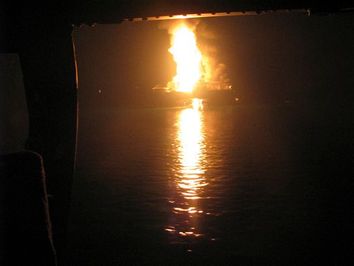
At least 11 workers sought after oil rig explosionIn this Wednesday April 21, 2010 photo released by the U.S. Coast Guard, a fire aboard the mobile offshore drilling unit Deepwater Horizon burns 52-miles southeast of Venice, La. Helicopters, ships and an airplane searched waters off Louisiana's coast Wednesday for missing workers after an explosion and fire that left an offshore drilling platform tilting in the Gulf of Mexico. (AP Photo/U.S. Coast Guard, Petty Officer 2nd Class Scott Lloyd)(Credit: AP)

Helicopters, ships and an airplane searched waters off Louisiana’s coast Wednesday for at least 11 workers missing after an explosion and fire that left an offshore drilling platform tilting in the Gulf of Mexico.

Most of the 126 people were believed to have escaped safely after the explosion on the rig Deepwater Horizon at about 10 p.m. Tuesday, Coast Guard Senior Chief Petty Officer Mike O’Berry said. The rig, about 52 miles southeast of Venice on Louisiana’s tip, was listing about 10 degrees and still burning Wednesday morning.

“It’s burning pretty good and there’s no estimate on when the fire will be put out,” O’Berry said.

Seven workers were reported critically injured, Coast Guard Lt. Sue Kerver said. Two were taken to a trauma center in Mobile, Ala., where there is a burn unit, but the nature of their injuries was unclear, she said. At least two were taken to a suburban New Orleans hospital.

O’Berry said many workers who escaped the rig were being brought to land on a workboat while authorities searched the Gulf of Mexico for any signs of lifeboats.

“We’re hoping everyone’s in a life raft,” he said.

The rig was drilling but was not in production, according to Greg Panagos, spokesman for its owner, Transocean Ltd., in Houston. The rig was under contract to BP PLC. BP spokesman Darren Beaubo said all BP personnel were safe but he didn’t know how many BP workers had been on the rig.

Kerver said the Coast Guard and the Minerals Management Service will work together to investigate possible causes of the accident.

“It’s still too early to tell the cause,” Panagos said. “Our focus right now is on taking care of the people.”

O’Berry said Coast Guard environmental teams were on standby in Morgan City, La., to assess any environmental damage once the fire was out.

According to Transocean’s website, the Deepwater Horizon is 396 feet long and 256 feet wide. The rig was built in 2001 by Hyundai Heavy Industries Shipyard in South Korea. The site is known as the Macondo prospect, in 5,000 feet of water.

The rig is designed to operate in water depths up to 8,000 feet and has a maximum drill depth of about 5.5 miles. It can accommodate a crew of up to 130.

——

Associated Press Writer Alan Sayre in New Orleans contributed to this report.

Eds: CORRECTS spelling of Panagos; UPDATES with quote from Panagos on cause; Coast Guard preparing to assess environmental affect; Coast Guard and Minerals Management Service will investigate accident. ADDS video, audio, photos. Moving on general news and financial services. AP Video.

Continue Reading Close

Page 1 of 2 in KEVIN McGILL