Kevin Zeese

Van Jones can’t occupy us

Democrats who want to co-opt Occupy Wall Street should start their own movement

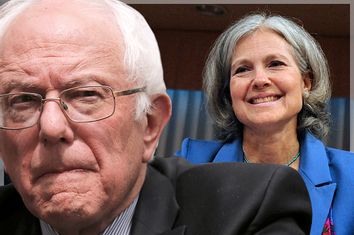
Left: Van Jones. Right: Occupy D.C. protesters march in front of the White House Nov. 15, 2011. (Credit: Center for American Progress Action Fund / CC BY 3.0/Reuters/Hyungwon Kang)

The corporate media seems to want to anoint a leader of the Occupy Movement, namely former Obama administration official Van Jones, now leader of the Rebuild the Dream organization.

When CNN’s  Suzanne Malveaux suggested to Jones last week that he might be a “leader” of the Occupy Movement, Jones demurred saying, “There are a lot of us,” and that the movement is “leader filled.”

All right, Van Jones, you might at least be a spokesperson, you know, maybe not a leader, but certainly a good spokesperson for the group,” Malveaux replied, according to a transcript, thus expressing the desire of the corporate media to appoint our leaders. Like Time magazine, CNN wants to make Jones a spokesperson for the movement. (Conservative commentators also find Jones useful as a straw man/leader whom they can attack.)

In fact, Jones, who received a golden parachute at Princeton and the Center for American Progress when he left the administration, is doing what Democrats always do: trying to co-opt the movement. Jones sees the energy of an independent movement and is racing to the front of it, in hopes of leading it down the familiar dead end path of electoral politics and essentially destroying it. While Jones and other Democratic Party front groups pretend to support the Occupiers, their real mission is to use it for their own ends.

As Glenn Greenwald noted in a recent Salon article, “White House-aligned groups such as the Center for American Progress have made explicitly clear that they are going to try to convert OWS into a vote-producing arm for the Obama 2012 campaign.”

Before the Occupy movement emerged, Jones said the first task of  Rebuild the Dream was to elect Democrats. Now he urges the movement to make a “pivot to politics,” claiming there will be 2,000 “99 percent candidates” in 2012. These Democrats will be rebranded as part of the 99 percent movement, just as Republican operatives rebranded corporate Club for Growth spokesmen as Tea Party candidates in 2010. (Exhibit A: Sen. Pat Toomey  before and after.) Even the Rebuild the Dream website has been rebranded as an Occupy movement site.

Jones’ call for the movement to “mature” and move on to party politics would only make us a sterile part of the very problem we oppose. As I learned working on Ralph Nader’s presidential campaign and running for the U.S. Senate in Maryland, the electoral system is a mirage where only corporate-approved candidates are allowed to be considered seriously. At Occupy Washington, D.C., we recognize that putting our time, energy and resources into elections will not produce the change we want. What we need to do right now is build a dynamic movement supported by independent media that stands in stark contrast to both corporate-bought-and-paid-for parties.

Democratic operatives want to steal the energy of the Occupy movement because they do not have any of their own.  These front groups operate within the confines of the two-corrupted-party system and their agenda is limited by what big business interests say is politically realistic. Rebuild the Dream is more of the same that has been seen over and over from groups like MoveOn and Campaign for America’s Future. “Elect Democrats” is their mantra; indeed, it is their only program — and it is bankrupt. If it wasn’t, there would be no need for the occupation movement.

Democrats need to derail and co-opt the Occupy Movement because it calls attention to their failure. The American people need a real jobs bill, not one that is merely a political tactic for an election year. We need a truly progressive tax system — one that taxes wealth more and workers less. The poorest Americans pay taxes on necessities like food and clothing, so why is it that neither party urges a tax on the purchase of stocks, bonds and derivatives — a tax that could raise $800 billion over a decade? And finally, we need an end to the wars and militarism maintained and expanded by both parties, bringing huge profits to the arms industry and immense suffering to millions.

We don’t need media-appointed leaders.

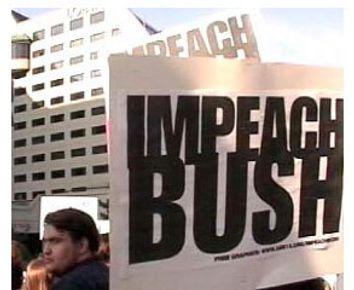
Bush is not above the law

Scholars missed the point of the essay I wrote with Ralph Nader about the case for impeachment.

The fundamental question is whether Congress and the American people were misled into an unnecessary, illegal war that has turned into a quagmire. Are the indications of false statements and misrepresentations sufficient to justify a pursuit of the truth?

The evidence includes a series of exaggerated and false claims by President Bush, Vice President Cheney and officials in their administration over many months as the drumbeat for war grew louder. Statements were made in contradiction to the evidence included in intelligence documents from a wide range of U.S. and international agencies. As weapons inspectors were unable to find weapons of mass destruction, President Bush’s rhetoric increased to the point of warning of a potential mushroom cloud over the United States generated by a nuclear attack by Saddam Hussein.

And, most recently, explaining these inaccurate statements, is the Downing Street memo, which summarizes a meeting at which the head of British intelligence reported that the Bush government was “fixing the intelligence” to support its plan to invade and occupy Iraq. On June 13, Raw Story printed five additional leaked British memos showing that the commitment to go to war occurred well before the issue was brought to the attention of Congress. If true, this changes the consistently inaccurate statements into intentionally false statements.

Unfortunately, there is no court of law in which to pursue these claims. No one has standing to sue the president for false statements leading to war. This can only be pursued by Congress in an impeachment inquiry. Should the president be held accountable for his actions? Is the president above the law or subject to the law? A “Resolution of Inquiry” is the first step to determining whether the president and vice president have committed “high crimes and misdemeanors.” If they have, impeachment is surely appropriate.

A secondary question is the likelihood of success. All of the law professors Salon asked about impeachment opposed it because Congress is controlled by Republicans and therefore it is not possible. However, if you were a Southern sheriff in 1932 and you knew that members of the local Ku Klux Klan had lynched an African-American, but also knew that the all-white jury of their peers was not likely to convict, would you prosecute the case? Shouldn’t the opposition party be raising the issue of impeachment because of false statements that led to an unnecessary war — no matter how it turns out — to ensure that the truth is uncovered?

Of course, it is difficult to predict the likelihood of success before the evidence is even gathered. Gathering the evidence is what the impeachment inquiry is for. But already we can see some breaks in support for the president from members of his own party. Most notably, Rep. Walter Jones, R-N.C. — infamous for changing the name of the congressional cafeteria’s French fries to “freedom fries” in protest of France’s position on the war — now recognizes he was misled into supporting the Iraq war and wants U.S. troops to be brought home.

What will happen if more evidence comes out? If members of the intelligence community, current and former, are subpoenaed to testify under oath and they testify about how intelligence was manipulated, will there be more defections from the president’s base of support?

And, facing reelection next year and with their popularity already at a very low 33 percent, will members of the House risk their political careers to cover up for a lame-duck president who lied to get the United States into war and whose popularity is also dropping in the polls?

One of Salon’s commentators, Cass Sunstein of the University of Chicago, took a particularly bizarre position. He opined that we should expect dishonesty from our president — so what’s the problem? Said Cass, “In any four-year period, the nation’s leader is highly likely to deceive the public on a serious matter at least once — sometimes inadvertently, sometimes for legitimate reasons, sometimes for illegitimate ones. Of course presidents should not exaggerate evidence, and it’s perfectly proper to ask whether Bush got us into war under false pretenses. But there isn’t anything close to a sufficient basis for impeachment.”

For shame. Let us hope we have not gotten so cynical about the honesty of the president of the United States that we would allow him to lie to send American troops to their death! Surely this type of dishonesty is, as Mark Tushnet of Georgetown University Law Center noted in his Salon commentary, “exactly what the impeachment provision is all about.” He went on to properly describe impeachment as a “mechanism for removing from office a person who had demonstrated the kind of political irresponsibility that seriously threatened the nation’s political institutions.”

Other Salon commentators say impeachment is inappropriate because the president was reelected to a second term. Yet, in 2004 Sen. John Kerry also supported the war and said he would have supported invading Iraq even without evidence of WMD. So there was really no debate on this topic. And if reelection cleanses the record of a president, then Richard Nixon should not have been threatened with impeachment. The Watergate break-in was reported in the Washington Post during the 1972 campaign. The public knew about it and Nixon won in a landslide victory. Should that have ended the investigation of Watergate? Of course not.

It is time once again for Congress to take up its constitutional responsibility as a coequal branch of government and provide a check and balance on a president who seems to have broken the law by manipulating intelligence and sending the nation to war.

Continue Reading Close
www.salon.com/writer/kevin_zeese/index.html