Half a world away from the Republican presidential primaries where candidates vie to outlaw birth control and promote abstinence, ban pornography and condemn the “sin” of homosexuality, Egypt’s first post-revolution parliamentary election was, thanks to the Islamists, dominated by similar issues.
As the first anniversary of the revolution approaches this week, Egypt is facing a spate of urgent political, social and economic issues, such as mass youth unemployment, a tanking economy and a cabal of die-hard generals who just refuse to call it quits. But you wouldn’t know it from listening to the discourse of Islamists, particularly the hard-line Salafist Nour party, which has focused attention on issues of “morality,” including talk of banning booze, prohibiting or restricting bikinis and censoring “sex scenes” in Egypt’s vibrant film industry.
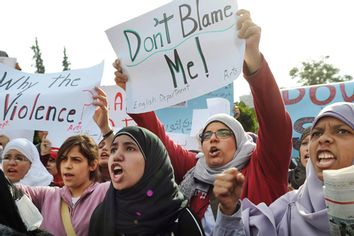
Although women from all walks of life have been at the forefront of the popular uprising and are treated as relative equals by the revolutionary youth movement that has orchestrated the revolution, the burden of this moralizing, as is often the case, has fallen on the shoulders of women. This has led Egypt’s secular, liberal women and feminists to look to the immediate future with a mixture of apprehension and worry.
“When Egyptian media spends hours and hours discussing bikinis and alcohol with presidential candidates, it tells you where women are going,” says Marwa Rakha, an Egyptian writer, broadcaster and blogger. “After the revolution, we saw women exposed to humiliating virginity tests, fired at, beaten up, arrested, molested and stripped naked by army officers. Why would I be optimistic?”
But why is Egypt’s Islamic right so obsessed with sex and women, and seems to view both as the root of all evil?
Rakha sees a cynical populist ploy. “They want attention, lights and media presence. How else will they get there unless they talk about women and their evil bodies?” she said.
“These are issues that people can relate to on a personal level,” explains Karima Abedeen, a secular British-Egyptian living in Cairo. “They are also vague and not quantifiable and most of the people who use these issues as their platform haven’t a clue about how to solve any of the other, more urgent social and political issues.”
On a more ideological plane, Muslim conservatives have successfully painted sexual liberty and gender equality as a Western import designed to weaken Egypt’s Islamic identity and corrupt Egyptians. The argument is that only by embracing Islamic traditions and morals wholeheartedly can Egyptians resist Western hegemony and recaputure their past glory.
“Focusing on issues of morality sends a message to the community that parties like the Muslim Brotherhood and the Salafis will protect our Islamic identity against the Western identity, which liberals try to promote,” observes Gihan Abou Zeid, an Egyptian activist and feminist who is working on a book about the women who took part in the revolution. “Many Egyptians believe that following Islamic orders would fix many of the current challenges that Egypt is facing.”
In this, Islamists and their supporters are confusing the symptoms with the disease. The reason Egyptian society is failing its people is not because it has veered too far from tradition, but because it has not embraced secular modernity enough, resulting in the relative marginalization not only of women but of young people too.
Similar to America’s Christian fundamentalists, Egypt’s Islamists and other social conservatives are alarmed by the corrosion of the traditional patriarchal order caused by the increasing emancipation of women. The loss of centuries of male privilege, especially in the public sphere, that this entails fuels the panicky public obsession with what should be private issues, such as virginity and promiscuity. In this worldview, strong, independent women are regarded with suspicion, as if they are carrying a volatile sex bomb that will explode upon contact with freedom and shred the fabric of society in its wake.
But despite the clear similarities between social conservatives in Egypt and America, the social context in which they operate is quite different. Egyptians on the whole may not necessarily be more religious than Americans, who seem far less inclined to abandon their faith than Europeans, but Egyptians interpret their faith far more traditionally.
Secularization has progressed much further in America than in Egypt, where it has been partially discredited through its association both with Western neo-imperialism and the corruption and failure of Egypt’s secular dictatorships. American Christian fundamentalism is a movement founded on freedom and imperial swagger, whereas Egyptian Islamism is a reaction to weakness and decline. The people who have been stripped of power in society for decades are focusing on those few areas on which they have been able to exercise control, i.e., “morality.”
Whereas religion is a fairly flexible and personal affair in America, in Egypt, religion, or tradition, is more often than not about conformity. And those who challenge this hegemonic view often suffer for their “indiscretion,” as witnessed by the massive overreaction by Egyptian society pretty much in its entirety to the decision by a bold art student, Aliaa Elmahdy, to post naked images of herself on her blog to protest the growing Islamization of society and to demand freedom of expression.
This traditionalist mind-set also partly explains the paradox that, although millions of Egyptian women have entered academia and the workforce, often outdoing and outperforming men, they have not become sexually freer but have had to compromise by stressing their “virtue” through adoption of the hijab. As men lose control of women in the public sphere, they try harder to control them in the family, suggests Abou Zeid.
Even Egypt’s secularists, although they view women more as their equals, share the Islamists’ objectification of the female form. “The secularists and the conservatives are two faces of the same coin when it comes to women,” concludes Rakha. “Most of the politicians in both currents objectify women; one side wants to cover us and lock us up, while the other wants to strip us naked and show us off.”
That said, there are significant differences between the right-of-center and heterogeneous Muslim Brotherhood’s Freedom and Justice Party (FJP) and the Salafis. For example, Abou Zeid points to the fact that the Brotherhood is not against women working, albeit within limits, but the Salafis want them to “return” to the home.
The Salafis, she also adds, want to force women to cover their faces, as demonstrated by their vigilante “morality police,” who have been roaming rural areas of Egypt, though, fortunately, Egyptian women have been fighting back.
“The Salafis are mad. They represent the very, very dark ages. The Muslim Brotherhood are not all bad,” says Abedeen. “I think the fact that the Salafis exist should push the Muslim Brotherhood toward a less conservative approach.”
In addition to the likelihood that the FJP will align itself to liberal, albeit economically conservative parties, the wind is not yet out of the sails of the secular revolutionaries who have so far spearheaded change in Egypt, as illustrated by the defiant “Revolution Continues” movement.
One consequence of the revolution is that it has empowered the previously marginalized, namely the young and women, and made them believe that they can be agents of their own destiny. “Attitudes toward women are better among the young generation, particularly the middle class, to which most of the politically active women belong,” notes Abou Zeid.
This is bound to widen the gap between the young generation and secularists, on the one hand, and older generations and traditionalists, on the other, leading to a more polarized social landscape. “I think that women’s attitudes toward themselves have changed,” observes Abedeen. “The new generation of women is much stronger than older generations and is much less willing to compromise.”
Abedeen also believes that once Egyptians see what the Islamists are like in power, they will soon fall out of love with them.
“I am trying to stay positive and tell myself that it is natural that people should gravitate toward a more conservative option, hoping that these people will not be corrupt,” she says. “I am hoping, down the road, that people will realize that is not the way forward for Egypt.”
It will be largely up to Egyptian women to carve out their rightful place in society.
“Looking at Egypt now, I see a lot of courageous defiant women, but I also see millions who realize how oppressed they are, yet do nothing about it,” says Rakha. “It is up to each woman on her own, in her house, at her desk, in her car, on her way to and from places. This is an individual fight whose collective gains and losses will reflect on the status of Egyptian women.”
JERUSALEM — In the land that put Christ in Christmas, Christianity is shrinking.
Less than a century ago, Christians comprised nearly 10 percent of the population of Palestine (now Israel and the Palestinian territories). In 1946, the figure was around 8 percent. Today, Christians make up about 4 percent of the West Bank’s population, although there are still a few Christian-majority villages, such as Taybeh, whose skyline is dominated by church spires and whose businessmen produce the only Palestinian beer. In Israel, though Christians make up 10 percent of its Palestinian population, they only constitute 2.5 percent of the total population. In Gaza, the Christian minority is even smaller, representing just 1 percent of the population.
One major factor in the decline of Christianity here: the Israeli-Palestinian conflict. The Arab-Israeli war of 1948 caused hundreds of thousands of Palestinians to flee or be driven out of their homes, most never to return – and each subsequent war has led to more Palestinians leaving. Today, though Palestinians are often materially better off than other Arabs, restrictions on movement, lack of economic opportunity, unemployment and the constant indignity of living under occupation prompt many to seek out new homes. Palestinian Christians, relatively better educated that Palestinian Muslims and sharing a common religion with the West, have generally been better placed to leave the region.
“Many Christians prioritize their religion over their nationality, thus feeling at home in Western Christian countries as immigrants,” says Ameer Sader, who teaches English and works as a young guide at the National Museum of Science and Technology in Haifa.
“Also, the fertility rate among Christians is the lowest within Israel and Palestine, playing a role, however small it is, in their decline,” he added.
But the exodus is not solely a Christian phenomenon.
“What is often ignored is the huge number of young Muslims who are leaving. And don’t forget there are more Palestinian Muslims living abroad than Christians,” says Dimitri Karkar, a Palestinian Christian businessman. Karkar lives in Ramallah, which has grown with the influx of refugees from other parts of historic Palestine and Israel’s continued annexation of East Jerusalem. Once a small village, Ramallah has become the de facto administrative capital of Palestine, where about a quarter of its population today is Christian.
Another factor: Christian charities and missionaries, who often do valuable work here, also have played an unwitting role in the exodus of Christians.
“I think that an awful lot of well-meaning Christians in the West, whether they are in America, Britain or other places, have poured a lot of money into the West Bank, and specifically into the churches and ministries here,” observes Richard Meryon, director of Jerusalem’s Garden Tomb, which is locked in a spiritual/territorial dispute with the nearby Church of the Holy Sepulchre over the exact location of the crucifixion, burial and resurrection of Jesus.
This outside aid, he notes, “is causing a hemorrhaging of Palestinian believers,” because many are given assistance to move to the West to study but, once there, decide never to return. At the same time, he points out, the numbers of foreign believers and Messianic Jews who believe in Jesus are rising.
And not all Christian activity has been “well-meaning.” For example, so-called Christian Zionists are passionately, even virulently, pro-Israeli, and many come to the Holy Land (some on Harley Davidsons) to express their support. They show rather less interest in the Christians who actually live there.
Republican presidential contender Newt Gingrich seems to even doubt they exist. In an apparent bid to court the Christian Zionist and pro-Israel right, Gingrich made the outrageous claim that “We have invented the Palestinian people,” as if the Palestinians I encounter every day here are figments of the imagination.
Foreign Christians and pilgrims tend to romanticize the “purity” of Christmas in the Holy Land. “Christmas here is fantastic because there’s absolutely no sign of the trappings of materialism,” says Meryon. “People in England hardly know the difference between Santa Claus and Jesus,” he jokes. Meryon has something of the quintessential English vicar about him, while a group of Singaporean pilgrims sing melodic hymns in the background. “Commercialism has taken Jesus out of Christmas.”
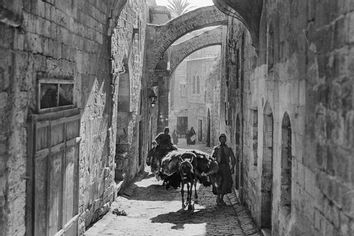
And the guitar-strumming young Singaporean who had led his evangelist group of pilgrims in song seemed to share Meryon’s sentiments. “Being here is incredible. I can see Jesus all around me,” he said, I imagine, figuratively. Lacking any semblance of religious faith and not being of a spiritual disposition, I have never seen Christ figuratively, in all my time in Jerusalem. I have, however, repeatedly spotted a pilgrim fitting his description making his lonely way through the old city.
For obvious reasons, Bethlehem, whose population today is still about half Christian, is a popular pull for local Christians and pilgrims alike, with the highlight for the faithful being the midnight Mass at the Church of the Nativity on Christmas Eve. And, as with Joseph and Mary, those who wait for the last minute often find that there’s no more room at the inn.
But given that the vast majority of the population is either Jewish or Muslim, the run-up to the holiday season in the public sphere is pretty low-key. “You see some decoration around, but Christmas here is a normal time of year,” says Karkar.
This demographic reality inevitably affects the spirit of the season. “On Christmas Day, the majority of people are working, so most Christians work too,” notes Karkar, although he does point out that Orthodox Christmas, which is on Jan. 7, has been made a public holiday for Christians and Muslims alike in the West Bank. “My wife and kids are traveling but I have to keep my restaurant open.”
“Christmas here feels spiritless and meaningless in comparison to the West,” Sader told me. “I’ve had the opportunity to celebrate Christmas in Paris. I felt the religious meaning of Christmas for two weeks long, as the midnight Mass was an integral part of Christmas and the highlight of the celebrations,” adding that he is not a religious person.
Sader’s idealized description of Christmas in Paris might come as something of a revelation to many Europeans, who never see the inside of a church and, instead, make offerings for their loved ones at the altar of consumerism and find the merry “spirit” of the season inside a bottle shared with family and friends.
The reality of Christmas here seems to me to lie somewhere between what Sader and Meryon describe. In a land where people are generally more religious than in the West – whether they be Christians, Muslims or Jews – church attendance is high.
Palestinian Christians I have met in Palestine and Israel insist that, although they may face a certain amount of discrimination from the country’s two major faith groups, especially with the rising tide of Islamic and Jewish fundamentalism, they are by no means persecuted.
“There is no Islamic persecution here,” insists Karkar, who points out that it was a Muslim, the late Yasser Arafat, who not only symbolized national unity by marrying a Christian but also restored the status of Christmas in Bethlehem after years of Israeli-imposed isolation had made it impossible for Palestinian Christians from other parts to visit the birthplace of Christ. Karkar also contends that even the Islamist movement, Hamas, is not “anti-Christian.”
The future of Christianity in the Holy Land will depend largely on whether Israelis and Palestinians will be able to find a just resolution to their conflict. If peace and justice reign, many diaspora Palestinian Christians may be encouraged to return. If not, the decline of indigenous Christianity in the birthplace of Jesus is likely to continue.
Continue Reading
Close
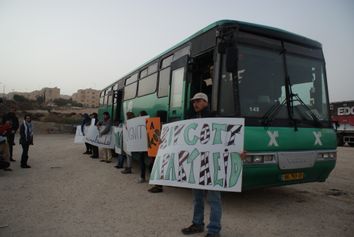
We headed for Road 60, one of the few main arteries in the Israeli-occupied West Bank, which is open both to Israeli and Palestinian travelers. When we finally arrived at a bus stop near the settlements of Psagot and Migron, it was difficult to tell whether the bewildered expressions on the faces of the waiting Israelis were due to the presence of the six Palestinian activists – who wore the emblematic checkered “keffiyeh” and T-shirts emblazoned with the words “dignity” and “Boycott Divestment Sanctions”– or the dozens of unruly journalists milling about the road, and even standing on the roof of the bus stop, who were on hand to watch the Israeli-Palestinian version of America’s freedom riders of the 1960s.
Drawing inspiration from the African-American struggle to desegregate public transportation, Palestinian activists set their own “freedom ride” on Tuesday, the anniversary of the Palestinians’ symbolic declaration of independence in 1988. Symbolic because, despite their current quest for U.N. membership, Palestinians still live under Israeli military occupation, with all the restrictions on their liberty that that involves, including the freedom to travel, work their land, to build and to manage their own affairs.
“Although the tactics and methodologies differ, the white supremacists and the Israeli occupiers commit the same crime: They strip a people of freedom, justice and dignity,” said Hurriyah Ziada, the spokeswoman for the Palestinian freedom riders. Her name, appropriately enough, means “more freedom” in Arabic.
“We demand the ability to be able to travel freely on our own land and roads, including the right to travel to Jerusalem,” she told the dozens of journalists who had crowded into the courtyard of the state-of-the-art cultural palace in Ramallah, the town that, with Israel’s continued annexation of East Jerusalem, acts as the Palestinians’ de facto capital.
One key difference between the situation in the southern American states in the 1960s and the situation in Israel and Palestine today is that there is no actual law that forbids Palestinians from boarding Israeli buses. Palestinians with Israeli citizenship and Palestinian residents of Jerusalem do so on a daily basis, although Jews and Arabs rarely mix in the troubled “Holy City” and possess their own parallel transportation systems.
However, holders of West Bank identity cards live under restrictions imposed by the occupying Israeli military and are barred from entering Jewish settlements and Jerusalem unless they are in possession of permits to do so, which is rare. So, while African-Americans were free to travel where they wanted but not to board whites-only buses, West Bank Palestinians are legally entitled to board Israeli buses but cannot ride them to their destinations. Such is the perverse logic of segregation and discrimination.
And this is what the six freedom riders set out to do: to challenge the ban on Palestinians traveling to Jerusalem, running the risk of arrest and possible attacks by violent settler extremists, who have recently not only escalated their attacks on Palestinians but have also increasingly targeted the Israeli military, Israeli leftists and human rights activists with what they call “price tag” violence.
The deadly serious confrontation has its surreal moments and light relief. As the six would-be passengers set out in search of a bus stop, the snaking convoy of perhaps 50 or more carloads of journalists followed on a sort of blind bus chase. This caused traffic jams on some of the narrower back roads used by Palestinians. (Another aspect of the occupation. Palestinians are not allowed to drive on many settler-only roads and so have to take massive detours to avoid them.)
The commotion eventually drew the Israeli police, army and the private security from one of the nearby settlements. But all of them seemed to be at a loss as to what to do. As we waited for a bus that would permit the Palestinians to board without just pulling away from the crowd, I spoke to some of the freedom riders.
“I haven’t been to Jerusalem for 14 years. It’s a dream of mine to enter Jerusalem,” said Nadeem al-Shirbaty, a 33-year-old ironsmith from Hebron, which is located just 19 miles from Jerusalem.
Huwaida Arraf, 35, the only woman and the only U.S. citizen in the group, said she refused to bring her U.S. passport along. “To be clear, Israel would not be able to do this without the United States’ financial support and political protection,” she told me. “It’s up to the American people to say, ‘No, we fought this during the civil rights movement in the ’60s. We don’t accept it for our own communities, so we should not be funding it abroad either.’”
One of the settlers at the bus stop, who could have easily passed for a Palestinian had it not been for his kippah (yarmulka), voiced a concern common among Israelis. “We are scared that those people will come and blow us up,” he admitted to me, without giving his name. “If one or two or even a hundred come in peace, so what. All you need is one in a thousand to have a bomb, then what are you going to do? How are you going to stop it?”
These are two of the central ethical issues raised by the freedom riders. Although a tiny minority of Palestinians has been guilty of violent resistance and terrorism against Israelis, including suicide bombings intended to kill civilians, does this justify the collective punishment of several millions of people who have done nothing wrong? Does such collective punishment reduce or increase the chance of future attacks?
As it began to look unlikely that the freedom riders would manage to find a ride, Basel al-A’raj, a 28-year-old man from Walajeh, a village near Bethlehem, shrugged. “We’ve been trying for over 60 years to bring our cause to the world’s attention,” he said. “It’s not a problem for me to wait here for a few hours for a bus.”
A bus soon arrived that the freedom riders managed to alight and the assembled journalists quite literally tried to press-gang their way onto the bus as the driver desperately attempted to shut the door.
Shut out, I joined a number of other journalists who went ahead to the Hizma checkpoint on the outskirts of Jerusalem to wait for the bus. When the bus arrived, Arabic-speaking police officers boarded and tried in vain to convince the activists to vacate the bus and informed them that they were under arrest for attempting to enter Jerusalem illegally and for disrupting public order.
“Our action has been a runaway success, regardless of what happens in the next few hours,” said Mazen Qumseyeh, a 54-year-old university professor.
“If they try to remove us from the bus, I’ll refuse to get off,” said al-A’raj, giving me a toothy smile from his undetected position at the back of the bus. “I will abide by the principles of the law, not military decrees, but civilian and international law, which guarantee my freedom of movement.”
A’raj told me that he was overcome with conflicting feelings of excitement and fear. “But we live with these mixed emotions all the time under occupation. Every day, homes are raided and people are arrested. The main difference is that, this time, there is media coverage.”
After a couple of hours, the Israelis delivered an ultimatum to the activists that they either get off the bus voluntarily or they would be forcibly removed. The police then carried them off one by one to a waiting police van, and the freedom riders shouted out their names and rejected what they regarded as the illegality of what the Israeli police were doing to them. They were released from custody a few hours later.
“This is only the beginning,” promised Arraf before her arrest. “This is the first bus, but there are bound to be future attempts involving more riders.”
Continue Reading
Close