Laura Wagner

The Haiti story you won’t read

Months after I was trapped under the rubble, I returned to the place we don't want to think about

  • more
    • All Share Services

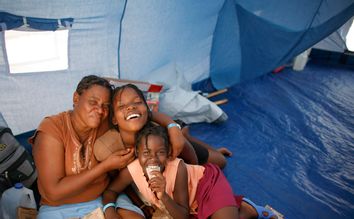
The Haiti story you won't readEarthquake survivors pose for a picture in their new tent in Corail, just outside Port-au-Prince, after being relocated there from Petionville Golf Club April 14, 2010. Haiti's government and foreign aid agencies started an operation on Saturday to move thousands of earthquake survivors to a safer refuge to avoid the risk of mudslides and flooding during the rainy season. REUTERS/Eduardo Munoz (HAITI - Tags: DISASTER SOCIETY)(Credit: © Eduardo Munoz / Reuters)

When I came back to Haiti in early April, after having been injured during the earthquake and evacuated a few days after, I was prepared to be shocked by the transformation of a city I once knew. Instead, what struck me was how quickly I adjusted to empty lots and mounds of broken-down rubble where landmarks used to be. Well-pressed and coiffed schoolgirls still gossip and giggle in the scant shade while waiting for tap-taps to drive them to class. People sleep under tarps and in tents in sweltering, unseasonable heat but still manage, somehow, to look professional and neat. A teenage amputee lies in her hospital bed, drumming her fingers to Miley Cyrus’ “Party in the U.S.A” and wondering when she’ll go back to school, and when the American missionaries will deliver on their promise to take her lòt bò, to the “other side,” the United States. On the street and on crumbled porches, people slap mosquitoes and make jokes, even jokes about the earthquake. And these things are lovely retentions, a heartening sign that the everyday humanity did not die even when so many people did.

But “normal” is not good. Normal means the things that didn’t work in Haiti before the earthquake have endured. That which seemed reassuring when I got back now seems depressing, tedious and ominous: Even the earthquake couldn’t change this place?

I am told that the American reading public has “Haiti fatigue,” that they don’t want to read stories about the disaster and its aftermath anymore. Part of me wants to retort, “You know who else has Haiti fatigue? Haiti.” But in truth, I don’t want to read about the earthquake, either. I don’t want to read about the conditions in the camps, or the increase in violence against women, or hurricane season, or what Sean Penn is saying today. When news stories about Haiti cross my in box, I skim them and then move them to a folder that I imagine, maybe wrongly, that I’ll be able to process someday. Most of the time, it’s too much. Knowing about something doesn’t mean you know what to do to fix it. Sometimes it feels as though words don’t matter as much as they used to, that we no longer live in a time when a persuasive essay or a provocative novel could change the world. Images and words flicker across our screens and minds, alighting only momentarily, and little surprises us. News stories and images of suffering rarely compel us to action but resign us to apathy and feelings of powerlessness. Why search the news for the stories that weigh on us and break our hearts when these only lay bare our futility and the inevitable gulf between our best intentions and our capabilities?

I’m sick, too, of stories about the Haitian people’s “resilience,” their indestructible spirit, their hardiness (which is eerily reminiscent of the justifications for the enslavement of Africans) — as if their minds and bodies are different from those of the rest of us, as if their endurance of the unrelenting sun, hurricanes, homelessness is anything more than what it really is: survival amid suffering when one doesn’t have a choice.

So I am back in Port-au-Prince, trying to find a perspective on things that isn’t coming out elsewhere, hearing stories. People are eager to talk, especially when they find out that I was anba dekomb (under rubble). Sometimes it feels as though the whole city has turned into a casual support group, meeting every day and everywhere.

On Haiti’s Jou Drapo, Flag Day, which in any other year would mean uniformed schoolchildren parading through town with paper flags, a woman named Nicole sits on a low wooden chair in the tent community in Pétion-ville’s Place Saint-Pierre, giving manicures and pedicures to other residents of the camp. She is in her 40s, compact and strong-looking with her hair in six puffy braids and a pair of glasses low on her nose. She wears a black tank top and a pair of jeans covered with the residue of her work — splashes of spilled polish, dustings of filed-away keratin. Like manicurists everywhere, her own fingernails are a mess. She is applying false nails to a young woman’s hands — super gluing long, clear extensions onto each nail and trimming them to the requisite length. They still look long and cumbersome, and I ask the young woman, “Can you do anything with those? Can you wash clothes?”

“I can do everything with these,” says the young woman. “Even braid hair.”

Nicole, whose home was damaged in the earthquake, lives in the tent community with her four children, who are 9, 12, 14 and 15 years old. She wonders aloud where all the supposed aid money is going. Haiti is in a fog of humanitarianism. That was the case even before the earthquake, with countless NGOs of different size and provenance and mission bumping up against each other, stepping on each other’s toes, obscuring each other’s projects. But it is a continual surprise how uncoordinated and piecemeal the aid effort is. No one seems to know where the aid is. They are aware that billions of dollars have been donated for Haitian recovery and reconstruction, but in everyday experience no one sees much of anything. They say, “Préval’s got it,” or, “It’s still in Clinton’s and Bellerive’s hands.” The aid is invisible — despite the “We Are the World” broadcast, despite the huge outpouring of international cash and international sentiment. Change, in the end, is not what we imagine it would be.

“They should build houses out of wood, or plywood,” Nicole says. “It wasn’t the earthquake that killed people. It was the cement blocks. We can’t afford to rent houses — houses are expensive! All this that I’m doing now,” she says, gesturing to the tray of different colored polishes in the plastic tray beside her, “is just so I can feed my children. We don’t know how long we can survive under these prela [tarps]. The state has to give us a little help.” She begins to buff the young woman’s nails, trying to even out the surface between the glued-on acrylic and the natural. I ask if her kids are in school.

“Not now,” she says. While her children’s school did not fall in the earthquake, it is still, like most schools, a multistory cement building — the sort of structure that gives Port-au-Prince residents chills. “The earth is still moving. I’m afraid. I want my children near me. If they are far away, I can’t control what happens to them.”

A pair of evangelical Haitian women arrive, two “servants of God” with lace kerchiefs over their hair, who have come to preach in the camp. The leader is a robust woman with a commanding presence; her tone is accusatory, angry, and she speaks of the earthquake as God’s revenge on sinners. Some camp residents watch with mild interest, and others ignore her.

One of Nicole’s neighbors in the camp shows me how the tents have electricity, wires running illegally from nearby electrical poles and crisscrossing the camp, cellphones charging in outlets dangling in midair above the canopy of tarps and sheets, light bulbs fixed in the entrances of crowded tents. I can’t imagine what will happen if an electrical fire breaks out in the camps. They don’t have electricity all the time, only when the state turns on the grid. “You should see the camp when they give electricity,” he tells me, smiling. “Everyone turns on their music, and you can’t sleep for all the noise.”

Nearly seven months after the earthquake, strangely, I find myself missing the emergency. Amid the tragedy, the sickening uncertainty, there was hope for change. The hours and days after the earthquake were hell, but an urgent and emergent hell: Because everything was thrown into tumult, no one knew where the pieces would land. Now it is clear how much institutional brokenness has endured. The crisis that, just half a year ago, felt like the end of the world is now chronic and stretching into an infinite horizon. Disaster, it turns out, is not an event but a process; the real crisis in Haiti comes not from the movement of the earth but from those structural, social and political factors that remain, seemingly intractably, intact amid so many broken things.

This is my selfish wish: to have been involved in relief at a time when things seemed morally unambiguous and every action was useful, even limping around the U.N. logistical base trying to find food for the injured, even scraping hardened sugar off the counters to mix with the oatmeal powder I found in the pantry, even sitting on a pee-scented cot holding someone’s hand and talking about anything. There was no question of what to do; the only choice was to do.

Now things are at once normal and completely strange, but the strangeness has a way of being absorbed into the landscape.

It is late May. Monica, Claudine, John and I drive out of Port-au-Prince. Monica and Claudine are both 22, the daughter and niece of Melise, the woman who lived, worked and died in the house I stayed in before the earthquake. Claudine was raised by Melise after her own mother died in childbirth years ago, and considered Melise her mother. John was my former landlady’s driver, who ran for hours to find the hammer and the flashlight that Frenel used to break me out of the cement on Jan. 12. Bathing suits under our clothes, plastic sandals on our feet: We are going to the beach in an overheating borrowed car, the radio on and a man singing, “Bondye renmen m, li ba m kouraj…” (God loves me, he gives me courage).

We drive past the uncleared rubble and the collapsed buildings hanging open with their plastic Venetian blinds drooping from crushed windows like the gills of a dead animal, and then we turn and drive more, until at last the roads become less congested with aid vehicles, up the coast through a treeless landscape that, viewed at a distance, is a patchwork of tents as far as the eye can see, white and a color I’ve begun to think of as “tarp blue.” As we drive far down Route 9 and draw near the tarp-dotted, shimmering hillsides at Bon Repos, Claudine exclaims, “Mezanmi! How can they do this?” Suspended in the foreground of this camp as you approach it from the north, there is a billboard for cigarettes featuring an attractive young light-skinned couple lounging with a yacht in the background. The woman reclines in the man’s lap, and her long, wavy hair cascades. “Mete w alez!” it commands, in Creole. “Make yourself comfortable!”

The water is clear and blue; the shore is rocky, not sandy, and burns our feet. We buy little plastic cups of freshly cooked conch doused in vinegar and hot pepper, and fried plantains, and eat them in the shade of a palm tree. To our right, we watch a group of Brazilian peacekeepers. They have their own section of the beach carved out, with palm trees painted U.N. blue and white and yellow tape demarcating the borders. One soldier stands in military fatigues with a machine gun while the others man their barbecue wearing board shorts and shiny blue Speedos.

The water is warm and salty and stings our eyes and we take the sorts of ridiculous, unflattering photos one takes when seawater keeps washing into your eyes and the tide keeps pulling you around and menacing your bikini top. Claudine wears a pink shower cap. Around us, several couples engage in protracted submerged make-out sessions and, as we lounge in the shallows, I glance about in mock-seriousness and say, “We’re all going to get pregnant.”

I remove myself for a moment and try to view this scene through a God’s-eye lens, rising up and over the beach like the camera setting up the establishing shot at the beginning of a film: In the blue water, I see Monica and Claudine, recently motherless. On the shore, watching our clothes, leaning against a palm tree with one leg bent behind him and chewing on banann pese, I see John, who found and retrieved Melise’s body in the rubble four days later and buried her in a temporary grave, and who says, “She was like my sister.” But today we don’t look like victims or players in an international humanitarian event that, for a while, at least, captured the attention and the imagination of the world. For this moment, we are a group of friends, sticky with seawater, looking for our sandals and squinting into the sun. Our feet on the ground, toes digging into the rough sand as we look out over the ocean into uncertainty. Haiti is not hell, or even limbo, however biblical it may appear at times. Amid the suffering and the absurdity, it is still a place, as all places are, on this sometimes-shifting earth.

Haiti: A survivor’s story

I came to Haiti to research. Six months later, I lay under the rubble of a house, my friend crushed to death nearby

  • more
    • All Share Services

Haiti: A survivor's story

I was sitting barefoot on my bed, catching up on ethnographic field notes, when the earthquake hit. As a child of the San Francisco area, I was underwhelmed at first. “An earthquake. This is unexpected,” I thought. But then the shaking grew stronger. I had never felt such a loss of control, not only of my body but also of my surroundings, as though the world that contained me were being crumpled.

I braced myself in a doorway between the hallway and the kitchen, trying to hold on to the frame, and then a cloud of darkness and cement dust swallowed everything as the house collapsed. I was surprised to die in this way, but not afraid. And then I was surprised not to be dead after all. I was trapped, neither lying down nor sitting, with my left arm crushed between the planks of the shattered doorway and my legs pinned under the collapsed roof. Somewhere, outside, I heard people screaming, praying and singing. It was reassuring. It meant the world hadn’t ended.

I want you to know that, before the earthquake, things in Haiti were normal. Outside Haiti, people only hear the worst — tales that are cherry-picked, tales that are exaggerated, tales that are lies. I want you to understand that there was poverty and oppression and injustice in Port-au-Prince, but there was also banality. There were teenage girls who sang along hilariously with the love ballads of Marco Antonio Solís, despite not speaking Spanish. There were men who searched in vain for odd jobs by day and told never-ending Bouki and Ti Malis stories and riddles as the sun went down and rain began to fall on the banana leaves. There were young women who painted their toenails rose for church every Sunday, and stern middle-aged women who wouldn’t let me leave the house without admonishing me to iron my skirt and comb my hair. There were young students who washed their uniforms and white socks every evening by hand, rhythmically working the detergent into a noisy foam. There were great water trucks that passed through the streets several times a day, inexplicably playing a squealing, mechanical version of the theme from “Titanic,” which we all learned to ignore the same way we tuned out the overzealous and confused roosters that crowed at 3 a.m. There were families who finished each day no further ahead than they had begun it and then, at night, sat on the floor and intently followed the Mexican telenovelas dubbed into French. Their eyes trained on fantastic visions of alternate worlds in which roles become reversed and the righteous are rewarded, dreaming ahead into a future that might, against all odds, hold promise.

I need to tell you these things, not just so that you know, but also so I don’t forget.

I think I was under the rubble for about two hours. Buried somewhere in what had been the kitchen, a mobile phone had been left to charge, and now it kept ringing. The ringtone was sentimental, the chorus of a pop love song. There was something sticky and warm on my shirt. I thought it was sòs pwa, a Haitian bean soup eaten over rice, which we’d had for lunch. I thought it was funny, that sòs pwa was leaking out of the overturned refrigerator and all over me. I thought, “When I get out, I will have to tell Melise about this.” Melise was the woman who lived and worked in the house. I spent a large part of every day with her and her family — gossiping and joking, polishing the furniture with vegetable oil, cooking over charcoal and eating pounded breadfruit with our hands. She said my hands were soft. Her palms were so hard and calloused from a lifetime of household work that she could lift a hot pot with her bare hands. She called me her third daughter. I thought Melise would laugh to see me drenched in her sòs pwa from the bottom hem of my shirt up through my bra. It took me some time to figure out that what I thought was sòs pwa was actually my blood. I wrung it out of my shirt with my free right hand. I couldn’t tell where it was coming from.

Melise did not make it out of the house. She died, we assume, at the moment of collapse. According to others, who told me later, she cried out, “Letènel, oh letènel!” and that was all. (The word is Creole for the French “l’Eternal,” a cry out to God.) “She had been folding laundry on the second floor — the floor that crumbled onto the first floor, where I was pinned, thinking wildly of sòs pwa. Melise worked and lived in that house for 15 years. She dreamed of one day having her own home and being free. She talked about it all the time. She died in the wreckage of a place she did not consider her home.

I want to write everything down – those mundane remembrances of how life was before — because as time passes I am afraid that people will become fossilized, that their lives and identities will begin to be knowable only through the facts of their deaths. My field notes are buried in that collapsed house. Those notes are an artifact, a record of a lost time, stories about people when they were just people — living, ordinary people who told dirty jokes, talked one-on-one to God, blamed a fart on the cat, and made their way through a life that was grinding but not without joy or humor, or normality. I don’t want my friends to be canonized.

——–

I had been in Port-au-Prince for a total of six months, conducting research on household workers and human rights. As a young American woman not affiliated with any of the large organizations that dominate the Haitian landscape, I was overwhelmed every day by the fierce generosity of Haitians. People who had little were eager to share their food, their homes, their time, their lives. Now I’m cobbling together this narrative — these nonconsecutive remembrances — in surreal and far-removed settings: first a hospital bed in South Miami, then a Cinnabon-scented airport terminal, now a large public university during basketball season. I can’t do anything for those same people who gave of themselves so naturally and unflinchingly. My friends, who for months insisted on sharing whatever food they had made, even if I had already eaten, promising me “just a little rice” but invariably giving more. My friends, who walked me to the taptap stop nearly every day.

Now that the first journalistic burst has ended, now that the celebrity telethons have wrapped, the stories you hear are of “looters” and “criminals” set loose on a post-apocalyptic wasteland. This is the same story that has always been told about Haiti, for more than 200 years, since the slaves had the temerity to not want to be slaves anymore. This is the same trope of savagery that has been used to strip Haiti and Haitians of legitimacy since the Revolution. But at the moment of the quake, even as the city and, for all we knew, the government collapsed, Haitian society did not fall into Hobbesian anarchy. This stands in contradiction both to what is being shown on the news right now, and everything we assume about societies in moments of breakdown.

In the aftermath of the earthquake, there was great personal kindness and sacrifice, grace and humanity in the midst of natural and institutional chaos and rupture. My friend Frenel, who worked cleaning and maintaining the house, appeared within minutes to look for survivors. He created a passage through the still-falling debris using only a flashlight and a small hammer — the kind you would use to nail a picture to a wall. Completely trapped, the nerves in my left arm damaged, I could not help him save me. He told me, calmly, “Pray, Lolo, you must pray,” as he broke up the cement and pulled it out, piece by piece, to free me. Once I was out, he gave me the sandals off his own feet. As I write this, I am still wearing them. At the United Nations compound, where Frenel ultimately guided and left me, everyone sat together on the cracked asphalt, bleeding and dazed, holding hands and praying as the aftershocks came. A little boy who had arrived alone trembled on my lap. Another family huddled under the same metallic emergency blanket with us. Their child looked at me, warily — a foreigner, covered in blood and dusted white with cement powder. His grandmother told him, “Ou mèt chita. Li malad, menm jan avek nou.” You can sit. She’s sick, too, just like us.

Social scientists who study catastrophes say there are no natural disasters. In every calamity, it is inevitably the poor who suffer more, die more, and will continue to suffer and die after the cameras turn their gaze elsewhere. Do not be deceived by claims that everyone was affected equally — fault lines are social as well as geological. After all, I am here, with my white skin and my U.S. citizenship, listening to birds outside the window in the gray-brown of a North Carolina winter, while the people who welcomed me into their lives are still in Port-au-Prince, within the wreckage, several of them still not accounted for.

As I sat waiting to be flown out, trying to convince myself that I was just another injured person using up scant food and resources, a non-Haitian man whom I presumed worked for the U.N. approached me.

“Can you do me a favor?” he asked. “Could you write something down?”

I nodded, and he handed me a pen and paper.

“Tear the paper in half, and on the first half write ‘unidentified local female’ in block letters. Then on the second piece of paper write the same thing.”

I looked up. There were bodies loaded into the back of a pickup truck. The woman’s floral print dress was showing and her feet were hanging out. There were not enough sheets and blankets for the living patients, never mind enough to adequately wrap the dead. The U.N. guy looked at me and sort of smiled as I numbly tore the paper and wrote.

“After all, you need something to do. All the bars are closed,” he said.

I stared at the bodies on the truck, and I hated him. I did not know which, if any, of my friends had survived. I imagined the people I love — Marlène, one of my best friends, or Damilove, the mother of my goddaughter – wrapped up in some scrap of cloth with their feet hanging out and some asshole tagging them with a half-piece of scrap paper that says they are anonymous, without history, unknown.

I am telling you two things that seem contradictory: that people in Haiti are suffering horribly, and that Haitians are not sufferers in some preordained way. What I mean is that suffering is not some intrinsic aspect of Haitian existence, it is not something to get used to. The dead were once human beings with complex lives, and those in agony were not always victims.

In Haiti I was treated with incredible warmth and generosity by people who have been criminalized, condemned, dehumanized and abstractly pitied. They helped me in small, significant ways for the six months I was there, and in extraordinary ways in the hours after the quake. Now I cannot help them. I cannot do anything useful for them from here, except to employ the only strategy that was available to us all when we were buried in collapsed houses, listening to the frantic stirrings of life aboveground: to shout and shout until someone responds.

Laura Wagner is a Ph.D. candidate in anthropology at the University of North Carolina Chapel Hill, who was living and conducting research in Port-au-Prince.

Continue Reading Close