Lauren Sandler
Lost faith in the GOP
Evangelical leader Richard Cizik explains how Iraq, corruption and other failures are transforming the political piety of America's religious voters.
Talk to most devout Evangelicals, no matter how Republican-red their blood runs, and chances are they’ll tell you that Jesus would never be a member of a political party, and that their faith, not politics, leads their vote. But after years in which an Evangelical revival has coincided with Republican domination in Congress and in the White House, that claim can seem disingenuous. If you follow returns instead of rhetoric, to be faithful has meant to be party-faithful. The oft-cited “God gap” — the perceived gulf separating holy-rolling Republicans from secular Democrats — has seemed like an unbridgeable one.
But watching Capitol Hill shift to Democratic control this week has challenged assumptions about Evangelicals and the GOP. According to the Associated Press, one-third of Evangelical voters supported Democrats this year, up more than 10 percent from 2004. And while many election-watchers predicted that sex scandals — be they Mark Foley’s or Ted Haggard’s — would keep Evangelicals away from the polls, they turned out in even higher numbers than they did to reelect Bush. Twenty-four percent of voters this year were born-again, up 1 point from 2004. And unlike in recent elections, Americans who attend weekly religious services voted in almost equal numbers for Democratic and Republican candidates.
No matter how much some voters may have opposed gay marriage — banning it this time around in seven states — many refused to vote a straight ticket. “We’re sick of being manipulated for Republican politics,” one conservative Christian voter told Salon in Colorado Springs on Election Day. “We’re sick of being taken for granted. I’m not saying I’m a liberal, but I’m fed up with these folks, and I’m not alone.”
Many voters told exit pollsters that their anger about corruption in government and the quagmire in Iraq led them across party lines. However, the races in which religious-right candidates lost tended to go to equally religious Democrats. Ken Blackwell lost his bid to govern Ohio to a Methodist minister. Rick Santorum handed his Senate seat in Pennsylvania to a pro-life Catholic, Bob Casey Jr. Rep. Charles Taylor was kicked out of Congress in favor of Evangelical Heath Shuler. It remains to be seen whether these races foreshadow a 2008 election in which candidates increasingly attempt to out-pray each other for political gain.
So what, exactly, has happened to the GOP’s heretofore bedrock coalition of devout Christians? Salon asked Richard Cizik, vice president of governmental affairs for the National Association of Evangelicals, to help us understand the changing colors of this year’s “Purpose-Driven” vote.
Did Evangelicals turn out for referendums banning same-sex marriage or stem-cell research, and, instead of voting a straight Republican ticket, vote for Democratic candidates?
I know from my experience in Virginia that’s happened. I talked to a fair number of Evangelicals who supported the same-sex marriage amendment and then punched the ballot for Jim Webb on the basis of the war issue. I know people very close to me — dare I say in my own family — who did just that.
What turned some conservative Christians against the party candidates they’ve historically supported?
The Republicans lost a lot of Evangelical votes with the corruption issue, and rightly so. The standard you see for voting is not as simple as [gauging] a politician’s stance on same-sex marriage or abortion. Moses gave some good advice: Pick capable leaders who are God-fearing, trustworthy and hate dishonest gain. Oh, really? You mean to say that God cares about greed? Just look at Colossians 3:5. What is greed? The apostle Paul says greed is idolatry.
Supporting the GOP isn’t one of the commandments the last time I checked, but it has felt that way in the past few elections.
Look, to be biblically consistent you have to be politically inconsistent. Evangelicals have to follow their Lord first, and not simply bend to the whims of a political party for the advantages that come with it. That is not good enough. We are not a cheap date. We have appeared so because of the alignment that many within our movement had had with Republicans.
Exit polls suggest that corruption was as important as the war — and more important than social issues — in determining the Evangelical vote. Do you think voters overreacted to the scandals that afflicted the GOP?
If there were some Evangelicals who became disenchanted with Republicans over corruption, and it seems to be from the election results, it was well justified. Any kind of funny business promoted voter retribution. And that’s the way it should be. We want trustworthy leaders who will tell the truth. We don’t need to go like supplicants to the political parties. We say, consider what our agenda is and join us.
Does this political moment strike you as a turning point, not just among some conservative Christians, but within the Democratic Party?
We need as Evangelicals to take stock of where we are as a country — not just ecclesiastically and theologically and otherwise, but politically too. And right now is as good a time as any to take serious stock. The Democrats know this, especially if they run candidates like Heath Shuler. Evangelicals didn’t depart entirely, but enough flipped over to make it possible for Democrats in certain districts to win, like Shuler did.
But wouldn’t it be hasty to underestimate the lasting appeal of Evangelical Republicans? Some candidates are honing their messages to widen their bases.
Sure. Gov. Tim Pawlenty in Minnesota is one Evangelical who is a conservative who won in a Democratic state. We need to take a look at him for his crossover appeal. The strategy is not a zero-sum game in which one side has to lose for the other side to win. That is so passi and unfortunate.
Would you say that many Evangelicals feel like they’re paid lip service by GOP candidates who take their votes for granted? Was this week a wakeup call?
Let’s just say that I think that for a long time the attitude [of politicians] has been, “Give them Oval Office cuff links and they’ll be satisfied.” I got mine in 1980. I don’t need any cuff links and haven’t for a long time. Cuff links aren’t on our agenda.
Answered prayers?
The base turned out for the GOP candidate -- and against gay marriage -- in Haggard's home turf, but the mood was blue.
At Mr. Biggs Family Fun Center in Colorado Springs, where Republican candidates were sweating out the local, congressional and gubernatorial elections on Tuesday night, the mood was hardly raucous. As party members trickled in to nibble cheese cubes and wait for word of victory, in a cavernous space off a go-kart track smack in the center of this blood-red district, everyone was looking a little, well, blue.
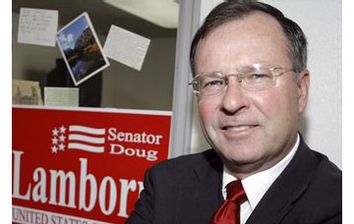
The mood was subdued while a volunteer wearing an American flag cap that partially covered her mullet circulated through the room, lighting red, scented candles, as a swing band set up on a stage festooned with giant banners blaring candidates’ names. Campaign workers hanging placards wore tight smiles. People casually referred to the “enemy” — which, in this conservative Christian crowd could refer to the Party of Pelosi or Satan himself — favored in the polls nationwide. A volunteer named Robin Koran hustled around in a cloud of hairspray and a flash of pink sequins, assembling balloon bouquets while discussing the “integrity” of Doug Lamborn, the Republican House candidate here, who Koran assured me was “a good Christian man.”
Continue Reading Close“This gay stuff has gotta stop”
At the Rev. Ted Haggard's polling place, his congregants turn out to back a gay-marriage ban.
Eight states are voting on whether to ban same-sex marriages, but in none of them does the issue feel quite as loaded as it is today in Colorado, just days after news broke that pastor Ted Haggard, the former head of the National Association of Evangelicals, had conducted a three-year relationship here with a male escort.
In the peach-painted atrium of Pike’s Peak Community College’s Rampart Range campus — Haggard’s precinct, where he has yet to appear — same-sex marriage seems to be what’s bringing people to the polls today. That, and the book fair sharing the giant room, where a woman in a whole lotta denim is selling texts for “Christian inspiration.”
Continue Reading CloseColorado Springs: A dead soldier, a fallen idol and a skunk
Vandalism and death threats in a deadlocked battle for the House.
Even in the town known as the Evangelical Vatican, all signs point to Iraq. When the citizens of Colorado Springs shuffled out to their doorsteps to fetch the local Gazette newspaper today, they were greeted by a top story that, for once this week, wasn’t about the gay sex scandal surrounding their local former pastor, Ted Haggard, or the amendment to ban gay marriage here.
Today’s top story was about a fallen soldier of a different kind: the deputy commander of Fort Carson’s largest force in Iraq was killed by a roadside bomb in eastern Baghdad. Two other soldiers in his humvee died as well. Fort Carson is one of five military bases in the heavily Republican congressional district centered on Colorado Springs. The Air Force Academy is here, too, where the Democratic contender for the local U.S. House seat, Jay Fawcett, began his own military career. Fawcett is running in a dead-heat race against Republican Doug Lamborn, and trying to draw service members away from the GOP via his promise to withdraw troops from Iraq, a region he knows firsthand from having served in the Gulf War. Perhaps today’s local headline will help Fawcett. Or perhaps he will get a boost from Lamborn’s connections to Haggard.
Continue Reading CloseThe pastor’s wife made him do it
Pastor tells flock that Haggard had gay sex because his wife let herself go.
Our friends at EvangelicalRight.com knew we’d be eager to hear about this response to Ted Haggard’s scandal, from our old pal/nemesis Pastor Mark Driscoll. Driscoll leads Seattle’s Mars Hill Church, and a good portion of the larger evangelical youth movement, teaching the doctrine of wifely submission to Christians nationwide. (To learn more about Driscoll, you can read Salon’s excerpt from my book “Righteous: Dispatches From the Evangelical Youth Movement” here.)
Continue Reading CloseAfter the fall
Will the Haggard scandal usher in a new age of Christian tolerance or increase the religious right's homophobia?
At last night’s evening worship at New Life Church, prayers continued for former pastor Ted Haggard. On Sunday morning, congregants had listened as a letter was read aloud in which Haggard confessed to being a “deceiver and liar” who had waged a lifelong struggle with “repulsive” homosexual urges. On Sunday night worshippers dabbed at their eyes and lifted their palms heavenward, pleading for God to forgive their fallen leader. But anyone who had been at the same Sunday night service a week earlier for what would turn out to be Haggard’s final sermon would think they had heard something like biblical prophecy.
Continue Reading ClosePage 1 of 3 in Lauren Sandler