Lenora Todaro

Power to the flower

Down with urban blight! Cultivating public land, as the author of "On Guerrilla Gardening" explains, is nothing short of a revolutionary act.

  • more
    • All Share Services

Power to the flower

Four years ago Richard Reynolds had his virgin guerrilla gardening experience. Fed up with the litter and tangled shrubs that filled the public planters in his south London neighborhood of Elephant and Castle, he set out at 2 a.m. wired on tea and began weeding and planting. “I felt like some kind of mischievous tooth-fairy or green-fingered vandal,” he writes in his new book, “On Guerrilla Gardening: A Handbook for Gardening Without Boundaries.” He began blogging about his experience and has, in a fairly short time, built a global network for guerrilla gardeners to plan late-night digs that stretches from London to Nairobi, Kenya; Mumbai, India, to Buenos Aires, Argentina.

Reynolds defines guerrilla gardening as “the illicit cultivation of someone else’s land.” Gardening takes place at night to minimize run-ins with authorities. He lays out a brief history of guerrilla gardening, stretching from the 17th century English diggers who, facing record food prices, began cultivating common land with carrots and beans, to 1970s New York city artists who coined the term “guerrilla gardening” when they created the Liz Christy garden on the Bowery, at the time a derelict neighborhood. He touches on the Zapatistas in Mexico, who began as an agricultural movement in the 1970s, and the Tacamiches in Honduras, who successfully cultivated an abandoned banana plantation between 1995 and 2001. Guerrilla gardeners, he notes, are even at work in Guantánamo Bay, Cuba, where one U.S. detainee used a plastic spoon to dig at night. With seeds saved from his meals he grew watermelons and cantaloupes.

At heart, 30-year-old Reynolds is a middle-class aesthete. He understands how neighborhoods are affected by neglect and sets about to make abandoned lots and barren traffic circles beautiful. A freelance advertising executive by day, he has become an avid publicist of this age-old movement at a time when more people are receptive to the idea of rethinking how land is used (from turning lawns into veggie gardens to harvesting fruit from public trees before they go to waste). Fears about global food shortages ratchet up the importance of gardens (guerrilla and otherwise) to our lives and Reynolds’ network offers a way to plug into how some people are choosing to be more self-sufficient in what they eat.

Although the first part of the book is history and memoir, the second half is more Dear Abby and Emily Post, consisting of advice about how to use light at night and find water sources. Etiquette rules: Don’t steal plants, leave a mess or be a smartass with passersby. And be polite to the authorities. The book mostly addresses newcomers in its coffee-bar-conversation style, with a bit of boot-camp boosterism thrown in. The use of numbers attached to gardeners’ names (Sandy 990, Heather 1986) protects their identities and gives the book a spicy, clandestine feel, as if we’re being let in on a secret. Beneath Reynolds’ civility, however, is a call to arms. Using the writings of Che Guevara and Mao for tactical advice, he encourages more people to take up the cause to beautify their streets and have a good time while they do it.

Reynolds shared his thoughts with Salon from his home in London about his flower power war, whether guerrilla gardening has gone mainstream and if that’s necessarily a bad thing.

You promote a very genteel attitude toward guerrilla gardening in your book. Gardening on public land is illegal, so it’s usually done at night, but, you argue, always be polite — to passersby, to authorities. Is it your aim that guerrilla gardens ultimately be legitimized, like many of the community gardens in New York City?

My tactics are about preventing getting told to stop. Discretion and politeness are part of that; reaching out with propaganda at the right time is part of that too. If guerrilla gardens can get legitimized that’s great. The guerrilla approach in my experience is very useful for getting to that point, but of course it’s not always possible or necessary.

You use a lot of war imagery. I understand the origins of the word “guerrilla” point that way (from the Spanish for “little war”), but does it have to be a war? It seems more suited to a peace movement — flower power, literally.

Flower power sums it up exactly. War, like gardening, is about destruction as a means to creating a better civilization. Guerrilla gardeners fight neglected land, fight the scarcity of land and fight the pests in their way. But of course using garden tools and flowers means our approach does not draw blood. Frankly, people who see gardening as something devoid of anything warlike are not in my experience serious gardeners but whimsical dreamers, the type of people who feel guilty pulling up weeds and foolishly imagine the best kind of garden is one in which humans have an absolutely minimal role — the wilderness, for example.

You were profiled in the New York Times Magazine, and in a recent People magazine the “hero” profiled is a guerrilla gardener from Long Beach, Calif. Has guerrilla gardening gone mainstream? What could be positive and negative about this turn of events?

The positives are that more people do it because 1) they have heard of the idea and appreciate its appeal on many levels, 2) they realize people like them are doing it, and 3) they realize the risks are slim.

The negatives are that, for those who do it because it’s a niche, underground or, dare I say it, cool activity, it will become less appealing. But in my experience this lot are not likely to be keen gardeners anyway, but pranksters who wouldn’t look after the garden after their first dig. So the more mainstream, the better!

What do you think of Michael Pollan’s work?

He’s thoughtful and provocatively showing how nature and society are at best totally integrated.

You provide the reader with some history of guerrilla gardening, including a discussion of movements like the Zapatistas in Mexico and the MST (or Movement of Landless Rural Workers) in Brazil, who did more than garden on neglected sidewalks — they began agricultural movements to lift themselves from poverty. Can you point to any contemporary example of this happening in the world?

I consider the activity of MST to be contemporary. There are also plenty of informal guerrilla gardeners in less industrialized countries who are doing so for far more necessary reasons than the beautifiers like me in wealthy cities.

Guerrilla gardening seems to be primarily an urban phenomenon, for obvious reasons — limited gardening space — but what surprised me about your list of “Guerrilla Garden Hot Spots of the World” is that this movement is happening mostly in the major cities — London, Paris, New York, San Francisco, etc., but not so much in cities like, say, Cleveland. Why?

I think it is going on in places like Cleveland; it’s just not so well documented. I keep finding new examples all over the place, in suburbs, rural areas and less global cities. It’s just that in bigger cities it’s more likely you’ll find guerrilla gardeners, I suppose.

You give the reader a number of Web sites to explore — everything from weed lovers to seed bombers. Can you say which might be the most unusual or provocative site that you’ve come across?

I enjoyed Christopher’s seed and clay molded into the shape of pistols as symbolic seed bombs. I thought it was a strong contrast, thought-provoking, a pictorial representation of the guerrilla-gardening approach. It’s at threemiles.com.

You write that guerrilla gardening is generally funded by the gardeners or through donations. What was one of the more surprising donations?

A car pulling over and handing me 10 pounds in cash as we gardened. That’s the kind of “curb crawler” we need more of.

What do you want newcomers to know about guerrilla gardening that hasn’t been said thus far?

Learn to love the gardening regardless of the obstacles. Gardening beyond your own boundaries takes commitment.

What do you want old-timers to know about newer guerrilla gardeners like yourself?

That we’re just like them. One old-timer, Adam in New York, said, “It’s like rock-and-roll. We’re the blues over here and you’re a Brit exporting the idea back to us like the pop invasion of the 1960s. It’s brilliant.” I was of course touched and relieved, having arrived in New York a little nervous that he and the other long-serving guerrillas might consider me an upstart.

Katrina, 9/11 and disaster capitalism

Naomi Klein talks about how governments and corporations take advantage of floods, wars and other crises to implement "shock and awe" economics.

  • more
    • All Share Services

Katrina, 9/11 and disaster capitalism

Naomi Klein is one of North America’s most lucid translators of globalization and its defects. Her book “No Logo: Taking Aim at the Brand Bullies” (2000) landed just after demonstrators in Seattle put demands for international economic justice on the front page. In “No Logo,” Klein critiqued multinational corporations for creating poor labor conditions in the developing world, all to further “the brand.”

Klein, a Canadian whose physician father and filmmaker mother left the United States during the Vietnam War, followed her concerns for workers’ conditions to Argentina after its economic collapse in 2001. There, with her husband, Canadian journalist Avi Lewis, Klein created “The Take,” a documentary about a group of autoworkers who occupy their dormant factory. After finishing her new book, “The Shock Doctrine: The Rise of Disaster Capitalism,” she partnered with Mexican director Alfonso Cuarón (“Children of Men”) to make a short film. (See it on today’s Video Dog.) The movie, which caused a stir at the Venice Film Festival, dramatizes the arguments of the book: that disasters — unnatural ones like military coups (Pinochet’s Chile) and war (Iraq) as well as natural ones (the Asian tsunami and Hurricane Katrina) — allow governments and multinationals to take advantage of citizen shock and swiftly impose corporate-friendly policies. The result: a wealthier elite and more-beleaguered middle and lower classes. Sri Lankan fishing villages become luxury resorts; public schools along the Gulf Coast become corporate-run “charter” schools.

Unafraid of controversy, Klein goes one step further in her new book than most progressive economists. She contends that in the aftermath of these various disasters, not only democracy but also human rights fall by the wayside — all in the name of freedom and the free market. Klein compares economic shock therapy to the horrific experiments conducted on psychiatric patients in the mid-’50s by a CIA-sponsored Canadian doctor, in which patients were subjected to drugs, electroconvulsive therapy and sensory deprivation in an effort to replace their problem behaviors with a more compliant personality. If a personality can be remade, so, too, a nation. The film, with its stark images of ECT, excerpts from CIA torture manuals, footage of Nobel economist and shock-doctrine promoter Milton Friedman glad-handing Pinochet, Thatcher and Reagan, and images of natural disasters (the Asian tsunami, 9/11) makes her message visceral: Be informed, be shock-resistant.

Klein spoke with Salon from London, one stop on a 10-country book tour, about Bush’s privatized war on terror, how free the free market is, and whether the anti-globalization movement survived 9/11.

“No Logo” and “The Shock Doctrine” each look at issues surrounding economic justice from different angles: marketing, direct action, public policy. Why are you so interested in economics?

I’m not really interested in economics; I’m interested in politics and culture. I studied philosophy and literature but forced myself to learn the language of economics later in life because I need it to understand the issues that I do care about. “No Logo” is about understanding the loss of cultural space to marketing; “The Shock Doctrine” is really about the loss of democracy at the hands of this economic program. My brother is an economist and directs a policy institute, so he hooked me up with academics and specialists.

For your research you traveled to Iraq, Sri Lanka after the tsunami, and New Orleans after the levees broke. What surprised you most?

I went on assignment for Harper’s to Iraq to write about Paul Bremer imposing shock therapy in the aftermath of “shock and awe.” After Sri Lanka and New Orleans I realized the story was bigger. In Iraq I was shocked by the level of resistance on the part of Iraqis to the privatization of factories. I quote one worker in my book who worked in a vegetable factory: “We will either burn it down or blow ourselves up inside it. We will not be privatized.” It’s a measure of just how wrong the occupation forces were that the Iraqis would be so shocked that they’d be easy to marshal from point A to point B.

In Sri Lanka I was shocked by the sight of shantytowns emerging for victims of the tsunami. I knew how much money had been raised, and there was no reconstruction going on. It was clear that these sprawling shantytowns would become permanent. They were the richest poor people in the world. The largest charitable drive in history, and the money just didn’t reach them. In New Orleans the disaster was being used to finish the project of transforming the Gulf Coast into a “tax-free enterprise zone,” as the Heritage Foundation called it.

In this book you talk about how certain businesses thrive after disasters like 9/11 or Hurricane Katrina. What are the most lucrative businesses?

One of the things that really struck me is how the stock market responds to hurricanes and terrorist attacks. The most significant change in recent years is that the stock market now responds favorably to terrorist attacks or narrowly averted attacks. A whole class of stocks jump — disaster stocks, like surveillance companies. Homeland security is now a $200 billion industry.

There is a new level of integration between homeland security companies and media companies. General Electric, which owns NBC, has been in the weapons industry for some time but has become very active in the homeland security business. They recently purchased InVision, which provides bomb detection for airports. Since 9/11 InVision has received $15 billion in contracts from the Department of Homeland Security — more such contracts than any other company. A company like that gains from the atmosphere of crisis and fear that is spread through media outlets. It’s war against evil everywhere with no end. That’s a war that can’t be won, and you couldn’t ask for a more profitable business plan. The only thing that threatens it is peace.

The recent subprime mortgage meltdown sent Wall Street to the government for a bailout. Is the free market really free?

This is yet another example of corporatism. It isn’t a free market. The contractor economy in Iraq is not a free market: It is a political alliance of corporate elite through tax cuts, contracts and bailouts. The irony of this ideological campaign is that everywhere that extreme free marketeers who like freedom go, what emerges is not a free market but an alliance of the small government elite and a corporate elite marked by these transfers and the accumulation of huge debt.

Has shock therapy run its course, or will it happen again?

We’re still seeing it, and the shocks that enable it are getting bigger. There was a strange period in the late 1990s when there was a shamelessness and openness about imposing these policies that date from the 1989 fall of the Berlin Wall and Frances Fukuyama’s book “The End of History” to 1999, with the Seattle protests against the WTO [World Trade Organization]. So it was really a decade when there was an openness to this agenda, including the Washington Consensus, that all governments must privatize whatever assets they have, that all governments must adopt free-trade policies, and that the World Bank and IMF [International Monetary Fund] can impose [those actions] as conditions on their loans. It began under the guise of fighting communism, but from 1989 to 1999 the ideology didn’t have a crusade. It was just naked before the world.

Now the policies are still advancing. The Bush administration has taken on the ideology of privatization and shock therapy — remember Bush wanted to privatize Social Security — but it’s also about creating new infrastructure (homeland security, reconstruction, the war on terror), fighting wars of preemption abroad, and simultaneously outsourcing the entire enterprise.

The 1990s was a time of pride for free marketeers, and that’s what was so important about the so-called anti-globalization movement. Now the war on terror acts as a shield and the ideology advances a far more ambitious scheme — it has entered the core of what we think of as essential state functions.

What is the current state of the anti-globalization movement?

The institutions that were advancing this ideology of shock therapy are in crisis because the anti-capitalist critique of markets is so mainstream now. The WTO talks have been derailed for four years. In Quebec in 2001, every leader in the Americas, except for Fidel, signed to pledge a free-trade zone from Alaska to Tierra del Fuego; no politician in his right mind would suggest such a thing now. The IMF and World Bank are both in a state of profound crisis.

There is more of a mood than a movement. Unless the progressive movement harnesses the growing rage, it will be taken over by the right.

Many critics of your work say, look at India or China or Chile to see how the middle classes are thriving with a free-market system. Do you see any long-term benefits to shock therapy?

It’s interesting that these are the cases that are consistently held up as success stories, because there are clear and dramatic examples of state repression used to impose free-market policies in all three countries: the terror of the Tiananmen Square massacre in China, Pinochet’s torture regime in Chile, violent crackdowns on resistance movements in India. Not one of these three countries is actually an example of the kind of unfettered capitalism advocated by Chicago School economists.

In terms of the long-term benefits of shock therapy, I never argue that no one benefits. The mark of the neoliberal state is a society of clear winners and losers, and an increasingly wide gap between the two. According to the United Nations, which tracks inequality in 116 countries, Chile is the eighth-most-unequal society on the list. In China and India the chasm between the country and the city, the slum and the call center, is so vast that it threatens national stability. We hear little about it in the Western press, but in China, India and Chile, fierce battles are fought every day over the legacy of shock therapy. For instance, there were 87,000 protests and labor disruptions in China in 2005, according to the government, and the number has gone up every year since. The Communist Party of China has identified income inequality as the most pressing issue facing the country. Chile, meanwhile, has seen a wave of strikes, unprecedented in recent decades, against the policies that were imposed in the shock therapy period, led by students and mineworkers.

You make a connection between torture and economic shock therapy. Can you explain the link?

I look at torture in two ways in the book. The first is as an enforcement tool used by states that are trying to push through an economic transformation of a country that is so wildly unpopular that terror — including torture — must be used to control the population. Chile, Argentina, Brazil and Uruguay in the 1970s are classic examples of places where very real shocks to bodies were used to spread terror, making it possible to impose economic shocks. China is another example. And I argue that the use of torture by U.S. forces in Iraq was related to the huge social unrest sparked by Paul Bremer’s attempt at an extreme country makeover. Many analysts agree that his decision to dissolve the army, to fire huge numbers of public sector workers, to push through investment rules that decimated Iraqi industry, and to cancel local elections all contributed to the rise of the armed resistance. And it was at that point that the war moved into the jails and torture spread.

The other way that I look at torture is as a metaphor for disaster capitalism. Disaster capitalism is an attempt to push through policies in the chaos and disorientation that follow a disaster — policies that wouldn’t stand a chance during normal, non-disastrous circumstances. The move to turn New Orleans public housing into condos after Katrina is a classic example. So is the current campaign to push through a highly contested oil law in Iraq, even as the country spirals into civil war.

What I argue is that this attempt to take advantage of the window of opportunity opened up by crisis has some uncomfortable similarities to the techniques for psychological torture laid out in declassified CIA interrogation manuals, which I quote in the book. For instance, the infamous 1963 Kubark manual talks about how to put a prisoner in a state of shock, using various regression techniques like sensory deprivation and sensory overload. Then it states that “there is an interval — which may be extremely brief — of suspended animation, a kind of psychological shock or paralysis. It is caused by a traumatic or sub-traumatic experience which explodes, as it were, the world that is familiar to the subject as well as his image of himself within that world. Experienced interrogators recognize this effect when it appears and know that at this moment the source is far more open to suggestion, far likelier to comply, than he was just before he experienced the shock.”

The first time I read that, it reminded me of the shock of Sept. 11, which, for millions of people, exploded “the world that is familiar” and opened up a period of deep disorientation and regression that the Bush administration expertly exploited. I want to stress that I am not in any way suggesting that a crisis like that was deliberately created in order to induce the state of shock, but I do argue that once the shock occurred it was deliberately deepened. And more to the point, the impulse to exploit a moment of disorientation opened up by mass trauma is, I believe, deeply immoral, in the same way that torture is immoral, because it is about exploiting an extreme power imbalance.

Continue Reading Close

Hives among us

Nothing will stop urban beekeeping fanatics from making their own honey -- not traffic, not smog, not even the law.

  • more
    • All Share Services

Hives among us

“Beekeeping is a completely sensuous experience,” says Roger Repohl, a beekeeper at the Genesis Community Garden behind St. Augustine’s Catholic Church in the South Bronx, in New York. “You touch and taste the honey, listen to the bees hum, smell the smoke.” Clad in his “vestments” — a white beekeeper suit, veiled hat, thick canvas gloves — he squeezes a “smoker,” a bellows attached to a can that he’s filled with pine needles and lighted with a match. The smoke warns the bees that the keeper is approaching to inspect the hive, but the aroma evokes Christmas. “I use pine needles,” he says, “because they smell good and you might as well be an aesthete about the experience.”

Repohl’s hives are not the natural conical ones that inspired 1960s hairstyles, but square wood boxes stacked five high, like file cabinets, or dresser drawers. He harvests about 300 pounds of honey a year at this peaceful outpost in the middle of auto repair shops, hardware stores and a mom-and-pop slaughterhouse.

Beekeeping is illegal in New York City. The law lumps honeybees together with alligators, lions and ferrets as “wild and ferocious animals.” The city’s urban beekeepers, then, form an unofficial secret society of asphalt naturalists — romantics drawn to the beauty of a beehive’s intelligent design, epicureans seeking the delectable taste of locally procured honey, and off-the-grid types keeping nature alive in the city. Restrictions on beekeeping like those in New York City are uncommon, however. “Chicago has beehives on top of City Hall,” says Kim Flottum, editor of Bee Culture magazine. “Chicago, along with Dallas, Boston, San Francisco and Portland, actively promote beekeeping for pollinator health.”

After years in which they seemed like charming throwbacks — rooftop denizens and community gardeners procuring raw honey and making beeswax candles, tending to insects that inspire fear and awe and irritation — beekeepers and their bees are having a moment. The current national interest in locally grown and organic food and low-impact city living is inspiring people to look into ways to have their hands in their own food production, whether by joining CSAs (community-supported agriculture), raising chickens, or keeping bees.

There are 513 beekeeping associations across the United States, according to Bee Culture magazine. Of its 12,000 readers, Flottum says, “Fifteen percent live in cities with more than 100,000 people.” However, trying to put a number on how many hobbyist beekeepers there are “is like asking how many people garden,” he laughs. “From our surveys, we estimate about 75,000.”

Troy Fore, executive director of the American Beekeeping Federation, which provides educational programs about bees for children and scholarships for graduate students of apiculture, says he feels the increased interest in beekeeping. “The further people get from the agrarian life and the more media attention to bee losses there is, the more people say, ‘Well, maybe I’ll get into beekeeping.’”

This interest, coincidentally, puts urban and backyard beekeepers on the cutting edge of one of agriculture’s biggest dilemmas: colony collapse disorder — the “AIDS of bees,” as Dennis vanEngelsdorp, acting state apiarist for the Pennsylvania Department of Agriculture, puts it. VanEngelsdorp is part of the CCD research team at the University of Pennsylvania. With CCD, the honeybees, highly organized, predictable creatures with finely tuned homing instincts, leave their hives to gather pollen and never return, like sailors drifting into the Bermuda Triangle.

More than a quarter of the country’s 2 million commercial bee colonies have been wiped out, according to the Apiary Inspectors of America, and the hobbyists are not necessarily immune. At stake, says the U.S. Department of Agriculture, is one-third, or $15 billion annually, of the food we eat — everything from almonds and apples to cherries and pears.

Explanatory theories abound, from pesticide and pathogen to radiation from cellphone towers and the onset of the Rapture. Losses by backyard beekeepers have been estimated only anecdotally, but the beekeepers are fearful of the implications. VanEngelsdorp says “pollinators are canaries in the coal mine,” and their disappearance is a referendum on the state of our environment — a reminder of the brilliant and frightening interdependence of our ecosystem.

- – - – - – - – - – - -

Bees stroll along Repohl’s neck like parrots on a friendly pirate’s shoulder. He has an intimate knowledge of their ways and a knack for reading their moods. Still, he says, “Sometimes I stand there looking at them just paralyzed and I don’t know what to do. It’s like looking into the mind of God.”

Repohl is a choir director who lives in the St. Augustine rectory in the South Bronx, providing an ecological education to local kids and sweet honey to those in the know. Each month the honey he procures takes on the flavor of the flowers in bloom: In June, linden flower; in July, clover. No bland-tasting honey pumped into supermarket plastic bears here. He’s dealt with mites, but thus far has been spared CCD.

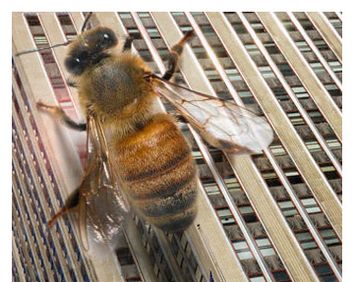
During a hive inspection, Repohl uses a tool similar to a chisel to pry open the top and assess the health of his hive. In a hive of some 60,000 bees, workers and drones, only one queen rules. Inside the honeycomb’s hexagonal shapes, connected like so many votive candles, worker bees deposit pollen for making bee bread and nectar for curing honey. Deeper down in the hive we see the brood: brownish-tan in color, capped with wax from side to side indicating a strong colony. Repohl breaks open a drone pupa and the bees go to work removing the carcass, which he says they will eat. “Bees live so that the hive may survive,” he says, “but bees also eat their brothers.”

Repohl grew up in the San Fernando Valley, “halfway between L.A. and Disneyland.” He came to the Bronx to do a Ph.D. in theology at Fordham University and befriended a former Trappist monk and master beekeeper who ran St. Augustine’s Church at the time. Now, Repohl, through his workshops at Wave Hill in the North Bronx and in garden conversation, baptizes many a soul into beekeeping. During my visit, we worked while we talked, scraping propolis (a type of glue the bees create to seal the hive) from the hive frames before checking to see if the queen he’d ordered from Texas had been accepted by the hive. She hadn’t. The bees were busily preparing the peanut-shaped cell for a queen of their own. In another hive, bee babies were being born, squirming in circles to push out of their eggs, arms up high, as if at the top of a roller coaster.

Norman Bantz, a Yonkers apitherapist, keeps his hives conspicuously between his door and driveway, the din of the Bronx River Parkway just yards away. The hives buzz with spring fever. At the other end of his unmanicured yard lay empty hive boxes lined with wax moth carcasses. Now in his 80s, Bantz believes that honeybee stings help treat multiple sclerosis and arthritis; he (and many other beekeepers) claim that eating raw, unpasteurized local honey banishes seasonal allergies. He began beekeeping decades ago to help one of his sons, whose allergies were so bad that he couldn’t go outside to play baseball. He and his wife, married 62 years now, sting each other weekly, and he says, “I never have been in a hospital except to visit friends.”

Bantz has perfected the art of mead making (honey wine) and swarm catching — how to act at that moment when the bees decide en masse to leave the hive in search of a new home, to the horror of the uninitiated. He developed an award-winning gadget to catch them: a pool pole attached to a wide-woven basket. Bantz never wears the traditional beekeeper’s protective suit when he enters a hive. He wears short sleeves and sandals. “I believe in divine providence,” says Bantz. “I survived three World War II invasions.”

Both Repohl’s and Bantz’s hives have been untouched by CCD. Bantz’s theory about CCD lays some of the blame with bioengineering. “Queens usually fly out to mate with a drone in the air,” Bantz explains. “The drone has to be very strong to hold them both together, but today the queens are artificially inseminated, the species weakens and loses its instincts.” Repohl uses minimal pesticides and says his bees live a relatively happy, isolated life in the South Bronx, so he prefers to leave the diagnosis of CCD to the scientists. But he likes this theory from his piano tuner: “He thinks bees have gotten turned on to hip-hop and when they do their little dance to tell their sisters where the honey is the bees just take off and don’t come back.”

Sidney Glaser, the retired beekeeper at the Clinton Community Garden on West 48th Street in Manhattan, found his hive dead after winter; the bees had disappeared, probably casualties of CCD. On May Day, as children dance around the Maypole, only flies circle his hive. A Brooklynite by blood and accent, a veteran of the Peace Corps, Glaser began beekeeping on the Lower East Side 20 years ago, having joined the Green Guerillas after retiring from teaching. Wearing denim jacket, pants and shirt, he appears slightly confused and impatient for his apprentice, Michael Hegedus, to arrive with a new queen and a colony of bees to replenish the deserted hive. He has his smoker at the ready, burlap burning in the can.

Glaser likes to tell the story about his bee beard, for which he is infamous in these parts. He first made one while in Paraguay, and then did it again five years ago for PBS. “I hung the queen cage around me like a necklace and all the bees come and gather around her. Before I knew it I had guys on the set doing it as well.”

Hegedus, an actor who renovates Brooklyn homes, arrives with a cardboard box from South Carolina marked “fragile” and bearing the cartoonish image of a bee. Inside, the bees hum actively. Hegedus says he’s waiting to hear the scientific evidence on CCD but he likes to tell people: “It’s the gasoline exhaust. Let’s get rid of the guzzlers.”

To date 35 states have experienced CCD. Maine is not one of them. Once commercial beekeepers have pollinated the state’s vast blueberry fields, there are concerns that CCD could come here as well — that the epidemic, having decimated agribusiness pollen factories and consumed city and suburban hives alike, will spread up the coast like urban blight.

Sitting in a House and Garden-ready country kitchen on the 65-acre Maine farm of the D’Entremont family, Phil Jackson ponders what CCD might mean for them. “If a commercial keeper has lost 80 percent of his hives, you can’t say, ‘I won’t use a cellphone,’ and hope that will bring the bees back,” he says. The cellphone theory, which proposes that the radiation from cellphone towers interferes with bees’ navigational powers, has been discredited by some scientists but is still under investigation. Yet Jackson’s point is clear: They have not been able to rule out any possible explanations.

Jackson started beekeeping during World War II to have some extra sweetener when sugar was being rationed. Since then he’s seen the “complete disappearance of wild honeybees” and watched the simple art of beekeeping become complicated. Not so long ago, he says, “basically they took care of themselves and you’d get 50 to 75 pounds of honey.” But problems have come with mites, and now CCD.

“If CCD continues then we’re at the threshold of catastrophe, especially the farming business. It’s one thing for us backyard keepers to not have a jar of honey, but for the big apple farmer, that [beehive is] a livelihood.” Without bees to pollinate, the apple fields’ survival is at risk.

The D’Entremonts, Chuck and Peg, have been raising their own beef, chicken and turkeys, and making maple syrup for 30 years. Their 18th century house has window sills blooming with orchids, and hummingbirds feeding outside the window at eye level. Chuck D’Entremont thinks that Maine has so far been spared CCD “because of what we do with diversity” — keeping a variety of flowering plants and wild grasses. “And the state of Maine has very strict pesticide license requirements,” which means that beekeepers are alerted when large sprays for gypsy moths or other pests will happen, and take precautions.

The theory that the bees have been taken out by pesticides seems obvious enough, and one group of pesticides — neonicotinoids — has been cited in particular. They impact the central nervous system of insects and can lead to memory and navigational impairment. To be careful, the D’Entremonts don’t order their queens by mail or use pesticides. “Somebody said to me that CCD was like human Alzheimer’s,” says Chuck D’Entremont. “If the bees are getting Alzheimer’s, then the things that are happening to them may be happening to us.”

Nutritional deficiency (the replacement of agricultural diversity with vast fields of a single crop), environmental stress (global warming screwing up the bee’s sensitive attention to seasons), and turning bees into migrant workers for large-scale agribusiness (a movable pollination force that travels by truck from state to state during blooming season) may also play a role in the ultimate diagnosis. The autopsies that vanEnglesdorp and his group are currently performing on those bees that have been recovered are leading toward an “all of the above” answer, but it’s a mystery in need of a particular detective, a cross between Agatha Christie and Rachel Carson.

Massachusetts farmer David Graves runs an underground collective of 17 rooftop keepers in New York City, finding homes for orphaned hives, then selling their honey at his stand in Manhattan’s Union Square Greenmarket. One of his hives sits precariously on a platform, 13 stories up on top of a hotel. Just Food, an organization that addresses food and farm issues, is lobbying the New York City Council to legalize bees so they don’t have to be hidden high in the sky and so that the city can contribute to pollinator health.

“Usually zoning changes to restrict beekeeping are the result of one bad beekeeper who pissed everybody off,” says Bee Culture magazine’s Flottum. “Or one bad neighbor who’s pissed off. And anyway you can’t legislate bees. If a bee wants to get in a hollow and make a hive it will. It’s like telling chipmunks where to dig holes. Having zoning restrictions on bees is just plain silly.”

As for change, as vanEngelsdorp puts it: “Things happen a backyard at a time.” Or one rooftop.

Continue Reading Close