Liz Galst

Burger and fries to go

How to convert a car to run on leftover vegetable oil from your local greasy spoon.

  • more
    • All Share Services

Hey, you, environmentalist: Want the greenest wheels going but find yourself lacking $109,000 for a Tesla Roadster? Despair not! There’s a vehicular option that makes a Prius seem like a gas guzzler and can save you major bucks, too. (Here’s the only catch: This option may not be strictly legal under the federal Clean Air Act. But more on that later.)

The vehicle in question is a grease car, a ride capable of lowering your motoring greenhouse gas emissions by 78 to 87 percent over regular gasoline. A grease car is a diesel car, truck or Jeep that runs on waste vegetable oil from your local greasy spoon or fine-dining establishment. A grease car also significantly reduces a bevy of environmental badness — asthma-triggering particulate matter, smog-forming carbon monoxide, likely carcinogenic polycyclic aromatic hydrocarbons and the sulfur emissions that lead to acid rain. The only environmental downside is a small increase in smog-forming nitrogen oxide.

Sold? Good. The first thing you need is, of course, a diesel vehicle. Old Mercedeses and V.W. Rabbits and Jettas — costing about 2,000 to 4,000 bucks — are popular among greasers. Or, if you’re feeling flush, you might want to spring for one of the V.W.s, Mercedes or Jeeps in showrooms now.

Next you need grease. Local restaurants and other food service establishments — cafeterias, caterers, hotels — are all good sources of what, in greaser parlance, is known as WVO, waste vegetable oil. “Just go into a restaurant during nonbusy hours and ask to speak with the manager,” advises California environmental consultant and greaser Stephanie Collins. The food folks usually give it up for free.

Your next step is to decide between two fueling options. Straight vegetable oil (SVO) or biodiesel. SVO is filtered WVO; to use it, you usually have to modify your car’s fuel system. Biodiesel is WVO catalyzed with methanol and lye. Biodiesel can be used in many diesel engines without modification. But making the stuff necessitates using and storing caustic and combustible chemicals.

“Modifying the car to run straight vegetable oil is great, and if you have just one vehicle, it makes more sense because it’s simpler,” says Lyle Rudensey, owner of Seattle’s BioLyle’s Biodiesel Workshop, which offers instruction on making your own fuel.

Key to success is careful filtration of your French fry grease. Otherwise you risk clogging your vehicle’s fuel injector and damaging the engine. Filtration systems run from low-cost/low-tech solutions that sell for next to nothing to mechanized systems that can cost as much as $1,500.

To make sure his grease is engine safe, SVO user Chuck Wyatt, a Holliston, Mass., Web developer, lets the oil he has collected sit in containers for a week or two, so most of the water and food remnants settle out. Then he pours the grease into a large hanging filter positioned above a 55-gallon drum. After the first filtering, he heats the grease with an electric heater and pumps it through a diesel-fuel filter into a second drum. “It’s not glamorous, but it works,” Wyatt says. Higher-priced mechanized systems can do all the work for you.

If you’re disinclined to get your hands dirty, you can purchase ready-to-use vegetable oil from a relatively small number of biofuels co-ops and fueling stations, such as Ithaca Biodiesel, in upstate New York.

Because SVO is more viscous than regular diesel fuel, you’ll probably need to have a mechanic install a kit that creates two fuel lines for your car — one for regular diesel, one for vegetable oil. You switch between one line and the other once the vegetable oil has been heated by the car’s engine. Modification kits cost about $1,000; mechanics, $1,000 to $1,500. (Here’s another good thing about your grease car: You can use “dino” (petroleum) diesel if you run out of the veggie stuff.)

Although SVO has many fans, biodiesel has its boosters, too. You can brew biodiesel at home, but “most of the people who do it are tinkerers,” observes Meghan Murphy, one of Ithaca Biodiesel’s founders. The equipment needed to make the stuff starts at $1,400 and can run as much as $13,000. That’s why the fuel is often produced by co-ops, whose members can share the cost of automated fuel-processing equipment. (Rudensey helped organize a 24-member group in Seattle.) WVO-based biodiesel is available at a growing number of fueling stations across the country, such as Berkeley, Calif.’s Biofuels Oasis. (Check out biodiesel.org for a national listing of stations and offerings.) If you do choose biodiesel, make sure to have a mechanic swap any rubber parts in your car’s fuel system for metal ones; biodiesel has some solvent properties that can cause rubber parts to crack and leak.

After all the parts and labor, depending on which filtering process you choose and where you get your grease, the price of your new fuel should range from $3 to as low as 50 cents per gallon.

In most cases, grease cars are against the law because they use a fuel that hasn’t had emissions testing approved by the Environmental Protection Agency. (Some fueling stations, including Ithaca Biodiesel and Biofuels Oasis, do offer EPA-approved biofuels.) The EPA has also yet to approve fuel system modification kits. None of the greasers I talked to, however, has heard of anyone being prosecuted under the federal Clean Air Act. But EPA spokeswoman Roxanne Smith says: “We have conducted some inspections regarding possible noncompliant biodiesel. Because these investigations are ongoing, we cannot discuss them.”

Depending upon where you live, you may be subject to certain road and fuel taxes that are usually included in the cost of petroleum at the pump. So consult a tax expert. And Bob McCormick, a biofuels expert at the federal National Renewable Energy Laboratory, warns that using waste vegetable oil can cause “carbon deposits in the engine, which could lead to poor performance.” None of the greasers reported engine trouble or knew of grease car users plagued by engine trouble.

Running your car on WVO isn’t for the time strapped. Wyatt estimates that collecting and processing grease takes him two hours a week. “You’ve got to be willing to put in the work,” he says. “It’s a hobby.” But a profitable one: Given his 70-mile round-trip commute, Wyatt says, “I’m saving about $200 a month on gas. I only need to fill up on diesel about once a month.”

Sadly, WVO isn’t the answer to the nation’s transportation fuel problems — there’s simply not enough of the stuff. The United States produces about 200 million gallons of waste grease each year, compared with a combined total of 180 billion gallons of gasoline and petroleum diesel used annually.

Nevertheless, running a car on WVO is definitely worth doing, says Rich Kassel, director of the Natural Resources Defense Council’s Clean Fuels and Vehicles Project. “We’ll never solve global warming by relying on used grease from the corner diner. But every little bit helps.”

Stop junk mail for good

The Internet hasn't slowed down the tree killers. But you can use it to keep their catalogs and credit card applications at bay.

  • more
    • All Share Services

Stop junk mail for good

You’d think that with all the spam floating around the Internet these days, good old-fashioned junk mail, the kind that clogs your home’s mailbox and the nation’s landfills, might be a thing of the past.

Alas, that is not to be. The amount of direct mail that catalog companies, Internet purveyors, and coupon captains send out each year continues to climb, up from 90.5 billion pieces in 2003 to a whopping 103.5 billion pieces in 2007, according to the U.S. Postal Service. “It’s a colossal waste,” says Kristi Chester Vance, communications director of ForestEthics, a group that has worked to reduce the environmental impact of the catalog industry.

In fact, the annual greenhouse-gas emissions from the production of junk mail are equal to those of 3.5 million cars. (That figure doesn’t include emissions from transporting and disposing of the stuff.) Beyond that, each year junk mail production in the U.S. consumes more than 96.7 billion gallons of water and more than 100 million trees, ForestEthics estimates. Most of those, says Chester Vance, come from carbon-dioxide-sequestering, biologically diverse old-growth forests, rather than from sustainably managed tree farms. And according to the Environmental Protection Agency, only about a third of all junk mail is recycled. “All that for a response rate of less than 3 percent,” Chester Vance notes, referring to the fact that fewer than 3 percent of people — often even fewer — respond to the solicitations.

Junk mail has nonenvironmental problems too. It exposes you to identity theft and is just a drag to sort through. If you spend five minutes a day dealing with junk mail — shredding credit card offers, for instance — you blow a full 30 hours a year. Time you could use to write the great American novel, hang out with your kids, or gaze up at the stars.

Usually your name and address end up on junk mail lists because you’ve purchased something with a credit card, subscribed to a magazine, or listed your name and address on the application for a store’s discount card. Merchants sell your information to others. You may have tried stopping your junk mail in the past, perhaps by contacting the Direct Marketing Association, the largest industry trade group, to little or no avail.

But fighting the junk mail hydra requires a multipronged approach, one that environmental groups and Internet-based service providers are taking up in equal measures. Now, several paid and some free services can effectively stop between 80 and 95 percent of all that mailbox clutter.

One such service is the Palo Alto, Calif.-based GreenDimes.com. For a $15 one-time fee, GreenDimes will “contact a dozen or so direct-mail groups on your behalf,” says general manager Dan Estabrook. GreenDimes instructs these groups, which compile and sell names to countless companies and banks, to remove your name and address — including past residents and the omnipresent “current resident” — from their databases. GreenDimes also monitors the DMA’s distribution list on a monthly basis to make sure your name is not included. “On the catalog side, we communicate directly with thousands of catalog companies, indicating that you’ve authorized us to remove your name,” Estabrook says.

GreenDimes’ coverage should last for three to five years, he estimates. If you move, you need to re-up. Like other services, GreenDimes allows consumers to choose, for the life of the membership, which catalogs they’d like to receive and which they’d like to stop. And with each new membership, the group plants 10 trees through tree-planting groups American Forests, Sustainable Harvest International, and Trees for the Future.

Ferndale, Mich.-based nonprofit 41pounds.org — its name is based on the average amount of junk mail a person receives each year — offers a similar service. For $41, it guarantees to stop junk mail for five years. It erases your name from direct mailers like Valpak, ShopWise, Reader’s Digest, Publishers Clearinghouse and Bed Bath & Beyond. It also donates $15 of your fee to nonprofits such as Stopglobalwarming.org.

Stopthejunkmail.com will put the brakes on junk mail to small businesses as well as consumers, for $20 a year.

None of these junk-mail-stopping services has been rated by consumer organizations such as Consumer Reports. But ever since signing up for GreenDimes this summer, I can happily report that my junk mail has stopped; the only pieces I now receive are from the environmental groups to which I belong.

If you don’t want to pay anything to stop junk mail, check out Catalog Choice, organized jointly by the Natural Resources Defense Council, the National Wildlife Federation, and the Berkeley, Calif.-based Ecology Center. The Web site allows individuals and businesses to remove their names from the mailing lists of catalogs they don’t want. Simply register, find the names of the catalogs you no longer wish to receive, enter the requested information into the Web form and click “Decline.” Catalog Choice will then contact merchants on your behalf.

Why focus on catalogs? Although they constitute only about 15 percent of the direct-mail pieces sent out in 2006 — that’s about 15.5 billion catalogs — “they have a disproportionate effect because of their weight,” explains the NRDC’s Kate Sinding. Sinding believes consumers aren’t the only ones who will benefit from the service. “We think this will help merchants, who can mail to people who want to get their catalogs and not waste money mailing to people who don’t,” she says.

Of course, the junk mail industry is hip to the fact that most people loathe much of what they produce. So the Direct Marketing Association is getting in on the act, sort of. Its new Commitment to Consumer Choice requires its 3,600-plus member companies to “notify consumers of the opportunity to modify or eliminate future mail solicitations.” As of October 2008, you should see a line on every piece of junk mail that explains how to get your name removed from the companies’ mailing list. If not, says DMA senior vice president for corporate responsibility Patricia Kachura, you should rat them out to the DMA. “Failure to comply means they can be brought to the DMA board of directors and could be expelled from the association,” Kachura says.

The DMA has also made nonbinding environmental recommendations, such as increasing recycled-paper content. And, for $1, the group offers its own consumer Mail Preference Service. The service claims to remove individuals from DMA-member lists; it doesn’t remove them from the lists of nonmember companies or from credit card or other financial solicitation lists, which are handled by other concerns. You can opt out of financial solicitations for free, though, by visiting OptOutPrescreen.com, a site jointly run by the four largest credit information agencies.

Finally, in dealing with junk mail, you might want to participate in new efforts by ForestEthics, the Center for a New American Dream and other groups to launch state “Do Not Mail” registries. The registries would prohibit direct marketers from sending unsolicited mail to those who sign up, much in the way the federal “Do Not Call” registry prohibits phone solicitations. “State ‘Do Not Call’ registries led to the creation of the federal ‘Do Not Call’ registry,” says ForestEthics’ Chester Vance, explaining why the groups are focusing their efforts on state legislation first.

The environmental benefits of such a registry could be pretty wide-ranging. And then, hey, think of all the time it could free up to deal with spam.

Continue Reading Close

Earth to PETA

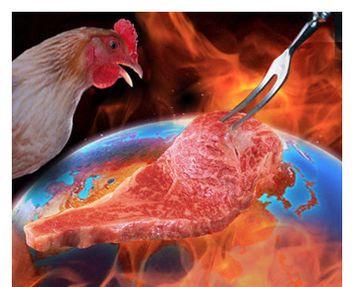
Meat is not the No. 1 cause of global warming. Yet our diet is cooking the planet, and one surprising staple turns down the heat.

  • more
    • All Share Services

Earth to PETA

At lunchtime in late September, on a relatively untraveled stretch of sidewalk outside the U.S. State Department, demonstrators from People for the Ethical Treatment of Animals attempted to catch the attention of, well, anyone.

Inside the building, Condoleezza Rice was trying to convince world leaders that the U.S. was serious about global warming; outside, two PETA members handed out fliers featuring a photo of Paul McCartney. “Think you can be a meat-eating environmentalist?” it read. “Think again!” Two other protesters, dressed in chicken suits, displayed a green and chartreuse banner: “CliMEAT Change,” it read. “Meat: #1 cause of global warming.”

Earlier that morning, as dignitaries entered the building, PETA made an effort to drive its message home. The group draped its banner across a champagne-colored Hummer and drove it around the State Department. By noon, the Hummer was parked across the street. “The plan didn’t work so well because of security and the way the roads are set up,” confessed Matt Prescott, PETA’s manager of factory farm campaigns.

Undaunted, PETA protesters, in October, drove a truck-mounted billboard around venues in Austin, Texas, and Denver, where Al Gore lectured about climate change. It featured a caricature of the Nobel laureate, potbellied and brandishing a partially eaten poultry drumstick. “Too Chicken to Become Vegetarian?” the billboard taunted Gore, and concluded, again: “Meat Is the #1 Cause of Global Warming.”

Not quite. As Phil Gutis, the Natural Resources Defense Council‘s communications director and an erstwhile PETA member, says, “I wouldn’t look to PETA for science.” The No. 1 cause of global warming is burning fossil fuels for electric power. Still, the group raises an important point. A November 2006 United Nations Food and Agriculture Organization report found that livestock accounts for 18 percent of global warming emissions worldwide, more than the entire transportation sector.

Here in the U.S., livestock’s impact is not quite so extreme: Six percent of our greenhouse gases come from livestock production, compared with 19 percent from cars, light trucks and airplanes. Still, for conscious eaters, those statistics are worth fleshing out.

According to the FAO, livestock production is a top cause of the world’s many environmental problems: deforestation, acid rain, dead zones in the ocean, land degradation, water pollution, species extinction and, most threatening of all, global warming. “We looked at every step of the commodity chain, from feed production to consumption,” says Henning Steinfeld, chief of the FAO’s livestock policy branch.

To begin with, Steinfeld says, “a lot of climate change damage is associated with clearing forest land, either for pastures or for feed crops.” Trees cut down to make room for cattle or soybeans no longer sequester carbon. Those trees are burned or decompose, creating carbon dioxide, the most common greenhouse gas.

Likewise, soil trampled underfoot or exposed to chemical fertilizers and pesticides retains significantly less carbon than forest soil or soil used to produce organic crops. “This is a particularly acute problem in Latin America,” Steinfeld says. Over 70 percent of the Amazon’s deforested land is used for pasture, and a substantial part of the remaining land is used for feed crops. Much of the world’s arable land is devoted to animal feed. In the U.S., 60 percent of the agricultural output of the Missouri-Mississippi basin is used to feed livestock.

Just as significant as those impacts are the potent methane and nitrous oxide emissions generated by livestock production. Livestock emit about a third of human-caused methane production and two-thirds of human-caused nitrous oxide. Cattle, bison, sheep and goats, “because of the specific features of their digestion, release methane from their mouths,” Steinfeld says. In other words, they burp out a lot of methane. That gas traps 23 times more heat per ton than carbon dioxide.

Steinfeld notes that “methane is also released from manure.” That’s particularly true when it’s stored in anaerobic conditions, such as the so-called waste lagoons common in U.S. industrial pork and dairy production, or in manure piles connected to American cattle feedlots. Feedlots are relatively unknown in other parts of the world.

In the U.S., there’s currently much more manure than land to spread it on. Consequently, the slurry is often sprayed on fields at concentrations that exceed by 200 times the underlying soil’s ability to incorporate the nitrogen the manure contains. The result? Nitrous oxide, a product of the manure’s decomposition. As a global warming gas, the compound has a heat-trapping potential 296 times that of carbon dioxide.

The Humane Society of the United States, good cop to PETA’s bad, has mounted its own effort to link livestock to global warming. Along with PETA, it advocates eliminating animal products from our diets, implying that all of these products — meat, dairy and eggs — are equally destructive. But that’s just not the case. “If you want to look at this globally,” says Steinfeld, “beef is absolutely the worst.”

Is grass-fed beef any better than the feedlot kind? Steinfeld says feedlot cows and grazed cattle create about the same amounts of greenhouse gases. Grazing, he says, “is not necessarily an environmentally benign form of production.” Even when deforestation and overgrazing are accounted for, producing beef still requires an enormous amount of land. And, individually, cows fed on forage release more methane that the grain-fed cows of mass feedlots.

Cornell University professor of ecology and agricultural sciences David Pimental disagrees. “Feedlot beef requires twice as much fossil fuel energy to produce as grass-fed beef,” Pimentel says. According to his estimates, producing 1 pound of feedlot beef results in the production of 8 pounds of carbon dioxide. That’s the equivalent of a third of a gallon of gasoline. Despite more burping by cows fed on forage, Pimentel says, their overall emissions remain lower.

Pork and dairy production occupies a middle ground, greenhouse-gas-wise, Pimentel says. Both dairy cows and hogs need a lot of feed, most of which is produced using nonorganic methods. But milk cows require less grain to make their product than do their cattle cousins. And pigs don’t belch methane, although the waste lagoons associated with industrial pork production do. The same goes for waste from large dairy operations.

Welcome, then, the savior of environmentally concerned carnivores everywhere: the chicken. Unlike cattle, chickens don’t burp methane. They also have an amazing ability to turn a relatively small amount of grain into a large amount of protein. A chicken requires 2 pounds of grain to produce a pound of meat, compared with about 6 pounds of grain for a feedlot cow and 3 pounds for a pig. Poultry waste produces only about one-tenth of the methane of hog and cattle manure.

That’s not to say chicken production is pure. The waste often contains the cancer-causing element arsenic, which is added to most U.S. chicken feed to promote growth. Plus, chicken poop frequently has mercury in it, possibly from fish meal used as feed, or from vaccines. And let’s be clear: The life of an industrially raised chicken is not a happy one. The growing birds are warehoused in spaces so small they can’t flap their wings, turn around or preen. Breeding for maximum meat production has resulted in animals whose bodies have difficulty supporting their own weight, meaning chickens live much of their lives in pain.

Still, chickens are such efficient producers of protein that a study in the science journal Earth Interactions finds that Americans who eat poultry, dairy and eggs, but not red meat, are responsible for fewer greenhouse gases than those who consume a vegetarian diet that includes dairy and eggs. “Astonishingly enough,” says study coauthor Gidon Eshel, a Bard College geophysicist, “the poultry diet is actually better than lacto-ovo vegetarian.” In other words, a roast chicken dinner is better for the planet than a cheese pizza. “If you need to eat dead animals, poultry is the way to go,” says Eshel, a vegan.

Eshel suggests that those eating with the climate in mind also steer clear of “large, predatory fish,” such as tuna, swordfish and shark. To catch them, he notes, “you have to schlep halfway across the ocean, and then you come back with less than a paltry amount of edible meat. It’s a big energy investment.” Salmon farming is also notoriously energy inefficient, Eshel says. He advises fish lovers to turn to sardines, anchovies and herring, or any non-overfished coastal species.

Eshel notes that the difference between a vegan diet and one that includes cheeseburgers is less than 2 tons of greenhouse gases a year. That’s about the equivalent of switching from a Camry to a Prius. The average American is responsible for about 26 tons annually, so if the entire U.S. population went vegan, we’d reduce our greenhouse gas emissions by only 6 percent.

How can you combat global warming with your fork? Simply by consuming less beef, pork and dairy. Choose beef products produced in the U.S. rather than in Latin America. And generally speaking, pick grass-fed meats and those produced on small, local farms rather than in industrial operations. Beef eaters might also want to keep an eye out for the USDA’s forthcoming “grass-fed” label, which has received high marks from a number of environmentalists and small-farm advocates.

Becoming a vegan is your best choice. But if despite all rational arguments, you find yourself jonesing for some flesh, look to PETA’s mobile billboard for inspiration, and have yourself a drumstick.

Continue Reading Close