Lt. Col. Darrel Vandeveld

Military commissions: A bad idea

They are a legal experiment that the Supreme Court has rejected. Federal courts can handle complex terrorism trials

  • more
    • All Share Services

Military commissions: A bad ideaKhalid Sheikh Mohammed

There are times in life when you don’t want to hear, “Well, this will be a learning experience for us all.” Open-heart surgery. In-flight emergencies. Repairing your Toyota. So what about the most important terrorism trial in United States history? Incredibly, there is a noisy political debate about whether to entrust the still-pending 9/11 trial to a military commissions system that, among its many flaws, is untested, likely unconstitutional, and has yet to demonstrate a single, credible result. Sen. Lindsey Graham now proposes legislation to bar a federal court prosecution of alleged 9/11 mastermind Khalid Sheikh Mohammed. That is a profoundly ill-conceived idea.

Whether we are at “war with terror” or at work destroying a ring of criminal terrorists, it makes sense, as a matter of national security, to use the right tool for the right job. Military commissions are not that tool. They are a legal experiment that the Supreme Court has rejected at every turn. Even presiding military Judge Col. Ralph Kohlmann derided the Guantánamo 9/11 proceedings as “a learning experience.”

The commissions are now in their fifth incarnation. Hastily conceived after 9/11, they were repeatedly revised by Presidents Bush and Obama, and by Congress. Under the most recent version (the Military Commissions Act of 2009), the Department of Defense has yet to even devise rules for these proceedings. It remains unclear whether commission defendants could plead guilty to capital charges. In fact, no version of the commissions has ever tried a murder case to verdict, never mind a case approaching the importance and complexity of the 9/11 trial. If insanity is repeating the same act and expecting a different result, the attempt to install another commissions system is a textbook case.

Add to this uncertainty the constitutional cloud lingering over critical legal issues like the use of hearsay and evidence obtained through coercion, the legitimacy of using a war court for offenses that the Department of Justice concedes are not war crimes, and the adequacy of the to-be-determined trial procedures. These issues are unique to the military commissions, and they will provide convicted defendants with multiple grounds for appeals. The resolution of these issues will not be speedy. They will grind their way to the Supreme Court only after years of avoidable litigation.

This latest attempt to rearrange the deck chairs on the Titanic actually complicates the legal process. It adds a layer of appellate review that does not exist in Article III federal courts or military courts-martial. Before the D.C. Circuit or Supreme Court could entertain an appeal, a third, brand-new appellate court called the Military Commissions Court of Review would have to weigh in. And when the Supreme Court finally hears a challenge to the commissions’ constitutionality, it may well overturn any conviction. If swift and certain justice is important to our national security, then using this Rube Goldberg-style system of criminal justice is ludicrous.

By contrast, federal courts are a constitutionally sound forum for prosecuting terrorists. There would be no threshold question about the court’s legitimacy, no grounds for appeal challenging the fundamentals of the system. And compared to the glacial pace of military commissions, a federal court trial would proceed pursuant to established standards designed to move cases forward in an orderly fashion. Federal courts are not only capable of handling complex terrorism trials, they are better than military commissions at doing it.

According to a new report by the NYU Center on Law and Security, the Department of Justice has successfully prosecuted more than 150 terrorism cases since 9/11, securing an average sentence of 16 years. As Colin Powell explained on “Face the Nation,” the military commissions are a failure by comparison: “In eight years the military commissions have put three people on trial. Two of them served relatively short sentences and are free. One guy is in jail … So the suggestion that somehow a military commission is the way to go isn’t borne out by the history of the military commissions.”

Professed concerns about leaks of classified information are a red herring. The 2009 Military Commissions Act adopted, nearly word for word, the same mechanism for protecting classified material used in federal court. Known as the Classified Information Procedures Act, these laws are time-tested and effective. An oft-cited but misinformed counterexample is that Osama bin Laden first learned that he was wanted by the U.S. from a document produced during a 1995 trial. As Eric Holder testified before Congress, that document was not classified, and prosecutors in that case did not attempt to protect the document from release by using CIPA. The strength and success of CIPA in federal court is precisely why Congress chose to adopt it for the military commissions.

The objection that a civilian trial would give Khalid Sheikh Mohammed a soapbox from which to spew his hateful rhetoric is simply false. Federal judges have no patience for courtroom outbursts. Witness the federal trial of Zacharias Moussaoui, the so-called 20th hijacker. His outbursts and anti-American insults led the judge to revoke his status as a pro se defendant, effectively silencing him for the duration of his trial. By contrast, the military judge at Guantánamo once invited all five of the 9/11 defendants to give a five-minute tirade before the media and victims’ families just to coax them into the courtroom.

In short, using our federal courts is being tough on terror. There is plenty of risk but no discernible benefit to trying the 9/11 defendants in an untested system. This trial should not be a “learning experience.” Too much is at stake for our national security, our values, and our future.

Lt.Col. Darrel Vandeveld (U.S. Army, Ret.) is a former Guantánamo prosecutor.  Joshua Dratel, a federal criminal defense lawyer in private practice, represented Guantánamo detainee David Hicks and is currently an advisor to the National Association of Criminal Defense Lawyers on the representation of high-value detainees.

Let’s hold Bush officials accountable for torture

The ACLU's executive director joins with a military officer to ask for a special prosecutor for torture

  • more
    • All Share Services

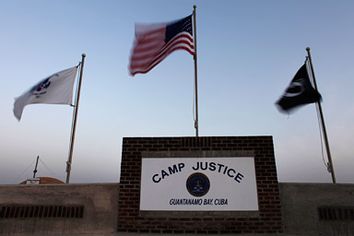
Let's hold Bush officials accountable for tortureFlags wave above the sign posted at the entrance to Camp Justice, the site of the U.S. war crimes tribunal compound, at Guantanamo Bay U.S. Naval Base in Cuba May 31, 2009. A session of the Guantanamo war crimes court began Sunday for Canadian Omar Khadr who is charged with killing an American soldier.

Torture is a crime and the United States engaged in it. Those are two indisputable facts. Given the mountains of evidence already in the public domain, any effort to deny or soften that harsh and devastating reality is either disingenuous, uninformed or a result of the human instinct to avoid painful truths. But one of the things that allows our democracy to endure is that time after time, no matter the misdeed, we have been willing to look ourselves in the mirror, acknowledge our wrongdoing and hold ourselves accountable.

Both of the authors of this piece chose professions devoted to protecting democratic principles, human rights and the rule of law. One of us is an Army prosecutor who resigned from six pending Guantánamo cases due to ethical failings of the tribunal system, and the other is the leader of the premier civil liberties organization in the U.S. We both understand that the process of self-examination and accountability has been, and remains, the only way to move forward and regain our moral and legal grounding.

To date, the evidence that U.S. officials engaged in widespread and systemic torture and abuse of detainees with the authorization of the highest Bush administration officials comes from a wide range of sources. There are congressional reports, journalistic investigations, detainees’ own accounts, and even — astonishingly — boastful admissions by some of the highest officials of the Bush administration, including former Vice President Dick Cheney, who has been aggressively forthright in his defense of torture methods including waterboarding. An ACLU Freedom of Information Act lawsuit has also produced more than 100,000 pages of revealing government documents, including the now well-known Justice Department memos laying out the legal framework for the Bush administration’s torture policies. And despite President Obama’s unfortunate decision to reverse his administration’s earlier intention to order their release, we know there are thousands of photographs depicting detainee abuse in overseas prisons beyond Abu Ghraib. While likely to be disturbing — as they should be — these images of human brutality would serve to confirm the pervasive and orchestrated nature of these crimes.

But notwithstanding all this evidence that domestic and international laws were violated, there are still those who would reduce these crimes to discretionary policy decisions subject to legitimate debate. There is even a robust public discussion about whether “torture works” — a jaw-dropping debate to be having in the United States of America — as if that could be reliably determined, and as if that would make it OK.

This cannot be the way forward in a country committed to the rule of law that applies to everyone, regardless of status or position. We have a Department of Justice for a reason, and now it’s up to Attorney General Holder, the nation’s top law enforcement officer, to do his job and appoint an independent prosecutor to follow the evidence where it may lead. In this country, we investigate crimes and, when appropriate, we prosecute them. Once we start compromising our principles and laws because it is too messy, too inconvenient or even too painful to enforce them, we render them meaningless. This is not a political issue, but a moral and legal one.

To date, the highest-ranking officer to be prosecuted for detainee abuse is a lieutenant colonel who was acquitted by a court-martial panel. Yet there is simply too much evidence of high-level orders and authorization for the use of torture and abuse to justify limiting criminal investigations to those in the field. What does it say about our commitment to justice when we are willing to sacrifice a few at the bottom but unwilling to hold accountable those at the top? When we are willing to prosecute military personnel but not the civilian officials and contractors who were also part of this horrific enterprise? What kind of legacy does that leave for future generations, and future administrations, when it comes to the consequences of those in power breaking the law?

There are some who might find it surprising to be hearing from the two of us together — a civil libertarian and an Army officer. But to us, the fit is quite natural. While having taken different paths, we have both sought the same destination: the preservation of American values, the rule of law and human rights. Without accountability, we cannot preserve those ideals. Without holding ourselves to the standards we wish to impose on others, we cannot move forward and we cannot hold ourselves out as a nation that adheres to a legal and moral code of conduct. It is critical that we hold accountable those who authorized, those who legally sanctioned and those who implemented the torture policies of one of the darkest periods in our nation’s history. What is at stake is nothing less than our democracy. 

Continue Reading Close