My mother threatened to kill herself so many times — rifling through the kitchen drawers to find a knife, getting drunk and swallowing pills — that when my brother called to tell me that she and my stepfather had been killed, I assumed it was a double suicide. Or that she killed him, and then killed herself.
My last words to her were “Fuck you.” The day before she died was the first time my family had gotten together since my father died the year before. We met at my brother’s house in Orlando, and although things started out OK, by the end of the evening Mama started up her usual shit, and I, tired of it all, said the magic words. My stepfather tried to get me to apologize, but I wouldn’t. Mama called later and talked to my sister, and I remember holding the receiver to my ear, listening to her cry, saying she was sorry. I didn’t say I was, though. After 21 years of dealing with her, I meant what I said.
She was 48 when she died. It was 1981. She and my stepfather were driving home from Clearwater Beach, drunk, still wearing their swimsuits at midnight, their bare feet grainy with sugary white sand. They ran their light-blue Plymouth under a tractor-trailer, shearing off the top. Both of them were thrown into the weeds on the side of the road. The next day the sheriff handed my brother a brown paper bag with a stiff bloody bikini in it. Instant death, he said, but I knew better. My mother had been aiming for that moment for a long time. She couldn’t have chosen a better ending to her story.
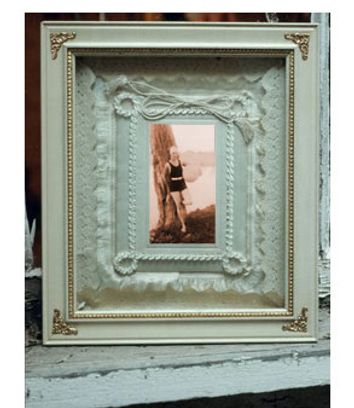
Her trajectory began inside the white scalloped edges of a photograph. She flirts with the camera, poses like a beauty queen standing in a small wooden boat on the shore of Lake Seminole, barefoot, hands on hips, head thrown back, a wide and bright smile. Open. She’s wearing short shorts and she’s conscious: “This is how I want to be remembered; I am as marvelous as Miss America.” She gives herself to the camera, maybe to the eyes behind the camera.
I imagine my father before he was my father, smiling at my mother before she was my mother. He has a head full of glossy black hair. Squinting his eyes, bringing her into focus, he snaps this photo of her, thinks of butterflies resting on leaves, camouflaged, right before they are netted, pinned into boxes.
In the next photo, she and my father are leaning against an enormous pine tree near the banks of the Apalachicola River, right on the Georgia-Florida line. He’s wearing shoes, thick brown brogans. She isn’t. Her long slender feet are posed calendar-girl style. Daddy surrounds her with a bearlike grasp, his arm draped over her shoulder, his big hand pulling her to him. He smooches her ear with his mouth, whispering, “Baby, I love you, I love you so much.” I can’t remember my father’s voice saying those words to my mother, but I know he did. Love her, that is, even if he did forget her birthday later.
Once, he did remember, and he hurt her feelings by buying her one pair of flimsy ladies underwear from the Dollar Store uptown and she wailed that nobody loved her, then threw the underwear in the garbage can beneath our pecan tree. But you can tell he loved her by looking at this photograph, the way his arm circles her, the way he holds her hand. She lets herself be contained, lets him whisper in her ear. This time the camera is peeping; Mama seems almost embarrassed at being watched; her eyes glance toward the ground.
Then there was a photograph taken after Mama had children. May 1962. That’s three years after my sister was born. Four children in five years and all of a sudden she’s wearing shoes, like she’s afraid we’re going to tramp on her feet. No more smiling, barefoot Miss America. The photograph is blurry, hazy. Mama’s sitting in one of those old-fashioned shell-shaped lawn chairs, scrunched to one side as if she’s going to share her seat with someone much smaller than herself. Her hands are clasped on top of her head, her legs crossed. She’s smiling but it’s a smile tinged with sorrow, the one I become most familiar with.
She sits beneath a tung oil tree, in front of a metal swing set. To her left is a clothesline, diapers fluttering in the breeze. In the corner of the photograph, there are bleary shapes, tiny feet, what seem to be hands. If you squint at this photograph you can almost see one baby helping another baby stand.
The stories I imagine behind those photographs seem as real to me as actual memories. What happened in real real life? The life I experienced? Consider me unreliable. I told my mother to fuck off, after all.
I am sitting in my mother’s lap in my cousin Billy’s backyard, a garden full of ferns, fountains, birds of paradise. Wind chimes dangle from the branch of a Japanese magnolia. Mama’s chin is resting softly against the top of my head. The grass we sit on is so lush and green it’s almost blue.
Even though I like sitting in my mother’s lap, her chin pressed against the top of my head, my small body folded into hers, I want to get up and walk across that green grass and down the beaten path to the metal pens where my cousin’s father, King, raised quail. I liked the smell of birdshit and cornmeal, the brownness of it all, the birds running back and forth in the powdery dirt, the worn wood, the earth beneath my feet.
When I think of that moment, I feel how torn I was between the quail and my mother. Her chin resting on my head was the completion of a circle, her body looped around mine. That circle said “You belong to me.” I should’ve savored the moment, and I suppose I did or I wouldn’t have remembered it, but the birds won, and I found myself edging through the azaleas to walk down the path bordered by weeds.
I looped my fingers into the wire pen, stared at the birds’ speckled brown feathers as they darted back and forth. I hadn’t learned yet to hold on to my mother’s happiness while it lasted.
It never lasted long. One morning, completely flustered by trying to get my brothers and sister and I out the door and up the hill to school, she threw my satchel on the floor and started shouting, “I wish I’d never had any of you!” She ran into her bedroom, flung herself onto her bed and started crying uncontrollably.
I remember moving forward to touch her, feeling sick on my stomach, on the verge of tears myself. I don’t remember what happened later that day — my father probably came home, set things right. I can’t remember leaving the side of her bed. In that memory I stand there, never moving, watching my mother sob into her hands, my heart forever breaking.
My mother was a study in opposites: a classic manic-depressive, full of light and dark. When she wasn’t suffering from one of her depressions, she took me and my brothers and sister to the Gulf of Mexico where she wore a bikini and we had picnics and built sand castles and played Goofy Golf.
Back home, she took us out to the country to fly kites. She let us drive down red dirt roads before we were old enough, and took us fishing practically every day during the summer. She once saved a boy from drowning even though she couldn’t swim herself, and she managed to laugh about the rattlesnake who’d crawled up under the quilt she sat on while she fished at Lake Seminole.
She would go into the bait store to buy crickets or worms, but she wouldn’t answer the door at our house. Once when a favorite teacher of mine came to visit, my mother locked herself in the bedroom and wouldn’t come out. Her inability to face people led to my having to go into the drugstore to get refills of the drugs she was addicted to, after my brothers refused to. I died of embarrassment every time.
Gradually, she began drinking, too, and once drunk, she’d climb out of the windows and sit hunched over in the dirt beneath the azaleas, not even speaking to us when we begged her to come back into the house.
When she and father weren’t home, my sister and I snuck into their bedroom to snoop around. It was silent and still as a church, full of mysteries. My sister and I always dug in the cedar chest to look at the blue jumper Mama’d worn as a baby. In the beginning there were quilts and old pocketbooks, and a blue-and-green silk dress I never saw her wear, couldn’t even imagine her wearing. There was a Nazi flag my father said he took from some dead Germans at the end of World War II.
Later, there were surprises, the things my parents hid, revealing they’d changed. We found a dirty-joke book in the closet; another time we found a manual on how to have sex. And then one afternoon, probably the last afternoon we snooped, there was a note in an envelope, a scrawl of words that said “Your wife is having an affair.”
I was stung by the sentence, but it wasn’t exactly a revelation. I figured she was running around with this black-haired cowboy she worked with. Something was going on. What was confusing was who put the note in the cedar chest. Who would even want to save a scrap like that?
Mama finally left my father and the black-haired cowboy or whoever he was, and moved to Tampa to live with another man. She came to visit me once during this period. She sat in my one-room apartment beneath a poster of flying dykes from the Michigan Womyn’s Music Festival, uncomfortable, as if she were visiting a stranger. I sat across the room from her, staring at the shadows the yellow lamplight made on her face.
It wasn’t until after she died that I found the note she stuck inside my dictionary that night. “Help me; I need your help,” she’d scrawled on a piece of drawing paper. It was strange, finding those words stuck in my dictionary months after she died. It was as if she’d known I’d snooped all those years; as if she were saying, “Here, find this.” I kept it, even though it reminded me of how sad she’d been and how little I’d been able to do about it.
After her death, my sister went down south to clean out my stepfather and mother’s trailer. As she moved boxes outside, the woman next door came over and shouted at her: “They were nothing but a couple of drunks.” In the end, I suppose that’s how she appeared. Maybe that’s what drove me to tell her to get fucked the day before she died. But that’s not how she appears to me now. Maybe it’s because I wish I could rewrite my last words to her, have the story end a different way.
Yes, she scared the hell out of me when I was a child. She hurt me. She stole corn from a field in the country, filled the trunk to the brim while I cried, worried she’d get shot. But she also took me to a Jackson County farm to pick hampers of White Acre peas she paid for. She taught me to appreciate the tinny sound of AM country-music radio. She let me drive to Panama City Beach when I was 12 years old. She bought me drawing paper when she thought I wanted to be an artist. She taught me how to bait a hook and how to hold a bream in my hand without getting finned.
I think of her at the oddest moments — when my girlfriend and I travel to Central Florida on back roads and pass one of those rinky-dink horse-riding corrals. I stopped at one of those once with my mother, and still remember the way she looked in the dappled green shadows beneath the trees. I think of her when I go to the Gulf of Mexico or see a stringer full of silver fish, a varnished bamboo fishing pole, paper kites, a car driving down a road with a roostertail of red Georgia dirt blowing up behind it.
I can’t remember my mother’s voice anymore, how she sounded when she said, “I wish I’d never had you,” but I remember how she looked in her white cotton nightgown, leaning over me at night, nibbling words into my ears, Mmmmmmm, I love you. Her breasts brushed against the sheets as she bowed her body over my bed. I remember her smell, the sweet, cherry-almond scent of Jergens Lotion. I can’t remember the exact brown of her eyes or how long her eyelashes were or how her lips were shaped, but I can remember how her chin rested on the top of my head, making us a perfect circle, just for a moment.
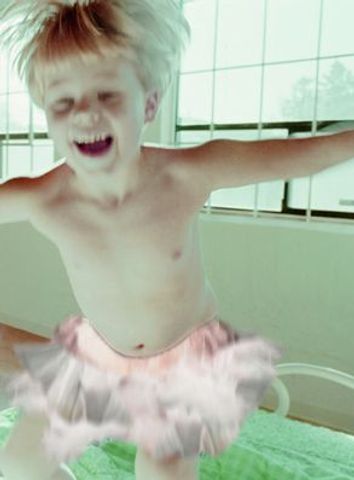
The other day I told a friend how Elias, my 3-year-old son, shimmies into his pink-sequined evening gown, slips his feet into his high-heeled silver shoes with the pink fluff on them, then clacks around the house like a tiny diva. “Did you get him on video?” she asked.
I said “No,” and she moaned, “Ohhhhh, you should have,” a look of disbelief and disappointment on her face. Then, when I explained that I don’t even own a video camera, she looked at me like I’m a neglectful parent, like I’m letting my boys’ very lives trickle through my fingers.
And sometimes I do feel downright neglectful, especially when I watch other parents, videocams pressed to their eyes like jeweler’s loupes, or held aloft, the scene unfolding on that tiny screen as they lurch around their children, taping their every movement. They tape their children’s birthdays, shouting out stage directions, Let’s blow those candles out one more time. They tape their children’s ballgames and piano recitals; they elbow each other out of the way to tape their children’s’ performances in those Thanksgiving pageants at preschool. When will they have time to watch all those miles of footage?
My kids are just going to have to depend on their memories to supply them with videos of themselves dressed as Native-Americans in brown paper-bag costumes, singing “I’m a Little Turkey” off-key. The remembrance of things past worked fine for Proust. If memory was good enough for him, it’s good enough for my boys, too.
There are no tapes of me dressed in a tutu as a fairy, waving my tinfoil wand in the first grade play. I don’t even remember the play, and wouldn’t have even known about it if weren’t for a blurry black and white photograph of me in all my knock-kneed glory. There’s probably a good reason why my brain edited out that moment.
There aren’t any tapes of me running brown-skinned and bare-chested around my backyard thumping my chest like Tarzan, either. There aren’t even any photographs of that chest-thumping me at all, yet I remember wanting to be Tarzan as if it were yesterday. I can see myself crawling through the jungle of velvety green kudzu in the woods across the street from my house, looking for a ropy vine to swing from. I remember how I felt, standing in the blue shadows of those trees, desperately wanting to be something I wasn’t. If my mother had had a video camera, you can rest assured she would’ve chosen to film me as a fairy.
But my parents barely photographed me or my siblings after we stopped drooling. When they did, it was usually a holiday. There’s a photograph of us lined up together in our Halloween costumes: a scarecrow, a big black witch’s hat, a small witch, a black cat. What’s evoked for me is what’s not in the photograph: my older brother itching furiously under all those cornshucks, my next-to-oldest brother nearly passing out from the fumes the black hat gave off, my sister madly scratching the redbugs that crawled out of the Spanish moss witch hair onto her scalp, me sniveling in the middle of my grandmother’s bedroom while my mother kneeled beside me sweating, pinning the seams of my cat costume together minutes before the parade started.
We almost always had a family crisis right before a photograph was taken, especially as we got older. There’s one Easter photograph I can barely stand to look at. My brothers are brand-new teenagers; my sister and I are on the edge. We’ve already made our appearance at the First Baptist Church, my manic depressive mother’s defining moment. We’ve fidgeted through a boring sermon, endured an endless version of the hymn “Up from the Grave He Arose.” It’s the last time Mama will be able to coerce us into dressing like that, my brothers in lookalike blue suits, my sister and I in identical flowery dresses, stockings the color of party mints, shiny white patent leather shoes.
Mama has arranged us in front of a bed of giant pink azaleas. Bees hum in the hot, muggy air. I am hunched to one side to give the illusion of shortness. My brothers look as though they have been shocked with cattle prods; my sister looks like she’s trying to will herself to disappear. And my mother and father stand on either side of us, my dad with his usual frumpy look, my mom beaming with fake happiness. She’d just told us what a bunch of fucking losers we were for not being more cooperative. My uncle snapped the picture. Cameras of any kind seem to bring out the despots in people.
But I confess; at times I do want a video camera: when Jordan fought off monsters in our front yard, wielding a stick sword and a garbage can lid shield; when Samuel danced like Fred Astaire across the wooden floor, his brown fedora tipped over his eyes; when Elias dressed as the pink princess, murmuring to himself. But I suspect that if I had stepped into the scene, video camera pressed to my eye, Jordan would’ve stopped fighting his monsters and started fighting for the camera. Samuel would’ve stopped dancing, and Elias, well, Elias would’ve probably primped, ham that he is. That’s what happens if they catch me lugging the old 35 mm out of its case — the air in the room shifts, the moment is changed.
I probably sound like a crank, or maybe a Luddite, someone afraid to embrace the technology. But in truth I’m probably more of a romantic, like my girlfriend, who told me how she’d gone camping with her old boyfriend. He spotted a deer grazing in the sunlit meadow by their tent. A classic Kodak moment. Get the camera, he whispered, but before she could click the shutter, the deer and the moment were gone and she’d missed both. She saw the camera as an intrusion on the natural order of life, which is to be experienced, she said, not watched from behind a viewfinder.
I’m not the purist my girlfriend is. I do photograph our children; I try to catch them unaware, lost in their worlds. It doesn’t always work out though — the bubble bursts and they end up posing for me instead.
I treasure the photos I have of my boys, their doe-eyed looks, their fat baby bottoms, their naked boy bodies rollicking in the tub. I want to hold them forever in those moments; preserve them, keep them alive. I’d love to always hear their baby boy voices, their made-up words, the songs they sing. I’d love to always watch them dance their little boy dances. I want to keep my boys forever. But I can’t, any more than those Victorian mothers in those silvery tinted Daguerreotypes could hold onto their stillborn babies by having them photographed cradled in their arms as if alive.
There’s no question: videotape is powerful stuff. We’ll be watching those images of the airplanes ripping into the twin towers for the rest of our lives. But the tape is no substitute for the actual event, which was more horrible than any of us can imagine, unless we were there. The tape is a sterile version of what happened; the same as it was during the Gulf War, when so many people watched those eerie green images on TV, tracers streaking across the sky like fireworks, those gray images of bridges being blown to pieces, all cold images preserved behind the glass wall of the television. More haunting, to me, are an old friend’s descriptions of the tracers she saw in Vietnam while serving as a nurse near the frontlines. They were beautiful, she said, bright orange streaks across the black jungle sky. I remember them so vividly, she said, yet I can’t remember the faces of any of the boys we ended up putting in those black body bags, not a one.
Our minds edit our stories for us in a way that videotape can’t. What we remember and what we forget becomes the narrative of our lives. When I watch Jordan gallop across the yard like a pony, neighing and pulling his squealing brothers in their little red wagon, I can’t help but wonder if a videotape of that moment would override his own memory, focus his eyes where they wouldn’t have been focused. If someone is taping you, they are taping what they see, not what you see.
I suppose I’m wary of narrating my sons’ lives by filming what I think are their memorable moments, plus I don’t want to watch Elias pull on his shimmery dress from behind a lens, worrying if the focus is right or wondering if my arm is jerking too much to steady the camera. I want to watch my boys with my naked eye. I leave the pink dress to Elias; let him make up his own story about what’s going on. I want all my boys to make their own home movies in the velvety darkness of their own imaginations, the same way Wordsworth made poetry from “emotion recollected in tranquility.” So, I reluctantly let those moments go, and try to remember as much as I can.
Continue Reading
Close
The summer I turned 12 years old, my mother let me drive all the way to Panama City Beach. I’d been driving for a couple of years already, sitting in Mama’s lap as I steered the car down the red dirt roads that snaked through the woods outside of Chattahoochee. But that summer, I’d finally grown tall enough to work the pedals and see over the dashboard, so as soon as we got outside of Sneads, Mama coasted into the grass next to a cornfield, scooted over and let me slide behind the steering wheel. We had a light-yellow Plymouth Fury that I thought looked like a Cadillac from the side. That’s how I liked to picture it. When I stood next to it on our carport, I could almost see fins rising out of its boxy back end.
I drove fast. It was just me, my little sister and Mama. All the windows were down and the hot wind whipped my long, dark hair in every direction. Nothing compared to the feeling I got going 60 toward curves I couldn’t see around. “Soft shoulders,” the yellow signs read. I hung onto to the inside of those curves like I did riding the Himalaya at the Miracle Strip Amusement Park, imagining the black rubber tires clutching the pavement. We rocketed around one curve after the other, zinging past cornfields and cow pastures. Grasshoppers green as crayons flew over the windshield. After half an hour or so the car felt real, not like an amusement park ride at all, and I slowed down and drove more sensibly.
Out of the corner of my eye, I could see Mama, her face tilted away from me into the wind, her eyes shut, her hair blown crazy. She is there, and not there at the same time. Mama and not-Mama. How many mothers let their 12-year-old daughters take over the wheel? I turned south onto Highway 231 and drove on. Mama did a slow fade and disappeared. Both she and my father end up doing the slow fade in most of my memories of summer vacations, the ones my mind has created out of all the trips my family made to Panama City Beach from the time I was 5 until I was about 12. They are bit players, visible only in the corner of my eye. After all, I’m the one driving the car. It never occurs to me that one day I’ll grow up, have children and do my own slow fade.
We went to the beach all the time in the summer. My mother didn’t think anything of driving down to Panama City for the day — it was only a couple of hours from our house in Chattahoochee, but it was a world away from our boring, gray sidewalks, even if they were canopied with wisteria vines, lined with mimosa trees dripping flowers pink as watermelon. The Miracle Strip was a couple of miles worth of unreal gaudiness — Pepto-Bismol-pink motels, plaster statues of monkeys and dinosaurs, souvenir shops with clamshells out front so big my sister and I could live in them; the Snaketorium, Goofy Golf, the Miracle Strip Amusement Park with the Starliner Roller coaster and giant Tiki Man.
Every trip started the same way, with my parents commanding center stage. My father stood on our front porch yelling at my brothers and sister and me to please be quiet, then turned to the screen door to sweet-talk my mother into coming outside. We always fought over who would sit where in the car, while my mother sat in the house and cried. She was manic depressive and threatened to call off the trip if we didn’t stop fighting. We’d quit long enough to lure her out of the house and into the Plymouth.
As soon as we pulled out of the driveway both she and my father disappeared, not to reappear again until I got hungry or needed to pee. It was as though I somehow got myself down to the beach where I floated on my back in the Coke-bottle-green water of the Gulf of Mexico, the waves lifting my 10-year-old body as gently as a breeze. I closed my eyes and the hot, yellow sun turned a velvety red against my eyelids. I pretended I was drifting through clouds along with the seagulls, suspended in the warm air above the white beach, until my mother’s screaming voice finally broke the spell, upsetting the hypnotic rhythm of the waves: “Don’t make me ask you again. Get your tail back over here; you are too far out.”
I knew without looking that she was standing on the beach flailing her arms. She’d probably called me 20 times by the time I finally heard her.
When I wasn’t floating, I played shipwreck with my sister, tumbling off a neon-blue raft into the crashing surf where I skinned my knees bloody against the sandy floor of the Gulf. Once I almost drowned — at least that’s what I told myself and all my friends later. A large wave knocked me over and under, spun me round and round like a load of laundry for what seemed like five minutes. My eyes were open and I saw bubbles of light every time I flipped over. When I washed up on the shore, I dragged myself over to the patchwork quilt Mama had spread out on the white sand and flopped down: I imagined I was on a deserted island. My parents are conspicuously absent from this memory, but I know they were there, lying together next to me on the quilt my grandmother made.
Later, they reappeared long enough to haul us over to the public showers at the Wayside Park where the water smelled sulfury like boiled eggs, where I stood uneasily in warm puddles on the concrete floor. The showers didn’t have roofs on them; I stared up at a cloudless blue sky, a helicopter full of sunburned tourists chopping through the air above. I wasn’t about to take my suit off. Mama disappeared again.
I stood with my back to the concrete-block wall, fascinated by the naked women around me, the way they handled their bodies. One chubby lady flopped her breasts out of her swimsuit like loaves of bread dough, then backed up to the shower and wiggled, letting the water run down her dimply white ass. I thought of the time my mother had fallen asleep on the couch at home, how I pinched the skin on her knuckles into tiny ridges, then watched as they flattened out. Then Mama whisper-yelled into my ear, “Stop staring at that woman and get undressed. We don’t have all day.”
Her voice was there but she wasn’t.
She wasn’t there in the public showers, not there when I tromped through Alvin’s Souvenir shop past the coconuts carved to look like shrunken heads, past the tiny dead sharks floating in jars of blue-tinted formaldehyde. She wasn’t there when I found the toy hula dancer and squeezed her belly so that her breasts popped out from behind her top. She wasn’t there when I played Goofy Golf and she wasn’t there when I rode through the haunted house at the Miracle Strip Amusement Park. I climbed to the top of the giant Tiki Man and looked out of his left eye. I could see the whole Miracle Strip, the cars backed up for miles, the teenagers making out and smoking cigarettes, the Ferris wheel, the roller coaster, the Gulf of Mexico and down below, tiny as ants standing still in the middle of a bustling crowd, my parents. They lifted their hands and waved.
I know this is my fate; this is how I’ll appear in my sons’ memories: as a tiny distant figure.
My partner and I took our three boys to Old Grayton Beach recently. This is a spot we like because there’s an estuary full of crabs and fish right on the beach; it actually empties into the Gulf of Mexico. My partner and I lug all our stuff across the sand and sit down on our quilt with baby Elias. The two older boys, Jordan, 9, and Samuel, 3, splash into the water, waiting for me to blow up their rubber boat. They crouch in the sand at my feet, staring at me like gators, waiting. I’m the center of attention at this moment, pumping air as fast as I can: “Mama, are you done yet? Mama! Mama! Mama!”
I know that once the boat is inflated, I’ll disappear.
And I do. Jordan and Samuel are off, dreamily pushing their boat away from me, wading knee-deep in the tea-colored water, nets in hand, heads down, looking for crabs. They fill the boat with water, then with crabs and fish and sand. Samuel moves to the shore where he scoops a hole into the sand and makes a pool for his creatures.
I never take my eyes off of these boys. I watch them like I’m watching a movie, Samuel squatting, his starfish-shaped baby hands pushing the brackish water around; Jordan, hanging off the back of his boat now, murmuring to his crabs. I am there and not there. Later, when I walk over to Samuel and place my palm against his warm back, he shudders, lifting his sandy hands, startled out of his dream. He looks at me like I’ve ruined something, and I have. I’ve pricked the bubble he was floating in. So I do the thing my parents did. I do the slow fade, move back across the water where I sit down small on my quilt and just watch.
Continue Reading
Close
On Sundays my father did not linger in front of the First Baptist Church in Chattahoochee, Fla., like other men. As soon as he stepped outside the big, white doors, he jerked his tie loose, lit a cigarette, then herded my brothers and sister and me down the sidewalk to the Plymouth where we waited for Mama to finish socializing. Walking into the house, he shucked his suit and finished cooking the Sunday dinner he’d started before we left the house that morning. Sometimes, after dinner, he and I drove out to his office where he worked on his bug collection. He was an entomologist for the Army Corps of Engineers, but this collection was a personal project. I was 9 years old, his only child patient enough to indulge him on those sleepy Sunday afternoons.
He sat across from me in his dusty office pressing the crackly bodies of insects into soft wads of cotton lining a shallow wooden box. Pale sunlight washed into the room. On a coal black Smith Corona, he used two fingers to type the insects’ Latin names onto thin white paper: Photinus pyralis, Bombus pennsylvanicus. Those were the same two fingers and the same typewriter on which he would type my essay on Virginia Woolf when I was a sophomore in college, because I refused to learn how to type, because I thought if I did learn how, it would doom me to a life of secretarial work.
He pulled the paper from the typewriter, cut it into strips, dabbed a bit of glue on the strips and placed them next to the insects. Then he lowered a plate of glass over the bugs and bent forward, admiring his work. He liked to gaze at these bugs, to tell me the exact spot of shade in the woods where he caught each one: next to the Flint River, Bainbridge Landing; Mosquito Creek Bridge; Boat house, Lake Seminole. Looking at his face as he murmured the names of places, I imagined he heard a humming, felt the damp heat of the hot yellow summer, saw the cool green of leaves.
Eventually he decided to turn his vision into substance; he had to have the leaves, too. So he began walking in the woods collecting plants: ferns, flowers, weeds, even plants that grew underwater in Lake Seminole. These he dried and pressed between rough pieces of paper right beneath their Latin names. One summer morning, my father took us kids along on one of those walks through the woods at Faceville Landing. We passed a waterfall and he noticed a tiny plant, its leaves a variegated green. This I’ve never seen before, he said, stopping to bend over the plant. He plucked it from the earth. Something about that, my father plucking the tiny plant from the soil, made me think of him as an Adam. After all, he discovered the plant, I thought; no one had ever seen it before. But it already had a name — trillium — and once we saw the first one, we saw another and another and another. Still, every time I saw one, I’d think, there’s that plant my father discovered.
But my father wasn’t an Adam. He was a child like my brothers and sister and me — he was as astonished at the natural world as we were, or maybe we were astonished at the natural world because of him. When my sister and I were knobby-kneed, flat-chested little girls, my father took us for rides in the back of his government truck as he cruised down the river road. The air was cool, fragrant with the delicate scent of pink mimosas. We laid flat on the cold metal bed of the truck, looking at sky, clouds, trees, the world above our town. We played a game of guessing where we were by looking at the lacy branches of the trees. We could always guess our grandmother’s street because oaks dripping with Spanish moss grew together over the road like giant fingers twined together, blocking out the sky. My father drove us all over town as light faded and we looked at the world over our heads, changing right before our eyes, a world we never really noticed when we were upright.
Years later, my father arranged with a government pilot to take me up in a little Cessna. We flew into the same blue sky that hovered over my sister and me on our truck rides, then sailed out over a shimmering Lake Seminole, then back over town, the airplane buzzing like a giant bumblebee. From my perspective Chattahoochee looked insubstantial, the buildings blocky and small like buildings in a play town. I put my hand out, covered the whole thing from one end to the other. I knew I didn’t belong on those narrow streets, couldn’t make myself fit between the lines, and I knew it was OK. My brothers and sister and I were the only kids in the neighborhood who knew what an Akdes aegypti was, who let mosquitoes bite us while we looked closely at the markings on their legs and wings, trying to decide to what species they belonged.
Just as I learned there were hundreds of types of mosquitoes, I learned there were many different types of fathers: Sonny Burton, handsome and clean-cut, Bobby Holt, hyper-masculine, mean as a pit bull; Henry York, chief cop, benign and wise like Andy of Mayberry. These men fit into the parameters of the popular conception of “manhood”: good looks, a willingness to fight, a sense of authority. Then there were the fathers who beat their children, fathers who drank, who ran around on their wives. One father even cruised the public restrooms looking for men.
Unlike any of those men, my father wasn’t stand-up handsome or a fighter or an authority figure or an outlaw. He belonged to the species of men raised by women. All men come from women, but my father had been surrounded by female flesh his whole life. He never knew his own father, who’d shot himself in the head when Daddy was only 6 months old. He had one brother and three older sisters. His mother was a redheaded fireball, a judge in Coffee County, Ga. She fathered Daddy as best as she could — even giving him a job as her clerk — and he in turn mothered us, peeling potatoes for dinner, shucking corn, snapping beans, churning ice cream, washing our clothes, whipping our asses, carrying us in his arms. My sister called him Mama.
Daddy was also shaped by my mother, a dreamer stuck in a less-than-ideal reality — raising four children in a small Florida town known for its mental institution. My mother was clinically miserable in fits and starts and we rode her moods the way you ride in a car that sputters and jerks along. I often wondered why my father stuck by her but I know it was because she was beautiful and passionate and she could be charming when she wanted to be. The combination of being raised in a family of women and living with my mother convinced my father that women, especially unpredictable ones, ruled the world.
In fact, I probably have my mother to thank for the close relationship I developed with my father. Some days I was so overwhelmed by the anxiety of living with her that I couldn’t make it all the way to school, even though it was only a block from our house. One morning I walked along behind my brothers, lugging my red plaid book satchel, trying to be excited, but a feeling of dread kept rippling through my stomach. Then all of a sudden it was like a big torrent of water gushed out of nowhere and knocked me over, carrying me back down the hill toward our house. I ran as fast as I could back to the house, back to Mama, my feet pounding the ground so hard my knees hurt. I ran up to the big sliding glass door at the back of our house and pressed my face to the cold glass, banging and crying till my knuckles bruised.
Mama didn’t take my panic very seriously. She finished what she’d been doing, then casually slid the door open and let me fall into the room. Then she called Daddy home from work to come and take me to school.
First he drove me uptown to the dime store. The door opened with a jingle of bells. He guided me to the toy section, walking across the creaking floors past Mrs. Bevis with her black cat’s-eye glasses and her rows of Sugar Babies and Black Cows. He didn’t say a word. I picked up a blue wooden yo-yo and he paid for it, then scooped me up in his arms and carried me to the car. He drove me to school, then we walked together down the halls, the smell of floor varnish heavy in the air. I wouldn’t let him leave. He sat in a tiny wood chair across the table from me in Mrs. Ball’s first-grade class, cutting flowers out of red and yellow construction paper with little kid’s scissors, until Mrs. Ball whispered in his ear and he left without me even noticing.
I didn’t notice a lot of things my father did for me until after he was gone. He died when I was 21 years old. But in that short time he managed to put some ideas into my head, to shape the way I viewed the world. He set up spelling contests between my brothers and me. Once I got a nickel for spelling “tiger.” I still remember how superior I felt to my brothers, how important the word “tiger” seemed — it was like conjuring the wild animal itself. My father encouraged me to show off with words. At the supper table, while plunking an ear of corn onto my plate, he would ask me to spell words like “lackadaisical” or “photokinesis.” I went on to become a spelling-bee champion. I could spell words I’d never heard before, could figure out their meanings from the Latin roots. I felt possessed as letters lined themselves up inside my head. Letters led to words and words led to sentences, and by the time I was 5 I was reading all by myself.
Once I got over my fear of actually making it up the street to sit in the first-grade class, my teacher would take me upstairs to humiliate the fourth-graders, making me read their history book to them. I decided I wanted to be a writer. Not because I’d read volumes of Shakespeare, but because words felt natural to me, like breathing air. I never struggled with them. Teachers complimented me; the local paper published an essay I wrote about a fishing trip I took with the Boy Scouts. My father thought I should be a journalist. He didn’t mention typing.
One Saturday morning when I was 18 or 19 years old, living on my own in Tallahassee, I was lying in bed asleep, my girlfriend twined around me, when I felt someone looking at me. I woke up and there, in the crack of the bedroom door, was my father’s face. He had come to take me grocery shopping, something he did once a week. I got up, dressed and walked out into the dining room and hid behind a newspaper as I drank coffee. He didn’t say a word about what he’d just seen. He took me out and we bought groceries, and then he took me to lunch. We never discussed that moment, which must have been one of discovery for him. Maybe the women in his life had prepared him for the idea that women do what women do. His mother had prepared him for Mama. As a county judge, she came into contact with all sorts of people and she told Daddy that she expected people not to behave the way most people thought they would. And Mama had prepared my father for me, for the idea that anything could happen at any time. She’d already figured me out.
Daddy must’ve taken those lessons to heart. Later that year, when my girlfriend broke up with me and ran off to Mississippi, I was devastated. Somehow I talked her into a reconciliation. My father offered to drive me out to see her. On the way, maybe just as we hit Mobile, Ala., he gave me the only piece of advice on love I’d ever get from him: It doesn’t matter who you fall in love with, just make sure they are intelligent.
I have lived nearly half my life without my father, but he has managed to stay with me. I am a parent too, of three boys, and on those days when I am my most pliable and most genial — when I say to my oldest son, OK, OK, I’ll drive you to St. Marks to see the dead alligator — I feel like my father must have felt. He had four kids begging him for Popsicles, or rides in the country, begging him for something: Daddy, do this, do that, and he, always, like a gentle bear, did his best to comply. When I am standing on the edge of that brackish pool of water, my oldest son measuring the gator off by walking next to him, wondering aloud what caused that alligator’s death, my 3-year-old squirming in my arms, screwing his face up at the smell, but unable to take his eyes off the great dead creature lying beneath the palms, I understand why my father was so compliant: He liked being led by curious children to mysterious places.
I always feel my father’s presence out of doors, whether my sons and I are hiking or walking along the Apalachicola River looking for pottery shards. My boys have inherited their grandfather’s eye for odd-shaped rocks and funny-looking plants. They drop to their knees in the woods to look more closely at bugs crawling through the grass, and I stand aside, looking at their curved backs through my father’s eyes.
These days I take my sons out to the baseball field to bat and play catch. Baseballs smell the same way they did 30 years ago, when my father used to take me and my brothers and sister out to play: red clay, leather, neat’s-foot oil. My boys are barefoot and I am my father, pitching slowly, telling them to keep their eyes on the ball, telling them, keep your eyes on the world boys, keep your eyes wide open.
Continue Reading
Close
Witness the archetypal ex-wife: She is uncooperative and bitchy. She sets unreasonable guidelines. She moves the kids out of state. She is manipulative. She sleeps with your lawyer. She jacks up the child support and spends the money on herself. The anger divorced men feel is palpable. And justly so.
The estimated 42 percent of men who fade out of their children’s lives after a divorce are in pain. That they lost their children — and their money — is all her fault. Some men are egalitarian enough to shift the focus to themselves. An old student of mine said he thought it was best for his child if he simply disappeared; the back and forth between parents was too hard on the boy. He nobly gave his son up so the boy could be adopted by his stepfather. My therapist’s ex-husband told her that it was too painful for him to see their child every other week. He couldn’t take the heartbreak; he loved his boy too much. She volunteered this information to me when I was sitting on her couch, seeking ways to maintain contact with my own son in the midst of a bitter breakup. Despite her suggestions, I did not want to join the pack of fathers slouching toward invisibility.
Actually, I was already invisible as a father to everyone but my son, Jordan. I am a woman after all. A female father, as it were. I’m gay, and my ex-girlfriend of seven years turned uncooperative and bitchy when it came to letting me see my son. Five years into our relationship, we had Jordan, but since she birthed him, the law was on her side. Unlike a “real,” biological parent, I didn’t exist in the eyes of the law. In fact, acknowledging my existence might have endangered Jordan’s relationship, not only with me, but also with his mother. We live in Florida, and here, announcing that you are lesbian is reason enough to lose your child, even if you are the biological parent. As recently as 1996 a judge awarded custody of a child to her father, a convicted murderer, because the child’s mother was a lesbian, and therefore legally unfit. Florida is also the only state that legally prohibits gays from adopting children or acting as foster parents.
Like heterosexual couples, gay partners can establish one another as legal guardian in the event that one or the other parent dies. The problem is that these wishes may not be enforced by the courts, depending on where you live. However, the situation is improving. About 20 states allow second parent adoptions, in which one partner adopts the child of the parent who already had legal custody, either through adoption or birth.
In 1989, the year before Jordan was born, Minnie Bruce Pratt published “Crime Against Nature,” a collection of poems about losing custody of her children because she wouldn’t deny being a lesbian. She wrote: “If I had been more ashamed, if I had not wanted the world / If I had hid my lust, I might not have lost them. This is where the shame starts.” I took her words to heart.
As if being invisible in the “law” wasn’t enough, now that we were breaking up, I ceased to exist in my ex’s eyes as well. Never mind that I had raised Jordan for two years; never mind that he considered me his parent too. One day, on my arrival at his preschool, he nearly tackled another kid in his hurry to reach me. “That’s my daddy,” he shouted. I guess I am a sort of daddy, the lesbian version of pater. The one who didn’t give birth. The not-mother. The truth is though, I don’t consider myself a father and Jordan has called me daddy only that one day. For most kids, though, people come in male-female pairs. They fill in the blanks the only way they know how. “Oh, you’re not his mama? You must be his daddy.” Never mind that I have ample breasts and a swivel in my hips.
Ending the relationship with my ex nearly killed me, because it meant that seeing Jordan would depend on her moods. Sometimes she let me see him; sometimes she didn’t. I was angry, but I was also committed to staying in Jordan’s life. Over the months, the inconsistency of our visits took their toll. I cried every time I dropped Jordan off, and I had nightmares about losing him or misplacing him. I became fed-up with my ex’s jerking me around. Plus, Jordan started to act out at his pre-school, his baggy-eyed teacher telling me tales of biting and spitting. I finally understood how a man would decide that the pain of hanging on to a child is too great. Better to just let the vine wither, let the fruit fall away.
A less committed parent might have given up, but I could not. Was my inability to let go of my son a natural byproduct of being a woman, of having “maternal instincts?” Was I more mama than papa? Or was I simply more committed to my child than many divorced fathers are? Ultimately, my gender didn’t have a lot to do with my staying power. I made a promise to Jordan at his birth — I will always take care of you — and I meant to keep my promise.
Since going to court was out of the question, I was going to have to deal with my ex directly, one on one. She wanted me to play with Jordan at her house — I played with Jordan at her house. She forbid me to take him out of the city limits — I stayed within the city limits. I left this woman because I felt strangled by her; now to see our son, I had to let her call the shots all over again. Dealing with her angered me to no end, but I kept reminding myself that this battle was about Jordan, not about her. I was willing to do anything to see my child. Then, a few months after our breakup, Jordan’s mother announced that she didn’t want me to ever see Jordan again. “You’re not his parent,” she said. “He’ll forget you. It will be best.”
During the four months Jordan and I were apart, I didn’t know if I would ever see him again. I could have mourned his loss and moved on with my life. I could have convinced myself that I was doing the right thing, that yes, he would forget me. But that wasn’t how I felt. I was insane with grief; I felt like he’d been kidnapped and I needed to look for him 24 hours a day. Of course I knew where he was physically, but I was forbidden to see him. Many divorced fathers find themselves in the same situation: Their ex-wives won’t let them see their kids and if custody has been decided by a court of law, they, like me, have no legal recourse.
One Web site, Divorcecoach.com, suggests that divorced fathers view the positive aspects of not seeing their children, that they should think: “I have uninterrupted time to devote to my work/career, the opportunity to spend adult time with friends, and the opportunity to spend time with a new partner … Rejoice that your children are with their mom so that you can get your work done and develop or nurture new relationships.” This sounds like most men’s lives before divorce to me. I believe that little bit of advice reveals the reason so many men walk away from their children. They are simply never taught to value their children above themselves or their work. The men who manage to overcome the odds and maintain relationships with their children are the ones who are able to reject a lifetime of cultural baggage, often at great personal and professional costs.
Unlike men, who are told to throw themselves at everything but their children, for once the cultural baggage was on my side. If I didn’t do something to see my child, something was wrong with me as a woman, as a mother. I had to be proactive. To paraphrase Zora Neale Hurston, I did not belong to the sobbing school of fatherhood who held that nature somehow had given them a lowdown dirty deal and whose feelings were all hurt about it. No, I didn’t weep at the world — I was too busy sharpening my oyster knife.
I had ditched my therapist for telling me to get over the loss and move on like her ex-husband had, so I went to see the minister of a church to ask for help. She didn’t tell me to focus on my job or my love life. She told me to think of my boy, send him thoughts of love. Zing ‘em right through the air. She told me stories of people separated who hadn’t given up on loving each other. When they were finally reunited, their love was just as strong as it had been before, because it had been kept alive in each of their heads. On a more practical level, she suggested I use the post office.
And I did. I spent hours making cards for Jordan and sending them off every few days. For me, those hours were equivalent to the time I might have spent in court arguing my case. The fact that I was exercising my right to spend time with my son, even when he wasn’t present, was my way of tackling the situation, of shouting at my ex, “You can’t control my love!” Every second I spent drawing, cutting and pasting was time spent thinking of my son. I almost felt like we’d been together. I was forcing my ex to face up to her unfair control of the situation. She would have to throw mail meant for Jordan into the garbage; she would have to lie to him, to hide from him a loving relationship. In the end she couldn’t do it. I made Jordan a killer Valentine and a week or so later my ex called and asked me when I wanted to see him. Today?
When I finally did see Jordan again, it had been four months. He was almost 3 years old. My deepest fear was that he would not recognize me, that I would be just another face in the room. Had he forgotten? When I saw him, he smiled and stretched out his arms to me. He said, “I cried for you.” So much for thinking children have the brains of blue crabs, that they can ever forget a parent.
Jordan is now 9 years old. So much has changed in those six years. I have a new girlfriend and we have two other children, Samuel, 3, and Elias, 4 months. Jordan is with us at least four days a week. He does his homework, sweeps the porch, sells lemonade, terrorizes and adores his little brothers. His mother is still a giant pain in the ass, but we have all learned to put up with and even appreciate her shenanigans — how she shows up at dinnertime to pick Jordan up, and ends up eating all our leftovers; how she invites us over for dinner and somehow gets us to cook the meal. She is a necessary evil. The way my partner and I see it, we have joint custody of her until Jordan is 18 and then we can let that vine wither, let that funky fruit fall away.
Continue Reading
Close