Marc Hujer

Obama’s G-20 confession: “I take responsibility”

World leaders may have struggled to reach consensus, but they did break new ground: Barack Obama admitted his country was responsible for the current crisis.

  • more
    • All Share Services

Obama's G-20 confession:

Something was missing and Italian Prime Minister Silvio Berlusconi wasn’t about to accept it. For the past four hours, the heads of state and government of the world’s leading countries had squabbled, made amends and reached agreements. They could now go home.

But there was a strange silence during this final phase, the silence of one man. Barack Obama, the president of the United States of America, the most important man at the G-20 summit in London, had remained silent for some time now.

Berlusconi now spoke to him directly: “I would like to extend my congratulations to Barack Obama,” he said, adding that the economic crisis had begun in the U.S. “Now he has to address it,” he said and looked towards Obama. “We wish him all the best for the citizens of the U.S. and the entire world.”

Then everyone turned to the American president. The 18 men and two women were sitting in the drab ExCel Conference Centre, where red bouquets that resembled flower boxes had been placed on the tables. The world’s top politicians were waiting for a closing statement.

“It is gratifying to see that good work has been done here,” Obama began. “Ten, 20, 30 years ago, it was not a matter of course that countries which were traditionally enemies solved problems together. After the Great Depression, a similar group did not convene until 1944. Also in 1982, following the Mexico Crisis, it took seven years before the problems were tackled together.” Now he spoke with urgency: “It is important that we do not sell short the results of this summit. The press would like us to have conflicts. Instead we have attained great achievements. And it is important that we exude confidence.”

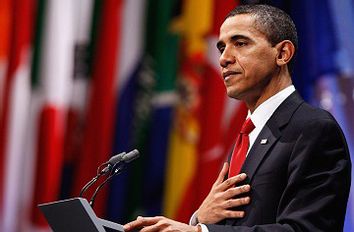
He then lowered his voice: “It is true, as my Italian friend has said, that the crisis began in the U.S. I take responsibility, even if I wasn’t even president at the time.” And he underscored how important it is for him “that we now genuinely make progress. Thank you.” Applause.

The others couldn’t believe their ears. Was that really a confession of guilt from the U.S.? Was it a translation error, or at least an inaccuracy? Afterward, this sentence fueled long discussions among the members of the German delegation. German Chancellor Angela Merkel was so impressed by Obama’s statement that she rushed to tell her finance minister, Peer Steinbrück. Japanese Prime Minister Taro Aso reacted immediately: The proposal to hold the next summit not in Japan, but rather in the U.S., is something that he no longer rejects, he says, “now that the U.S. has shouldered responsibility.”

Obama’s confession may go down in world history as one of the greatest statements ever made. The U.S. president is accepting responsibility for the beginning of one of the worst economic crises of the last century. By doing so, he has admitted that one of the excesses of the American way of life — the insatiable craving for huge profits — has brought the world to the brink of disaster. The others may have played their part, but the origins lie in the U.S. The fact that Obama has now admitted this sends a strong signal of hope to the world, perhaps the strongest to emerge from the G-20 summit in London last Wednesday and Thursday. Such an admission could begin to pave the way toward rectifying the situation.

A number of resolutions were also made in London: Pledges to introduce greater regulation of financial markets, ban tax havens and grant loans for poorer countries. It still won’t be enough to save the world yet. The summit will not help liberate the world’s banks from the burden of billions of dollars’ worth of toxic derivatives. It won’t trigger an economic upswing, and the expectation that it can successfully rein in global financial markets is little more than wishful thinking.

But the conference does signal an important departure from Anglo-Saxon-style turbo capitalism, with its unregulated credit markets, promises of double-digit returns and astronomical bonus payments for managers. It could mark the beginning of more moderate business practices, under the watchful eye of countries with more regulatory muscle.

In the hours immediately preceding the conference, it didn’t look as if the representatives of the world’s leading economic powers would be able to achieve such a result. The host, British Prime Minister Gordon Brown, didn’t think much of firm controls of financial markets, and preferred to boost the economy with new stimulus packages. Obama appeared to share his views.

Over the previous week, though, a united front had gradually emerged on continental Europe. This alliance had existed earlier, but had started to crumble. Germany and France seemed to have drifted apart under Merkel and French President Nicolas Sarkozy.

But after a flurry of phone calls and a number of meetings, they found a joint position on the financial crisis: regulation of the financial markets and no new stimulus packages. It looked like the stage was set for a battle between the continental Europeans and the Anglo-Saxons.

Shortly after Merkel and Sarkozy landed in England on Wednesday, they held a joint press conference. The German chancellor said she was “slightly concerned” that participants at the conference might too easily opt to sweep things under the rug and “not seize the evil by the roots.”

Sarkozy then said that he and Merkel spoke with one voice. He said that he would not leave here “without new regulations.” The French president said that one was either in favor of putting an end to how things had been done or continuing as before. He said that nobody had to lecture Europe on how to forge compromises, but a compromise had to be shared by all the regions of the world, especially since the crisis had clearly not erupted in Europe, “n’est-ce pas?”

All of this sounded fairly confrontational, despite the frequent use of the word “compromise.”

When the world’s most powerful leaders met on Thursday afternoon at the ExCel Conference Centre for the plenary session that concluded the summit, it looked like a deadlock situation. In the middle of the previous night, the preparations of the sherpas — as the negotiators are called — for the final communiqué had come to a standstill. At some point in time, the aides had thrown their hands up in despair. It seemed to them that the differences between the Anglo-Saxon and German-French worlds were simply too great.

As a result, their bosses found no polished texts on the table, only a draft with many gaps and question marks. At an international summit, this counts as a worst-case scenario.

Fighting over each word

Now the full-scale wrangling began. They argued over sentences, phrases and individual words, but in the end these words would be decisive, would dictate a transformation or a continuation of business as usual. Victory or defeat. Triumph or humiliation.

The world was expecting from the heads of state and government an answer to the question of what will happen now that global capitalism has crashed. But there were other expectations as well — national expectations. Everyone here at the table had a reputation to lose on their home turf. In the run-up to this event, they had all told their constituents what they intended to push through here at this table. They knew that people back home were watching carefully to see how they would perform.

Shortly before noon, Merkel had finished pleading her case for regulation of the financial markets. Her red jacket radiated among all the dark suits like a buoy in the sea.

Now it was a question of what positions the other countries would take — a question of determining the top issues at the summit. Obama and Brown had repeatedly said that regulation and tax havens were of secondary importance. Merkel and Sarkozy wanted to give them priority. The previous evening, Merkel’s advisors had estimated that she had a 50-50 chance of pushing through her agenda.

So it was important now to hear from the Chinese leader, the representative of the superpower of the future. Hu Jintao began by saying that he wanted to make some remarks concerning strengthening financial oversight. He said it was “very appropriate to strengthen financial regulation.” There must be external supervision, no self-regulation. He added that an impenetrable barrier should be put up between the conventional banking world and investment banks. “Shadow banks” and hedge funds should be abolished. And he called for an early warning system. Those were clear words. The German chancellor nodded with satisfaction. China had come through.

But this was followed by a bitter setback for the supporters of regulation. Japan’s Prime Minister Aso said that it would be better “not to rush forward with regulations and supervisory plans.” Japan had countered China, as has often been the case in history. The contest remained undecided.

At 12:10 p.m., Brown gave “Nicolas” the floor. Sarkozy at first adopted a decidedly polite tone. “The communiqué is truly outstanding,” said the French president. “We have, and you have, Gordon, done outstanding work. But there remains a problem that we have to face up to. Is there a list of tax havens: yes or no?”

Over the next few hours, the dispute over the list became a symbol for just how serious the world’s most powerful leaders are about creating a world with new, fair rules. It served as a measure of their willingness to initiate reforms.

This list already exists. At least, the OECD has all the data required to publish it at short notice. But until now it has met with political resistance. The list names those countries that get rich at the expense of other countries by doing business with dirty money from tax evaders. Now the question is whether — with the approval of the G-20 — the list should be made public as a modern form of putting someone in the stocks.

Sarkozy needed this list. He had promised the French that he would get it in London, that it was non-negotiable, and that he would leave if his demand wasn’t met.

Of course he was fighting for more — for a new economic model, for more regulation and restrictions. This also included a new, more stringent system of bank supervision, a watertight monitoring of all financial products — but also the fight against tax havens.

Brown had not mentioned the list in his draft version of the communiqué. “We all know that there are tax havens,” the Frenchman informed his British counterpart. And he said that every one of them threatened the global financial system.

Sarkozy worked himself into a fury. Two-thirds of all financial risks, he said, lie dormant in the tax havens — some $1.8 trillion is hidden in the Cayman Islands alone. “These are the countries where there is crime and speculation.” Nobody at this table abides speculation, he said. Why then “shouldn’t we publish the list today? The list exists, of course. That would be an honest approach.”

Then the Netherlands joined sides with those who favor regulation. “I totally agree with what Angela Merkel has said and I would like to support her,” said Prime Minister Jan Peter Balkenende.

This was followed by yet another setback for Merkel and Sarkozy, a blow that came from their own ranks. Czech Prime Minister Mirek Topolánek, who currently holds the rotating presidency of the EU, addressed the conference. He spoke at length against issuing a list. Many countries had announced “that they would now respect the rules,” so such an instrument was no longer required, he said. The German delegation suspects that Luxembourg Prime Minister Jean-Claude Juncker was behind this intervention. After all, his country has a rather murky reputation when it comes to tax matters.

Then Brazil’s President Luiz Inácio Lula da Silva made a small but nasty comment. He presented concrete proposals for who exactly should stand on the list of evil, tax-dodging countries. “I think that Costa Rica, Guatemala, Malaysia, the Philippines and Uruguay should also be condemned,” he said.

Suddenly, the conference resembled a world court. Countries whose names were quite openly mentioned sat in the dock. Prosecutors presented arguments, and lawyers rushed to the defense. And Gordon Brown presided over this world court like a judge.

With a sonorous voice, he tried to keep a tight rein on the debate. At 12:15 p.m., Brown adjourned the first part of the plenary session and invited everyone to eat lunch. The heads of state and government sat at four long tables that were arranged in a square. Now the constellations were smaller and more intimate than in the larger format of the plenary session — now those whose opinion really makes a difference found themselves sitting together over liver paté and vegetable strudel.

At the lunch table, World Bank President Robert Zoellick was asked to give an overview of the crisis. “If I say too much, then tell me and I’ll stop,” said the American, and then he began his dramatic analysis.

“For the first time since 1945, the global economy has shrunk. We expect it to contract by 1.5 percent,” he said. “Infant mortality will also rise. That’s 200,000 babies who will have to die. The situation in developing countries is particularly dire. Today, there have already been massive job losses in Botswana and Sri Lanka. Even growth in China is critical.”

Zoellick noted that the situation continues to be uncertain and that “2009 will be a dangerous year.”

“I can’t sign this”

Alarmed by Zoellick’s comments, the G-20 leaders once again turned their attention to the wording of the final communiqué. Chinese President Hu expressed concern that they might be promising too much. The draft text contained the assertion that the projected $5 trillion in stimulus programs would lead to the creation of 19 million jobs.

“That seems to me to be too optimistic,” Hu said. “Could it be the case that these figures were arrived at simply by assuming a certain ratio of job creation to investment volume?”

Hu’s question went unanswered. Merkel had a question of her own about another figure. “The 4 percent by which economic output is supposed to rise, is that 4 percent of global GDP or 4 percent of growth? We should specify exactly what is meant or we could end up saying something that turns out to be baloney,” she said. Her choice of words was a reminder that world leaders are no less given to plain talking than ordinary citizens in their respective countries.

Brown, who in his function as summit chairman was responsible for formulating the draft text, tried to attribute blame for the lack of clarity to the sources in question, saying the 4 percent was a growth forecast and that the reference to 19 million jobs had come from the International Monetary Fund and wasn’t a calculation his people had made.

“In that case, it has no business being in your text,” someone called out.

“We do occasionally rely on information from other organizations,” Brown replied somewhat defensively.

Indian Prime Minister Manmohan Singh also had doubts about the promise of 19 million new jobs. “If I go home with this figure, people are going to be asking me: ‘How many of these jobs have you created in India?’ And they will want to hold me accountable for the fact that the number of new jobs available in India is continuing to decline.”

This was followed by further comments on the 19 million job figure by the Australian prime minister, the Russian president and the head of the IMF. In a display of Asian wisdom, South Korean President Lee Myung Bak attempted to defuse the debate by saying: “If the economy has become so unpredictable, then economic statistics are likely to be less reliable as well.” He suggested they write 19 million “according to the IMF.” “No forecasts are correct anyway. Economics isn’t like mathematics. One and one isn’t always two. In economics it can sometimes be three or four. One and one can also turn out to be one.”

This kind of talk was starting to make some of those listening to it feel a little dizzy. The exchanges between world leaders were redolent of the kinds of meetings that are held in thousands of companies around the world every day where, as here, people are prone to get hung up on minor details all too easily.

Now, it seemed, only the authority of a superpower would be able to end the debate that continued to rage in reference to the 19 million jobs. Before the meeting Barack Obama had said that he was there to listen, not to lecture. He had kept his word up to that point, but apparently felt things were getting out of hand: “I think we shouldn’t waste too much time on this. If we want to use this number we should add ‘according to economic models’ or name the source.”

Perhaps one should hold off for a while yet on writing the U.S. off as a superpower.

At 2:27 p.m. Gordon Brown announced: “The final version is here.” By that he meant the version of the communiqué in which all the desired changes had been made, at least those that had been discussed up to that point. The delegations then withdrew to consult further before beginning the final round.

Brown opened the meeting by saying that with a little bit of goodwill they could get the job done fairly quickly and asked everyone to be fair and not to make any major changes to the text.

He then started going through the text of the communiqué, reviewing each paragraph where changes had been made.

Brown was just about to call out paragraph 26 when he was interrupted by Argentinean President Cristina Kirchner. “I need to say something here.” She wanted to talk about attempts to grant poorer countries more IMF support through the sale of gold reserves.

Kirchner was upset by last-minute changes that had been made in the text. “The delegations worked on this text for four months and then five minutes ago we get an entirely different text. Making changes in this manner, without discussing things beforehand, isn’t very businesslike. I can’t sign this unless a formal reservation is written into the text.”

Brown was apologetic: “If I had known there was going to be a change in meaning, I would have let the old formulation stand.”

That was the starting bell for a renewed round of haggling. One after the other, the leaders of the world’s 20 most powerful countries presented their pet interests in an attempt to gain a further advantage of some kind for their countries. Italian Prime Minister Silvio Berlusconi was at the head of the line. As is so often the case, his motivation was pure vanity. “In paragraph 24 we have not taken advantage of the opportunity to mention the summit being held in July on La Maddalena,” he complained. Berlusconi was referring to the G-8 summit, which his country will be hosting this summer.

Another person at the table, also known for his vanity, felt he had waited long enough. There was still no reference in the communiqué to Nicolas Sarkozy’s list of tax havens and he took this as an affront. “What’s with the tax havens?” he asked with an element of irritation in his voice. “I won’t be able to agree to this thing if there’s no list. I won’t be able to sign it. I won’t assume political responsibility for it. If there’s no list these are just empty words. It would be a disaster.”

Brown tried to calm him down again, saying that the OECD Secretary-General would be publishing a list that afternoon and adding that he had personally made sure of that just a little while ago.

“But our communiqué needs to make reference to this list,” Sarkozy objected. He was gesticulating wildly and having difficulty staying seated. “A clear connection has to be made between them. Otherwise this is all meaningless.”

Angela Merkel wanted to say something, but was interrupted by President Kirchner of Argentina. The latter wanted to resume talking about her favorite issue, gold reserves. “Cristina, please don’t get angry about this,” Merkel urged. “Our formulation is a success for the poor countries.”

Once again Brown tried to mediate and once again he failed. Kirchner refused to stop. Finally, the British prime minister tried to take command of the situation by exerting his authority: “I’m the chairman, Cristina.”

This failed to make any impression at all on Kirchner. She kept on talking. “What Merkel is saying makes it sound like I don’t want to help the African countries. If that’s the way it came across I apologize. What I’m getting at here is the way things are being done. Changes are being made at the last minute. We can’t operate this way. And by the way,” she said, looking at Merkel, “I’m not angry at anyone.”

Before the dispute between the two women could escalate further, Sarkozy started up again about his list: “I can’t tolerate the fact that tax havens are riding roughshod over our principles. There can’t be an agreement here unless this matter is addressed. I don’t want to be unpleasant about this, but it is clear that we are at a historical crossroads here. This is a time for a decision. We need to say who is honest and who is dishonest.”

Brown again tried to calm him down by saying, “Nicolas, keep in mind what it was that we agreed on here. The era of banking secrecy is over. I’ll see to it that this list is published before you hold your press conference.”

“But then what would be so bad about writing that into our communiqué?” Sarkozy asked. “If there are ulterior motives of some kind here then we should say so openly.”

“I think there’s a misunderstanding here,” Brown said. “It’s not us, it’s the OECD who’s publishing the list.”

Sarkozy hung on doggedly: “Then just one short sentence: ‘The G-20 welcome the fact that the OECD is publishing the list.’”

“Couldn’t the solution be that we write into the annex that we welcome the fact that they published a list,” Merkel suggested. “That way it wouldn’t be in the main document, but it would be included somewhere.”

Berlusconi chimed in at this point: “I’m with Angela and Nicolas on this. It won’t look good if we don’t make reference to the list. The media in my country will be hugely impressed if we do.”

Sarkozy finally leaned back and relaxed. He had received the additional backing he needed and managed to get what he wanted. Brown proposed that they agree on the following formulation: “We note that the OECD has today published a list of countries assessed by the Global Forum against the international standard for exchange of tax information.” After that there were no further objections.

Whether or not the final communiqué is, in the end, an effective document — one that will help get the financial world back on its feet again — will depend on each and every one of the G-20 countries and the extent to which they feel committed to implementing the goals agreed on. It is possible that the London summit will be a turning point, but it is by no means certain this will be the case.

But the mere fact that the G-20 leaders were able to arrive at an agreement on the contents of a joint communiqué after weeks of wrangling over principles can certainly be viewed as a success.

In the end, Germany and France gained points. To the disgruntlement of the British, the summit communiqué doesn’t call for further stimulus programs, rather only for billions in funds for the IMF, most of which had already been decided on anyway.

While the promise to put new spending programs in place was expressed rather vaguely, statements regarding financial market controls were more concrete than expected. The G-20 not only approved a comprehensive list of new rules for banks, ratings agencies and hedge funds — they also agreed to create a new international supervisory authority, the Financial Stability Board (FSB), as well as to accept Sarkozy’s list. From now on, that list will include the names of tax havens that are unwilling to cooperate with other countries in efforts to identify tax evaders.

While this is all a step in the right direction, it is far from constituting a final victory over speculation and tax evasion. It will take years before the declarations of intent made in London are implemented in national legislation and it is unlikely the spirit of unity that informed the summit can be sustained over a longer period of time.

And even if these doubts should prove to be unjustified, the London G-20 summit will not really defuse the global economic crisis. The biggest dangers to the global economy weren’t even addressed by the summit. The G-20 leaders paid no attention at all to the fact that bank balance sheets throughout the world continue to be burdened by toxic assets — i.e., mortgage-based securities, now worthless, constituting total risks in the trillions of dollars, and to the problem constituted by deadlocked trade talks.

Since 2001 the international community has been engaged in trade talks known as the Doha development round, aimed at lowering tariffs and farm subsidies in Europe and the United States as well as protecting patents and brand names in Asia. If the countries involved could come to an agreement this would lead to a tremendous spike in international trade that would have the effect of a stimulus package in the current crisis situation.

The London summit failed to agree on a date for concluding the Doha round. The call by experts for the WTO in Geneva to be given a stronger say in these matters wasn’t even put on the agenda for consideration.

Worse than that, the G-20 remained silent on growing imbalances in the global economy. Prior to the crisis consumers and companies in the United States accumulated debts on a gigantic scale. At the same time, countries like Germany, China and Japan showed considerable export surpluses. These imbalances are seen as being contributing causes of the current financial and economic crisis.

But instead of working to reduce existing imbalances, the countries in question seem to be intent on aggravating them further. The United States has created stimulus programs involving hundreds of billions of dollars that will expand an already huge public debt. Germany and China are providing support to their export industries with a view to continuing to achieve export surpluses. If a common strategy is not found soon that can overcome conflicting interests, the result could be new trade wars and currency instabilities.

As such, people in Asia, America and Europe have been left with mixed feelings about the outcome of the London summit. The G-20 leaders managed to avoid an open conflict, but their agreement basically served to deepen existing economic differences. Those of us who witnessed how passionately they squabbled over matters of secondary and tertiary importance have every reason to be skeptical that this situation is going to change any time soon.

It will take a number of further summits and policy shifts on the part of national governments before the G-20 will have earned the right to refer to itself as a global government that is looking to promote the good of the world as a whole. The world we saw in London was a world in transition. It was no longer the old world of nation states, but it was also not yet a new world capable of thinking in harmony.

When the G-20 leaders presented the results of the summit at their national press conferences on Thursday afternoon, they had Barack Obama’s warning words — not to sell the results of the summit short, not to show journalists the discord they want to see, and to display confidence — echoing in their ears.


Translated from the German by Paul Cohen and Larry Fisher.

Inside Myanmar’s violent crackdown

Eyewitness accounts from the uprising led by Buddhist monks, and how the junta silenced the city after days of bloodshed.

  • more
    • All Share Services

It is Friday afternoon in Yangon, the former Burmese capital, and the city of 5 million broods silently under heavy rain clouds. The last clashes between demonstrators and soldiers happened in the morning. In Okkalapa, a slum neighborhood on the city’s eastern outskirts, citizens blocked the path of troops as they attempted to storm yet another Buddhist monastery.

The ruling junta’s security forces are attempting to seal off as many monasteries and temples as possible with barricades and barbed wire to prevent the monks from sparking further demonstrations. The strategy has already succeeded around Burma’s national symbol, the Shwedagon, a giant golden pagoda in downtown Yangon. It shimmers in the soft dawn rays of the tropical sun, silent and completely devoid of people. In the areas surrounding the Shwedagon, where the pagoda rises on a hill surrounded by a tangle of markets and monasteries, barricades block the access roads to Burma’s holiest site. Elite government troops are now positioned behind those barricades.

Curious passersby find themselves facing the soldiers’ Kalashnikov automatic rifles. “Just keep going, for heaven’s sake, and don’t look them in the eye,” one local resident urges. “They shoot without warning.” The soldiers have their steel helmets pulled down deep over their faces, and are all wearing orange-red scarves tied around their shirt collars.

Convoys of four or five trucks at a time constantly patrol the temple district. Young recruits sit on the truck beds, pointing their rifles at people on the streets whenever they feel threatened.

The situation is similar at the Sule Pagoda about two kilometers away, in Yangon’s decaying business district, where heavy iron gates now block the doors to the temple complex’s prayer and congregation rooms.

Soldiers from the government’s elite 77th Brigade — its toughest fighters — are positioned under the trees lining some of the city’s boulevards. A tense calm lasts until 3 p.m., but then the students arrive. Some are wearing the longyi, the traditional sarong worn by men in Burma, and simple rubber sandals, while others wear frayed jeans and sneakers. Buddhist monks, in their red and saffron-yellow robes — who have hitherto dominated the images of the resistance against the military government — are nowhere to be seen.

Yangon still reveals the architectural vestiges of the British Empire in neighborhoods like the one surrounding the Sule Pagoda. Five-story apartment buildings are built of red brick, and yet the plaster is crumbling from their façades, the asphalt on the streets is in need of repair, and heaps of garbage are piled up in the side streets. The shops sell video recorders, television sets and cheap knickknacks, all made in China. The local residents, who are comparatively well-off, stand on their balconies applauding the students.

The students have prepared their strategies well. They appear in groups of 200 demonstrators at a time, advancing toward Anawrahta Street, a bustling commercial strip, where they occupy several intersections at the same time. Then they confront the security forces in their defensive positions around the Sule Pagoda.

A student leader calls out: “Give us freedom! We want democracy!” Residents shout: “Soldiers, don’t shoot at the people!” But the soldiers shoot nonetheless.

The first shots whip through the humid afternoon air around 4 p.m. and the students quickly scatter. They run into the next street, which is named after Aung San, one of Burma’s national heroes and the father of opposition leader Aung San Suu Kyi. Soon they block the next intersection on Aung San Street. A few demonstrators redirect traffic, keeping the street clear to provide the crowd with an escape route from the soldiers’ bullets. The leaders chant, once again: “Give us democracy!” The crowd responds with the same chorus as before: “Soldiers, don’t shoot at the people!” And the soldiers shoot again.

The cycle continues until nightfall. “Now we will come back every day,” says one of the leaders, “unless they shoot us all.”


These eyewitness accounts from Yangon describe the most recent chapter in a struggle that began as a clash between two powers that couldn’t be more asymmetrical: thousands of monks in their colorful robes, walking barefoot or in rubber sandals, armed with the rice bowls they use to beg for alms, facing off against soldiers armed with automatic weapons and tear gas, and police officers wielding clubs and riot shields.

It is a struggle for power in a country full of pagodas and rich in natural resources, one that has been ruled by a succession of military regimes for the last 45 years. The generals have shown few scruples in using deadly force against their own people, a population that has somehow managed to intimidate them at the same time. Two years ago, the ruling junta moved the country’s capital to Naypyidaw, a remote location in the jungle 189 miles north of Yangon, where they believed themselves safe against uprisings.

But now the generals no longer trust even their own regular soldiers. Instead, they are bringing in elite troops who were stationed on the country’s borders to subdue the rebellious monks with beatings and bloodshed. Since these special forces arrived in Yangon, the direct threat to the regime appears to be over, at least temporarily. After surrounding key monasteries in Yangon and the central Burmese city of Mandalay on Thursday, the government declared the areas off limits the next day. Hundreds of monks had already been arrested by then. Eyewitnesses report seeing the soldiers beat some of the monks and drag them from their temples, leaving behind pools of blood in the monks’ ransacked quarters. All remaining monks were placed under house arrest.

“We will fight until we have achieved democracy,” representatives of the All Burma Monks Alliance, an organization established in September, announced. Despite their initial defeat, the Buddhist monks remain resolute.

This week, however, there were no signs of further protests in Yangon. Thousands of heavily armed soldiers patrolled the streets, stopping young men on foot and in cars, searching for cameras that could be used to get photographs and footage to the international media. Barbed wire barricades blocked off Shwedagon Pagoda, with soldiers stationed at the four entrances.

Witnesses in Mandalay told the Associated Press that security forces had arrested dozens of students who had staged a street protest on Sunday. The Democratic Voice of Burma, a Norway-based opposition news organization, estimated that 138 had been killed in the violence and around 6,000 detained.

Burma is a deeply Buddhist country where more than 600,000 monks and tens of thousands of nuns live in monasteries and temples. Every morning they walk from house to house, barefoot and carrying empty rice bowls, begging for alms.

The regime’s thugs made their biggest mistake at the beginning of the protests, on Sept. 5. In an effort to prevent the protests from spreading, they began beating a group of demonstrating monks in the central Burmese city of Pakokku. Shots were fired, and the police arrested the monks, tore off their robes and threw them in jail.

The All Burma Monks Alliance, a previously unknown group, made its voice heard only a few days later, demanding an apology from the police and the release of their fellow monks. What began as a small protest soon spread like wildfire.

Besides the country’s 400,000-strong military, the clergy is the only well-organized force in the country. At first tens of thousands of monks took to the streets in Mandalay, chanting Buddhist sutras and carrying statues of the Buddha and religious pennants. The demonstrations soon shut down the city of Sittwe in western Burma and later the surrounding Rakhine state.

By the time the protests reached Yangon, the Saffron Revolution had turned into a massive protest against Burma’s grim and repressive military junta. By this stage, the monks had expanded on their initial demands of reversing hikes in fuel prices and releasing political prisoners — they began calling for a national dialogue with the opposition pro-democracy movement.

Local residents who lined the monks’ protest routes are accustomed to seeing the clergy play a role in shaping Burmese politics. In the days of the monarchy, in the 19th century, they performed a mediating function between the government and the people, taking up positions on both sides. They would typically defend the king when he reached decisions they saw as necessary but unpopular, such as tax increases, but they would obstruct him if they felt that he was abusing his power. Buddhist monks have consistently been a powerful force in the Burmese state.

But the generals refused to give in. On the day before the bloodbaths began, Religious Affairs Minister Thura Myint Maung knelt before the monks’ leaders and lowered his head to the ground, a gesture of respect for the clergy. But then he declared war on the monks, making it clear that the regime would show no mercy.

Ironically, the monks were not the ones who had begun the protests. Dissidents from an underground group known as the 88 Generation Students, led by men like Ko Ko Gyi, 45, and Min Ko Naing, 44, were behind the initial demonstrations.

As students they led mass protests in 1988 against the military regime, which, with its “Burmese Way to Socialism,” had driven the Southeast Asian country into international isolation and economic chaos since 1962. The generals quashed protest marches on Sept. 18, 1988, in a massacre that claimed at least 3,000 lives, then robbed the opposition leader and later winner of the Nobel Peace Prize Aung San Suu Kyi and her National League for Democracy (NLD) of their election victory. The student leaders were thrown into prison. “It was 16 years of hell,” Gyi said last summer in Yangon. And yet the military never managed to break the two men’s will.

After being released from prison last year, the dissidents established the 88 Generation Students as an informal network and began organizing events such as peaceful prayer meetings in Yangon’s Shwedagon Pagoda and readings and gatherings in other cities.

When the junta raised gasoline prices by 100 percent without warning on Aug. 15, it became a rallying cry for the opposition. Four days later, veterans of the 1988 student protests took to the streets once again in various cities and towns throughout the country, often alone or in groups of only two or three people. Most were arrested immediately. But the Burmese people soon followed suit.

“It was the straw that broke the camel’s back,” says Bertil Lintner, a Swedish expert on Asia and Burma. “The people simply have nothing left to lose. They are hungry, and they have been bled dry.” What makes their hatred of the regime even stronger is constant talk of the junta living in the lap of luxury, squandering public revenue on weapons and senseless prestige projects.

The monks and the pro-democracy activists had long coordinated their activities behind the scenes. The monks would stage the protests while the people would form human chains.

By Saturday, Sept. 15, the military leaders must have realized how serious the situation had become for them. Monks were marching along University Avenue in Yangon. There, in a house with a view of Inya Lake, opposition leader Aung San Suu Kyi, 62, has been under house arrest for more than 11 years.

Suu Kyi had returned to Burma from abroad in 1988, and as the daughter of national hero Aung San, she was soon at the head of the protest movement. In 1990, Suu Kyi led the National League for Democracy in free elections, winning more than 80 percent of the vote. But the junta, which had ordered the massacre in the streets of Yangon in 1988, declared the results invalid.

As the demonstrators marched toward Suu Kyi’s house two weeks ago, it set off a panic in the new jungle capital, Naypyidaw. Would the monks liberate the Nobel Prize winner? On Sunday the junta’s leader, Than Shwe, ordered his family to pack their bags, and early in the week they took a charter flight to Bangkok. That was when the regime began the “extreme action” it had earlier threatened.

The regime brought in its elite troops from the borders. When the troops arrived in Yangon on Tuesday, the government imposed a curfew on the city. Any remaining hopes that the soldiers would shy away from shooting at monks were quickly dashed. On Wednesday, after initial warning shots were fired over the heads of the demonstrators, government troops began shooting directly into the crowds. The dead and injured included a foreign victim, Japanese photographer Kenji Nagai, who was executed by a soldier as he lay on the ground.

The regime launched a propaganda campaign against the protesters at the same time. In an attack on the NLD, the government-run New Light of Myanmar wrote: “Saboteurs from inside and outside the nation and some foreign radio stations, who are jealous of national peace and development, have been making instigative acts through lies to cause internal instability and civil commotion.” The media was quickly filled with the regime’s appeals to the Burmese: “We favor stability,” “We favor peace,” “We oppose unrest and violence.” The government-controlled press was, of course, quick to place blame abroad for the unrest, writing that the BBC and the Voice of America are broadcasting “a sky-full of lies.”

On Thursday afternoon, soldiers combed the Traders Hotel in downtown Yangon for foreign journalists who had sneaked into the country on tourist visas. Telephone lines to other countries were cut off and Internet connections shut down. As night fell over Yangon on Friday and the students ended their protests, the generals seemed to have won the first round.

Nevertheless, the junta is still a long way from winning the fight. “They are extremely hunkered down, delusional, paranoid and probably afraid at the moment about what could possibly happen,” David Mathieson, an expert on Burma with the U.S.-based group Human Rights Watch, told the New York Times.

The country’s military leaders would presumably prefer to persist in their isolation. They have denied an entry visa several times to Ibrahim Gambari, the United Nations special envoy to Burma, in the past, and this time around they were no more willing to let him into the country. It wasn’t until Thursday night that they finally agreed to meet with the U.N. representative.

Since arriving in the country on Saturday, Gambari has been allowed to meet with Suu Kyi, with whom he had a one-hour talk on Sunday, and has also been given an appointment to meet with junta leader Than Shwe on Tuesday. Gambari had originally hoped to meet Than Shwe on Monday, but the regime postponed the meeting, sending Gambari on a government-sponsored trip to the north of the country instead.

The junta’s decision to let Gambari enter the country came in response to collective international outrage, at least among Western nations, over the junta’s attempts to violently suppress the Saffron Revolution. German Chancellor Angela Merkel condemned the government’s use of soldiers, and British Prime Minister Gordon Brown called for tougher sanctions. The United States imposed visa bans on Burmese leaders and froze foreign assets of senior junta members, as far as it could. But little more than a delicate clearing of the throat was heard from Burma’s neighbor to the north, rising global power China.

“We hope that all parties in the Myanmar issue will maintain restraint and appropriately handle the problems that have currently arisen,” Chinese Foreign Ministry spokeswoman Jiang Yu breathed into the microphone, as if Burma had just experienced a minor marital quarrel.

But Beijing’s actions in New York were not nearly as soft-spoken. Last week the Chinese ambassador to the U.N. voted against a proposed Security Council resolution condemning Burma. “We are not supporting the Burmese military, but rather stability,” said a foreign policy advisor to the Communist Party and Burma expert in Beijing, seeking to downplay the embarrassing vote.

China has benefited for many years from the leaden calm that has prevailed in Burma. When the West slapped economic sanctions on Yangon after the 1988 massacre, the Chinese jumped in to fill the void. Relations have blossomed ever since. More than a million immigrants from throughout the People’s Republic have already settled, more or less legally, in Burma.

For the Chinese, Burma is a land of rich prizes, including oil and natural gas, natural resources, and timber. China mines nickel, copper and coal in Burma. According to the nonprofit organization Earthrights International, at least 14 Chinese companies are building hydroelectric power plants in the country. Trade between the two nations approached $1.5 billion last year. Beijing’s state-owned energy groups plan to exploit oil and gas fields off the Burmese coast and have already signed agreements with the junta. Another project in the works calls for the construction of 1,480 miles of oil and gas pipelines from Burma’s western Rakhine state all the way to Kunming, the capital of China’s southern Yunnan province.

Economic ties are already so close that the Chinese yuan is treated as legal tender, in addition to the Burmese currency, the kyat, in the northern border regions. Sections of the old royal capital Mandalay, with their Chinese shops, apartment buildings and shopping centers, could already be mistaken for neighborhoods in a Chinese city. Close to one-third of Mandalay’s residents are believed to be Chinese.

China is also providing Burma’s generals with weapons and materiel. The Burmese have already purchased about $2 billion worth of helicopters, aircraft, artillery guns, warships and tanks from their northern neighbor.

But by generously supporting the Burmese junta, the Chinese risk provoking the anger of the international community. With the Olympics less than a year away, it is not in Beijing’s interest to appear as the protector of an inhumane regime, one whose atrocities are all too reminiscent of the brutal suppression of its own student uprising in Tiananmen Square in 1989. “It’s a problem for us,” officials in Beijing quietly admit.

To head off a potential conflict, the Chinese government facilitated a secret meeting in June between U.S. diplomats and representatives of the junta in Beijing, where the Americans hoped to convince the Burmese to release opposition leader Aung San Suu Kyi. Chinese officials also invited opposition groups to take part in informal talks.

But by the end of last week, Chinese diplomats were not convinced that the monks’ uprising could cause the junta to fall from power. If it does, Beijing said, it “hopes for a smooth transition.” If the generals are driven out after all, said the Communist Party’s foreign policy advisor in Beijing, “we will have no trouble in coming to terms with the lady.”

Of course, this would come at a cost to the Chinese. “If the lady comes to power, the international economic sanctions will be lifted,” the advisor said. “And then we will no longer be without competition in Burma.”


This article has been provided by Der Spiegel through a special arrangement with Salon. For more from Europe’s most-read newsmagazine, please visit Spiegel Online or subscribe to the daily newsletter.

Continue Reading Close