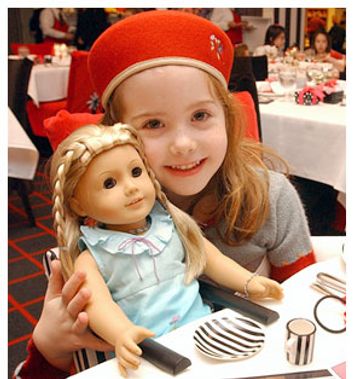
I don’t have anything against dolls, but part of me has always found them a little creepy — their inert perfection, their blinky eyes, the way you find them in odd corners of the house, limbs akimbo, as if dropped from a great height. As a child, I had a Barbie with a frothy black cocktail dress and a Heidi doll I was fond of, though I could never get her hair rigged back up into those cinnamon buns on either side of her head after I’d unbraided it. I was impatient and a klutz, so buttons and bows, especially tiny ones, were a trial. In any case, I was more of a stuffed-animal girl myself, and my daughter, who is five, seems to be one too. She’s had a few baby dolls, which she has graced with peculiar names — Ha-Ha, Pogick — but her interest in them, though warm, is intermittent. They spend most of their time upside down in the toy basket, missing crucial garments, which is why, I suppose, I don’t care much for that genre of children’s story in which toys come to life and bemoan their little masters’ neglect of them.
So it was something of a surprise to me when, about a year ago, I developed a mild obsession with American Girl dolls. I read the catalogs; I read the books. I made a special trip to American Girl Place, the vast doll emporium in New York, where, without my children, I felt like a doll stalker or one of those self-styled hobbyists with a little too much time on her hands. (I kept thinking of a little amusement park we sometimes go to that has an ominous placard forbidding adults to enter unaccompanied by children.) I drifted by the clusters of mothers and grandmothers and little girls in satin-lined winter coats, their noses pressed against glass cases of doll accessories, their expressions sweetly avid. Sales people kept asking pointedly if they could help me.
Could they? I didn’t know. The American Girl story fascinated me partly because of its sheer, almost shocking success. Mostly it fascinated me because of what it seemed to say about American girlhood. Parents I knew with girls on the brink of adolescence seemed anxious to prolong their daughters’ childhoods, and some had specific advice on how to do so. Encourage an interest in horses — that was my sister’s idea. She was certainly relieved that her thirteen-year-old spent most of her afternoons mucking out stables and soaring over jumps rather than, say, IMing trash talk to her friends. Sports, in general, other people recommended — unless they were the kinds of sports that led to extreme dieting. But for more and more families, it seemed, American Girl dolls were the chosen talisman against unwanted precocity.
How odd, when you think of it, that such an idea should exist. Who would have predicted that here in America, at the start of the twenty-first century, girls in high-necked Edwardian dresses, girls in bonnets, girls with labor-intensive chores, would seem so sturdy, competent, and admirable — so much like the girls we hoped our little girls would want to be? But there it is: perhaps the most popular strategy for protecting your young daughter from Britneyhood and Paris Hiltonville, for holding her from the brink of mall-haunting, ‘ho’-dressing tweendom, is to get her interested in American Girl dolls. It is a strategy that involves buying something in order to try and be something: the mother of a girlish girl, an innocent girl, a girl who, at nine or ten, still likes playing with old-fashioned dolls. But then again, there aren’t that many options for parents who don’t wish to succumb to what the toy industry calls “age compression,” or “kids getting older younger” — KGOY, for short. “The girls these days grow up so fast,” a seven-year-old girl’s grandmother explained to Newsday in 2003. The woman and her husband were waiting patiently in line at the opening of American Girl Place in Manhattan. They had already paid about four hundred dollars for Kaya, the Nez Perce American Girl doll and various accessories, but they did not regret it. “These toys,” the woman said, “help them be girls for a little longer.” These toys, she implied, were needed.
American Girl dolls are a very big deal, though if you have sons and no daughters, you may have to take my word for it. But this, in brief, is the story: In 1986, a forty-five-year-old woman with the fateful name Pleasant T. Rowland started a new career as a doll entrepreneur. Rowland had been an elementary school teacher, a TV news reporter, and a textbook author, but in 1984, when she accompanied her husband on a business trip to Colonial Williamsburg, she had something of an epiphany about what she wanted to do next. She loved the material culture of history, the stuff you could touch — the wood, the pewter, the parchment. Rowland wondered whether there was a new way to market this tangible history to children, and she was still wondering when she headed into a toy store that Christmas to buy dolls for her eight- and ten-year-old nieces. She didn’t want Barbie and she wasn’t crazy about the other choices either. “Here I was, in a generation of women at the forefront of redefining women’s roles,” she recalled years later, “and yet our daughters were playing with dolls that celebrated being a teen queen or a mommy.”
Soon Rowland hit on the idea of combining her love of history with her drive to create an uplifting girl culture. She would accomplish her aim by marketing dolls that represented little girls from different periods in American history. Eventually there would be eight of them: Kaya, an “adventurous” Nez Perce girl; Felicity, a “spunky” colonial girl; Josefina, a “hopeful” girl living on a New Mexican rancho in 1824; Kirsten, “a pioneer girl of strength and spirit”; Addy, a “courageous” girl who escapes slavery; Samantha, “a bright, compassionate girl living with her wealthy grandmother in 1904″; Nellie, who is Irish and also “practical and hardworking,” which is just as well, since she was “hired to be a servant in the house next door to Samantha”; Kit, a “clever resourceful girl growing up during America’s Depression”; and Molly, “a lively, loveable schemer and dreamer growing up in 1944.” The dolls would be exceptionally well made — Rowland went all the way to Germany for doll eyes that met her exacting standards for realism — and outfitted in costumes that could pass some sort of muster for historical accuracy without sacrificing any girl appeal. (Nellie, the servant girl, for instance, would not be clad in anything too practical or gray, nor would Addie, the slave, look too disheveled. Their boots, however, would have a lot of buttons.)
Each girl had a book and eventually a series of books that told her story, and each book was sprinkled with historical details: steamboats, breadlines, Victory Gardens. In a sense, all the girls are pretty much the same girl — the historical backdrops change, but the same basic personality type cycles cheerfully through all of them. All American Girls are “plucky,” “spunky,” and mildly adventurous but not overtly rebellious, and they are never misfits. They often have a pesky boy in their lives: a brother or neighbor who annoys them to no end. They are inclined to help the less fortunate, useful to the household economy, talkative without being mouthy, and bright without being egg-headed. Because all the leading characters in the books have a second and more compelling life as dolls (though pleasant enough, the books are not great children’s literature), they must be pretty. Some of the most memorable children’s book heroines are not pretty — though it is understood that they may grow up to be handsome or striking or even, to the discerning eye, beautiful — which is one reason so many generations of awkward, intellectual girls have loved them. Jo in Little Women is famously plain and tomboyish; Meg in A Wrinkle in Time describes herself as “snaggle-toothed,” “myopic,” and “clumsy,” a bespectacled frump in the shadow of her gorgeous mother; even dear Laura in the Little House books compares herself unfavorably to her golden-haired, lady-like sister Mary, who always remembers to save her complexion by wearing her hat. In a freestanding book, a homely or an unkempt heroine is fine. In a book that supplies back story for a doll, it won’t do.
The girls of color — Josefina, Addy, and Kaya — came later, but neither late arrival nor cultural distinctness did anything to alter their essential personality or, in some respects, their appearance. All American Girl dolls are plump-cheeked and sturdy-legged (the dolls look younger — and hence cuddlier — than the girls illustrated in the books), with round eyes and small smiles that reveal precisely two teeth. The catalogs often show girls matched to dolls by race: Addy is snuggled by an African American girl, Josefina by a Hispanic one. But in real life, girls quickly exhibited a happy disregard for such conventions. Kaya, the native American doll, for instance, has entranced girls of various ethnic backgrounds. (She is, after all, a nine-year-old with ready access to fast horses, beaded dresses, and the wide-open plains.)
The concept was, almost from the beginning, a remarkable success. Pleasant Company did not advertise and made its wares available by catalog only, but between September and December of its first year, 1986, it sold $1.7 million worth of products. By 2003 it had sold seven million dolls and eighty-two million books, still without advertising. In 1998 it opened its first store — American Girl Place — in Chicago, which became, in its first year, the top-selling store on Chicago’s prime shopping street. In 2003 it opened a second American Girl Place, on Fifth Avenue in New York. “Place” was a significant word, for both the Chicago and New York stores were meant to be more than stores: they were destinations for families, safe harbors for innocent girlishness and mother-daughter bonding. Each store featured a doll hospital; a hair salon, where, for fifteen dollars, doll tresses could be styled by an adult; a theater with a live, Broadway-meets-Bransonstyle stage show, in which young actresses playing the American Girls belted out original tunes; and a classy black-and-white-and-fuchsia tearoom, where mothers could eat smoked salmonand-cucumber sandwiches with orange fennel butter and daughters could eat grape jelly flag sandwiches, and dolls got “treat seats” of their own. In 1998, Rowland sold the brand that was essentially the anti-Barbie to Mattel, the Barbie maker, for $700 million. And since then, American Girl has done the amazing: it has nearly displaced the venerable, vacant Barbie as the best-selling doll in America.
Ours, it’s clear, is a moment in consumer history when middle-class American parents will spend, pretty much happily, a great deal of money on what they perceive as quality goods for their children, particularly if those goods can be seen as in any way educational. A Samantha starter kit, which includes the doll, a slim paperback book, and a few teensy accessories, sells for $98. Samantha’s cunning little wooden school desk, with its historically accurate wrought-iron legs, costs $68. Her trunk, with its oval mirror and three wee hangers, costs $175. Josefina’s carved wooden chest, in tasteful Santa Fe style, goes for $155. And so on. For many American girls, these are, of course, unimaginable luxuries. At an economically and racially diverse private school where a friend’s daughter goes, American Girl dolls are a dividing line — and an early introduction to class in America — for a group of third-graders. Two of the girls are from families who cannot afford the dolls, let alone the fripperies that go with them. And, lately, these two girls have been getting left out of play dates and playground games, which often center on American Girl fantasies. Ironic, in a way, since these particular girls are from newly arrived immigrant families of modest means, whose life stories are, therefore, classic American Girl. The “Barbie as Halle Berry in Catwoman” doll may come swathed in stereotypes, but at least it has the virtue of being available at your local Target for $14.99.
For middle-class and upper-class families, however, the American Girl brand seems to work in part because it is so expensive. “Few goods are purchased as flat-out status symbols; each one carries a subtle message about its owner and user,” writes Michael Silverstein, the co-author of Trading Up: The New American Luxury, and a great fan of Pleasant Rowland’s vision. “When a mother gives her child an American Girl doll, she is telling the child, ‘I love you and care about your emotional and intellectual development.’” There are easier and less expensive ways, perhaps, to convey such things, but maybe we don’t consider them as surefire, or as likely to please our little girls. Or maybe they require more time and resourcefulness than harried mothers feel they have to give.
But the other reason the American Girl brand succeeds is that it aims to please both mothers and daughters in equal measure. For years, moms with feminist leanings had been complaining about Barbie and her ilk. But previous attempts to sell edutaining alternatives to Barbie — dolls in lab coats, dolls with briefcases — had failed. Sometimes they failed because they were too transparent, too earnest — kids could see that adults were aiming straight for their self-esteem, as zealously as Mormon missionaries. Sometimes they failed because their trappings of empowerment seemed faintly absurd — okay, it’s Barbie, and she still has those torpedo boobs and those pointy little feet that fit only into stilettos, but now she’s a dentist! And the doll Emme, the plus-size model, which came out a few years ago — how literal-minded could you get? Since dolls are role models, the thinking went, a size-twelve doll will help big little girls accept themselves — as though any doll, let alone a doll of a model, could be entrusted with such a task. Even the GetRealGirl dolls, the well-meaning attempt to introduce more “athletic figures,” fell short. “They’re active girls,” crowed a toy website, “who have all kinds of toys and they can kick Barbie’s butt like you wouldn’t believe.” Well, all right! I guess. But the GetRealGirls were still babes — it’s just that they were in the babe mode of today (tanned and toned surfers, snowboarders, and soccer players), not of the 1950s. And, anyway, wouldn’t a girl who loved action sports prefer to be out doing them to playing with dolls?
American Girl dolls set out in a different direction, going backward in time and in age: the American Girls were nine-year-old girls, not happenin’ teenagers or blowzy adults. Parents liked the idea that their girls might be learning history from them. (The company has a new line of contemporary dolls, American Girl Today, but the historical dolls are still the brand’s most distinctive franchise.) And Rowland understood that, for kids, history is in part a fantasy realm, a distant land of eternal dress-up and inscrutable, vigorous chores, such as churning butter and pounding flax seed, a place sufficiently different that it might as well be Oz or Hogwarts. American Girl offered a festive view of history, one that was full of character-building hardship but also of really neat stuff — little lockets and fringed shawls, sun bonnets and bee veils, washstands and split-log school benches, jelly biscuits and rock candy.
Of course, there are sober-minded critics — mostly of the ideological left or right — who fault the dolls and their books for offering too anodyne a view of history. Peter Wood, writing in the conservative National Review a few years ago, chided American Girl for creating “cloying p.c. play worlds.” He particularly loathed Kaya because, he contended, she is shown at “the apex of the Nez Perce culture” to which she belonged, while the other American Girls are shown living through periods of “ethnic oppression and social crisis.” But then, American history pretty much consists of “periods of ethnic oppression and social crisis.” And, besides, the American Revolution and World War II (the backgrounds for Felicity and Molly) are generally considered heroic moments in our history, social crises though they may also be. What did Wood expect — a Kaya doll who works the night shift in a reservation casino?
From the other end of the spectrum, Cynthia Peters, writing in the left-wing Z Magazine, complained that the Pleasant Company’s multiculturalism didn’t go nearly far enough. The Kirsten books ignored the “fact that the pioneer presence in the area, made possible by fraudulent U.S. treaties with the various Ojibwe bands, leads to the displacement of most of the Native people.” Peters is disappointed that Kirsten’s cousin Lisbeth says, the Indians might get angry, but “we need the land, too.” Yet that seems more or less what a pioneer girl in 1854 might say — at least a pioneer girl willing to acknowledge the feelings of native Americans at all, which would already make her slightly ahead of her time. What did Peters expect? That little Lisbeth would run off and join a nineteenth-century version of AIM, shaking her blonde pigtails and denouncing fraudulent treaties all the way? The truth is there is history that evokes, that summons up a brightly colored though flickering and incomplete picture of the past, like a home movie or a dream. And there is history that analyzes and criticizes. History written for eight-year-old girls about their dolls is probably going to do the former. Eventually eight-year-old girls grow up and some of them, with appetites for history piqued by the kind of sunny, commercial culture that some purists disdain, go on to read the critical and analytical kind. When I was a kid in L.A. in the sixties, my family used to go to a restaurant called the Old North Woods. It was meant to be a log cabin, though it was surely made of fiber glass and Sheetrock, and I was utterly taken in by it. I still remember the hurricane lamps on the tables, the waitresses in calico, the peanut shells you were encouraged to throw on the floor — in keeping with some agreeably old-timey, and probably made-up, custom. It was my first intimation that the past could be simultaneously cozy and alien, recondite and inviting — and I loved it.
What the American Girls phenomenon best represents, though, is the fact that fathers and mothers, even if they do not consider themselves social conservatives, want help in keeping at bay certain aspects of the pop culture. And they want help they can buy. “Mothers are tired of the sexualization of little girls,” Pleasant Rowland said in an interview with Fortune magazine. Dolls based on girls of the past are appealing because girls of the past presumably weren’t being pressured to give blow jobs or sending sexually explicit videos of themselves to the guys they liked. Girls of the past weren’t hip-hop like the Flava dolls or diva-esque like the Bratz dolls. They were, or so we are content to imagine, “good girls.” This was a supreme irony: that in an era when feminism had given American girls so many more opportunities to exercise ambition of all kinds, there was still a way in which a girl who was growing in the 1940s or the 1930s or even the 1700s and 1800s could seem less encumbered — freer, if that is the word — to work on the content of her character rather than on the condition of her skin.
In part, of course, this was a simplification, if not a whitewash. The notion that kids, and girls especially, “just grow up too fast today” is a clichi now, and it was probably a clichi in our parents’ time, and in their parent’. It’s too easy to embrace; it dovetails too neatly with the common feeling that each of us has about our own children — that childhood really is a fleeting thing, which is both just as it should be and deeply sad. And it is also a convenient shorthand for expressing a generalized nostalgia, a sense that the world is no longer as we knew it, to its great misfortune and ours. Moreover, to answer the question “Are children growing up faster today?” you first have to ask which children you’re talking about. For child laborers in nineteenth-century mills and factories and, of course, for children born into plantation slavery, childish innocence could scarcely have been supplanted any more swiftly and cruelly.
And yet there is some truth tangled in the proverbial longing for a “simpler” time, when a girl, or at least a white, middle-class girl could be a girl, in the bosom of her family, as they say, for just a little longer. For all our precious gains, for all the opening-up of the wider world, for all the possibilities that I would never, ever want to foreclose for my daughter, there is a way in which girls enjoyed a sense of themselves as vitally needed and yet protected by their families that they do not quite have today. In a book called The Essential Daughter: Changing Expectations for Girls at Home, 1797 to the Present, historian Mary Collins argues that although the kind of work that daughters did to help their mothers throughout much of our history — sewing, canning, taking care of brothers and sisters — narrowed their horizons in ways we would never accept today, it also accomplished something good: it imparted competence. And there might be “something in that culture of usefulness,” Collins argues, that is “worth salvaging.” The hale, resourceful, family-minded American Girls are always pitching in — Kit sells eggs door-to-door to help her family make ends meet during the Depression; Kirsten milks cows and catches fish enough to feed “nine hungry people” — and though the emphasis on their can-do helpfulness might seem treacly at times, it’s also a big part of what makes their characters appealing.
Life for American girls of the nineteenth and early twentieth centuries was not characterized by unrelenting oppression, as we used to think, in the early, sometimes smug, days of feminist history. In that sense, the high-spirited American Girls are not necessarily anachronistic. “Little girls lived as unfettered and vigorous an outdoor life as their brothers,” writes Anne Scott McLeod in her essay “The Caddie Woodlawn Syndrome: American Girlhood in the Nineteenth Century.” Indeed, mothers were advised to encourage open-air exercise for their daughters to counteract “artificial habits” and maladies that afflicted genteel girls. “Millions of us lived in small towns where we … had complete freedom of movement on foot, roller skates, and bicycles,” recalled one woman about her early-twentieth-century girlhood. In surveys about toy use taken in the late nineteenth century — yes, apparently there were such things, even then — girls preferred jumping rope, playing tag or hide-and-seek, and bicycling to more sedate pastimes such as playing with dolls or doing embroidery, according to Miriam Formanek-Brunell, the author of Made to Play House: Dolls and the Commercialization of American Girlhood, 18301930. Girls “walked fences, flew kites, belly-bumpered down hills on [their] own sleds.” And, though the American Girl characters aren’t usually intellectual types, the truth is that in the late nineteenth century, middle-class urban girls, at least, did have opportunities to exercise their minds. Many of them attended intellectually rigorous boarding schools, wrote and read constantly, challenged themselves to improve their minds and characters, and led rich interior lives, illuminated by the poetry and novels they cherished. It isn’t really such a stretch, in other words, to make role models out of Victorian girls.
For all that, though, the curatorial meticulousness of the American Girl world can seem a bit oppressive. Silverstein argues that the dolls appeal to middle-class buyers who want something with a pedigree — in this case, the elaborate back story that comes with each of them. But in a way, that’s what is disappointing about this doll world. An American Girl doll comes with so much story, so much baggage, it’s hard to know whether a girl could approach play with an untrammeled imagination — making of the doll whatever she wants. The catalog copy for Kaya’s pretend food is a typical study in detail-oriented pedantry: “Help Kaya gather huckleberries and camas roots in her woven basket — cover it with huckleberry branches to keep all her food safe inside. Later, she can lay everything on a tule mat to dry: her berries, some salmon, and a bowl of mashed cama to make into finger cakes.” (Or maybe you could just put some mud in a cup and call it soup.)
And it might be harder still when a girl’s parents are deeply invested — both emotionally and financially — in a particular kind of child’s play. “When you own dolls and accessories that cost thousands of dollars, you really like to keep it going,” as one mother told a Massachusetts paper, explaining why she had enrolled her daughter in an American Girl doll club whose meetings they attended together. Sometimes, evidently, kids begin to feel a bit encumbered by the particular intensity of adult interest in their hobby. Ten-year-old Talia, writing in for advice from a teenage counselor on a PBS website, described this scenario: “A few years ago, I begged my mom to get me a doll that everyone had,” writes Talia. “Now I never touch it, even though it was very expensive. My mom wants to take me to a place in New York that’s all about the doll: American Girl Place. Since I never play with my doll, I don’t want to waste $500 on a trip there. My mom is all excited about it. Should I go or not?” I don’t blame Talia’s mother — it’s an entrancing world she wants to linger in with her daughter, an elegant and a safe one. And besides, the moment when a daughter relinquishes those dolls is poignant. A few years ago, when I was writing a magazine article about “mean girls,” I sat in on several classes in which twelve- and thirteen-year-old girls were meant to apologize to one another. One girl said she was sorry for having spread it around that her friend still had an American Girl doll. It was apparent that this was somehow worse than saying you still had a Barbie. It was more like saying you cried for your mother every night at sleep-away camp. It was something that could make you hot-faced with embarrassment. It was saying that this was a girl in conspiracy with her mother — or at least her elders — to remain, for a little while longer, a little girl.
Sometimes at night I lie awake and think about how fast time goes with children. For years adults said this to you and you never knew what it meant. And then you had children and the baby time was molasses slow and then it seemed to go faster and faster, and you could imagine far too clearly all the things your children, who are so sweet and full of blooming affection now, wouldn’t want to do in just a few years time — like hug you in public. I see the ridiculousness of brooding about the inevitable and desirable — we want our children to grow up, which means, in part, away from us — not to mention the not-even-here-quite-yet. But there it is. Talia’s mother probably feels something like the same sentiment, and Talia probably senses it.
It’s odd what will draw a child into history, and into history’s particular way of vouchsafing a sense that our world is not the only world. And it’s odd how we can’t know or always plan for the edifying moments. Not long ago, on a trip to Boston, my husband and I and our two children wandered into a very old graveyard. It was a place I’d always liked when I’d lived near it in my early twenties — a quiet place on a hill, with a view of the Boston Harbor, gleaming like a nickel in the sun. We had planned to stop there for a few minutes on our way to get pizza. But our children loved it and wanted to linger. The seven-year-old lay on his stomach in front of a stone and read the inscriptions as though he were cracking a code, which in a way he was. His younger sister traced the words with a long stalk of grass and rubbed her fingers over the little death’s heads with wings that you see in old New England graveyards — not quite angels, something harsher. They asked a lot of questions. What did the skeletons look like? Where were their souls? Where was their skin? Why were African Americans buried in a separate part of the cemetery? Why did people die so young then? What sort of a name was Hephzibah?
Children are like us, but they are not us. That’s the thing we forget sometimes: that their world is in some sense ineffable for us, as passionately as we love them. And in that sense, imagining their inner lives — as immediate as a horse’s in some ways and yet much more mystical than mine — is like imagining history. I can no more remember what it felt like to be four years old or seven, not really, than I can know what it felt like to be a person of the eighteenth or nineteenth century. I have little pictures, just as I do of history — magic lantern slides, backlit, endlessly fascinating, and somehow just beyond my grasp. We’ve all heard that “the past is a foreign country; they do things differently there.” Well, childhood is too. American Girl dolls are one way to visit both those foreign countries, I suppose. But every day my children surprise me with where they want to go, and how they want to get there.
Excerpted from “Because I Said So: 33 Mothers Write About Children, Sex, Men, Aging, Faith, Race & Themselves,” edited by Camille Peri and Kate Moses, former editors of Salon’s Mothers Who Think. Copyright (c) 2005 by HarperCollins. Published by arrangement with HarperCollins Publishers.
The saddest thing I have ever read about Hillary Clinton was the compliment paid her by a young man who saw her give a fund-raising speech in September. The Starr Report had been available to the public for two weeks. The first lady had been touring the country, gamely campaigning on behalf of Democratic congressional candidates for three days. And somewhere along the way, the admiring young man told the New York Times, Hillary Clinton had become “kind of like our American Princess Di.“
It was a silly comparison in a way — poor dead Diana, that Piet` drawn by Keene, and smart, tough, policy-minded Hillary. But you knew what he meant. As different as they were, both women had achieved their greatest popularity in direct proportion to their husbands’ philandering. Cast as the embarrassed but unbowed wife in a tabloid triangle, Hillary won higher favorable ratings from American voters than she ever had when she cast herself as an architect of the nation’s health-care policy or a children’s advocate or even as our working-mother in chief — an immensely influential woman who, just like you and me, had to slip out of the office early to catch her kid’s soccer game. Hillary and Diana were two golden-haired, porcelain-skinned, inscrutably beaming women lashed to the public stage while their husbands were outed as philanderers. The clichid abjection of the woman scorned washed away both their sins — Hillary’s ambition, Diana’s callowness — but for such redemption, Hillary has, in a way, paid a higher price. She was a politician, not a princess, and was supposed to have had less use for the filigreed archetypes of femininity past.
Now Hillary is a political asset again — witness her ability to get out the vote for Democrats in November. But it is a curious thing that she owes this latest transformation less to any policy innovation or vision for the future than to the rather fusty idea that men always cheat (they’re dogs, remember?), women always suffer, and at least Hillary suffers with class. Her new appeal battens on the kind of dumbed-down politics-free version of feminism that animates many a sitcom girls’ night out. The first lady is getting some gushing press these days, but the subtext of, for example, her Vogue photo spread is: See, we thought she was dowdy, but really she’s glamorous; we thought she was a hard-headed politico, but really she’s a crowd-pleasing celebrity.
Yet it would be too easy — and not quite fair — to conclude that Hillary owes her new popularity only to a kind of relief or delight at the spectacle of a powerful woman brought to heel — “humanized,” as the euphemism has it. For what Americans actually said as they were polled and interviewed over and over again about Hillary Clinton’s behavior in the eye of the Monica Lewinsky scandal implied a more complicated take. They rallied to her in part because they reviled Kenneth Starr and hated the idea of impeaching her husband, yet could not quite excuse the president’s behavior either. Advertising their faith in the first lady was a way of protesting Starr’s ham-fisted conflation of the public and private without endorsing Bill Clinton’s recklessness. They liked her because she showed “dignity” and “strength” in the face of betrayal and excruciating exposure. Women employed the feminist language of “choice” — Hillary, they said, “chose” to stay with Clinton — to try to make sense of her rather pre-feminist fealty to the institution of marriage. They refused to believe that Hillary was a “victim,” victim being one of those words so stretched to its limits by identity politics and 12-step culture that many people who might have used it without much thought now feel they must consciously abjure it. (“I don’t buy into this victim stuff,” a 27-year-old investment banker named Betty Hung told the Washington Post. “I tend to think she knows everything that is going on.”) In this sense, they refuted the useful fiction promulgated by the White House that Hillary had not known about her husband’s affair with Lewinsky until his speech to the nation in August. In A U.S. News and World Report poll taken the following month, 49 percent of the respondents said they thought of the Clinton’s marriage as “a practical business and political relationship,” while only 13 percent saw it as “a loving marriage that has its troubles.”
You could see these sentiments as a hopeless mish-mash or as an exquisitely calibrated attitude, but either way, there wasn’t much gloating about uppity women in them. They embraced a double standard — but it wasn’t a double standard for men and women, it was a double standard for wives and first ladies. In the U.S. News poll, 57 percent of women said they thought Hillary should stay with Bill, but only 36 percent said they would stay with their own partner if he cheated as Bill had. “She may not be behaving as a first wife should behave,” said Myrna Blyth, editor in chief of Ladies Home Journal, “but women believe she is behaving like a first lady should behave — loyal and dignified.”
The truth is that the Di-ification of Hillary is not a litmus test for attitudes toward working mothers or strong wives, not a metaphor for backlash. It owes as much to the peculiar institution of first ladydom as it does to ambivalence about how the rest of us balance our lives. And that institution, with all its whalebone strictures, owes as much to the mediagenic, post-partisan politics of our era as it does to gender roles. This is worth remembering because there are so many people — not least Hillary herself — invested in having us believe otherwise. Throughout her White House tenure, Hillary Clinton has shown a willingness to take the image of the working mother and the baby-boomer feminist down with her. She has repeatedly defended herself against legitimate criticism — of her handling of Whitewater and Travelgate, her role in the health-care debacle — by crying sexism or allowing others to cry it for her. She has called herself a “Rorschach” for attitudes toward working moms, and her defenders have often made much the same point.
“She’s an icon,” people will say of Hillary, perhaps not knowing exactly what they mean — but then there are plenty of partisan types to fill in the content for them. “The attempted character assassination of Hillary,” wrote feminist historian Ruth Rosen in a typical defense of the first lady, “is simply one more battle in the gender wars.” This is by no means an absurd line of argument. We have, in our culture, a kind of underground reservoir of misogyny that can easily be tapped for specific political purposes. This misogyny traffics in certain atavistic images of conniving, emasculating womanhood — Delilahs, harpies, succubi. (Under synonyms for “evil-doer,” my thesaurus contains seven specifically male terms and 18 specifically female ones, including “hellhag,” “hellcat” and the charming-despite-itself “bitch-kitty.”) And so it was no surprise that, during the 1992 presidential campaign, Hillary quickly acquired the sobriquet “the Lady Macbeth of Arkansas.” (The conservative American Spectator magazine seems to have been the first to attach it to her, but it stuck.)
The key to these sorts of insults — what clues you in to their folkloric status, their kinship to the antisemitism of Eastern European villagers or the fear of goblins — is that they are almost always self-contradictory, a panicky catalog of iniquity. Thus, the targeted woman can be both a man-hating lesbian and a sexually insatiable man trap, a rigid ideologue with a single-minded mission and a shape-shifting political machinator. These stereotypes tend to be deployed more often against influential first ladies than against female politicians — perhaps because it is easier to demonize wives in sexual terms and perhaps because Americans have a legitimate discomfort with people who acquire political power through their bedmates. And though they may seem to overlap with a socially conservative agenda, such sentiments do not belong solely to the right. Nancy Reagan — probably the most vilified first lady in postwar history, whatever Hillary’s partisans may say — was denounced as a “dragon lady” by plenty of good liberals, and Rosalynn Carter took a drubbing from feminists for having achieved her influence through marriage. (“You were handed an assignment simply because you were the wife of the president,” reporter Judy Woodruff upbraided Rosalynn when the first lady returned from a political tour of Latin America in 1977. “Isn’t that kind of a setback for the women’s movement?”) And the fact that fears of female power persist and sometimes take political form does not mean that they represent mainstream political opinion or even the well-considered opinion of social conservatives. Such misogyny is at once deeper and less efficacious than it might appear.
Surely when we consider what it is that has cut Hillary Clinton down to size, what has helped to make her more beloved as a first-wives club kind of gal-pal than in any of her more ambitious or unorthodox guises, we have to think about first ladydom itself. The rise of the presidential couple is a recent phenomenon and not one to be taken for granted. Before the mid-20th century, first ladies were certainly written and gossiped about, but they were not seen as politically necessary adjuncts to their husbands. The occasional widower or bachelor (Thomas Jefferson, Martin van Buren, James Buchanan) could make it to the White House; it’s almost impossible to imagine a man without a wife, and preferably a display-quality wife, doing so today. In the 19th century, the first lady’s chief duty was to serve as the White House hostess — a mandate whose limited scope is apparent in the fact that an unmarried sister or daughter could just as easily do the honors when a wife was absent or invalided. Elizabeth Monroe suffered from one of those unspecified 19th century ailments that kept her confined to her bed much of the time, so her daughter Eliza often filled in for her. The press grumbled and made unflattering comparisons to the vivacious Dolly Madison, but there were no political consequences for Monroe.
Eleanor Roosevelt was the first presidential wife to reimagine the role from the inside, using her status as Franklin’s “eyes and ears” to carve out an independent mission for herself as a crusader for the poor and the downtrodden. But it was pressure from the outside — most of all from the rise of the mass media and celebrity culture — that transformed the first lady into a necessary campaign asset and the first family into a marketable commodity. Harry Truman was the first president to make a practice of incorporating his wife and child into campaign appearances. In 1948, on a whistle-stop tour of the United States, he took to bringing Bess and their daughter Margaret out on the rear of the train with the introduction “Howja like to meet my family?” The matronly and retiring Bess was “the boss,” the more glamorous Margaret was the “boss’s boss.” It was a calculated joke — the humor and the safety of it lay in the fact that Bess could in no real way be construed as “the boss” and the calculation lay in the fact that calling her “the boss” implied that Truman had a civilizing, feminine influence at home, a renewable source of Midwestern moral uplift. Neither woman ever spoke, but Bess perfected the glazed convention-hall smile of the candidate’s wife — trained first and most intensely on the husband and only then on his cheering supporters. (As Germaine Greer points out, “the gaze” tells us the wife is there for him, “miming” a subservience and self-abnegation she may or may not feel, while he is there only for us: “He may place a hand on her waist or shoulder but, though her eyes must be turned to him, his eyes must be turned to the public.”) The “Truman Ladies” soon became “a presidential trademark,” essential to the president’s appeal, Newsweek concluded, and there was no retreat to anonymity or independence for first ladies after that.
“Today, spouses often do what political parties once did, helping to define the country’s leader in an accessible, standard shorthand,” writes historian Gil Troy in a penetrating book called “Affairs of State: The Rise and Rejection of the Presidential Couple since World War II.” “As partisan identity declined, presidents instinctively offered up their wives to help forge ties with millions of voters in this mass democracy. As a result, modern presidential couples have been pressured more intensively than ever to embody an ideal” — of the deferential helpmeet with no career other than her husband’s to tend, the grateful and wholesome and attractive children — “at a time when this same ideal has been both repudiated and revered.”
Americans want what Troy calls “joint image-making” from the president and his wife, but they don’t want joint governing; they don’t want a co-presidency. And while there may be a tincture of sexism in that attitude, the more important element is the recognition that it is undemocratic to cede political power to a consort we have neither elected nor provided a role for in the Constitution. Indeed, it’s not so hard to imagine a female president whose ambitious husband, having been asked to give up his own career and privacy in order to smile for her on the dais, might then feel entitled to some portion of real power. And it’s not hard to imagine that voters would feel just as chagrined. The tension between the extraordinary demand for visibility that modern campaigns place on spouses and the expectation that spouses will not set themselves up as co-presidents has produced an unsustainable bind. And it has made first ladies, as Troy writes, into “prime political targets, attacked, ridiculed and grilled about their childhoods, their child rearing, their marriages, their fashions and their philosophies. It is a thankless task. Often, it seems that a first lady cannot do anything right: Nancy Reagan was too trendy; Barbara Bush too frumpy; Rosalynn Carter was too powerful; Pat Nixon too passive; Betty Ford was too outspoken; Bess Truman too discreet.”
But then there are so many pitfalls built into the modern notion of a presidential couple. Long before second-wave feminism adopted it as a slogan, postwar politicians and their handlers decided that the personal was political. But now that we live at a time when “personal” is more and more elastically defined, when a ravenous media and a cultural premium on lurid confession has left us with only the wispiest notions of discretion, the threats to a first lady’s dignity are manifold. It was possible for first ladies of the past to escape being seen through the lens of their husbands’ philandering and so to escape our pity, which is such a dubious gift. Lady Bird Johnson could be regarded primarily as the stolid, sweet-natured mother of two bright daughters and as the author of “beautification” projects (really a cover word for a much more ambitious and successful environmentalism) rather than as the cuckolded wife of a boorish husband. (“Ah’ve had hundreds of women in my life,” LBJ supposedly told visitors to his Texas ranch. “But let me tell you,” he’d say when he got to the master bedroom, “nobody is better in that bed than Lady Bird.”) Hillary has not had that luxury. Though she is not exactly blameless in this regard, either. When she went on “60 Minutes” to talk about the “pain” in her marriage, thereby making a campaign tactic out of therapeutic pseudo-honesty, and when she cited George Bush’s alleged girlfriend by name to a Vanity Fair reporter, thereby violating once and for all one of the unspoken rules of campaign etiquette, she certainly did nothing to protect the principle of privacy.
Popularity is really the only way a first lady’s success is measured, since her various projects — inveighing against drugs or promoting literacy or remodeling the White House — generally have no legislative component. (The underrated Lady Bird offers an exception. She actually did get a bill passed: a restriction on billboards throughout the federal highway system that was strenuously protested by business interests.) What tends to matter disproportionately in assessing a presidential wife’s tenure are all those magazine polls of the 10 or 20 or 100 most-admired women. But the popularity of first ladies is a strange and rather ethereal force; it seems as though it ought to have predictable political consequences, mapped neatly onto recognized political categories, but it doesn’t. Betty Ford, for instance, was an immensely popular presidential spouse, especially with reporters. The chattering classes liked her spacily honest ’70s dysfunctionalism — the time she embarrassed her husband by doing the bump with Tony Orlando at the Republican Convention; the “60 Minutes” interview in which she casually remarked that all her kids had smoked dope and she would have, too, at their age; her frankness about breast cancer and drug addiction and sex with her husband. But her popularity actually hurt Gerald Ford; he looked as though he couldn’t manage a wife who was blossoming, a little floridly, in middle age. Hence the appearance, in 1976, of buttons that read “ELECT BETTY’S HUSBAND.” And while grandmotherly Barbara Bush was the best-liked first lady since Jackie Kennedy — her pledge of apoliticism was her political weapon — affection for her was not enough to get Poppy reelected.
With all this in mind, it becomes possible to see some of Hillary Clinton’s least successful gestures — as well as the high-water mark of her popularity — as the by-products of an absurd role. Not the role of working mother (which is hard but not absurd), but of first lady. Think, for example, of the time (campaign season 1992) when she challenged Barbara Bush to a cookie-baking contest or the interview with Time (campaign season 1996) in which she let it be known that she and the president were talking about having a second child. It was difficult to read such announcements as anything other than cynical attempts to coat herself in the kind of retro domesticity that, like Vaseline on a camera lens, had softened the image of so many previous first ladies. Only with Hillary it was never quite believable. And why should it be? She wasn’t Mamie Eisenhower, who could say that “Ike runs the country, I turn the lamb chops” and not be laughed off the airwaves and whose fondness for pink — pink ribbons in her hair, pink dressing gowns, pink satin sheets — could be plausibly regarded as a matter of taste rather than poll-tested imperative. But when Hillary tried to swim in the other direction — explaining that she was just like any working mother who had to go out on her lunch hour to buy her daughter’s’ birthday invitations and who found the whole balancing act very, very hard — she failed to work the magic of reassurance, either. Because who really wants a first lady who shares all your worries? We want one who understands that we have them, sure — but also one who has transcended them herself (with the help, after all, of a very large staff), so that she can concentrate on her obligations to advise and support the Leader of the Free World. The image Hillary seemed bent on projecting early in the first administration — of, in the words of an Esquire profile, a “bionic” woman who “worries about rug stains in the Lincoln Bedroom, whether to let Chelsea pierce, and reinventing health care,” was, frankly, scary. Please, I thought, don’t let it be true that you are as harried and distracted as the rest of us.
Maybe it really is time, in the name of humane egalitarianism and of reclaiming the personal from the political, to retire the role of first lady as we now conceive of it. No woman of substance should have to perform throughout the long, grueling months of a campaign as so much glorified arm candy. No family should have to serve such a patently political function. Besides, if a president’s personal life is now to be subject to the kind of unrelenting scrutiny we have lately come to expect, then the institution of the presidential couple simply will not hold. The performance of fidelity will not withstand the continual investigation of it.
But most importantly, as Germaine Greer pointed out in a prescient essay about the impossibility of first ladydom, “In a democratic world, mere relationship to an elected officeholder should never be a route to power.” Let unmarried people be considered suitable candidates for high office. Let presidential wives who have had their own careers — and in the future, that will be most of them, even the Republicans — continue to practice those careers as independently as possible while their husbands occupy the White House. And let women with abundant political talent and ambition — women like Hillary Clinton — seek office in their own name and their own right.
Continue Reading
Close
In November 1997, the journal Pediatrics published
the results of a terrifying experiment. Doctors at several
hospitals in Great Britain had decided to covertly videotape 39
parents — most of them mothers — whom medical personnel had begun
to suspect were deliberately bringing their young children to the
brink of death. What they saw astounded them.
In 30 of the 39 cases, the parents were observed intentionally
suffocating their children; in two they were seen attempting to
poison a child; in a third, the mother under surveillance
deliberately broke her 3-month-old daughter’s arm. Many of the
parents seemed as methodical and as brazen, as scoured of fear or
conscience, as any serial killer. “Abuse was inflicted without
provocation and with premeditation, and in some instances,
involved elaborate and plausible lies to explain consequences,”
the study’s authors wrote. “For example, one mother claimed that she
had suffocated her son because of stress related to his crying
and continually waking her from sleep. However, under
surveillance, the mother was seen, with premeditated planning, to
suffocate her infant when he was deeply asleep. The majority of
other cases showed attempted suffocation when the child was
asleep or lying passively on the bed. Children did not appear to
provoke their parents into abusing them.”
The odd thing — the really chilling thing — was that these were
women (and a few men) who masqueraded as good parents, the sort
who rushed their children to the emergency room when they had
trouble breathing, and stood by them with fortitude and devotion
while the doctors puzzled out what was wrong. They were slick,
many of them; they could morph from demonic menace to concerned
mum the minute a doctor or nurse walked in the room. They liked
the social prestige of a mysterious disease; they liked the
proximity to powerful medical professionals; they liked the
attention and the drama — the wail of the sirens, the adrenalin
rush of the ER. And more than that, they seemed to get some
acidy trickle of satisfaction out of terrorizing their children.
“2:02 p.m.,” reads the transcript of the case in which the mother
snapped her daughter’s arm before nurses, alerted to what was
happening on videotape, could stop her. “Mother slaps the
infant’s head. 2:03 p.m.: repeated. 2:09 p.m.: repeated. 2:53
p.m.: The mother tears up the nursing record and throws it out
the window. 2:58 p.m.: The mother swears at the infant, accusing
her of being responsible for them having to remain in the
hospital. There is growing anger with the mother repeatedly
ordering the infant to kiss her. ‘Give me a kiss, you little sod,
give me a kiss. Kiss! Kiss! Kiss! Kiss!’” And so on and on.
With further investigation, it turned out that the 39 patients
under surveillance, ages 1 month to nearly 3 years old, had
41 siblings, and that 12 of those siblings had died suddenly
and unexpectedly.
How could these parents have gone on so long unrecognized for
what they were? How for that matter did others like them get
away with it? Waneta Hoyt, whose five babies were thought to have
died of Sudden Infant Death Syndrome — indeed whose experience was
virtually the entire basis for the influential theory that SIDS
runs in families — and who, in 1995, finally confessed to having
suffocated them herself. Marybeth Tinning, the Schenectady, N.Y., housewife who, over the course of 14 years, just kept
ferrying her kids to the hospital, and collecting flowers at
their funerals, until she was eventually found to have killed
nine of them.
“She was a predator,” journalist Patricia
Pearson writes of Tinning. “Had she been a man, she might have
been a particularly ruthless entrepreneur, an organized criminal,
a serial rapist. But she was a woman, and she located her
well-spring of power in maternity.”
For Pearson, the author of a provocative new book called “When
She was Bad: Violent Women and the Myth of Innocence,” the
mystery of how these women eluded suspicion is really no mystery
at all. It helped that they were accomplished liars. It helped
that medical science had settled on the SIDS-in-families
explanation. It helped that the kind of crimes they committed
were rare (though perhaps less rare than we think; some
researchers now say that 5 to 10 percent of the 3,200 SIDS cases reported
each year in the U.S. should be considered suspicious). But above
all, argues Pearson, these women got away with their crimes for
years because so few of us are willing to acknowledge that women
are as capable of cool and calculating brutality as men are.
“Violence,” Pearson writes, “is still universally considered to be the
province of the male. Violence is masculine. Men are the cause of
it, and women and children are the ones who suffer.” The
conventional wisdom, born of old-fashioned paternalism and
new-fashioned feminist essentialism, holds that when women maim
or kill, they do so only from the cringing posture of a battered
wife or on orders from an unhinged boyfriend. Or, like Jean
Harris, who murdered her diet-doctor boyfriend, or Susan Smith,
who murdered her two little boys, they were really intending to
commit suicide and somehow “found themselves” killing others
instead. Either way, they manage to keep some saving drapery of
innocence and haplessness, even of victimhood.
Pearson’s is in many ways an original book, but it did not emerge
in a vacuum. Over the last few years, criminologists have been
locked in an escalating debate about women’s capacity for
violence. And that debate has in turn been shaped by the
longer-standing confrontation between equality feminists (who
argue, in this context, that a woman can be as power-hungry, as
greedy or as vicious as a man and that female criminals ought to
take responsibility for their crimes) and difference feminists
(who believe that women are gentler, more nurturant, more
virtuous — and as criminals, more easily bullied).
In fact, that’s just the trouble. So infused with ideology has
this debate become that the numbers trotted out by the
increasingly hostile camps have begun to seem muddled at best and
suspect at worst. Are women treated more leniently in sentencing?
The studies are all over the map. Are they just as likely as men
to beat on their spouses? Those who think they are — and that men
are getting a bad rap as the sole perpetrators of domestic
violence — cite the 1980 survey conducted by family violence
scholars Murray Straus, Richard Gelles and Suzanne Steinmetz. In
a random survey of 3,218 American homes, they found that 12
percent of men — and 11.6 percent of women — reported hitting, slapping
or kicking their partners. It’s also true that many counties and
municipalities have reported increases in the number of women
arrested for domestic violence over the last few years. But then
again, these may be due to mandatory arrest laws, which oblige
police officers to collar the wife who hurls a plastic jar of
Jiffy in the general direction of her husband just as surely as
they do the man who smashes his wife’s nose. Battered women’s
advocates seem blind to the idea that some couples taunt and
torment each other with equal gusto and that some men may
actually be the brunt of domestic abuse; adherents of the
women-are-as-thuggish-as-men school seem blind to the fact that
even if a woman slaps first, men are physically able to inflict
more damage. As for the observation that, yes, some women
clearly are capable of mayhem but for whatever reason, women
resort to it far less often than men — suffice it to say that
you’ll wade pretty deep into this debate before you’re likely to
encounter such common sense.
- – - – - – - – - – - – - – - – - – - – - -
“When She was Bad” has much to recommend it — clear and
vigorous prose, an engagingly urgent tone, plenty of reporting.
But it is also, alas, very much an artifact of this rigidly
polemical debate. On the one hand, Pearson details the exploits
of enough female rogues and ghouls and offers enough startling
statistics — 17 percent of American serial killers are women; the
majority of child homicides in the United States are committed by
women — to shake up the most sanctimonious believer in the moral
superiority of females. She is excellent on the subject of the
battered women’s defense, arguing that it has been applied so
loosely that it is in danger of becoming an all-purpose excuse
for female criminals, a denial of women’s free will and moral
agency. She has interesting things to tell us about why it is
that even women who commit the most “male” of crimes — serial
killing or the killing of strangers — don’t seem to frighten us as
much. Aileen Wuornos, the armed robber and sometime hooker who
shot seven of her johns and dumped their bodies in the
Everglades, was the subject of a sympathetic TV movie that
portrayed her as the helpless victim of child abuse. (Imagine,
Pearson asks us, if somebody made a movie about Charles Manson or
John Wayne Gacy, also victims of child abuse, that depicted them
in a mainly pitiable light.) Female killers, as criminologist
Eric Hickey points out, attract monikers that either trivialize
them — “Old Shoebox Annie,” “Giggling Grandma” — or sexualize
them — “Black Widow,” “Beautiful Blonde.” (Compare those to “The
Slasher” or “The Night Stalker” or “Jack the Ripper.”)
“No female serial killer has the mythic force of the classic
predator,” Pearson observes. “We find it impossible to perceive
of them as frightening.” One reason for this, she points out, is
that women who murder more than once are still “place-specific”
killers. They don’t tend to prowl. Like Waneta Hoyt or Marybeth
Tinning, they’re more likely to kill their own children in their
own homes; or, like another of Pearson’s subjects, the matronly
Sacramento landlady who poisoned 11 men and women in her boarding
house, to snuff out the elderly or the sick left in their care.
Yet all of these level-headed observations don’t
necessarily add up to a reliable picture. Since Pearson makes no
reference to overall crime statistics, for example, it would be
easy to come away from this hard-selling book with the impression
that women commit as many violent crimes as men do. A glance at
the FBI’s “Uniform Crime Reports” over the last 10 years shows
otherwise. In 1996, for instance, men accounted for 89.7 percent of the
arrests for murder. In the aggravated assault
category, men accounted for 82.1 percent of all arrests. Indeed, the only offenses for which women’s arrests came
close to men’s were fraud and embezzlement; the only one in which
they actually exceeded men’s was runawayism. Even in the category
of “offenses against family and children” (which includes
desertion and non-support as well as abuse), men outstripped
women, 77.6 percent to 24.6 percent. Whether you regard these proportions as a
good thing or a bad thing, as politically useful or politically
inconvenient for your particular brand of feminism, there they
are, hulking and unequivocal.
At times, “When she Was Bad” sounds like the evil twin of those
early feminist tracts celebrating the suppressed accomplishments
of history’s lost women. We’ve all heard of Jack the Ripper, but
who, Pearson demands, has heard of his female equivalent, the
bloodthirsty Jane Toppan? It’s not exactly boasting, but it could
be mistaken for boasting. (Women can be serial killers, too! And
not only that, but they have a proud feminist heritage! You go,
Grand Guignol girls!) Surely we don’t need to insist on women’s
equality in every sphere, no matter how tortured the argument or
undesirable the sphere, in order to achieve it in most. Go too
far down the road with the equality feminists and you part
company with reality.
Go too far in the other direction, though, and you end up with a
book Like “‘Bad’ Mothers: The Politics of Blame in Twentieth-Century America.” Notice the quotes around bad. Moral judgments –
at least of women — are few and far between in this collection of
essays, whose authors mostly share the conviction that the “bad”
mother is a “social construction” or a punitive stereotype. (As
one essay puts it, “Bad mothers are the ones who get caught.”)
To be fair, feminist historians Molly Ladd-Taylor and Lauri
Umansky do note in their introduction that “some mothers are not
good mothers. No one can deny that. There are women who neglect
their children, abuse them, or fail to provide them with proper
psychological nurturance.” (Yes, and there are women who kill
their children, too.) And you can find several essays here that
make smart and subtle arguments about the ways in which
child-rearing experts and social commentators have pinned the
blame on mothers for everything from autism (refrigerator
mothers) to homosexuality (overprotective mothers) to juvenile
delinquency (working mothers).
But this is also a book that shirks distinctions it ought to have
the gumption or the decency to make. It’s one thing to hold a
mother responsible for her child’s autism — a neurological
disorder over which she could have had no control; it’s quite
another to hold her responsible for using heroin when she’s
pregnant or for failing to protect her child from abuse or
incest. Yet for Ladd-Taylor and Umansky, the latter two examples
are just as sexist and stereotyping as the first.
The truth is that there are times when the myth of female
innocence and the scapegoating of individual mothers not only co-exist, but work in tandem. Doughy-faced, half-pretty Louise
Woodward, the young English nanny accused of shaking to death 9-month-old Matthew Eappen, won both leniency in sentencing and an
astonishing amount of public sympathy in part, it seems, because
she was a woman. (Chalk one up for Pearson’s side.) Meanwhile,
Matthew’s mother, Deborah Eappen, an ophthalmologist who had gone
back to work part time, got hate mail from people who blamed her
for leaving her children in anyone else’s care. (Chalk one up for
Ladd-Taylor and Umansky.) For some people, it seemed possible to
believe simultaneously that Deborah Eappen was a terrible mother
for leaving Matthew with Woodward, and that Woodward was a good
girl who did Matthew no harm. The Woodward case was too late-breaking a story to make it into either of these books, but I
wonder what they would have done with it. Sadly, it seems to
prove them both right.
Continue Reading
Close
It’s 6:30 in the evening and Mary Matalin, Republican operative
and media phenom, has her cowboy boots propped against her desk
and her 2-year-old daughter, Matty, propped against her cowboy
boots. Matty, whose resemblance to James Carville leaves her
paternity in no doubt, wants her denim jacket, now. “No whining,”
says Matalin evenly, and coming from her it sounds like a credo.
Matalin was almost certainly the first Republican woman anyone
ever called hip, and one of the ways she won that label was by
bad-mouthing Democrats in the rhetoric of the tough broad.
Snivelers, she called her opponents when she was political
director of George Bush’s 1992 campaign. Whiners. It was she who
made the world safe for a new crop of self-described “Republican
chicks” — the caustic TV commentator and conservative “It” girl
Laura Ingraham, the gum-snapping Congresswoman-turned-TV anchor
Susan Molinari, the swaggering anti-feminists of the Washington-based Independent Women’s Forum. The Republican chicks haven’t
exactly closed the gender gap (women still vote for Democrats far
more reliably than men do), but that’s not to say they’ve been
insignificant. They have, for instance, contributed mightily to
the cultural re-evaluation of feminists as querulous fuddie-duddies who refuse to buck up and get on with it as the
conservative gals have. And they have jumbled up what might be
called the aesthetic signifiers of conservatism, so that it is
possible now to imagine a Republican woman who is neither a
society matron hosting luncheons in St. John’s knits nor a born-again housewife storming an abortion clinic.
The Republican chicks aren’t always in lock step on the issues.
Molinari and Matalin are pro-choice, for example; Ingraham isn’t.
But they are united by their moony-eyed love for their own
novelty, which they are forever touting, just as Matalin was
forever reassuring young Republicans that they were “way cool.” A
press release for a recent Independent Women’s Forum confab — “No
Left Turn” — made winking reference to the good looks of its
membership, burbling that “this event will definitely lend itself
to photographers since the committee does not look at all like
Phyllis Schlaflys or Barbara Bushes.” For her part, Laura
Ingraham has managed to squeeze more ink out of her penchant for
leopard-wear than Mobuto Sese Seko ever got out of his. One of
the chickhood, former Dan Quayle speech writer Lisa Schiffren,
says a lot of the attention paid it can be attributed to what she
calls the “talking dog thing.” They’re young! They wear
miniskirts! They’re conservatives!
At 43, with her own radio show modeled on her idol Rush
Limbaugh’s, Mary Matalin is the big sister, the head girl, the
top talking dog in this sorority. (It helps, of course, that by
marrying James Carville, her opposite Democratic number, she sort
of cornered the talking dog market once and for all.) She is also
the first to have become a mother, which makes her an interesting
test case for how parenthood will or won’t change the politics
and image of the Republican chick.
OK, first the image: Matalin’s, anyway, is still ecumenically
hip. When I meet up with her in her funky office in a gentrifying
corner of southeast Washington, she has just finished her three-hour daily radio show and is considering whether to join Carville
at the Orioles game that night. Her outfit looks like it was put
together with fun in mind: slim, faded jeans, green brocade vest,
dangly locket, and those boots. Her office is an unintimidating
mess, with a cherry-red jogging stroller taking pride of place
and a desk piled high with hair curlers, half-empty pizza boxes
and press clippings. Matty is rooting around in this tableau,
gurgling to herself and intermittently crowing “Ciao, Baby!” to
various members of Matalin’s staff as they leave for the night.
In some ways, talking with Matalin is like talking with any other
working mother — or at least any working mother of a certain age
and class. There was never any question that Matalin would resume
her career after her daughter was born. “I have a roving mind,
and if it’s not roving in some directed way, it’s going to rove
somewhere else. I can’t just stay in the house.” Besides, she
grew up with a mother who worked — first as a beautician and then
as the proprietor of her own chain of beauty schools on the
south side of Chicago. “It was sort of unique for that time and
place that she had a job. All the other moms in the neighborhood
sort of talked behind her back. But my earliest memory is of
being proud of her, and now when I look back I’m even prouder.”
Sometimes when she’s musing about motherhood, Matalin even sounds
like the hippie she claims to have been, ineluctably rooted in
her generation. “Matty has never slept in a crib,” she says at
one point. “It just felt so much more natural for her to sleep
with us. It hasn’t bothered us; we get done what we need to get
done. And it’s so beautiful to wake up and see her little face
right there.” She wants to have another child and worries that she
won’t be able to because she started so late, but admits that,
like so many in her cohort, she was never interested in kids when
she was younger. “We’d love to have more. We’re trying, but we’ve
had a lot of miscarriages before her and since… I’m not going to
do in vitro and all that stuff. I’m pretty philosophically
steeped in if it’s meant to be it’s meant to be. But you know, all
my friends who’ve had kids are older and they all say that their
biggest regret is that they didn’t have another.”
Yet for all this, it quickly becomes clear that Matalin’s
superficial resemblance to any number of yuppie liberal moms does
not extend as far as her politics. If anything, she says,
motherhood has pushed her further to the right. She’s more
skeptical of government programs than ever and firmly believes,
for example, that the Family and Medical Leave Act — the
centerpiece of the Clinton administration’s anodyne family
policy — should be repealed. (“It’s not working and it’s driving
a lot of businesses crazy,” she claims. “It’s insulting to
businesses to say they wouldn’t already have policies in place
that are helpful to their employees and allow them to keep the
best people. I’ve been a steelworker. I’ve been a cocktail
waitress. I’ve been a hairdresser. I’ve been a political
operative, and I’ve never worked anywhere where the system was set
up to abuse me or to make it difficult for me to attend to a
family emergency.”) She’s more devoted than ever to school
vouchers — an idea she says she used to push mainly for its
campaign appeal and now believes in for its merits. When I ask
her if she thinks there’s anything the federal government can or
should do to make families’ lives better, she says “make our
streets safe.” But then she pauses and says, no, “even that’s not
the federal government’s job; it’s the local government’s.” The
hip Republican moms may change the look of the conservative
movement but, judging by Matalin, they aren’t likely to prod it
much closer to the political center.
Is there any common ground, I ask Matalin, between the pro-family
forces of the left and right? Maybe, she says, in one area: the
growing consensus that divorce is damaging to children and should
be made more difficult to obtain. Even Carville, she says, has
come around on that. She’s right, but truth be told, there are
limits even to that convergence — disputes within the marriage-saving ranks about, for example, whether to push for the repeal
of no-fault divorce laws.
On the way home, I think about what my own proposal for
finding common ground would be. I remember the argument made in a
recent issue of the “Women’s Quarterly,” the newsletter of the
Independent Women’s Forum. “Unfortunately,” wrote editor Danielle
Crittenden, “the feminist women who implored millions of middle-class women to leave their families and homes for the work force
have virtually nothing useful to say about the problems this
exodus created.” The main solution women’s groups have put
forward — state-sponsored day care — is the least attractive, yet
“it has dominated national debate to the extent that measures
which might genuinely help women to combine motherhood and work
seldom get much attention.”
Mainstream feminists could acknowledge the merits of this point
of view — namely that most American women don’t seem to want
government-sponsored institutional child care — and in exchange
the Republican chicks could declare a moratorium on dissing them
for even considering government solutions to family dilemmas.
Mainstreamers could think seriously about adopting the
(Republican) idea of child-care vouchers that could be used to
subsidize your choice of baby sitter — grandma, nanny, neighbor or
child-care center. And Republicans could acknowledge that
repealing the Family and Medical Leave Act is the kind of turn-back-the-clock measure that turns off most female voters, and
rightly so. (Matalin’s solicitude for their feelings
notwithstanding, most businesses can probably take the “insult”
of government-mandated leave policies.)
It’s a modest enough idea, and not especially hip, but hey, Mary,
what do you think?
Continue Reading
Close