Marion Lignana Rosenberg

“Deus lo volt! Chronicle of the Crusades” by Evan S. Connell

A masterly novelist re-creates the medieval campaigns in all their depravity, faith and gore.

Why is it that new centuries and millenniums seem to bring out a thirst for moral certitudes, for struggles to the death between the forces of good and evil? Though such battles today tend to lack the apparently neat ethical demarcations that characterized those of the past, anyone who has switched on a television or scanned the movie pages lately can find ample fare to sate this hunger. Biblical films are pulling in audiences, J.R.R. Tolkien’s “The Lord of the Rings” is getting a luxe (and feverishly anticipated) cinematic treatment and even gladiator flicks seem to be making a comeback — though that phenomenon may reflect a hankering after guys in skirts more than anything else. And what are agents Scully and Mulder of “The X-Files” if not postmodern crusaders who famously “want to believe,” careening about on the assumption that “the truth is out there” — even if it’s a truth tangled in webs of conflicting story lines and fatally compromised by the private obsessions of whoever happens to be pursuing it?

All this comes to mind while perusing Evan S. Connell’s latest undertaking, “Deus lo volt! Chronicle of the Crusades.” (The title is Latin for “God wills it!”) Connell — the author of such masterworks of fiction and nonfiction as “Mrs. Bridge,” “Mr. Bridge” and “Son of the Morning Star” — resists labeling his work a “historical novel,” and indeed, it bears little resemblance to such essentially plot-driven fictions as, say, Richard Zimler’s “The Last Kabbalist of Lisbon” and Tracy Chevalier’s “Girl With a Pearl Earring,” two recent and especially beguiling examples of the genre.

More like Marguerite Yourcenar’s “Memoirs of Hadrian,” “Deus lo volt!” almost spookily reproduces, from within, the particular sensibility — spiritual, cognitive, literary — of a particular moment in history. In this case, the events unfold starting in 1096, when Pope Urban launches the crusades to free Jerusalem from the “infidels,” and are filtered through the mind of one Jean de Joinville, a descendant of the original crusaders, who attempts in the late 13th century, following the fall of Acre, to reconstruct the muddled, labyrinthine course of events. Connell claims to have invented nothing except “the fictional device of Joinville as spokesman,” relying on medieval documents for the anecdotes and exchanges recounted in “Deus lo volt!”

The result is something of a tour de force: a meticulous re-creation of the style and technique of medieval chronicles that speaks powerfully to the contemporary new historicist creed that fictions can be archives — and archives, fiction. That said, “Deus lo volt!” is also one seriously tough read. The Reading Group Guide for the book — available at bookstores or by phoning (800) 242-7737 — includes maps, genealogies and a timeline, which are sure to come in handy for those readers not gifted with a superhuman memory for seemingly countless names, battles, itineraries and intricate, shifting alliances. The book is likewise crammed with material best avoided over one’s morning latte and scone: vanquished fighters being led about by their intestines, roasted on spits and splattered with various manner of bodily effluvia.

The novel, though, rewards those who hang on to the end of its nearly 500 pages with stately prose and lofty, captivating ambition — the positively epic sense of pathos and lyricism, for example, as Acre crumbles under the assaults of Ashraf Khalil:

Houses and markets were looted, burnt, watchtowers dismantled, broken walls left to disintegrate. It is said that people throughout the East grieved over this destruction in plaintive song as they are wont to sing over tombs of their dead, bewailing a grandeur none would see again.

Brimming with accounts of heroism and depravity, faith and fanaticism, supernatural apparitions and all-too-human exploits, “Deus lo volt!” is a lovingly crafted (if challenging) exploration of the religious wars that scarred the Mediterranean early in the last millennium and a bracing and admonitory tale for the one just under way.

“The Dress Lodger” by Sheri Holman

A lurid and literary novel offers a tale of prostitution, cholera and body snatching in 19th century England.

“Clothes make the man,” Mark Twain is thought to have remarked. “Naked people have little or no influence in society.” Twain’s witticism, however penetrating, merely hints at a few of the dense, intertwining issues that Sheri Holman probes in “The Dress Lodger,” her grandly ambitious and luridly fascinating new novel.

Set in the port city of Sunderland, England, during the cholera epidemic of 1831, “The Dress Lodger” weaves a chilling tale of disease and social unrest, following the tangled relationships among an unlikely gathering of characters: Gustine, the “dress lodger,” a young prostitute who rents a lavish blue gown from her pimp to attract a tonier clientele; the Eye, a silent, hideously deformed old woman who guards Gustine’s precious frock; Dr. Henry Chiver, a self-loathing surgeon and anatomy teacher who depends on Gustine to locate corpses for dissection; and Whilky, Gustine’s pimp, for whom the “so-called cholera morbus” and the dreaded practice of dissection are part of the government’s “Grand Plot” to eliminate the poor.

Tying together these and the novel’s other principal characters is Gustine’s infant son, whose swaddling clothes hide a pitiful secret — a sign of damnation for some, of morbid fascination for others and for Gustine, the nexus of all her gritty hope and tenderness. Whilky’s disbelief notwithstanding, cholera snakes its way through the lives of these people, meting out its own grisly parody of justice, its victims blue and convulsed like the azure crimps of the streetwalker’s gown.

One of Holman’s great strengths is her way of combining the novel’s varied thematic strains into a dissonant but weirdly compelling symphony. Nakedness, in her unsentimental view, can denote the innocence of a helpless babe or the most repugnant perversions of sexuality and medical science; clothing can protect or mask, can serve as a vehicle of contagion or of fresh beginnings and protean self-fashioning — as when someone envisions a hopeful future for Gustine, no longer a frilly, filthy whore but “a tidy adolescent girl in an indigo frock, her hair smoothed back into a demure knot at the back of her neck, her white nurse’s apron tied in a perfect bow in the back.”


While the blurbs and early reviews have emphasized the novel’s Dickensian overtones, its roots dig deeper into literary history, weaving their way around the paradoxes of Milton’s “naked beauty more adorn’d,” the bitter paeans to labor and impassioned apostrophes of Virgil’s “Eclogues” and “Georgics” and the cosmic despair of Genesis and Job. If these antecedents suggest a ponderous or didactic read, think again: Compulsively fascinating, the novel draws the reader through the alleys and quays of Sunderland with all the practiced charm of its title character. Holman’s vivid prose slithers and whispers like the sumptuous folds of Gustine’s silk dress:

Some nights, Gustine feels like she’s unraveling behind her, leaving a thin blue trail along the ground to mark where she’s been. Sometimes when she lets her mind wander, she feels the thread drag along the gutters, snagging dead rats and bottles, chicken feathers and broken furniture. She feels the tangled thread grow heavier and heavier, tugging her back, making her strain to drag it.

Dense and absorbing, “The Dress Lodger” wraps up a bit too neatly, the visionary strains of its final pages striking a jarring (though richly ambiguous) tone. With its stark depictions of human innards and industrial squalor, Holman’s novel is not for the faint of heart. Hardier readers, though, are likely to welcome its fearless scrutiny of what the English poet Edward Young called “that hideous sight — a naked human heart.”

Continue Reading Close

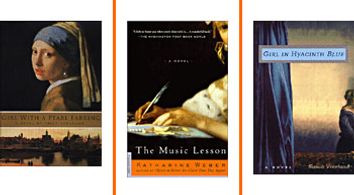
“Girl With a Pearl Earring” by Tracy Chevalier, “The Music Lesson” by Katharine Weber and “Girl in Hyacinth Blue” by Susan Vreeland

Three recent novels shimmer with the sensuousness of Vermeer, the painter who inspired them.

It is the peculiar genius of the Dutch to seem, at the same time, familiar and incomprehensible,” Simon Schama wrote in “The Embarrassment of Riches,” his cornucopia-like 1987 study of Holland’s Golden Age. And it is precisely the uncanny quality of Johannes Vermeer’s paintings — their arresting, prosaic sensuousness combined with what one scholar has called their “spectral sense of mood” — that permeates three wonderful recent novels: Tracy Chevalier’s “Girl With a Pearl Earring,” Katharine Weber’s “The Music Lesson” and Susan Vreeland’s “Girl in Hyacinth Blue.” They join the new Louis Andriessen/Peter Greenaway opera “Writing to Vermeer” (due to travel to New York from Amsterdam this summer) as the latest fruits of the Vermeer mania that seems to have gripped the world since the 1995 mega-show of the artist’s works in Washington and the Hague.

Griet, the title character of Chevalier’s “Girl With a Pearl Earring,” puts her finger on Vermeer’s uniqueness as she mentally defends his latest work against the envious sniping of her father, a former tile painter. “It may not have told a story,” she reflects, “but it was still a painting you could not stop looking at.” Chevalier’s novel is the newest of the three and the only one that treats the artist’s life and times (he lived from 1632 to 1675) at length; and it is a wondrous, enthralling piece of work, told through the eyes of a 16-year-old girl who goes to work as a maid in Vermeer’s household after her father is blinded in a kiln explosion.

Like Vermeer’s paintings, “Girl with a Pearl Earring” is deceptively simple, its events recounted in a matter-of-fact language that belies the novel’s immense ambition and sophistication. Its narration, after all, enacts a hoch feminist maneuver: relating a monumental event (in this case, the genesis of one of Vermeer’s most unsettling masterpieces) from the perspective of a “marginal” participant (a woman, of course — here, Vermeer’s poor, reluctant model), thereby rewriting history from the point of view of the voiceless and oppressed.

But whatever its agenda, Chevalier’s novel sings with the freshness and the thoroughly intoxicating sense of a specific time, place and personality that I have encountered in only one other recent novel: Diane Johnson’s “Le Divorce,” a very different first-person account of a young woman’s rite of passage far from home. In Griet’s case, the physical distance is not so great, but the cultural and psychological gulfs are daunting. She has been uprooted from Delft’s Rietveld Canal to “Papists’ Corner” in the city’s Oude Langendijck, and from an industrious, salt-of-the-earth Protestant family to Vermeer’s chaotic Catholic household, teeming with children, burdened with debts and soured by the malice of Catharina, the painter’s dull but beautiful wife, and of their vindictive little daughter Cornelia. Stealth and jealousy seem as palpable here as the honeyed light in the master’s paintings; so do the prerogatives of prestige and class.

Complicating things further is the favor the painter shows Griet from their very first meeting in her family’s kitchen, when he admires her artful arrangement of cut vegetables for the daily soup. Griet eventually earns the unheard-of privilege of working at the artist’s side and mixing his colors, and she reluctantly models for him, wearing his wife’s pearl earrings, after a wealthy patron takes a fancy to her. Here again, Chevalier considers the reality of a young woman’s life in 17th century Delft from a modern perspective, though without disturbing the almost claustrophobic illusion of authenticity she so meticulously crafts. The rapacious male gaze permeates the novel no less than the spite of women, and it settles Griet’s fate, as in her first meeting with her future husband: “His eyes came to rest on me like a butterfly on a flower and I could not keep from blushing  As I turned to go I caught the glance that passed between father and son. Even then I knew somehow what it meant, and what it would mean for me.”

Lecherous fishermen, philandering burghers, even Vermeer himself, kindly but remote — ultimately they shatter Griet’s sense of innocence. Van Leeuwenhoek, her master’s patron, warns her:

“Take care to remain yourself.”

I lifted my chin to him. “To remain a maid, sir?”

“That is not what I mean. The women in his paintings — he traps them in his world. You can get lost there.”

Shattered innocence also permeates Katharine Weber’s “The Music Lesson,” whose protagonist, art historian Patricia Dolan, comes at the end to a devastating realization: “I am an idiot. A naive idiot.” In her early 40s, divorced following the accidental death of her young daughter, Patricia goes numbly through the motions as a research librarian at the Frick Collection until the arrival of her 25-year-old Irish cousin, Mickey, with whom she falls madly, obsessively in love.

Less obviously “about” Vermeer than Chevalier’s novel, “The Music Lesson” takes the form of Patricia’s diary entries after Mickey seduces her into his plot to ransom a Vermeer on behalf of an IRA splinter group. They settle on a choice painting from “Betty Windsor’s” collection, whose theft and smuggling Weber conveys in tense, breathtaking detail. Violence and treachery inevitably emerge, with Patricia feeling “deeply sick, hot, cold,” at each revelation of duplicity. “Betrayal,” she announces, “is a body blow to the soul.”

Superbly stylish (Weber has an extraordinary ear for the varied cadences of Irish speech, and her writing about sex is refreshingly non-trivial and to the point), “The Music Lesson” is nonetheless a touch more didactic than “Girl With a Pearl Earring,” laden as it is with quotations from Walter Benjamin and snippets of mass-market psychologizing: “Mickey was someone I had invented for my own needs … He had invented me to suit himself.” Yet it, too, addresses the vexing issues that simmer beneath the surface of beloved creations of the imagination, whether on wood panels or in flesh, with intelligence and panache.

Susan Vreeland’s lovely “Girl in Hyacinth Blue” brings together an even more artfully constructed narrative — a kind of Chinese box unfolding from the contemporary hiding-place of a painting attributed to Vermeer all the way back to the moment the work was conceived — with subject matter that is, for the most part, achingly humble and quotidian. The novel starts off on a lofty note, with university professors debating issues of penance and redemption, and the confession of a former Nazi on his deathbed: “I only joined because of the opportunity to make lifelong friendships with people on the rise.” Here, too, issues of lust and possession come to the fore, as the painting’s owner furtively caresses his prize: “He stroked her neck and was surprised he could not grasp the tie string hanging from her cap. And then her shoulder, and he was astonished he could not feel its roundness …”

The further back the narrative travels in time, the more simply human the issues under examination become — and the more intricate the thematic counterpoint as the painting is variously bartered, stolen or given away. There are heartbreaking stories of a Jewish family in occupied Amsterdam, sacrificing their much-loved carrier pigeons and celebrating their last Passover together, and of a wild young woman burned as a witch in 18th century Delfzijl, her baby abandoned to the mercy of a poor but respectable family. The novel ends as Vermeer’s daughter Magdalena returns home following an auction of her father’s work, Vreeland’s prose mirroring the shimmering, mesmerizing depth of the master’s canvases:

She walked away slowly along a wet stone wall that shone iridescent, and the wetness of the street reflected back the blue of her best dress. Water spots appeared fast, turning the cerulean to deep ultramarine, Father’s favorite blue. Light rain pricked the charcoal green canal water into delicate, dark lace, and she wondered if it had ever been painted just that way, or if the life of something as inconsequential as a water drop could be arrested and given to the world in painting, or if the world would care.

Magdalena thinks back to her portrait in the auction: “People … would be that close to her … a matter of a few arms’ lengths, looking, looking, and they would never know her.” Just as Vermeer’s paintings speak so powerfully, nearly four centuries after their creation, of the mysteries of character and time and of the trifling details that make up a life, so do these three novels, haunted by the artist’s ghostly presence, trouble the soul and engage the mind.

Continue Reading Close

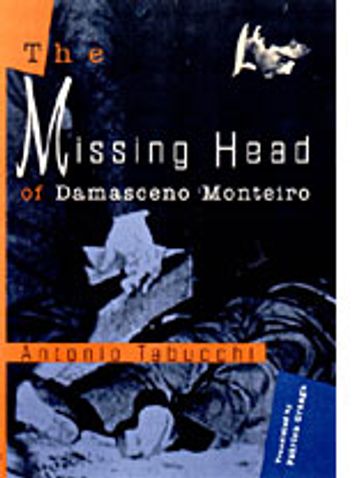
“The Missing Head of Damasceno Monteiro” by Antonio Tabucchi

A mystery of corruption, drug trafficking and decapitation by the Italian novelist.

What does it mean to be against death?”

A heady question, that, and not the kind you would expect to find at the
climax of a murder mystery. But Antonio Tabucchi’s “The Missing Head of
Damasceno Monteiro” is not your typical murder mystery. In fact, it’s
not much of a mystery at all. Starting with the discovery of a headless
corpse near a gypsy camp, its plot, which centers on drug trafficking
and state corruption in contemporary Portugal, unravels with surprising
ease and inevitability; most of the puzzle pieces are simply handed to
Firmino, the young journalist who chronicles the novel’s events, by a
series of remarkably obliging witnesses.

No, enigmas of an altogether more vexing type permeate this brainy
page turner. Like the Italian novelist’s much admired href="/sneaks/sneakpeeks960514.html">“Pereira Declares” (1994), “The
Missing Head of Damasceno Monteiro” pits a motley crew of bohemian
characters — intellectuals, transvestites, members of the economic
underclass, as well as actual Gypsies — against apologists for “military
valor, devotion to the flag, lofty patriotism, the defense of true
values, the struggle against crime [and] perfect trust in the State and
Nation.”

If the background has changed — the seaport city of Oporto instead of
Lisbon, neo-liberal democracy instead of the Salazar regime — the
underlying moral rot remains the same, and the people on the margins,
like victims of some Kafkaesque machine, bear the consequences of
official abuse and neglect in their flesh. Manolo the Gypsy, for
example, once a proud craftsman, must now pick his way through lots
littered with condoms and syringes to attend to his humblest needs; and
Damasceno Monteiro himself, a hapless devil who steals a cache of heroin
meant for a more powerfully connected dealer, pays for his
miscalculation with torture, death and decapitation with an electric
carving knife.

Kafka, in fact, is invoked repeatedly in this novel, as are Lukacs,
Camus and Austrian legal philosopher Hans Kelsen, whose theory of the
“basic norm” the lawyer for the Monteiro family accuses of concealing a
“vampire,” ungeheuer (monstrous) like the vermin in “The
Metamorphosis.” It’s all a bit much at times and may well prove baffling
to readers who aren’t conversant with Continental philosophy.
Fortunately, Tabucchi’s lush and evocative prose also conjures up a
vivid sense of old town Oporto’s sweltering, labyrinthine streets and
paints mouthwatering pictures of the local cuisine, such as tripe ` la mode
d’Oporto
and rice with red beans and fried bass, described
in loving, lingering detail.

And Tabucchi often manages to make his points through less abstruse and
didactic means — the lurid dispatches Firmino dutifully grinds out for
his scandal sheet, O Acontecimento (whose motto is “What every citizen
needs to know”), and wryly surreal exchanges such as this one between
Firmino and a waiter on a late-night train whose stock has run dry:

“So what’s to be done?” asked Firmino.
“You
cannot stay here without ordering something,” repeated the waiter, “but
you cannot order anything.”
“I don’t follow the logic,”
retorted Firmino.
“It’s Company regulations,” explained the
waiter placidly.

Though sometimes preachy, “The Missing Head of Damasceno Monteiro” is a
gripping read: Lithe, elegantly plotted and, with its unblinking
scrutiny of the measures deployed against “people aiming to subvert our
culture,” disconcertingly timely for readers on both sides of the
Atlantic. Patrick Creagh’s translation is on the clunky side, far from
the apparent artlessness of the original. Still, “The Missing Head of
Damasceno Monteiro” is a bracing, clearheaded look at the not-so-inextricable
crimes that are passed off as justice in our supposedly
evolved, transparent democracies.

Continue Reading Close

“Sugar and Rum”

Barry Unsworth guides the reader through the dark places of depression -- hilariously.

“My life seems to have lost all direction,” remarks Clive Benson, the 60-ish novelist and protagonist of Barry Unsworth’s 1990 “Sugar and Rum,” just issued in the United States. “I am not aware of any operation of the will, any progression. One minute I might be sitting down, the next I am standing or walking. There is no sense in my mind of an interval between those two states, no moment of purpose or decision.”

Unsworth’s book is a journey through the dark, claustrophobic places of depression, both personal and economic, as well as a dazzlingly ambitious work of fiction. Set in a Liverpool festering under the Thatcher regime, it conveys Benson’s misadventures as he struggles with writer’s block and ministers to his “fictioneers,” the ragtag assortment of aspiring authors whose manuscripts he critiques to eke out a living.

The fictioneers’ prose and Benson’s glosses deliver consistent belly laughs, as when Sheila and Albert, the perennially frustrated lovers of Mr. Carter’s opus, finally copulate: “She eased the implement of his power into the deepest fronded recess of her being.” “There was a disturbing touch of the Black and Decker in the description of Albert’s member,” Benson muses. The varied fragments of student narrative, though, along with Benson’s own scrapbooks and his unfinished novel on the Liverpool slave trade, also form a daring, sophisticated counterpoint to his restless meanderings through the city streets and alleys and his quest for “a thread, a pattern of meaning” in the “sickening welter” of words, memories and events on which he ruminates — a quest that culminates in encounters with two fellow Second World War veterans of the harrowing Anzio campaign, one a homeless drunk, the other a pompous, socially ambitious leech.

It’s an undertaking worthy of Italo Calvino in its dizzying layers of inter- and intratextual references. Though Unsworth lacks the Italian master’s deftness, you can’t help admiring his command of this intricate material and his graceful, evocative way with what his hero refers to as “the mildewed Logos”: “Benson swept the glasses slowly through a world that was arbitrary and intense, disconnected, vivid green of the lawn, deep blue glow of the canvas, glittering sections of the lake, woods a depthless tangle of sunlight and leaf.” Just as remarkable is the way that silence permeates this story of wordy undertakings and characters. Much of the dialogue is, in fact, monologue, either uttered by Benson to dazed vagrants during his nightly wanderings or exchanged by him with impossibly defensive interlocutors — his students, for example, and the political zealot he is courting.

Readers will have to decide for themselves whether the novel’s breathless, surreal conclusion amid riots and terrorism doesn’t tie things up rather too neatly, and whether the continual winking at cultural icons — a would-be muse named Alma, the Tolkienesque subdivisions “Signs and Portents,” “Middle Passage” and “Reunions” — isn’t finally cloying. Still, “Sugar and Rum” is a rewarding meditation on literature, with its limits and consolations, and its shifting, elusive interplay with the obscure, disreputable places of the body politic and the human heart.

Continue Reading Close
www.salon.com/writer/marion_lignana_rosenberg/index.html