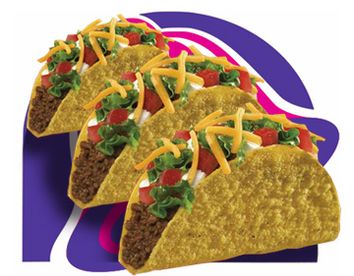
I’m having a señor moment. Dinner tonight is the unthinkable: a Taco Bell Original Taco and Burrito Supreme, abominations that haven’t profaned this chowhound’s palate since I was a kid in Southern California, birthplace of fast food. I’m committing this foodie felony partly because I’m à la recherche du whatever: the goldenrod-and-avocado-colored memories of my ’60s-’70s youth, when dinner out, more often than not, meant Taco Bell.
Growing up white and middle-class in San Diego in those days meant that “cultural hybridity,” as the postmodernists like to call it, was my birthright: Mexicans might have been “wetbacks” and “beaners,” but our shared historical (sometimes literal) genes, reaffirmed on school trips to the region’s Spanish missions, meant that Mexican food was “our” food.
Somehow, Taco Bell outlets felt like home, in an Alta California, Helen Hunt Jackson, wrought-iron-lantern kind of way. Their cute little mission-style facades, scaled down to Disneyland proportions and topped by a hole-in-the-wall-style belfry, complete with fiberglass bell, felt cozily familiar to Southern Californians like me. The Old California vibe was enhanced by trash cans shaped like saguaro cactuses and gas-jet fire pits (an inexhaustible source of entertainment for junior pyromaniacs, in that dark age before iPod and Gameboy). Sure, the theme-parked architecture put a friendly face on the mission system, built on the backs of enslaved Indians. And the original Taco Bell sign — the proverbial lazy Mexican dozing against a cactus — was to Mexicans what the golliwog was to American blacks. But we were clueless Anglos, and who knew?
The food, if not truly Mexican, was at least Mexican-ish. Not that my family scrupled at the difference: recently transplanted from Connecticut and resigned, in a Stockholm syndrome sort of way, to my mom’s unhappy-homemaker cooking — the vaguely resentful, let-them-eat-Hamburger Helper cuisine of ’70s mothers politicized by Ms. and Maude — we either didn’t know what distinguished a real taco from a Taco Bell taco, or just didn’t care.
But that was then. This is now. Which is the other reason I’m eating Taco Bell tonight: I want to sink my teeth into the culture clash between past and present — the whiter, more monocultural society we were, versus the hyphenated nation we’ve become. Taco Bell harks back to the Wonder Bread America of 1962, when the chain was founded on the assumption that real Mexican food was too slow, too spicy, too unpronounceably foreign, even in the Los Angeles suburb of Downey, where Glen Bell launched his chain. “Buh-ree-toh,” I ordered, prompted by the painfully phonetic rendering on the early Taco Bell menu boards. “Toast-ah-duh.” Ordering in Español when you can’t even habla! How bitchin’ is that?
Paradoxically, even as its architecture and barefoot, serape-clad mascot, the “Taco Bell Boy,” insisted on the Mexican-ness of the brand, Taco Bell was taking the “Mexican” out of Mexican food — destigmatizing it by deracinating it. Since the 19th century, the racial unconscious of white Southern California had projected its fear and loathing of brown-skinned people onto the food they ate. The racist commonplace that Mexican food is dirty — a coded way of saying that our brown-skinned neighbors to the south are third-world cucarachas, peeing in the Great Race’s gene pool — is a durable myth. In 1895, the chronicler of frontier life John G. Bourke noted that the “abominations of Mexican cookery have been for years a favorite theme with travelers,” then joined in the fun, deploring Mexicans’ “indifference to the existence of dirt and grease” (not to mention their “appalling liberality in the matter of garlic” and their “recklessness in the use of chili colorado or chili verde”).
Taco Bell made Mexican food safe for postwar white America by turning down the tongue-searing heat, translating alien ingredients into the gabacho idiom, and automating food prep: The queso fresco sprinkled onto Mexican tostadas became cheddar cheese; the fragrant, meltingly delicious tortillas made by hand in Tijuana taco stands became prefab taco shells, uniform as widgets.
Most important, Glen Bell recontextualized the experience of eating Mexican food. In the gothic fantasies of white America, taquerias indifferent to the existence of dirt and grease served meat of uncertain origin and colon-scarring spiciness, calculated to exact Montezuma’s revenge from whimpering, backfiring whites. Bell moved Mexican food to the right side of the tracks: Brightly lit and spotless as operating rooms, early Taco Bells were staffed and patronized exclusively by Anglos, at least in my experience. (Times have changed, apparently: SoCal-based Mexican-Americans interviewed for this story claimed that the sight of Latinos working and eating at Taco Bell is not at all uncommon.)
“At the time, Mexican restaurants were considered dirty,” said the culinary historian Andrew F. Smith, in an e-mail interview. Raised in L.A. in the ’60s, he recalled that “in racist Southern California, Mexicans and Mexican-Americans, then popularly known as greasers, were also considered dirty. Few suburban Anglo kids ate Mexican food until Taco Bell arrived. It sanitized ‘Mexican’ food (and in many ways, it also cleaned up the image of Mexican-Americans).”
But what’s Taco Bell’s reason for living in an America where public schools are adding mariachi to the music curriculum and huitlacoche is the new porcini? In the United States of 2007, Hispanics are now the nation’s largest minority — at 44.3 million, they make up 15 percent of the population — and 64 percent of them are of Mexican origin. Who needs partial-birth cuisine like the Meximelt or the Crunchwrap Supreme when the real thing, in more and more American cities, is just a barrio away? Yet, defying all cultural logic, the chain “serves more than 2 billion [American] consumers each year in more than 5,800 restaurants,” according to its Web site; in 2005, company-owned Taco Bells rang up $1.8 billion in sales, while franchisees tallied $4.4 billion. However, as the chain’s corporate parent, Yum Brands Inc., concedes in its first quarterly statement of 2007, U.S. operating profits are down by 11 percent, thanks to “negative and unforeseen incidents at Taco Bell” (translation: Andromeda strain of E. coli! Rodent infestation from hell!). Taco Bell had been Yum’s most profitable brand. To compound its woes, the chain is getting squeezed, on one hand, by local restaurants selling home-style Mexican cuisine, and on the other by “fast casual” competitors such as Chipotle Mexican Grill, Qdoba and El Pollo Loco (all of whose offerings are, in this writer’s opinion, higher-quality and more authentic than Taco Bell’s).
But opinions differed regarding the cultural politics of eating at Taco Bell. “This fake Mexican food on steroids can never come close to the dishes my mother, tías [aunts], and welita [grandmother] used to cook for me and our family,” writes Luis Valderas, 40, a San Antonio Chicano artist.
Francisco Bustos, a “border-crossing writer” who lives in San Diego, remembers a cousin who worked at Taco Bell saying the beans “weren’t real.” Bustos writes, “What did he mean by the beans not being real? I guess I simply thought, right, claro que si. If they’re not cooked the way our parents and grandparents cook them … it changes everything in a plate. No real beans means no real plate.”
Daniel Olivas, on the other hand, seems to savor the cognitive dissonance of Taco Bell’s “wonderfully wrong” gloss of Mexican cookery. “I admit to being awestruck by the warped brilliance it took to invent something like the Mexican Pizza,” writes Olivas, a lawyer and fiction writer living in California’s San Fernando Valley. Obviously, he concedes, “It’s nothing like the food my mom makes, but I’m not expecting that … I’m not one of those Chicanos who believes that Mexican food is sacred. I’ll leave such snootiness to the French.”
But it is Perry Vasquez’s wry, ambivalent take on Taco Bell that best encapsulates the brand’s polyvalent slipperiness, as well as the deeply personal, sometimes paradoxical ways in which we negotiate consumer culture. To Vasquez, a San Diego artist whose work explores border culture, Taco Bell’s “corporate caretakers swallow up every exploitable image of the Spanish history and Mexicanismo and turn it into something like Hello Kitty.”
Ironically, Vasquez “had very good feelings” associated with the brand when he was growing up in conservative, fundamentalist High Point, N.C. He and his mother and brother had moved there from Escondido, Calif., after his parents divorced, and when a Taco Bell opened “in the late ’60s or early ’70s, I actually took some pride in it,” writes Vasquez. “For me, it was like having a small part of California in North Carolina. Much of my identity was built around being from California. It was fun for me to go there with friends and say, ‘Yes, this is what a taco is like. We eat them all the time in California. Aren’t they good?’”
They were good. Or, at least, I remember them that way, in defiance of my gastronomic superego’s insistence that Taco Bell food is a dismal simulacrum of the real thing. That’s the perversity of memory: No matter how sophisticated my palette has grown, nor how politicized it has become, I still feel a nostalgic fondness for Taco Bell tacos, triggered by sense memories of that first bite, when the shell would disintegrate into a heap of tortilla shards and meat on the orange wrapping paper that doubled as a tray. The sublimity of that crunch, the sensuous contrast between brittle, ultra-thin shell (worlds away from the chewy, chamois softness of the griddle-warmed tortillas served by Tijuana taquerias) and moist, spicy-sweet meat: Taco Bell tacos combined the delights of Pringles chips and sloppy Joes. For a kid in the late ’60s and ’70s, what could be better?
But why am I, a gabacho who barely speaks Jell-O-shooter Spanish, so devoted to the pursuit of the One True Taco? Is my ironic dream of making a “run for the border,” as the Taco Bell tag line has it, leaving behind the Wonder Bread soullessness of white, middle-class culture for the mythic richness of Mexicanismo? Isn’t that just the old Orientalist fantasy of going native, equal parts Malcom Lowry and Cabo Wabo?
Then again, maybe my hopelessly overdetermined reading of Mexican food is simply the product of a Proustian preoccupation with lost time, an attempt to beam back to the endless summers of my San Diego youth.
Before I bite into my Original Taco, I perform a “CSI”-like necropsy of it, anxiously examining what the Taco Bell menu insists is “crisp, shredded lettuce” and what I insist is limp, dispirited lettuce. Dissecting it with my fork, I probe the “real cheddar cheese” (accept no substitutes!) and tiny mound — a tablespoonful or two, at most — of what is purportedly “seasoned ground beef.”
I think of the Carolina highway patrolman who found a freshly hawked lunger, courtesy of one disgruntled employee, dangling from one of his Taco Bell nachos. I think of the scores of people poisoned, in 2006, by the E. coli outbreak in Taco Bells throughout the nation. I think of the plague of rats gamboling contentedly around a Greenwich Village Taco Bell; NBC reporter Adam Shapiro described one showboating rodent climbing onto an upside-down stool, then dangling from it “like a gymnast.” Cute, in a Willard meets “Ratatouille” sort of way.
With these thoughts as an amuse-bouche, I take my first bite. I chomp through the millimeter-thin shell, flavorful as corn-fed cardboard and eerily crunchless in the soggy-armpit humidity of a New York summer. Chewing, I ruminate on the L.A. Weekly food writer Jonathan Gold’s comment to me, “I don’t think there’s any such thing as authentic Mexican food” — this from a Pulitzer Prize-winning critic who also told me, with palpable excitement, about his lard connection, a guy who sells “manteca de carnitas … the liquid lard rendered in the process of making carnitas [fried pork], liquid gold. I fried a few batches of chicken in it last night, accompanied by fiery red salsa and homemade tortillas, and I’m pretty sure I saw god herself.”
So what is Gold, a guy who admits he “did plow through most of the Semiotext(e), Frankfurt school, poststructural stuff” in his 20s, saying? That Jacques Derrida had it right when he dropped the chalupa on Western philosophy? Derrida argued that meaning can never be pinned down, since we define every concept in a system of knowledge using terms from within that system. In other words, there is no cosmic meaning that stands outside a self-referential system — no “transcendental signified,” to use Derrida’s term. Or, in this case, no authentic Mexicanismo. No transcendental taco to which all tacos refer.
So maybe I need to lose my illusions of an authentic Mexican-ness, somewhere over the border. But not before I’ve mainlined some of Gold’s liquid gold. I reflect on all the psychobiographical and cross-cultural meanings I’ve tried to stuff into a folded, fried tortilla, symbolically speaking. Then I recall Perry Vasquez’s mini-dissertation on the matter: “What is a taco? It’s a fast food entrepreneur’s task to ask that question, much the same way a modernist painter might ask: What is a painting? A ‘taco’ is an empty form, a genre, a shell that can be stretched, expanded, recombined, redefined, and recontextualized … up to a point maybe, until it is no longer a taco and then apparently it becomes a wrap. And that’s the ingenuity of it. But is it worth eating? In my opinion, no … Unless you’re faced with starvation … and even then maybe not … Orale!”
As I munch, one thing, at least, is instantly clear: You can’t go home again.
Rudy Rucker — who once told Jerry Falwell’s “Vice Ayatollah” Cal Thomas to his face that “Christ sent me here to take you and Jerry out!” — has found God.
Mercifully, the Revelation to Rudy, chronicled in his new novel “Saucer Wisdom,” is just the sort of spiritual epiphany you’d expect from a seminal cyberpunk writer and professor of computer science at San Jose State University.
Lying on a hilltop, recollecting his dream of a flying saucer “sketched in lines of pale light against a blue sky,” Rucker remembers the Pythagorean belief that “the whole air is full of souls.” He writes, “I felt the sun beating down on my closed eyelids, filling my eyes with bright light. God is everywhere, I thought, trying the notion on. God can hear me. And finally, for the first time in years, I let myself pray … “
Not that “Saucer Wisdom” is “The Celestine Prophecy” for cyberpunks. Rucker’s sensibility is a combination of gonzo humor, fictionalized autobiography in the Kerouacian mode (what Rucker calls “transrealism”), and the sheer, bugs-in-your-teeth thrill of scientific extrapolation taken to blitz-punk extremes. He’s equally at ease with chaos science, cellular automata, live sex shows and ghostly visitations from Philip K. Dick (his mind-stretching new nonfiction collection, “Seek!,” includes essays on these very subjects).
It’s no surprise, then, that “Saucer Wisdom” is an antic romp through weird science and quantum mysticism on the eve of the millennium. The novel chronicles the time-traveling escapades of a harebrained alien abductee named Frank Shook, as told to the narrator, one Rudy Rucker.
Rucker records Shook’s visions of things to come, glimpsed during his saucer rides into the future: “limpware engineering” (squishy, slithery machines made of programmable plastic), “mindfaxing,” pet dinosaurs, “piezoplastic sewer slugs” — all this and quark-flipping, too. (Quark-flipping is the sci-fi alchemy that enables Rucker’s future-dwellers to fabricate virtually anything, from gold to chicken soup, out of thin air by changing protons into neutrons.)
More than anything, though, “Saucer Wisdom” is an unabashed account of the author’s evolution from caustic agnostic into a cyberpunk who has made his peace with God — or some post-Einsteinian version thereof.
According to an alien named Herman (only in a Rucker novel!), the universe itself is a living organism. “The cosmic-background radiation is the One Mind,” he tells Frank Shook. “The vibrations of God are always present, just like the radio waves that encrypt interstellar travelers such as me. God is always prepared to appear within you if only you open your … your heart.” Was that beam of light that blasted Saul on the road to Damascus a “skull-etching information ray” from time-warping aliens? Only Rudy Rucker knows for sure.
Science fiction, cyberspirituality and “the cosmic fractal of real life” were just a few of the ideas we volleyed back and forth in a flurry of e-mails this June.
I was stunned to hear pearls of cosmic wisdom such as “God is love” from the lips of a man who once used pages torn from a Gideon Bible for rolling papers. Can you offer any helpful hints for readers trying to reconcile the wise-ass skepticism of your earlier works with the wide-eyed mysticism of “Saucer Wisdom?”
I’ve been interested in mysticism ever since I first heard the word in college. Mysticism in the sense of attaining direct contact with God, or the one or the divine nature of the universe. The eye on the top of the pyramid. The white light. Any problems I’ve ever had with organized religion have been caused by political differences rather than religious or theological differences.
In and of itself, there’s no reason why Christianity should be associated with right-wing politics. Indeed, in the 1960s some of the most dedicated anti-Vietnam War activists were Roman Catholic priests. So it always grates when one sees Christ used as a poster-boy for right-wing political interests. It’s comparable, in a way, to how Apple has been systematically using pictures of great thinkers to promote their style of machine. There’s no intrinsic connection between Einstein and the Macintosh, just as there’s no connection between Jesus Christ and the Republican party.
This said, I will grant that, regardless of anything having to do with politics, I’m more comfortable with religion than I used to be. I’ve always believed in a cosmic absolute, but only recently did I start feeling like it could make sense to pray. I would, by the way, take exception to your knee-jerk characterization of mysticism as “wide-eyed.” One can in fact have a quite practical and, if you will, “narrow-eyed” reason for choosing to believe that God is everywhere and that God will help you if you ask: This kind of belief makes it easier to be alive.
Critics often discuss your books in the same breath as cyberpunk novels by William Gibson and Bruce Sterling. Even so, your fiction has always struck me as more cyberdelic than cyberpunk. There’s a playfulness to your writing that’s in short supply in most cyberpunk, a Silly-Putty sense of the absurd that seems to descend from underground comix and pot-head humor on one hand and the thought-experiments of physicists like Schrodinger and Feynman on the other. Who are your literary precedents in SF and outside it?
I’ve often said that my work might more accurately be termed “transreal” than cyberpunk, “transreal” being a word that I coined to mean science fiction based on one’s immediate life and daily perceptions. But certainly I have a lot of affinity with the cyberpunks. They’re my friends, they’re my favorite SF writers, I collaborate with them, and so on. In self-aggrandizing moments I think of us as an ’80s version of the Beats. The Beats were indeed some of my biggest literary influences, also Thomas Pynchon and Jorge Luis Borges.
Growing up, my favorite SF writer was Robert Sheckley. He wrote wonderful short stories, which were real and funny and had gnarly science twists. And the main characters were often bumbling, flummoxed men whom one sensed were very much like the author himself. I eventually got to meet Sheckley; in 1982, he turned up in a camper van at my house in Lynchburg, Va., and lived in our driveway for a week. I can’t remember exactly how he happened to come there; he’d read my “White Light” and he liked me. It was like a miracle to have Sheckley in my driveway, the great SF hero of my youth here in, as it were, his space cruiser.
To return to the theme of spirituality, the shelves are groaning, these days, with books on techno-transcendentalism, such as Margaret Wertheim’s “The Pearly Gates of Cyberspace,” which considers the mythologization of cyberspace as “a technological substitute for the Christian space of Heaven,” and Jennifer Cobb’s “Cybergrace: The Search for God in the Digital World.” As someone who shuttles effortlessly between spiritual epiphanies and fractal geometry, what do you make of this stuff?
A few of them are good, but many don’t have much content. The author talks to a bunch of experts and then strains for an epiphany, which is normally some very familiar received idea, written in italics. But I just finished “The Pearly Gates of Cyberspace,” and it was terrific.
Wertheim, for one, does have a clear, original, provocative idea. She talks about how the invention of perspective in the Renaissance gave people a mental tool for thinking of space as an undivided unity. She points out that once we had the idea of space, it was possible to develop physics. And this had the effect, says Wertheim, of crowding God and the angels out of our physical cosmos. She feels that in modern times we have begun to think of heaven as lying not in physical space but in cyberspace. As an example of this tendency she cites the science fictional notion of uploading your mind into a computer, as in my Ware books. [Rucker is referring to his interrelated SF novels: "Freeware," "Wetware," and "Software."]
I recently gave a talk called “The Dimensionality of Cyberspace” at the Public Netbase Project in Vienna. I extended Wertheim’s line of thought a bit to come up with the following analogy: perspective is to physical space as cyberspace is to mental space. My point is that hyperlinked Web pages may serve as a good tool for creating models of how the human mind works. Both the Web and the human mind have a fractal quality; that is, if you start out to go from A to B, you tend to end up detouring into C, and then into D, E and on beyond Z.
Speaking of fractals, much of your writing looks for the meaning of life in what you call “the cosmic fractal of real life.” In “Seek!,” you see patterns, patterns everywhere: in the ripples on a swimming pool’s surface; in tree shadows; in the “arabesque two-dimensional curves” in Bruegel’s painting, Peasant Dance. I have difficulty harmonizing your cybernetic vision of the cosmos as a “huge parallel computation” with your conviction, in “Saucer Wisdom,” that “God is everywhere, and if you ask, God will help you.” The latter seems like a humanist holdover; the former a post-human theology for an age of intelligent machines. How do they square? Or do they?
I see the universe as everywhere filled with beautiful computing that generates much of what we might think to be designed. Patterns emerge from the iterations, lovely ones. It’s how things work. Parallelism, iteration, feedback. So who needs God? It’s the old super-ultimate question: Why is there something instead of nothing? So, granted, there has to be some white light, some cosmic “a-ha,” some ground of all being. But is it just a spark, or is this ultimate in any way an approachable mind, a possible friend or even lover? A couple of years ago I decided, after all these years, to suppose that God might actually heed a human prayer and could indeed give a person strength. Believing this, when I remember to, makes me feel happier than I used to.
Continue Reading
Close
in “PR!: A Social History of Spin” (Basic Books, 320 pp., $30), Stuart Ewen knocks over the painted flats and tears away the gauzy scrims that have hidden the stage managers of consensus reality public relations experts throughout this century.
Ewen is a social critic and professor of media studies at New York’s Hunter College. A decade in the making, “PR!” is the long-awaited follow-up to “All Consuming Images,” a mordant critique of commodity culture that inspired Bill Moyers’ PBS series “The Public Mind.” Written in lively, front-page poetry that combines a historian’s passion for buried truth with a sociologist’s view of the topography of everyday life, “PR!” is the first history, incredibly enough, of one of the formative influences on the public mind in the 20th century: the manufacture of consent through the mass media.
The book begins with Ewen’s quixotic audience with the nearly 100-year-old “double nephew” of Sigmund Freud, Edward L. Bernays, a larger-than-life Svengali who was present at the birth of public relations and who, Ewen writes, “from the early 1920s onward, helped to consolidate a fateful marriage between theories of mass psychology and schemes of corporate and political persuasion.” It ends in the present, where an unseen army of PR specialists, pollsters, image consultants, organizers of ersatz grassroots campaigns (known in the trade as “Astro Turf organizing”), and other “engineers of consent” (Bernays’ term) put a corporate-friendly spin on much of our mass-mediated reality.
Between these historical bookends, Ewen tells the story of the emergence of PR as a technique for orchestrating the mental life of the restless masses. He excavates PR’s roots in the “progressive publicists” of the 1900s activist journalists whose denunciations of the excesses of the robber barons gave voice to middle-class anxieties brought on by the cultural upheaval following the Civil War, as America moved from being an agrarian nation to an industrial leviathan. By World War I, middle-class fears of the rising tide of immigrants and the social turbulence borne on their wake were overtaking the progressive agenda; the Enlightenment faith in a reasoning “public,” susceptible to arguments founded on fact, was giving way to a vision of the masses as an irrational, unmanageable “crowd.” Informed by social science, public relations emerged as a tool for controlling cultural chaos and maintaining the status quo.
Ewen traces the evolution of PR, from Woodrow Wilson’s WWI propaganda ministry, the U.S. Committee on Public Information, to the “unseen engineers” who drew on psychology to burnish corporate images in the postwar period, to PR’s evangelical exhortations on behalf of the free market at the 1939 World’s Fair, to its ultimate triumph, the casting of GE pitchman and B-movie actor Ronald Reagan in the role of a lifetime. “PR!” ends with an impassioned call for the introduction of media criticism and visual literacy programs in grade schools to parry the effects of what the French social theorist Guy Debord called “the society of the spectacle.”
Unfortunately, by failing to address the playful, sometimes subversive ways in which people respond to PR in their everyday lives, Ewen implies that the public is credulous and compliant a psychological portrait that veers ironically closely, at times, to PR’s own vision of its subjects. Moreover, his “top-down” analysis of the media makes the powers that be seem even more monolithic than they are. But these sins of omission are minor ones. “PR!” is a fascinating account of the social and historical forces that created the virtual reality in which we now live. It’s not too much to say that Ewen’s work brings the dream life of the 20th century to light for the first time.
Even though your critique of him is unsparing, Edward Bernays whom you call “one of the most influential pioneers of American public relations” emerges as an almost avuncular presence in “PR!”. Your effectiveness as a critic of public relations, advertising, and consumer culture clearly owes something to your fascination with this stuff a fascination that shades, at the edges, into a perverse affection.
I’ve spent a lot of years working on this stuff and I don’t think I would have if I didn’t delight in it in certain ways. I had been trailing Bernays around, in my research, for about 20 years and had assumed he was dead, so I was tickled to have the opportunity to talk to the living dead.
But there’s another side to it, which is that part of being effective at public relations is understanding people, knowing how to make your interests and theirs apparently coincide. Bernays was very hip to the psychological bonding that can be achieved between a message-transmitter and a message-receiver. He was an authentic charmer, and for me to turn him into a depersonalized historical force would have been an inaccurate description of who he was, and what happened when we met.
Bernays was one of a very broad population of intellectuals experts, I would call them whose primary expertise is engaged in the management of the perception and behavior of the masses, who are assumed to be irrational blobs of protoplasm that will respond to the right triggers if you pull them. You can look at a guy like Bernays and erect a demonic vision of him, and it’s certainly easy to do that, particularly when one recalls his influence on Goebbels.
But I think what’s missing from that argument is that part of what makes advertising and PR work is that people see their own personal needs or interests being stoked, and I think that unless you acknowledge the appeal of this stuff its eroticism and the self-interest of the receiver of the message, it’s like presenting a machine without anything driving it; there’s no sense of what propels the apparatus.
You argue in the book’s conclusion that the faction within the PR industry that envisions public relations as the strategic manipulation of symbols to mold our minds and modify our behavior has carried the day.
If one looks at the broad panorama of contemporary culture, the professional manipulators of symbols are to a large extent defining public discourse. It’s not conclusive, but it is where we are right now, and for it not to be conclusive, we need to be able to look things in the face. It’s a dire threat to democracy when PR and public opinion polling become a surrogate for an engaged, interactive public life.
Jefferson believed that an informed electorate was the cornerstone of a democracy. How can we winnow fact from fiction in an information society where our windows on the world the media are owned by an ever-shrinking pool of transnational conglomerates and where “news” consists, more and more, of pseudo-events concocted by PR experts and other unseen stage managers?
People need to scrutinize and better understand the processes and techniques by which virtual or phantom facts are routinely manufactured. Even though we live in a society where public relations is a ubiquitous presence, no history of public relations had been written, until “PR!”
In writing “PR!” I discovered that by looking at public relations, you’re looking at a biography of a large segment of American intellectuals in the 20th century.
Many of PR’s founding fathers are really public intellectuals, operating outside the academy.
We may be hesitant to use the term “intellectual” to describe these people, but if you avoid the fact that the practice of public relations is one of the lives of the intellectual in the 20th century, then you’re avoiding one of the major pieces of the story namely, the way in which more and more people who use their minds as their primary professional tool are people whose jobs have to do with managing opinion and managing behavior on behalf of powerful interests, and in an attempt to counteract the “dangers” of democracy.
According to “PR!”, public relations as we now know it is rooted in the school of socially conscious investigative journalists of the early 1900s known as “progressive publicists.” How did it come to pass that principled reporters ended up conscienceless propagandists during World War I?
The progressives were part of a generation that moved from being outraged by corruption at the top to being increasingly concerned about the growing power of the underclass, specifically an underclass of foreign birth. As a result, they began to feel that there was a need for the imposition of some kind of managerial order on what were seen as the dangerous proclivities of the masses. So, by the time the First World War comes around, they’re alarmed at the disorder within working-class America. Consequently, a whole generation of progressive journalists ended up working in the propagandistic Committee on Public Information because they believed that the war would disseminate the notion of the sane, socially responsible management of a society, on a global scale.
These are people who were really occupying two different worlds at the same time. While they were still verbally committed to an 18th-century public-square vision of democracy, they were also living in a world that convinced them that popular sovereignty was impossible. So amidst this fascination with an “informed public,” and with the power of the fact, they were also inventing a new language, where the commitment to laying facts before a candid world was mitigated by a mass-mediated language of tawdry sensationalism.
The publisher’s catalogue blurb for “PR!” says that it’s “based on unexplored and often confidential sources.” How did the PR community respond to your incursions onto their turf?
A lot of those confidential sources are sources which were confidential when they were produced and which nobody has looked at since. As a historian, you’re often able to examine materials which the corporate watchdogs no longer view as particularly dangerous. I think it “is” still dangerous it’s still live ammo but because the corporations in question are primarily engaged in keeping a lid on embarrassing things from the present and the recent past, there isn’t a great deal of diligence regarding the protection of old records and documents, which is what makes doing a history like this possible.
Also, since public relations is largely the activity of people who are paid to be invisible, a lot of these people cherish the idea of emerging as historical figures. When I first contacted Bernays, he sent me an article about himself as one of the 100 most influential Americans of the 20th century; this was a guy who, despite the stealth of his practice, clearly craved historical recognition.
I can’t resist asking: As someone who sounds the depths of the public mind, have you ever been approached by corporate image consultants, advertisers, and other manufacturers of consent?
I’ve been approached a lot. I was asked to edit the Benetton magazine “Colors,” I was approached by people at Condi Nast to consult with them when they were so worried about Generation X, and when the Cold War ended I was contacted by IBM about how to deal with anti-corporate sentiment as anti-Soviet feeling began to evaporate from the popular consciousness.
What was your response to IBM?
[chuckles] I told them that they should become a humane institution and they’d have nothing to worry about.
Where do you draw the moral line in these situations? If, as the editor of “Colors,” you’d been allowed to devote an entire issue to, say, media literacy and anti-consumerism, wouldn’t that have constituted a global forum for the dissemination of your ideas?
It might have, but I decided against it, in part because I felt it would undermine my ability to do what I do. I told a historian friend of mine the story of how Benetton creative director Oliviero Toscani had approached me.
“Colors,” he explained, was going to be a magazine when you held it one way, and a catalogue when you flipped it over. I said, “That’s not a magazine, it’s a catalogue!,” and he retorted, “The New Yorker’s a catalogue, too; wouldn’t you write for The New Yorker? All magazines are catalogues. They’re simply vehicles for selling the products in their ads.” His argument was that “Colors” was more honest because it was overtly a catalogue. Although I thought this was sophistry, I also thought it was an intelligent response to my resistance, the sign of an agile mind at work.
In any event, I made a decision not to do it. When I told my historian friend this story, she said, “Oh, you should’ve done it! All I ever read are catalogues.” She had a point; in recent years, the catalogue has emerged as a new literary form, a media environment in the same sense that the Web or various other places are environments within which one might do one’s mischief. I didn’t do it, but it would be dishonest for me to say that I didn’t find it an intriguing proposition.
I look forward to the day when a Victoria’s Secret catalogue edited by Stuart Ewen lands on my doorstep.
[laughs] That one I’d do in a minute!
Continue Reading
Close