Mark Simpson

Capt. Kirk’s bulging trousers

A touring exhibition of genuine "Star Trek" gimcracks reminds us of the virile greatness of the original Shatner/Nimoy series -- and the p.c. limpness of all the spinoffs.

  • more
    • All Share Services

Capt. Kirk's bulging trousers

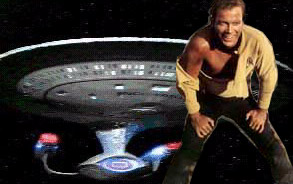
The first thing that greets me is Capt. Kirk’s package. Jim’s intergalactic manhood is clearly, alarmingly outlined against the fabric of his tight 1960s-cut black trousers, dressing very much to the left. I assure you I wasn’t looking for it — it just loomed up like a de-cloaked Romulan Bird of Prey. It shouldn’t be surprising that James Tiberius Kirk, the famously gung-ho Starfleet commander, went commando, boldly swinging where no man had swung before. Maybe that, as much as his twinkly mascara’d eyes and his captaincy of the fastest, flashiest vehicle in the galaxy, the USS Enterprise, was the secret of caddish Jim’s phenomenal success with lady humanoids and aliens alike.

Indubitably, as his first officer might have said, raising one angled eyebrow: This was the crucial difference between the sweaty, highly Freudian original “Star Trek” series and the sexless, sweatless, p.c. “Star Trek: The Next Generation.” Can you imagine Jean-Luc Picard not wearing spotless knickers with a built-in containment field, changed twice a day and incinerated after use?

Alas, I’m not actually in the humbling presence of the godlike genius of William Shatner himself. Rather, I’m gazing up at a monitor playing a clip from “The Trouble With Tribbles” in a medley of “classic ‘Star Trek’ moments,” at an exhibition dedicated to a genre and a universe that have, so to speak, sprung from his loins. “Star Trek: The Adventure,” held in a “climate-controlled” “hi-tech” 7,000-square-foot tent in London’s Hyde Park, showcases the “Trek” universe, from the original series more than 35 years ago to the newest feature film, “Star Trek: Nemesis.” Sets, costumes, props and models from “Star Trek,” “The Next Generation,” “Deep Space Nine,” “Voyager” and the current “Trek” series, the low-tech “Enterprise” prequel, are all here. Billed as the biggest “Star Trek” exhibition ever, the London show has been a great success. This is only the first stop on a world tour, taking in Europe, Australia and the U.S., on a “five-year mission to boldly go where ‘Star Trek’ has never been before” — although where that would be is something of a mystery.

In addition to six successful “Trek” TV series, each of them being rerun somewhere in the world right now, there have been 10 “Trek” movies, grossing well over $1 billion. Amazon lists 1,238 “Trek” books, 1,832 “Trek” auctions, 515 videos, 73 music items, 61 PC and video games. I simply refuse to enter “Star Trek” into a Web search engine, as I fear it will cause some kind of terrible e-feedback loop and global net overheating of the kind that happened whenever Kirk asked some upstart out-of-control alien computer to compute “love.”

The whole phenomenon is, to use another Spockism, fascinating. The “Trek” series is not only the most frighteningly successful and profitable TV series of our “timeline” but also one that has helped to make television what it is — and us what we are. “Star Trek” really did turn out to be the future — not of faster-than-light space travel, but of couch-potato entertainment. We have been, to use yet another Trekkian phrase, assimilated. Resistance was futile.

If the original “Star Trek” series was an exercise in the power of human imagination — and frustrated aspiration — the massive “Trek” exhibition can only be called an exercise in hubris. Perhaps that is why the monitor on which I glimpsed Kirk’s package is swaying a little, as is everything else suspended from the ceiling — the vast “hi-tech” tent is moving in the wind, making slightly distracting and very nonfuturistic clanking noises. Close up, imprisoned behind glass cases, the props and costumes look rather disappointing and forlorn, like deeply discounted items in a theatrical supply store. The disrupters and phasers are bits of badly painted wood; the scale models of the various Enterprises are the discarded toys of rich kids. The recreated bar from “Deep Space Nine” looks like the sort of place you wouldn’t hang out in unless you wanted to pick up a low-rent transvestite (mind you, if that had been true of the infantile series itself it might have been worth watching).

The armory from the “Enterprise” series, complete with photon torpedo launchers, is more impressive but something of an elaborate tease. Like the other control-panel-based exhibits here, much of the instrumentation is covered with glass screens and large signs warning “DO NOT TOUCH.” What other reason would you have to come to a “Star Trek” exhibition except to press, in Stimpy-esque tongue-lolling abandon, all those buttons you’ve seen winking at you on TV over the years?

The Scimitar brig restraint cage from the “Nemesis” film, in which Picard is all too briefly imprisoned, is here, but has, like the film itself, the rather tired, S/M-catalog feel that dominated the later, Borg-rich episodes of “Next Generation” — the nearest that series ever got to sex. The Borg were, after all, everyone’s nightmare fetish-party people — sadomasochists who tried to accessorize themselves a personality and considered themselves irresistible.

My pulse begins to quicken near the exit, however, when I spot, like a beacon, Capt. Kirk’s cocky chartreuse green velour shirt with gold braided cuffs and also his  black trousers. They are, in a display of costumes from the original series, wrapped around a headless dummy instead of around Kirk’s corseted, bewigged torso. No doubt I’m a terminal nostalgic — as a boy I watched “Star Trek” on ’70s TV in a state of arousal bordering on psychosis which, obviously, has yet to subside — but the original “Trek” uniforms, like the series itself, seem much more exciting than anything that followed. These are not clothes so much as archetypes. Like “Trek” technology, they embody an idea of function rather than a practical elaboration of it. Here is the cool, intellectual blue of Spock’s tunic, with his trusty tricorder handbag slung over the shoulder; here the feisty red of Lt. Uhura’s costume, breasts surging forward like rockets, with streamlined waist, miniskirt tailfins spouting a plume of long, long tights, and knee-length pointy black boots.

Ahem. Anyway, “Star Trek” was very … pointy. In addition to the boots, and Kirk’s package, there were pointy sideburns, pointy breasts, pointy ears, pointy Federation logos, pointy lettering in the credits, and also the pointedly pointy mission statement: “To boldly go where no man has gone before,” which of course was bluntly de-sexed by “Next Generation” to “…where no one has been before.” Perhaps this is why the “Next Generation” crew were dressed like flight attendants on a particularly dull 1980s airline — one that went bust because the synthetic fibers and padding produced so much static electricity that insurers refused to cover them. “Voyager” became much pointier, and more watchable, when in later years declining ratings beamed aboard the streamlined and coolly logical Seven of Nine (Jeri Ryan), promptly massaging up the Nielsen points. (Perhaps that is why “Enterprise” features the similarly spaceworthy female Vulcan first officer T’Pol, her uniform snugly inhabited by Jolene Blalock.)

“Star Trek” uniforms remain timeless classics, ones that seem to have directly inspired ’70s glam rock — Ziggy Stardust, for instance, looked as though he would have fit in on the Enterprise. Certainly Kirk would have shagged him.

It seems ironic, given the kind of people who are Trekkies — bed-wetting idealists for the most part — that the post-’60s incarnation of the series has become perhaps the symbol of corporate culture, globalization and “American imperialism” — though generally dressed in the drabbest kind of political correctness. The spinoffs have produced an empire of nerdiness. Give me a stripped-to-the-waist Republican Kirk in full-body makeup, trying to remember to suck in his waist while battling a rubber lizard-head alien with half-learned karate and pro-wrestling moves, any day of the week.

And then I spy it, like a mirage: the bridge of the original USS Enterprise. It’s roped off so I can’t ride the turbo lift, fire Sulu’s phasers, mess with Spock’s science station, or put my butt where Kirk’s has gone before and take “the con.” I suspect that in this instance I wouldn’t even if I could. You can get too close to something that has been so important to you for so long. In fact, there is something so venerable about this silly wooden set that I don’t know whether to laugh or cry. This is, after all, the holiest shrine of TV culture, of much more importance to the contemporary world than, say, the Church of the Nativity, Shakespeare’s Globe or even Lucille Ball’s living room.

They really knew about the future in the ’60s. They really cared about it. It was, of course, a time when people still believed in it, a time when “Don’t stop thinking about tomorrow” was not necessarily a self-consciously retro slogan. Perhaps that is why the original series, with its female crew members (albeit in submissive jobs) and racial harmony (ditto — except for Spock, the Jewish Vulcan), was rather more adventurous and progressive for its time than its spayed spinoffs.

More important, in the ’60s they also knew how to make buttons and dials that, 35 years on, are much more “futuristic” than anything seen since. Not only that, they made them for next to nothing. (“Star Trek” cost about $100,000 an episode; Enterprise costs $6 million.) From where I’m standing, those buttons and dials look like the most precious and promising jewels in the universe. By comparison, the “Next Generation” bridge displayed next door looks like the foyer of an expense-account motel.

Naturally, true Trekkies prefer the more recent series, precisely because they have much bigger budgets, more special effects — and no William Shatner. Apparently Star Trek creator Gene Roddenberry (and much of the original cast) despised Shatner and the way he played Kirk. He was too aggressive, too violent, too sexist, too vain. The anal-retentive goody-goody Jean-Luc Picard, played fastidiously by Patrick Stewart, was much closer to what Roddenberry had in mind.

It was Shatner’s Kirk, with all his magnificent flaws and vanities, however, who made “Star Trek” more than just another canceled ’60s sci-fi series. He saved the show from its own appalling virtuousness — or, to put it more pretentiously, he was the Dionysian bass line to Roddenberry’s Apollonian synth music. (By the same token, Cmdr. Data’s quest to become human on “Next Generation” is comic, since his colleagues seem to aspire to be androids.) Shatner was rock ‘n’ roll — his post-Trek album-cum-aural breakdown, “The Transformed Man,” notwithstanding. It was his perversity, his Napoleonic ego, that made “Star Trek” an epic for our times. Not for nothing was his pre-”Trek” project a canceled series called “Alexander the Great,” starring Shatner as the lovable Macedonian psychopath himself. Shatner has earned his place in the pantheon of postwar virile degeneracy: What Brando did for the cinema and Elvis did for music, Shatner did for the small screen.

In fact — and I think I can say this with no fear of insulting Jim Carrey, himself a helpless Shatner fanatic — Bill is simply the greatest actor that Canada has ever produced. Although he was (and is) an outrageous ham, applying the “skills” he developed performing in Canada’s Shakespearean theater (“I combine English technique with American virility”) as indiscriminately to “Star Trek” scripts as LBJ did Agent Orange to the jungles of Southeast Asia, bafflingly stressing words and syllables that mere mortals might think had no importance, pausing painfully in the middle of sentences while rushing headlong over their conclusions, there is something oddly powerful about many of his performances. Even something believable and human, especially in the slightly camp context of a series like “Star Trek.” Even Shatner’s vanity is sympathetic. The tasteful, restrained, mannered — and, let’s face it, bourgeois — seriousness of Picard and “Voyager’s” Capt. Janeway (Kate Mulgrew) seems faintly ridiculous by comparison.

Jim Kirk, as I say, was clearly a Republican, while the Federation itself was clearly Democratic. The arrangement appeared to reflect that of a Republican White House and a Democratic Congress, the favored mechanism of Cold War consensus. Fortunately for the story lines, this meant that Kirk was constantly breaking the Federation’s Prime Directive, which forbade interference in alien cultures. Currently, we see Adm. George W. Bush, with his apparent disdain for the Prime Directive and also the Federation (United Nations) itself, in orbit around planet Iraq, preparing to beam down a heavily armed away team. Bush probably thinks himself more Kirk than Picard, but he’s mistaken: He simply doesn’t have the same pathos. Or the twinkly eyes.

Spock, half alien and half human, was another example of the inherent drama of “Star Trek.” He was supposed to be coldly logical but was clearly a borderline hysteric, as evidenced by those occasions when he was called on to show emotion, such as the proto-environmentalist episode “Devil in the Dark,” when he mind-melds with the Horta, a silicone-based life form whose eggs are being destroyed by Federation miners. ‘Pain! PAIN!’ he shrieks, his usually impassive face distorting horrifically. “Oh, PA-A-A-A-A-A-A-A-A-IN!

Moreover, Spock was obviously passionately in love with his rug-wearing bisexual WASP jock captain, something not lost on the bitchy, swishy and rather jealous ship’s doctor, Bones McCoy, who wasted no opportunity to tease his green-blooded colleague. (For some reason all the male “Trek” medical staffers have been queeny, even the holograms). Interestingly, the stellar love affair between Spock and Kirk, which has its roots in Greek mythology and American literature (e.g., Alexander and Hephaestion, Huck and Jim, Ishmael and Queequeg) seems to have grown out of the clash of Shatner’s and Nimoy’s planet-size thespian egos: Roddenberry, driven frantic by their on-set competitiveness, was advised by Isaac Asimov, no less, to channel it by strengthening their on-screen relationship. In addition, a “favored nation” clause was introduced into their contracts, stipulating that any benefits accorded to one must apply to the other. In other words, gay campaigners still calling for gay characters in the next “Trek” series are missing the point. “Star Trek” featured the world’s first on-screen same-sex marriage back in the ’60s. (Little wonder then that a whole genre of female-authored “slash” fan fictions built around the Spock/Kirk love affair has flourished, making explicit what was always implicit.)

There was a kind of innocent intensity to many of those shows that is impossible to replicate today, an intensity that somehow manages to coexist with a campy tone, even down to the marvelous episode titles: “For the World Is Hollow and I Have Touched the Sky,” “City on the Edge of Forever,” or “Is There No Truth in Beauty?” — the one where the Enterprise gives a lift to the Medusan ambassador and his earthling assistant, a female in a glittery dress played by Diana Muldaur). Apparently the Medusans have miraculous navigational abilities in which the Federation is interested. Like a gimp magician, the Medusan is kept in a shiny box — Medusans are so ugly that no human may gaze upon one without going mad (in this respect, apparently, they resemble David Copperfield). It transpires that his glamorous female assistant is actually blind and “sees” through “a sensor array hidden in her dress.” The Enterprise gets lost and Spock has to mind-meld (wearing natty pink goggles) with the Medusan so that the ambassador can use his body to navigate the ship back to familiar space.

All goes well. Unfortunately, however, while restoring the Medusan to his box, Spock forgets to put his pink goggles back on and goes mad (cue truly frightening hysterical overacting by Nimoy, in wide-angle extreme close-up). Diana has to mind-meld with Spock to draw him back to sanity. Then, having been made insanely jealous by Spock’s melding with the Medusan, she mind-melds with her boss permanently.

If I had used more cocaine I could have founded an entirely new school of psychoanalysis on that one episode. “Oedipus Rex,” eat your eyes out. That was the greatness of “Star Trek” — at its best it was like an updated Greek drama for the TV generation. At its worst, well, it was still entertaining. Take “Spock’s Brain,” in which the science officer’s gray matter is stolen by some intergalactic sex kittens and a triumphant Bones uses an implant and a TV remote control to pilot a zombie Spock around.

The true measure of the original series’ brilliance is that it’s so immense and timeless that it almost makes up for the “Trek”-dreck spinoff series that have followed. Mercifully however, it seems that the Trek universe, which has been rapidly cooling since 1969, may finally be imploding. The new series, “Enterprise,” desperately escapes the p.c. present-future by returning to a low-tech, pre-Kirk past-future (with, appropriately enough, Scott “Quantum Leap” Bakula at the com) in which men are men and are still permitted to captain spaceships by the seat of their pants. It’s something of a “Home Improvement” in space, though rather less popular. Diminishing ratings for the first season of the new series, and protests by devout Trekkies at the cynical rewriting of “Trek” history to include opportunistic enemies such as the Suliban may finally mean the end of that five-year mission that has lasted 35 years.

In this instance, I doubt that even cutting the jib of Bakula’s baggy trousers and persuading him to go commando will work. Let’s hope they don’t try.

- – - – - – - – - – - -

“Star Trek: The Adventure” is at London’s Hyde Park every day through March 30. William Shatner will accept a Pop TV award for the original “Star Trek” television series at the TV Land Awards ceremony at the Hollywood Palladium on March 12.

Meet the metrosexual

He's well dressed, narcissistic and obsessed with butts. But don't call him gay.

  • more
    • All Share Services

Meet the metrosexual

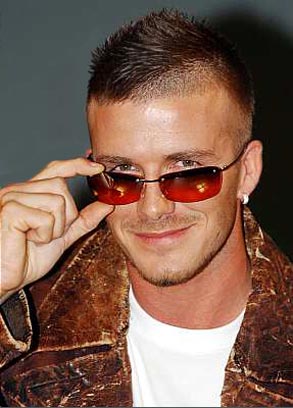
David Beckham, the captain of the England soccer team at this year’s World Cup in Korea and Japan — quite possibly the most famous and photogenic soccer player in the world — recently posed for a glossy gay magazine in the U.K., just before leaving for battle in the Far East.

Well, you can imagine the outcry. The leader of England’s courageous lads tarting around in a pooftah magazine? Handing our enemies such an embarrassing pink stick to hit us with when the nation is girding its manly loins? Well, actually, apart from a few predictable but strangely muted snickers in the tabloid press, the sensation was that there wasn’t a sensation. It was entirely what the British public has come to expect.

You see, “Becks” is almost as famous for wearing sarongs and pink nail polish and panties belonging to his wife, Victoria (aka Posh from the Spice Girls), having a different, tricky haircut every week and posing naked and oiled up on the cover of Esquire, as he is for his impressive ball skills. He may or may not be the best footballer in the world, but he’s definitely an international-standard narcissist, what would once have just been called, in the Anglo world at least, “a sissy.” Hence in that World Cup game against Brazil that kicked England out of the tournament, Becks was the only English player not to be upstaged aesthetically as well as athletically by the Latins.

In the interview with the Brit gay mag Attitude, this married father of two confirmed that he’s straight, but as he admits, he’s quite happy to be a gay icon; he likes to be admired, he says, and doesn’t care whether the admiring is done by women or by men.

All of this is very modern and progressive, I’m sure, and Beckham’s open-mindedness and “equal ops” narcissism has undoubtedly helped to change some — how shall we say? — unsophisticated attitudes in this very male, tough, still largely working-class sport. However, I feel it is my duty to inform you that Mr. Beckham, candid to the point of blatant exhibitionism as he is, is not being entirely honest with us about his sexuality.

Outing someone is not a thing to be contemplated lightly, but I feel it is my duty to let the world know that David Beckham, role model to hundreds of millions of impressionable boys around the world, heartthrob for equal numbers of young girls, is not heterosexual after all. No, ladies and gents, the captain of the England football squad is actually a screaming, shrieking, flaming, freaking metrosexual. (He’ll thank me for doing this one day, if only because he didn’t have to tell his mother himself.)

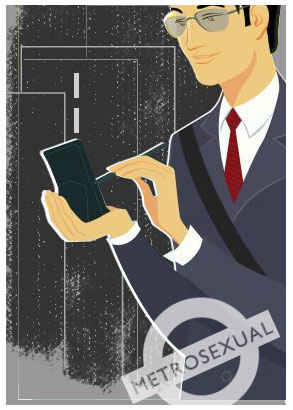
How do I know? Well, perhaps it takes one to know one, but to determine a metrosexual, all you have to do is look at them. In fact, if you’re looking at them, they’re almost certainly metrosexual. The typical metrosexual is a young man with money to spend, living in or within easy reach of a metropolis — because that’s where all the best shops, clubs, gyms and hairdressers are. He might be officially gay, straight or bisexual, but this is utterly immaterial because he has clearly taken himself as his own love object and pleasure as his sexual preference. Particular professions, such as modeling, waiting tables, media, pop music and, nowadays, sport, seem to attract them but, truth be told, like male vanity products and herpes, they’re pretty much everywhere.

For some time now, old-fashioned (re)productive, repressed, unmoisturized heterosexuality has been given the pink slip by consumer capitalism. The stoic, self-denying, modest straight male didn’t shop enough (his role was to earn money for his wife to spend), and so he had to be replaced by a new kind of man, one less certain of his identity and much more interested in his image — that’s to say, one who was much more interested in being looked at (because that’s the only way you can be certain you actually exist). A man, in other words, who is an advertiser’s walking wet dream.

Beckham is the biggest metrosexual in Britain because he loves being looked at and because so many men and women love to look at him: He’s the future, but also a way of adapting other, less advanced specimens to that future. More to the point, he sucks corporate cock with no gag reflex. A staple of newspapers, men’s magazines, TV advertising and billboards, last year he earned around $8 million for sponsoring various male fashion accessories, such as Police sunglasses.

The Beckham advertising phenomenon, however, goes beyond the usual cash-in, slightly wooden product endorsements of sporting stars. Becks gives the impression that he’d do it for nothing (except the attention); he’s a sporting star who wants to be a model.

Oddly, while Beckham is now officially a gay icon, he’s probably someone that gays would rather be than fuck — all that money, all those free designer clothes, living with a Spice Girl and all those straight men in love with you. Of course, they also like him because imitation is the sincerest form of flattery.

Gay men did, after all, provide the early prototype for metrosexuality. Decidedly single, definitely urban, dreadfully uncertain of their identity (hence the emphasis on pride and the susceptibility to the latest label) and socially emasculated, gay men had pioneered the business of accessorizing masculinity in the ’70s with the clone look enthusiastically taken up by the mainstream in the form of the Village People. Difficult to believe, I know, but only one of them was gay and 99 percent of their fans were straight.

In the Eighties, the moustaches were shaved off and the male body became more smoothly, invitingly aestheticised and commodified by media regents such as Bruce Weber, Herb Ritts and Calvin Klein. Two decades on, and the hairless — perpetually adolescent and available — dazzlingly toothy, muscular, masculine template is still with us, simultaneously a clichi and de rigueur in an Abercrombie & Fitch world. A&F may be looked down upon as middlebrow and middle American by the most refined metrosexuals, but its alarming popularity with straight, beer-drinking frat boys is proof of how metrosexuality has gone mainstream — while its lusciously produced, semi pornographic quarterly catalogues deliver conclusive proof that male narcissism (in photograpic shorthand: Weber-ism), is only ever a post-workout shower away from homoeroticism.

Perhaps this is because nowadays straight men are also emasculated. Female “Sex and the City” metrosexuality has seen to that. Female metrosexuality is the complement of male metrosexuality, except that it’s active where male metrosexuality is passive. No longer is a straight man’s sense of self and manhood delivered by his relationship to women; instead it’s challenged by it. Women are still monarchs of the private world, but increasingly assertive in the public world too. Series like “Oz,” set in a male prison and featuring story lines that revolve around violent buggery, probably look like a kind of sanctuary for some men from the female voraciousness of “Sex and the City.”

And, as the pages of the celeb mags reveal, the more independent, wealthy, self-centered and powerful women become, the more they are likely to want attractive, well-groomed, well-dressed men around them. Though not for very long. By the same token, the less men can rely on women, the more likely they are to take care of themselves. Narcissism becomes a survival strategy; apparently, some men actually buy their own underwear and deodorant these days. Beckham, unlike most metrosexuals, is happily married, though he seems to wear his marriage and even his children as accessories: The name of his first child, Brooklyn, is tastefully tattooed across his back.

Many years ago, Norman Mailer described homosexual men as narcissists who occasionally bump into one another. Which was true, of course. But now that everyone’s gone metrosexual it’s also true of straights. Perhaps this is why straights are almost as promiscuous as gays these days: All those TV dating shows where marriage or even sending each other Christmas cards is the last thing on anyone’s mind; all those youth holidays that appear to have become fortnight-long rum-soaked orgies, while Mum and Dad back home are taking part in wife-swapping parties in the suburbs.

Sometimes it seems as if the only thing holding straights back from full equality with gays is the fact that most restroom facilities are not yet co-ed. Perhaps this is also why hetero sodomy has become such a hot topic of late: These days my straight male friends talk of no other kind of intercourse (though maybe it’s because they think I’m an expert on it). According to the same straight men, the vagina was made not for their penis but for another female’s tongue.

Perhaps because it represents the definition of recreational sex and doesn’t remind them of their heterosexual responsibilities but rather of their homosexual possibilities (the exhibitionism of male metrosexuality is literally asking to be fucked), or maybe because it’s seen as a kind of extreme sport (it involves trusting your life to some stretchy rubber and taking the plunge), anal sex has become the unholy grail of metrosexual sex. The booty has become the pervey focus of so much fashion lately, including those Engineered Levi’s ads featuring men and women with their jeans on back-to-front, zippers over ass cracks.

Kylie Minogue‘s career was recently successfully and spectacularly relaunched as a global brand by her bending over and offering her pert, almost boyish ass literally to the world. A front-page headline on Britain’s most popular national newspaper drooled: “Has Kylie Had a Bum Job?” (One of the most popular taunts used by opposing fans against Beckham used to be “Posh takes it up the arse!!” Now it just sounds like flattery.)

Metrosexuality has also converted Hollywood to its persuasion. Films like “Fight Club” and “American Psycho” and “Spider-Man” exploit and/or negotiate the anxiety created by metrosexuality’s impact on masculinity while of course employing all the advertising techniques that have been used to convert young men to metrosexuality in the first place. This can lead to an irony that loops back on itself: auto-fellatio with arched eyebrows. In “Fight Club,” a film that looks like a feature-length glossy men’s magazine fashion shoot, Brad “six-pack” Pitt, smooth Calvin Klein model turned Hollywood pretty boy, and one of America’s most famous metrosexual males, leads an all-boys-together rebellion against … Calvin Klein, or rather emasculating consumerism.

In “American Psycho,” the antihero serial killer’s problem is presented as his failure to recognize the woman that could civilize him: “Have you ever wanted to make someone happy?” she asks innocently. He doesn’t hear her: He’s too busy getting out his giant nail gun. Making someone else happy is of course an even more impossible quest than making yourself happy — our parents taught us that. But in this case it is rather less likely to stain your white silk sofa.

The “Spider-Man” movie meanwhile offers us the kinky, fetishistic spectacle of a geeky ordinary young man whom no one notices transformed into a raving metrosexual before our very eyes. Apparently injected with steroids and ecstasy by a gay spider, he admires his new buffed body with widening eyes in the mirror, dresses up in a tight lycra gimp suit and runs around a lot on all fours with his arse in the air, after having setting up (Web?) cameras to record his (s)exploits. Peter Parker/Tobey Maguire employs designer drugs, clothes, perverse sexuality and multimedia technology to get people to look at him as he swings between the billboards and skyscrapers from what appears to be his own hardening jism.

In one memorable bondage/mummification-resonant scene he hangs upside down in his gimp suit while Kirsten Dunst peels off the lower part of his mask to kiss him, before replacing it: a perfect example of the new power dynamic between metrosexual men and women and how metrosexual men have to be the center of attention. We’re supposed to believe that Tobey is motivated by old-fashioned virtues of social concern and love for Kirsten but we don’t believe it for a moment. Nor does, in the end, the movie: Kirsten finally offers herself but Tobey declines, realizing that she would come between him and his real love: his metrosexual alter ego in the Day-Glo gimp suit.

American publishing meanwhile is effectively repeating the ironic formula of “Fight Club” and the Brit lad-mags (Maxim, FHM) exported to the U.S. from the U.K. (sorry, another bad habit we’ve passed on to you guys, along with Wang Chung and Ozzy Osbourne). In the editorial these magazines perform a kind of hysterical heterosexuality of tits, beer, sports, cars, and fart-lighting — but the real money shot is the pages and pages of glossy, straight-faced fashion spreads and ads featuring glossy male models selling male vanity; that, after all, is what these magazines exist to deliver. Which is to say, the lad-mags are actually raving metrosexual but still in denial, which is the place that most men are at right now.

Mind you, denial has something to be said for it. It can take some interesting and creative forms — such as Eminem, for example. The “faggot” boy bands that Mr. Mathers hates are definitely metrosexual. And yet Em, who like Beckham can’t resist a big fat shiny lens, who loves to pose half-naked (and drag it up in his videos), and who also wears his children as accessories, is clearly and alarmingly metrosexual himself; we’re all looking at him and he’s meeting our gaze with his pretty, hooded baby-blue eyes. He bitches and moans about all the attention he gets, but succeeds in turning that bitching and moaning into another album.

Eminem poses dreamily for the cover of glossy magazines, but then has a hissy fit when they Photoshop his shirt pink and demands that they pulp their entire print run. The real “Eminem Show” is exhibitionism and passivity masquerading, very attractively, very seductively, as rap-ismo activity — and is probably why most of his songs contain references to being “fucked in the ass.” (And perhaps why his former bodyguard has alleged that Eminem’s wife regularly beat up Slim Shady and not the other way around.)

By way of contrast, the relaxed, faggoty, submissive metrosexuality of David Beckham, posing for gay magazines and more than happy to wear pink shirts — and even pink nail varnish — may be less overtly pathological, and probably represents a more benign or successful adaptation of masculinity to the future, but is a trifle distasteful, not to say occasionally downright nauseating. The final irony of male metrosexuality is that, given all its obsession with attractiveness, vanity for vanity’s sake turns out to be not very sexy after all.

But then, it’s much too late for second thoughts. Metrosexuality is heading out of the closet, and learning to love itself. Even more.

Continue Reading Close

Page 2 of 2 in Mark Simpson