Mary MacVean

Krazy kravings

L.A. lines up for Krispy Kreme and other doughnut spots.

  • more
    • All Share Services

Krazy kravings

Sunday morning in Southern California. Blue skies, sunshine. It’s a day for the beach, or maybe brunch at a chic little outdoor cafi that serves fruit smoothies. Or perhaps a nondescript, utterly banal commercial stretch of suburban Van Nuys, where Krispy Kreme Corp. is rolling out thousands of doughnuts every day. People cannot get there fast enough or often enough.

When I show up, two guards are directing traffic into the parking lot and around the drive-up window line of waiting cars that snakes back on itself. In the shop, as many as 75 people wait in line and watch little rings of dough drop into a vast vat of hot oil, get automatically flipped over and then pass under a Niagara Falls of opaque white glaze.

Somehow, the marketing guys at Krispy Kreme have turned this into a mystical process, a sacrament in the worship of doughnuts that has found a devoted following in L.A., America’s doughnut capital.

Krispy Kreme is where the melting pot truly melts. Fidgety kids, women in crisp business suits with $100 haircuts, beer-bellied couch potatoes and 20-somethings dressed always in black and shades all take their place in line. All skin colors, languages and education levels have a place at Krispy Kreme.

People don’t seem to mind the line; I imagine New Yorkers grumbling and yelling at the workers to hurry up already. There’s plenty of doughnut chatter, comparing notes and trying to figure out just why these doughnuts are so good. One couple brags that they once waited three hours in line at the drive-up window. Hot Krispy Kremes “melt in your mouth, they’re light. I’m not a heavy-duty sweets person, but you can eat a couple of these,” says the woman. When her husband suggests she actually could put away a half-dozen, she refuses to give her name.

“I don’t eat doughnuts,” says another customer, Jeri Sobel, as she takes a bite of a hot glazed one — just … this … once.

Nearby, two well-spoken couples sit, discussing Krispy Kreme’s marketing brilliance as they eat doughnuts and drink coffee.

“I don’t eat a lot of doughnuts, but you have to come here, because everyone else is,” says one of the men, claiming to be eating his first doughnuts in 10 or 15 years. His friend, wearing a Colgate University T-shirt, seems to have more experience. He says the doughnuts “lived up to the expectations … They’re light, not greasy. They’re crispy on the outside, and warm and tender inside.”

Could you tell me your names? “No, no. Don’t tell her,” the wives loudly insist. The husbands are bewildered. In the ensuing argument, it becomes clear that the wives are not about to let the world know that they are spending a Sunday morning in a doughnut shop.

But that would hardly make them unusual. Angelenos are mad for doughnuts. There are doughnut shops on practically every corner, in every cruddy little strip mall. Besides the pedestrian doughnuts and coffee, there are shops that sell doughnuts and Chinese takeout, doughnuts and flowers, doughnuts and gasoline. You can buy doughnuts while you do your laundry. There’s even a doughnut shop shaped like a doughnut. Early this year, when North Carolina-based Krispy Kreme began its incursion into Southern California, people waited in line two hours to buy dozens of hot glazed doughnuts.

Frankly, I don’t get it. I just moved here, and I expected a populace that was colonically clean and Pilates-toned, one that ate tofu scramble instead of real eggs and that lived in homes made peaceful and productive by the magic of feng shui. That’s all here, but what’s up with the doughnuts?

I talked about it with Abe Price, a young Angeleno who recently graduated from law school, over doughnuts and coffee at Bob’s in the Farmers Market. To Price, these are the finest doughnuts around, better even than Krispy Kreme, and he considers the best doughnuts a notch above the best croissants. He once took a first date to Krispy Kreme, but she was unimpressed and he was pretty thoroughly disgusted. “She couldn’t admit that she eats doughnuts,” he said. “The doughnut is a food of shame.”

And they’re tacky. Isn’t Los Angeles supposed to be cooler than that? Aren’t doughnuts junk food for cops and office workers and assorted night owls? They’re working-class grub — easy, cheap and sweet. And fattening. A serious doughnut habit will cost you hours of spinning on a stationary bike if you ever hope to scrunch into one of those little satiny sheaths from Fred Segal. Just try to catch Lara Flynn Boyle with a cruller in her fist.

The skinny on doughnuts: A yeast-raised glazed doughnut from Winchell’s Donut House, the area’s homegrown chain, has 210 calories, about half of them from fat. A jelly-filled doughnut from Dunkin’ Donuts runs 310 calories, more than a third of them from fat, according to the Center for Science in Public Interest, a Washington, D.C.-based advocacy organization. Worse, says CSPI, doughnuts often are fried in fats high in artery-clogging trans fat, somewhat similar to saturated fat.

Nutritionally, doughnuts are full of holes. I asked Dale Ogar, managing editor of the Berkeley Wellness Letter, published by the School of Public Health at University of California-Berkeley, where the doughnut fit on the food pyramid. “I’m trying to think if it has any redeeming value at all … I don’t think so,” she said.

So why are doughnut sales at about $2 billion a year, according to Modern Baking magazine? Another trade publication, Bakery Production and Marketing Magazine, says that as of November 1997, there were 9,743 doughnut shops in the U.S. — 2,632 of them in California. (Next was Texas, with 995.) There are 1,650 shops in the five-county L.A. area, more per capita than anywhere else in the country, said Lou Franson, vice president of brand management for Winchell’s Donut House, a 51-year-old chain of 300 shops, based in Santa Ana.

“It’s the secret side of Southern California,” he said.

A doughnut is like an earthquake: a real leveler. This is what Laura Davis, retail manager at the iconic La Brea Bakery, tells me. Even there, where the yeast starters are as good as gold, everyone loves doughnuts, and the shop sells them some mornings, alongside dried-fruit scones and other pastries of snootier lineage.

Martha Stewart sells a doughnut kit for $48 that includes bakery boxes and red twine.

Doughnut devotees just don’t care about the fat and sugar. How can health food deliver that dreamy, sweet, slightly greasy joy you get when you bite into a doughnut? Or better yet, that feeling of bliss if the doughnut is hot, when the dough is almost melting?

Edward Andrews’ childhood home in Chattanooga, Tenn., had a back gate that opened onto a Krispy Kreme parking lot. He went through that gate “constantly.” But for a long time in L.A., doughnuts held no special appeal for him. Now that Krispy Kreme has arrived, he makes pilgrimages and has converted his family. “Even my mother, who keeps strictly kosher, will sneak over and take a bite,” said Andrews’ wife, Tamar.

But it’s more than taste or childhood memories that bring doughnuts and Southern Californians together. It’s their cars. People here spend more time in traffic than anyone else, and doughnuts are good car food, powdered sugar aside.

A doughnut shop takes relatively little money but a huge effort, making it appealing for new immigrants willing to work zillions of hours a week. In Southern California, many independent doughnut shops are run by Cambodian families.

Whatever the cause, it’s great for Krispy Kreme, which has four shops in the L.A. area and plans for 36 more — setting off a war with Winchell’s.

At Krispy Kreme, a neon light flashes when there are “Hot Doughnuts Now.” Winchell’s has installed lights that look like red police car lights to signal fresh, hot doughnuts. In January, Winchell’s opened its own “see ‘em made” shop in Pomona, similar to the glass walls at Krispy Kreme that allow waiting customers to watch the process.

Winchell’s plans to sell new varieties of muffins and desserts. It already has some sandwich-chain partners. Company President Tom Dowling said he hopes to increase the number of outlets to 500 by the end of the year, and to increase sales from $60 million to $100 million.

Krispy Kreme has a more limited menu and boasts of making 1.3 billion doughnuts a year. Because the company has told the federal government it plans a public stock offering this year, its officials cannot talk about the company and so refused requests for interviews.

While doughnuts come in endless — and sometimes unappealing — varieties, it is the basic yeast-raised glazed doughnut most places are judged by. Winchell’s sells a hand-cut version, while Krispy Kreme takes pride in its extruder system (which leaves no doughnut holes). Each company, of course, has a secret formula that produces the best doughnut on the planet.

But for retro-chic ambiance, the 62-year-old Krispy Kreme takes the doughnut. It’s been praised in Elle, the New Yorker and GQ magazines, and featured on national TV. It is said that Elvis Presley demanded that a dozen fresh jelly-filled Krispy Kremes be at Graceland at all times.

Never ones to miss an opportunity to be hip, Southern Californians have been swarming the new Krispy Kremes. The first two shops, in very unhip La Habra and Van Nuys, each sell more than 400,000 doughnuts a week, said Richard Reinis, chief operating officer of Great Circle Family Foods, the Southern California franchisee of Krispy Kreme. And, he said, a zip code study showed that more than half the customers come from more than 10 miles away.

Kristy Wunsch, owner of the Hot Spot, a new shop near the beach in Venice, said cops say they don’t patronize her place because they’re sick of being stereotyped as doughnut fanatics. Then why is there a sign in the parking lot at a doughnut shop in Marina del Rey reserving a space for police cars?

Actually, soldiers, not police officers, can claim to have made doughnuts an everyday American food, though fried cakes have been around for centuries in many cultures.

During World War I, Salvation Army “Sallies” sent to France wanted to do something that would remind the boys of home. Baking was impossible in the tents and old barns where they set up, so the Sallies started frying dough, handing out as many as 9,000 doughnuts a day, said Diane Winston, author of “Red Hot and Righteous: The Urban Religion of the Salvation Army.”

“The soldiers loved them. They were being taken care of, mothered,” Winston said. “When those guys came home, they said, ‘We want doughnuts just like the Sallies gave us.’”

Entrepreneurs obliged them, and in 1920 Adolph Levitt invented a doughnut machine, leading eventually to a doughnut shop population explosion.

Of course, the soldiers probably needed all the calories they consumed. Most of us do not. Millions of Americans are overweight, and hunks of dough deep-fried in artery-clogging shortening are not exactly what the cardiologist ordered.

As he left the Van Nuys Krispy Kreme, the guy in the Colgate T-shirt joked that he was on his way to the cemetery, to see all the people who’d eaten Krispy Kremes.

Sure they’re dead. But they died smiling.

Cold plunges and sport singing: Life in a Russian kindergarten

A wee New Yorker is sent to Rodnik, a temple of rigidity and complex grammar. And he loves it.

  • more
    • All Share Services

Cold plunges and sport singing: Life in a Russian kindergarten

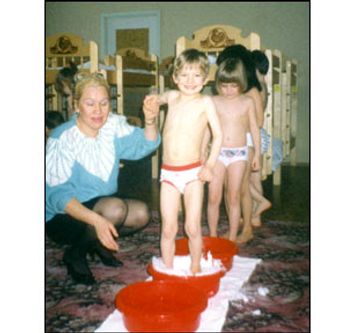
There’s my son in the photograph, first in line among the 10 boys and girls
in his kindergarten class. It’s Jan. 20, they’re stripped down to their underwear, and Sam is standing in a wash basin full of snow. He is smiling. He tells us that every day after lunch, the children of kindergarten No. 1671 parade from a basin of warm water to one of snow (or cold water when there is no snow) to another of warm water. Then they dry off and climb into wooden bunk beds for naps.

“They do this to be healthy,” says Sam. He says it’s fun. I learn that it is called “tempering,” a practice designed to make children become “strong as steel” to survive the long, cold Russian winters in good health. Once again my husband and I question our decision to put our very American, New York-born little boy into a Russian kindergarten — cold turkey.

We moved to Moscow early in 1997 from New York City. My husband, then a reporter for the Associated Press, had taken a job as a Moscow correspondent. Our time there, we felt certain, would be wonderful for Sam and his 16-month-old brother. We thought a second language would be a huge gift, especially as we struggled mightily to
learn enough Russian to buy food once we got there. And even if we could have afforded the $10,000 it would cost for Sam to go to the American school in Moscow, we figured Russian school would be a great opportunity for our son.

Also, to be honest, I was quite happy to escape the pressure of choosing a school in New York. When Sam was barely 3, people began asking whether we’d applied to nursery schools, taken exams, made the big decision. Strangers in restaurants and parks would ask where he was going to go to school. There were good schools and other schools, schools that did not lead to Yale but to a destiny too awful to contemplate.

Our choice took us out of competition. But it didn’t take away the anxiety. We decided to send Sam to a school where neither he nor we could speak more than a few words to the teachers, a place where we would know only what our 5-year-old son chose to tell us about his days.

We chose Rodnik, kindergarten No. 1671, for a couple of reasons. A
Russian friend had called the Moscow education department and gotten a
recommendation. And in walks around the neighborhood, I had found it to be the only school without broken glass in the playground and crumbling
exteriors. It turned out that two other American families and one
Russian-American family also chose it. Thank God, I thought: solidarity.

When my husband and I visited Rodnik, we were still naive enough to ask what sort of curriculum was used. At first, Nadyezhda Mikhailovna, the imperious director, could not understand the question. Finally, she gave us a withering look and replied, as if to simpletons, “The National Curriculum, of course.”

Having not a clue what that might be but feeling that the woman who would be his teacher was warm and friendly, we signed Sam up. And so on that Sept. 1 he left home clutching a bouquet of flowers, which every schoolchild in Russia brings to the teacher on opening day. (No surprise that a country with a National Curriculum also has a nationwide
first day of school. It also turned out to be the only day we had the services
of a crossing guard on our super-busy street.)

Rodnik is a square, three-story building in the Krilatskoe Hills of western
Moscow. The playground is appallingly dilapidated (though normal for
Moscow), and the building is at home among the surrounding, equally
dilapidated Brezhnev-era high-rises. Inside it’s charming: mosaics and
photos of children on the walls, pint-size painted wooden furniture,
a small swimming pool and rooms for music and gym. Sam’s group had a
changing room with big bulletin boards to show off their schoolwork; a room for work, play and meals; and a sleeping room with a half-dozen bunk beds.

From the start, life at Rodnik (which means a water spring) seemed
harder for us than for Sam, who came home each day full of tales about new
friends and accomplishments. What we saw as rigidity or evidence of outdated theories, Sam simply took in stride. Early on, when I asked him how he knew what to do if he didn’t understand the teacher’s words, he looked at me as though I were a fool and said, “I just look at the other kids and do what they’re doing.”

One day, Sam showed me a bulletin board covered with paintings of snowmen. All were identical, except for one. That picture, he explained, was “wrong.” As with most things at kindergarten 1671, there was a right way and a wrong way to draw, with very little room for individual expression. When a child was not able to draw a perfect circle, Sam explained, the teacher usually drew them instead. Teachers also demanded that Sam have the “right” slippers for school and that he bring only one kind of paint (Russian-produced, never foreign-made).

The stubborn right-mindedness culminated for me in the New Year’s show, Rodnik’s biggest event of the year. While Russia is no longer an atheist state, all the trappings of Christmas — trees, parties, presents brought by the magical, blue-robed Grandfather Frost — remain relegated to New Year’s celebrations. And at every kindergarten, or “dyetsky sad” in Russian, the children put on a show and have a party.

In Sam’s class, all the boys were rabbits and all the girls were snow maidens, a character akin to a young Mrs. Claus. Diana, Sam’s beautiful and athletic
classmate, wanted to be a rabbit, not a maiden. When she refused to put on
her white dress and instead sat sobbing on a couch, she was taken home and missed the celebration. By the next assembly, in the spring, she sat with her hands in her lap, dressed in a pretty dress with a pale blue satin ribbon tied around her neck. I ached for her.

Rodnik children learned to recite poetry and sing songs in front of their
parents and teachers. But they were played for their strengths, not their interests, in order to avoid the possibility of much-dreaded mistakes. The same kids always got the biggest parts; the best singers always sang; the prettiest girls always played the girliest roles. On “health day” it hit home again. For this, a day full of athletic contests, Sam, being the smallest child in his class, was chosen to compete at the well-known sport of singing. The taller, stronger kids were chosen for running, jumping and other sports.

Life at Rodnik turned out to be a strange mix of indulgence and demand. When the children weren’t being coddled they were being pushed from the nest. Teachers would routinely help 5-year-olds dress each day but expected them to learn fractions, memorize long passages and master relatively complex grammar.

To learn early-reading skills, the children would say a word, the number of
letters it contained, the number of sounds, the number of vowels and the
number of consonants. That was the way, the only way. The reading teacher worked from a national manual; you could imagine millions of little 5-year-olds reciting, in Russian: “dom,” which means house: “three letters, three sounds, one vowel, two consonants.”

We grownups were treated as oversized children. At
parents’ meetings, teachers would openly criticize their pupils — this one doesn’t pay
attention, that one eats poorly, this one is not doing well in math — and blame the parents. I was scolded on more than one morning for
not dressing Sam warmly enough or for being late. Parents were welcome in school
only when invited, their opinions were never sought, and they were usually wrong if they ventured a thought. At first I assumed I was being singled out because I was an
American whose Russian was rather poor. But soon I learned that every parent
is assumed to know less about raising their children than the school.

So how could we let Sam go to school there for two years? He thrived at Rodnik. He took learning seriously and worked with pride. He was truly loved and cared for in a class of 10 children and two teachers. He cross-country skied at recess and danced in the afternoon. There was homemade soup with freshly baked rolls at lunch.

Sam graduated from Rodnik in May, certified ready for first grade. Over the summer, we moved to Los Angeles. Here, his class is racially and ethnically diverse, the school makes an effort to include parents and the curriculum allows some freedom of expression. Then again, his first-grade class has twice as many children as Rodnik and half as many teachers. There is not enough art or music, nowhere near as much as in Russia.

I fully expected to feel nostalgic about Rodnik and I do. We all do. The experience was hard and foreign but it was also warm, even comforting. It was tempering. And we are healthier for it.

Continue Reading Close