Matthew DeBord

The Believer

Dave Eggers is back -- sort of -- with a lively new monthy magazine from his McSweeney's team that attacks poison-pen literary cynics. So do we dare criticize the Believer?

As soon as I was spotted with the Believer on a Brooklyn subway platform, I was promptly accosted by a dark-eyed woman in her 20s wondering where she could find the debut issue. It didn’t take long for word to get out that the new literary/cultural magazine published by the McSweeney’s collective in San Francisco had hit the bookstores.

Already, the power of the Believer is strong.

The magazine, as has been reported elsewhere, is the brainchild of novelist Heidi Julavits, author of “The Mineral Palace,” and Vendela Vida, who wrote the female rites-of-passage investigation “Girls on the Verge,” and is, not incidentally, Dave Eggers’ fiancée.

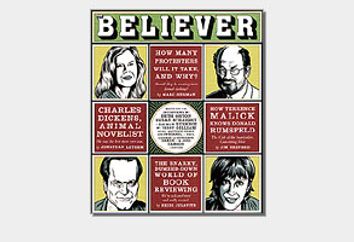
Physically, it’s a very attractive product that has Vida’s future husband’s fingerprints all over it. Small ink drawings of animal skulls break up page after page of carefully justified, three-column text. There’s nary a sans serif typeface in sight, nor an ad. Footnotes are present, though not in such abundance that they represent a separate meta-commentary — these footnotes are really just footnotes. The masthead is demurely located on the back cover. The headlines and subheds are written in a gnomic style (“‘Badlands’ and the ‘Innocence’ of American Innocence, Featuring Martin Sheen as Donald Rumsfeld and a Voice-over by Our Laconic Complicity”) that’s clever, even if it ends up being tedious.

The longer pieces are paced by single-page literary experiments, including a travel-writing parody about a motel in Vermont, an analysis of the evolutionary development of the star-nosed mole, and an amusing attack on cute children. Cartoonist Charles Burns has contributed arresting, borderline-malevolent cover and interior art, including portraits of Salman Rushdie (who interviews Terry Gilliam) and Beth Orton, among others. There’s an elaborate chart tracing the international provenance of magic realism. Overall, it’s a compelling browse, even if it does suffer from the Eggers/McSweeney’s fixation on some rather dried-out visual ideas borrowed from Joseph Cornell and the Museum of Jurassic Technology.

However, as an exercise in cultural journalism, at this stage, the Believer is pretty uneven. It gets your hopes up, but doesn’t completely deliver on its quietly ambitious promise.

The magazine’s avowed editorial mission is to stake out fresh territory, somewhere between Harper’s or the Atlantic Monthly and a limited-circulation literary journal, but with an earnestness that the editors feel is lacking in these cynical times. “We will give people and books the benefit of the doubt,” reads point No. 6 of the introductory 10-point “Notes about The Believer.”

Now, it would be the easiest thing in the world to take some swipes at a publication whose editors have decided to run essentially unmolested Q & A interviews with an obscure English philosopher and Wes Anderson’s favorite Indian character actor, and an intensely personal profile of the ’80s-referencing band Interpol. The magazine’s name, in fact, seems like deliberate bait, given the cultlike reverence that arises around anything Dave Eggers gets involved with. Eggers evidently advised the Believer’s editors only on the design, while McSweeney’s Publishing provided distribution services, but no funds. Still, it’s hard to separate the Believer from Eggers’ overall agenda, which is to restore some honesty and passion to American letters.

We’ll see how it goes. My take on Eggers is that he’s an interesting and occasionally inspired writer, but his unacknowledged significance is that he’s one of the most important graphic designers of his generation. In fact, although his aesthetic is fairly reactionary and at times unbearably twee, he has a rare talent for the arcane art of typesetting and publication design.

The look of the Believer, with its sophisticated attempt to professionalize the shaggy, Bay Area broadsheets of the ’60s and ’70s, confirms my suspicion that Eggers’ goal is not to become postmodernism’s answer to Bennett Cerf, but to function as an update on the 18th century “gentleman printer” — a contemporary Ben Franklin. (Eggers, however, wants to be Franklin minus the political and scientific enthusiasms, which distracted the founding father from the altogether more fascinating business of printing.)

The Believer’s lead essay, however, is bound to convince some people that Eggers did more than recommend a typeface; some critics will doubtless conclude that he has locked Julavits and Vida in his mesmerist’s gaze and commanded them to use the magazine to extend some of his own Peter Pan-ish cultural preoccupations. In “Rejoice! Believe! Be Strong and Read Hard!” Julavits, over the course of 9,000 words, complains about the state of contemporary book reviewing, mounting an argument against “snark,” which she defines as a twisted ethic of cheap shots embodied in such smartass urban newspapers as New York Press and the New York Observer (full disclosure: I’ve written for both).

To summarize, she wants book reviews to be as lively as they are responsible; she never, ever wants to encounter an innocent reader who was turned off to a deserving author by the careerist flimflam of some hot-shot media Turk looking to score points.

This amounts to a manifesto — one that Eggers himself would be sympathetic to. Unfortunately, it’s almost always a bad idea to make the lead story in a new magazine a manifesto, especially when its verdicts are so flaccid (manifestoes are supposed to be fiery and emboldening). “I want to encourage readers to sample books they might otherwise never open or hear about,” Julavits writes. Hoo-boy! Get out of my way as I rush the book-reviewing battlements, ready to poleax the purveyors of snark.

It’s an even worse idea to lead with a manifesto when it buries your best article, in this case a very Harper’s-esque report on San Francisco’s protest culture by Marc Herman. The Believer’s editors have forced it to languish behind Julavits’ meanderings and the first seven pages of Paul LaFarge’s insightful meditation on Nicholson Baker’s debt to New England literary realism. (At least Herman’s story fared better than the only other really good piece in the issue, co-articles editor Ed Park’s disquisition on the vigorous career of “True Grit” author Charles Portis, which dwells meekly in the four-spot.)

Herman’s take on the Bay Area’s lazy legacy of antiwar protests is focused, intelligent, well-reported and downright frisky. His core point, presciently expressed well before the United States invaded Iraq, is that our current round of taking to the streets, unlike many prior forms of civil demonstration, is unlikely to achieve its goals. Why? Because Bay Area protest culture is just that: a culture. Its overriding interest is in perpetuating itself, not effecting change. Organizers are obsessed with being inclusive rather than introducing discipline to their troops. According to Herman’s sources, this free-form tactic has made it easy for the media to ignore the protesters. Why give them column inches and airtime when all they do is deliver disorganized speeches, march on the wrong landmarks, and base their thinking more on Chomskian conspiracy theories than facts?

To me, Herman’s story plus the Believer’s distinctive, collectible design make it worth the $8 cover price. In future issues, I’d like to see a little more editorial ferocity. I think Julavits and Vida have it in them, but only time will tell. It might boil down to a fight between the good they want to do and the magazine they need readers to, well, believe in. The Believer hasn’t made me one yet, but given the generally sorry state of the American magazine, I’m more than willing to be patient with my faith.

From “Bright Lights, Big City” to gamay Beaujolais

Brat Pack novelist Jay McInerney finds being a jet-setting wine expert far more glamorous.

People my age fall into two camps when it comes to Jay McInerney: They either recall with misty fondness reading “Bright Lights, Big City” one swift afternoon back in the ’80s, or they hate his stinkin’ guts and wish he would go away forever. I tend to fall into the first camp. There are times, however, when I drift toward the second (though not to an extreme degree). McInerney is a gifted writer (and don’t believe anyone who tells you otherwise), but he can seem lazy and self-derivative, as if he’s coasting. Sometimes, he disappoints.

This was the case with his last book, 1998′s “Model Behavior,” which contained a short novel with the same title that was essentially a reworking of “Bright Lights, Big City.” The characters were all older, though not much wiser, and McInerney’s signature theme — the corruption of youthful idealism by the cold reality of affluence — was present, but otherwise the effort felt phoned in, a bit tired. And 1996′s “The Last of the Savages,” his last real novel, was ambitious but also meandering and, for a hillbilly aesthete such as me, irritating in its preposterous depictions of Old South gentility colliding head-on with the counterculture. In fact, the last McInerney offering I truly dug was “Brightness Falls,” his 1992 response to Tom Wolfe’s “The Bonfire of the Vanities.”

Here was McInerney, the last Fitzgeraldian, in top form, and painting on a wide canvas. A satire both of ’80s Wall Street and of the publishing business (his caricature of Harold Brodkey alone is worth the price of admission), the novel was also richly compassionate. The Boston Globe called it McInerney’s “most giving” book, an affectionate verdict for an author who once posed as a Ninja warrior on the cover of Esquire, poised to decapitate his critics, and who was often lumped in with the “cocaine novelists” (as Lev Grossman once put it) of the Reagan years.

Unfortunately, McInerney has thus far failed to live up to the promise of “Brightness Falls.” True, it’s slightly ridiculous to fault a writer who with “Bright Lights, Big City” did succeed in capturing, in fewer than 200 pages, an entire decade — a now-vanished but still influential moment — in the life of America’s most vital metropolis. (McInerney himself said that he was lucky to have written that one “zeitgeist” novel.) Still, an impression of wasted days fell upon his fans.

The profiles he contributed to the New Yorker were slickly spun fluff, literate candy of the sort that seemed more at home in W or Vogue. He was obsessed with models. And celebrities. And the social hierarchy. His fawning interview with Julia Roberts drove his second wife to a face-lift. He co-wrote a screenplay, about the premature death from AIDS of supermodel Gia Carangi. Improbably, “Bright Lights, Big City” was made into a musical, which was widely ridiculed. Clearly, Jay Mac had slipped over the edge. Clearly, Jay Mac had shot his wad.

Or had he? If the ’90s demonstrated anything, it was that the old notion of becoming a famous novelist had lost much of its shine. What, after all, did an accomplished young writer like McInerney have to look forward to after that initial flush of success? The lunch basket at Yaddo? A career teaching moody collegians the gospel according to Raymond Carver? Getting spiked by Alec Baldwin at second base in the annual East Hampton artists and writers softball game? Yet another lunch with Binky Urban? Day after soul-sucking day at the computer, struggling to fabricate plots, when — goddamn! — there was vastly more fun stuff, not to mention snazzier people, to be found outside?

Arguably, McInerney and his literary compatriots — Bret Easton Ellis, Tama Janowitz, the usual suspects — had arrived at precisely the best and worst time to be coronated as novelists. Best because more people were reading than ever before and because the baby boom was pushing its last members out into the book-buying population. And worst … for the same reason. The reading public was changing, as was the culture itself. Writers, regardless of how talented or controversial, simply didn’t rate magazine covers anymore.

Credit McInerney for figuring this out, and for (stealthily) finding a new line of work, one that he is probably better suited for than writing novels. For the past few years, he has contributed the “Uncorked” column for Condé Nast’s House & Garden, and I won’t be going out on any limbs if I maintain that, in doing so, he has become the best wine writer in America. “Bacchus & Me” bears this out, collecting no less than 48 uniformly witty and informative H&G pieces about all things viticultural, from French Champagne to the “wine goddess” of California’s Napa Valley.

Even better, “Bacchus & Me” reveals, in ways that reading the columns in isolation can’t, how McInerney has worked his old novelistic preoccupations into his writing about wine. You can see how this would restore some spring to his step. Rather than sitting around some apartment in New York, trying to bang out another 400-page novel that his critics would just murder anyway, McInerney was able jet off to Bordeaux and Piedmont in search of the ’90s wine boom’s fattest quarry. Along the way, he got Condé Nast to pick up the tab for his passion. (And believe me, his passion isn’t cheap.)

There are other wine writers — redoubtable Brits Jancis Robinson and Oz Clarke leap to mind — who have managed to weave together fine writing, personal narrative and considerable knowledge with greater aplomb than McInerney does. But where Jay Mac surpasses them is in his sure-footed ability to enter a realm of luxury, rife with lively and tendentious personalities, and figure out who really matters. Most wine writers focus on the product first and attune themselves to the social burlesque, pick up the inside baseball, later. Not McInerney. It’s not as if his tasting faculties aren’t notable — they are. (And if Lyons Press had included his concise notes in the collection, readers could see this.) It’s just that they are secondary to his considerable ability to survey the vast sweep of European and American winemaking and suss out the genuine players.

For example, McInerney is a thoroughgoing, self-confessed Robert Parker Jr. acolyte. For the uninitiated, Parker is the single most powerful figure in wine, a Maryland lawyer and Ralph Nader devotee who in the late ’70s began publishing the Wine Advocate, an ad-free newsletter that introduced Americans to his now-widespread 100-point rating scale, his belief that most wine critics are shills for the booze business and his controversial preference for big, fruit-forward wines. (A relatively low Parker rating — a 75, say — can ruin a wine, particularly an expensive premium wine from Bordeaux or California, and his critics complain that his preference for “large and in charge” vintages is producing a unidimensional international style of wine.)

McInerney has studied his Parker as closely as he once pondered the Manhattan social whirl. The master’s ideology shapes Jay Mac’s taste, something that only becomes obvious when one reads all the H&G articles in sequence. You could suggest that this means McInerney is a toady, but the truth is that he’s merely efficient. By zooming in on Parker, he eliminated the need to slog through all those less important and less influential wine writers. This is vintage McInerney. He is not, after all, a guy who, when he chose to become a novelist, went off and studied with a slouching old coot at Podunk U. He chose Carver, who in the ’80s was the most significant figure in American fiction.

McInerney’s canniness becomes more apparent as the collection moves along. He starts out by introducing readers to different styles of wine, but this kind of plug-and-chug journalism fails to fully satisfy his desire for lifestyle climbing. Gradually, the big kahunas of California and the vintner aristocrats of Europe become his beat. By sticking to it, he delivers a series of snapshots of the wine world’s key ’90s personalities: California hired-gun cult winemaker Helen Turley, who produces wine of such celebrated quality in such small quantities that you need to be on an exclusive mailing list to obtain any of it; Robert Mondavi, the godfather of premium wine in America (and the original Napa pretender to European-style viticultural nobility); Chateau Ducru Beaucaillou’s Bruno Boire, a dapper gold-plated Bordeaux superbachelor whose pot-au-feu lunches for his female admirers, not to mention his generous ways with his stash of Chateau d’Yquem, have McInerney literally drooling with envy from the moment he turns into the driveway; Italian wine maestro Angelo Gaja and his speeding BMW 750; Jean-Luc Le Du, the rock ‘n’ roll sommelier at Daniel Boulud’s namesake New York restaurant; and so on.

McInerney even sets up a Fitzgeraldian East Egg-West Egg rivalry in the American winemaking heartland, the Napa Valley. Down on the valley floor hunker the old-guard flatlanders, while up on the hillsides dwell the young turks (“guerrillas,” according to McInerney). It’s an old money/new money distinction — the flatlanders might as well be Knickerbocker blue bloods to the hillsiders’ go-go arrivistes. Now, the valley vs. the hills rivalry has not been lost on the rest of the wine press, but only McInerney’s powerful social radar could zero in on the real story, the two sides eyeing each other warily across some of the most financially productive real estate in America. McInerney also pushes his luck here, raising the hillsiders — who make limited-production, ultrapricey cult wines — to Bordeaux-like “first growth” status. It’s a risky bet, because most of these wines haven’t been around long enough to prove themselves. But the rugged individualists are all in the hills, and McInerney can’t resist their maverick allure.

McInerney’s bacchanal culminates, somewhat repulsively, in an authentic binge. As the millennium turns, he and his crew of wine cronies — Robinson, Julian Barnes, Auberon Waugh, Stephen Fry — whip up a series of gourmet dinners in London and wash them down with many thousands of dollars’ worth of extremely fancy wine. Compared with the genial amateurism, the deft Candide’s progress, that has preceded it, this account of unabashed glugging ends the collection on a sour note. McInerney, who for the bulk of the collection has presented himself as a wide-eyed ally of the insecure reader, suddenly looks more like a glutton who has given in to the uglier side of his nature — who has betrayed the Parker-esque advocacy he convinced his readers he was pursuing. This is unfortunate but hardly a huge knock on the overall effort, because one could spend a lot of money and a lot of time sorting out the maddeningly wide world of wine. Or one could read McInerney and, in a few hundred pages, learn just about everything anyone really needs to know.

Continue Reading Close

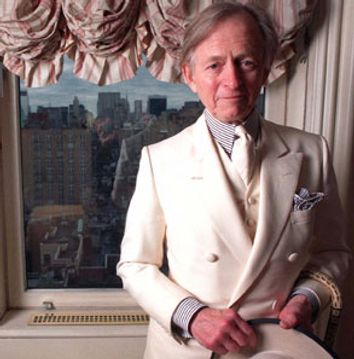
Hang it up, Tom

The once massively cool Tom Wolfe is trying to secure his legacy, but his new book doesn't pass the acid test.

Here’s how it goes with Tom Wolfe: You were in high school, you stumbled across “The Kandy-Kolored Tangerine-Flake Streamline Baby” or the “The Electric Kool-Aid Acid Test” while killing time in the fluorescently depressing library stacks. That prose! That frantic, amped-up, rollicking, vigorous language! Who was this guy? And the payoff? He wrote for Rolling Stone, your pimply adolescent bible. You were captivated. This was not your father’s journalism. You checked out everything you could get your hands on and didn’t leave your room for a week.

That’s how it goes with Tom Wolfe, for young men who came of age in the ’70s, who were weaned on the New Journalism; in fact, who didn’t even know that there was any other kind of journalism that could be written. Tom Wolfe was a touchstone, the nonfiction equivalent of Thomas Pynchon and Jack Kerouac, a dandified brother to Hunter Thompson (who young ’70s men would discover soon enough). Tom Wolfe didn’t write about boring crap; Tom Wolfe wrote about the Merry Pranksters and whether you were on or off the bus, and about dropping acid, and he wrote about surfers, and he wrote about cars, man, and he wrote about those superbad mofo Black Panthers and it was all so … unbelievably exhilarating. He had no respect for grammar, his syntax scintillated, it sparked, it throbbed. He threw around exclamation points and capital letters with efflorescent abandon. He broke the rules. He looked frooty in that white suit, but so what? He was massively, unquestionably cool.

Then — POW! — “The Bonfire of the Vanities” began to appear in Rolling Stone and there it was: Tom Wolfe really was a genius. The dude could write anything. It was a bright time, and Tom Wolfe, in that crazy white suit, burned more brightly than anyone. He wasn’t young, but he seemed like he was. He was the Dick Clark of American letters. You could dance to Tom Wolfe. You wanted to.

Unfortunately, nothing bright can stay that way forever, and like the Hindenburg, exploding and crashing in flames in New Jersey, Wolfe is currently burning out in dramatic fashion. The spectacle is heartbreaking, because Wolfe, formerly a maestro of perspective, possessed of a preternaturally reliable critical eye and a sensibility that could slice steel, has lost it. Worse, Wolfe no longer reads young. In “Hooking Up,” a flabby collection of recently published and reprinted articles, plus a novella that originally appeared in (where else?) Rolling Stone, Wolfe reads old.

Of course, the secret to Wolfe’s success was that he always thought old, but he had the foresight to phrase his contrarian insights in brassy pop chords. A patriot, a conservative, a stodgy champion of throwback architecture and the naturalism of Zola, Wolfe — like his equally severe though far less entertaining distaff counterpart, Joan Didion — was the haughty interloper who was unexpectedly adopted by the Woodstock Nation. He got away with it because his curiosity was unflagging. The national freak show served his purposes, but you could also tell that he loved it. And, as the pieces included in “Hooking Up” clearly demonstrate, he never lost his faultless reporter’s nose for a great story. Or a fur-flying, guns-a-blazin’ dogfight.

The problem is that Wolfe’s talent for polemic has superseded his appetite for stories culled from the American hurly-burly (the “Billion-Footed Beast” of his notorious 1989 Harper’s essay). His once-infectious enthusiasm has been replaced by glib thuggery, a journalistic version of the toothless coot telling the damn kids to get the hell out of his yard. The title essay is a soap bubble, the reportorial sketches (“Two Young Men Who Went West,” “Sorry, But Your Soul Just Died”) rich in detail but rife with contradiction and the hardcore stuff, the much discussed attacks on campus radicals (“In the Land of the Rococo Marxists”) and the literary lions (Updike, Mailer, Irving — Wolfe’s “Three Stooges”) who jeered “A Man In Full,” the bestselling follow-up to “Bonfire,” suggest a bully whose huffing pugnacity is infuriatingly ignored.

Wolfe also continues to prove that he is one of the worst art critics who has ever lived (which is surprising, because he is a skilled artist himself and has illustrated several of his books). “The Invisible Artist,” a pained eulogy for Fredrick Hart (and a quickie rehash of his 1975 anti-art-world screed, “The Painted Word”) proves this beyond a reasonable doubt. Hart is the sculptor whose trilogy of faithfully realistic soldiers was tacked on to the Maya Lin Vietnam Veterans Memorial in Washington. “Her proposal,” Wolfe writes, “was a V-shaped wall, period, a wall of polished black granite inscribed only with the names [of the dead]; no mention of honor, courage, or gratitude; not even a flag. Absolutely skillproof, it was.”

And absolutely unforgettable, it should be pointed out, certainly the most aesthetically and emotionally resonant war memorial … in the history of warfare. It doesn’t matter to Wolfe that there is both wide popular and critical agreement on this, and that most people of even mild opinions about art consider the Hart addition to be a vulgar distraction from Lin’s stoic, powerful slab. In his mind, art ought to represent the world. He is at least consistent — pledging allegiance to naturalism on numerous fronts throughout his career — but sifting through “Hooking Up,” it becomes painfully obvious that, while Wolfe might be scarily good at characterizing the footwear of bond traders or the sweat stains of bankrupt real estate tycoons, his eye for anything not drawn strictly from reality is dreadful. He is a flagrant, rhetorically overheated literalist. Abstraction, ambiguity — anything tainted with the funk of European modernism — repels him. It fires the reactionary furnace that has always smoldered deep within his rather bland personal sensibility.

Of course, we should have seen this coming. Anyone who would persist in donning, for every public appearance, that dumb white suit, complete with spats, dwells in a realm of self-contrived fantasy so insular and narcissistic that only a journalist on the order of … Tom Wolfe could be relied upon to capture the full arrogance of the pose. (Which is precisely what happens, as Wolfe alarming references himself throughout “Hooking Up.”)

The analogy that leaps to my mind is that of the swayback thoroughbred, still trying to jump the fence and sprint to the racetrack. Trouble is, America doesn’t want to play the ponies anymore, and Wolfe, who once held all the speed records at the Churchill Downs of American journalism, finds himself in the awkward role of hustling up buzz from the back of the pack. True, he can still sell a million books. Big books. But his thumb has slipped from the nation’s pulse to his own. The inclusion of his legendary two-part hit job on William Shawn’s New Yorker, “Tiny Mummies” and “Lost in the Witchy Thickets,” causes “Hooking Up” to resemble a post heart-bypass Wolfian attempt to secure, Clinton-style, his legacy.

Both pieces, published in 1965 when Wolfe was a staffer at the New York Herald Tribune, are an absolute hoot. Post-Tina Brown, it’s difficult (though not that difficult, depending on how old you are) to remember how fusty, how devoutly unhip, the New Yorker was during the Shawn era. You hear the stories about the dilapidated sofas and the shuffling hush of the sepulchral hallways and the dandruffy editors in their third-generation tweeds and it all seems … well, pretty pre-Tina. Still, back in the day, the New Yorker functioned as the very citadel of WASPy literary eccentricity, and in 1965 Wolfe nailed it, right down to the colors of paper used for the magazine’s memos. The ensuing brouhaha, for all practical purposes, made him the Tom Wolfe we know today.

And he’s not about to let us forget it. It’s difficult to figure out why he so ardently longs for this validation, unless his own sense of mortality has finally begun to kick in. Sad? Probably. But the seeds of this crisis were planted years ago.

To a degree, Wolfe’s snobbery — which is the snobbery of a writer who, for a time in his career, was basically frozen out of the media elite — has always been at odds with his oft-stated recommendation that any writer worth his salt must bravely venture forth to see for himself the woolly hog-stomping America that all the world envies. Again and again, however, Wolfe has returned from his own field trips simultaneously invigorated and repulsed. His relationship with his mad mistress, with her spacious skies and the purple haze and the sordid cities, has always been deeply schizo. He believes that American is great. But he believes Tom Wolfe is greater.

None of this in and of itself means that a lot of readers won’t relish “Hooking Up” (I must admit that the inclusion of the New Yorker pieces alone makes the book worth $25). But some of us know better, because we’ve seen Wolfe in full gallop and we know that he should be able to find some fat American oxen in greater need of goring than Stanley Fish and Judith Butler (both get creamed in his essay on academic Marxists). The new century belongs to America — to O.J., Monica and Bubba and skatepunks, PlayStation 2 and pro wrestling and a thousand new as-yet unspawned pop horrors. Now, more than ever, we need Wolfe to get his game back. “Hooking Up,” unfortunately, suggests that we both may be running out of time.

Continue Reading Close

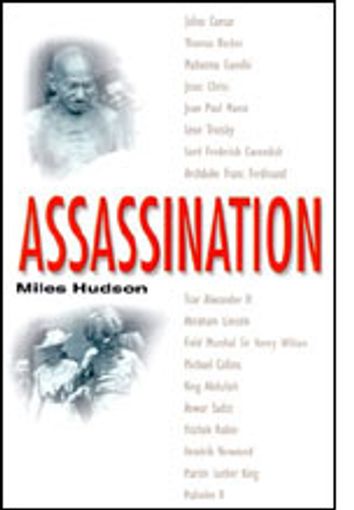
“Assassination” by Miles Hudson

A historian coolly assesses whether killing a leader is a useful political tactic.

It’s an Ethics 101 classic: If you could have assassinated Hitler in 1938, would you have? Few would argue against a premature death for Hitler. But would eliminating him have prevented World War II and the slaughter of millions?

In “Assassination,” Miles Hudson sets out to determine whether the violent removal of a critical historical figure at a crucial historical time makes any difference. To do so he has assembled 18 assassinations, ranging from that of Julius Caesar to that of Jesus Christ (though it’s an asterisked one, a “judicial execution” rather than an assassination proper), and asked whether they worked.

Hudson, a conservative British political intellectual who now lives as a farmer, concludes — unsurprisingly — that assassinations almost never influence historical outcomes. “In over half the assassinations studied,” he writes, “the result was the exact opposite of what was intended; in one-third of the cases nothing much happened; in one case, something else, a world war, was the result; and in only one instance can it be said that the assassin’s sponsor succeeded in his political aims.”

In the “exact opposite” category, Hudson places Caesar, Lincoln, Jean-Paul Marat and Martin Luther King Jr., among others. In the “nothing much” slot are Gandhi, Malcolm X, Anwar Sadat and Yitzhak Rabin. The assassination that produced the world war is of course Archduke Franz Ferdinand’s in 1914. The lone successful assassination was that of Leon Trotsky, in Mexico in 1940. Hudson asserts it succeeded because all Stalin hoped to prove was that, if he wanted to, he could have Trotsky killed. In this sense, it was more a hit than an assassination.

So, if most assassinations are contextually interesting but historically meaningless — if in nearly every instance Hudson discovered that assassination was not a useful instrument of policy — why bother writing a whole book on the subject? I’m not entirely sure, but I’m glad that Hudson did, because “Assassination,” which ranges from Imperial Rome to nearly the present day, is one of the best short histories currently available. Hudson covers the conflicts in the modern Middle East in 30 pages, the Civil War in fewer. He’s able to pull it off because he deals in biographical sketches of assassinated figures rather than the grand sweep of events. But still, I now know more than enough about late-19th century Russia and the reign of Henry II (both of which were formerly vast holes in my knowledge) to fake it at cocktail parties for the rest of my life.

Throughout, Hudson deals with the assassination question in a balanced tone that might seem disaffected to some readers, too coolly judgmental to others. (He never lingers over what might be called the assassination “money shot”: that moment when assassin and target finally meet.) This is primarily because he considers fanaticism, and the impulse to murder prominent leaders that seems to come with it, to be a fundamentally doomed proposition. Consequently, the reactionary anti-Union sentiment that persuaded John Wilkes Booth to shoot Lincoln and the fervent anti-Arab views of Orthodox Jews seem cut from the same cloth. Furthermore, Hudson suggests that most significant historical figures inspire envy and hatred in their own ranks at the same rate as admiration and loyalty. This is especially evident in the case of Malcolm X, who, Hudson argues, somewhat controversially but without a hint of equivocation was assassinated by his enemies in the Nation of Islam.

What Hudson seems to want to resist is anything that resembles the sort of historical romanticism — almost always ineffective, at times ruinous — that typically fires the confused soul of the assassin. No one is going to come away from this book with the sense that assassination is a good idea, and that’s the way Hudson wants it. Maybe if the British or Germans had managed to eliminate Hitler, World War II would have ended early and millions would have been spared. But then again, maybe a sane leader would have assumed command — and the war would have lasted twice as long. Assassination is the gasoline of history. Throw it on the fire and the fire blazes more brightly, more dangerously, for a brief period. But it’s worth remembering: The fire was already burning.

Continue Reading Close

Saucy soccer moms

Forget supermodels, it is She of the coveted vote whom I most desire.

The Sports Illustrated swimsuit issue — annual apex of service journalism for boys — is supposed to bring every red-blooded straight male, or his trousers, to his knees. And yet, the specially wrapped pack o’ porn, accessories included, did nothing for me this year.

There was no pop-eyed lust, no furtive boner, no drooling over dusky bazooms and stiletto gams. I could not be moved by Teutonic nubility, taut bellies or thong-flossed buttocks. In fact, the entire 3-D section conjured up only the grim image of nearsighted shut-ins with red and blue cardboard glasses perched on their trembling noses, soiled BVDs clumped around their varicosed ankles.

I tossed my copy on a groaning pile of erotically benign rags: Harper’s, the New Yorker, Golf Digest. I was saving myself for the superior stroke book, my own true erotic bible, the glossy guide to honeys most likely to succeed with me, myself and a box of Kleenex: The Lands’ End “America’s Ultimate Swimwear” catalog, demurely billed as “26 pages of the kindest cut anywhere.”

To hell with coltish babefests and contrived 3-D hooey. It withers in the face of this robust confidence, these sturdy thighs, those downy arms. What is a collagen-plumped pout and a belly ring in the face of a tender grin and the endless promise of maturity? I am over the supermodel; we’re not even friends. These days, most nights, I belong to the soccer mom.

That’s right, she of the coveted vote and the Plymouth Voyager. Am I the only one to have discovered her sultry poignancy, the sexy affirmation that everything — and I do mean everything — is possible after childbirth at the age of 35? Nope. We are legion (though still somewhat stealthy and apologetic).

I know, I know. The Lands’ End models are fairly young women, but that’s only because catalog models usually are. What they project is unabashedly adult. These are still proto-soccer moms, here to dispel the ridicule and denigration heaped on their sisters by smarmy comedians and jealous Type A urbanettes. This subtle swan might require a kinder cut, but that’s about all the supermodel has on this Venus in a tankini.

I am not the first guy to complain (others in a suspiciously defensive tone, I with great sincerity) that the overwhelming majority of women promoted by SI, Vogue, Harper’s Bazaar, Cosmopolitan, Allure — the whole panoply of publications dedicated to starvation chic — tend to be about as sexy as plaster mannequins. Beautiful, yes — if you subscribe to the criteria of Hugh Hefner and Hamish Bowles — but also unapproachable, unreal and kind of cadaverous.

The typical supermodel is, to my eye, oddly lifeless, sterile. Does she have genitals? Or is her authentic sexuality subsumed by the awesome austerity of her calculated media presence? Could I really contrive a convincing fantasy in which I would throw down Heidi Klum and blitz her fleshy battlements? Nah. For that I need a real woman. For that I need a soccer mom.

A soccer mom implies an inner life; she bristles with knowledge and heat and can-do sexuality. Her alluring humanity and softness — coupled with the expectation that she has a lot more on her plate every day than rolling out of bed and posing for dollars — brings to mind novelist Nicholson Baker’s observation, made in his highbrow trash novel “Vox,” that an orgasm in the mind of an intelligent woman is far more exciting than one that occurs in an outwardly gorgeous void. Soccer moms are smart, not just brainy in that “librarian about to take her hair down way,” but charged with a brand of common sense that conveys sufficiency of a superior, and way-sexy, grade.

In some quarters (pretty much everywhere but deepest, darkest suburbia), soccer moms have a bad rep, not to mention an aesthetically displeasing habitat (the mall), boring priorities (marriage and children) and bad footwear (white leather Keds). But how blind we are to interpret their sweet suburban industriousness as repressed and sexless. What could be more seductive to the active sexual imagination than pluck and verve and white cotton underpants?

I wasn’t nuts for the postmodern meanderings of Dave Eggers’ phenom-book “A Heartbreaking Work of Staggering Genius,” but at least one aspect of the work resonated for me: Eggers’ desire to get over on one of his fellow parents. “I was looking to score,” he writes of attending Back to School Night with his younger brother. “I expected attractive single mothers and flirting.” I would probably have hatched the same plot, given the chance. Eggers, unfortunately, sees his plan wrecked on the shoals of his fellow single parents’ unattractiveness. I, on the other hand, have kept my fantasies intact.

I see myself cruising soccer practice. The moms arrive in Dodge Caravans, hulking Suburbans, Volvo station wagons with Raffi thumping hard from the speakers, kids yelping in the back seat. I’m well prepared. I have SnackWells and nonalcoholic beer, baggies full of those dwarf carrots and tiny boxes of raisins tucked in my pockets. I ogle the moms from a louche distance, voyeuristically pondering the rustle of L.L. Bean “Freeport Studio” separates against calves and biceps made sinewy by the aerobic exertions that only chasing 7-year-olds all day long can promote.

I shamble over to my quarry, who is perusing a copy of “Real Simple” on a beach towel redolent of Tide. I lay down my mojo, thick as the Welch’s grape jelly I will lick from her heaving bosom in the back seat of her tinted-window SUV. I break the ice by asking if she voted for Christie Todd Whitman in the last New Jersey gubernatorial election. I suggest that maybe we’ve met someplace before, possibly at the big Nordstrom shoe sale.

Finally, I ask for the digits. She fishes around in the pocket of her willowy sundress and comes up with a crayon and a report card. “Call me,” she whispers. I crack open another O’Doul’s and offer her a pull. She tosses her nape-length chestnut tresses. She hiccups nervously — and we’re off.

As seductions go, I think it’s pretty compelling. And thanks to an ever-enlightening popular culture, it doesn’t even involve much in the way of imagination. Ever since Sela Ward hefted the banner, during her “Sisters” days, for foxy maternity, more than a few of us have had a thing for babes with babies under their belts. Now Ward and her dark chevron 40-something eyebrows and come-hither half-smile (her overbite alone should be declared a national treasure) are starring in ABC’s hit post-divorce, single-parent series “Once and Again,” and every week, I’m vibrating with lust.

When Sela hollers at her girls, I pop a woody. I had the same reaction to the Hope character on “thirtysomething”: Infant on her hip, her house tumbling down around her, she still managed to embody the kind of woman you’d want to fuck so often that she’d get pregnant a few more times.

This is one of the core differences between soccer moms and supermodels: Soccer-mom fertility inflames masculine virility. Supermodels would rather smoke cigarettes and get a pedicure; soccer moms want to fuck all night (once they get the kids to sleep, of course).

For guys who share my devotion to the Lifetime cable demographic, to the siren call of the estrogen set, the best soccer mom to score with is probably the single-mother soccer mom. (Just ask Nick Hornby.) I recall fondly (and with predictable firmness) that old IKEA TV ad that featured a recent divorcie on a shopping spree for new furniture, talking about how she might even want to have a guy over to her new bachelorette pad someday. “Oh yeah,” I thought. “Put the kids in front of Elmo and I’ll help you break in that new mattress.”

There is a saucy sensibility, calibrated with a tad of neediness and unwanted celibacy, in these women. Plus, if I am to be completely honest, they represent the whole enchilada — sexy, appreciative women with kids and a no-nonsense approach to marriage.

Then again, I am susceptible to a melancholy reverence (and shivering horniness) when confronted by the married soccer mom. She, too, is saucy and, if statistics are correct, not averse to the stray romp with a young man. I adore her and am forced to envy her husband, one lucky dude by my measurement. Down deep, and despite my bacheloric protestations, there’s a big part of me that wants to be him. After all, he gets to spends Saturdays studying the toggle of her proud soccer-mom ass as she navigates the fluorescent aisles of the supermarket, stocking up on Fruit Roll-Ups and Trix and gallons and gallons of reduced-fat milk.

And I, as the story always goes, am not alone. Ostensibly raffish single men — real lady-killers — have been mooning over moms forever. Does the acronym MILF (Mother I’d Like to Fuck) ring a bell? It might sound juvenile, but in truth it’s an expression of desire for elegant maturity. And we are not talking here about the cross-generational couplings of a Benjamin Braddock and a Mrs. Robinson. The idea here is not to be a Young Turk out of his element with an older woman, but to be a youthful gentleman brought into his element through the ministrations of a woman bashful enough to wear a sarong, gentle enough to mop the drool from a baby’s chin.

Literature is rife with images that derive from hallowed observations of soccer-mom lust. The hands-down sexiest paperback novel cover in my bookcases belongs to “The Sportswriter” by Richard Ford. It depicts sad-sack narrator Frank Bascombe’s estranged suburban golf-pro wife in full, leggy, short-skirted follow-through. I stared at this cover for a solid 10 minutes in the bookstore one day, considering all the smutty possibilities. No kohl-eyed urban slattern, this one. Not a “Sex and the City” floozy, vamped out in Pat Field skankwear and bounding from sack to sack in a futile quest for love and multiple orgasms. No, this woman had made her peace. This woman had once been spoken for, but not necessarily satisfied. She had experienced contractions. She was sexy and secure. She was June Cleaver, post-Summer of Love. She was Donna Reed with a diaphragm.

And then there is the quintessential cinematic soccer mom, Joan Allen, who managed, in Oliver Stone’s “Nixon,” to make Tricky Dick’s Pat a sort of simmering Republican sex symbol. She did even better in “The Ice Storm,” where, pitted against Sigourney Weaver’s New Canaan swinger, it was Joan who got shtupped in the station wagon while Weaver struggled with Kevin Kline’s guilty natterings. This is the thing about the saucy soccer mom and her transgressions: When she takes the plunge, she takes it deep.

Not that I know from experience. Alas, I have never shared a fling with a soccer mom. I’ve never slipped that mug of herbal tea from her hand and slid my tongue between her parted, unpainted lips. I’ve never consummated the Lands’ End swimsuit issue smut that percolates in my reptile brain.

But I am confident that the day will come. Part of the soccer-mom charm, after all, is the suggestion of attainability. And if these women constitute a viable political constituency, there can’t be a shortage of them out there. I imagine that sometime I will find myself in an American suburb on a crickety evening in late summer and all the soccer moms will be sipping vodka tonics on the patio and the moonlight will be illuminating their delicate crow’s-feet and the enticing strands of gray that flicker in their no-muss, no-fuss dos. It is then that I’ll strike.

I just worry that by that time there will be a waiting list. It can’t be long before, smitten by the Nordstrom “Reinvent the soccer mom” ads or the hottie mommy around the block, many, many fellows like me will be prostrating themselves before our bemused and eternally tolerant idols.

For the sake of fantasy, we must assume there will be enough to go around, a battalion of unconditional lovers who will smooth our rumpled khakis, run their fingers over our incipient bald spots and nurture our brains out.

Continue Reading Close

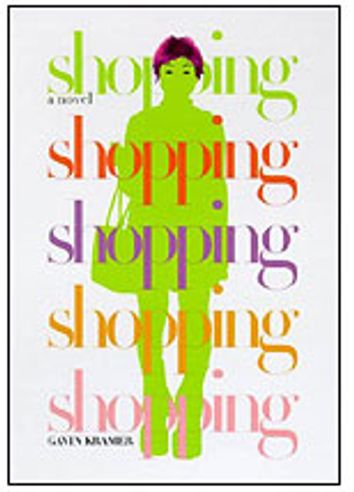
“Shopping” by Gavin Kramer

A doomed East-West romance set in a Tokyo of brand-name whores and green-tea-flavored condoms.

More than half a century after incinerating two of its cities and then turning the entire country into a war-spoiled quasi colony, Westerners like to think that they get Japan — that a smooth continuum of cultural understanding bridges the Pacific, neatly joining Tokyo and its PlayStations to the Port of Los Angeles. “Shopping,” Gavin Kramer’s debut novel, sets out to show that we couldn’t be more wrong. Short-listed for the 1998 Whitbread First Novel Prize, “Shopping” goes out of its way to depict how utterly bizarre and awkwardly, bafflingly symbiotic the relationship between Japan and its World War II foes is. As far as Kramer is concerned, the war never really ended — it merely shifted to less violent, more ambiguous battlefields.

The plot is minimal: A jaded, expatriate narrator recounts the collapse into debauchery and near-madness of Meadowlark, an uptight, dim and lunkish fellow Englishman who finds himself slip-sliding uncontrollably across the alluring neon surfaces of Tokyo’s “nightless city.” “Of the young professional expatriates,” the narrator says, “it was clear to which category Alistair Meadowlark belonged. They were here against their will, condemned to serve in this city because of the vast, unified effort … to plug a once bomb-levelled country into the very heart of the worldwide money machine.”

Meadowlark — his name provides a gentle clue to his haplessness — is a minor cog in this effort, a lawyer running on professional autopilot whose grasp of Japanese customs, mores and contemporary styles is as limited as the dicor in his bland high-rise apartment. He’s an Anglo Everyman who, unfortunately, can’t disappear in Tokyo because he’s a big white guy in a land of small brown people. He seems to lack interest in the sexual smorgasbord of the city’s Roppongi district. He has almost nothing in common with his narrating compatriot, who has gone native. (He’s one of the expatriates who “liked to be seen in places where we were the sole white face.”)

But then Meadowlark encounters Sachiko, a Western-fashion-obsessed teenager from Tokyo’s suburbs. He meets the Asian Lolita at McDonald’s, where she’s sipping a strawberry milkshake. “I suspect what attracted him,” the narrator says, “was the image she presented of the miniature businesswoman, the doll-size auditor of books.” Later: “Each time she spoke to him … with her girlish yet icily precise little voice, his excitement (I inferred) irrevocably grew.”

It doesn’t take long for Meadowlark, the British rube, to fall apart in Sachiko’s tiny clutches. The process of exploring his collapse from an upstanding dullard to an unemployed, head-shaved freak dressed in a chicken suit supplies Kramer with countless opportunities to fix Japan’s youthscape in his Tory moralist’s gun sights. “Anything can be bought,” he writes of Tokyo’s insatiable consumer appetites, prefacing a list of brand-name detritus that includes inflatable geishas, green-tea-flavored condoms and the collected works of Bashv. In this context, Sachiko is less a callow 16-year-old and more a physical manifestation of how far from its insular, carefully balanced past Japan has come. She’s a label whore who manipulates the “white men in suits” to fill her closets with Italian clothes.

Apart from Kramer’s distinctive prose style — which is world-weary but also extremely tense, both sinuous and spiky — what’s appealing about “Shopping” is its nearly absolute disregard for what its Japanese characters might be feeling. It’s the opposite of what we expect from a novel, but it serves his purpose well. Kramer is preoccupied with the city of Tokyo, its “stratum of sadness,” which “is always there: subcutaneous, beneath the skin of everything, despite the brilliance of its surface, the ceaseless movement, the apparent plenitude.” But he maintains a judgmental distance from whatever emotions might exist beneath his Japanese characters’ skin. He allows us mainly glimpses of how miserable the Japanese — who lost everything in the 20th century, only to convince themselves that they had gained it back — currently are.

In the end, Kramer endorses a nostalgic view — a Japan of heroically antiquated wood houses straight out of Hiroshige, a Japan that has rolled the clock so far forward that if it hopes to save its soul, it must consider rolling it back. To have arrived at this verdict requires a fair amount of aesthetic and ethical courage on Kramer’s part; his is an unexpectedly engaging xenophobia. In the doomed romance between Meadowlark and Sachiko, he has given us a metaphor for the strained postwar seduction of the victorious West by the vanquished East.

Continue Reading Close

Page 1 of 2 in Matthew DeBord

www.salon.com/writer/matthew_debord/index.html