Matthew Fishbane

“My Colombian War”

A kidnapping target in her native Colombia, journalist Silvana Paternostro returned there to document life beyond the drug war.

  • more
    • All Share Services

To listen to a podcast of the interview, click here.

To subscribe: Click here to add Conversations to iTunes or cut and paste the URL into your podcasting software:

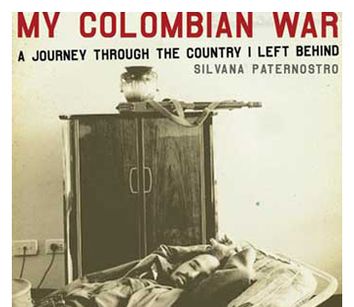
A kidnapping target in her native Colombia, journalist Silvana Paternostro returned there to document life beyond the drug war. In 1999, 22 years after she left to come to the United States, Paternostro decided to “open up the Pandora’s box” of her past. What followed was a series of trips that became the material of “My Colombian War,” a book she calls “a mix of memoir and reportage about Colombia and all its complexities.”

As a reporter for publications such as the New Republic, the Paris Review and Newsweek, Paternostro knows that Americans rarely stop to think about the legacy of the war that disappeared from view after 9/11: the drug war. Like the billions of dollars in military and humanitarian aid the U.S. has spent in Colombia, Paternostro’s book provides no happy endings. It’s not giving away too much to quote her conclusion that, for Colombia and for her, things “did not work out between us.”

Not for lack of trying. In September of 2001, Paternostro returned to her family farm, El Carmen, in the north, for a New York Times Magazine story. As the daughter of wealthy landowners and thus, Colombian logic goes, a target for kidnapping, she required heavily armed escort for her trip that lasted only four hours. “My Colombian War” explores the “feudal dynamics” that result in such brutal reality. Paternostro’s earlier book, “In the Land of God and Man” (1999), established her reputation for turning a critical eye to her own culture, as a woman who dared to take on the sacred cows of Latin American Catholicism, machismo and patrician values, from within.

NNow, as a self-described outsider and yet still a member of the Colombian elite (Paternostro’s mother descends from French aristocracy who fought on the Conservative government side of the same war Gabriel García Márquez depicts in “One Hundred Years of Solitude”), Paternostro’s tangled relationships with the places and people of her Colombian past provide an apt metaphor for the sticky complexities of the country itself, and American involvement there. Colombia remains exceedingly violent — the UNHCR counts 2 million to 3 million internally displaced persons, second only to Sudan — and “My Colombian War” comes out this month in the U.S. with names changed to protect “the privacy and safety of the Colombians still living amid violent conflict.”

Paternostro spoke with Salon in New York (with an interruption to field a phone call from Aleida March, Che Guevara’s widow) about Colombia, her involvement in Steven Soderbergh‘s pair of Che biopics, and the literary genre she calls “nonfiction magical realism.”

In a recent speech to the Council on Foreign Relations, Condoleezza Rice declared that “Colombia is on a trajectory of positive change — politically, economically and socially,” marveling that “Colombia’s transformation in less than a decade from failing state to thriving democracy is one of the greatest victories for the cause of human rights in our world today.” Why is Washington’s Colombian war so different from yours?

A lot of Colombians probably agree with that, and would be happy to have their country seen that way. There are glimpses of concrete change, local political machinery being challenged. Still, Rice’s comment is wishful thinking, and something that we will achieve, but we’re not there yet. And there are things in the social, fiscal, educational and foreign policies, and in the legal world of the country, that need to change before we achieve this perfect state that she refers to.

The overarching narrative journey in your book is framed by encounters with a U.S. army serviceman called “Charlie” who has volunteered to go to Colombia because, as the son of a drug addict, he says he wants to “kill each and every motherfucking drug dealer with [his] own hands.” How does he fit into this story?

Charlie became an important part of my journey of going back and writing this book. He was going to Colombia as U.S. military, but also to fight his own personal war. When I met him he was on his way. After his time there, he recognized how much more complicated it is, and how [U.S. involvement in Colombia] creates more problems than it solves.

Colombia is seen as the country that has only drug problems. I am always surprised to see how little the fact that Colombia is a drug-producing country plays out in the day-to-day of politics, of the quotidian life there. Charlie realized this, and to me he represents Washington’s narrow focus and how they see this very complex country.

Are you saying that narcotics trafficking isn’t important in Colombia?

It’s not what carries the political discourse of Colombia. It is not what Colombians are preoccupied with, although it is a large part of how the country works.

Isn’t drug trafficking the source of the kidnappings, the violence, the injustice?

The violence in Colombia was not brought about by drug trafficking. We had a period called “La Violencia,” in the 1950s, for example. Colombia has a situation that is complicated by drugs, and although it’s important to focus on what effect drug trafficking has on Colombian society, I’m more interested in human dynamics, the relationships between employer and employee, between man and woman, teacher and student, government and citizen, artists and civil society. That’s what my book wants to show: how that Colombia works. A lot of the way people treat each other leads to me calling Colombia, [in the book,] “a fiefdom of dysfunction under one flag.”

In the book, you spend some time living at your grandmother’s in Barranquilla, a coastal capital, and find that you have very little in common. What makes you different?

My grandmother had this slew of granddaughters who were sent to American schools and wore clothes that were maybe a little inappropriate to her. She lived in a very rigid world where, if it wasn’t how her world worked, she was not interested, even if it was her grandchildren. So we lived these parallel lives, and in a way that’s a metaphor for Colombia: The feudal and the modern never sit down to talk at a table. Maybe we’re starting to now.

Since reporting this book, you’ve been researching the biography of an iconic figure of Latin American revolution, Che Guevara. Why?

I started without any intentions of getting so involved in the life of Che Guevara, but in 2001 I had taken a trip to Cuba. Things were different. There was a cultural relationship between Cuba and the United States, and as a senior fellow at the World Policy Institute, I had a license to go as a journalist.

I brought the three people who had just come out from doing the movie “Traffic”: Laura Bickford, the producer; Steven Soderbergh, the director; and Benicio del Toro, who won an Oscar for his performance. They had all informally spoken about doing a movie about Che Guevara. So now I’m writing a book on Che and also have been helping research and produce the film that we are shooting right now. Benicio del Toro knows so much about Che Guevara that together we’ve become almost like a research team, and we have visited and interviewed all the principal characters of the Che Guevara story who still live.

And you actually appear on-screen in the film?

About two years ago, we shot here in New York at the U.N. This was a trip that Che Guevara made to speak at the General Assembly in December of ’64. We wanted to re-create that visit, actually the last time he was seen in public. As we were going through all the archival material, literally three days before we started shooting, I saw a picture of Che sitting at the desk at the General Assembly, probably taken minutes before he went up to the podium to speak, sitting between two men, the ambassador and the secretary at the U.N. mission. And right behind him I saw this woman sitting with them.

When I looked at the script, we only had the two men in it. So I asked the director if there was any chance that a woman could be sitting there, and I asked him if it could be me. He said yes. That turned into a whole series of scenes with me as this woman [Cuban revolutionary leader Alba Griñan Nuñez]. But sometimes I think that Steven was just playing a joke on me, shooting with no film. You know, when you’re 4 years old and you tell your mother, “Oh, Mommy, take a picture of me!” and there’s no film in the camera? So I have to see if I make the cut.

You have been quoted as saying, “What I’m writing is like the nonfiction version of what Gabriel García Márquez did with ‘One Hundred Years of Solitude.’” (You even borrow the first three words, “Many years later…” for your opening.) What do you mean by that?

I call it “nonfiction magical realism.” Magical realism has become a way to describe a literature that lightens or makes quaint the problems and the dynamics of a society. For me magical realism prettifies the problems that we live with. I don’t think that was García Márquez’s intention, but I think that’s what it has become. Magical realist things, as they’ve come to be known in Latin American literature, happen in my reporting. The fact that there are [guerrilla-run] checkpoints [that lead to kidnappings] and that people call them “miraculous fishing” — that is an example of magical realism, but it’s true.

Being Juan Valdez

A "Colombian idol"-style search transformed a humble farmer into the 21st century version of TV's coffee icon. Meet the man behind the mule.

  • more
    • All Share Services

Being Juan Valdez

You know Juan Valdez: He’s been the rugged, mustachioed icon of Colombian coffee since 1960. That’s when a Madison Avenue ad agency, realizing the potential of campesino cachet, invented a name even gringos could pronounce, and hired an actor to play the role of a humble coffee grower. The TV commercials asked, “Where do the beans come from?” and Juan Valdez would answer, strolling through lushly planted hills, “I hand-picked them myself.”

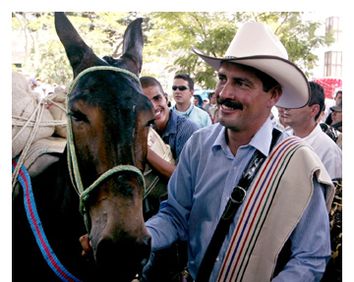
Last year, in a passing-the-poncho ceremony widely publicized in Colombia, the National Federation of Coffee Growers of Colombia introduced the new, improved Juan Valdez: a 38-year-old farmer from the village of Andes. Carlos Castañeda was the real deal, a third-generation coffee grower with a seven-acre farm and two cows. He was chosen after an elaborate, reality TV-style search that involved competitors in a variety of games and tests — a bizarre mash-up of “Colombian Idol” and “Survivor.”

Now Castañeda spends half his time on his small coffee farm, and the other half jet-setting around the world as Juan Valdez, a fictional creation. In fact, the federation doesn’t like Castañeda speaking to the press about his life before Juan: “He’s a character, not a person,” the media office told me. When I asked the New York advertising agency that now handles the coffee account about Castañeda’s English, I was told, “It’s pretty nonexistent. He doesn’t really talk for us, more just makes appearances.”

I couldn’t help wondering how Castañeda’s life had changed. I wanted to know if, in becoming the thing he was supposed to represent by staying true to himself, he had in fact become something else.

But I quickly found that it isn’t easy to get to the real farmer behind the symbolic one. Since becoming Valdez, Castañeda had largely handed over farm duties to his wife and two teenage children. For his safety and convenience (this is Colombia, after all), he had been moved from his village to an “undisclosed location” closer to an airport. He now had handlers.

I submitted a request in writing to the federation’s director of intellectual property. “I’d like to talk with Carlos Castañeda,” my awkward note asked, “not as the spokesperson he has become, but as the man you discovered one year ago.”

- – - – - – - – - – - -

For 37 years, the poncho-wearing, mule-driving Valdez character was played by one man, an actor named Carlos Sánchez — in building-size ads, in personal appearances at the White House, in “Bruce Almighty” — until Sánchez, Juan Valdez and the 560,000 small coffee farmers he represents merged into one. Together, they became the face of the $1.7 billion Colombian coffee industry and its growing chain of Cafés around the world. Still, even icons get old.

In October 2004, Gabriel Silva, who had been brought in to steer the National Federation of Coffee Growers of Colombia — the largest agricultural non-government organization in the world — out of near-bankruptcy after the coffee crisis of the 1990s, decided it was time to breathe new life into his brand. He had launched North America’s first Juan Valdez Café in Washington, D.C., with big plans to expand into Starbucks territory in Seattle and New York. Colombia was still the world’s third-largest coffee producer behind Brazil and Vietnam, providing more than 12 percent of the superior-grade arabica beans consumed. But after years of belt-tightening neglect, the image needed refurbishing — it needed a new Juan.

A multinational talent-search agency failed to produce more than a few desperate actors. Then Silva’s colleague Luis Fernando Samper, the federation’s director of intellectual property, had a crazy idea: Why hire an actor to play authentic when you could get an actual coffee grower to be it?

It was a risky proposition for so precious a brand, and a bold experiment in authenticity marketing. Some 4 million Colombians, nearly a tenth of the population, depend today on the successful export of Colombia’s legal stimulant, and on the federation’s financial support, political prowess, technological know-how and marketing savvy. What began as a casting problem became a massive search for the purest, most distilled representative of the humble farmers of Colombia.

Samper and Silva knew they needed a man with a good mustache, but they were also looking for three qualities they felt identified the Colombian coffee grower: authenticity, proud humility, and the ability to be convincingly rural. Juan Valdez was not just a branding tool for foreign markets; he was also (closer to home) a symbol of national pride and industry.

The search committee they put together was led by events producer Juan Ángel. In the 1990s, Ángel had starred in a hugely successful Colombian soap opera called “Café: Scent of a Woman,” playing the scheming director of a coffee exporter. His team included a pair of psychologists, a local design guru, advertising executives from New York and Bogotá, the outgoing Juan Valdez and “El Profesor Yarumo,” a popular public TV personality who makes on-air visits to coffee plantations to teach agricultural technique. They also brought in David Altschul, of the Portland, Ore., brand-management firm Character, who conceded “any vaguely Hispanic-looking guy with a costume would do” to fill the role of Juan Valdez. But Altschul also saw an uncommon opportunity to deepen the back story of a well-established brand — and to reintroduce the story of the “real coffee growers Juan Valdez represents” to the all-important upper-middle-class Starbucks customer.

Ángel sent dozens of scouts (with a film crew) into the coffee-growing regions to photograph and identify Valdez look-alikes in the town plazas and rural cooperative meeting houses, with patter about making “a documentary on coffee culture.” Back in Bogotá, assistants pored through the personnel files of 380,000 pickers, growers, agronomists, social workers and field managers on the federation registry to cull 406 men, aged 30 to 45, with photogenic mugs. At regional “fairs,” Ángel and his evaluators interviewed candidates, weeding out the alcoholics, vegetarians and dropouts, the products or causes of broken families, and the high-strung. Or, as one of the evaluating psychologists put it: “If he’s even half a depressive, he’s out.”

In April 2006, a short list of 30 men were invited, first, to sign strict confidentiality agreements and, second, to stay incognito with the federation handlers for 25 days. They were also encouraged to start growing a mustache, if they didn’t already have one, and to dye existing ones black if any of the whiskers showed gray. To avoid premature press, Samper and Ángel kept proceedings secret and moved the contest from hotel to hotel to avoid speculation about the concentration of affable men with similar facial hair.

Over the next three weeks, the producers prepared all kinds of theatrical and improvisational games to assess the self-possession, tranquility and charm of the candidates. Actors tempted each would-be Juan Valdez with seduction, lewd drunkenness, heckling and crying babies. They played traffickers asking Juan Valdez to be a “drug mule.” Professor Yarumo crammed coffee-growing history and technology in grueling study sessions. Contestants cleared brush on a coffee farm, attended a brewing and tasting course, toured the federation agricultural labs, and faced Rafael Pombo, the Tim Russert of Colombia, in a simulated press conference.

Since the greatest demand placed on whoever plays Juan Valdez — besides the burden of permanent and unflappable likability — is overcoming boredom, Ángel’s team went to great lengths to simulate the unglamorous reality of hotel rooms, convention halls and greeting lines. One test rousted the contestants out of their farm bunks at 4 in the morning, threw them on the earliest flight to Bogotá, and then locked them on the set of a TV studio, where a crew had been instructed to botch every attempt to film a commercial.

Ángel began handing out colored badges: Anyone wearing a blue one at the end of the week was given a parting gift of traditional thatch slippers and told he hadn’t made the cut.

When they got down to 10 finalists, the judges set up events designed to replicate the culture shock and high-society demands of the job: the presidential visits and gala soirees. The organizers flew the finalists to the Caribbean resort of Cartagena and allowed them to wander freely, but watched to see what kind of indulgence might tempt them (apparently, none: All the contestants stuck together and retired early). In Bogotá, they were taken to a Japanese restaurant where obscure food had been chosen for them. The would-be Juans were loaned black tie attire and invited to a cultural evening in Bogotá’s Colonial Theater, attended by dignitaries — an event that prompted one teary-eyed coffee grower to confess that it was the first time he’d ever worn a tie, and the first time he’d “ever felt so special.”

For Samper’s team, it was akin to the search for a Tibetan Lama: There was talk of avatars and icons, and a humble, unsuspecting man elevated out of his rural mountain setting into a position designed to radiate joy; then there was the coterie of businesslike priests who coddle the chosen’s image and care for his needs. It was that serious.

Everyone wanted something different from Juan Valdez. The ad guy in New York just wanted someone photogenic to put in his posters. The federation needed someone who wouldn’t quit, and whose story would be believably authentic. “For us,” Angel says, “that meant the ability to say, ‘I wake up, I weed, I drink coffee, I milk the cow, and that’s it.’ If you give me that line I can say it, but somehow it just won’t sound the same. We want the story to become the mythology. It’s like seeing tigers in the zoo. They represent all the tigers in the wild that people can’t see.”

The judges soon agreed that one man stood out. When a mule was brought in to be posed and photographed, one coffee grower “managed the mule, the rig, the event the way any of us would have stepped into a car,” Altschul says, “and put everyone else to shame.” His friends and neighbors back home in coffee country had always called him “Mr. Tranquility.” He showed patience and emotional control, family stability and, as Altschul points out, “the looks of a Hispanic Tom Cruise.”

The man thought of himself as “normalito,” certainly no movie star. In the Japanese-restaurant test, he let himself be taught how to use chopsticks for the first time, then thanked the teacher, put the chopsticks down, picked up his fork and began to eat. In the mule test, he tightened Conchita’s sagging load by sticking a boot in her haunch, yanked the rein under her chin, snapped her head back and forth a few times, and said, “So, who’s going to be the boss here: you or me?”

- – - – - – - – - – - -

After weeks of negotiation, Samper finally arranged for me to speak to Castañeda by phone. But even then, I was prohibited from discussing anything irrelevant to coffee promotion. Castañeda wouldn’t be giving his opinions on politics, violence, drugs or free-trade agreements. He would be available solely to discuss his experience playing Juan Valdez.

And so, I talked to Carlos Castañeda — in Spanish, by phone to the undisclosed location where he lives — in the first interview he has ever given as himself. Apparently no one else had ever wanted to interview Carlos Castañeda before, and why should they? After all, he’s just a coffee farmer from rural Colombia.

In fact, what you learn by talking to him is that he appears to be so genuine there’s no need to interview him. He really is Juan Valdez. Like over 90 percent of Colombian coffee growers, Castañeda worked a small farm, where he keeps his two cows and sundry “farmlike things.” He purchased the land where he was born by selling off a new Renault 12 he won in a village raffle one day. He says his favorite thing is the sunrise over the hill there. His parents, who raised him on the farm, had taught him to “never stop being what you are.”

Castañeda refers to himself, as do others in Colombia’s rural class, using an antiquated plural pronoun, the royal we, as in “we’ve been blessed with this responsibility,” or “we’ve been chosen,” which conveys humility. His sentences tend to begin with an amused little chuckle and tend to end with “todo muy rico, muy lindo,” which translates poetically to “Groovy!”

The new Juan Valdez had never — “NEEEEEvver,” in his singsong phrasing — been out of his local region, let alone out of the country, until his crowning sent him to Japan, Russia, Spain, France and the U.S. in just the first year. His previous life had him occasionally leaving his farm, riding down to the village market on a Willy’s Jeep share-taxi, returning to the farm, occasionally venturing to the capital on business, but only once in a while. How was Tokyo, in comparison? “Japan was groovy,” he said. “They even walk orderly there.”

Castañeda has told Silva that, “if the Virgin so chooses,” he has every intention of outlasting his predecessor Carlos Sánchez to carry Juan Valdez into 2044, and beyond.

The federation has been cautious in its first year with Castañeda. It wants him to adjust to his new life, and make sure that the attention doesn’t go to his head. Long lines of older women form wherever he stands, and some confess to him their platonic love for the figure of Juan Valdez, and how pleased they are that he has rejuvenated the icon so handsomely. Colombians overseas, and federation growers back home, are uniformly moved to see their country represented in him.

This fall, Castañeda will be deployed to prod the hearts and buying habits of the American 18-to-34 set in a campaign being called the “Feel-Good Factor.” It will be followed by the socially conscious “Do-Good Factor,” which may bring Castañeda out of the shadows: less character, more person. The first half of the campaign has already appeared in People and Us Weekly.

By 2009, the federation hopes to have opened its 300th Juan Valdez Café around the world. The trick, as Starbucks knows, is to turn a pleasurable purchase into the perception of a good deed. For purveyors of premium coffee, that’s the serious business of “free trade.”

Selling the authenticity of Juan Valdez to the world is crucial to the whole Colombian coffee brand. That is the mantle Carlos Castañeda has taken up, from the hilly groves of Colombia, where, when he can, he still hand-picks his beans.

“Life on the farm is hard,” he says. “You can spend a long day starting at 5 in the morning doing nothing but weeding with a machete, up and down the rows.” Greeting a long line of visitors at a trade show is not that different. “It takes the same mental preparation, to just keep going.” Still, “to go out with your mule onto the streets of New York … to walk up Fifth Avenue in a poncho and thatched slippers — How can I describe it? It just gives you the goose bumps.”

For a video history of the Juan Valdez ad campaign, click below:

Continue Reading Close

Teachers: Be subversive

Jonathan Kozol, author of "Letters to a Young Teacher," talks with Salon about why No Child Left Behind squelches learning and about reading Rilke's sonnets to first graders.

  • more
    • All Share Services

Teachers: Be subversive

School days, writes Jonathan Kozol, should be full of “aesthetic merriment.” But instead, too many of America’s 93,000 public schools, particularly those in the inner cities, are what the poet Gwendolyn Brooks once called “uglifying,” brimming with demoralizing indignities. Those indignities — and also the acts of “stalwart celebration” that surface in classrooms across the country — are the topic of Kozol’s latest book, “Letters to a Young Teacher.”

Kozol, who will turn 71 this year, has written about race and class in the classroom before, most recently in 2005′s “The Shame of the Nation” — and in his latest work, an undercurrent of anger still simmers. But rather than descend into polemic, Kozol returns in “Letters” to his teaching roots, using a correspondence with a teacher he calls Francesca as a chance to pay tribute to the men and women who devote their lives to children every day.

Francesca herself is “semi-fictionalized,” a stand-in for the young educators — almost all women — who have been writing in remarkable volume to Kozol over the years. Still, Kozol insists that Francesca “is a very real person,” “marvelously well-educated” and certified as a teacher. Written for an audience that is just becoming politically engaged, their exchange gives Kozol a forum in which to address No Child Left Behind, high-stakes testing, vouchers and other privatizing forces in public schools — while at the same time leaving ample room to praise and celebrate the inspiring, human qualities he encounters in teachers, “empathetic principals” and, of course, kids.

From page to page, the focus of Kozol’s “Letters” shuttles from the mundane to the profound — from loose teeth to the democratic aims of education — in a thoughtful first-person that echoes another “buoyant spirit” of New England: Henry David Thoreau, who wrote in “Civil Disobedience,” “as for supporting schools, I am doing my part to educate my fellow countrymen now.” And in fact, Kozol’s goals — in calling for “a sweeping, intellectually sophisticated political upheaval” — are no less lofty.

Salon spoke to Kozol from his home in Byfield, Mass., about the fun of first graders, the trouble with “utilitarian” teaching, and why No Child Left Behind is “the worst education legislation” in 40 years.

Unlike some of your previous books, “Letters” strikes me as being more about teachers than students.

Yes, that’s true, although the students — especially because they’re young and so delightfully impertinent — force their way into the story repeatedly. Like most teachers, Francesca talks about the children all the time.

But it’s true, the main purpose of the book is to describe what it’s like to be a young teacher just beginning in an inner-city school at a time when there are unprecedented pressures, in part because of No Child Left Behind. It records a year of correspondence and visits with an irreverent young woman who also happens to be an excellent teacher. I think of the book as an invitation to a beautiful profession.

Can you really call it an “invitation” when a huge part of your work is describing the many challenges teachers face in urban schools?

Well, teachers have been profoundly demoralized in recent years and are often treated with contempt by politicians. There’s a great deal of reckless rhetoric in Washington about the mediocrity of the teaching profession — and I don’t find that to be true at all. We are attracting better teachers and better-educated teachers today than at any time since I started out in 1964.

I emphasize teachers because they are largely left out of the debate. None of the bombastic reports that come from Washington and think tanks telling us what needs to be “fixed” — I hate such a mechanistic word, as if our schools were automobile engines — ever asks the opinions of teachers. By far the most important factor in the success or failure of any school, far more important than tests or standards or business-model methods of accountability, is simply attracting the best-educated, most exciting young people into urban schools and keeping them there.

In your letters, you spend a lot of time reassuring Francesca that it’s OK to follow her instincts, or even encouraging her to be subversive, to disregard school policies if they don’t make sense to her.

I would say pleasantly subversive. In part that is Francesca’s character anyway — but I do recommend an attitude of irreverence on the part of teachers who are having tests and standards shoved down their throats from Washington. We try so hard to recruit exciting teachers into these schools, but nearly 50 percent of them quit within three years. In order to survive, they need to keep their individuality, their personalities, intact, and they need to fight to defend a sense of joyfulness that brought them to this profession in the first place.

In most suburban schools, teachers know their kids are going to pass the required tests anyway — so No Child Left Behind is an irritant in a good school system, but it doesn’t distort the curriculum. It doesn’t transform the nature of the school day. But in inner-city schools, testing anxiety not only consumes about a third of the year, but it also requires every minute of the school day in many of these inner-city schools to be directed to a specifically stated test-related skill. Very little art is allowed into these classrooms. Little social studies, really none of the humanities.

In some embattled school systems these high-stakes tests start in first grade, or even kindergarten, in order to get the kids used to the protocol of test taking — yet a vast majority of low-income kids have no preschool before they enter kindergarten. According to Marian Wright Edelman of the Children’s Defense Fund, less than 50 percent of eligible children are provided with Head Start nowadays, and it’s even worse in the poorest inner-city districts. Meanwhile, the children of my affluent Harvard classmates, or their grandchildren, typically have three years of developmental pre-K education. Then a few years later, they all have to take the same exam — presuming the affluent kids go to public schools — and so some are being tested on three or four years of education and some on twice as many years.

Is that what you said recently when you went to speak to the Democrats on the Senate education committee?

Yes. I think the tests in their present form are useless, because although President Bush promoted them by saying, “All we want to do is help these teachers see where their students need more help,” the results typically don’t come back before the end of June. What is the teacher supposed to do when she finally sees the test scores in the middle of the summer, send a postcard to little Shaniqua, saying, you know, “If I knew last winter what I know now, I would have put more emphasis on the those skills”?

I recommended to the Democrats that they replace these tests with diagnostic tests, which are given individually by the teacher to her students. They are anxiety-free and you don’t have to wait six months for McGraw-Hill or Harcourt to mis-score them, as they often do. The teacher gets results immediately. And it’s not time stolen from education because she actually learns while she’s giving this test.

After the Supreme Court decision last June on segregation in Seattle’s school districts, you wrote a critical Op-Ed in the New York Times about a transfer provision in No Child Left Behind that says that if a student is in a perennially failing school, that child must be permitted to transfer to a high-performing school. Can you explain your argument?

The idea of the provision is that a child’s parents should be able to transfer the child to a successful school in their district if the child’s school has proven to be a hopeless failure. The trouble is, there aren’t enough schools in overwhelmingly poor and minority inner-city districts to which a child can transfer. So less than 3 percent of eligible kids have transferred during the years since No Child Left Behind came into effect.

I proposed that the transfer provision be amended not only to permit but to require states to make cross-district transfers possible — so that a student in the South Bronx could be transferred to Bronxville, which is, I have tested in my car, only about a 12-minute drive. It would be a very simple amendment to add and it would drive a mighty blow against the deepening re-segregation of our urban schools, without making any reference to race. Justice Kennedy, in his partial concurrence, pointed out that strategies like these, which are race-neutral, would certainly be constitutional.

How would those changes help to retain the wonderful young teachers you write about?

First of all, it would immediately relieve that sense that there’s always a sword above their heads, and that sword is empirically measurable testing. It would relieve the sense that every minute of the day has to be allocated to a predesignated skill. It would free them from the absurdity of posting numbers and the language of standards on their blackboards, which are of absolutely no benefit to a child. As Francesca once pointed out to me, no child’s going to come back 10 years later and say, “I’m so grateful to you for teaching me proficiency 56b.”

It would free the teachers from all of that, and it would allow these young teachers, most of whom have majored in liberal arts, and who love literature and poetry, to flood the classroom with all those treasures that they themselves enjoyed when they were children, most of them in very good suburban school districts.

You use a lot of military language like “combat,” “assaults” and “capitulation” and return again and again to the idea that the administrative brass doesn’t know what the grunts are living through. Are our schools really war zones?

Yes, they are. You rightly called teachers “grunts,” in that they are the ones who are doing the actual work. In the inner-city schools these classrooms are not simply the front lines of education: They’re the front lines of democracy. No matter what happens in a child’s home, no matter what other social and economic factors may impede a child, there’s no question in my mind that a first-rate school can transform almost everything. So long as the teacher is energized and highly skilled and her personal sense of exhilaration in the company of children is not decapitated by a Dickensian agenda.

I’ve received at least 30,000 letters, calls and e-mails or written notes handed to me from young teachers in the past two years alone: These teachers by and large are very well-educated and they are highly idealistic. And they know something that the testing and standards experts don’t seem to know: namely, that the main reason for learning to read is for the pleasure it brings us, not for the utilitarian payoff of being able to read your orders.

So you take issue with the argument that children need to be prepared for the realities of the marketplace. But isn’t that what they will face?

Yes, children do have to be prepared for the economic world — but the invasion of the public schools by mercantile values has deeply demoralized teachers. I’ve been in classrooms where the teacher has to write a so-called mission statement that says, “The mission of this school is to sharpen the competitive edge of America in the global marketplace.”

Francesca once said to me, “I’m damned if I’m going to” — I don’t think she said “damned,” because she’s too polite; maybe “darned” — “treat these little babies as commodities or products. Why should they care about global markets? They care about bellybuttons, and wobbly teeth, and beautiful books about caterpillars.” I think we have to protect those qualities.

Most of the teachers we’re trying so hard to recruit into these schools, then driving out, tend to be the children of the 1960s generation, and they are steeped in civil rights values, and those who have gone to good colleges and universities come into these schools with what I would call almost a preferential option for minority children of the poor. But no matter what they’ve read beforehand, they’re generally stunned at the profound class and racial segregation they encounter. It’s not as if they didn’t know that this was the case, but when they’re suddenly in a class, as Francesca was, with not a single white child and only three white kids in the entire building, it hits them hard.

Is that how Francesca experienced it?

Francesca and I once had a long talk. I tend to say that we’ve basically ripped apart the legacy of Brown v. Board of Education, but it was she who first pointed out to me that we haven’t even lived up to the mandate of Plessy v. Ferguson, because our schools are obviously separate but they’re certainly not equal.

Now, especially with the recent Supreme Court decision [on segregation], there’s a sense of profound anger among these teachers. A sense that everything they grew up to believe is good and right is being discarded by our society. They also note that despite all the fatuous claims from the secretary of education, the achievement gap between the races has not closed. And even worse, the cultural gap has actually widened because of the narrowing of the curriculum in these schools.

Francesca, despite the fact that she refused to teach to the test, managed to be very effective in teaching skills, and her children did well. Apparently you don’t need to hire Princeton Review to come into your school and use scarce education funds to pay them to create artificial test-score gains.

You’re an advocate now. Have you ever considered going back to the classroom yourself?

All the time. When I was visiting Francesca’s class, I was jealous of her. When I give lectures what usually happens is some teacher or principal in the audience will grab me at the end and say, “Do you have four hours tomorrow morning before you leave? Would you visit my school?” and I always try to do it. And then I don’t want to leave because it really brings my spirits back. I love the unpredictable. I love the whimsical in children. I love it when a child asks me what you might think is a funny question, like, “Do you feel sad because you’re old?” Or, “Is it lonesome to write?” It’s a wonderful question, don’t you think?

I’m still very healthy and I sometimes think I would love to go back and teach first grade or second grade. First grade, under the best conditions, is what I call the miracle year, because that’s the year when — if you’re in a reasonably good situation, and if your children have a little pre-K, and if they’ve had a good kindergarten year — it’s in first grade that you see the children go from knowing letters only as images, the shapes of the letters, to suddenly writing and reading. Writing real sentences and reading real books. That’s a miracle to me. To me that’s more dramatic than anything that happened to me at my four years at Harvard.

This book revisits some of the topics — like dealing with unsupportive administrators — from your 1981 book, “On Being a Teacher.” Why did you feel the need to return to those subjects?

Well, I’ve spent more time with other teachers since then and spent so much time in classrooms that — I can’t quite explain why. I know this book has a political cutting edge and it’s going to make me a lot of enemies in Washington from the right-wing think-tank types. I’m sure they won’t be sending me any bouquets from the Heritage Foundation, or the Manhattan Institute. But it’s the first book I’ve ever written where I actually enjoyed it every day, and it’s because there’s enough in it, and because I think of it sort of as an invitation to the dance. I think the book, in a strange way, is kind of a cheerful book. Wouldn’t you say so?

Somewhere between naive romance and sophisticated idealism.

I hope it’s not naive. It’s not a theoretical book, like, wouldn’t this be wonderful? or something. It’s based on being there. Francesca’s kids did well. At the same time, she did not stick to the standards. I don’t think there’s anything in No Child Left Behind about reading the sonnets of Rilke to first graders.

Continue Reading Close

India to swear in first female prez

But will she do anything for gender equality in her country?

  • more
    • All Share Services

The swearing in tomorrow of India’s first female president, 72-year-old Pratibha Patil, will not be the first occasion India has used its largely ceremonial post to offer underrepresented groups a voice. But while there’s a lot to celebrate about the election of a woman in a nation where gender discrimination remains (according to recent reports) “bitter,” “deep-rooted” and “widespread,” it remains unclear whether Patil’s victory will bring significant changes to the daily lives of her countrywomen.

Patil is a former governor and member of the Indian Parliament whose political career began four years before Indira Gandhi was elected prime minister in 1966. Last week, she won nearly two-thirds of the country’s votes after what had been an especially acrimonious campaign. Still, Patil faces lingering accusations of trying to shield family members from police investigations and scorn from Muslim leaders who denounced her call to women to abandon wearing headscarves.

And although we’re usually optimistic, Patil has us asking once again — just as Nefertiti’s Egyptian subjects may have more than 3,000 years ago — whether female leaders necessarily help make female lives better. Will her example widen the role of women in South Asian politics? Will watching the brass of the world’s fourth-largest armed forces greet a woman as their commander in chief be a powerful enough symbol to dissuade Indian families from aborting female fetuses out of preference for sons? More to the point, what effect — if any — will having a female leader make on the issues of gender equality in her country?

Continue Reading Close

The pro-choice pirate

Four questions for Rebecca Gomperts, captain of the "abortion boat," and founder of the pro-choice activist group Women on Waves.

  • more
    • All Share Services

Rebecca Gomperts, founder of the pro-choice activist group Women on Waves, has been labeled a “pirate,” a “cowboy doctor” (and in need of “some psychiatric help” by an Irish antiabortion group). Since 2001 her Netherlands-based nonprofit, Women on Waves, has operated a mobile clinic on a ship that sails to countries where abortion is illegal — and while the organization has attracted plenty of critics along the way, it has also been recognized for helping advance women’s reproductive freedom across the globe, most recently by lobbying to bring about legalized abortion in Portugal. With a woman dying from an illegal abortion every six minutes, according to the group’s estimate, and abortion laws growing ever more politicized, is direct action, like that taken by Women on Waves, the new activist frontier? We called the captain of the “abortion boat” at her Amsterdam office to test the waters.

Just this week, Portugal legalized abortion within the first 10 weeks of pregnancy. You went to Portugal in 2004. Where will Women on Waves be sailing next?

We hope to sail again within a half a year, but I cannot tell where exactly we plan to go. We would love to go to South America. There are a lot of changes happening there now, with Mexico City legalizing abortion, and Colombia too, and we’d also be very interested in going to Argentina. We have to see if we can pull it off. The obstacles in front of us have been growing and growing since we first sailed in 2001 [to Ireland].

So your success has actually made your work more difficult?

Well, sometimes you have to change strategies. We’re just a very small group of people. We’re still struggling with the Dutch government. We have to go to court again because we have a license that is so restrictive that we cannot really work with it. Basically, we work in a loophole of the Dutch law, which means we can only do abortions up to six and a half weeks of pregnancy. But the fundamentalist Christian government proposed to change the law so that these early abortions will also fall under license requirements. And they want us to have a contract with a hospital wherever we plan to sail, among other requirements. So we will not be able to work anymore if the law goes through.

But in 2004, when we sailed to Portugal, our minister of foreign affairs had to intervene because the Portuguese government stopped us with warships. So our campaigns still have an effect on a governmental level.

We are also looking at the possibility of getting a ship registered in another country, but because [abortion] has such a political effect, you have to know who the supportive and unsupportive politicians are, to be able to inform the supportive ones to make sure that people are also well informed. And that always requires a lot of work. We have done that work already in the Netherlands. But if you go to another country, you have to understand the whole political landscape again in a different context. Abortion may be fundamentally a health issue but it’s so politicized that we cannot ignore politics.

No matter where you go?

American antiabortion groups are exporting their antiabortion rhetoric and campaigns all over the world. So it doesn’t matter where you go, it becomes an issue.

What is Women on Waves working on these days?

Our main activity is guiding women through e-mail, telephone and online about doing safe abortions themselves. In the U.S. we don’t know how things will turn out with the new high court. But I think we will see that more and more states will get more and more restrictive with abortion laws — and that women will indeed resort to doing abortions themselves at home, with mifepristone. It can be done safely — as long as the women have the proper information.

Continue Reading Close

Party time!

An Australian mother of six throws herself into her country's political ring by founding the What Women Want party.

  • more
    • All Share Services

Today on Salon, Joan Walsh speaks to Elizabeth Edwards about why her husband is the best presidential candidate for American women. But meanwhile, across the big, big pond, Justine Caines, a mother of six and resident of rural New South Wales, Australia, has thrown her bush hat in the ring ahead of her country’s likely parlimentaries in late 2007. And crikey! She’s calling her party What Women Want.

So what do women want? “Mostly, it is what they need,” says the party’s Web site, which also insists that WWW is not “anti-bloke.” Women want “to be heard; to be respected; and to participate in public life and not be excluded from doing so simply because they don’t have hairy chests and testosterone.”

Even at the risk of alienating others?

Caines gives her reply in an opinion for Australian Broadcasting: “Women are not participating in the political process to their capacity. Many are turned off by ‘bully boy’ tactics or simply feel they are unable to make a difference. We plan to give women a ‘soft entry’ into the political process. This inclusion is not at the exclusion of men.”

And before you decide the whole thing is a political stunt that’s not worth two bobs, consider that, already, 30 percent of Australia’s senators and 25 percent of its representatives are women, compared with just 16 percent female representation in each of the chambers of the U.S. Congress. That’ll put hairs on ya chest, eh?

Continue Reading Close

Page 1 of 2 in Matthew Fishbane