Michael Deibert

The Haiti I love is still there

Returning to my sometimes-home, I discovered devastation and friends who died, but the country's heart is beating

  • more
    • All Share Services

The Haiti I love is still thereGirls play jump-rope at a makeshift camp in Port-au-Prince, Haiti, on Jan. 21.

One night, only days after an earthquake had leveled huge swaths of Haiti’s capital, Port-au-Prince, and killed an estimated 200,000 people there and in its environs, I found myself cruising thorough the city on the back of a moto-taxi.

A crowded, dirty but also irrepressibly vibrant city during normal times, Port-au-Prince that night presented a landscape that could fairly be described as nightmarish.

Visible through the darkness, the ruined shells of buildings destroyed in the 7.0 quake looked over the fragile forms of hundreds of thousands of people reduced to sleeping in the streets, while in the air mingled the corrosive smell of burning garbage and the vomitous, cloyingly sweet stench of human decay.

A city I have sporadically called home since I first visited Haiti in 1997, and whose personality had become deeply ingrained in my soul, Port-au-Prince had never seemed more desperate or defeated.

Then something happened. Despite the terrible suffering that had been visited on this poor nation of 9 million people, it began to dawn on me that, along the streets that I knew so well, life was going on after this terrible trauma.

Next to the shell of Haiti’s Palais National, the hypnotizingly white grand dame of the city’s architectural jewels that successive Haitian politicians have fought to control even as their country grew ever-more impoverished and ruined, market women were still frying up marinade and fritay in old steel pots. In the Petionville market, despite the late hour and lack of electricity, goods and fried chicken were still being sold by the orange glow of kerosene lamps. By the following day, dozens of young Haitians had begun sweeping with brooms in front of the ruined Cathédrale Nationale, in preparation for the Saturday funeral on its grounds of Archbishop Serge Miot, who perished within its walls.

“I’ve worked with this moto for my entire youth,” the driver, a young man named Emmanuel, told me that night as we headed up Avenue Pan American, passed the ruins of the United Nations compound where scores of United Nations workers, including mission chief Hédi Annabi, and his deputy, Luiz Carlos da Costa, lost their lives.

Tout moun jwenn,” Emmanuel told me as we conversed in Haiti’s native Kreyol language. “Kounye-a, y’ap domi ak Jesu.

Everyone was hit. Now they sleep with Jesus.

Far from being the looting mobs that some media have portrayed them as, hardly anyone who has witnessed the response of the Haitians to this great catastrophe has not been moved by their incredible resilience and solidarity and their intact sense of humor in the face of an unimaginable tragedy.

As all the pillars of the Haitian state — a state that has often seemed only able to rouse itself to parasitically victimize its own people when it did make its presence felt — collapsed around them, the Haitians helped one another, dug through rubble, prayed, sang and showed everyone who has watched them what the meaning of true perseverance in the face of adversity looks like, even though the losses have been tremendous and irreplaceable.

Micha Gaillard, a university professor and son of one of Haiti’s eminent historians, was one of the first political leaders I met while traveling to Haiti, and I recall him greeting me in his modest home in the Turgeau neighborhood as his charming wife, Katy, prepared us coffee. Katy passed away far too early a few years ago, and Micha died after the Palais de Justice collapsed on him, dying in what must have been agony after having been trapped for many hours. Three of the country’s foremost feminist thinkers — Myriam Merlet, Magalie Marcelin and Anne Marie Coriolan — also died that day. The damage to the country’s artistic heritage, from the almost-total collapse of the Episcopal Cathédrale Sainte Trinité, which boasted stunning indigenous murals by such eminent Haitian painters as Wilson Bigaud and Philome Obin, to the loss of much of the Nader art collection, probably the best private collection of Haitian art in the world, is incalculable.

Sometimes since I have returned to Haiti in the immediate aftermath of the earthquake, I have felt as if I would be overcome by despair. Looking at block after block of ruins throughout the capital’s downtown, or seeing the terrible death and destruction caused by the collapse of the Université de Port-au-Prince, ringed by weeping, desperate relatives of those lost, one almost wants to turn away.

But the Haitians, always the Haitians, keep one going, and seeing their dignity in this moment has made me love them and their battered country as never before.

“Life goes on,” a friend of mine who lost his wife in the earthquake told me yesterday, bringing to mind the famous Haitian proverb, deye mon gen mon. Beyond the mountains there are more mountains.

There is time to mourn a loss, and to bury the dead. More aid is needed, and more transparency and coordination to get it out to people, not just now but over the long term. But step by step, I believe that Haiti, a country of personal goodwill and stunning artistic accomplishment as much as it is a place of dysfunctional politics and venal politicians, will indeed rebuild. Perhaps differently than before, but a people who have suffered and endured so much seem, in my conversations with them on street corners under the blazing sun, in tent cities that have sprung up along the roadside, and in grievously affected provincial villages, to be able to withstand even this latest grievous shock and come back swinging.


I hope that we foreigners, who have been so moved by the place, treated so kindly and educated so patiently by its people, will be there to help. Haiti needs its friends now more than ever. 

Michael Deibert is the author of “Notes From the Last Testament: The Struggle for Haiti.”  He writes at www.michaeldeibert.blogspot.com. 

Bluegrass for the 21st century

The great Del McCoury Band looks backward and forward to bring a traditional music into the new millennium.

  • more
    • All Share Services

Bluegrass for the 21st century

Toward the end of the Del McCoury Band’s performance at the B.B. King Blues Club in New York last month, the normally boisterous establishment’s crowd of 20-somethings and wayfaring soul fans sat in a hushed silence as the group unraveled the nearly whispered, five-part harmony on the old gospel chestnut “City of Stone,” a song portraying a world without rest, solace or hope.

Suggesting a vision of devastation akin to that of Bob Dylan’s “Desolation Row,” or the Stanley Brothers’ “Rank Strangers to Me,” the band members sang, abandoning, for a moment, their expected musical virtuosity, and for all that moment seemed to be as much addressing their current brutal, hectic urban surroundings as reciting a hymn from their past.

The modernizing of traditional American musical forms is nothing new. Indeed, Dylan himself built most of his early career on it, and musicians from the Rolling Stones to Shelby Lynne have taken creative succor from plumbing the depths of early American blues. Few, however, have sought to bring early acoustic music to a new audience with such a traditionalist approach (and as much success) as Delano “Del” McCoury and his band of family and friends. With their aforementioned kick-ass instrumental chops (featuring Del on guitar, sons Ronnie and Rob on mandolin and banjo, respectively, Arizona native Mike Bub on string bass and Jason Carter on fiddle) and a penchant for unorthodox pairings (whether with country-rocker Steve Earle on 1999′s “The Mountain” or onstage with DJ Logic at this year’s Jammys at Manhattan’s Roseland Ballroom), the band has managed to reach — in less than a decade — a level of musical eclecticism and daring matched by few players in any genre. The band’s new album, “Del and the Boys,” is a compelling mix of the groundbreaking and the familiar, and serves both to solidify their reputation as masters of the form and to point out new and compelling directions in the future.

Now an elegant, affable man in his mid-60s, Del McCoury was just a boy when he moved with his parents from the hills of North Carolina to Pennsylvania’s York County, but the music he grew up with and loved was never far behind. Working alternately on a farm and at a logging job to support his family, McCoury still found time to delve into the bluegrass festival circuit before relocating to Baltimore and eventually landing a role as lead singer with legendary bluegrass master Bill Monroe in the early 1960s. “He just kind of taught by example, you know?” McCoury says about his time in apprenticeship. “He knew how to play that kind of music because he kind of invented it.” Today, McCoury plumbs the depths of the repertoire from those days for inspiration, pulling out a somber cover of Monroe’s “Get Down on Your Knees and Pray,” or enlisting the band for a raucous “Heavy Traffic Ahead.”

When the current band finally coalesced with producer Jerry Douglas for 1994′s “Deeper Shade of Blue,” notable for a great version of a Jerry Lee Lewis signature tune, “What Made Milwaukee Famous (Made a Loser Out of Me),” the songs and rhythm flowed free and easy, and that has remained the case ever since.

Although bluegrass as a whole hasn’t been immune to the conservatism that has swept all forms of country music in recent years, the Del McCoury Band have consistently shown daring and innovative taste in material, as if to assert that the emotional resonance of bluegrass can go beyond lonesome winds and silver dew. Their new album, conspicuously, opens up with a searing version of British folk-rock legend Richard Thompson’s “1952 Vincent Black Lightning,” a song whose modern themes of love, lawlessness and death fit perfectly into the canon’s more ornery side.

And by simply changing the identification of the song from “Vauxhall” to “Knoxville,” McCoury transforms the number from Thompson’s original paean to British mythologizing into a bluegrass standard. At the end, its main character, James Adie, lies dead, much like the protagonist of the bluegrass standard “The Knoxville Girl,” another song drawn from the British Isles (originally having been titled “The Wentworth Girl”), albeit from a much more ancient source.

This same adventurous spirit brought them to “The Mountain” in 1999, their collaboration with Steve Earle, a record that in many quarters is credited with the current revival of interest in bluegrass in cities such as New York and San Francisco. While one might think a collaboration between the gentle, sunny McCoury and the (at one time) notoriously hard-living Earle would be as likely as, well, Elton John performing with Eminem, the record in fact has its roots in a dual gig at Nashville’s landmark Station Inn, where Earle and the band were thrown together to perform a set in a typical example of Del’s open-mindedness.

The album, featuring Earle’s impeccable songwriting originals set to the McCoury Band’s freewheeling bluegrass backing, was released to glowing reviews, and the subsequent three-month joint tour served a twofold purpose in breaking the band to a far larger audience than it had played to before (such as Earle’s rock ‘n’ roll fans) as well as confirming Earle’s comeback from the clutches of a drug addiction that had gripped him through much of the 1990s. “It did a lot for us, it did a lot for him at the time,” Ronnie McCoury says.

Well-received appearances, both with Earle and solo, on PBS’s prestigious “Sessions at West 54th” followed the album, as well as pivotal performances on both David Letterman’s and Conan O’Brien’s late-night shows. Consistently mentioned as favorites by artists as diverse as country singers Wynonna and members of Phish (with whom they played frequently), the band seemed, through its tireless touring, to be breathing new life into a style too often characterized by excessive reverence and monochromatic sameness.

What is it about this craggy, age-old music that people are responding to? Why does it seem to hold as much resonance for a bunch of jam bands and laid-off dot-commers as it did for Del’s mother back in the misty reaches of the Carolina hill country?

“There’s always been different blues, whether it’s the delta blues or the mountain blues,” Ronnie McCoury said shortly before the band’s New York show. “Love, family, home — you can’t get away from songs like that. There’s something in it for everyone to relate to.” In fact, one of the standout tracks on the new record, a cover of Country Music Hall of Famer Cindy Walker’s “The Bluegrass County,” addresses just these issues.

“Lord, I’m lonesome for Kentucky,” Del McCoury sings in his high, clear voice, at once as tangible and ephemeral as morning mist. “And the thought that she loves another is like a bullet through my heart.” Beneath, Ronnie McCoury’s mandolin shimmers and, above, Jason Carter’s fiddle soars, evoking both the giddy deliriousness of love and reunion and the skittish possibility that everything might have changed after all.

Despite the song’s surface buoyancy (for bluegrass musicians were among the first to realize that marrying a grim theme to an upbeat melody was one of the keys to a great song), there lurks, above all, a sense of unease that when the singer returns to what he once knew best, the world he used to know will have changed beyond recognition. In an age when companies come and go with the rise and fall of the stock market, and where today’s 28-year-old millionaire “genius” can be tomorrow’s financial and social pariah, is it little wonder that there would be an appeal to music that questions the viability of returning to the world we left behind?

Continue Reading Close

Haiti’s battered faith

Impoverished, terrorized, their elections corrupted, the country's people still believe in their hero, Jean-Bertrand Aristide.

  • more
    • All Share Services

Haiti's battered faith

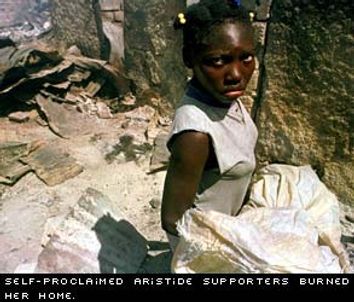
Haiti, a country I love and where I lived for months in 1997, seems once again to be drifting, inexorably, toward its own terrible, particular marriage of anarchy and dictatorship. In the run-up to the parliamentary elections that were held May 21 (where former president Jean Bertrand-Aristide’s Fanmi Lavalas party won 16 of 19 Senate seats outright), the country witnessed a spate of political violence on a level not seen since the dark days of Raul Cedras’ military junta of the early 1990s.

In the space of six months, Jean Dominique, the country’s most respected journalist, was gunned down outside his radio station, an opposition campaign director was macheted to death inside his home and the campaign offices of opposition party Espace de Concertation were burned to the ground by a mob chanting pro-Lavalas slogans and calling for the death of Espace’s leader, former mayor of Port-au-Prince Evans Paul. Recently, the president of Haiti’s electoral council fled to the United States, fearing for his life after he refused to sign off on the election results.

Members of various opposition groups were jailed in advance of last week’s announcement of the electoral results. The Lavalas government has given explanations for these “detainments” ranging from the accusation that those arrested were accumulating firearms in preparation for a strike against the government, to saying that the detained were being threatened and that they were taken into protective custody for their own good as a “preventative measure.” Meanwhile, the disputed count has Lavalas taking 16 of the 17 available Senate seats and likely to control both houses of Parliament.

While a second round of voting has been indefinitely postponed, the elections so far have been marred by allegations of fraud. The opposition has declared the results invalid, vowing to sit out the runoff elections. People murmur that the Organization of American States (OAS) electoral monitors are trying to shove a sham election down the country’s throat just so all the international types can go home feeling that their money was well spent on “democratic” development programs, since some form of democracy was restored in 1994. Although the OAS recently released a statement calling the methodology of the vote tally “incorrect,” there are many who think that it is too little, too late.

This situation is all the more troubling because Fanmi Lavalas (“lavalas” means “the flood” in Creole) is a political party whose dominant figure, Jean Bertrand-Aristide, has been the country’s most outspoken, fearless champion of democratic rights. He fought for those rights during days when championing such a cause meant death.

Aristide is the preeminent political figure in the country. It was Aristide who spoke out against the Tonton Macoutes and human rights abuses of Frangois and Jean-Claude Duvalier’s regimes. Aristide, who continued the democratic struggle under the military regimes of Henri Namphy and Prosper Avril, men who found it politically expedient to massacre voters in 1987 on Ruelle Vaillant at Port-au-Prince, and then again in 1988 at the Cathedral St. Jean-Bosco while Aristide, then a practicing Catholic priest, was celebrating Mass.

It was Aristide and Lavalas, also, who were chased out of the country by a military coup in 1991 (after Aristide had become Haiti’s first democratically elected president) and then returned to power by the U.S. Marines in 1994. Barred from serving consecutive terms as president, Aristide reluctantly handed over power to his protigi, Rene Preval, and is said to be waiting until he can again run for (and almost certainly win) the presidency of Haiti in 2001.

Haitians, meanwhile, are left wondering whether they will have a heroic, visionary Nelson Mandela or an authoritarian, scapegoating Robert Mugabe (two other third-world leaders who came to power on a tide of popular movements) on their hands come that time.

Sadly, as I found out, the hard facts of Haiti don’t make it easy to stay a hero for long.

“These are difficult times in Haiti,” said Mirlande Manigat, an unsuccessful candidate for the Senate. Manigat is a member of the Assembly of Progressive National Democrats (RDNP), and a constitutional law professor at the University of Quisqueya in the capital. “The many political parties in Haiti reflect the polarization of Haitian society, and one party wins over 90 percent of the vote? Impossible.”

A pleasant, highly educated woman, Manigat is the wife of onetime Haitian president Leslie Manigat. Her husband (whom Haitians had never really warmed to and whose election many regarded as fraudulent itself) was booted out of the post in 1988 in the chaos of post-Duvalier Haiti by Gen. Henri Namphy, a vicious dictator now alleged to be slowly and quietly drinking himself to death in exile in the Dominican Republic.

“My political party doesn’t believe in violence or dictatorial force, so we now have no recourse … We are heading for a gloomy time in Haiti.” She looked down at her desk, and then wistfully out the window of her university office. “I didn’t expect this for my country, now.”

The climate of violence affects everyone here. A shellshocked Reuters correspondent, just arrived from the States, appeared at the house I was staying at in Port-au-Prince to inform us that his car had been detained as a group of young men ran past, smashing bottles and carrying tires under their arms. Word on the street had it that they were angry because Lavalas still hadn’t paid them for their “work” during the elections. Zenglendos (armed thugs) stuck a gun in my friend’s sister’s face as she sat stuck in traffic on a downtown street. Finding notebooks that indicated she was a student, they threw them back at her through the car window as they drove away on their motorcycles.

As a friend of mine, a wealthy progressive mulatto, said, “The security situation here is not good.” The fact that the streets of a city of 2 million people are empty at 8 p.m. is testimony enough to that.

I got a taste of how unstable that situation was firsthand when a group of friends and I ventured out one night to a hotel in the affluent suburb of Petionville. We went to see a concert by Sweet Micky, the legendary “president” of compas, Haiti’s singularly slinky and sensual popular music. Micky is an unrepentant supporter of the 1991 coup against Aristide, and is as famous for his scabrous double-entendres as for his anti-Lavalas politics. His sweaty, exhilarating shows are known to attract a raucous crowd of ex-secret police, soldiers and gang members.

Sure enough, once we arrived among the massive, dressed-to-kill crowd, the audience scattered over the demurely arranged deck chairs and around a pair of illuminated pools — not once but three times — as groups of men drew their guns on one another, spitting invective and threatening violence. After one particularly nasty stampede, where I badly twisted my ankle knocking over a table to get away from any potentially flying bullets, a teenage Haitian boy got up with his girlfriend from their own pile of scattered chairs, looked at me and said simply, “Blan,” the Creole world for foreigner. He was doubled over with laughter.

But in the face of such terror, kindness persists. A musician insisted that I partake of his young daughter’s first Communion cake. An evangelist minister drove me the whole, hot, long, dusty way from Aristide’s foundation at Tabarre to drop me off in downtown Port-au-Prince and then refused to take any payment for his services. A Haitian English teacher in a frayed suit who had lived near my own home in Brooklyn for 14 years began a conversation with me, unsolicited, just to hear what New York was like these days. As we walked down the street, he asked me with a sad shake of his head to tell people “what they [Lavalas] did to these elections.”

Cleansing rain showers began in a flash on an afternoon of brilliant sunshine, the city never darkening a bit. These people’s kindnesses and the stunning beauty of this place are what make the story of what is happening in Haiti something you must know.

“I came down here in 1985 to research voodoo rhythms,” says Richard Morse, a surpassingly tall New York transplant, as he takes a drag off an early morning cigarette. We’re in the lobby of the hotel he runs, a space where his group, Ram, also plays regular weekly gigs. The hotel itself is one of the outstanding examples of gingerbread architecture in Port-au-Prince.

“I took over the hotel in 1987, formed a band in 1990 and stopped counting governments in 1996.” He remembers a time in the early 1990s when coups and counter-coups gave the country three governments in 12 hours. Morse, a Haitian-American educated at Princeton, is not hopeful about the current state of affairs in his adopted country. He says the lines between the old military regimes and Lavalas are getting fuzzier.

“They’re trying to set up a system where there’s no opposition, and they’re willing to try any methods necessary to attain that,” he says. He disagrees with the Organization of American States’ qualified approval of the election results. “The OAS is saying, ‘There were some discrepancies, but everything’s OK.’ Well everything’s not OK. They’re killing people. They’re killing people and people are going into hiding.”

Lavalas essentially terrorized the opposition into hiding until two weeks before the elections, Morse believes. Then, with a statement from Aristide calling for peaceful elections, the violence miraculously ceased and the opposition was told to field their candidates in what was to be a competitive election.

Morse thinks that the OAS is trying to pretend an election is valid despite obvious fraud and unfair voting practices, as they are currently accused of doing in Peru. Critics say the OAS is lowering the bar for what is acceptable in democratic elections under the philosophy that some movement forward (i.e., the holding of elections at all) is better than no movement forward.

Reiterating Manigat’s sentiment, Morse stated flatly: “The precedent has been set that if you want to be involved in politics in this country, you’ve got to get your guns together … Nothing’s changed, the teams have changed but not the modus operandi.”

Before we switched to music and New York, he punctuated our political conversation simply. “You can get killed here for saying the shit I just said.”

- – - – - – - – - – - -

Yvon Neptune and I sat around a table inside the house where he keeps his offices in downtown Port-au-Prince. An intense man with his beard and hair going gray around the edges, Neptune is the spokesman for Fanmi Lavalas who recently defeated Manigat to become a senator in the Haitian parliament.

The room was cool and quiet, away from the noise of the street. Cabinets were arranged around the room, lined with books in several languages. A bird chattered away from somewhere in the garden out back.

“The Haitian people are pleased” with the results of the election, he said. “The majority of the voters are pleased, because the elections have been an opportunity for them to state their position on the situation in Haiti.”

Over the course of an hour, Neptune spoke of the policy of agrarian reform begun under President Aristide and continued under Preval, and also about encouraging the private sector, local and foreign, to invest in Haiti. He alluded to the pending approval of agreements with the IMF and World Bank by the new parliament, and of the necessity of modernizing the administrative infrastructure of Haiti.

Asked about Lavalas’ commitment to democracy, and about the violence preceding the election, Neptune commented that “we continually stated our position on violence in Haiti: denouncing the violence, condemning the violence. We encourage everybody, everybody,” he continued, “not to let themselves be intimidated and to come out and vote. And that’s exactly what they did.”

When questioned about the attacks on the opposition headquarters, specifically the arson of Espace de Concertation’s offices, Neptune shifted blame back to that party’s leaders, and their supporters, whom he characterized as party “cronies.”

“It is difficult to accept the value of the opposition, the weight of that opposition, because it is practically nonexistent except for a few politicians who would use the airwaves to make accusations,” he said. “They often commit violent act [sic] or delegate people to commit violent acts and they go as far as posturing as Fanmi Lavalas partisans. It is very easy for them to do that.”

The fire, he implied, was probably set by Espace themselves. “That particular organization failed to pay the rent on that building for almost five years.”

Again and again, talking to people of various backgrounds and political stripes, I heard of how Aristide’s party has been acting recently in ways that are reminiscent of dictator Frangois “Papa Doc” Duvalier. It’s hard for many Haitans to forget that Papa Doc came to power on a wave of noirisme, resentment of the elite light-skinned minority. And recently Lavalas members on state-run TV labeled mulattos of any ideological orientation as the “racist bourgeoisie” for the crime of criticizing Fanmi Lavalas (and by extension Aristide).

Dany Toussaint, a close confidant of Aristide and a newly elected senator, dismissively referred to several prominent mulattos including journalist Jean Dominique as “ti wouj” (the little red ones). Dominique had been an advisor to both Aristide and Preval. But he was murdered shortly after Toussaint’s comment. That fact, and Dominique’s intimations about Toussaint’s alleged involvement in drug trafficking, shifted suspicion for the journalist’s killing onto Lavalas.

And yet.

One goes downtown in Port-au-Prince to the slums of Bel Air, near the Palais Nacional, the crowded, congested streets of Avenue Jean-Jacques Dessalines, or the dusty, chaotic suburb of Delmas (favored base for the zenglendos) where, as one friend told me, “everyone gets robbed.” You go to these neighborhoods and you are struck by the absolute belief that exists there that “Titid” (as Aristide is affectionately known) is the only man capable of solving Haiti’s multitude of problems, the only man who has ever stood up for the poor, the only one who ever gave a damn.

The desperate, begging street boys on the Champs Mars dress in rags and sleep on the ground. I talked to young men who have moved from the countryside to the Cite Soleil and La Saline slums who have never found a job and probably never will. Old women sell fritays and fried bananas under the withering noonday sun. “N’ap toujou renme w Titid” (We will always love you Aristide) is scrawled on crumbling walls.

Some words come to mind that Aristide spoke, just days before the coup of 1991 forced him out of office and Cedras and company began an orgy of bloodletting unrivaled even in Papa Doc’s time. Aristide, his back to the wall, had been informed of rumors that a plot was about to topple him and perhaps kill him, and that lists of his supporters who were also to be killed were being drawn up. This was the famous “Pere Lebraun” speech, which many in the media never tire of referring to as the moment when Aristide began calling for the “necklacing” of the opposition:

Again, under the flag of pride, under this flag of dignity, under this flag of solidarity, hand in hand, one encouraging the other, [...] each one will pick up the message of respect that I share with you, this message of justice that I share with you, so that the word ceases to be the word and becomes action. [...] it’s you who will find what you deserve, according to what the Mother Law of the country declares.
One alone, we are weak,
Together we are strong. Together, together.
Together we are the flood (crowd: Frenzy!)
Do you feel proud? (crowd: Yeah!)

So true, that there is power in numbers. Whether or not Jean-Bertrand Aristide and Fanmi Lavalas are committed to using their popularity — and, more important, Aristide’s sacred relationship with many in the country — to push forward a program of real democratic change remains to be seen, but the signs are not encouraging.

If they fail, or succumb to the temptations for a naked power grab that have too long plagued Haiti’s rulers, their betrayal of the Haitian people will be doubly bitter, coming as it does on the backs of all who followed Aristide’s clarion call for democracy to their graves: the voters at Ruelle Vaillant, the martyrs of St. Jean Bosco and the thousands who died under the junta of 1991-94.

As always in Haiti, only time (and not words) will bear out their true intentions. But they’re walking on a razor’s edge.

“With a strong government and parliament, and a strong political program,” Neptune said to me toward the end of our interview, “we’ll spend less time bickering over power, so the majority who represent the people will have enough time to concentrate on their jobs. I think that’s what needs to happen. And it is about to happen.”

Continue Reading Close