Michael Schwartz

Why Mubarak fell

The (sometimes) incredible power of nonviolent protest

  • more
    • All Share Services

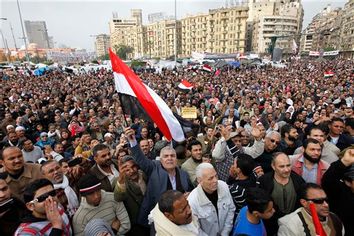
Why Mubarak fellThousands of anti-government protesters gather in Tahrir Square, Cairo, Egypt, Monday, Feb. 7, 2011. The protests, which saw tens of thousands of people massing daily in downtown Cairo for demonstrations that at times turned violent, have raised questions about the impact on the economy. More than 160,000 foreign tourists fled the country in a matter of days last week, in an exodus sure to hammer the vital tourism sector. (AP Photo/Manoocher Deghati)(Credit: AP)

This piece originally appeared on TomDispatch.

Memo to President Obama: Given the absence of intelligent intelligence and the inadequacy of your advisers’ advice, it’s not surprising that your handling of the Egyptian uprising has set new standards for foreign policy incoherence and incompetence. Perhaps a primer on how to judge the power that can be wielded by mass protest will prepare you better for the next round of political upheavals.

Remember the uprising in Beijing’s Tiananmen Square in 1989? That was also a huge, peaceful protest for democracy, but it was crushed with savage violence. Maybe the memory of that event convinced you and your team that, as Secretary of State Clinton announced when the protests began, the Mubarak regime was “stable” and in “no danger of falling.” Or maybe your confidence rested on the fact that it featured a disciplined modern army trained and supplied by the USA.

But it fell, and you should have known that it was in grave danger. You should have known that the prognosis for this uprising was far better than the one that ended in a massacre in Tiananmen Square; that it was more likely to follow the pattern of people power in Tunisia, where only weeks before another autocrat had been driven from power, or Iran in 1979 and Poland in 1989.

Since your intelligence people, including the CIA, obviously didn’t tell you, let me offer you an explanation for why the Egyptian protesters proved so much more successful in fighting off the threat and reality of violence than their Chinese compatriots, and why they were so much better equipped to deter an attack by a standing army. Most importantly, let me fill you in on why, by simply staying in the streets and adhering to their commitment to nonviolence, they were able to topple a tyrant with 30 years seniority and the backing of the United States from the pinnacle of power, sweeping him into the dustbin of history.

When Does an Army Choose to Be Nonviolent?

One possible answer — a subtext of mainstream media coverage — is that the Egyptian military, unlike its Chinese counterpart, decided not to crush the rebellion, and that this forbearance enabled the protest to succeed. However, this apparently reasonable argument actually explains nothing unless we can answer two intertwined questions that flow from it.

The first is: Why was the military so restrained this time around, when for 50 years, “it has stood at the core of a repressive police state.” The second is: Why couldn’t the government, even without a military ready to turn its guns on the demonstrators, endure a few more days, weeks, or months of protest, while waiting for the uprising to exhaust itself, and — as the BBC put it — “have the whole thing fizzle out.”

The answer to both questions lies in the remarkable impact that the protest had on the Egyptian economy. Mubarak and his cohort (as well as the military, which is the country’s economic powerhouse) were alarmed that the business “paralysis induced by the protests” was “having a huge impact on the creaking economy” of Egypt. As Finance Minister Samir Radwin said two weeks into the uprising, the economic situation was “very serious” and that “the longer the stalemate continues, the more damaging it is.”

From their inception, the huge protests threatened the billions of dollars that the leaders and chief beneficiaries of the Mubarak regime had acquired during their 30 year reign of terror, corruption, and accumulation. To the generals in particular, it was surely apparent that the massive acts of brutality necessary to suppress the uprising would have caused perhaps irreparable harm, threatening its vast economic interests. In other words, either trying to outwait the revolutionaries or imposing the Tiananmen solution risked the downfall of the economic empires of Egypt’s ruling groups.

But why would either of those responses destroy the economy?

Squeezing the Life Out of the Mubarak Regime

Put simply, from the beginning, the Egyptian uprising had the effect of a general strike. Starting on January 25th, the first day of the protest, tourism — the largest industry in the country, which had just begun its high season — went into free fall. After two weeks, the industry had simply “ground to a halt,” leaving a significant portion of the two million workers it supported with reduced wages or none at all, and the few remaining tourists rattling around empty hotels, catching the pyramids, if at all, on television.

Since pyramids and other Egyptian sites attract more than a million visitors a month and account for at least 5% of the Egyptian economy, tourism alone (given the standard multiplier effect) may account for over 15% of the country’s cash flow. Not surprisingly, then, news reports soon began mentioning revenue losses of up to $310 million per day. In an economy with an annual gross domestic product (GDP) of well over $200 billion, each day that Mubarak clung to office produced a tangible and growing decline in it. After two weeks of this ticking time bomb, Crédit Agricole, the largest banking group in France, lowered its growth estimate for the country’s economy by 32%.

The initial devastating losses in the tourist, hotel, and travel sectors of the Egyptian economy hit industries dominated by huge multinational corporations and major Egyptian business groups dependent on a constant flow of revenues. When cash flow dies, loan payments must still be made, hotels heated, airline schedules kept, and many employees, especially executives, paid. In such a situation, losses start mounting fast, and even the largest companies can face a crisis quickly. The situation was especially ominous because it was known that skittish travelers would be unlikely to return until they were confident that no further disruptions would occur.

The largest of businesses, local and multinational, are not normally prone to inactivity. They are the ones likely to move most quickly to stem a tide of red ink by agitating the government to suppress such a protest, hopefully yesterday. But the staggering size of even the early demonstrations, the face of a mobilizing civil society visibly shedding 30 years of passivity, proved stunning. The fiercely brave response to police attacks, in which repression was met by masses of new demonstrators pouring into the streets, made it clear that brutal suppression would not quickly silence these protests. Such acts were more likely to prolong the disruptions and possibly amplify the uprising.

Even if Washington was slow on the uptake, it didn’t take long for the relentlessly repressive Egyptian ruling clique to grasp the fact that large-scale, violent suppression was an impossible-to-implement strategy. Once the demonstrations involved hundreds of thousands, if not millions, of Egyptians, a huge and bloody suppression guaranteed long-term economic paralysis and ensured that the tourist trade wasn’t going to rebound for months or longer.

The paralysis of the tourism industry was, in itself, an economic time bomb that threatened the viability of the core of the Egyptian capitalist class, as long as the demonstrations continued. Recovery could only begin after a “return to normal life,” a phrase that became synonymous with the end of the protests in the rhetoric of the government, the military, and the mainstream media. With so many fortunes at stake, the business classes, foreign and domestic, soon enough began entertaining the most obvious and least disruptive solution: Mubarak’s departure.

Strangling the Mubarak Regime

The attack on tourism, however, was just the first blow in what rapidly became the protestors’ true weapon of mass disruption, its increasing stranglehold on the economy. The crucial communications and transportation industries were quickly engulfed in chaos and disrupted by the demonstrations. The government at first shut down the Internet and mobile phone service in an effort to deny the protestors their means of communication and organization, including Facebook and Twitter. When they were reopened, these services operated imperfectly, in part because of the increasingly rebellious behavior of their own employees.

Similar effects were seen in transportation, which became unreliable and sporadic, either because of government shutdowns aimed at crippling the protests or because the protests interfered with normal operations. And such disruptions quickly rippled outward to the many sectors of the economy, from banking to foreign trade, for which communication and/or transportation was crucial.

As the demonstrations grew, employees, customers, and suppliers of various businesses were ever more consumed with preparations for, participation in, or recovery from the latest protest, or protecting homes from looters and criminals after the government called the police force off the streets. On Fridays especially, many people left work to join the protest during noon prayers, abandoning their offices as the country immersed itself in the next big demonstration — and then the one after.

As long as the protests were sustained, as long as each new crescendo matched or exceeded the last, the economy continued to die while business and political elites became ever more desperate for a solution to the crisis.

The Rats Leave the Sinking Ship of State

After each upsurge in protest, Mubarak and his cronies offered new concessions aimed at quieting the crowds. These, in turn, were taken as signs of weakness by the protestors, only convincing them of their strength, amplifying the movement, and driving it into the heart of the Egyptian working class and the various professional guilds. By the start of the third week of demonstrations, protests began to hit critical institutions directly.

On February 9th, reports of a widening wave of strikes in major industries around the country began pouring in, as lawyers, medical workers, and other professionals also took to the streets with their grievances. In a single day, tens of thousands of employees in textile factories, newspapers and other media companies, government agencies (including the post office), sanitation workers and bus drivers, and — most significant of all — workers at the Suez Canal began demanding economic concessions as well as the departure of Mubarak.

Since the Suez Canal is second only to tourism as a source of income for the country, a sit-in there, involving up to 6,000 workers, was particularly ominous. Though the protestors made no effort to close the canal, the threat to its operation was self-evident.

A shutdown of the canal would have been not just an Egyptian but a world calamity: a significant proportion of the globe’s oil flows through that canal, especially critical for energy-starved Europe. A substantial shipping slowdown, no less a shutdown, threatened a possible renewal of the worldwide recession of 2008-2009, even as it would choke off the Egyptian government’s major source of steady income.

As if this weren’t enough, the demonstrators turned their attention to various government institutions, attempting to render them “nonfunctional.” The day after the president’s third refusal to step down, protestors claimed that many regional capitals, including Suez, Mahalla, Mansoura, Ismailia, Port Said, and even Alexandria (the country’s major Mediterranean port), were “free of the regime” — purged of Mubarak officials, state-controlled communications, and the hated police and security forces. In Cairo, the national capital, demonstrators began to surround the parliament, the state TV building, and other centers critical to the national government. Alaa Abd El Fattah, an activist and well known political blogger in Cairo, told Democracy Now that the crowd “could continue to escalate, either by claiming more places or by actually moving inside these buildings, if the need comes.” With the economy choking to death, the demonstrators were now moving to put a hammerlock on the government apparatus itself.

At that point, a rats-leaving-a-sinking-ship-of-state phenomenon burst into public visibility as “several large companies took out adverts in local newspapers putting distance between themselves and the regime.” Guardian reporter Jack Shenker affirmed this public display by quoting informed sources describing widespread “nervousness among the business community” about the viability of the regime, and that “a lot of people you might think are in bed with Mubarak have privately lost patience.”

It was this tightening noose around the neck of the Mubarak regime that made the remarkable protests of these last weeks so different from those in Tiananmen Square. In China, the demonstrators had negligible economic and political leverage. In Egypt, the option of a brutal military attack, even if “successful” in driving them off the streets, seemed to all but guarantee the deepening of an already dire economic crisis, subjecting ever widening realms of the economy — and so the wealth of the military — to the risk of irreparable calamity.

Perhaps Mubarak would have been willing to sacrifice all this to stay in power. As it happened, a growing crew of movers and shakers, including the military leadership, major businessmen, foreign investors, and interested foreign governments saw a far more appealing alternative solution.

Weil Ziada, head of research for a major Egyptian financial firm, spoke for the business and political class when he told Guardian reporter Jack Shenker on February 11th:

“Anti-government sentiment is not calming down, it is gaining momentum…This latest wave is putting a lot more pressure on not just the government but the entire regime; protesters have made their demands clear and there’s no rowing back now. Everything is going down one route. There are two or three scenarios, but all involve the same thing: Mubarak stepping down — and the business community is adjusting its expectations accordingly.”

The next day, President Hosni Mubarak resigned and left Cairo.

President Obama, remember this lesson: If you want to avoid future foreign policy Obaminations, be aware that nonviolent protest has the potential to strangle even the most brutal regime, if it can definitively threaten the viability of its core industries. In these circumstances, a mass movement equipped with fearsome weapons of mass disruption can topple a tyrant equipped with fearsome weapons of mass destruction.


A professor of sociology at Stony Brook State University, Michael Schwartz is the author of War Without End: The Iraq War in Context (Haymarket Press). Schwartz’s work on protest movements, contentious politics, and the arc of U.S. imperialism has appeared in numerous academic and popular outlets over the past 40 years. He is a TomDispatch regular. His email address is ms42@optonline.net. To listen to Timothy MacBain’s latest TomCast audio interview in which Schwartz discusses the Egyptian revolution and the power of nonviolent disruption, click here, or download it to your iPod here.


Ten ways to argue about the war

How to talk back to die-hard war supporters.

  • more
    • All Share Services

Ten ways to argue about the war

I often receive e-mails — pro and con — about my postings on the war in Iraq, and I try to respond to any substantive questions or critiques offered. But when I received an e-mail titled “10 Questions,” in response to a TomDispatch commentary detailing the arguments for immediate withdrawal, I must admit my heart sank — the questions were familiar, but the answers were complex and I was in no mood to spend the time needed to respond properly.

After a couple of days, however, I began to warm to the idea of writing short but pointed responses to these common criticisms of antiwar positions because, I realized, they are the bread and butter of daily Iraq discourse in our country. When the war comes up in the media or in casual conversation, these are the issues raised by those who think we have to “stay the course” — and among those who oppose the war, these are the lurking, unspoken questions that haunt our discussions. So here are my best brief answers to these key issues in the crucial, ongoing debate over Iraq.

“I read your article on withdrawal of American troops,” my correspondent began, “and questioned the lack of discussion of the following…” (His comments are in bold.)

1. Nothing was mentioned about improvements in Iraq (elections, water and energy, schools). No Saddam to fear! Water and energy delivery as well as schools are worse off than before the U.S. invasion. Ditto for the state of hospitals (and medical supplies), highways and oil production. Elections are a positive change, but the elected government does not have more than a semblance of actual sovereignty, and therefore the Iraqi people have no power to make real choices about their future. One critical example: The Shiite/Kurdish political coalition now in power ran on a platform whose primary promise was that, if elected, they would set and enforce a timetable for American withdrawal. As soon as they took power, they reneged on this promise (apparently under pressure from the United States). They have also proved quite incapable of fulfilling their other campaign promises about restoring services and rebuilding the country; and for that reason (as well as others), their constituents (primarily the Shiites) are becoming ever more disillusioned. In the most recent polls, Shiite Iraqis now are about 70 percent in favor of U.S. withdrawal.

2. Nothing was mentioned about Iraqis who want the U.S. to remain (especially the Kurds and the majority of Iraqi women). Among the three principal ethno-religious groups in Iraq, the Sunnis (about a fifth of the population) are almost unanimous in their opposition to the American presence, while around 70 percent of the Shiites (themselves about 60 percent of the population) want the United States to withdraw. Hence, even before we consider the Kurds, the majority of Iraqis are in favor of a full-scale American departure “as soon as possible.” It is true that the Kurds (about 20 percent of the population) favor the United States remaining. However, they have their own militias, and many of them do not want significant numbers of American troops in their territory. (The U.S. presence there is small scale at the moment.) What they desire is a U.S. occupation for someone else, not themselves. I think we can safely say that the vast majority of Iraqis oppose the presence of U.S. troops.

I know of no study indicating that Iraqi women favor the U.S. presence. Perhaps you are referring to the fact that large numbers of women in Iraq are upset and angry over the erosion of their rights since the fall of Saddam. I know some commentators claim that the U.S. presence is insurance against further erosion of those rights, but everything I have read indicates that a significant number of Iraqi women (like all other Iraqis) blame the Bush administration for these policies. After all, the Americans installed in power (and continue to support) the political forces spearheading anti-woman policies in the country. Polling data does not indicate that any sizable group of Sunni or Shiite women support a continued U.S. presence.

3. Nothing was mentioned about the benefits of the U.S. military gaining valuable experience and knowledge daily. Certainly, the U.S. gains military and political “experience” from the war, as from any war, but at the expense of many deaths (2,127) and injuries (at least 15,704) to American soldiers. Beyond these publicly listed casualty figures lie the endless ways in which the lives of our soldiers are permanently damaged: On Nov. 26, for example, the New York Times reported on a recent Army study indicating that 17 percent of all personnel sent to Iraq have “serious symptoms of depression, anxiety, or post-traumatic stress disorder.” Since about a million American troops have now seen service in Iraq, approximately 170,000 have gained the “experience” of having a severe mental problem. Moreover, the war experience in Iraq has proved so demoralizing to the military that many of the best soldiers are leaving at the end of their tours, instead of staying on in active or reserve status. This is undermining the viability of the military, long term.

U.S. casualties, of course, have been dwarfed by the damage done to the Iraqi people. Between 25,000 and 40,000 Iraqi civilians are dying each year — and multitudes are injured. We are wrecking the country’s infrastructure.

Certainly there is a better way to gain experience than this.

4. Nothing was mentioned about the future benefits of a strong democracy in the Middle East. We can all agree that a strong democracy in the Middle East would have huge benefits for Iraq and for its neighbors as well as for the rest of the world. If I thought that our actions there were helping to bring this about, perhaps I might also believe that the benefits of an active democracy outweighed at least some of the many problems we have been creating. But from the beginning, the talk of democracy was a hollow mantra, just one of a group of public rationalizations for a war motivated by the Bush administration’s desire to dominate Middle Eastern politics and economics. The U.S. government has never actually relinquished sovereignty to the Iraqi government.

5. Nothing was mentioned about the future benefits of oil reserves. Though the Bush administration denies it, many observers agree with you that access to Iraqi oil was a major motivation for the war. But we need to understand the nature of this motivation. Even before the invasion, when U.N. sanctions were still in place against Saddam Hussein’s regime, American oil companies could (and, in many cases, did) buy Iraqi oil at market price. The issue was never “access” to Iraqi oil in the sense of simply being able to buy it. The Bush administration was thinking about other kinds of energy access, including controlling the heartland of the word’s main future oil supplies and giving American oil companies privileged access to Iraqi oil reserves. (See, for example, the recent report by the Global Policy Forum.) It’s my contention that such privileged “access” for U.S. oil companies would not help the American people. Moreover, such privileged access would have deprived the Iraqis of their right to use the oil to their own benefit — something they desperately need now that the Saddam Hussein regime, 12 years of brutal sanctions, and the current war have gutted the country.

The best approach for us (but not necessarily for the American oil companies) would be to buy our oil on the open market, put our research money into conservation and renewable fuels instead of military adventures, and avoid trying to get “control” of something that doesn’t belong to us.

6. Nothing was mentioned about what fundamentalist Muslims would like to achieve. I assume that, when you refer to “fundamentalist Muslims,” you are referring to terrorists, including those in Iraq and those who attacked the World Trade Center, the London tube, and the Madrid trains. First, I have to disagree with this identification of the terrorists (who are indeed fundamentalist) with all fundamentalist Muslims. That would be the same as characterizing those who bombed the Oklahoma City Federal Building as “fundamentalist Christians” and then implying that the destruction of such buildings is what all fundamentalist Christians yearn to achieve.

Second, I disagree with the implicit argument that somehow withdrawal will allow the terrorists to dominate Iraqi society and impose a horrible regime on an Iraq bent on attacking its neighbors and the United States. A large part of my commentary in favor of withdrawal was devoted to debunking this prevalent idea. I think I made a reasonably good case for the possibility that Bush administration actions in Iraq are creating and strengthening the terrorist groups within the Iraqi resistance. The longer the United States stays, the more the Islamic terrorists there are likely gain strength; the sooner the United States leaves, the more quickly the resistance will subside, and — with it — support for terrorism. The administration’s Iraqi occupation policies are the equivalent of a nightmarish self-fulfilling prophesy.

7. Nothing was mentioned about the results of the U.S. evacuation from Southeast Asia (over a million killed within 5 years). I think we need to disentangle two different events involving the (forced) American departure from Southeast Asia. First, there was Vietnam, where it was always predicted that a horrendous bloodbath would follow any American withdrawal. Indeed, there were certainly deaths there after the U.S. left, and many refugees fled the country, some for the United States. But whatever these figures may have been, they were dwarfed by the incredible bloodbath that the United States created by being in Vietnam in the first place. Reputable sources suggest that millions of Vietnamese died (and countless others were permanently wounded) during the war years. We must conclude, therefore, that in Vietnam our departure actually resulted in a drastic decline in the levels of violence, and — sometime afterward — an end to the havoc and destruction, not to speak of the fact that, for years now, the United States has had plenty of “credibility” in Vietnam.

Second, there was the holocaust in Cambodia, which may well have resulted in a million or more deaths. This was also, however, a complex consequence of the U.S. presence in Southeast Asia, not a result of our departure. Cambodia had a stable, neutral government until the Nixon administration launched massive secret bombings against its territory, invaded the country, destabilized the regime, and set in motion the grim unraveling that led to the rise of the murderous Khmer Rouge. If the United States had withdrawn from Vietnam in 1965 or 1968, that holocaust would quite certainly never have happened.

The situation in Iraq is not that dissimilar. If the United States withdraws soon, there is at least a reasonable chance that the violence will subside quickly and that peace and stability in the region might ever so slowly take hold. The longer the United States stays — further destroying the Iraqi infrastructure and destabilizing neighboring regimes (like Syria and Iran) — the more likely it is that horrific civil wars and other forms of brutality will indeed occur.

8. Nothing was mentioned about the reputation of the U.S. if it retreats. Don’t forget the quotes about Somalia from Osama bin Laden: “Cut and run.” Here we agree. If the United States withdraws, this “retreat” will undermine U.S. credibility whenever, in the future, an administration threatens to use military power to force another country to submit to its demands (and may also, as after Vietnam, make Americans far more wary about sending troops abroad to fight presidential wars of choice). I think there are two important implications that derive from this observation.

The first is that this has, in fact, already happened. The most crystalline case making this point is that of Iran, whose leaders were much more compliant to U.S. demands before the Iraq invasion than they are now that they have seen how the Iraqi resistance has frustrated our military. In fact, the invasion of Iraq has probably done more to strengthen the oppressive Iranian regime, domestically and in the Middle East, than any set of events in the past quarter-century. In other words — from your point of view — the longer the Bush administration stays and flounders, the more it undermines its ability to use the threat of military intervention to force other countries to conform to its demands.

From my point of view — and this is the second implication I want to point out — the undermining of U.S. credibility is one of the few good things that have resulted from the war in Iraq. I do not believe that anything positive is likely to come from American military adventures; quite the contrary, the Bush administration (and the Clinton, earlier Bush, and Reagan administrations) have used military power to impose bad policies on other countries. We would be much better off, I believe, with the multipolar world that many Americans advocate (and this administration loathes the very thought of), in which no single state (including the United States) could impose itself on others without at least the support of a great many others. We would be far better off in a multitude of ways if our country stopped spending more on its military than the rest of the world combined and started spending some of that money on things that would improve the welfare of our people.

9. Nothing was mentioned about Germany, Japan, Korea and the former Yugoslavia. Should we get out of those? Where was the prewar planning to get out of all those locations? Did Lincoln have a prewar plan to leave the South? I agree that some wars, some interventions and some occupations can be positive things (without evaluating the particulars of the examples you offer). That does not mean that all, or even most, of them are good. The invasion, occupation and destruction of Iraq is neither justified nor moral.

10. Nothing was mentioned about 9/11, where we were attacked by fundamentalist Muslims. How do we change their attitudes? This query rests on two premises: The first belongs to the Bush administration and was part of the package of lies and intelligence manipulations that it used to hustle Congress and the American people into war — the claim that Saddam Hussein’s regime and the terrorists who attacked the United States on Sept. 11, 2001, had anything in common or any ties whatsoever. They didn’t, and the truth is that 9/11, important as it was, really should have nothing to do with Iraq and no place in any discussion of the war there — or at least that was certainly true until George Bush and his advisors managed almost single-handedly to re-create Iraq as the “central theater in the war on terror.”

The second premise is one held by many Americans — that the only way to change the attitudes of those who are fighting the United States involves “whipping their ass,” which rests on another commonly held opinion — that “these people only understand force.” Attitudes are never changed in this way. Every serious scholar who studies terrorism agrees on this essential point: Terrorism arises from the misery that many people are forced to live in or in close proximity to. It is misguided and criminal, but it nevertheless derives from complaints people have about their daily lives, about the humiliations they experience in the larger social and political worlds they inhabit, and about the apparent impossibility of changing these circumstances.

This article was originally published at TomDispatch.com.

Continue Reading Close