Michal Lemberger

What “B—-” leaves out

The coy titles of two new shows, "GCB" and "The B---- in Apt. 2B," show the awkwardness of feminist progress

  • more
    • All Share Services

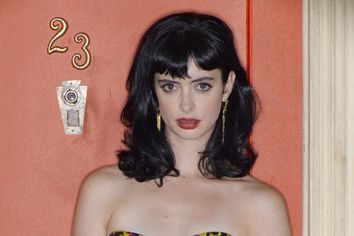
What Krysten Ritter

Every morning as I walk my daughters to school, I pass a billboard advertising a new sitcom on ABC. Alongside a close-up of a smug young woman dangling a key off the end of her finger reads: “Don’t trust the B—- in Apt. 23.” And every morning, I’m glad that they’re too young to read, not only because the whole thing is so staged and lame, but because of what that dash says. More important, it’s what it elides — how we think and talk about women — that’s very troubling. It’s what the title doesn’t say that screams the loudest.

My discomfort will come to an end soon. “The B—- in Apt. 23” debuts tonight. The billboard will be replaced, but what it tells us about how we talk about women isn’t going anywhere.

According to Google Books, the word “bitch” appeared 170,710 times in the decade beginning in 2000, almost always in an up-with-women way. (Compare that to the 1930s, when the 11,369 entries ran more to issues of animal anatomy and veterinary medicine.)

Over the past year, in both politics and the entertainment world, talking about women has become an opportunity to fling around insulting language. A lot has been said about “slut,” but it’s that other word — “bitch” — that really gets at the heart of the issue. “Bitch” occupies a strange and conflicted place in our lexicon and our culture. On the one hand, it’s the ultimate put-down — just ask any woman who’s rejected a sexual advance how it feels to be called a bitch, usually in public. On the other, it’s become a term of affection among, for lack of a better word, the sisterhood.

Which is not to say that we’re entirely comfortable with the word. It still doesn’t pass the polite society test. You still don’t want to say it in front of your grandma. Celebrating — or denigrating — a woman as a bitch still carries a hint of the subversive.

It’s been said that TV is the most democratic of media. If that’s true, then “Don’t Trust the B—-” and its big sister, “GCB,” already airing on ABC, have a lot to teach us. Pitched as “Don’t Trust the Bitch in Apt. 23” and “Good Christian Bitches,” respectively, the shows were picked up in part, I suspect, because of the supposed cheekiness of their titles. They communicate an adult sensibility, one that won’t be afraid to ruffle a few feathers.

Except that the titles were changed immediately. “Don’t Trust the B—- in Apt 23,” a half-hour sitcom, tells a classic odd-couple story about two roommates, one a savvy, possibly psychotic con artist, the other a seeming naif who quickly catches on and earns her harder-edged peer’s respect. Inevitably, they become friends, etc., etc. Scared of actually using the word “bitch” in the title, the network suits originally shortened it to the terminally dull “Apt. 23.” When that didn’t catch on, they reverted to the original, adding a pleasing new rhyme along the way.

The same thing happened to “GCB.” Fearing that Christian audiences would be offended, ABC changed “Good Christian Bitches,” an hour-long comedy-drama about a former “Queen Bitch” who returns to her childhood home in the Dallas suburbs, to “Good Christian Belles.” It was then shortened to its current title, a meaningless acronym that no longer seems to refer to anything.

The new shows’ coy evasion is part of a trend. We saw it in the short-lived sitcom “$#*! My Dad Says.” Based on a popular Twitter feed, the network advertised the show as “Bleep My Dad Says.” “Bleep” is a clever ruse, a censoring of the censoring, but anyone familiar with the show’s history, or cartoon graphics, for that matter, knows what “$#*!” stands for.

“$#*!” can’t actually be spoken on TV, but “bitch” can. Not too long ago, hearing the word come out of a character’s mouth raised an alarm. Hell, Lucy couldn’t even use the word “pregnant,” much less anything really salty. Now, “bitch” has become so commonplace it isn’t even edgy anymore, at least after 8 p.m.

There’s a disjunction here, and it points to the fact that, despite its gains, the word still makes us squeamish. After all, ABC wanted the word to titillate and communicate its own hipness, and yet wouldn’t commit to it for fear of offending anyone.

The word itself holds an interesting, perhaps unique, place among our current crop of go-to slurs. These days, we like to insult people based on sexual characteristics. What better way for Americans still squeamish about sexuality to put someone down than by labeling him with a coarse term for actual genitalia? A man can be a “prick,” “dick” or “asshole,” none of which is considered unspeakably bad. Not so for a woman. We reserve our worst for other words, those that begin with “c” and “t” and conflate an ugly image of female genitalia with the behavior and/or attitudes of women. That’s why they are so offensive. They reduce women to the purely bodily and declare that a woman’s body is inherently offensive at the same time.

“Bitch” comes from a different tradition of insult, in which a person is compared to an animal — in this case, a highly sexualized one — and so stripped of some of his or her humanity. Think “cur,” which has an air of old-fashioned quaintness about it. “Bitch” doesn’t have any overtones of a lost, imperial past.

Outside of dog-breeding circles, the meaning of the word has evolved. Tell a man that he is “someone’s bitch,” and you’ve emasculated him. You’ve reduced him to the level of a woman, which, if the slur is used effectively, is the core of the insult. Any woman who is labeled a bitch is, on the other hand, someone who won’t give what’s asked of her. She has broken the social contract that demands women be pliable and accommodating. Which is precisely the opposite of its meaning when used as a compliment. A woman who admiringly calls another woman a bitch is declaring her admiration for someone who won’t conform to those expectations.

What I can’t figure out is what ABC means by it. Are they trying to offend, or are they attempting, in a ham-handed way, to appeal to young women who want to see themselves as rule-breakers? Because I’m not sure that retaining the initial letter and only gesturing to the rest of the word is any less offensive than just saying it. If network standards-and-practices departments allow dialogue to contain the word, then just go ahead and use it in the title. On the other hand, if “bitch” is too incendiary to appear in a show’s title, it shouldn’t be allowed so liberally once the action starts.

We are already familiar with the double use of words once reserved for bigots and misogynists. Marginalized subcultures often reclaim words that have been used to hurt them. But the process is awkward. They speak to a history of relations — whether they be racial, sexual or gender — that have been complicated, at best, and brutally unjust, at worst. Examples aren’t hard to find. While some people are seen as allowed to use the “n-word,” our general discomfort with it isn’t surprising in a country where young black men are in danger just walking down the street. The same process has been seen in the gay community, which has embraced “queer.” (Remember “Queer Eye for the Straight Guy,” which didn’t have to tiptoe around a formerly offensive word, because it had been so widely accepted.) “Fag,” on the other hand, inhabits that stranger space, in which context is everything: Spat out by a homophobe, it’s hate speech. Used by one gay man to refer to another, it can be an affectionate form of in-speak.

And it’s what’s happening with “bitch.” Despite the gains women have made, gender relations in America remain troubled: Widespread wage gaps still exist, as does a paucity of women at the highest levels of power. We’re still arguing about why women get blamed for their own rapes. The list goes on and on. The words we use to refer to women show us how far that process is from being complete. Every once in a while — as with TV-show titles — our ambivalence about them comes into sharper focus.

Rush Limbaugh learned the limits of our tolerance, at least when it come to a public figure attacking a private citizen using a gendered insult. But the powers-that-be at ABC want to play it both ways. They want to wink at an audience that appreciates the audacity and irony of using the word “bitch,” but are still afraid enough that they will censor it, at least partway.

Television is ubiquitous in America. We invite it into our homes and it reflects us back at ourselves. “Don’t Trust the B—- in Apt. 23” and “GCB” tell us something about how we think about ourselves. If TV executives, their nervous eyes trained on Nielsen ratings and the bottom line, can’t figure out our attitudes about how we think and talk about women, then neither can we. I’m just not ready to tell that to my daughters.

“Downton Abbey,” we’re breaking up

As the Season 2 finale arrives, an obsessive mourns that her favorite show is now just another ridiculous soap

  • more
    • All Share Services

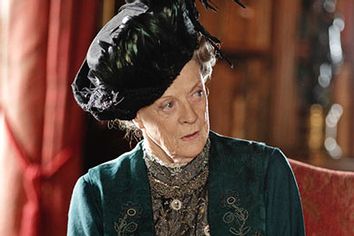
Maggie Smith in "Downton Abbey"

I have a confession to make. “Downton Abbey” is getting on my nerves. This will be taken as heresy in some circles. More specifically, it will be almost treasonous in my own circles. But it’s become harder and harder to sit through the episodes of Season 2 (which concludes tonight) without feeling the need to constantly apologize — to my husband, in particular — for its excesses.

Let me be clear. I remain an avid fan. I loved “Downton Abbey” from the first moment I laid eyes on it. The lustrous sets. The gorgeous costumes. I could watch the upholstery on that show for an hour and be satisfied. Each month that passed between the end of Season 1 and the start of Season 2 brought a small heartache. I squealed just a little when the swelling violins took up again in January.

What’s changed is that “Downton” is now just another melodrama. What so many viewers fell in love with was not just the setting, or the clothes, or Lady Mary’s magnificent eyebrows (which, I’d like to note, deserve an entire plotline to themselves). It was the complexity of the whole. There was an attention to detail in Season 1 that drew the viewer into its world. So much of what made the show work could only happen in that house, during the years of 1913-1914. It gave the story an authenticity that made the experience akin to reading a novel instead of watching a television show. There was the housemaid who dreamed big and wanted to become a secretary. The Irish Socialist who somehow lived with the cognitive dissonance of serving as a chauffeur in an English estate. The middle-class lawyer thrust into the middle of the aristocracy. The closeted footman who couldn’t find any outlet for his passions.

It was all fantastic upstairs/downstairs stuff. Picking up where he had left off in “Gosford Park,” Julian Fellowes fleshed out the world of the manor house. Sure, there were the love affairs. Feckless, often cruel Mary played with Matthew’s emotions, but their relationship served a larger purpose. We saw the traps of upbringing and expectations in her conflicted feelings about marrying him. We experienced his confusion and wounded pride at being turned down when it seemed he wouldn’t actually inherit all the money.

Which is why, perhaps, “Downton Abbey” was appointment TV for my husband and me, two people whose  tastes rarely coincide. He watches sports. I watch upholstery. But as the season has progressed, the groans  from his end of the couch have gotten louder.

I knew we were in trouble during episode 4, when Matthew, feared captured or worse during the war, showed up unannounced in the middle of a concert for the recuperating officers and walked up the aisle, singing. There is no surer sign that a TV show has turned the corner into shameless soap opera than when a man walks up an aisle toward the woman he has jilted, leading the wounded in song.

Melodrama in and of itself is not a problem. The genre has a long and storied history, although it is not usually embraced by those with middle-brow pretentions as assiduously as “Downton Abbey” has been. “Uncle Tom’s Cabin” is nothing if not melodramatic, and it ignited the Civil War, at least according to Abraham Lincoln.

And let’s be honest, “Downton Abbey” has been a melodrama from the start. Set in a distant and unknown (but still familiar enough) culture whose customs and mores are foreign to us, Season 1 featured a family in peril, star-crossed lovers, evil machinations, the works. It’s an irresistible combination that writers have gone back to over and over again, from Gothic novels like “The Castle of Otranto” to vampire lit.

Season 2 does have some stalwart holdouts. The Dowager Countess’ tongue remains as tart as ever upstairs, and Mrs. Patmore still grounds the downstairs world with her earthy, observant candor. Beyond that, what’s left is the most basic, pedestrian soap opera. Sure, we’ve seen World War I and the Spanish flu, but as the season has evolved, everything and everyone has become merely contrivances to propel the sudsy plot. It’s gotten so that “Downton Abbey,” which used the conventions of the soap opera to such great and subtle purpose before, seems to check off each outlandish mark as it goes. Miraculous nonparalysis! Stolen kisses! Overheard conversations! Pretty young woman dead of a broken heart! Murder most foul!

More and more characters — especially the female ones — have become nothing more than useful plot points. We saw something of this in Season 1. Mary’s Turkish lover, for example, was ushered in and out quickly. The difference is that he had an immediate impact — the look of incredulity on Mary’s face when Pamuk suggests that his family would look down upon a match with her is still, to my mind, one of the series’ finest — and lasting importance. His visit, and his death in her bed, still haunt the show.

It’s hard to see how the presence of Jane, the housemaid conjured as if to fill Lord Grantham’s lonely, frustrated fantasies, will continue to resonate. And Lavinia, who finally acquired a scintilla of personality, had to be dispatched so that she’s not in the way of the real story anymore.

Other characters have gotten more one-dimensional, too. Where is Branson’s political fire? All he did for most of this season was stand around the garage mooning over Sybil. She’s proved herself worth it, but he has been reduced in the process. The new maid, Ethel, is a descendant of Tess of the D’Urbervilles and every disgraced relative in Jane Austen’s novels who give into physical passion and are punished for it. Whereas Gwen aspired upward to the heights of secretarydom, Ethel’s dreams are thwarted in the most conventional, and most sensational, way.

Most disappointing is how good everyone is turning out to be. The bitchy Mary, who would string a man along for money without a second thought, now spends most of every episode crying over her lost love. Taciturn Bates, who was so cut off — physically and emotionally — from everyone else, has been turned into a puppy dog in love. The bite is gone. The flawed characters we all loved, or loved to hate, have been flattened by niceness.

There is still a lot of drama to be mined from the characters and situations set up by “Downton Abbey.” England in the 1920s is still as foreign to us as it was in 1913. I will continue to watch. I want to see how Bates’ trial turns out. I hope Fellowes uses it as an opportunity to show us how justice was meted out back then, and how class plays a role in the proceedings and the verdict. I want to see how Sybil adjusts to the plebian life, and to be there when Matthew and Mary finally get together. Which they will. This is a melodrama, after all. Fantasy and wish-fulfillment have to play their parts. The beauty of “Downton” was that it made room for that while still giving viewers a meaty, layered look at a fully conceived world. Watching upholstery had never been this exciting.

Continue Reading Close