


Mike Doherty

Adele: The new Kurt Cobain

A Grammy sensation is cheered for her "authenticity." Coming next: Dour, humorless copycats invade the pop charts

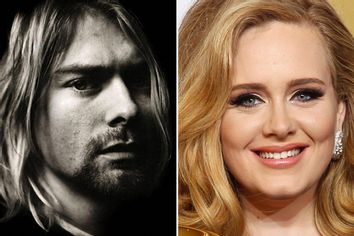
Kurt Cobain and Adele (Credit: Reuters)

With her armload of Grammys, three nominations for tonight’s Brit Awards and a stack of platinum albums, England’s Adele reigns over pop music at home and abroad. “Someone Like You,” the closing track of her 17-million-selling album “21,” is arguably the past year’s signature song, widely hailed – as is all her music – for its “authenticity.” But beyond its piano-and-voice starkness, it sounds like, well … 1992.

The song’s quiet/loud structure, its nakedly personal lyrics, and Adele’s aggressive, cathartic yawp in the chorus are all hallmarks of grunge-era rock. And authenticity, that elusive concept, is what Kurt Cobain was said to embody 20 years ago. As a resolutely working-class singer who penned songs about psychological pain and refused to conform to a stereotypical pop-star image, he was seen as a beacon of “realness” in an era of manufactured pop. The same could be said of Adele. If her success is any gauge, we’re entering a new era where displays of “authenticity” will be de rigueur. Let’s just hope it doesn’t do away with fun.

The early ‘90s fetishization of authenticity arose at a time when R&B-flavored dance confections by C&C Music Factory and Paula Abdul topped the charts, and even the über-sincere U2 embraced electronics and irony. Revelations that Milli Vanilli had lip-synced their way to a best new artist Grammy led to album-burning and an S.O.S. for artists who believed there was nothing better than the real thing. Enter Kurt Cobain.

Nirvana’s breakthrough single, “Smells Like Teen Spirit,” was an attempt to emulate the arty rock of the iconoclastic Pixies, but it was received as the raw sound of disaffected youth. Cobain bought into his own mythology: He professed to feel “a duty to warn the kids of false music that’s claiming to be underground,” citing the “corporate” Pearl Jam as a prime example. Authenticity, as Hugh Barker and Yuval Taylor point out in their book “Faking It,” is “an absolute, a goal that can never be fully attained,” and Saint Kurt, the idealist, went “to tremendous lengths to ‘keep it real,’ to rebel against commercial expectations, and to expose his problems to the public.” At least Cobain had a sense of humor; after his suicide, however, his devotion to “rawness” became elevated to orthodoxy, adopted as dogma by a host of moaning miserabilists who delivered wave after wave of angst-soaked grunge and grunge-lite.

From Puddle of Mudd to Staind to Creed to Nickelback, the yarling grunge descendants replaced rock’s devil-may-care excitement with blazoned earnestness and sludge. In doing so, they forced a schism between rock and pop, two forms of music that, in terms of style, at least, had been creeping closer together over the course of the ‘80s. It took bands like the White Stripes, the Strokes and the Hives, in the early ‘00s, to bring self-awareness and fun back into rock music. Despite their own assertions of what Barker and Taylor would call “cultural” authenticity (or adherence to a well-defined tradition) in rock ‘n’ roll, they were self-consciously contrived: Theirs was authenticity at one remove, a stylistic decision.

In recent years, stylistic dogmatism has largely receded, and genres have intermingled freely; a rapper like Lil’ Wayne can sing through heavy Auto-Tune (a device beloved in pop and dance music) to produce a rock album (“Rebirth”). But high seriousness has once again started to creep in, as even former enfant terrible Eminem now delivers introspective lyrics with emo choruses, while the latest hip-hop superstar Drake shows us it’s best not to celebrate success without maudlin self-critique.

Cultural reasons for this broadcasting of inner turmoil might include the recession and Facebook-induced oversharing, but it may also be due to the cyclical nature of fashion and popular music, where each new trend reacts against the last; as flannel makes a catwalk comeback, it’s natural that “authenticity” should do so as well. Adele, clearly, is at the vanguard of such supposed bald, unmediated self-expression, and for her critics, this is integral to her appeal: She’s “a real person, with real music” (New York Examiner); a champion of “authenticity and old school talent in a sea of Auto-Tuned belly buttons” (Toronto Star); and “authentic because she is her own creation” (Daily Telegraph).

Her antithesis is widely held to be public whipping-girl Lana Del Rey, who (horrors!) has changed her name, gussied up her image, and dared to be somewhat theatrical; by implication, if she had sung her songs (which sound like anemic, monochrome versions of Adele’s glummest balladry anyway) as Lizzy Grant of Lake Placid, all would have been forgiven. And where one might expect dance-pop stars to challenge Adele’s pervasive earnestness, they’ve instead been joining her: Taio Cruz and Katy Perry, for instance, have delivered straight, po-faced covers of “Someone Like You.” Where authenticity has historically been the province of rock rather than pop, Adele’s crossover appeal extends its reach.

Adele-worship has, however, been greeted with some suspicion in her native England, where she has been seen as the standard-bearer for an artistic “movement” dubbed the New Boring, with her erstwhile tour mate, soul singer Michael Kiwanuka, cited as an acolyte. Undeterred, fellow English singer/songwriter Ed Sheeran has affirmed, “If Adele’s seen as boring, then I’m happy to be boring as well,” and in the wake of Adele’s Grammy sweep, Jessie J, who once sang, “Why is everybody so serious?,” has vowed to pare down her live show in order to prove she’s “real,” as “The English … can sniff a fake very easily.”

But exactly how “authentic” is Adele anyway? She’s a big fan of the Spice Girls, devotees of Auto-Tune and miming who, she has claimed, “made me who I am.” Her musical style is highly derivative of American soul music, with a smattering of heartbroken country. And the “highly personal” songs on “21″ were written in collaboration with the likes of Ryan Tedder (Backstreet Boys, Sugababes), Fraser T. Smith (Britney Spears, Taio Cruz), Francis White (James Blunt, Take That), and Greg Wells (Mika, Katy Perry).

Not that there’s anything wrong with any of this. Rather, it’s the concept of authenticity itself that’s problematic, especially when it’s linked to “honesty” and “sincerity,” which are easy to assert but impossible to prove, and to a serious mode of “expressing oneself,” which admits of no irony – and therefore no humor. And Adele is capable of both: On “21,” the cheeky stomper “Rumor Has It,” for instance, opens with the lines “She ain’t real,” describing a love rival, but later suggests that the singer ain’t exactly what she seems: “You made my heart melt, yet I’m cold to the core.”

Authenticity is as much a pose as it is a state of being, but we’re conditioned to value it nonetheless. What if Adele, who has recently claimed she’s “never writing a breakup record again,” were to release her next new album under a pseudonym and fill it with peppy, Auto-Tuned dance numbers? Nevermind, we’d find someone like her.

William Gibson: I really can’t predict the future

The science fiction legend tells Salon that if he had a crystal ball, he'd have put Facebook in an early novel

William Gibson (Credit: Michael O'Shea)

On the Toronto stop of his book tour this month, William Gibson was asked by an earnest 20-something reader for advice: “Give my generation whatever you think is helpful for it to survive.” Where an author with an inflated sense of self-worth might have dispensed a few pearls of wisdom, Gibson replied that one should distrust people on stages offering programs for how to build the future.

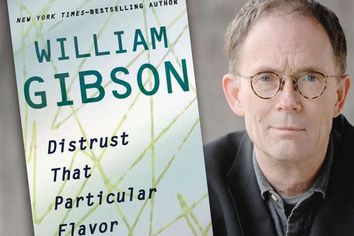
As much as people look to Gibson as a prophet, the science-fiction writer who invented the term “cyberspace” (in the 1982 short story “Burning Chrome”) helped conceptualize the ways we interact with the Web (in 1984’s “Neuromancer” and later works) and foretold the explosion of reality TV (in 1993’s “Virtual Light”) is notoriously reluctant to predict the future. The title of his new collection of journalism and essays, “Distrust That Particular Flavor,” is taken from a piece on H.G. Wells where Gibson explains his suspicion of “the perpetually impatient and somehow perpetually unworldly futurist, seeing his model going terminally wrong in the hands of the less clever.” Though he’s often able to extrapolate from the present with great prescience, Gibson prefers to probe, not prescribe.

“Distrust” is the Vancouver-based Gibson’s first book of nonfiction; mostly it deals with aspects of technology, and his prose, as in his novels, is always vivid and keen-edged. And yet the newly written afterwords he appends to each piece can be unflinchingly self-critical. Some articles are very much of their time and place; others cram startling insights into a mere few pages. Still others read like provocative responses to Frequently Asked Questions – one is even titled, “Will We Have Computer Chips in Our Heads?” (The answer? “Maybe. But only once or twice, and probably not for very long.”)

Over a bagel and cream cheese at Gibson’s hotel, the morning after his Toronto talk, the lanky writer, with his friendly drawl, furrowed brow and perpetual mien of engaged curiosity explained how his fiction and nonfiction overlap, and how he plans to dream up more imaginary futures out of the weirdness of the present.

How do you feel when a young reader asks you – or orders you – to “Give my generation whatever is helpful for it to survive?”

Oh, it’s complex. I feel old, and unwilling to be the golden geezer. At the same time I feel sort of avuncular. When I was that young man’s age, I wouldn’t have asked that of anyone. I wouldn’t have thought that anyone over 30 was capable of saying anything much that I should be believing anyway.

Does it hearten you in a way that he asked this, as maybe now there’s less of a perceived gap between generations?

I suppose so. I didn’t really have a problem with that question; I just had a problem thinking of any piece of advice. I should have said, “Never pass up a chance to use the toilet,” and “It’s a good idea to eat three reasonably sized meals a day. Take care of your gums.” [laughs] This is the kind of advice you can actually give younger people.

In your piece about Steely Dan’s album “Two Against Nature,” you write, “I’m starting to feel like a reviewer, which makes me intensely uncomfortable.” Your nonfiction, in general, resembles your fiction in that it’s presented as one person’s direct experience. Are you more comfortable with this method of writing than with a kind of omniscient critique?

Yeah. With the nonfiction, I have an instinctive need to present the material as simply as, “This is what I think it is.” Whenever I sense myself moving into pundit mode, I like to stop and check my motivation. Am I just doing it for some extra attention? Do I actually believe what I’m saying? It makes me a very poor television guest, because I’m incapable of saying anything without qualifying it. It’s very hard for me to produce the sort of demonstrative sound bite that that medium runs on: “X is x, don’t you know?” And mine is like, “Well, I sometimes feel that x is x, but then again, it can seem like y.” The medium doesn’t know what to do with that – at least the kind of trad television that we’ve got.

That said, your nonfiction pieces do tend to start out with strong, declarative sentences, even though there are nuances later on.

Well, that’s probably an attempt to do the culturally accepted thing … When I move into a different form, somebody’s paying me for it, and I have to produce on a relatively short deadline, I become a cultural chameleon and start to emulate, say, the look and feel of a Wired article. There are artifacts of that attempt at camouflage in all of those pieces, and it always made me feel a bit reluctant to bring out a collection like ["Distrust"]: some of it seems forced in a way that I would be uncomfortable with in my fiction. [In nonfiction], the reader wants to be immediately assured that this is somebody who knows what he’s talking about. So I jump into the middle of the stage, make a declarative statement, and possibly by the end of the piece I’ve completely reversed my opinion! [laughs]

You write that you’ve been “mining” one of the pieces in this book “for over a decade now,” for both talks and fiction. Does this mean you have an ongoing relationship with your texts in general?

Someone who’s very familiar with my work can read this new book and see where the nonfiction later bled into the fiction. The flip side is that unless there’s a very pressing professional reason to do so, I very scarcely reread my own fiction. I could not, if it were required of me right now, give you précis of the plots of my earlier novels. I remember scenes and characters somewhat, but I haven’t read them for 20 years, and I know “Neuromancer” very well because I’ve had endless, largely pointless, talks with filmmakers about turning it into a movie. Something someone gave me at the signing last night reminded me that in “Virtual Light” [from 1993] there’s a country song called “Me and Jesus Are Gonna Whup Your Heathen Ass.” I thought, “That is kind of predictive, pre-9/11.” It isn’t really predictive; it’s just that the tendency was there in the culture to think that way, which is why I wound up putting it in the book.

In an afterword, you mention that writing the piece “Dead Man Sings” “was entirely a matter of taking dictation from some part of my unconscious that rarely checks in this directly.” Certain passages in the book are quite poetic in an unexpected way, and I wonder if they might have come from a place other than the organizing journalistic brain. Do you ever write something and then figure out what it means later?

I very seldom compose anything in my head which later finds its way into text, except character names sometimes – I’m often very much inspired by things that I misunderstand. Have you ever seen Brian Eno’s deck of Oblique Strategies? One of them is “Honor thy error as a hidden intention.” That’s my favorite. [At a] hotel in New York a couple of days ago, the young woman who checked me in said what sounded to me like, “Thank you, sir; my name is Tyranny. If there’s anything you need …” I’m not enough of an extrovert to go, “Your name’s what?” … For the rest of the day, I was thinking of young, benevolent female characters with the first name “Tyranny.” Possibly an Asian character, where it’s kind of an ESL issue. Those things inspire me, but what you’re talking about is a result of the process of composition having spun itself up to a certain wonderfully flaky level, where it says something that I transcribe without quite being able to understand it. I’ve learned to trust that, and it seldom lets me down. Occasionally if I look back at something I’ve written I’ll find one of those that I don’t understand, but that’s a bad thing – the unconscious has dealt me a bad hand.

Last night [fellow science fiction author] Rob Sawyer pointed out how opposite his idea of creativity was to what I describe in the introduction to this book. He said that he had to be able to decide beforehand what [a book] was about, how he was going to do it, and then as he went along, he would compare what he was composing to this directive that he had arrived at prior to the work. To me, that’s absolutely incomprehensible; the part of me that sits here having this conversation with you is incapable of doing any very original literary work. The part of me that creates stuff is right now largely offline and unavailable, and I couldn’t summon it if my life depended on it. I have to make myself available and hope it turns up. To me, that’s where the good stuff comes from. It’s like, William Gibson doesn’t get ideas for novels while I’m walking around in the world … [He stops and grimaces.] That scared the shit out of me, because a friend of mine that’s a publicist in New York once told me that the worst sign in the interview is if the author ever starts to speak of themselves in the third person … so I did that for effect.

If you’re traveling somewhere, are you simply aware that what you see around you might seep into something you write, or do you actively seek to have experiences that may be useful?

As William Burroughs liked to say, “A writer always gets his pound of flesh.” No matter what I’m going through, I can always step back and go, “This is material.” [He pulls out his iPad, encased in a black sleeve, and calls up a picture he took of a house in Key West with strange curved shutters that open out into awning-like structures.] I could get a whole novel out of that house. That’s got some mojo going on! Not just the window, but the front door has got at least one layer of inch-thick plywood, no hinges.

I’m a fairly visual writer; I can get an awful lot out of really closely examining a photograph like that. It’s a very interesting exercise that I would recommend to anyone. Take any photograph – preferably a photograph that contains relatively little information (no humans or animals in it) – and catalog everything visible. It usually can’t be done in less than a thousand words, and it can’t be done well in less than about two [thousand]. It always leaves me thinking that pictures really are worth a thousand words, at least, that the visual matrix is so incredibly rich with stuff and meaning, that there’s actually no place to stop. People who have tried it find they stop because they just get exhausted.

Your first three books were set relatively far in the future from when they were written –

For my own purposes I assumed that “Neuromancer” was set in 2035, but I was very careful to keep out of the book anything that would allow anyone to date it by internal evidence, which I think was a smart move, considering the longevity that it has strangely enjoyed.

The next three were set in the near future, and your latest three have been set in an “imaginary present.” Are you working your way around to the past?

I once thought I was, but I think I’ve actually worked my way around to the future again. The first three were full-on “This is the future” genre sci-fi books; the next three were like the ‘90s in high cyberpunk cosplay mode. Those [characters], for me, hadn’t been altered by history at all. They were like ‘90s people, but inhabiting this satirical set. I never saw a critic or a reader even remark on that. They accepted them as folk from the very near future, and noticing the lack of response to that was one of the things that emboldened me to write “Pattern Recognition” [2001] and then the next two books ["Spook Country" (2006) and "Zero History" (2010)], which are speculative novels of the very recent past, in that they are each set in the year prior to the year in which the book is actually published, with huge amounts of internal evidence of when it is. A lot of people said to me, “Why are you doing that? It’s going to date it.” I said, “I want to date it. It’s in some way a description of life, and I want to know which month these imaginary events supposedly happened in.”

The other thing that sent me on that program was a worrying sense I had, by the end of my sixth novel, that my yardstick of absolute quotidian weirdness was actually an ‘80s yardstick. In order to accurately judge the degree of cognitive dissonance I’m inducing in the reader with my fiction, I need a yardstick of how weird the world is right now, and by the time I got to “All Tomorrow’s Parties” (1999), the world outside the window was fully as weird as the world of [the book]. Then we abruptly found ourselves in the post-9/11 era, when the 21stcentury seriously began, and my yardstick was just too short. I couldn’t navigate. Where those last few novels have fit for me in the process was getting myself a really contemporary early-21st-century yardstick of weirdness. And now, if I want to write something set in a future rigorously imagined from this incomprehensibly strange and complex world we now live in, I’ve taken the measurement of that, to some extent, by writing the fiction, just by opening myself further to the weirdness of it.

So now I’m feeling my way towards what that could be. As always at the beginning of the process, I’m completely overwhelmed. It seems to be either impossible or hideously difficult to describe the future of social media from the point of view of characters who would be participating in it, perhaps even while they’re sleeping, and not be paying its workings any mind. A huge part of the work in writing “Neuromancer” was a kind of stage-managing on behalf of the reader. I want the reader to be experiencing something akin to culture shock constantly and be slightly off-balance in an enjoyable way, but never fully lost. It’s a very complex and tedious business to keep the reader supplied with reliable information about the strange place that the reader’s entering, and yet keep it out of sight so that the reader doesn’t have the text issuing what science fiction writers of my day were taught to regard as the “expository lump.” It becomes strategic – the more novel the environment you’re describing, the more complex the act of providing the reader with the oxygen of meaning. A totally disoriented reader generally won’t stick around.

If somehow in 1985 you had the idea for Facebook as the idea for a science fiction story, and you sat down to write it, you’d have all those problems, because the artifact that the character is encountering and interacting with is incredibly complicated and would require a huge amount of exposition or totally adroit set-handling.

Continue Reading Close

What Occupy can learn from the Hunger Games

A leaderless political movement still trying to find its place might look to heroes of dystopian fiction for ideas

(Credit: AP)

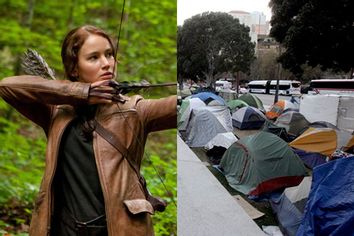
“YOU CAN’T EVICT AN IDEA,” proclaim the banners fronting an otherwise dull building in east London, owned by banking giant UBS but inhabited and decorated by squatters from the Occupy movement. They’ve adapted the phrase from Alan Moore and David Lloyd’s graphic novel “V for Vendetta,” in which the titular terrorist explains his seeming immortality to a detective who has just shot him: “Ideas are bulletproof.” A poster of V’s trademark Guy Fawkes mask smiles eerily at all who walk into the foyer of 8 Sun Street, now dubbed “The Bank of Ideas” and used as a community center. The caption underneath reads, “We are the 99%, and so are you.”

It’s fitting that the Occupy movement should have drawn inspiration from dystopian fiction, an increasingly popular genre for teenagers and young adults in particular. If, as Time magazine suggests, the person of the year was the Protester, the publishing phenomenon was the Dystopia — the story of the dissenter in a repressive society who becomes a revolutionary. The new wave was led by two trilogies, both published from 2008-10: Suzanne Collins’ “Hunger Games” (whose big-budget Hollywood adaptation kicks off in March) and Patrick Ness’ “Chaos Walking” (now being adapted by Lionsgate). Scores of other books and series are now rising in their wake. “V for Vendetta,” from 1988, is an important antecedent, telling the tale of Evey, an adolescent girl in a run-down future London who, indoctrinated by the self-styled freedom fighter V, becomes a thorn in the side of a fascist state. Toward the end of the 2006 film adaptation, hordes of the working class – the 99 percent, if you will – don the Fawkes masks themselves and, led by Evey, stand firm against their oppressors.

Since the film’s release, replicas of these masks have been manufactured widely, and Occupy protesters in the U.S. and the U.K. have often worn them (as have members of the hackers collective Anonymous), both to disguise their faces and show solidarity. But the film is an odd, Hollywood-ized work that the iconoclastic Moore has typically dismissed. In contrast, his book is philosophically more complex than is often acknowledged. Unlike propaganda, literature is difficult to adopt as a template by movements of any stripe, and such is the case with “V for Vendetta.” V is, despite his protestations, is more than just an embodied idea: He’s an ideology, and this makes him dangerous to both the ruling elite and his own followers. And if there’s anything we can learn from dystopian literature, including the work of Collins and Ness, it’s that ideologies can, and should, be evicted.

*

There’s no necessary cause-and-effect relationship between world events and publishing phenomena, but there can certainly be a resonance. Suzanne Collins has said that “The Hunger Games” was inspired in part by coverage of the war in Iraq — and  yet it raises issues of economic inequality, misinformation and corporate greed that are even more relevant now. Collins’ heroine, Katniss Everdeen, is an independent and even ornery 16-year-old who saves her younger sister by volunteering for, and then winning, a telecasted fight-to-the-death competition. Though her feats of derring-do have elements of escapist fantasy, her ultimate goal isn’t to win the Games, but to avoid exploitation: She wants to circumvent the rules and figure out a way to shut down the games for good. Just as Collins and other writers of young-adult  dystopias cleave to the Romantic nostalgia for childhood freedom, they’re raising the stakes of the coming-of-age novel’s traditional struggles with the pressures of growing up and the need to integrate with society. In these dystopias, integration means the death of freedom and imagination, and subjugation to a way of thinking that curbs creativity and stresses survival of the least scrupulous.

The societies depicted in these novels generally fall into one of two broad categories. In the first, as in “Hunger Games,” Ally Condie’s “Matched” (2010-12) and Veronica Roth’s “Divergent” (2011), they’re dystopias masquerading as utopias, where everyone is supposedly provided for through work assignments that keep the plebs docile and benefit the ruling elite. In the second, as in “Chaos Walking” and Jeff Hirsch’s Collins-blurbed “The Eleventh Plague” (2011), they’re post-apocalyptic settlements where the physically strongest and best-organized have taken power and bent all to their will.

All of these books feature adolescent protagonists of generally unimposing physical stature who, at a crucial point in their lives (usually an adult-initiation process of some kind), reject the limited choices they’re offered and learn self-sufficiency instead. They pull together support from other outsider teens and some adults (especially lapsed countercultural hippie-types who remember pre-dystopian life), and make difficult decisions that open the door to a new and better way of life. Thus, they avert catastrophe and avoid the trap of the minimum-wage, dead-end job – or its near-future equivalent.

The formula for self-sufficiency is a familiar one: The protagonists need to rough it, to live for a time off the land as early colonists did, escaping the dystopias’ infantilizing control and surveillance. This connects them with nature both literally and symbolically, putting them in touch with their inner noble savages. From the start of “The Hunger Games,” Katniss hunts with a bow and arrow in the forbidden wild; later, she becomes known as the Mockingjay, after a species of bird who lives there. In “Crossed,” the sequel to Ally Condie’s “Matched,” the protagonist, having lived all her life in suburbia so sanitized it makes Disneyland look like Bangkok, bolts to a Grand Canyon-like back country to join her dark, brooding outsider boyfriend (the opposite of her society’s chosen match for her, who is of course blonde – even in the future, love triangles will keep young hearts aflutter). There, she learns personal independence through physical effort.

But they’re not quite noble savages, because they’re self-aware. In the wild, they find misfits who safeguard learning, hoarding the books and lore that the dystopias have repressed. The Occupy movement often casts itself in a similar light, as its members “rough it” in parks in the middle of cities as if keeping alive a more earthy, simple, honest way of living; their library tents symbolize their devotion to learning from the past as they forge a better way for the future. Indeed, the library is a synecdoche for the movement itself: in Toronto, protesters chained themselves to theirs as it was about to be removed as part of the camp’s eviction; at Occupy Wall Street, the demolishing of the library has been viewed as a repressive dystopian act.

In the wilderness, the dystopian protagonists also encounter rebels – and not necessarily the same people who read books. Unlike in escapist fantasies such as “Star Wars,” where the rebels unambiguously deserve our support as they fight an evil empire with the light side of the force, the rebels in YA dystopias can be as dangerous as those in power. Often the two are mirror images of one another, led by charismatic but delusional figures who seek to wrest power for themselves by violent means and view the teenage heroes as vehicles for them to do so. In “The Hunger Games,” Katniss becomes an icon for the rebels in the legendary District 13 but ultimately distrusts their humorless and pathologically driven leader, Alma Coin; in “Chaos Walking,” Viola (Todd’s girlfriend and female counterpart) falls in with The Answer, a group of terrorists who are healers by profession but are just as adept at setting off bombs, and wouldn’t blink at blowing her up if it achieved their own ends.

The heroes are called upon to navigate between dystopian rulers and rebel would-be-dystopian-rulers; as champions of democracy, they pull together disparate disenfranchised groups in ragtag bands that become as strong as the sum of their parts. In doing so, they demonstrate the power of not being “confined to one way of thinking,” – a phrase used by the mother of the heroine in the pointedly-titled “Divergent,” shortly before she’s violently killed by a zombified soldier. Homogenization is the enemy – which is why it’s odd to find so many Occupy-movement protesters wearing the V mask.

Like the new YA dystopias, Moore and Lloyd’s “V for Vendetta” highlights problems with rebels who have the same aptitude for violence, disregard for collateral damage and distrust of nuanced world-views as the dystopias they fight. V is a vigilante revolutionary for whom any ends justify his means. He takes Evey under his wing as he attacks members of London’s ruling elite, and when she balks at killing people, he then “kidnaps” her and, in disguise as a police officer, tortures her, effectively breaking her down to nothing and then building her back up again in his own revolutionary image. This is the ur-terrorist narrative, which upholds the belief that each person must be shattered and remade to serve a purpose, in order that the same may be done to civilization itself. It’s the strategy employed, in “Chaos Walking,” by the dystopian Mayor Prentiss as well as the opponent he brands a “terrorist,” the bombing-happy healer Mistress Coyle. But neither can ultimately control the book’s dual protagonists, Todd and Viola, whereas in the even darker “V for Vendetta,” Evey becomes V’s disciple, blowing up 10 Downing Street and offering the citizens of London a choice between “lives of your own and a return to chains” – apparently she has read her Rousseau. The bloodthirsty version of freedom she offers them is more savage than noble, and itself suggests another form of imprisonment. The book ends not with the triumphant Evey but rather with the consistently questioning Inspector Finch, who wanders off alone outside London, into darkness and the unknown, rather than choosing one of two unattractive sides.

Finch refuses to let others think for him. He, not Evey, is the analogue to Todd and Viola in “Chaos Walking,” whose strategy of avoiding violence unites their people as well as other species on the planet. In “The Hunger Games,” Katniss ultimately undermines the regimes of both President Snow and Alma Coin, throwing her society into disarray but perhaps helping to usher in what one character calls “the evolution of the human race.” In “Divergent,” where a future society is split up into factions based on personality traits, Tris grows up as Abnegation (forsaking herself), undergoes initiation as Dauntless (having no fear), and saves both factions from destruction by a third (Erudite) by being divergent – rejecting received and rigid modes of behavior and thought. In “The Eleventh Plague,” in the post-apocalyptic aftermath of biological warfare with China, orphaned and distrustful teenager Stephen and his bad-seed Chinese-American girlfriend Jenny secure help from people that their town elders had thought were plotting their destruction. Ironically, in action-packed, plot-driven novels filled with violence, these novels interrogate the practice of using violence (and sometimes torture) as a solution to political and social problems.

Stories of people who are trampled on by competing ideologies and broken by enforced scarcity are certainly apt at a time when the U.S. political system is regularly brought to a standstill by politicians unwaveringly devoted to ideologies, the European Union threatens to disintegrate due to its members’ conflicting demands, divisions between the rich and the poor are ever-increasing, and those with the power to help offer rhetoric instead. The Occupy movement, as a loosely affiliated band of concerned people – Marxists, anarchists, environmentalists, survivalists, and more – has on the whole avoided ideology and embraced diversity and democracy. Some would say its lack of specific goals has undermined it, but the adoption of a V-style oppositional stance surely wouldn’t help. Occupy has done much to cast the U.S. and U.K. as dystopias, as pictures of police in riot gear confronting protestors have proliferated in the media; nonetheless, it needn’t cast itself as the kind of rebel movement that uses repressive strategies similar to those of the ruling elite.

Propped against a wall inside the Bank of Ideas is a placard that reads, “’1984′ was not supposed to be an instruction manual.” Nor, indeed, is “V for Vendetta,” and neither are “The Hunger Games” or “Chaos Walking.” The new YA dystopian novels are thoughtful books, but they don’t offer solutions or blueprints – they merely suggest ways of combating stifling political ideologies. They’re full of different voices, or what literary theorist Mikhail Bakhtin, writing in – and against – Soviet Russia, called “polyphony”: the opposite of propaganda, and the enemy of ideology. Where they resonate with the Occupy movement, it’s in the protagonists’ determination to recalibrate the world around us in creative ways: seeing a bank as an educational institution, a tent as a library, a movement as a gathering of people asking questions, and encouraging ways of thinking by which solutions could be found.

While you can’t – and perhaps shouldn’t – evict an idea, it’s best, as the U.K. singer Nicolette has said, and as these dystopias suggest, to let no one live rent-free in your head.

Continue Reading Close

David Lynch: Why brutality makes me laugh

In a Salon interview, the director says his music, like his films, finds the moment when the chilling turns comedic

David Lynch (Credit: AP)

It’s fashionable these days for young musicians to cite David Lynch as an influence, but the director’s new album, “Crazy Clown Time,” is a stranger, wilder beast than his followers – among them Lana Del Ray, Anna Calvi and Dirty Beaches – have ever released. The album’s songs are fractured narratives torn from fever dreams, where tales of stalking, fear and violence are punctuated by bursts of naive hope. Sometimes the horror is funny and the happiness disquieting – as with just about anything the director (and sculptor and painter and screenwriter and producer) has ever made, it’s never obvious how we should react to the music.

Since his debut feature, “Eraserhead” (1977), Lynch has given his films and other projects sonic worlds that enthrall and unsettle in equal measure. He credits Angelo Badalamenti, composer for “Blue Velvet,” “Twin Peaks” and “Mulholland Drive,” for steering his sonic experiments toward full-fledged music-making. Lynch has been involved in a number of albums before – as a member of the warped-blues-rock duo BlueBob (whose self-titled album was released in 2001), as producer and songwriter for singer Chrysta Bell’s debut “This Train” (released in September), as a guitarist on Jocelyn’s “Lux Vivens: The Music of Hildegarde von Bingen” (1998), and as a singer on the Danger Mouse/Sparklehorse project “Dark Night of the Soul” (2009). “Crazy Clown Time” brings all of these threads of his career together, as he and collaborator/engineer Dean Hurley offer atmospheric songs that start with the forthright starkness of the blues and veer off, as if on a lost highway. Leadoff track “Pinky’s Dream” is sung by the Yeah Yeah Yeahs’ Karen O, but otherwise it’s Lynch himself who whispers, keens and bellows at the mic, taking on the personae of disparate characters.

Lynch has a reputation for being oblique – perhaps even obfuscatory – in interviews, but in discussing “Crazy Clown Time” over the phone from Los Angeles on a “really beautiful” afternoon, he sounds enthused. He’s more relaxed than he is on camera, sometimes casting about unself-consciously for the right word. Lynch’s last feature film was “Inland Empire” (2006), and though questions about new original projects tend to elicit vague responses, he will admit he looks at his script from “Ronnie Rocket” (an unproduced ‘50s-inspired science fiction film) “from time to time … there’s always something I haven’t figured out yet. I want to make it; I love that world.” He has confirmed he’s working on a documentary on Maharishi Mahesh Yogi; it seems apt to begin our conversation with a nod to his devotion to transcendental meditation.

You’ve said the tracks on “Crazy Clown Time” gestated in jams with Dean Hurley. Considering you’ve spoken about using transcendental meditation to “catch ideas” at deep levels for your films, did you also use it for the genesis of some of the tracks?

Well, you don’t use transcendental meditation to catch ideas necessarily; you use it to expand whatever consciousness you have to begin with. When you expand and you have more consciousness, you can catch ideas easier and easier, and when you get on a thing, the ideas flow more freely. … It brings so much happiness too. This consciousness is also bliss, and so you get happier in the doing of things. I don’t know what it would be like without it, ‘cause I’ve been doing it for 38 years. On a jam, if Dean has got a certain beat going on the drums, and I’ve got a certain sound on the guitar, and we start going, and there’s a certain chord pattern, I know every musician knows this – it just causes you to go a certain way. In following it, something you feel is thrilling and new can come from jamming.

You’ve used the sound of the tremolo guitar often in your work, going back to the days of “Twin Peaks,” for instance. What is it about its sound that attracts you so much?

It probably started in the ‘50s. When the electric guitar was born, an instrument “beyond the beyond” was born. It is such a thrilling sound, and it’s sort of magical. When you’ve got one in your hands – I don’t play, really, but I play it more like a sound effect – it’s like a gasoline-powered, V8, rough-running, incredible engine, and it’s just rough, beautiful power. … I think there’s a magic in a pure tone sliding off-tone, sliding back, and two things beating against each other, trying to get harmonized. There’s some kind of great beauty in the tension, and a little bit of beauty in off-tune, bad music.

On “Pinky’s Dream,” when Karen O sings, “Are you laughing, or are you crying?,” she’s asking about two very different displays of emotion, which seem related here.

Yeah, there’s a Vedic expression, “The world is as you are.” So two people could hear the same song, and one says, “This is a sad song,” and the other says, “No, that’s really, really happy.” And there’s something about a lot of ‘50s music that had those two things, depending on the [listener] – it kinda held both, would work for both moods.

Is that kind of complexity something that interests you in general? It seems some filmmakers or songwriters seem to want to evoke one emotion at a time, but with you, there are more layers.

That makes sense. When you get something that’s thrilling, if it’s working on a couple of different levels, it’s more thrilling. How you get there is not an intellectual thing. You stumble on it, really.

Going back to the question in “Pinky’s Dream,” do you sometimes laugh at things that other people would find disturbing?

Oh yeah. But I’m not maybe the only one. In Frank Booth [the nightmarish villain played by Dennis Hopper], in “Blue Velvet,” I saw so much humor, and many times, I would have to cover my face, in his most brutal scenes. I think it had to do with a person that’s so obsessed that the obsession can sometimes, if you look at it at the right angle, be humorous. The person could kill you, but at the same time, there’s some humor swimming in it.

Would that translate into a song like “Speed Roadster” on “Crazy Clown Time”? It’s about a stalker, which is ominous, but it seems kind of funny as well.

Exactly. “Speed Roadster” is a song [where] a kind of character was born, and this character is not unlike a lot of us. It’s a subject that’s so tormenting to so many women, and it’s not funny, but at the same time, this kind of thing is driven not by love; it’s lack of love that will drive a man absolutely to do sometimes terrible and strange things. … Dean and I had the track, and I listened to it for a couple of hours, over and over, and the lyrics came out of the music.

The “making-of” video for the Chrysta Bell album you just produced shows some interesting objects in your studio: a melodica, an old phonograph, DVDs of your movies. Are there things that you like to keep around for inspiration?

Not really. Dean is a big collector of many musical instruments and gizmos, but I just like the studio because it’s very soundproof, and it’s a safe, kind of comfortable area. It’s a place where you can experiment.

Is being in a “safe, comfortable” place important for you? I understand you don’t like to sing in front of people.

[laughs] No, I sure don’t! And yeah, it’s super-important. I’m really only ever singing in front of Dean, and he’s not looking at me, and he puts a lot of the stuff [effects] on my voice, so I feel it’s almost like somebody else is singing, and it helps me a lot. If Dean puts certain stuff on the voice, and the music is a certain way, a character can be born.

Did the song “Strange and Unproductive Thinking” [the album’s longest track, featuring a monologue that veers from the evolution of humanity to cutting wood to dental hygiene] arise from something you wrote separately?

I sometimes write these things I call “meaningless conversations”; they’re just long, no-punctuation things, and when the whole [conversation] is read, they might have a certain kind of feeling to come, or a world, but they’re just really meaningless. I tried to do it through a Peter Frampton tube, but it didn’t really work, so then Dean found another way for me to do it, and it sounded pretty much the same as your mental image of the tube.

There’s quite a sense of space in your music – you don’t use very many layers or elements at once. Is this something you’re going for specifically, and what attracts you to that kind of sound?

That’s a real good question. I like this girl Lissie. When I hear her and her two band members – the lead guitarist and the bass player [who] plays drums at the same time – it’s incredible. When it’s minimal, they’re so good. Lissie’s got this way of singing, and the melodies are so good, but it’s pure. It’s like there’s no tricks. And then I feel like her album is over-produced: it’s not that pure way, and I wonder why, ‘cause it can weaken something. We really like the old blues men and women, and the way they went real pure, and it was the starting point to this album. It took off in weird directions. It goes through Pro Tools, and there’s lots of stuff we can do to it later so it’s not so pure, in that way, but there’s not a lot of lines going together; it’s kind of minimal.

It’s pure and complex at the same time.

Maybe so.

Continue Reading Close

Noel Gallagher: It’s not about whiskey and heroin

The hard-partying songwriter, now on his own, laughs off the last decade of Oasis and looks to his solo future

Noel Gallagher (Credit: AP)

On a rooftop patio looking out over Manhattan, Noel Gallagher is clutching a glass of white wine and making small talk with people he doesn’t know. Though the booze may be flowing at the launch party for his debut solo effort, “High Flying Birds,” there’s little sign of the legendary rock ‘n’ roll hedonism that fueled the early, swaggering Oasis albums. Gallagher proclaims confidence about Manchester City, the once-scrappy, now-nouveau riche football team he supports, and he admits he has sketchy recollections of growing up a few miles from its grounds: “too many drugs” in the interim.

Such substances are in the past, as is Oasis — more or less. Lounging on a sofa at a boutique hotel on the Bowery the next day, the singer and guitarist is somewhat subdued. He looks lean and fighting fit, but he’s still getting the hang of a solo career that began, effectively, in August 2009, when he quit Oasis after a bust-up with his brother Liam, the band’s lead singer.

The rooftop party, he says, made him slightly uncomfortable. “It’s quite strange on your own. … The focus is on you. It would have been nice to have been in a band last night.” In his Oasis days, he was happy at the side of the stage – in control, as the primary songwriter, but out of the spotlight. Does he still feel this way?

“Oh yeah. I’d much rather be in a band,” he says, then stops short. “Let me rephrase that. Initially, when I started this, I was like: ‘This is a fucking pain in the arse; I don’t need this at my age’” – Gallagher is 44 – “being a frontman. And I might eventually grow into it. Each time I rehearse, I find it easier. I’m inching forward day by day.”

It’s odd to hear such introspection from someone so infamously mouthy, especially when the stomping tunes on “High Flying Birds” find Gallagher singing about riding a tiger and shooting a hole into the sun. The album, helmed by latter-day Oasis producer Dave Sardy and beefed out with a string section and a choir, sounds huge.

Its overriding theme, Gallagher says, is “escapism and the longing to be somewhere else. And then when you get there, is the grass really greener on the other side?”

Gallagher admits that he wrote the opener, “Everybody’s on the Run,” “toward the end of the band breaking up.” And although he doesn’t figure that’s what the song is about, he admits, “Who knows? Subconsciously that might have been in there when the words came.”

Not that he’s keen to speak of such things. Asked about the lawsuit for defamation launched against him by Liam this summer (and dropped shortly thereafter), he chuckles – “I don’t want to get sued again” – before admitting that the situation, to him, “was all a bit mad. I don’t take those things quite seriously. Somebody called me, explained what was going on, and I was like, ‘Really? Fuckin’ ‘ell.’ But whatever. We move on. That was last week. It’s something else next week.”

For years, he has been fond of telling interviewers that his brother has no sense of humor. Noel clearly does, but people don’t always get it. “Every fucking day, I do an interview, and I have a certain turn of phrase and way with words and semantics – somebody’s always taking offense to what I say. … I make a flippant comment about whatever, and all hell breaks loose. It’s just the thin ice I walk on.”

For all his protests, Gallagher clearly enjoys the interview process, and as he warms up, he holds forth about poetry books (“People buy me them for Christmas, because it’s nice to just throw open a page, read somebody’s words, and go, ‘Fucking ‘ell, it’s amazing’”), modern music (“The Arctic Monkeys and Kasabian – it’s strange to think that they’re the only two real new bands that are worth anything”) and the “cinematic” images on “High Flying Birds” (“I don’t know why it’s happened this time. Maybe it’s because I haven’t wrote [the lyrics] down and I am visualizing something. Maybe it’s just ‘cause I’m a fucking genius”).

He makes the last comment with the hint of a smile, but here, it would appear he’s not entirely kidding. Being a solo act has its advantages: Not only does he not have to work with Liam, but also, he can write all the songs. On later Oasis efforts, Gallagher loosened the reins, sometimes to unfortunate effect. “If you’ve got four songwriters, trying to make something that’s concise and has a direction is very difficult. For every ‘Don’t Believe the Truth’ [2005], there was a ‘Heathen Chemistry’ [2002].” As for “High Flying Birds”? “This is the best album I’ve written. Not ever … but for well over a decade.”

Now that he’s on a conversational roll, it’s easy to forget that scant minutes ago, he was lamenting his lack of experience as a lead singer and wondering if people would enjoy his shows. The only person who can convince Noel Gallagher that he’ll be reborn as a solo rock star, it seems, is Noel Gallagher himself.

“I came from nothing,” he says. “I taught myself to play the guitar. I’ve been in one of the biggest bands of all time, wrote some of the greatest songs … Rock ’n’ roll to me is all about freedom of thought and to be whatever you want to be. It’s not about black leather jackets and fucking Jack Daniel’s and heroin. It’s just about being yourself. D’you know what I mean?”

Continue Reading Close

Peter Gabriel: The past is the future

The pioneering musician tells Salon his latest remakes album isn't backward-looking -- it's a new way forward

Peter Gabriel (Credit: Shannon Stapleton / Reuters)

There are no electric instruments, African drumbeats, props, or costumes on “New Blood,” the new album and concert film by Peter Gabriel. For an artist who helped pioneer sampling in pop music, famously crossed Eastern and Western rhythms, and has been seen on stages dressed up as a flower and a fox and rolling in a Zorb ball, this is somewhat startling. In the film, Gabriel, for the most part, stands in front of an orchestra, clad in sober gray and black, straightforwardly singing his back catalog and a few covers.

At 61, has the great musical adventurer grown conservative? In an interview with Salon, Gabriel reveals a complex motive for might seem a backward turn. “I think [Stanley] Kubrick said, ‘If you want to make the future credible, include the past.’ A world that is both familiar and strange is the most interesting to me.”

In the Western canonical tradition of music, little is more familiar than the orchestra. Gabriel deployed an orchestra on last year’s “Scratch My Back,” to reinvent a selection of cover songs by artists from Neil Young to Radiohead. Most radically, he took “The Boy in the Bubble” from Paul Simon’s “Graceland,” and as he says, drained “all the African blood out of it and just [left] this sad Western song. But at the same time, for me, it was quite a fresh world.”

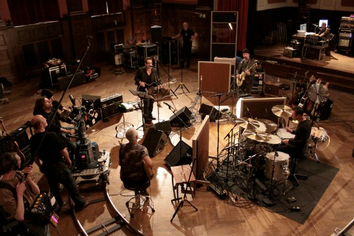
Together with arranger John Metcalfe (Blur, George Michael), he then developed acoustic versions of his own songs with strings and horns, and decided to tour the project with a 46-piece orchestra — a rather prog-rock move from the man who used to front Genesis. But Gabriel stripped out the electric guitars, the synths and the drums, as well as most of the theatrical elements in his music’s presentation. “I wanted to keep it much more simple, where I was just a singer rather than a performer,” he says.

Gabriel’s voice, distinctive though it is, with a husky lower register, a yearning falsetto, and the ability to switch between the two with quicksilver speed, has perhaps been his music’s least celebrated attribute. “Scratch My Back” brought it to the forefront. After hearing Gabriel’s cover of his Noel Coward-esque song “The Book of Love,” Stephin Merritt, of the band the Magnetic Fields, told the New York Times, “If I could sing like him I wouldn’t have to be a humorist.”

Gabriel seems genuinely touched when he’s told this. “That’s a lovely thing to say … Somebody said to me on this tour, ‘I think your art is vulnerability.’ And I guess in my voice, there is a sort of a vulnerability; I do try and open myself up to the worlds which are created in the song.”

In conversation, Gabriel comes across as both open and contemplative, even though he’s a somewhat reluctant interviewee who expresses discomfort at having to “sell” something. He explains that he also tries to keep his music separate from his activist work: “People get really fed up with musicians preaching at them all the time.” Nonetheless, he admits, “You have opportunities that I think would be wrong to ignore.”

Gabriel is a co-founder, with Richard Branson, of The Elders, a human rights organization designed to “link young people through technology” to statesmen such as Kofi Annan and Jimmy Carter and create what Gabriel calls “a pincer movement on those in power.” In March, The Elders’ chair, Archbishop Desmond Tutu, was given an award by the Skoll Foundation in Oxford and asked Gabriel if he would sing his 1980 song “Biko” for the ceremony. “We thought we’d try for a small string group and [Senegalese singer] Baaba Maal joining in.” The stripped-down arrangement (sans Maal) made its way onto “New Blood.”

Gabriel relates this story without a hint of name-dropping self-importance, and thankfully, “New Blood” reflects his lack of pretense. It turns away from the earnest dreariness of most “unplugged” albums, which strip out much of what makes the originals exciting; he and Metcalfe instead add new motifs, as played with rhythmic verve by bassoons and flutes instead of electric guitars.

And though there may be no synthesizers onstage, the concert film isn’t technology-averse: Screens behind and above the performers illustrate the songs, and the film was shot in 3D. The latter, Gabriel insists, won’t be just a passing fad: “When they’ve got the technology correct on 3D without glasses, people won’t think twice about it; it’ll just be how everything is done. We have two ears and two eyes, so visuals should be 3D in the same way that audio should be at least stereo.”

By the time we reach that stage, Gabriel may even have recorded a new album of original material. When his last, “Up,” was released in 2002, he claimed he’d have a follow-up, called “I/O,” ready within a year and a half.

“Did I?” he laughs when reminded of this. “Well, that was probably bullshit.” He’s noncommittal as to whether he’ll finish the songs he recorded for this project or work on new ideas. Either way, he promises, “I’ll still do things that are fun and theatrical in the future.” Whatever music he releases will take into account the way his voice has lowered over time — not a bad thing, necessarily: “I think Leonard Cohen, for example, is more interesting and effective delivering songs for the last 10 years than he was as a young man.”

So there’s an advantage, then, as a musician, in growing older?

“Not always an advantage — it’s just different … You are aging, so you get on with it. And try and make it work.”

Continue Reading Close

Page 1 of 2 in Mike Doherty

www.salon.com/writer/mike_doherty/index.html