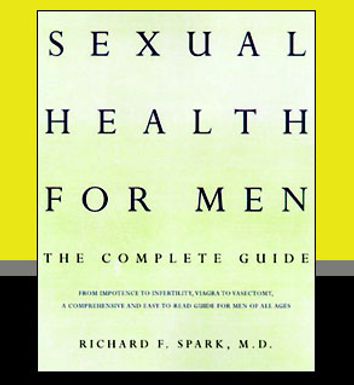
From Rudy Giulianis prostate to Tom Greens testicle, mens private parts have been on public parade of late. In the opening pages of his new book, “Sexual Health for Men: The Complete Guide,” Harvard endocrinologist Richard Spark ties the new willingness of men to publicly discuss the fallibility of their love tackle directly to the 42nd American president and a little blue pill.
Using the randy commander in chief and Viagra as a jumping-off point, Spark delivers an encyclopedic guide to all things male, from discolored semen to the viability of alternative erectile treatments. “Sexual Health for Men” is instructive, calming and frequently entertaining.
During a recent interview, Spark discussed his version of the Clinton legacy, shifting attitudes about male sexual health and alternatives to Viagra. Oh, and then theres the one about Dr. Brindley and his performing penis …
The first paragraph of your book mentions President Clinton. The second paragraph mentions Viagra. Can you talk a little bit about the pivotal part the president and Viagra played in opening up the discussion of male sexuality?
We really didnt talk much about male sexuality in polite company until the episode with Clinton and Monica [Lewinsky]. That sort of opened the floodgates. Fortuitously, almost two months to the day when the article regarding Clinton and Monica appeared in the papers, the New York Times had their first Column 1 story about the fact that Viagra was being approved. Everybody was chatting about Viagra, from Maureen Dowd to Jay Leno. After that, the whole issue of mens sexuality became open game.
You write that Viagra legitimized male sexuality not only as conversation material but as a valid health-care issue.
Absolutely, because men who had problems with sexual health didnt discuss it. But now, when doctors [ask about sexual function], theyre being surprised to hear men say, “Im glad you brought it up, doctor, because now that you mention it …”
Are there specific at-risk populations in the field of mens sexual health?
The major at-risk group are the smokers. [Then there are] the people who have certain other problems like diabetes mellitus, certain individuals who abuse recreational drugs — cocaine, for example, is a stimulant initially, but eventually has a negative effect on a mans sexual function. There are other men who take medications designed to treat problems like high blood pressure or depression who can experience side effects that interrupt their sexual function. All of this is gone over in the book; we try to cover every area.
Even down to the effects of bike riding.
Well, bike riding is one thing that has been a source of great interest to the cyclists of America. There have been some studies reported on cycling and its impact on a males potency, and we review those in some detail in the book. The difference is that the studies have been done on the real champion bike racers. The people who are cyclists in my practice tell me that the average cyclist who is out for the weekend jaunt or something of that nature does not place himself at the same degree of risk as the individual who is doing these marathon bike races, where he is constantly putting pressure on his genital area and perineum and compressing the nerves that are important to use to allow erections to occur.
I imagine that for some segments of the male population, cultural taboos — stoicism, for example — put them at risk as much as anything.
When men experience sexual difficulties, its the same sort of symptom as a headache. Theres a reason for it, and we can usually work it out. The vast majority of headaches that people have are related to the fact that theyre under tension, or extreme stress — a couple of aspirin or Tylenol and the headaches will go away. Every now and then the headaches are indicative of something more lurking. Most patients, if theyre troubled by headaches, have no hesitation whatsoever in talking to their physician, saying, “Look, this is bothering me.” The trouble is, people dont recognize sexual dysfunction as a symptom. They recognize it primarily as a failure of being a man, and that really is devastating, because it puts a block between them and the help they need.
Much of the progress made in the recognition and treatment of womens health issues — most notably breast cancer — has come about as a result of highly publicized campaigns, events and celebrity involvement. Do you see a need for a corollary movement for mens health? There have been some recent examples, including Bob Dole speaking about erectile dysfunction.
I thinkBob Dole was very courageous to speak about that. There is one thing that distinguishes Bob Doles courage from other mens courage: His problems occurred after he had surgery, so his problems were the result of something that was done to him and not his fault. [Professional cyclist] Lance Armstrong was courageous also. But again, [his testicular cancer] was nothing that he did; its something that happened to him. And thats really a distinction that has to be made. The concept that sexual dysfunction is a mans fault is something that has to be rooted out and eliminated.
In Chapter 3, you write “paradoxically, in an age smug with a sense of heightened sexual enlightenment, the only ones left ‘in the closet’ are men — impotent men.” The phrase “in the closet” reminds me that when we think of the problems of male sexual health, many of us tend to think in terms of heterosexuality. Does the gay male population tend to its sexual health in more open terms, and indeed, in some ways, have recent historical events involving the gay community helped men in general address issues of sexual health?
The gay man is more aware of his sexuality, and when his sexuality is disrupted, he tends to seek help more promptly. He may go through his friends in the gay community to see what can be done; he may be more comfortable with certain physicians who are primarily dealing with the gay population. But they recognize its a major disruption in their health because its a disruption in the way they derive pleasure from life, and they will go immediately and try to achieve some sort of resolution of their problems. So they are a little bit more tuned in to their own body — at least thats my experience. They are more willing to discuss this promptly. If they dont discuss it or recognize it as a problem, their partner will point it out to them.
Early in the book you hold an interesting conversation about the sea change in the understanding of impotence — the great shift from psychogenic impotence. While advances in recognition and treatment of the physical forces of impotence have been welcome, is there a danger that men may fall into the classic American trap of thinking a pill will fix everything? In some cases, I guess a pill does fix everything.
There are a variety of different problems for which we would like to have a single-pill solution, and in the case of erectile dysfunction, with the availability of Viagra, and soon Uprima, and all the buzz about getting the new testosterone gels available, there is a hope that the single treatment will change everything around. I think we all have this sort of fantasy that were going to be able to recapture life as it was 20, 30, 40 years ago, and while I dont want to dash anybodys fantasies, the reality is that we will be able to function and function very, very well, but we will never be 21 again. While thats unfortunate, there are probably some blessings associated with that also!
Theres a lot in the book about Viagra, but you also branch out into everything from fakery to yohimbine that may actually have some potential.
Yohimbine has a very interesting history. It was introduced years ago, and it was said to be the pill that would resolve all mens sexual problems — a perfect segue from what we were just discussing. It came on the market with this exotic lineage; it came from this tree in Africa, and it was marketed under the name of Afrodex. The initial report said it was phenomenally successful, and there was a brief flurry of interest when it was put on the market, and then it almost immediately disappeared. Subsequently, other pharmacy firms have resurrected it, and its now available in several forms. And it turns out to be useful for certain types of sexual dysfunction, particularly those that occur in men who take antidepressant medications and lose their ability to have sex.
Speaking of erectile treatments and their development, I have to mention the tale of Dr. Brindley.
Are you talking about the section of the book called “Dr. Brindley Goes to Las Vegas?”
Yes. Its a stunning anecdote.
Well, it is a stunning anecdote, but in point of fact, everybody who was at that meeting tells me about it, and it really was a dramatic event. In 1985, Brindley went to an American Urologic Association convention in Las Vegas. He presented rather erudite data on the nature of relaxation of muscles in the part of the penis that must dilate for an erection to occur, and then pointed out the fact that you could probably create an erection by giving yourself an injection directly into the penis and allowing blood flow to occur. And in point of fact, he said, he had just injected himself in the bathroom. He then dropped his pants and showed everybody his rather prodigious erection. He even marched around the room to have people inspect it. This was a very bold and daring thing to do. It started the whole technique of intrapenile injection, which still remains a viable treatment for men with sexual dysfunction.
So the upshot is that he made a valid point and quite an arresting impression.
Well, it was quite a dramatic impression. I cant imagine anybody I know doing anything like that in any medical meeting that we have. Most of the people we have are nervous enough just getting up to give their regular lecture and show their slides.
In the historical section of the book you write of times in which impotence was blamed on spirits and witches. In some ways, are we still hung up on the karma and voodoo of male sexual health?
[Historically,] the whole recipe for dealing with sexual dysfunction was very imaginative and very, very clever. It related to the fact that sometimes people believed that witches were responsible for the loss of their sexual function and that when they were responsible for this, there were ways to rid themselves of these spells. One of the things was placing the testicles of a cock under the bed, or sprinkling the walls of the house with dogs blood, or carrying bile of fish. All of these things are folklore, obviously, but they were passed on from person to person because they didnt know where to turn. This is part of the legacy that persists today. You can look into any of the mens magazines and find advertised products guaranteeing to improve your sexual function.
Is there any sort of general statement you want to make regarding mens sexual health?
One of the things that we are well aware of is that the population of men that I see in my practice is older and older. Fifteen to 20 years ago, if I saw a 75-year-old man who came into my practice and wanted to have his sexual function improved, we would have found it unreasonable. You know the joke about that?
No, go ahead.
The 80-year-old man comes in and says, “Doctor, I want you to lower my sexual function.” The doctor says, “Look, youre 80 years old — any sexual function you have only exists in your head.” He says, “Thats what I mean — I want you should lower it!” But in point of fact, I have 80-year-old men now who are doing quite well on small doses of Viagra and theyre very happy with that. We have the capacity to do that, to do it carefully and not put them at risk.
And thats what the exciting thing about this is today. Weve got the capacity to deal with men and their problems and say to them, “Look, we can chat about almost anything, and theres no person who at any age has to feel embarrassed about talking about this.” The important thing is, we have some solutions, we have some answers and the sense of being all alone and isolated is no longer valid. You just have to come forward and speak to the doc about the problem, and we can have a solution for you.
A while back in these parts, a man was accused of molesting a child. One day after he had been charged, he was sitting in his truck when he was approached by the child’s mother. She asked him to extend his hand. He did, and she quoted him some scripture: “If thy hand offend thee, cut it off,” she said. Then she reached into her purse, drew out a pistol and
blew a slug through his palm.
Several years later, I was at the wheel of the local ambulance, racing to a
hospital some 14 miles away. The man in back was having seizures, maybe a
heart attack. His wife was in the passenger seat beside me, clutching her
purse and a hefty, well-worn Bible. I was trying to focus on the road, and
she kept cursing and praying and pestering me to join in.
Back at the
house, she’d been hysterical, screaming and grabbing at her husband. One of
the emergency medical technicians had pulled her aside. If you can’t contain yourself, you can’t ride
with us, he’d said. It sounds cold, but it is dangerous and irresponsible to
let a frantic family member loose in a speeding ambulance. Now she
was getting agitated again. “Ma’am,” I said sternly, over the siren, “you
promised. You have got to let me drive.”
She composed herself, hugging her purse, knuckles white over her Bible. We
delivered her husband to the hospital and settled her in the waiting room.
On the way home, the assistant chief looked at me. “You know who that was,
don’t you?” “No,” I replied. “That’s the vigilante woman, the one who shot
the guy in the hand. You know she never goes anywhere without her pistol in that purse.”
I recalled the tone I had taken with her, and gave a little shudder.
Earlier this year, I was at my desk writing when the fire chief knocked at
my door: “You busy?” I asked what he needed. “Remember that guy you took care of last night?” I did. We had been called to an outlying tavern in the wee hours. A man had been making trouble in the bar, and when the police finally arrested him, he began complaining of chest pains. When I tried to take his vital signs and give him oxygen, he was cranky and recalcitrant, so I adopted my stern voice and lectured him into compliance.
The chief told me the man was holed up in a trailer with a shotgun
and a pistol, shooting at people. “The county SWAT team has got him
surrounded,” said the chief. “They’re gonna try to take him in about half
an hour. They want us to come stand by with the ambulance.”
I recalled the tone I had taken with the man the night before, and reprised
the little shudder.
- – - – - – - – - – - – - – - – - – - -
-
From so-called “reality programming” to shows like “ER” and “Third Watch” and movies like “Bringing Out the Dead,” big-city rescue services get most of the attention, and they earn it. Their call volume is far higher, their drama more sustained. But when it comes to surreal rescue, it’s tough to beat rural service. For example, last winter a fisherman collapsed and died on the ice. He must have been catching fish pretty regular because when the ambulance crew arrived, another fisherman was standing over the body with his line down the hole previously manned by the deceased. Strange things happen in the city, but out here, deep in the trees or on a plain of white ice, the strangeness presents itself in tableau.
There is no ambulance in our town. Depending on the location of the telephone pole you clip with your pickup, or where you’re standing when the big one hits, an ambulance will be dispatched from a town nine miles to the north or nine miles to the south of our little village. Some of us on the volunteer fire department are basic EMTs and first responders; we’ll set out with a pack of rudimentary medical supplies and do our best to stabilize the situation until the ambulance or medical chopper arrives. Sometimes that means crawling into a tangled car in an attempt to keep an unconscious victim breathing. Sometimes it means simply holding the hand of a sickly grandmother or a suicidal farmer.
The business of “rescue” is often rough and impersonal — you cannot put a tube down someone’s throat and deliver a shock to his heart without engaging in a certain level of assault — but out here, we often get to reassure someone we know, take time to tell them we’ll call their brother, or aunt, or grandson.
- – - – - – - – - – - – - – - – - – - -
-
I became an EMT 12 years ago. I had just finished nursing school, and
thought working on the ambulance would be an exciting diversion. I took a
110-hour class through the technical school, passed the National Registry
exam and started pulling 48-hour weekend shifts for a private ambulance
service in a mid-sized city. We had a high call volume, and I got lots of
valuable experience. But when I moved back to my hometown in 1995, the
experiences became more personal. I found myself being reacquainted with
faces I hadn’t seen for 12 years. When you serve as a rural EMT, you meet
your neighbors one crisis at a time.
It’s a rare privilege, really, a way to thread yourself into the fabric of
a place. A few winters back, we were called out for a heart attack. When
my partner and I arrived, we found an old man, his body sunk in the snow.
He had been dead some time. There was nothing to do but wait for the
coroner, and so we stood there, scuffing our feet in the melting drifts,
recalling the man we now recognized from our childhood. “He used to feed me cranberry juice in the summer,” said my partner. For my part, I remember him standing tall behind the wooden counter of the old general store, beside a large candy jar. He lay dead at our feet, but from the perspective of memory, he smiled above us.
We are by no means isolated. A major highway runs right past town. But
our coverage area is large, and extends well out into forest and marshland.
Our clients are a mix of townies, farmers, upper-crusters who own lake
property and a wide range of trailered recluses. Other areas are far more
remote, but we have our pockets of darkness, and we’re often the first to
discover them.
On a night when it is 20 below and our breath freezes on our beards, I
follow our fire chief into a skeletal, slouching farmhouse. The fire we’d been called for has been extinguished, but the air inside the house is toxic with
the odor of scorched carpet and raw fuel oil. A black dog woofs
thunderously from beside a greasy couch. A young woman is cradling a baby. The baby’s lips and nose are soot-stained. A crooked length of copper
tubing snakes over the slanted floor to a small heater the husband has
rigged. He is tattooed and wiry, and has a burn across his forearm. Like
his baby, his face is soot-stained, and he has a hacking cough. The only
light in the room radiates from a garish aquarium and a huge console TV.
We take the family to the rescue van, give the baby and father oxygen and wait for the ambulance. The father worries about what our help is going to
cost. (His concerns are not uncommon. When one of our crews arrived at the cabin of an Illinois tourist recently, his wife met them at the door with a
handful of plastic. “What credit cards do you accept?” she asked. When the
crew told her pre-payment wasn’t necessary, she was flabbergasted. “Where
we’re from, you have to pay before they’ll take you.”)
A practical note: When we respond on behalf of our fire department, there is no direct charge to the patient — the charges are paid by the townships we serve. The ambulance service bills patients directly, but since many of our patients are covered by Medicaid or Medicare, the service receives only partial payments. Most of the remaining costs are subsidized by the townships, but the service “eats” a number of delinquent accounts every year. The bottom line is, if you call the ambulance, it will come, and you will receive care regardless of your ability to pay.
I warm a stethoscope and listen to the baby’s lungs. I hear the air go in and out, and I wonder what this little life will come to. Back in the lopsided house, the aquarium is bubbling, and Jay Leno is giggling with a starlet.
I keep using the nominative I, but only because I am telling the story.
The story is not mine. The place is not mine. Our roles — those of the rescuers and the rescued — are not clearly defined. Out here, rescue is less about throwing ropes or stanching blood than assuming a role in a quirky narrative that weaves itself without seams, until one day you look back and it has become history.
Every two years my fellow EMTs and I take a 30-hour refresher course and complete an additional 48 hours of continuing education classes on our own. We are trained, and retrained. But we are never completely prepared.
A man is having a heart attack in the middle of nowhere. When we finally
locate the patient, deep within the stygian woods, he is standing staggered
in the snow, leaning against a tractor, surrounded by a leery knot of men
who reek of bacon grease and banjos. One of the men detaches from the
group, puts his rawhide face in mine and, in a boozy, baccy-stained gust,
announces, “He coded three times. I did mouth-to-mouth.”
It’s a little
strange, out here in the moonless boonies and snot-freezing blackness at the
tail end of some logging trail, to be informed by an alcoholic apparition in
stained coveralls that someone has “coded.” Later I will decide that he
picked up the term from TV, and that after a long day of whiskey-stoked ice
fishing, his buddy hadn’t coded, but simply passed out. I don’t doubt for a
moment, however, that he revived whenever Dr. Deliverance laid on the
lip-lock. The very thought tightens my spine.
We’d been led here from the county road by two guys in a car who signaled our rescue van with their flashers, then we’d careened down a snaky dirt trail paved with nothing but snowpack. We were already 12 miles from town when they led us off the paved road, farther and farther into the forest until the road petered out and we were fishtailing up this twin-track logging trail.
We kept radioing directions to the ambulance — still several minutes out –
right until the logging trail opened into a clearing and our headlights
illumed the banjo boys.
The patient is big and bearded. I try to give him oxygen, but he isn’t
having it. He acts woozy, but his eyes are fierce. When the ambulance
struggles into the clearing, I give a report to the lead EMT, explaining that
the patient had reportedly experienced cardiac arrest, whereupon one of the
coverall contingent, hearing the word “arrest,” rushes me and threatens to
knock my teeth in if I take his friend to jail. The other men form a
protective circle around the patient while I commence a rather hurried
review of medical terminology.
Apparently my explanation penetrates the ethanol fog and paranoia and is deemed satisfactory, as the patient is released back into our care, although not until he has whispered into the ear of his chief defender, who then clasps him by the head, looks deep into his eyes and says, rather mysteriously, “I promise, man, I promise.”
Once on the cot, the patient commences to thrashing and cursing and tearing
his shirt to reveal slack tattoos of an unprofessional sort. The trip back
to the county road is a trial and a test of our goodwill, although the
patient’s determined efforts to wrassle provide us the opportunity to
surreptitiously pat him down for weapons. When we finally emerge from the trees and reach blacktop, we transfer him to a waiting chopper and
gratefully release him to the sky.
Continue Reading
Close
In parts of rural India people believe that if your ears are ringing, you
are hearing the voice of God. If this is so, then “God” is no longer
speaking to William Shatner. For a while there, God wouldn’t shut
up. God’s voice made William Shatner go very nearly mad. William Shatner
was ready to do anything to rid himself of the Lord’s reverberations. Even
kill himself. But in 1996, before he could be driven to suicide, William Shatner met Dr. Pawel J. Jastreboff.
Jastreboff cast the Lord out of William Shatner’s ears.
Audiologists have a specific term for Shatner’s affliction: tinnitus.
Pronounced tin-NIGHT-us or TIN-it-us, the term refers to ringing or other noises in the ears or head. Tinnitus is one of the most widespread
disorders of the auditory system — and with a battery of recent studies
demonstrating that our aging ears are paying the price for noisy lives in a world that keeps getting noisier, tinnitus is on the increase.
According to the American Tinnitus
Association, 50 million Americans
suffer from “annoying” tinnitus. Of these, 12 million find their tinnitus
so distressing that they seek medical intervention.
You probably have tinnitus. More than 90 percent of us have some level of it. If you put yourself in a very quiet place (Jastreboff would recommend an anechoic chamber, but a closet full of coats will do) and concentrate, you will likely detect a high-pitched whine, a soft seashell roar or perhaps chirping crickets. Unless you’re one of the 50 million people for whom it reaches the level of annoyance, however, the white noise of everyday life is probably enough to mask your tinnitus. The trouble begins when this threshold shifts. We’ve all been to a loud concert or ballgame and left with our ears ringing. Now imagine if that sound never left, and kept intensifying. A relentless little demon, tinnitus announces itself in the ears but frequently extends its residence to the spirit, where it can have debilitating emotional
effects. It can, quite literally, drive you crazy.
“It just takes over your life,” says Patsy Clark, a 52-year-old piano
teacher from Bowling Green, Ky., who was forced to resign her position as church
organist last year when tinnitus made it impossible for her to hear the
music she was playing. “It makes you feel desperate and frustrated, and
your whole outlook is bleak. Sometimes I couldn’t eat.” Frustrated after fruitless trips to medical doctors, Clark found a librarian who put her in touch with the ATA, who in turn put her in contact with Dr. Jay Hall, an audiologist and director of the
Vanderbilt Balance and Hearing Center in Nashville, where Clark is currently
under treatment.
Both Shatner and Clark found relief through tinnitus retraining therapy (TRT), a technique pioneered in the early 1990s by Jastreboff, a
tinnitus expert and researcher at Emory University. TRT is attracting
widespread attention both for its success and its attention to the emotional
aspects of tinnitus. Through a combination of counseling and a
sound-generating device that “retrains” the brain, TRT essentially provides
the patient with the ability to unconsciously tune out tinnitus — to ignore,
if not escape, the demon.
But how can a little ringing in the ears drive you to depression? Why can
some people ignore it, while others obsess over it? According to
Jastreboff, we are just beginning to understand these things. “If I believe
my own theories,” says Jastreboff, tinnitus “is happening on a dynamic
balance scenario.” In other words, what goes in your ear can come out your
psyche. It’s not as far-fetched as it sounds. Studies using positron
emission topography to chart brain activity have recently confirmed
what researchers have long suspected: In certain people, tinnitus activates
both the auditory and limbic (emotional) centers of the brain. Tinnitus can
raise your blood pressure, induce anxiety, unleash feelings of guilt, loose
the bats in your belfry. “Sounds can trigger all kinds of emotions,” says
Hall. “That’s why music is so powerful. You can hear one song and not
even know it’s there, or you can hear another and be moved to tears — and
it’s just sound. So the emotional response to sound can be very, very
dramatic. Tinnitus should be in a neutral category. It should be like Muzak
in an elevator — you shouldn’t even notice it. Unfortunately, with certain
people, it generates profound negative emotions.”
Operating on the psychological principle that known, even unpleasant,
phenomena are less frightening than the unknown, directive counseling
centers around “demystifying” tinnitus by teaching the patient about its
mechanisms and its dynamic association with emotion.
Habituation begins with the attachment of a noise generator the size of a
hearing aid that makes a low-level sound just below the volume of the
individual’s tinnitus. The device is worn eight to 10 hours a day for
18 to 24 months. During that time, according to Jastreboff, the brain
undergoes “plastic” changes, reprogramming itself to tune out the sound; in
the process, the tinnitus is “tuned out” as well. If treatment is
successful, the tinnitus remains, but the patient is no longer aware of it.
TRT is riding a wave of unprecedented research on tinnitus and its
treatments. Publications like Tinnitus Today and the International Tinnitus
Journal Online describe
interventions ranging from acupuncture to implanted
tinnitus suppressors. Relatively unheard of 10 years ago, international,
multidisciplinary tinnitus conferences are now common.
As with any hot area of research, competing camps of thought have begun to
emerge. “For many years, few people were interested because it seemed
little could be done,” says Hall. “We’re just now going through that
transition where people are learning more about it, and some battle lines
have formed around professions — the audiologists vs. the psychologists
vs. the ear surgeons — but this is a complex problem that is bigger
than any one profession. In many cases no one professional can evaluate it.
[In the future], I’m optimistic you will have a lot of multidisciplinary cooperation.”
Tinnitus is not a disease; it is a symptom. Because it can be caused by an
underlying medical condition or drug reaction,the ATA recommends that anyone seeking treatment for tinnitus begin with a medical evaluation, preferably by an ear, nose and throat specialist.
It is possible to have tinnitus and still have normal hearing. In more than
90 percent of cases, however, it is accompanied by hearing loss. While many
severe tinnitus sufferers peg their troubles to a single intense incident,
the intrusion of clinically significant tinnitus is generally cumulative
and gradual, and long-term noise exposure is the No. 1 cause. “In most cases, tinnitus has probably been present, but not noticed,” says Hall. “But then an event will come along — they’ll go to a loud concert or shoot a gun, or they may experience an emotional event such as an illness or the death of a spouse — and that’s when they start to notice the tinnitus.” In
other words, something happens to our ears or our emotions that nudges
tinnitus over the hump from intermittent distraction to disturbing nuisance.
Not everyone gets a bad vibe from all the noise. In remote regions of
China, tinnitus is welcomed as a sign of wisdom. In parts of Turkey, it
portends good luck. And, according to Jastreboff, certain religious
sects in India feel that tinnitus is an intimate message from the very voice
of God. William Shatner, who is not from India, sought out
Jastreboff. “He came in very discouraged,” says Jastreboff. “He was very
close to a suicidal state. He blames the breakup of his second marriage to
tinnitus — I’m not sure about that, but he was in very, very bad shape
indeed. He went through my treatment, and he’s fine now.”
Continue Reading
Close