Mirwais Khan

Gunmen kill 2 guards in attack on Afghan governor

  • more
    • All Share Services

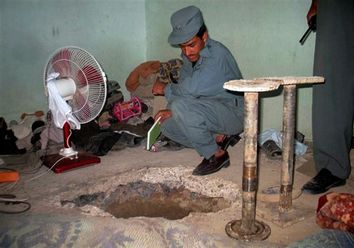
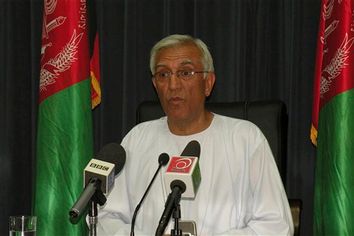
Gunmen kill 2 guards in attack on Afghan governorAn Afghan investigator checks sandals belonging to militants after an attack at the governor's compound in Kandahar south of Kabul, Afghanistan, Saturday, April 28, 2012. Two Taliban militants hiding small guns in their shoes slipped into a provincial governor's compound in southern Afghanistan on Saturday, setting off a fierce gunbattle that left two security guards and both attackers dead. (AP Photo/Alludddin Khan)(Credit: AP)

KANDAHAR, Afghanistan (AP) — Two Taliban militants hiding handguns in their shoes slipped into a provincial governor’s compound in southern Afghanistan on Saturday, setting off a fierce gunbattle that left two security guards and both attackers dead.

Also, a roadside bomb killed 10 Afghan security forces in eastern Wardak province, officials said.

In the attack on the governor of Kandahar province, the assailants made it through a pair of security checks without their weapons being detected before a guard at the last check — in the reception room for the governor’s office — noticed something suspicious and stopped them, said Gov. Tooryalai Wesa.

The militants then pulled the guns out of their shoes, shot the guards and took their weapons, Wesa said.

That sparked a gunbattle with security forces that lasted about 30 minutes and left both attackers dead, said Parwiz Najib, a spokesman for the governor. One guard was wounded in the fighting.

Taliban spokesman Qari Yousef Ahmadi claimed responsibility for the attack.

The Taliban routinely target Afghan officials in an attempt to weaken the resolve of a government they say is collaborating with foreign occupiers. Wesa’s office said in a statement that Saturday’s attack was the ninth to target the governor in the past three years.

The assault also serves as a reminder of the insurgents’ ability to strike in even some of the most secure areas of the country. Earlier this month, militants launched a large-scale coordinated attack on the diplomatic center of the capital, Kabul, and three other cities in which 36 insurgents and 11 others were killed.

Wesa said he was in his office meeting with constituents when he heard shooting out in the reception room.

“There was an explosion,” Wesa said, but he did not know whether the blast was caused by grenades or something else.

He and his guests escaped out a back door to the press office, where they waited for the fighting to stop.

Wesa said the assailants came under the pretext of asking for him to intercede on behalf of relatives that had been detained — a common request.

“The insurgents are not stupid. They had hidden very small guns in their shoes and at two checkpoints they didn’t catch them,” Wesa said.

Police also discovered two cars parked outside the compound that had been rigged with explosives, apparently ready to be set off if there was a surge of people out into the street, Wesa said. The police defused those bombs, he said.

The roadside bomb in Wardak province’s Chak district killed 10 members of the Afghan security forces driving in a pickup truck, officials said, speaking on condition of anonymity because they were not authorized to release the information.

The dead were members of the Afghan Local Police, a government-sponsored militia that works alongside the Afghan army and the national police.

___

Associated Press writers Rahim Faiez and Chris Blake contributed to this report from Kabul.

Afghan official: US chopper crashed in bad weather

  • more
    • All Share Services

KANDAHAR, Afghanistan (AP) — A U.S. Army helicopter crashed in bad weather during the night in Afghanistan as it was en route to respond to a suicide attack on a local police checkpoint, an Afghan official said Friday.

The American military has confirmed the Black Hawk crashed on a nighttime mission Thursday, and initial reports indicated that as many as four soldiers may have been killed. It said the cause of the crash was unknown.

The chief of the Garmsir district in southern Helmand province, Mohammad Qayum Gorbaki, said the helicopter was flying to the scene of a suicide bombing in his area when it crashed late Thursday because of bad weather. He had no further details about the crash.

Gorbaki said four Afghan police officers were killed and seven others were wounded in the suicide attack on the checkpoint.

Two U.S. defense officials in Washington said late Thursday that four American troops were aboard the helicopter, identified as an Army Black Hawk, and one official said initial word from the scene was that officials “don’t expect” that any of the four survived. Both officials spoke on condition of anonymity because details were still being collected and the families of the helicopter crew had not yet been notified.

In a brief official announcement, the American military command in Kabul said there were “no confirmed reports” of casualties “at this time.” The announcement did not specify the nationality of the helicopter crew and said the cause of the crash was unknown.

Continue Reading Close

Motorcycle Bomb Kills 4 Afghan Civilians

  • more
    • All Share Services

KANDAHAR, Afghanistan (AP) — A bomb hidden in a parked motorcycle exploded at a market in southern Afghanistan on Wednesday, killing four people, officials said.

All those killed in the midday blast in Spin Boldak, on the Pakistani border, were civilians, said Zalmai Ayubi, a spokesman for the Kandahar provincial government.

Eight people were wounded in the explosion, including one border police officer, he said.

Civilians have born the brunt of the violence in Afghanistan, despite insurgent claims that they are targeting government and military installations. Last year was the deadliest on record for civilians in the Afghan war, with 3,021 killed as insurgents ratcheted up violence with suicide attacks and roadside bombs, according to U.N. figures.

Taliban-affiliated militants were responsible for more than three-quarters of the civilian deaths in 2011.

No one immediately claimed responsibility for Wednesday’s attack in Spin Boldak, which is often the case when civilians are killed.

Suicide bomber kills Kandahar mayor in Afghanistan

Fatal attack comes just two weeks after assassination of Ahmed Wali Karzai, a major force in the city

  • more
    • All Share Services

Suicide bomber kills Kandahar mayor in AfghanistanIn this undated image made available by the provincial media center Kandahar Mayor Ghulam Haider Hamidi addresses a press conference in Kandahar south of Kabul, Afghanistan. The mayor of Kandahar was assassinated on Wednesday July 27, 2011 by a suicide bomber who hid explosives in his turban Afghan officials said. The Taliban say they sent the suicide bomber who killed the mayor of Kandahar in southern Afghanistan. Hamidi was the third major powerbroker from the south to be slain this month. (AP Photo/Provincial Media Center )(Credit: AP)

A suicide bomber hiding explosives in his turban assassinated the mayor of Kandahar on Wednesday, just two weeks after President Hamid Karzai’s powerful half brother was slain in the southern province that is critical to the U.S.-led war effort.

Mayor Ghulam Haider Hamidi, 65, was the third powerbroker from southern Afghanistan to be killed in just over two weeks, underlining fears of a surge in violence in the wake of the slaying of the president’s half brother. The Taliban have claimed responsibility for all three attacks, yet the area is rife with tribal rivalries and criminals and it is not yet certain who is behind the trio of killings.

Ahmed Wali Karzai was gunned down in his home in Kandahar by a close associate on July 12, leaving a power vacuum in Kandahar and dealing a blow to the strength of the president’s support as well as the stability of the south where the Taliban hold the most sway.

Five days later, Karzai’s inner circle suffered another hit when gunmen killed Jan Mohammad Khan, an adviser to the president on tribal issues and a former governor of Uruzgan province, also in southern Afghanistan. A member of parliament also was killed in the July 17 attack at Khan’s home in Kabul.

Taliban spokesman Qari Yousef Ahmadi told The Associated Press that they killed the Kandahar mayor because he had ordered the destruction of homes that city officials claimed had been illegally constructed. Ahmadi said the mayor was killed to avenge the deaths of two children who were killed during the demolition work.

Kandahar Gov. Tooryalai Wesa said the two children were accidentally killed by a bulldozer knocking down the homes.

During his four years as mayor, Hamidi became the enemy of the Taliban as well as others involved in criminal activities.

The mayor’s son-in-law, Abdullah Khan, said Hamidi had launched a campaign against warlords and criminals and was particularly harsh on people who took illegal control of property. Just two days before the killing, he said his father-in-law had ordered several large homes torn down because they had been built illegally.

“I don’t know who did this,” Khan told the AP in a telephone interview. “From day one I was afraid. Even I wanted to put pressure on him to leave.”

“It is up to the police to investigate, but we don’t really have police that can do a good investigation,” Khan said.

Ryan Crocker, the new U.S. ambassador to Afghanistan, and Gen. John Allen, the new commander of U.S. and NATO forces in Afghanistan, both condemned the assassination.

Crocker told reporters during his first briefing at the U.S. Embassy in Kabul that the assassination was indicative of the challenges ahead in Afghanistan.

“Assassinations are horrific acts — they are acts of terror and can have major impacts,” he said. “But I don’t think you can chart a straight line that says that three assassinations guarantees a total unraveling either of international support or Afghan confidence. It could very well go the other way.”

The mayor was killed inside the heavily fortified compound of a government building in the heart of the city just before he was to meet with citizens involved in the land dispute, according to Mohammad Nabi, an employee of the mayor’s office. The explosion occurred when somebody holding a piece of paper approached him as he was walking with another person, Nabi said.

“He tried to say something to the mayor and then suddenly the explosion happened,” according to Nabi, who said the man with the paper was the bomber. “After that there was some shooting. I hid behind a wall. The windows were shattered. There was dark smoke.”

Black cloth with thin gray stripes that the bomber had used to wrap his turban could be seen on the ground where he detonated his explosives. Blood was spattered on the dirt ground of the compound and the trunk of a nearby tree.

The governor’s spokesman, Zalmai Ayubi, said one civilian also was killed and another civilian and a security guard were wounded in the explosion.

“The suicide bomber put explosives inside his turban,” said Sher Shah Yousafzai, deputy police chief in Kandahar province. “As soon as the mayor came to work, the attacker detonated his explosives.”

Militants have targeted scores of government officials in Kandahar, heightening fears that security in the already volatile south is unraveling.

In April, a suicide bomber wearing a police uniform killed Khan Mohammad Mujahid, the Kandahar provincial police chief and one of the most prominent law enforcement officials in the nation. Two deputy mayors also have been killed — one in April 2010 as he knelt for evening prayers in a mosque and another during an insurgent attack in October 2010.

Two days after the president’s half brother was slain, a suicide attacker — also with explosives hidden in his turban — blew himself up inside a mosque where Afghan officials were attending a memorial service for him.

Hamidi, who worked in the U.S. financial sector for many years and was a U.S. citizen, was considered to be Wali Karzai’s ally in Kandahar. But Hamidi operated behind the scenes and his tribal contacts were not considered strong, leading some to speculate that he could not take over for Wali Karzai, a master operator who played Kandahar’s hard-line tribal and political factions against one another to retain ultimate control over the restive province.

According to the Kandahar governor’s office, Karzai had offered Hamidi other posts, but that he had chosen to remain mayor. Karzai had offered to appoint Hamidi as a deputy finance minister, the head of the government’s local governance unit in Kabul as well as the governor positions in Herat and Kandahar provinces.

“He was struggling with all the powerful people in Kandahar — the land grabbers and people who were breaking the law,” the governor’s office said in a statement. “That’s why the militants targeted him.”

The gray-haired Hamidi, who was from Kandahar’s Arghandab district, attended high school in Kandahar and Kabul University. He worked for 13 years in the Afghan Finance Ministry’s budget department and was employed at a government bank. He moved to Pakistan and later to the United States and then returned after the collapse of the Taliban regime in 2001.

Associated Press writers Amir Shah, Patrick Quinn and Rahim Faiez in Kabul and Kathy Gannon in Islamabad contributed to this report.

Continue Reading Close

Bomber targets service for Afghan leader’s brother

Militant carries out suicide attack at funeral for Ahmed Wali Karzai in Kandahar

  • more
    • All Share Services

Bomber targets service for Afghan leader's brotherFILE - In this Wednesday, April 14, 2010 file photo Ahmad Wali Karzai, half-brother of Afghanistan's President Hamid Karzai gestures during an interview with The Associated Press in Kandahar, Afghanistan. An Afghan official says Afghan President Hamid Karzai's half brother has been killed in southern Afghanistan. Zalmai Ayubi, the spokesman for Kandahar province, says that Ahmad Wali Karzai was shot dead on Tuesday July 12, 2011. Ahmad Wali Karzai, who was head of the Kandahar provincial council, had become a political liability for the Karzai government _ a symbol of cronyism and a lightning rod for criticism of all that is wrong with the Karzai administration. (AP Photo/Rahmat Gul, File)(Credit: Associated Press)

A suicide bomber concealing explosives in his turban blew himself up inside a mosque in southern Afghanistan on Thursday during a memorial service for the president’s assassinated half brother, officials said. At least four people were killed.

Among the victims of the attack in Kandahar city was Hekmatullah Hekmat, head of the clerical council for the province, and a young child, the Interior Ministry said. At least 15 people were wounded, including a parliamentarian, Bismillah Afghanmal.

The Kandahar provincial government said all other high-ranking officials at the ceremony were safe and had been taken to a secure location.

No one immediately claimed responsibility for the attack, which added weight to assertions that the slaying of President Hamid Karzai’s younger brother would further destabilize a violent region of Afghanistan.

The Sarra Jamai mosque in the southwest of the city had been filled with relatives and friends of Ahmed Wali Karzai, who was killed earlier this week. They were offering their condolences to the family of the provincial leader.

Officials believe the bomber got the explosives past security by hiding them in his turban.

Kandahar Governor Tooryalai Wesa, who was attending the memorial, said he saw the man’s turban explode. Provincial intelligence chief Gen. Mohammad Naeem Momin said authorities drew the came conclusion after examining the bomber’s remains.

The attacker approached Hekmat after mourners ended a prayer, the governor said.

“There was a prayer going on and after that prayer the man came close to the director of the religious council and exploded,” Wesa said. “It looks like he was targeting the director.”

Wali Karzai was shot at close range by a confidant on Tuesday, leaving President Karzai without a powerful ally in Kandahar province, a former Taliban stronghold and the site of recent military offensives by the U.S.-led military coalition.

The Taliban claimed responsibility for the killing, which has threatened to create a power vacuum in the south.

Wali Karzai was regarded as the most powerful man in southern Afghanistan. He was head of the provincial council, the influential Populzai tribe, and the Afghan president’s confidant and emissary.

Beyond his more official roles, Wali Karzai was also known as a master operator who played Kandahar’s hard-line tribal and political factions against one another to retain ultimate control over the restive province.

Even the international alliance begrudgingly accepted Wali Karzai’s sweeping influence in southern Afghanistan, despite their strong suspicions that he was involved in opium trafficking, smuggling and other criminal enterprises.

The mosque bombing was the second attack in Kandahar city on Thursday. Earlier in the morning, a bomb exploded near a police vehicle in the city, killing one civilian, said provincial police Chief Abdul Raziq.

As the conflict intensifies in the south and southeast of Afghanistan, the United Nations said Thursday that civilian deaths jumped 15 percent in the first half of 2011. The U.N. blamed a rise in insurgent roadside bombings and suicide attacks for the increase.

The U.N. said 1,462 Afghan civilians lost their lives — many in the crossfire of battle between Taliban insurgents and Afghan, U.S. and NATO forces. During the first half of last year, 1,271 Afghan civilians were killed.

But many of the most contentious incidents continue to be international military strikes in which residents routinely claim civilians are killed.

In the latest such dispute Thursday, government officials in eastern Afghanistan accused NATO troops of killing six civilians in an overnight raid, and more than 1,000 people poured into the streets of Khost province in anger.

The military alliance said the joint patrol with Afghan forces in Khost province killed six fighters from a militant group allied with the Taliban known as the Haqqani network and injured one civilian.

“I don’t have any indication that we killed civilians,” Capt. Justin Brockhoff told The Associated Press.

But the reports stirred up anger in Khost and hundreds of people marched on the capital, shouting, “Death to America! Death to the government!” Men in the crowd carried the bodies of the dead on their shoulders.

The raid took place in the village of Toora Worai in an area known as Matoon, about four miles (seven kilometers) from the provincial capital of Khost city.

“The coalition last night ran an operation in that village and unfortunately they were acting on an incorrect report that there was a meeting of Haqqani network commanders going on,” said Mubarez Zadran, a spokesman for the provincial government. “The operation left six civilians dead.”

Khost provincial council member, Gul Mohammad Zazi, said international troops stormed into the village around midnight and fired into the windows of houses. Zazi said the dead were not connected to the insurgency.

Brockhoff said that NATO and Afghan forces were going after a Haqqani leader who was responsible for attacks and weapons trafficking in the area.

“As the security force was clearing a compound in the area, multiple insurgents armed with AK-47 rifles and pistols, opened fire on the force,” Brockhoff said. Among those killed in the firefight was a woman who was armed with a pistol and fired on the troops, he added.

He said the international troops administered first aid to the female civilian who was wounded and transported her to a medical facility.

Asif Khan, a resident of Toora Worai who lives next to some of those who were killed said all of the dead were civilians. A spokesman for local schools, Sayed Musa Majro, said the dead included a teacher and two students.

Meanwhile, NATO said one of its service members was killed Wednesday in an attack in eastern Afghanistan. The coalition did not provide further details or the nationality of the service member.

Vogt reported from Kabul. Associated Press writers Amir Shah, Solomon Moore and Deb Riechmann contributed to this report from Kabul.

Continue Reading Close

Afghan president’s half-brother assassinated

Ahmad Wali Karzai, a leader in Kandahar and suspected drug trafficker, was killed by a bodyguard in his home

  • more
    • All Share Services

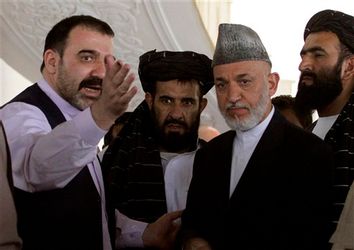
Afghan president's half-brother assassinatedFILE - In this Saturday, Oct. 9, 2010 file photo Afghan President Hamid Karzai, second from right, is met by his half brother Ahmad Wali Karzai, left, in Argandab district of Kandahar province, south of Kabul, Afghanistan. An Afghan official says Afghan President Hamid Karzai's half brother has been killed in southern Afghanistan. Zalmai Ayubi, the spokesman for Kandahar province, says that Ahmad Wali Karzai was shot dead on Tuesday July 12, 2011. Ahmad Wali Karzai, who was head of the Kandahar provincial council, had become a political liability for the Karzai government _ a symbol of cronyism and a lightning rod for criticism of all that is wrong with the Karzai administration. (AP Photo/Allauddin Khan, file)(Credit: Associated Press)

Afghan President Hamid Karzai’s half brother, a lightning rod for criticism of all that is wrong with the Afghan government, was assassinated Tuesday at his home in southern Afghanistan, an official said.

The death of Ahmed Wali Karzai was confirmed by Zalmai Ayubi, the spokesman for Kandahar province, and Sediq Sediqqi, a spokesman for the Ministry of Interior.

Ahmed Wali Karzai, who was head of the Kandahar provincial council, had become a political liability for the Karzai government. But the president repeatedly defended him, denouncing accusations that his brother was involved in criminal activities in the restive south.

Ahmed Wali Karzai has been the reported target of multiple assassination attempts.

In May 2009, his motorcade was ambushed by insurgents firing rockets and machine guns in eastern Nangarhar province. One of his bodyguards was killed, but he was not harmed.

That attack came less than two months after four Taliban suicide bombers stormed Kandahar’s provincial council office, killing 13 people in an assault that Ahmed Wali Karzai said was aimed at him. A Taliban spokesman said the attack targeted the general compound. The president’s half brother had left the building a few minutes before that attack.

Continue Reading Close

Page 1 of 2 in Mirwais Khan