Nathalie Gorman

Thomas Friedman wants a revolution

Only an uprising in green technology will revive America and promote world democracy, the New York Times columnist now argues.

  • more
    • All Share Services

In his new book, “Hot, Flat and Crowded: Why We Need a Green Revolution and How It Can Renew America,” Thomas Friedman, author of the best-selling “The World Is Flat” and “The Lexus and the Olive Tree,” argues that America can fire up its economy and restore its world standing by turning its considerable technological might on clean energy and conservation.

Advocating a green path to world democracy would seem to mark a new direction for Friedman, who initially supported the Bush administration “in trying to bring democracy to Iraq,” he writes in “Hot, Flat, and Crowded.” In a lively interview with Salon, he acknowledges his about-face on the Iraq war and outlines what he now sees as America’s — and his own — environmental responsibilities. He looks at the current presidential candidates and explains why only one appears capable of leading a green revolution.

What does “Hot, Flat and Crowded” mean?

The shortest way I can explain it is that “hot” stands for the increase in global warming, “flat” is my metaphor for the rise of middle classes all over the world, from India to China to Brazil to Russia, who are now able to consume and produce like Americans, and “crowded” is the fact that the population of the planet in my lifetime — I’m 55 — has almost tripled. The year I was born, there were 2.7 billion people on the planet. If I live to be 100, there should be 9.2 billion.

When the world gets that flat and crowded, the energy, climate and natural resource implications are going to be enormous. My core thesis is we’re at a perfect storm or convergence of global warming, global flattening and global crowding, and it’s going to drive five mega-problems that are going to shape the 21st century: energy and natural resource supply and demand, petro-dictatorships, climate change, biodiversity loss and energy poverty. How will we answer those five problems. Who can invent abundant, cheap, clean, reliable energy? Whichever companies, countries and communities do that are going to own the next great global industry, which I call E.T., or energy technology.

You say a green revolution can renew America. What is it about America that would be renewed?

That’s a good question. The thing about the energy technology industry is that it cuts across the entire economy. It can produce blue-collar jobs or green-collar jobs in either retrofitting homes or building, manufacturing and erecting geothermal plants, solar thermal plants or wind [farms]. So there’s a real chance to bring manufacturing and skilled blue-collar jobs back to America. You cannot outsource a wind farm.

At the same time, the level of innovation and research to achieve these new technologies is a moonshot quality. It’s the kind of thing that can drive our technological foundation to a whole new level. If we lead this revolution, which is the biggest story in the world today, we’re going to have more respect as a country. We become more secure. We are not dependent on some of the worst regimes in the world; we’re not dependent on anybody. We’re going to provide jobs for the working class, drive innovation and build up energy security and economic security. It’s how we get our groove back.

You write that today we don’t have a green revolution but a green party. What do you mean?

The green revolution is still at a symbolic and hobby level. There are a lot of small things people are doing — wonderful things — driving a hybrid car, putting solar panels on their roof, generating their own power. But the problem is, the scale of this problem is so large. I say, “Well, here’s a phony revolution. It’s doing nothing toward that scale.” So that’s why I’m down on Earth Day concerts and more focused on the real engine for innovation and deployment, which is the marketplace.

Do you think symbolism has outworn its use? Or do you think it can be deployed in the service of trying to move things to scale?

It’s a good question. What I’m trying to do is rename green. I’m a big believer that to name an issue is to own it. “The World Is Flat,” you know? My problem with “green” as a label is that it was named by its opponents. They named it “liberal,” “tree-hugging,” “girlie-man,” “sissy,” “unpatriotic”; vaguely French. What I’m trying to do is take that definition and rename it “green geopolitical,” “geo-strategic,” “geo-economic,” “patriotic.” Green is the new red, white and blue. I very much want both conservatives and liberals to wear that color. If this is just a thing for liberals, it’ll never scale. If it doesn’t scale, it stays at the hobby level. If it’s a hobby, we’re cooked.

What’s going to make Americans change their energy-consuming behavior?

Well, I’ll give you a really lame answer. According to some reviews of the book, this answer’s just not adequate! I say, I’m sorry it’s not adequate, it’s the only answer: It’s leadership. You must have a leader who can frame this problem in an exciting way — not just the answer to these big five problems, but this incredible opportunity. It’s why I say, “Change your leaders, not your light bulbs.” Not that changing your light bulbs isn’t important. We’ve done it. Everyone should do it. But leaders write the rules and rules shape the markets — tax incentives, carbon taxes, cap and trade — and markets are what give you scale.

To me, the engine of this whole change is the market. We’re not going to regulate our way out of this problem. We can only innovate our way out of it. But that requires rules. It requires legislators, Congress, to write different rules. There’s no substitute for leadership. You and I could have the greatest green ethic in the world. We could do everything and it wouldn’t make a dime’s worth of difference. Markets must be shaped to scale these things down to a price where people can afford them.

You write warmly of Al Gore. How much closer do you think we’d be to a green revolution if we were nearing the end of a Gore administration as opposed to a Bush administration?

From your lips to God’s ears. I have to believe that given everything he knew, and everything he believed — even though the first time around with Clinton, they really didn’t do much — I have to believe had Gore been president, he would have been a real change agent. But we didn’t not have Gore, we had Bush going the other way, making us stupid. It’s enough to make you weep.

You write that if you don’t run your company or country like a chief energy officer, you’re not going to be effective as a chief executive officer. Of the two presidential candidates, John McCain and Barack Obama, who do you think is more likely to run the United States like a chief energy officer?

I recently wrote a column saying that one of things that excited me about this campaign initially is that there were two green candidates, two people talking seriously about energy. Now there’s only one and it’s Obama. McCain, starting with his gas-tax holiday for the summer, which only would have driven up consumption and the price of gasoline, is missing all eight votes for renewing the reduction investment tax for wind and solar, and then topping it off with the “drill, baby, drill” mantra. I have no reason to believe whatsoever that someone who would run this kind of campaign, who could flip so easily, would be the kind of leader we need of this green revolution.

Maybe Obama will do it. I don’t know. But I think he believes the right things. I think he has the right impulses and instincts, and at least he hasn’t pandered in the worst possible ways on this issue. If he were to win, he’d have a lot more room to maneuver. He’d have very few words to eat. That matters.

Could Obama improve his energy plan?

You know, the one thing I would do to improve the campaign — and I understand calling for a cap and trade or a gasoline tax is not a big winner right now — is connect it up with American renewal, American revival. Get a little excited about it. I just wish he conveyed a little more excitement about it.

Talking about someone who’s conveyed a lot of excitement lately, do you think a Vice President Palin would have a positive or a negative effect on a President McCain’s energy policy?

She comes from Alaska, the Saudi Arabia of America for oil, and I really don’t see anything in her background that suggests she’s thought in any way about an energy technology revolution beyond oil.

You say in your book that you supported the war in Iraq as part of a “strategy to weaken … forces of tyranny,” and you talk a lot about promoting democracy. You now say you no longer think invasion is a good way to do this. Is this book an effort to go back to the drawing board and figure out a different strategy for promoting democracy?

It would be way too grand to say that was part of it. But that’s what the book is about, to be honest. One thing we know for sure is that we’re not going to do this again: try to build a democracy in the Arab Muslim world by invasion, and trying to collaborate with people on the ground. We’re just not going to do this again. Yet if you still believe that this is a really important issue, whether it’s in the Middle East or in Russia, then what strategy do we have? What leverage do we have to try to drive the forces of democratization, women’s empowerment, and all these other issues associated with oil? To me, being the leader of energy technology, and developing alternatives to oil to weaken all those forces, is very much a part of driving that process.

You emphasize that America can promote greening and democracy if it leads by example. But right now the European Union and a lot of other countries, including China, appear to be ahead of us in going green. Is America going to be able to get ahead?

It’s not like we’re out of the game. But it would really be hard to call us the leaders today. Look at what Denmark did after 1973 — wind power, a CO2 tax, energy efficiency. Japan is far ahead of us in many of these technologies. We are not in last place, but given the level of technology we have, we’re just not where we should be.

In terms of moving ourselves ahead, you write, “We have a target. We want to avoid the doubling of CO2 by mid-century and to do it we need to avoid the emission of 200 billion tons of carbon as we grow between now and then.” Do you think we’ll make it?

I have to live my life thinking that we can. I really like the quote from [environmental writer] Dana Meadows at the end of the book. As Amory Lovins remarked at her memorial service, she’d always say, “We have exactly enough time — starting now.” I really think that’s how you’ve got to live your life. “She treated the future as choice, not fate,” Lovins said. I choose to live my life believing that our future is our choice, not our fate, and that we have exactly enough time — starting now. That’s how I want to live my life. That’s about all I can say.

McCain camp responds angrily to S.C. Dem

Carol Fowler, who heads the state's Democratic Party, had said that Sarah Palin's "primary qualification seems to be that she hasn't had an abortion."

  • more
    • All Share Services

Earlier today, Politico’s Jonathan Martin reported that Carol Fowler, the chairwoman of the South Carolina Democratic Party, commented that John McCain had picked a running mate “whose primary qualification seems to be that she hasn’t had an abortion.”

McCain’s running mate, Governor Sarah Palin, who is pro-life, recently gave birth to her fifth child, Trig, who has Down Syndrome. Before she joined the Republican ticket, Palin was supported by social conservatives — a portion of his base McCain had real trouble with — in large part because of her decision not to terminate her pregnancy after the test results came back.

The McCain campaign, which has been all over this sort of thing this week, hastily organized a “Palin Truth Squad” conference call featuring Sen. Lindsey Graham (R-S.C.) and Rep. Marsha Blackburn (R-Tenn.).

Senator Graham expressed his shock — shock! — at “yet another personal smear on Governor Sarah Palin” coming from Carol Fowler, who he said is a personal acquaintance of his. He stressed that it was “not characteristic [for Fowler] to say something this out of bounds” and suggested “it shows that our Democratic colleagues are in a meltdown mode.”

“Only very blinded, partisan people,” Graham claimed, could treat Palin and her record as Fowler and other (noticeably unnamed) Democrats are. He called on Barack Obama to reject the comment and later added, “if a Republican had said that about a Democrat, it would be the firestorm of the century.”

And, of course, for appearances’ sake, it’s always nice to have a woman around if you’re going to complain about supposed sexism. Blackburn was there to fill that role; she said this comment represented “a pattern” of sexist comments made by Democrats during the 2008 campaign season, citing the time Obama called a female reporter “sweetie.” Further evidence of sexism, she said, could be found in Obama’s choice of running mate. Blackburn also referenced what she called “the lipstick comment.” That kind of behavior, she said, “show[s] so much disrespect to all women.”

But the reporters on the call seemed uninterested in the Truth Squad’s crusade against sexism. They were more interested in factual holes in the McCain campaign’s ads. One asked a question about how the McCain campaign could play victim and at the same time launch attacks that falsely accuse Obama of supporting comprehensive sex-education for kindergarteners. Another asked why the McCain campaign continued to insist that fighting against the Bridge to Nowhere was part of Palin’s record of reform. Graham insisted that “Governor Palin has walked the walk” when it comes to reform. And then, illustrating exactly why the McCain camp relishes these kinds of opportunities, Graham returned to Fowler, saying, “This effort to demean [Governor Palin] or wipe out her accomplishments because she disagrees with the NARAL crowd about one issue is not going to succeed.”

Hari Sevugan, an Obama spokesman, has responded to Fowler’s comment, saying, “Carol Fowler was speaking for herself. Her comments do not reflect our views in any way.”

Update: Fowler has now apologized for her remarks. Her statement reads:

I personally admire and respect the difficult choices that women make everyday, and I apologize to anyone who finds my comment offensive. I clumsily was making a point about people in South Carolina who may vote based on a single issue. Whether it’s the environment, the economy, the war or a woman’s right to choose, there are people who will cast their vote based on a single issue. That was the only point I was attempting to make.

Continue Reading Close

Sarah Palin’s pastor problem

Move over Jeremiah Wright

  • more
    • All Share Services

This election season has already seen Barack Obama repudiate his pastor, the Reverend Jeremiah Wright, for his controversial views. Sarah Palin, John McCain’s newly-minted running mate, may soon be considering doing the same.

Palin’s pastor, Larry Kroon, invited the founder of Jews for Jesus, David Brickner, to speak at her church on August 17th, Politico’s Ben Smith reported. According to its mission statement, Jews for Jesus is an organization that tries: “to make the messiahship of Jesus an unavoidable issue to our Jewish people worldwide.”

Palin and her family were present in the church for Brickner’s sermon, the full text of which can be found here. In the sermon, he made a number of inflammatory claims, most particularly about terrorist attacks in Israel. “Judgment is very real and we see it played out on the pages of the newspapers and on the television. It’s very real,” he opined. Speaking of his son, who had recently been in Jerusalem, he said: “When Isaac was in Jerusalem he was there to witness some of that judgment, some of that conflict, when a Palestinian from East Jerusalem took a bulldozer and went plowing through a score of cars, killing numbers of people. Judgment — you can’t miss it.”

The McCain campaign has denied that Sarah Palin or her family support Brickner’s views. Andrew Sullivan of The Atlantic’s Daily Dish quoted one of the campaign’s spokesmen, Michael Goldfarb, saying that: “Governor Palin does not share the views he expressed, and she and her family would not have been sitting in the pews of this church for the last seven years if his remarks were even remotely typical.” But according to Larry Kroon’s introduction to the sermon, Brickner, who also spoke at the church four years ago, was influential in his decision to become a pastor.

John McCain has long been perceived by voters as friend to Israel, in no small part because he enjoys the support of Senator Joseph Lieberman, one of Israel’s more vocal champions on the national scene. Palin’s pastor problem could weaken that perception.

Jews for Jesus now has a statement on its homepage claiming Brickner’s “statements regarding God’s judgment have been published out of context in a way that we feel is misleading. David holds the traditional evangelical belief that God judges all people for sin, and that Jesus is the solution for the sins of everyone who will repent and receive God’s gracious forgiveness.”

Continue Reading Close

“WTF” of the day

Is there really a National Abortion Records Database?

  • more
    • All Share Services

Our sisters over at Jezebel alerted us to AbortionTracker.com. According to the website:

Our unique search database pulls information from a variety of 3rd party and proprietary sources to compile a full, comprehensive list of every woman who has had an abortion procedure performed in the United States and Canada, dating back to 1940, in many cases.

Simply join our network, submit your personal information, and once you are approved, we will grant you access to our cutting edge, patent pending system. Before you know it, you’ll know your friends and neighbors for who they really are.

Sound enragingly over the top? Well, there’s a reason for that. The whole site is almost certainly a hoax — “Bear in mind that our offices are technically located overseas, and very few of the laws you know actually pertain to anything bearing upon our operation” reads one portion, while another part suggests women seeking internships send in photos of themselves in bikinis — but even as subtle satire, it’s just plain creepy.

Continue Reading Close

Chaos in the Caucasus

An expert on Russian politics talks about what's behind the military assault on Georgia, and how the U.S. and Europe failed to prevent it.

  • more
    • All Share Services

Chaos in the Caucasus

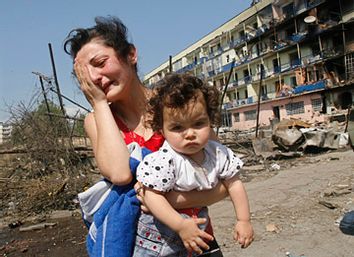
Russian President Dmitri Medvedev announced Tuesday that his country would stop its attacks against Georgia, declaring that the small southern country had been adequately “punished” for its own recent military actions against the separatist region of South Ossetia. Medvedev’s agreeing to a cease-fire nominally ended the hostilities, with President Nicolas Sarkozy of France, who negotiated the agreement, then heading from Moscow to Tbilisi to negotiate with Georgian President Mikheil Saakashvili. According to several news reports late Tuesday, however, Russian attacks continued after the announcement in Moscow, including airstrikes and ground operations. The conflict seems far from over.

The Caucasus region to Russia’s south has been a volatile place for years, with various factions struggling for control and post-Soviet Russia seeking to reassert its hegemony. To better understand how the long-simmering conflict boiled over into a full-blown assault by the Russians, Salon turned to Michael McFaul, an expert on Russian politics and a director of the Freeman Spogli Institute for International Studies at Stanford University. McFaul has also served as a foreign policy advisor to the Obama campaign. He spoke to Salon by phone on Monday night.

What is the conflict in Georgia all about?

There were skirmishes between fighters in South Ossetia and Georgia that went on for some time. President Saakashvili then decided he needed to use greater military force and actual soldiers to quell it. He went into South Ossetia, escalated the conflict in doing so and, by the way, struck civilian targets.

The Russian response to that was to invade Georgia, not just to try to get back to the status quo. They have been attacking cities in Georgia proper, and bombing civilian targets in Georgia proper. I think the bigger reason why we see this happening is that Mr. Putin — and he’s the one calling the shots here, it seems to me, the prime minister, not President Medvedev — decided [to do so] a long time ago. This was a fight that they have wanted to have for some time. The events of last week [in South Ossetia] were the trigger to make it happen.

The Russians are extremely frustrated with Georgia’s move toward the West, thinking of themselves as part of the Euro-Atlantic community, and especially upset about their petition to join NATO. The Russian leaders see the world in, I would say, very old-fashioned, 19th-century real-politick ways — in terms of spheres of influence and regional powers and super powers. So what they’re trying to do, in a grotesque way, is to reassert Russian power in the region. But they’re not doing it through what we call soft power. They’re using hard power.

What does Russia have to gain from a protracted confrontation?

I would speculate that they’re trying to destabilize the regime, the Georgian government. I don’t quite see how what they’re doing leads to that, but they’ve hinted at that enough to suggest that that’s what they’re trying to do. They’ve said Mr. Saakashvili is the problem.

Does Georgia have anything to gain from extended conflict?

They have absolutely nothing to gain from this fight. They know, and they’ve said this repeatedly, that they have no chance to fight a war with Russia. The asymmetries are overwhelming. They are suing for peace unconditionally. They’re fighting for their lives, they’re fighting to survive, so I’m quite convinced when they say they want a cease-fire.

So why provoke Russia by sending troops into South Ossetia in the first place?

I think they miscalculated. I don’t think they anticipated that Russia would invade their country. I mean, I was very critical of the use of force against Tskhinvali, the capital of South Ossetia. I think that was inappropriate use of military force. Civilians died. But they didn’t anticipate that Russia would respond the way they did. And, let’s be clear: However awful it was, President Saakashvili was using force inside his own country, inside the borders of Georgia that all countries of the world recognize. Russia, when it invaded, was violating the territorial integrity of Georgia, and therefore violating all sorts of treaty obligations and international law that they’ve signed onto.

You mentioned Putin’s role; is Medvedev, the Russian president, a relevant player in this situation?

If he is, he’s a really behind the scenes kind of guy. I mean, I haven’t been following closely who’s been saying what publicly, but all the optics and everybody in Russia that I know sees this as Putin’s show, not Medvedev’s.

I think it sends a very strong signal to everybody else in the Russian government, in the Russian presidential administration and abroad, that Putin is in control — and not on just security matters, but all matters.

What do you think of the way the U.S. government has been reacting so far?

“Reacting” is exactly the right way to say it. We’re reacting to things that are happening there, when instead we should have been proactively — and I would even use the word preemptively — involved in a political solution in South Ossetia and Abkhazia. It’s not like this is some new thing. There should have been an international mediator appointed. There should have been genuine international peacekeepers in those territories, not Russian soldiers. None of that was really tried with great strength or force, and it should have been, certainly months if not years ago.

I’m convinced that this whole war could have been avoided. It was not inevitable. Had that kind of negotiation started, I think Saakashvili himself in particular would have been much more constrained in the initial use of force that he deployed.

How do the U.S., the E.U., the U.N. and to the extent that it’s participating, NATO, work effectively to get Russia to back down?

That’s the million dollar question which I do not have a good answer for. I think at a minimum you show solidarity with Georgia. You make sure all the allies are in line.

When it comes to punitive measures, though, the West is constrained. I think this is an important point. Part of the reason we’re constrained, and why we don’t have any leverage today, is because we don’t have much of a relationship with Russia. We’ve allowed it to deteriorate over the last several years. When you go and you look at your toolbox, and what leverage we have, there’s really nothing there. I think, if one compares to other periods and other crises, we’re a lot more limited because of the neglect of this relationship.

What might a solution to the crisis look like?

I know what I think it should be, I just don’t think it’s very probable. I think now we have to—we just can’t go back to the way it was before. [We need to focus on] permanently helping resolve these territorial disputes. But that’s going to be very hard to get to from where the situation lies now.

Continue Reading Close

ExxonMcCain ’08? Maybe not

John McCain has taken in more money from the oil industry generally, but Barack Obama's leading in contributions from Exxon employees.

  • more
    • All Share Services

The Democratic National Committee unveiled a new strategy this week, slamming John McCain for his ties to the oil industry by starting up a parody campaign Web site, ExxonMcCain ’08. Barack Obama himself has similarly worked to tie McCain to Exxon. Turns out they could have picked a better oil company, though — a study released this week showed that while McCain has received more donations from the oil industry generally, Exxon employees have given more to Obama than to McCain.

Released by the Center for Responsive Politics, the study explains:

Through June, Exxon employees have given Obama $42,100 to McCain’s $35,166. Chevron favors Obama $35,157 to $28,500, and Obama edges out McCain with BP $16,046 vs. $11,500. McCain leads the money race with nearly every other top giver in the oil and gas industry, though — Koch Industries, Valero, Marathon Oil, Occidental Petroleum, ConocoPhillips, the list goes on.

Altogether, McCain has still raised much more from the oil industry than Obama has. The presumptive Republican nominee has taken in a total of $1.3 million, while his opponent trails with approximately $394,000. And there are questions about some of the money McCain has gotten from people who work for other oil companies, like the surprisingly large amount donated by a low-level Hess employee and her husband.

Nonetheless, the McCain campaign has taken delighted notice of the study. On the official John McCain Report blog, Michael Goldfarb gloated, “Earlier this week Obama told an audience: ‘make no mistake — the oil companies have placed their bet on Senator McCain.’ It looks like somebody made a mistake.” (The link Goldfarb provided directs readers to the DNC’s parody site.) Conveniently, however, Goldfarb left out the total amount that McCain has raised from oil industry employees, as well as any indication of how little Obama has received by comparison.

Continue Reading Close

Page 1 of 2 in Nathalie Gorman