P. Smith
Crash culture
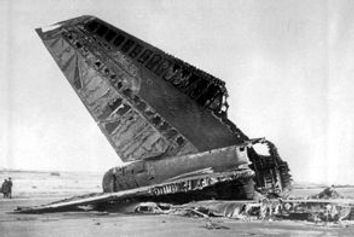
Who is to blame when a 22-year-old 747 falls from the sky?
Following the crash of a China Airlines Boeing 747 on Saturday, the press has been quick to bring up the seemingly related issues of aging aircraft and the questionable safety records of certain foreign airlines.
The aircraft, a 747 of the original, so-called “classic” series introduced in the early 1970s, went down under mysterious circumstances about 20 minutes after takeoff from Taipei, bound for Hong Kong. Not only had the airplane been in service with the Taiwanese carrier for 22 years, and was due for retirement in the next few weeks, but the airline itself has been battling a dubious reputation because of its record of 12 fatal accidents since 1969.
Although nothing has come to light indicating age-related structural failure or mechanical malfunction, coverage has consistently invoked the 747′s age (and made cryptic reference to its ironically scheduled retirement) as a potential factor. “Why did they put this old plane in service?” asked El-Hinn Ibrahim, relative of three of the victims aboard the doomed flight. This inflammatory statement has given various reports of the crash a darkly suggestive tone. Twenty-two years, after all, surely would find most aircraft in the scrapyard, right?
No, actually. And the flying public might be surprised to learn that a 22-year-old airliner is hardly a geriatric jet.
Commercial aircraft are built to last more or less indefinitely, which is one of the reasons they are so expensive (over $150 million for a shiny new 747-400). Older planes are routinely upgraded with newer navigation systems and enhanced safety features, while the scrutiny of maintenance and overhaul procedures increases with an airplane’s age. Generally, an older plane is no less safe or well-maintained than a newer one. Planes are retired not because they’ve become unsafe or are falling apart, but because they’ve become uneconomical to operate, and this may or may not be directly related to their age.
Nor is it correct, by any stretch, to assume U.S. carriers operate the newest and most modern fleets.
When ranked with the world’s largest 100 airlines, U.S. carriers’ fleets are among the oldest. Asian and European airlines, meanwhile, tend to fly the newest. Many of the most up-to-date fleets pop up in some surprising places: Poland, the Czech Republic, Turkey, Morocco.
Often this is due to government subsidies or outright nationalization, or the tough noise restrictions in Europe that essentially mandate operation of newer planes. But just as frequently it’s the result of the progressive attitudes of various carriers. Lufthansa, Emirates, and Singapore Airlines are just a few world-class companies of great prestige that make a point of quick turnover among their flying machines.
Here in America, most jets are between 5 and 12 years old, and as fuel-efficient 737s or Airbuses are swapped in for more thirsty 727s and MD-80s, that number is going down. The jets at Delta, for example, average 9.1 years. But even after last September’s terrorist attacks, when many chronologically challenged jets were sold or mothballed, it is still not uncommon to find 20- or even 30-year-old aircraft in service with the major U.S. airlines. Minneapolis-based Northwest Airlines still flies many McDonnell Douglas DC-9s of mid-to-late 1960s vintage (but meanwhile has retired younger planes that grew economically unsuitable for its routes and operations). The average age of a venerable Boeing 727, still in the ranks of Delta and American: about 20 years.
Upstart JetBlue surprised the industry by inaugurating service with brand-new Airbus A320s, a break from the typical assumption that new entrants and old airframes go hand-in-hand. And other carriers, like Southwest and AirTran, have made a point to outfit themselves with the latest models. But among the majors, large numbers of planes and fleet-specific infrastructures make it far less practical for complete, short-term renewal. Despite the post-September cutbacks, you still might find yourself seated on a 727 or DC-9. (And incidentally, those puddle-jumper commuter jets many people hate to fly on tend to be the newest of all, and are at least as sophisticated as most larger jets.)
But not to worry. If your concerns rest with overhead luggage storage capacity or particle emissions from older-generation turbofans, go ahead and gripe. But from a safety standpoint the statistical difference is negligible.
The key to dependable longevity, of course, is the quality of maintenance and upkeep over the years. The greater the total of hours in a jet’s logbook, the more and better care it needs in the hangar.
Which brings us back to China Airlines. Founded in 1959, the airline (not to be confused with Beijing-based Air China of the mainland) operates a 50-strong fleet of Boeing and Airbus jets, all but a few of which were constructed in the last 10 years. Yet the airline has suffered 12 fatal accidents since 1969, a number well out of kilter with its overall size. Other airlines, too, have earned reputations for danger. The stories about Aeroflot are notorious, while Korean Air found its code-share arrangement (dual use of routes and flight numbers) with Delta temporarily severed after a spate of accidents. So which airlines are safe and which are not?
There are only two things, alone or in combination, that can bring down an airplane: a failure of things mechanical or a failure of things human. Accident records prove there’s a lot more to running a safe operation than buying the newest or most expensive equipment. Safety runs deeper than the shine of new aluminum. The tangibles of technology are easily addressed, while the long history of accident investigation has filled the industry lexicon with catch phrases like “human factors” and something the airlines call “CRM,” or Crew Resource Management, which are, often enough, an ivory tower way of saying “the pilot did it.”
Sure, some airlines are statistically less safe than others, but figuring out which ones, exactly, can get messy. And alas, the ugly American tendency is to invoke a certain conceit toward airlines from other shores. Thus the term “foreign carrier” has become a sort of collectively derogatory buzzword.
In 2000, some 60 million Americans flew foreign airlines to or from the United States. These range from highly respected European companies like Lufthansa, British Airways and KLM (the oldest continuously operating airline in the world), to less-renowned names like Ghana Airways and Uzbekistan Airways. Although some of these airlines are known for young fleets and a level of passenger pampering that often puts their U.S. counterparts to shame, a few notorious accidents have raised the specter of some unbelievably poor decision making on the part of foreign flight crews.
One of the greatest hits of the airline training school video circuit, for instance, is the morbidly hilarious reenactment of the Saudia L-1011 fire at Riyadh in 1980, when the crew inexplicably delayed an evacuation resulting in the deaths of more than 300 people. More recently, apart from the China Airlines crash, events involving Singapore Airlines, Gulf Air, and of course EgyptAir, have made the headlines, raising our suspicions about training, maintenance, and even culture, in airlines of distant lands.
But are we looking at things naively out of context? “There’s no reason why Americans should be afraid of foreign carriers,” said Robert Booth of Aviation Management Services, a consulting firm based in Miami, in an article in the Boston Globe. And all in all there are very few airlines this particular writer would refuse a seat on, none of the aforementioned among them. This is a realm where even tiny differences in statistics translate to huge differences in perception, often unfairly. To find anything close to a dangerous airline, one would have to break out the machete and jungle boots and scour the depths of equatorial Africa, or hitch a ride, perhaps, on a Sudanese-registered cargo plane.
The FAA has established a ranking system for the commercial aviation safety standards of other nations. The rankings, awarded to the nations themselves and not the specific airlines, are based on International Civil Aviation Organization (ICAO) mandated guidelines, with Category 1 status awarded to those who meet the mark, and Category 2 to those who do not. An airline in Category 2, of which there are surprisingly few, does “not provide safety oversight of its air carrier operators in accordance with the minimum safety oversight standards established by the International Civil Aviation Organization.” Airlines from places in this classification, however, are still allowed to operate to and from the U.S. under careful FAA oversight.
Many misconceptions exist about the fleets and operational standards of airlines outside the U.S. Did you know that Colombia’s Avianca is the second-oldest airline in the world, just behind KLM? A ground school instructor in a training class at a major U.S. airline recently lamented the “dangerousness of these third world carriers” when lecturing about operations in South America. I’d bet some folks at Avianca would take issue with that, as would the employees at LAB, the Bolivian national airline. LAB operates out of La Paz, the highest commercial airport in the entire world, and plies the high peaks of the Andes every day. Lo and behold, they haven’t suffered a single at-fault fatality since the early 1970s. And there are dozens of examples of similarly tight-shipped companies worldwide.
A list of airlines around the world that have not suffered a fatal accident since 1970 includes the likes of Tunis Air and Air Jamaica. Allowing for one or two mishaps, the list expands immensely to include several airlines that, by name alone, might cause an eyebrow to arch. At the other end, China Airlines is joined by EgyptAir, Philippine Airlines and Indian Airlines, whose crash totals in the past three decades or so range from seven to 12.
But in either case, it’s important to consider factors such as the overall size of the airline and the numbers of takeoffs and landings its crews make. A quick look at some stats on the Web does not see the whole story. Taking raw crash tallies out of context will misleadingly show American Airlines and United Airlines ranking with the worst, not accounting for their vast networks and frequencies.
One of the carriers with the worst legacies is Russia’s Aeroflot. Put a checkmark next to Aeroflot for each accident, and compare that record to a given U.S. airline. (Before the breakup of Aeroflot into many smaller airlines, the World Aircraft Accident Summary shows nine accidents in the years from 1991-2000, involving 329 fatalities) But consider that Aeroflot was, at its peak, by far the largest airline in the world, with a fleet size approaching that of all U.S. major airlines combined. And today, still maligned and assumed to have a fleet of aging rust buckets, Aeroflot (though now considerably smaller) has a younger roster than most American majors.
In the backs of our minds can lurk a sinister suspicion — one that suggests an airline’s cultural, or even religious, orientation might be a weak link in the safety chain. In the summer of 1988 when the USS Vincennes accidentally shot down an Iran Air A300 in the Persian Gulf, one pilot suggested that the Iranian crew had intentionally flown in harm’s way in a suicidal gesture of Islamic martyrdom. “What the heck do the Iranians care if they die? They just go to Allah!” In reality, of course, you can find many millions of Iranians who very much care if they die. To lump all Muslim pilots together as suicidal commandos and violent fundamentalists is ridiculous, yet we tend to project all sorts of cultural biases onto situations we don’t understand, and onto people we’ve never met, especially when entrusting our lives to them in an airplane. Although many stateside crews have committed some infamous blunders, we tend to judge our own airlines’ actions through a quasi-scientific veil of human factors analysis, while sometimes dismissing similar behavior by foreigners as blatantly irresponsible or stupid.
Are U.S. airlines the safest in the world? Well, you’ll get a good argument from the Europeans, but they’re certainly on par with the very best. There are ways to measure, evaluate and quantify safety, and yes, some carriers will outscore others. But an accident can happen anywhere, to any airline. We are wrong to marginalize the crews and capabilities of another country’s airline by virtue of some assumed cultural or technological superiority. We make such assumptions at our own cultural peril.
Back in the saddle
These days, because I am an airline pilot, people want to know if I'm scared. Of course I'm scared. I would be nervous flying with a pilot who wasn't.
I junked my car, an old red Hyundai, back in 1993, and started riding the subway out to the airport. With my black case, and sometimes in full polyester regalia, I was, maybe, one of the more interesting curiosities on the Blue Line.
In time I became an expert at gauging the intent of peoples’ stares. Businessmen would check out the stickers on my flight bag. College kids would try to decipher the logo on my brass wings. Others would contemplate the number of stripes on my gold shoulder epaulets: What did three bars mean? Four? Now and then strangers would strike up conversations. “My sister-in-law,” they would say, for example, “is a flight attendant, too.” And with that I’d politely explain I was not, in fact, a flight attendant, but a pilot.
Continue Reading CloseAir travel’s communications killer
Twenty-five years ago, the greatest disaster in airline history killed 538 people, in part because of a radio glitch that still hasn't been fixed.
Air travel, always a source of stress for the traveler, has gone full scale in the headache department. From the terrorist hijackings and the crash of American Flight 587, to the hassles now confronting travelers at our terminals, our skies have entered a new realm of insufferability in the mind of a worried populace.
It’s a given that any vestiges of aviation’s glamour days were long ago devoured in post-deregulation chaos, but our ambivalence toward flying never quite evolved into outright fear. It is different now, and the industry cannot afford to miss a step. Should another plane go down, whether from a terrorist’s act of sabotage or a proverbial act of God, or should word emerge of some safety-oriented negligence, unprecedented numbers of citizens may be stowing their seat trays for the last time and opting instead for highways, trains and buses.
Continue Reading CloseHow safe is your airplane?
After the crash of American Airlines Flight 587, some pilots requested that all Airbus A300 planes be grounded. But they're still aloft.
A group of pilots at American Airlines, the world’s largest air carrier, have been rallying for the grounding of American’s fleet of Airbus A300s. Their concerns follow the mysterious crash of an American A300-600 after takeoff from John F. Kennedy Airport on Nov. 12, in which 265 people died. A letter of protest circulated in Miami, New York and Boston, the three stations at which American bases its 34-strong fleet of the European-built wide-body jet, and at least five dozen pilots added their signatures.
Continue Reading CloseThe inherent danger of flying
Shoe bombs and suicidal 15-year-olds are heightening fears about airline security. But aside from creating more chaos at airports, what can we do?
As airplane nuts in junior high school, my friends and I spent virtually every weekend between Grades 7 and 9 roaming the terminals of Boston’s Logan International Airport. I came to know that airport with as much intimacy as I knew my own house. From the 16th-story observation deck of Logan’s control tower, equipped with binoculars and notebooks, we logged the registration numbers of arriving and departing jetliners. “Plane spotting,” it was called.
But I’ll admit that since we were kids on the verge of our teens, these innocent pursuits sometimes gave way to pranks and unauthorized snooping. Logan became a kind of amusement park of harmless but dastardly challenges. We would ride the luggage belts into the airside tarmac areas. We crawled through hatchways, sneaked into elevator shafts and fire escapes. At one point we knew the doorway combination codes to several of Logan’s most secure areas, our intelligence gathered simply by spying on employees as they punched in the digits.
Continue Reading CloseTurbulence can kill
Investigators are suggesting that Flight 587 may have become fatally entwined in the jet wake of another plane. Stranger things have happened.
More than five years after TWA Flight 800 blew up in the twilight off Long Island, the result of exploding vapors in an empty fuel tank, the conspiracy mongers remain undaunted. They’re willing to oppose any version of the truth that is publicly propagated: Theres even a Web site devoted to the idea that Pan Am 103 did not fall on Lockerbie, Scotland, because of terrorists’ Semtex-laden bomb, but thanks to a malfunctioning cargo door. In a kind of equal-and-opposite, Newtonian Third Law way, the information age has become a sort of Dark Ages-style incubator of strange suspicions and mistrust, pseudo-truth so easily spread with merely the tap of a Send key.
Continue Reading ClosePage 1 of 2 in P. Smith