Curious fliers want to know

What happens when air conditioning fails, engines won't start, planes get too heavy, and more

  • more
    • All Share Services

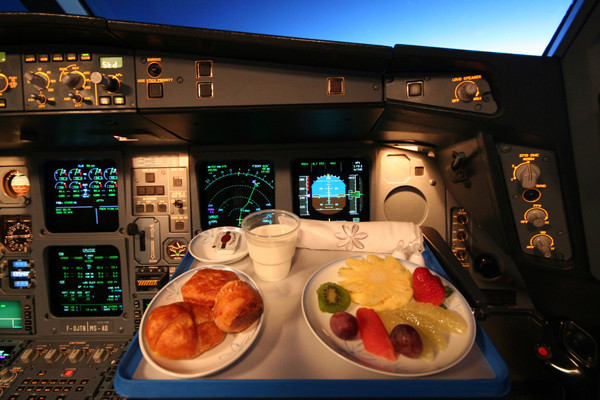
Curious fliers want to know (Credit: Salon)

An old-timey, classic Q&A:

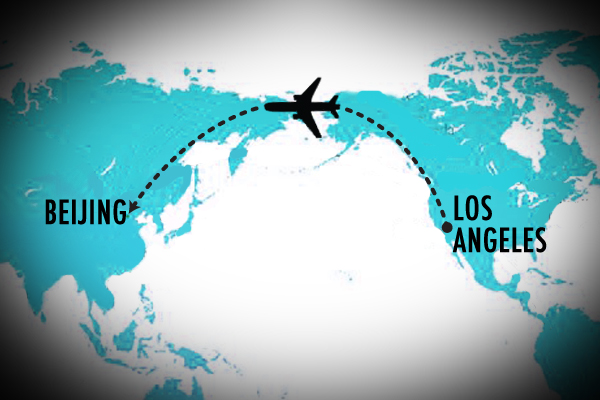
I routinely fly from Los Angeles to Beijing on United. It’s an all-daylight flight over Alaska and Russia. How can I find the approximate route the Air China flight takes on the same route? I’m flying that airline later in the month and would like to know what I’ll be seeing below.

Routings aren’t commonly airline-specific. The determining factors tend to be air traffic control constraints and weather (winds, storms, etc.). Routings tend to be somewhat consistent, but it can vary day to day, even for flights between the same two cities.

Another factor is the aircraft type. Two-engine planes are subject to what we call ETOPS (extended twin-engine operations) restrictions, which might result in a different, less direct routing than a plane with four engines can accept. ETOPS rules require planes to remain within particular flying distances (three hours, most commonly) of an acceptable diversion airport. (The diversion airports themselves will vary, subject to weather.) Across the North Atlantic it makes little difference; two engines or four there are always adequate diversion options relatively close by. Over the Pacific, though, it’s a little different, and there might be considerable differences between a route operated by, say, a two-engine 777, and the same route operated by a four-engine 747.

We were flying from San Juan, Puerto Rico, to New York on a 757. While taxiing out, the plane’s air conditioning malfunctioned and the cabin temperature became very hot. After several minutes of troubleshooting, the problem could not be fixed and we taxied back to the gate. The captain explained that although it was permissible to continue on with the broken AC, a whole new flight plan was required, including an altered routing that would add over 45 minutes’ flying time — in turn requiring us to take on more fuel. We departed more than an hour late. I’m baffled. Why on earth would a broken air conditioner mandate a whole new flight plan and a longer routing?

For better or worse, crews are often reluctant to to explain the technical nitty-gritty of mechanical failures, and this is a great example of how, as a result, a passenger’s perception of the problem — in this case, “a broken air conditioner” — isn’t nearly the whole story.

Planes are not air-conditioned in the manner of your car or home; there is no air conditioner, per se. The machinery used to heat and cool the cabin is something known in pilot parlance as a “pack” (an acronym for pneumatic air cycle kit). Normally there are two packs, located in the belly of the aircraft. They are supplied by bleed air from the engines, adjusting temperature by means of a compressor, turbine and air-to-air heat exchanger; there is no coolant gas (i.e., Freon). These same packs are also responsible for pressurization, which is where the complications described above enter the picture.

A single functioning pack is adequate to maintain both adequate pressure and temperature. Thus if one fails, a flight can still be dispatched safely. However, you’ve lost your redundancy; if the remaining pack were to fail, pressurization and temperature control would be lost entirely. So, single-pack operation entails some important restrictions — namely a lower-than-normal altitude and the need to stay within a certain distance to a diversion airport at all times. The exact rules vary from plane to plane, but a typical example is having to remain below 35,000 feet and within 60 minutes’ flying time of a suitable landing spot (transoceanic flights are likely to be forbidden outright). Usually this increases both flying time and fuel burn. In this case, a flight from Puerto Rico to New York that was originally planned to be mostly over water now required a longer inland routing at a more fuel-thirsty altitude.

I was once on a flight from Chicago to Atlanta and we had to make an emergency landing in Nashville due to something that made it necessary to fly only as high as 10,000 feet. Due to such a low altitude, we were told, we would burn too much gas and could not reach Atlanta nonstop. Were they telling us the truth and how serious was the situation?

This sounds perfectly legitimate to me. See the previous question. Every so often a plane will be altitude-restricted due to this or that mechanical issue — perhaps something pressurization-related. This will increase fuel burn to the point where an interim stop is required. (Remember that you need enough fuel not only to reach your destination, but enough to reach at least one alternate airport, plus a substantial buffer on top of that.) This malfunction might be something that happens en route, or the flight might be planned that way from the start.

About a year ago I was working a flight from South America to the United States. Over the Caribbean, a pressurization malfunction dictated a prompt descent. Efforts to troubleshoot the problem failed, and so we had to stay low. Together with our dispatchers we ran some calculations, and sure enough, it would have been impossible to complete the flight without violating legal fuel parameters. And so we wound up diverting to Puerto Rico.

You speak of an “emergency landing.” Passengers have a habit for referring to any diversion or precautionary landing as an “emergency,” when most are in fact precautionary or even routine. Declaration of an emergency is reserved for situations that are a lot more urgent — such as when there is a risk of injury or damage to the airplane, when the extent of a problem is not fully known, and/or or when priority air traffic control handling is required. Knock on wood: I’ve made several diverts and one or two precautionary landings, but never an emergency landing.

My mother was on a flight that couldn’t take off because an engine wouldn’t start. They were towed back to the gate and had to have the engine started with the help of an external cart of some sort. Could you explain what causes an engine to fail to start, how the external is used, and why it’s safe to fly in this condition?

That “the engine would not start” doesn’t sound right. That’s not telling me much. Starting a jet engine is a multi-step process and the malfunction could involve any of several components — not all of which are ultimately responsible for the continued running of the engine. Again, an airplane is not a car, and a jet engine does not start, stop or run the way a piston engine does.

Jet engines are started using compressed air, which is normally supplied either by the APU (the small auxiliary turbine in the back) or another, already running engine. This air spins the engine’s compressors to a certain minimum RPM, at which point fuel is introduced. Combustion then accelerates the compressors and turbines to “idle” speed, and the starter (air valve) is shut off.

It sounds to me like there was a problem with the APU generating adequate duct pressure to get the compressors spinning to the necessary RPM. Why this may have been happening I can’t say. There are different possibilities (duct problem, valve problem, unusually high elevation …). And so, an external air machine — sometimes referred to as an “air cart” or “huffer cart” — needed to be hooked up instead. In fact, before the advent of APUs (the Boeing 727 was the first jetliner to have one), jet engines were always started this way.

Once up and turning, jet engines don’t shut off or “stall” the way the engines in cars sometimes do. However, if for whatever reason an engine failure occurred later in flight and was to be restarted, this air problem no longer applies. You can use the APU, the other engine or the speed of the airplane — the airflow itself pushing into the engine — to turn the compressors to the required RPM.

More on the weirdness of jet engines here and here.

I was on a Southwest flight from Chicago to Portland, Ore. We were at 35,000 feet and the air was very choppy. The captain came on and apologized. He told us that although it was much smoother at 37,000 feet, we were “too heavy” to climb that high and would have to ride out the bumps for a while. Really? Why would another 2,000 feet make that much difference?

For fuel economy, if not a smoother ride, higher is always better, but planes can climb only as high as their weight allows. As you climb, the air thins. Engine output is reduced, and the wing cannot support as much airplane as it can down low. A given cruise altitude must account for both high-speed and low-speed stalls, in both smooth and turbulent conditions. Over the course of a flight, climb capabilities improve as fuel is burned away. The allowable altitude at any given time isn’t something you ballpark; there are specific maximum altitudes based on very specific weights, and they must be adhered to. The difference between 35,000 and 37,000 can be fairly significant.

- – - – - – - – - – - -

Don’t believe me? You can always “Ask the Pilot.” This guy, I mean. Introducing my latest imitator.

Defeated by TSA

Sometimes you just can't win. Plus: OK, not all the airport bookstores are bad

  • more
    • All Share Services

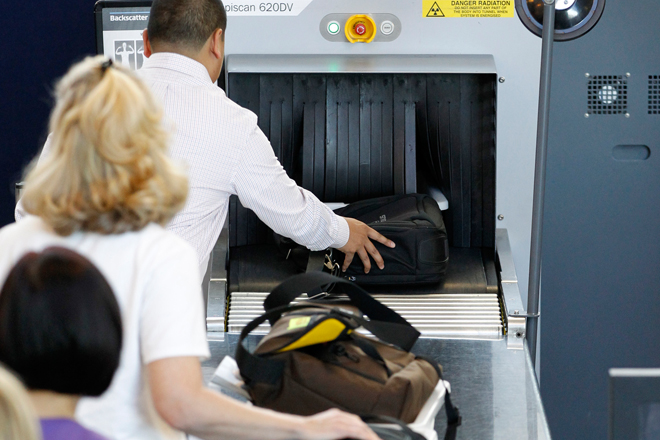
Defeated by TSA (Credit: Jason Reed / Reuters)

Thoughts running through my head at the TSA checkpoint …

All of these measures in place today — the liquids and gels rules, the pointy object confiscations, the multiple ID checks, the body-scanners and the pat-downs — would they have stopped the Sept. 11 attacks?

Of course not. The success of the 2001 attacks had nothing to do with box cutters. The hijackers’ critical tool was an intangible one: the element of surprise. That is, taking advantage of our understanding and expectations of a hijacking. What weapons they had in their bags was irrelevant. They could have used anything.

For that matter, would any of these measures have prevented the terrorist bombing of Pan Am 103? How about the bombings of Air India 182 or UTA 772?

Again the answer is no. It was bombs in the lower holds that got those planes.

I don’t know about you, but when I’m on a plane I worry a lot more about what’s going on below deck — in checked luggage and cargo — than I do about passengers and their carry-ons. The Transportation Security Administration tells us that all checked bags are scanned nowadays for explosives, and that’s about the most valuable thing the agency does for us. I just hope agents do it with as much over-the-top scrutiny as they use to paw through carry-ons looking for forks and toothpaste.

I’m traveling off-duty, just a regular old passenger. Approaching the body scanner, I “opt out,” as I always do. I’ll be taken aside for a thorough pat-down.

I don’t opt out because of worries about radiation. I do it because I find it appalling that passengers are effectively asked to pose naked in order to board an airplane. And because the scanners are strategically ineffective. I don’t “believe in them,” you might say. I mean, think about it: You’ve got a scanner at one checkpoint, but no scanner at the one right next to it; scanners at some terminals, but not at others. Are terrorists really that stupid? And what about overseas? If somebody is going to sneak something deadly through a checkpoint, it is far, far, far more likely to happen at an airport in Asia, Africa, South America or the Middle East, than in Peoria, Wichita or Cleveland.

Is this one of those “follow the money” situations? Are these machines really in the interest of safety? Is that what this is about? Or is it about the corporations who stand to make billions of dollars in their design and deployment? Why not explosives-sniffing dogs instead? Are they not just as effective, and cheaper and friendlier to boot? Or is that the problem?

I’m chatting with the TSA guard about this while he frisks me. He shrugs. “A lot of waste in government,” he says.

“Bag check!” A woman’s voice, loud.

Oh great. Off to the side, the X-ray machine has detected an extremely dangerous 6-ounce bottle of aloe vera gel in my roll-aboard.

“Is this your bag, sir?”

“Um, er, ah, yes.”

She sticks a gloved hand inside and pulls out the tube. The look she gives me — it’s a scolding sort of glare with an unmistakable glint of satisfaction.

“But … but it’s only half-full.”

“I don’t have a scale to weigh liquids, sir.”

“Why do you need a scale? You can just look at it. It’s a 6-once tube and obviously it’s only half-full.”

She doesn’t look. “Sorry. You cannot bring this through.”

“But …”

Plop. She throws my aloe into a waste barrel.

Aha! But in tossing it away like that, hasn’t she just admitted that the container is harmless? After all, if it was something potentially dangerous, you wouldn’t just fling it into the garbage.

Are TSA screeners looking for bombs, or are they looking for innocent liquids? I’m reminded of those tests I’d heard about, when, supposedly, water bottles were attached to mock-up bombs and sent through the X-ray machines. Screeners found the bottles, while the bombs went sailing through. “An Easter egg hunt for minor banned items,” in the words of former TSA chief Kip Hawley, from his upcoming book, “Permanent Emergency.”

“Look,” I say. ” Since you’re throwing that tube away, you’re telling me that you know it’s nothing harmful.”

Perturbed stare.

“So, like … can I have it back?”

She stares at me, clearly annoyed and unable to tell if I’m kidding or not.

I am kidding, of course. My gel is gone for good; another $4.65 into the TSA hole. But am I not correct at the same time? I’ve lost my property, but I feel that I’ve made a useful point and can walk away having established the upper hand. Yeah. I’m proud of my snappy little assessment: so tight, so logical and righteous!  Take that, TSA!

And it’s exactly at this moment, the screener’s eyes still fixed on me, that my cellphone goes slipping out of my hand. I drop it; catch it; drop it and catch it again. My arms are wiggling and flailing in a ridiculous little dance until finally the phone flies completely away from me. It goes clattering off a stack of gray bins and slides pathetically onto the floor — directly at the screener’s feet.

She picks up the phone and hands it to me. “Good day, sir.”

I skulk away feeling like the biggest goofball in the world.

And maybe this was a kind of divine intervention, a dose of humiliation engineered to shut me up and kick me on my way. A lesson summed up in two easy words: lost cause.

If the TSA’s tactical flaws are ever going to be fixed, it certainly won’t be me who gets it done. I spend too much time writing about it, and too much time worrying about it.

—————

GO-AROUNDS

Re: Airport bookstores, or lack thereof

As various emailers pointed out, not every airport bookshop is a glorified magazine stand. There are still some good retails options in U.S. terminals. Renaissance Books at Milwaukee, for example, got several kudos from readers. There’s Powell’s still at Portland’s PDX, I’m told. I can personally vouch for a place called BookLink (formerly a Borders franchise) at terminal A in Boston. Even JFK’s Terminal 3, for all its demerits, has a decent bookstore just inside the east-side security checkpoint, abeam gates 4 and 5.

And the following letter is from a vice president of Hudson Booksellers, one of the companies mentioned in my story:

Having been a buyer for airport bookstores for over 15 years, I have witnessed the amazing growth and diversification of airport bookselling, as well as the recent downturn, largely due to the e-book effect. Blending customer expectation with personal passion is the essence of our selection process. Yet, so frequently when we see Hudson in print, including in your article, we are pigeonholed as corporate peddlers of “airport books.” Clearly our message and product isn’t getting through the way we’d like.

Airport bookstores are in competition against many other product categories. For the last 15 years my team and I have been turning over every stone in trying to meet the challenge of bringing the best books to the most readers.  One of your reader comments mentioned — incredulously — discovering Roberto Bolaño at the airport in San Francisco. But that type of thing honestly happens every day at Hudson. We’ve sold hundreds of Bolaño’s novels, which are part of our core bookstore selection. You mention Gary Shteyngart, another personal favorite, who we have been promoting since “The Russian Debutante’s Handbook.” We went all out with “Absurdistan” and sold over 26,000 copies the year it came out, which I believe was more than 25 percent of all copies sold. We have many great locations with a locally curated assortment that I would put up against Powell’s or Compass, etc. — in Denver, Chicago, Pittsburgh, Newark, Raleigh.

I am also surprised at your statement about your own book, “Ask the Pilot.” We have carried your book since it came out in 2004, selling over 1,000 copies in one LAX store alone — thousands more over the years — and we are still carrying it in a few locations.

Sara Hinckley
Vice President of Book Purchasing & Promotions
Hudson Booksellers

Author’s note: In retrospect, I ought to have been a little more gracious in my references to Hudson.  Indeed, many of the chain’s airport outlets are full-fledged bookstores with a very good selection, and the chain did stock and sell many copies of my book when it was new. (Though, honestly, the thing is so out-of-date at this point that I’m pleased when I don’t find it for sale.)

Continue Reading Close

Where are the books?

There's nothing like a good read to pass the time when flying. So let's get some proper bookstores at our airports

  • more
    • All Share Services

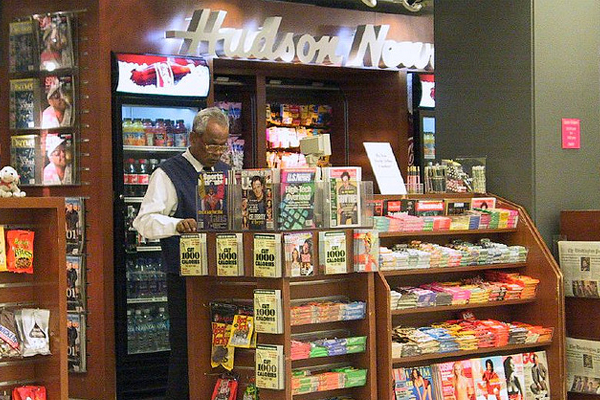
Where are the books? (Credit: DannyMcL / CC BY 3.0)

Reading on planes is a natural, am I right? The trick to getting through a long flight is distraction, distraction, distraction, and what better way to distract yourself than with a good book.

Why, then, is it so bloody hard to find a proper bookstore at an airport? Not all of us pre-load our reading material on a Kindle.

I was in Detroit the other day. The terminal at DTW is one of America’s best, and the mile-long concourse is jammed with retail shops. But do you think I could find a book in there? If I wanted a diamond bracelet, a $300 Tumi briefcase or a cup of gourmet coffee, on the other hand, no problem.  But a book?

Sure, there are places selling books — there are lots of places selling books — provided you’re interested in one of a tiny sample of titles. There was something vaguely North Korean about walking the length of the concourse and seeing the exact same hardcovers, over and over and over and over — Steve Jobs staring out at me every 20 steps or so from the shelves of any of 50 different shops, all utterly indistinguishable from one another.

Not long ago almost every major airport had a proper bookseller. Nowadays they are harder and harder to find. Usually, what passes as a bookstore is really just a newsstand. The vast majority of these outlets are owned and controlled by one of two companies: Hudson Group and an Atlanta-based company called Paradies Shops Inc. Both conduct business under numerous sub-brands that hawk a very thin selection of bestsellers, business books, thrillers and pop-culture trash.

The terminal guide at DTW told me there was something called Heritage Books — two of them, in fact, one at either end of the hall. That got my hopes up. Maybe I’d score a copy of Gary Shteyngart’s new novel.

As they say, good luck with that. Turns out that Heritage is just one of those Paradies Dba franchises.

They did stock a copy of Jonathan Franzen’s novel “Freedom” (yet not “The Corrections,” which was much better), and obviously no retailer can get by without a token Malcolm Gladwell or two, a gesture to the “sophisticated” reader who is seeking something headier than “American Sniper,” or the latest Suze Orman guide to success, or one of two — two! — books by Chelsea Handler.

I couldn’t get out of there fast enough.

On the bright side, though, am I correct in observing that America’s fascination with Sudoku has begun to taper off?

Lingering resentment, yes. Several years ago I nearly had a nervous breakdown trying to get Paradies and Hudson to stock my own lousy little book, “Ask the Pilot — Everything You Need to Know About Air Travel.” I was stupid enough to think that the airport, of all places, might be a good selling point for a book exclusively about air travel. I’ll never make that mistake again. It was carefully explained to me that, no, it matters not what your book is about, captive audience be damned. What matters is getting on the company’s shortlist of airport-worthy bestsellers, or having your publisher pay for an airport promotion. Hudson carried “Ask the Pilot” briefly, into the fall of 2004, after which it disappeared from airports forever.

All of airport retailing, though, seems to suffer from a kind of dementia. This is something I explore in my famous essay, “What’s the Matter With Airports?” Enough already with the jewelry, the souvenir sweat shirts, the remote-control helicopters and the high-end luggage.

(The fixation with luggage is particularly strange to me. Who in the world buys luggage * after * they get to the airport? No wonder these places are always empty.)

How about something practical instead? Like a halfway decent bookstore.

But I digress.

Getting back to the positive…

Thanks to the many readers who contributed to my “Hidden Airport” collection. The idea, for those of you who missed it, is to highlight spots of unexpected pleasantness at U.S. airports. I showcased two: the garden adjacent to the Marine Air Terminal at New York’s LaGuardia, and the connector walkway between terminals B and C at Boston-Logan.

Several of you wrote in with pictures and descriptions of other little-knows oases. For example, the SFO Aviation Museum and Library at San Francisco International. But my favorite so far, I think, is the sculpture garden at the Greenville-Spartanburg (GSP) airport in South Carolina.  You can view it here in this interactive panorama put together by reader John Riley.

Continue Reading Close

Escape to “hidden airport”

Find unexpected pleasures at a terminal near you. Plus, the best and worst airports

  • more
    • All Share Services

A tree-shaded hideaway at LaGuardia's Marine Air Terminal. (Credit: Patrick Smith)

Frommer’s, the travel guide people, recently released its list of the world’s best and worst airport terminals.

JFK’s Terminal 3 (scheduled for replacement in 2013) was voted the worst, while the Hajj Terminal in Jeddah, Saudi Arabia, was ranked best.

These things are subjective, and we all have our own criteria, but both lists leave me scratching my head.

As to the worsts, they’ve obviously never been to the arrivals hall at Dakar (or, from what I’ve been told by several emailers, to N’djili Airport in Kinshasa, Congo). The best list, too, is a little strange. I’m unsure how fair it was including the Hajj terminal — a building that is open only six weeks each year and visited almost exclusively by pilgrims. Seoul’s Incheon airport is a well-deserved inclusion, but conspicuously absent is Bangkok’s Suvarnabhumi. BKK ought to be there on aesthetic merits alone — its central terminal is one of the most stunning buildings I’ve ever seen.

I’m also disappointed to see JFK’s Terminal 5, the much overhyped home of JetBlue, rated near the top. As I’ve opined before, this building has to be one of the most disappointing airport projects of the last three decades. It’s certainly one of the ugliest. The airside view — the exterior as seen from the runways and taxiways — is criminally hideous. It looks like the back of a shopping mall; all that’s missing are some pallets and dumpsters. (Which is fitting, I suppose, given how the ongoing trend in airport design is to make terminals and malls utterly indistinguishable from each other.) On the inside … wow, hey, a food court. And although the terminal is only a few years old, already it’s overcrowded.

With scattered exceptions, U.S. airports don’t have a whole lot going for them. Putting aside aesthetics, cleanliness and a lack of public transport options, another thing that doesn’t help, and which you don’t hear about much, is that American airports simply do not recognize the “in transit” concept. All  passengers arriving from overseas, even if they’re merely transiting to a third country, are forced to clear customs and immigration, recheck their luggage, pass through TSA screening, etc. It’s an enormous hassle that you don’t find in most places overseas. Compare it to Singapore, Dubai, Frankfurt, Amsterdam and so on, where transit passengers walk from one gate to the next with a minimum of fuss.

Here’s how this hurts us: Flying from Australia to Europe, for instance, a traveler has the option of flying westbound, via Asia (namely Singapore, Bangkok, Kuala Lumpur or Hong Kong) or the Middle East (Dubai, Qatar), or eastbound via the U.S. West Coast (Los Angeles or San Francisco). Even though the distance and flying times are about the same, almost everybody will opt for the westbound option. The airports are spotless and packed with amenities, while the connection is painless and efficient.

Change planes at LAX or SFO, on the other hand, and you’d have to stand in at least three different lines, be photographed and fingerprinted, collect and recheck your bags, endure the TSA rigmarole, and so on, just to change planes. Few passengers will choose this option, and I suspect it costs our airlines many millions annually in lost revenue. Indeed, this is part of what has made carriers like Emirates, Singapore Airlines and others so successful.

But now …

So that you don’t accuse me of harping on the negative, allow me to introduce a new feature. I’m calling it “Hidden Airport.” The idea is to highlight little-known spots of unexpected pleasantness at U.S. airports. It can be a place for some peace and quiet, an unusually good restaurant, etc. It should be somewhere out of the ordinary and relatively unknown — an escape spot.

I’ll start things off with two:

1. I’ve already written at length about the Marine Air Terminal at LaGuardia Airport in New York City. This historic art deco building, in a far southwest corner of LGA, adjacent to the Delta Shuttle, is one of the most special places in all of commercial aviation — the launching point for the Pan Am flying boats that made the first-ever transatlantic and round-the-world flights. Inside the cathedral-like rotunda is the 240-foot “Flight” mural by James Brooks, as well as Rocco Manniello’s Yankee Clipper restaurant — a good greasy-spoon place that is one of the few remaining non-chain airport restaurants. What few people know about, however, is the cozy garden just outside. Facing the building, it’s to the right of the main entryway, set back from the street. It’s a quiet, tree-shaded hideaway amid grass, flowers and shrubs. There’s even … well, I guess sculpture is the best description. Grab a sandwich from the Yankee Clipper and enjoy it on one of the wooden benches.

Getting there: Take the A Loop inter-terminal bus to the Marine Air Terminal. The spot is best appreciated in the warmer months, of course. Like the Marine Air rotunda it is outside of the TSA checkpoint, so you’ll need some time.

2. The connector walkway between Terminals B and C at Logan International Airport in Boston.  This isn’t one of the newer, elevated walkways with the inlaid sea life mosaics, cool as they are, but rather the old, main-level passageway between gates used by AirTran and Virgin America. Massport has installed a series of whimsically painted rocking chairs that face floor-to-ceiling windows with a view of the runways. There’s relatively little foot traffic and, best of all, no public address speakers. It’s a quiet, sunny location to read, send some text messages or otherwise relax.

Getting there: From terminal C, walk toward B. From B, walk toward C. Stay on the main level; don’t take the stairways into the elevated walkways.

- – - – - – - – - – - -

Do you have questions for Salon’s aviation expert? Contact Patrick Smith through his website and look for answers in a future column.

Continue Reading Close

Who needs UFOs?

There are plenty of other spectacular views from the cockpit window, like the northern lights or shooting stars

  • more
    • All Share Services

Who needs UFOs?The northern lights above the mountains.

As pilots are sitting up there for hours, often late at night, or above the cloud level, have you ever seen anything really weird or fantastic?

Weird or fantastic? I know what you’re thinking. I know what you’re thinking and the answer is no.

A reader once asked me about a supposed “tacit agreement” between pilots in which we will not openly discuss UFO sightings out of fear of embarrassment and, as the reader put it, “possible career suicide.” I had to laugh at the notion of there being a tacit agreement among pilots over anything, let alone UFO sightings. And although plenty of things in aviation are tantamount to “career suicide,” withholding information about UFOs isn’t one of them.

For the record, I have never met a pilot who claims to have had a UFO sighting. Honestly, the topic is one that almost never comes up, even during those long, dark flights across the ocean. Musings about the vastness of the universe are one thing, but I cannot recall ever having had a conversation with another pilot about UFOs specifically. Neither have I ever seen the topic discussed in any industry journal or trade publication.

Which isn’t to say there aren’t plenty of spectacular views to behold through the cockpit windows. Some of my personal favorites:

– Shooting stars. Especially during the annual, late-summer Perseids meteor shower. Most impressive are the ones that linger on the horizon for several seconds, changing color as they burrow into the atmosphere. I’ve seen shooting stars so bright they were visible even in daylight. (Who knows how many I’ve missed? At night we often turn the ambient cockpit lighting to full bright, which makes it difficult to see outside.)

– The northern lights. At its most vivid, the aurora borealis really has to be seen to be believed — a quivering, horizon-wide curtain of fluorescence. And you needn’t traipse to the Yukon or Siberia; the most dazzling display I’ve ever witnessed was on a flight between Detroit and New York. The heavens had come alive with immense, wavering sheets of color, like God’s laundry flapping in the night sky.

– The eerie, flickering orange glow of the Venezuelan oil fields — an apocalyptic vista that makes you feel like a B-17 pilot in 1945.

– Similar, but more thoroughly depressing, are the thousands of slash-and-burn fires you’ll see burning throughout the Amazon. Some of the fire fronts are literally miles long — walls of red flame chewing through the forests.

– Somewhat compensating for the above are the vast, for now untouched forests of northeastern South America. Over Guyana in particular the view is like nothing else in the world — an expanse of primeval green as far as the eye can see. No towns, no roads, no people, no clear-cutting or fires. Yet.

– Climbing out over the “tablecloth”  — the cloud deck that routinely drapes itself over Table Mountain in Cape Town, South Africa.

– The frozen, midwinter oblivion of northeastern Canada. I love passing over the jaggedy, end-of-the-world remoteness of Newfoundland, Labrador and northern Quebec — this gale-thrashed nether-region of boulders, forests and frozen black rivers.

– The majestic, primordial nothingness of Greenland.  The great circle routes between the United States and Europe often take us over Greenland. Sometimes it’s merely a brush of the southern tip; other times it’s 45 minutes across the meatier vistas of the interior. If you’ve got a window seat and your seat-back progress screen is headed this way, do not miss the opportunity to steal a peek, even if it means splashing your fast-asleep seatmate with sunshine. Set an alarm if you have to. It’s worth it.

Other views aren’t spectacle so much as just peculiar.

One afternoon we were coasting in from Europe, about 200 miles east of Halifax, Nova Scotia. “Gander Center,” I called in. “Got time for a question?”

“Sure, go ahead.”

“Do you have any idea what the name of that strange little island is that we just passed over?”

“Sure do,” said the man in Gander. “That’s Sable Island.”

Sable Island is one of the oddest places I’ve ever seen from aloft. The oceans are full of remote islands, but Sable’s precarious isolation makes it especially peculiar. It’s a tiny, ribbony crescent of sand, almost Bahamian in shape and texture, all alone against the relentless North Atlantic. It’s like the fragment of a submerged archipelago — a miniature island that has lost its friends.

I’d flown over Sable many times and had been meaning to ask about it. Only later did I learn that the place has been “the subject of extensive scientific research,” according to one website, “and of numerous documentary films, books and magazine articles.” Most famously, it’s the home of 250 or so wild horses. Horses have been on Sable since the late 18th century, surviving on grass and freshwater ponds. Transient visitors include grey seals and up to 300 species of birds. Human access is tightly restricted. The only permanent dwelling is a scientific research station staffed by a handful of people.

“Island,” maybe, is being generous. Sable is really nothing more than a sand bar, a sinewy splinter of dunes and grass – 26 miles long and only a mile wide – lashed and scraped by surf and wind. How staggeringly vulnerable it appears from 38,000 feet.

Odder, even, than a UFO.

Continue Reading Close

You wouldn’t believe how long my flight was!

No, I wouldn't. And you probably didn't climb at 45 degrees or drop hundreds of feet either. We love to exaggerate

  • more
    • All Share Services

You wouldn't believe how long my flight was! (Credit: graph via Shutterstock)

People love embellishing the sensations of flight. They can’t help it perhaps — nervous fliers especially — but the altitudes, speeds and angles they perceive often aren’t close to the real thing.

During turbulence, for example, people believe that an airplane is dropping hundreds of feet at a time, when in reality the displacement is seldom more than 20 feet or so — barely a twitch on the altimeter.

It’s similar with angles of bank and climb. A typical turn is around 15 degrees, and a steep one might be 25. The sharpest climb is about 20 degrees nose-up, and even a rapid descent is no more severe than 10 degrees nose-down.

I can hear your letters already: You will tell me that I’m lying, and how your flight, was definitely climbing at 45 degrees and banking at 60.

And you’re definitely wrong. I wish that I could take you into a cockpit and demonstrate. I’d show you what a 45-degree climb would actually look like, turning you green in the face. In a 60-degree turn, the G forces would be so strong that you’d hardly be able to lift your legs off the floor.

Also routinely exaggerated are the flight times between cities.

“Oh my god, when I flew from New York to Sydney it took, like, 35 hours.”

Actually it takes about 20 hours. Six hours to the West Coast, then another 14 or so from there. Maybe less, depending on winds and weather.

In his book “The Second Plane,” Martin Amis claims that it takes 10 hours to fly nonstop from Washington, D.C., to London-Heathrow. It does not. Neither does it require another 10 to reach Kuwait City from there. Those legs are about seven hours and six hours, respectively.

In the January 2012 issue of Harper’s magazine, a memoir by Alexandra Fuller describes it taking 12 hours to fly from Wyoming to Mexico City, via Dallas. “Having flown twelve hours through the Christmas midnight.” Really? Twelve hours to go 1,500 nautical miles? That’s an average of 125 miles per hour. Even a four-seat Cessna can beat that.

(Somewhat offsetting this gaffe, in the same issue of Harper’s, as part of his “Easy Chair” essay, the great Thomas Frank gives a rare shout-out to the ’80s punk-pop band the Dickies.)

Of course, maybe it depends how we define a flight. Is it merely the time spent in the cabin, or the journey in full, curbside to curbside: the time checking in, waiting in the security line, connecting between flights, and so forth? Some people obviously include the whole shebang, but I don’t think that’s fair. Too many variables. A 10-hour layover at the airport in Dubai might add to your travel time, but that’s not flying.

At least by my definition, no flight anywhere lasts longer than approximately 18 hours. That being the length of Singapore Airlines’ nonstop between Singapore and Newark, the longest scheduled flight in the world. They use an Airbus A340 decked out in an all-business class configuration.

On one hand 18 hours sounds excruciating, but knowing that airline’s reputation for service and the over-the-top amenities found on its planes, I suspect many passengers are sad when it’s time to land.

- – - – - – - – - -

GO-AROUNDS

Re: Air France Flight 447

Numerous readers have written to ask what I think about the recent Popular Mechanics story on the findings pertaining to the 2009 Air France disaster.

I normally don’t have nice things to say about aviation coverage in the media, but this story, written by Jeff Wise, was excellent. It was the best analysis of the accident that I have seen. (Caution: The version that ran in Huffington Post wasn’t nearly as good.)

What I especially appreciated is that he didn’t go hunting for a single tangible cause or try to explain the unexplainable. Why did the crew become so disoriented and react the way it did? Nobody really knows. We can’t know.

One of the article’s more interesting aspects pertains to the design of the Airbus sidestick controllers. Unlike conventional steering columns, which are physically connected and move in unison, the Airbus sidesticks feature asynchronous loading, meaning that inputs made on the captain’s side are not seen or felt on the first officer’s control, and vice versa. Only when contradictory inputs are made does this system register an alarm. While there are valid engineering and human-factor reasons for this design, in the Air France cockpit that night, when all hell was breaking loose, it’s possible that the pilot in the left seat simply didn’t recognize that his colleague in the right seat was inadvertently flying the airplane into a stall.

- – - – - – - – - – - -

Do you have questions for Salon’s aviation expert? Contact Patrick Smith through his website and look for answers in a future column.

Continue Reading Close

Page 2 of 90 in Patrick Smith