Paul Greenberg

Why are we still eating bluefin tuna?

This beautiful fish is in serious trouble. Fishermen, diners and chefs need to band together in order to save it

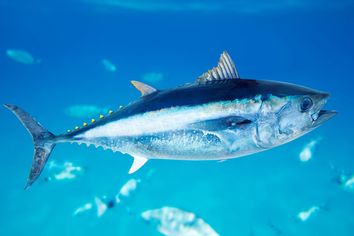
(Credit: holbox via Shutterstock)
This article originally appeared on Gilt Taste.

If you eat fish regularly, you’ve probably grown used to regularly being told by conservation groups — or that slightly irritating, politically correct friend — that certain fish shouldn’t be eaten: American striped bass, Atlantic swordfish, Chilean sea bass and Caspian sturgeon have all been the focus of vocal consumer and chef boycotts. Happily, some of these campaigns have been effective in helping fish populations recover. But amid all the sustainable seafood media noise, we’ve somehow managed to let the biggest and arguably most beautiful fish of all slip away.

GiltTasteThe Atlantic bluefin tuna — an animal that reaches 1,500 pounds, swims at 40 miles per hour, heats its blood 20 degrees above ambient and crosses the breadth of the ocean — is in serious trouble. The western, American stock has declined by about 80 percent and the Mediterranean-spawned population by about 70 percent. Even after the fish garnered a series of major PR hits (such as campaigns by Greenpeace and Sea Shepherds to liberate netted tuna in the Mediterranean last year and my subsequent New York Times Magazine cover story), the bluefin remains persistently present on menus around the country and around the world.

Why is this the case? Why is any chef out there still serving bluefin?

The answer is complicated, and a work in progress. So much so that the answer may change by the time you read this article. But as delegates to the International Commission for the Conservation of Atlantic Tunas (ICCAT) sit down this week in Istanbul to discuss the fate of the bluefin, it’s useful to identify a few reasons why we are still eating what ranks among the most abused fish in the sea.

Reason No. 1: Confusingly, there is more than one species of bluefin

Since the seafood world has few recognizable brands, the “brands” seafood consumers respond to most are species names. “Sea bass” “snapper” and “cod” all have many actors playing those respective, marketable roles. So it is with the bluefin.

There are not one, but three species of bluefin: the Atlantic, the Pacific and the southern. Each species has declined severely, but each fares differently from year to year. Recently, Pacific bluefin have probably been the bluefin most commonly served in American restaurants and some argue that this is due to the Pacific being the healthiest of the three species. Others would point out that we have yet to even complete a full stock assessment of Pacific bluefin, and we have no idea how many there may be. And quite often, because of poor labeling and tracking, an even more distantly related fish, the bigeye tuna, may be fitted in and passed off as bluefin when no bluefin can be found. But whatever the case, the confusion of species means that different creatures can be substituted when a deficit occurs in a particular ocean, giving a false sense of abundance in the marketplace.

Reason No. 2: Every fish, even one in serious trouble, can have a good year, which can cause bad decision-making by regulators

One of the trickiest things about managing fisheries is that fish populations go up and down naturally — a typical fish abundance graph looks something like the Dow Jones going through successive bear and bull markets. This is because most fish play penny stock odds that only occasionally yield significant dividends. Large blue water fish like tuna lay hundreds of thousands of eggs, and out of those, only a few individuals survive. But a slight shift in temperature or planktonic blooms or some other random factor can radically, albeit temporarily, shift the odds in a given fish’s favor. When this happens a boom year ensues, something that can persuade fishermen and science-ignorant regulators that the fish has recovered and can now be caught with abandon.

The Atlantic bluefin did indeed have a year of “strong recruitment” a few years back and if this good class of fish was protected — as was done in the recovery of American striped bass — it could probably fuel a recovery for future generations. But instead, regulators seem to have taken a short-term approach, fishing this momentary good blip as if it were a long term trend. Not a good idea. As Andre Boustany, a postdoctoral tuna researcher at Duke University wrote me, regulators are not taking into account “that there are several years with extremely poor recruitment behind this good one, so when looking at the overall picture, it becomes quite a bit less rosy.”

Reason No. 3: The Atlantic bluefin trade involves dozens of countries, and a consumer boycott would have to be global to be effective

Most successful fish rebuilding campaigns to date have had one distinctive quality: The fish being rebuilt were pursued by just a few nations. In the 1980s, only Americans were fishing striped bass when the fish went into decline. When consumer pressure to preserve them became political, draconian limits and even moratoria on the catching of stripers could be imposed.

But there really is no single lever that can be thrown to stop the vast global bluefin-catching machine. The majority of Atlantic bluefin are consumed in Japan, where fish abstinence campaigns are unheard of. And the Japanese don’t really do any of the catching of Atlantic bluefin anymore. Most of that happens in the Mediterranean, where 20-plus countries that range from post-revolutionary Libya to desperate Greece share portions of an overall quota. A recent study by the Pew Environment Group found that the total poundage of Atlantic bluefin sold in the world exceeded the legally sanctioned quota by 50 percent. Indeed, one of the biggest “asks” being made by conservationists at this fall’s ICCAT meeting is to institute an electronic tracing system aboard bluefin vessels, so we can at the very least nail down who is catching what.

—–

So, will the Atlantic bluefin tuna ever get a break? There are nascent campaigns like that of World Wildlife Fund which maintains a badge-of-honor list of purveyors that have exited the bluefin trade. And there is a coterie of artisan hook-and-line and harpoon fishers on both sides of the Atlantic which have the potential to fish the bluefin less egregiously than the large ships and spotter planes that regularly scoop up entire schools in today’s over-the-top fishery.

But like many of the major environmental problems facing humans today, it is no longer up to a handful of nations to change the dynamics of the bluefin business. Regulators, fishermen, chefs and diners from New York to Paris to Beijing to Tokyo will all have to agree that a fish has no business being on a menu until it is managed well enough to endure.

How to fix fish farms

A deadly salmon-farm disease has reached the wild. What can the industry do to protect itself and the environment?

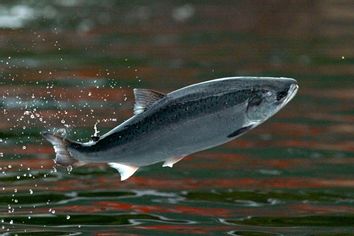
A salmon jumps for food pellets at a salmon farm in Chacabuco, Chile. (Credit: Reuters/Carlos Barria)
This article originally appeared on Gilt Taste.

My brother, in a mad dash to get dinner on the table, once made a crucial error. Instead of reaching for his stepdaughter’s plastic Barbie plate that neatly defined the space for vegetables, carbs and protein, he put down three overlapping portions of the three unlike items. When he presented this intimate arrangement to my niece, bedlam ensued. Tears poured down. Fists pounded. Dinner, The Sequel, soon followed, with food properly meted out to their respective containers. With calm finally restored, my niece let forth one of our more memorable family utterances. “Keep the food separate” she said. “That’s my motto.”

GiltTasteAs it turns out, this has may have to become the motto for the fish-farming industry.

This past week, the disease Infectious Salmon Anemia (or ISA) was first discovered in wild salmon off the coast of British Columbia.This was something people in the anti-farmed salmon camp have been anticipating, perhaps even greeting the news as validation. In the last decade ISA mutated from its benign wild state in densely-packed populations of farmed salmon until it finally became a virulent epidemic. The disease has done serious damage to the European farmed salmon industry; the Chilean salmon industry was leveled and is only now starting to hobble back to life. Until now, though, ISA had not reached the heartland of the world’s last truly robust wild salmon populations. British Columbia and Alaska are home to wild runs of hundreds of millions fish a year and contribute billions of dollars to the region’s economy. Should ISA make the jump from the farm to the wild in those parts we will be facing a serious economic as well as a potential ecological catastrophe.

The fish farming industry is understandably skeptical. The Canadian government’s high profile “Cohen Commission” is just now in evidentiary hearings on the question of farmed salmon’s impact on the wild and more than one fish farmer has suggested that the anti-aquaculturists have gone looking for the ISA disease rather than applying a scientific method to judge its real threat. But whatever the case, many “what ifs” are being suggested if ISA has indeed taken up Canadian residency.

Which brings me back to my niece’s compartmentalized Barbie plate. In a world where nearly 50 percent of our seafood is farmed, we really don’t have the luxury to say we will no longer farm fish and shellfish. The demand is too great. The industry is too entrenched. But with the alleged appearance of ISA on America’s west coast we have to think about how we might separate the farms from the wild.

Fortunately, good technology and methods already exist to make this happen, and have lots of benefits besides. The first and most obvious way to get farmed fish out of the way of wild fish would be to put them into land-based tanks. While energy intensive, “recirculating aquaculture systems” not only keep wild fish from catching farmed-fish diseases, they also do the reverse, providing a sterile environment where fish can thrive. Temperature and water current can be carefully regulated, which adds to fish health and growth rates. Using these advantages, companies like SweetSpring of Washington state have managed to grow coho salmon in containment that reach maturity in a year and the market at a reasonable price. Closed containment’s other major advantage is the ability to create fish farms close to markets. In an experimental facility in downtown Baltimore, Yonathan Zohar, the director of the Center for Marine Biotechnology at the University of Maryland, is growing a variety of chefs’ favorite species in containment and providing fish to local restaurants that are steps rather than miles away.

The second, slightly lower tech way is to choose species and waterways that do not interact with the wild. Farmed “striped bass” are in fact a hybrid of striped bass and white bass that are sterile and cannot interbreed with wild populations. They are grown in manmade ponds and raceways that have limited interaction with the surrounding environment. It’s interesting to compare the fates of salmon and striped bass since the modern age of aquaculture was born. Whereas wild salmon populations have generally declined, striped bass have not. In fact, striped bass populations have been largely rebuilt over the last two decades even as the farmed striped bass industry grew. Today, 60 percent of all striped bass eaten are farmed.

The third path to separation is markedly less popular among conservationists. Instead of removing fish from the ocean, “offshore aquaculture” seeks to move fish farms away from sensitive coastal migration routes and put them offshore where there is little or no interaction with similar species. This, of course, has its problems. Wave action is considerably more extreme far offshore and a heavy storm can make mincemeat of the best technology. Moreover, an aquaculture operation three or more miles from land incurs a pretty heavy gasoline tax. Indeed, depending on how you run the numbers, a recirculating land-based facility can come off as more fuel efficient that an offshore pen.

The fourth and final way to separate things is on a hemispheric scale. Despite its salmon farming industry, salmon are not endemic to Chile. The equator acts as a “thermal barrier” to salmonids and so there are no wild populations in the global south farmed salmon can impact. But damage has been done: The introduction of salmon and trout to the region has probably dealt a blow to indigenous fish we never even had data on. A family of southern hemisphere fish called galaxiids probably suffered considerably from the competition. But a cynical argument can be made that this is already old news, and we needn’t worry about lost, unknown fish so much so long as farm-based diseases do not cross back up to the north and infect salmon populations there.

Whichever of these four avenues humanity chooses it’s clear now that wild populations will increasingly be exposed to the vagaries of a globalized farmed fish sector. Nevertheless we may still have time to keep the farmed food and the wild food separate. For the sake of both, it might be worth trying.

Continue Reading Close

Falling in love as the USSR crumbled

Twenty years ago, we were caught up in the throes of history. And the throes of passion

“I saw you in my dream last night,” my ex-wife said, touching my arm when we happened upon each other in downtown Manhattan the other day. She spoke as if continuing a conversation only recently interrupted. In fact, the last time we’d talked intimately was two decades ago, back when the Soviet Union had crumbled to dust.

“Mm hmm, yes, I saw you in my dream,” she repeated, her Russian accent faded now to a passable American. “Very clearly I saw you. And you were dead.”

Like many intelligent Russians who came of age during the closing act of the USSR, my ex-wife was a kind of stand-up comedian in reverse. Just as the talented comic artfully sets up a punch line, so too could she expertly build toward a release of sorts. But the punch line was never a joke. It was instead an opening up of a psychic trap door, showing foolish Americans that beneath their feet was not the security of a prosperous and powerful nation, but rather the void of the impending destruction that awaits us all. When your superpower homeland has been blown apart into 15 compromised statelets it’s comforting to keep in your pocket that great transnational equalizer: death.

And yet, once upon a time I found all her moody blueness charming. We had met at a university dormitory in 1990, the final year of Soviet power. I had registered temporarily at the dorm as part of the many bureaucratic sleights-of-hand the Westerner had to execute to stay in the country. Technically I was supposed to leave the USSR when my study abroad program ended. But while I was desperate to leave I also had a hankering to stay. And so through the machinations of the many machinators of the Perestroika era, I arranged it so that I would register in the Leningrad University dorm, pay some functionary a nominal $150 and then relocate to an old lady’s flat, far out on the Prospekt Prosveshchenie where for $7 a month I would have a room of my own. All I would have to do beyond these trifling payments was to stay a single night at the dorm. A bargain it seemed, until the future ex-Mrs. Greenberg walked in.

There was much talk and a lot of weak tea during that one legally necessitated sleepover. My East German bunkie who spoke much better Russian than I seemed in full control of the evening, artfully throwing out pogovorki — proverbs that seem particularly embedded into Russian and that irritatingly keep the poor student of the language in the dark. “The peasant doesn’t cross himself until the thunder sounds,” “chicken and girls are seized with the hands.” That kind of thing. But when her visit was over, the East German found himself oddly rebuffed and it was I who was slipped a phone number and an appointment that led eventually to a foldout bed pressed up against the thin wall adjoining her parents’ room. Half-understood, rolling under cool embroidered sheets, struggling to communicate things that should have come out as easy praises, I was only able to mutter blunt, minor words: “beautiful,” “interesting,” “very.” And in the end she took a breath and arranged herself and then turned to me and asked with yet another tricky Russian idiom:

“Did you finish?”

“Finish?” I said.

“Yes, did you finish? Are you satisfied?”

“Yes, I, um, finished.”

“Nu, nu,” she said, “then it’s time to go.”

I did go. Not only out of the room and out onto the empty dawn streets of Leningrad but eventually back to New York where I brooded, alone, in the broke and semi-employed way today’s shiftless post-boom 20-somethings would likely find familiar. It was the walloping recession of the early ’90s. There was very little to do or to hope for. And so I found my thoughts drifting to the stoic, vaguely sad woman I’d left in Russia. But if she was on the sad side, “tending toward depression” as a psychiatrist like my father might say, well, that was OK with me. I liked her melancholy abruptness. I liked the whole direct-but-gentle sadness of the Soviet Union. I liked how nobody went to a shrink and how people stayed away from shrink words like “depressed,” “depressive” and “depression.” Russians somehow seemed to understand that depression was just sadness and that sadness was just a mood. One of many lenses through which you can take in life’s light. Moods colored life, sometimes darkly, but they also gave life immediacy and freshness, allowing you to react sincerely to every new thing that came your way.

As luck would have it, I was given another chance to go back to that way of thinking. A few months after my return to the United States a small-time Siberian hustler posing as a documentary maker arrived in New York and cobbled together a film crew that consisted of a Dutch producer, an American camerawoman and, for reasons I don’t understand to this day, me. All of us were flown to Moscow, put on a four-day train ride to Lake Baikal, and then told to film a documentary about, well, I really have no idea. Vague pieces of Michael Moore-esque intervention were staged where we would storm into the offices of a Soviet bureaucrat, insult him, film him and then leave. We would gather random crowds on the streets of Irkutsk and make them sing the Lake Baikal ode “Slavnoe Morye” — Glorious Sea. We slaughtered and ate a sheep. And then toward the end of our stay, just as I was trying to figure out a way to get back to that captivating woman in Leningrad, our driver walked into our hotel room, told us breakfast was ready and, also, by the way, “Snyali Gorbacheva.” They took Gorbachev.

It was the infamous hard-liner military coup attempt of August 1991, although, of course, we at the time didn’t know it would turn out to be only an attempt. For three days we drove the back roads of Siberia debating whether we should turn south and head out through Mongolia. All of our hotel reservations were mysteriously canceled as the single thread of Soviet power gathered itself together and drew tight on a million different knots. At one point on a narrow muddy road our van pulled over and two taut-tummied Russian boys with a guitar jumped in. Apparently they were known to the Russians in the group. Once they were seated, the guitar came out and one of the boys spat out a fast-paced Visotsky-style ballad that ended (for my benefit?) with an English refrain “goodbye America, hello Siberia.”

It was during these three days of political vertigo that I found I thought of her the most. At one little outpost I sent (how quaint to remember!) a telegram. “Are you all right?” I scribbled on the toilet-paper quality telegraph form (though it should be noted that the coarseness of Soviet toilet paper and the flimsiness of Soviet writing paper were a good deal closer together on the spectrum of “paper” than the American variants). But it may as well have been toilet paper. Passing it through the telegraph window to the bored, platinum blond operator seemed akin to a flush.

But, alas, it wasn’t. Miraculously the coup ended. Boris Yeltsin emerged and stood on a tank. The hard-liners were imprisoned. One shot himself. The phones worked again. I called her and the creaky Siberian lines issued forth her voice. “I got your telegram,” she said. “Very sweet.” I flew to Leningrad, which now everybody was suddenly calling St. Petersburg, and we made love again and again in a tiny apartment I’d rented for another $7. We made love on an overnight train to Moscow. We made love again in the apartment of her pioneer camp counselor. On my final day in Russia we necked on the steps of Patriarch’s Pond until a young Soviet malcontent yelled a phrase at us that must be known the world over: “Get a room!”

And of course she came to New York. And of course we were married. And of course we were divorced. And of course all of it faded away as most passions tend to. Only our most intense moments of togetherness — unlike the world-stopping moments others feel when they launch a romantic connection — occurred when the world actually stopped. When two of the greatest powers ever to occupy the globe shrugged off their mutual enmity for a fleeting moment and actually paused to look one another in the eye.

All of this came rushing back to me as she pulled her hand away from my arm on Seventh Avenue and we retreated back into the small talk that is my national tradition and that she had seemed to have mastered in the last two decades. Children (me yes, she no)? Work (not so interesting). Travel (now and again). She had seen me in her dream and I was dead. And given that I had firmly closed the Soviet chapter of my life, the chapter in which I was young and impetuous, when the thought of intense, inexplicable coupling could fill my whole mind, the chapter in which I was open to the world and where she had come to know me most intimately, I guess you could say that her dream was right on the money.

Continue Reading Close

An engineered salmon’s fishy agenda

How a corporate-created fish won't solve any problems, but may create some

For those who follow the theater of food politics, particularly the underwater portion of the drama, AquaBounty’s AquAdvantage genetically engineered salmon has played something of leading role for two decades, dating back to the 1990s when the fish was first conceived. The AquAdvantage salmon, in case you haven’t heard about it, is an Atlantic salmon with a (much larger) Chinook salmon growth gene inserted into its DNA. This is coupled with a promoter from a third fish, an ocean pout, that keeps that growth gene more or less permanently in the “on” position. This makes for a fish that grows faster than an unmodified salmon — something which its creators hail as a key to providing more fish for the world and easing the crisis in over-fishing.

I have long opposed the AquAdvantage salmon, taking pretty familiar positions that any member of the local/organic/wild food community would recognize: Positions that include the fear that the fish will escape and contaminate wild populations of salmon, and that the fish requires much wasteful transport since it would be cloned in Canada, grown in Panama and then flown back to the U.S. for consumption. But at a recent lecture when I was laying out these old chestnuts, it suddenly occurred to me that the non-fishy public might be missing one monumental fact about the AquAdvantage salmon, with all its attendant risks:

It is completely unnecessary.

Despite AquaBounty’s appeals to our concern about over-fished oceans, the environmental and market advantages they claim for their genetically modified salmon are readily debunked. And while the fish is not very useful to us or the oceans, it may be, in fact, very useful to AquaBounty — in a grab to control salmon farming as we know it.

So, rather than hash out the old arguments, I thought I would lay out four somewhat fresh points that show exactly how unnecessary this particular fish really is.

Reason Number 1: There are plenty of wild salmon.

AquaBounty likes to emphasize that their fish will be a way of taking pressure off of stocks of wild salmon. But there are many, many wild salmon still out there. The 2011 wild Alaska salmon harvest is projected to be one of the largest since Alaska became a state, with something like 203 million fish anticipated to be caught. These salmon are harvested under strict supervision of the State of Alaska’s Department of Fish and Game and nearly the entire Alaska salmon harvest has been certified as sustainable by the Marine Stewardship Council. Even with these intense restrictions on fishing in Alaska, we still have much more salmon than we use. As much as 50 percent of the United States’ wild salmon catch is shipped abroad in canned or frozen form, leaving one with the question: Why are we sending the cleanest, most omega3-rich protein abroad when it could be a key source of (delicious) nutrition here in the United States, particularly for children?

Reason Number 2: Farmed salmon is already pretty efficient, and getting more so without genetic engineering.

In the early days of salmon farming it could take as much as six pounds of wild fish to grow a single pound of salmon. But improvements in diet, husbandry, and selective breeding programs that don’t involve genetic engineering have lowered the feed conversion ratio on the most efficient farms below 2-to-1. AquaBounty claims that it could improve that efficiency by another 20 percent (a claim organizations like Food and Water Watch dispute). But even if their claims are true, making a salmon more feed-efficient is just one of many pathways to make salmon have a smaller footprint. There are now vegetable-based salmon diets in trials that require no wild fish at all and some of these new feeds are made from recycled agricultural byproduct that might otherwise go unused. Shouldn’t improving feed be our first priority, not artificially improving salmon?

Reason Number 3: There are fish that offer many of the advantages of the genetically modified salmon, with none of the risks.

For many years, conservationists have worried that farmed salmon, grown in “sea cages” where there is frequent interaction with wild fish, has led to disease transfer, escapes into the wild, and fouling of the environment. Tank, or “containment” growing, environmentalists argue, is the only safe way to farm salmon, but it is energy intensive and farmers worry that slow-growing fish would not allow a farm to cover its energy costs. One of the arguments put forward by AquaBounty is that their salmon grow so fast that they can be cost-effectively produced in out-of-ocean, re-circulating tanks that would not impact the ocean. But this barrier has already been broken with two unmodified fish. The arctic char, a fish from the same family as salmon, turns out to have a natural adaptation for living in close quarters and does well in containment facilities. Nearly all the arctic char that reaches the market today is grown in containment either in Iceland or Canada. The char’s flesh is delicate and moist like a salmon but does not have the overpowering salmon taste that many diners find off-putting. And for those who do like that salmony taste, SweetSpring of Washington state has perfected a technique for growing Pacific coho salmon entirely in containment. If these two options exist for cost-effective containment growing of salmonids, why should we even broach the possibility of genetic contamination in the form of genetically modified salmon?

Reason Number 4: People don’t seem to want it very much.

Consumers have expressed distaste for a genetically modified salmon in the marketplace. If the fish is accurately labeled (as it will be in California thanks to a recent move in the state legislature) it is unlikely we will see droves of consumers flocking to buy it. Online polls by the Washington Post and the Wall Street Journal showed that only about 36 percent of consumers would willingly eat genetically modified salmon if it were labeled as such. And in European markets zero percent would eat it. Thanks to overwhelming consumer disapproval, genetically modified foods cannot be sold in the European Union.

Why then is AquaBounty pursuing this course? What’s the motivation if there are plenty of other fish that do the job in the water and little appetite for it in the supermarket? It seems to me that what the AquaBounty AquAdvantage salmon represents is the privatization of the salmon genome. Should salmon farming come to be dominated by the AquAdvantage fish, farmers could become dependent on a single company for their stock, just as soy, corn and wheat farmers must now rely on large multinationals like Monsanto to provide seed for their fields year in and year out. AquaBounty will literally own salmon farming.

Of course none of these arguments necessarily hold legal water for the folks at the Food and Drug Administration who are debating the genetically engineered salmon’s future. For them, the AquaBounty-designed genetic material inserted into the AquAdvantage salmon is a “veterinary drug.” Yes, a drug — a Chinook Salmon/Atlantic Salmon/ocean pout genetic construct that “medicates” fish to help them grow faster. But the issue is much larger than this narrow definition. It is about the protection and preservation of a democratic and healthy food system that we Americans actually want and desperately need.

Continue Reading Close
www.salon.com/writer/paul_greenberg/index.html