Paul Maslin

Is Obama really that unpopular?

A pollster applies some historical context and gives three reasons why things aren't bleak for the president

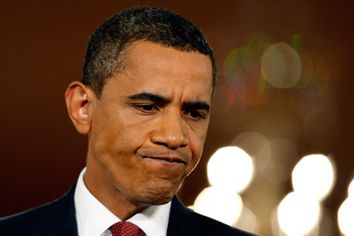
U.S. President Barack Obama listens to a question during a news conference in the East Room of the White House in Washington, July 22, 2009.

Let’s dispense with the “dog bites man” aspect of this first — Barack Obama’s approval rating has slipped. As it does for all presidents in the first year, as hope collides with reality, expectation with output.

His latest number is about 54 percent, according to the Real Clear Politics average of most recent national surveys. That places him practically at the bottom (Bill Clinton was lower at 44 percent) for this stage of presidents for which we have a track record of polling in their first terms, essentially beginning with Truman. (I suspect Obama’s fellow Illinoisan Lincoln — depending on how the South was sampled — would never have hit 54 percent.) It marks a decline from Obama’s early peak of 69 percent, a faster decline than any of the most recent six presidents. The most recent drop has largely occurred among the critical electoral group of independents, as Republicans have been fairly hostile to Obama from the get-go and Democrats are still supporting him in overwhelming numbers. And his specific approval marks on issues such as the economy and healthcare have dipped below 50 percent.

Fifty-four percent is, by the way, a point more than Obama’s standing in “the only poll that counts.” Obama’s final tally on Election Day 2008 was 52.92 percent. And with that context in mind a longer view of this admittedly vital measurement suggests that the 44th president of the United States is hardly in a real danger zone just yet. Three pretty huge factors argue against the increasingly popular and clearly facile view that — “I’m shocked, shocked to find that gambling is going on in here!” — Obama is now in deep doo-doo.

Popularity ain’t what it used to be. Simply put, sustainable approval from the public is increasingly hard to achieve for our fearless leaders. Consider the last 11 presidents before Obama — I am excepting Truman and Ford because one was elected more than three years after taking office, and the other never was. That leaves nine elected presidents. Consider their average approval marks as of August in their first year of elected office. The first three, Eisenhower, Kennedy and Johnson, had a 71 percent rolling average. The second three, Nixon, Reagan and Carter, averaged 61 percent approval. Bush One, Clinton and Bush Two managed only 56 percent. See where this is going? In our hyped-up, media-saturated, partisan age, the numbers of old are simply unattainable. By the way, the last two occupants of the White House, who stood at 44 and 57 percent, respectively, at this stage? They both won reelection.

It’s all in the timing. No two presidencies are alike, due to each president’s own initiatives, electoral or other opponents, and uncontrollable external events. The two highest approval ratings ever recorded in the Gallup Poll were by the two George Bushes — 89 and 90 percent. The elder Bush came off his Gulf War high and received 38 percent of the vote and a pink slip less than two years later; the younger Bush won narrowly three years after his post 9/11 peak. Two of the lowest early-first-term ratings were handed to Ronald Reagan and Bill Clinton — neither had a difficult reelection. There is certainly at least some plausible evidence that a first-term presidency that stacks its bad news, like a recession, or a troubled attempt to reform healthcare, into the first half of that term has a good chance to recover by the second and most crucial half.

In Obama’s case, it really is the economy, stupid. All the other carping about the vagaries or deficiencies of his healthcare plan, the role of government, about his supposedly overly ambitious agenda, his foreign policy foibles, won’t mean a thing if his economic ship comes in at any point in the next 18 to 24 months. He will then have a recovery with which to construct a narrative: “We inherited a mess. We took action, bold action, though some of it was unpopular. And in tandem with the great skill and power of the American people we turned things around.” Now how persuasively are Bobby Jindal, Sarah Palin or even Rush Limbaugh going to counter that?

You can’t beat something with nothing. Speaking of that opposition, it does matter with whom and how Obama is challenged. The GOP is still exploring new depths of partisan unpopularity,

Almost none of the cases where a president did not win reelection in the last 60 years offer much in the way of comparison to the current situation. Truman and Johnson opted not to run in the face of unpopular wars, though LBJ only did so after a stinging rebuke from the primary voters of New Hampshire. Gerald Ford, though he almost closed the gap with Jimmy Carter in the final days of the election, failed to deliver a third consecutive Republican term in the White House after the worst political scandal in the nation’s history. Bush Senior similarly failed to deliver a fourth consecutive term for his party because a) the nation’s attention turned to the economy as his turned to his wristwatch, and b) a skilled young Democrat emerged to run through the gaping hole left by a populist blocking back who desperately wanted Bush out of office. Those were all the last gasps of political eras lasting eight to 20 years. Obama’s historic presidency is the first term for a party that had previously been out of power for two.

In the only “pure” case of a first-term defeat that could be analogous to Obama’s situation, Jimmy Carter was manhandled by events and an exceptional opponent. First he was battered by an out-of-control inflation rate, an oil embargo and a lingering hostage crisis. Then he was weakened by an internecine primary battle with the liberal wing of the Democratic Party and its “royal family.” Remember that for all the hoopla over Hillary Clinton’s refusal to concede in 2008, in 1980 Teddy Kennedy took his fight with an incumbent president all the way to the convention, despite having half as many delegates. Once Carter limped into the general, he was dispatched by the “Great Communicator,” one of the most skilled Republican political figures since Teddy Roosevelt. It was Carter’s 1976 victory that was the fluke. A Baptist from Georgia won narrowly in the wake of Watergate and Vietnam with votes from constituencies whose support no Democrat could sustain. Reagan’s ascension in 1980 was the more predictable outcome, the result of long-term demographic trends, given the growing impact of the Sunbelt and evangelical Christians, and the Democrats’ weakened hold on blue-collar America.

In 1996, Clinton used triangulation and unappealing GOP foils named Gingrich and Dole to win a second term; Bush the younger used 9/11 and fear about terrorism plus organizational power to best Kerry in 2004; Nixon and Reagan ran to landslides in 1972 and 1984 over Washington figures who came to represent the failed or liberal (read: weak) elements of their party. First-year approval ratings or lack thereof had almost nothing to do with these victories. And unlike Jimmy Carter, none faced any significant primary opposition.

Where will the primary challenge to Obama come from? Would any significant element of the Democratic Party be likely to lend support to such a rebellion? He won by a larger margin than any Democrat since LBJ, and mobilized electoral blocs that are key to the future of the party.

Where is the ascendant trend for the GOP, when they are the ones losing the “growing” constituencies — young people, Latinos and the West — and they are the ones whose policies created the mess Obama inherited? Where is the GOP’s heir to Reagan? Or even the two Bushes? In Wasilla? The 21st century Gipper is certainly not in Washington.

As to the economy, everyone’s guess is as good as the next person’s. Approval ratings won’t matter much if we never get out of the current bind, as even Obama himself in a moment of surprising honesty has admitted. But if things get even moderately better, it is hard to imagine, short of scandal or war, that this nation will turn its back on the choice for change it so decisively made last November. 

How Obama won, by the numbers

The polls were right after all, and it was the economy, stupid, but there were still some surprises in the final results.

While some more mail-in ballots must still be counted on the Pacific Coast, it appears that Obama has won by approximately 6 percentage points (it may yet rise to 7), garnering just over 52 percent of the vote. And depending on the final outcome in North Carolina and the “rogue” Nebraska 2nd Congressional District, he may have won 364 electoral votes. Both the margin and the electoral count appear to be almost precisely what the average national poll result forecast and the compilation of state-by-state polls suggested as well.

Victory has 100 fathers, John Kennedy famously observed, quoting the Italian Fascist Count Ciano. But in this case I believe three contributing factors to Obama’s triumph stand out.

First, the extraordinary support Obama won among young people and African-Americans. I speculated last spring in this space that these two factors alone would pretty much eliminate the Bush-Kerry margin — I believe that to be exactly what occurred. The 18-to-29-year-old cohort supported Obama by a 2-to-1 margin (66-32), and while it is too soon to gauge precise turnout measures, their numbers clearly grew. Likewise for blacks, who responded to the history-making call of Obama with a 96 percent support level, dwarfing the margin earned by other recent Democratic nominees, and also apparently voting in higher numbers throughout most of the old Confederacy.

Second, the financial crisis. While I believe that without the collapse of Lehman Brothers and all the chaos that ensued from that September weekend Barack Obama would still have ridden the wave of change to victory, his margin was clearly enhanced by the dominant role played by the economy this fall. The Upper Midwest and Industrial Belt became a killing zone for John McCain — as Obama carried every state between Boston and St. Louis, and apparently only narrowly missed extending that command west to Kansas City with a victory in Missouri. In my home state of Wisconsin, Obama’s margin mushroomed to an extraordinary 13 points. Just look at any of the electoral maps of the Badger State and realize that all that blue was produced by nearly all-white rural counties and small towns that many thought would never support an African-American candidate.

Third, the actual performance of the two candidates. The flip side of a change candidate, particularly someone as new to the national scene as Obama, is always risk. And the McCain campaign signaled very early on that it would try to exploit its man’s advantage on experience and national security matters against the untested newcomer. And yet the other axiom is that presidential debates are the province of the challenger, for they allow him (or her, though Palin didn’t quite pull off her version) to pass through a credibility or acceptability threshold with the electorate — to increase the comfort level, if you will. Obama did just that in the three debates, and it didn’t hurt that for one critical period McCain seemed to come unglued, suspending his campaign, threatening to pull out of the first debate, and setting up shop in Washington to no apparent end. The supposedly risky candidate became the steady hand, and vice versa.

Here’s what else we have learned from the dimensions of this victory:

1) Turnout rose, but only selectively. It may actually have dropped in California and parts of the Northeast, where the outcome was never in doubt and the candidates did not compete for votes. But there were large gains in Florida, North Carolina, Virginia, South Carolina, Texas, Alabama and Georgia, obviously a product of African-American voting, but also of simple population growth. And there were also large gains in Indiana, Missouri and Nevada, all testaments to the Obama organization as well as the late media focus on the close battle in each of those states. Actually, I am willing to guess that a couple of million or so Republicans who voted in 2004 stayed home this year — Ohio’s vote actually seems to have declined.

2) The map was pretty much what I laid out last May, with two big exceptions. Obama produced the predicted Western sweep, with impressive victories in Colorado, New Mexico and Nevada, buoyed by young voters but also 65 percent support among Latinos. Obama won impressively in Virginia and perhaps narrowly in North Carolina, an exacta I hinted at last spring but frankly thought would be limited to just the home of Jefferson. He dominated the supposedly close swing state troika of Michigan, Pennsylvania and Ohio. The surprises were the breakthrough win in Florida, and the narrow victory (as of this writing) in Indiana. The latter was an incredible feat that only those of us associated with Sen. Evan Bayh (I was his pollster in the run-up to his decision not to run) thought possible.


3) Within that map, there has been a lot of moving and shaking from 2004. Obama’s national vote share will rise about 4 points from that earned by John Kerry four years ago, from 48 to 52 percent. Here are the current leaders in improved Democratic presidential vote, 2008 over 2004 (precise numbers subject to change by final vote tallies):

Hawaii +18 (this, not his margin in Illinois, was Obama’s real home-state edge)

Indiana +11 (a simply stunning outcome)

Delaware +9 (the other home-state edge)

North Dakota +9

Utah +9 (Some Republicans stayed home?)

Montana +8

Vermont +8

Nebraska +8

New Mexico +8

Stop for a second. Look at the six states I’ve just listed (after Delaware) and realize one fundamental fact about all of them. There is no appreciable African-American population in any. These are gains that Obama registered among whites (and in the case of New Mexico, Hispanic voters), GOP turnout decline or no GOP turnout decline. And if you remember my “Northern” theory, it is not a surprise that the whites who would move toward Obama live in places with few blacks and therefore little intra-racial antagonism or perceived threat.

California +7 (may still change)

Nevada +7

And then a whole host of states with roughly 6-point Obama gains, including Colorado, Connecticut, Illinois, Michigan, North Carolina, South Dakota, Texas (!), Wisconsin, Idaho and Virginia.

The single striking regional exception is the Deep South. One can certainly speculate that there Obama’s gains among white voters were either nonexistent or negligible. But again it is the marvel of the Obama ground game that it produced huge performance increases in Indiana, North Carolina, Montana and Virginia, as well as the three crucial Southwestern states — places the campaign clearly targeted as opportunity red states from the get-go. Some of the map expansion talk was a feint, trying to draw McCain’s money away from key states, but most of it was real, and it paid off handsomely.

4) He only got half the congressional loaf. As of this writing the Democrats have picked up five Senate seats for certain, and very possibly another to come in Oregon, but have fallen short of the filibuster-proof majority some hoped for, as Alaska’s Ted Stevens appears headed for a narrow victory, Minnesota’s Norm Coleman leads Al Franken pending a recount, and the Georgia runoff would still appear to favor Saxby Chambliss. They were thus stopped well short of a filibuster-proof majority. And the gains in the House appear to be around 20 seats, and not the more bullish 25- to 30-seat gain that many were forecasting. Is this good or bad for Obama? Some might argue he got all the responsibility of a near-landslide win without the strongest possible team to execute that responsibility. Others might claim that the limits placed on Democratic power and hubris might be a good thing, and lead to more consensus building if not outright bipartisanship that will better preserve what, after all, is still a pretty fragile majority against the turmoil undoubtedly to come.

And finally, a personal note. Twice in my life I have found myself shockingly overcome with emotion when I least expected it. Once came at the end of what I had been thinking was a good, but not great, film about baseball, the sport I love, “Field of Dreams.” Kevin Costner started throwing catch with the ghost that was his father and I lost it.

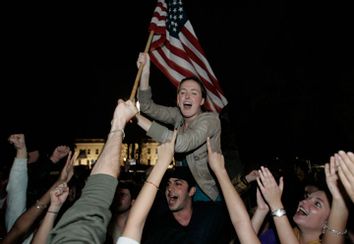
Last night a victory occurred that I had expected for months. After Sept. 15, the outcome for me was never in doubt and I chided fellow Democrats for their Nervous Nelliedom or suspicions about Republican high jinks or racist backlash. “He’s going to win — and pretty big,” was my constant refrain. And as a hired gun who knows some of Obama’s top command, of course I had mixed feelings. In part I was envious of their incredible success. That’s the nature of a highly competitive industry. Ten minutes before 10 p.m. Central, I realized what was going to happen when the next hour hit and the West Coast polls closed, and I called my wife and told her to make sure our 16-year-old daughter, who had volunteered for Obama here in Madison, was watching. And then came the announcement, and the crowd shots from Grant Park, and tears just started to flow. My country had done something so extraordinary, so unthinkable just a few years ago, so inspiring. We didn’t erase the stain of slavery and racism, but we sure did bury it — at least for a while.


Continue Reading Close

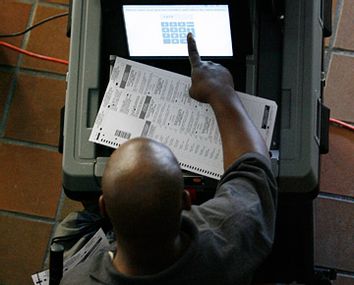
How to read the numbers on Election Day

Howard Dean's pollster tells you the five things to look for in early returns Tuesday.

Barring some cataclysmic change in the race’s final hours, Tuesday’s outcome no longer seems in doubt. What still hangs in the balance is the size and scope of the victory. Do the Democrats bust through, with Obama winning by more than 5 or 6 points — even double digits, 350 or more electoral votes, and a congressional majority enhanced by more than seven new Senate and 25 new House seats? Or does Obama, as often happened in the primaries, fail to close part of the sale and win by a less impressive margin, say 3 or 4 points, with a later than expected Election Night sweat and less modest increase in his party’s congressional ranks?

Here are some things to watch for as the numbers start to come in on Tuesday night.

1) One voter turnout model defines the electorate largely by past voting history, another allows for more young and minority voters than in the past. The latter model clearly helps Obama. Even turnout figures for Eastern states, however, won’t be complete till after midnight. The best piece of early evidence among the night’s numbers as to which turnout model is more accurate may be Virginia. If Virginia is called for Obama immediately after the polls close at 7 p.m. Eastern, based on both exit polls and key precinct results, then a near double-digit national margin may be possible, fueled by African-American and younger/suburban votes. That would undoubtedly bode well for Obama’s chances in North Carolina, Florida and the growing Western states such as Colorado, Nevada and New Mexico.

2) Did the late undecideds break for McCain, whether because of racially based doubts about Obama, or, perhaps more likely, some unwillingness to participate in a coronation — to “crown his ass,” to paraphrase former Arizona Cardinals coach Dennis Green. What if undecideds, realizing that Obama is almost certain to win, decide they want to express some reservations about him? Watch Florida and Ohio, the two linchpin states of the last two elections. If their outcomes are in doubt as the evening progresses, then McCain’s late efforts combined with the worries of “undecideds” about Obama may have borne fruit. But while the networks may be reluctant to call these two states quickly, if a clear trend toward the Democrat is emerging in both, it would suggest that the late undecideds did not break toward McCain, and that Obama’s national popular vote margin will be comfortable.

3) Just how big was the impact of the economy? If Obama is running several points better than either Al Gore or John Kerry throughout the Rust Belt — and particularly in more rural or working-class areas such as southern Ohio or southern Indiana, and the “T” that defines the interior portions of Pennsylvania not dominated by the Philadelphia or Pittsburgh media markets — then obviously economic concerns trumped all others and the linkage of McCain and Bush exceeded any question about Obama’s tax policy or redistributive philosophy. But if he is actually trailing the past two Democratic nominees in those areas, and is winning Pennsylvania and perhaps Ohio either by smaller than expected margins or because of huge turnouts in major metropolitan areas, then perhaps the economy was not such a universally powerful weapon.

4) What about the exit polls themselves? Their results in both 2000 and 2004 — or at least the ones made available throughout Election Day to the inside political community — seemed more pro-Democratic than the eventual results. One big reason may be greater reluctance or unwillingness on the part of conservative voters to participate in exit polling. Will we be duped or misled by early exit poll readings that suggest a big Obama/Democratic tide?

I think exit polling will be more accurate this year. There have been previous snafus where exit polling failed to properly gauge the impact of early voting, particularly in California, where it has been common for nearly a generation. Until recently the early vote in most states tended to be older and more conservative, meaning the early vote skewed Republican, thus producing one of the factors that led to more bullish same-day exit polls for the Democrats in 2000-04. But the company providing the exit polls this year has expanded the number of states — based on early voting trends and expansion — where they supplement the same-day interviewing with a telephone sample of early voters. The “partisan evening” as the practice becomes more widespread, plus the intense Obama effort to promote and produce early voting, should have eliminated much if not all of the bias. In short, we can no longer assume that based on this factor the exit polls will lean more Democratic than the actual vote. This does not, however, address any bias in the response rate that might be introduced by the possible reluctance of conservatives to talk to pollsters.

5) And finally, will Obama break the magical 50 percent mark, becoming the first Democrat since Jimmy Carter to win an actual majority of the votes cast? If the combined vote share for Ralph Nader and Bob Barr is running under 2 percent in the early returns, then it will be very difficult to imagine how Obama will fall short of the 50 percent barrier. And it is not out of the question that he might approach 55 percent, a preposterous thought just a couple of months ago.

Continue Reading Close

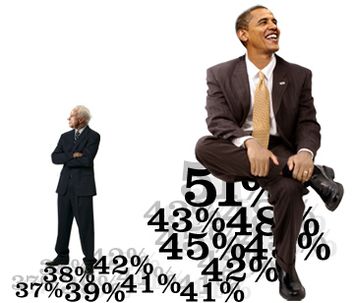
Obama’s big lead in the polls is real

Democrats are afraid to believe he's really winning. But a pollster explains why those polls that show a tight race should be treated with skepticism.

At the time of this writing, just past midnight in the opening minutes of  Oct. 24 — meaning a mere 11 days before the first votes in the 2008 presidential election will be cast in Dixville Notch, N.H. — I am looking at the results of no fewer than 11 national polls. Barack Obama leads in every one.

Obama leads by a double-digit margin in five of the 11. With over 50 percent support in seven of the 11. At the same time state polls show his lead outside the margin of error in supposedly critical battleground states like Virginia, Colorado and New Mexico, and he has growing double-digit leads in such formerly competitive states as Wisconsin, Pennsylvania and Michigan.

But because one of the 11 polls, the one performed by a survey company that touts itself as “America’s most accurate pollster,” shows only a 1-point Obama edge and another, from venerable Gallup, shows a slim 4-point margin among so-called likely voters, many Democrats are still nervous. Afraid that the polls with the wide margins are misleading; scared that the “Bradley Effect” will cause many more white votes for McCain and against Obama than the polls are registering. Worried that despite Obama’s financial advantage, enthusiasm gap and vaunted field organization, the breakthrough young and minority vote will not materialize as promised.

Well, this Democratic pollster has three simple things to say:

1) The current Obama margin is real, has been present and generally growing for more than a month, and is predicated on three very firm foundations unlikely to change in the final 10 days of this campaign. First, a general negative mood about the country and the current administration. Second, the specific profound impact of the financial collapse and deepening recession, which has dominated this election since the collapse of Lehman Brothers in mid-September. And third the difference in candidate performance and persona, particularly in the three televised debates, that has led to the Democrat growing in stature and steadiness while his more experienced opponent has seemed increasingly risky and uncertain. While the margin could still fluctuate — and perhaps there will be a snap-back from an “anti-coronation” effect — i.e, undecided voters who realize Obama is about to be elected but don’t want to add to his or the Democrats’ margin of victory — the dynamic of the overall situation is clear.

2) The likely voter model offered by Gallup is flawed. The Gallup organization itself seems to recognize this, since it is also reporting an “expanded” turnout model that has shown Obama running anywhere from 2 to 4 net points better than its “traditional” model. The flaw is simple: Gallup identifies “likely” voters by asking their previous voting history, meaning that if you are a first-time voter or you skipped voting in either 2000 or 2004, your preference is either not counted at all or weighted down. Needless to say this discounts the substantial numbers of new voters who have already participated in the 2008 primaries, have just registered to vote as part of record registration drives across America, or are planning to cast a vote on Nov. 4, spurred by a massive Democratic field organization. Many other pollsters are eschewing this rear-view mirror approach in favor of questions that ascertain respondents’ current intentions to vote and their overall interest in the election. Obama performs better in their models.

3) There will always be outliers. The IBD-TIPP poll, the one that shows a 1-point margin, is published by Investor’s Business Daily and is the product of a firm called the Technometrica Institute of Polling and Politics. The company’s tag line, “America’s most accurate pollster,” derives in part from its claim to have had the most accurate record of all pollsters in 2004. But one indication of potential bias is the fact that among TIPP’s current “hot topics” is the question “Are we ready for socialism?” You could argue that the liberal Web site Daily Kos is biased too, and discount its sponsored poll that shows a 10-point Obama lead — except the Kos poll numbers resemble those in surveys conducted by traditional network powers ABC, NBC, CBS as well as C-SPAN/Reuters. Those all report double-digit Obama margins. Even a Fox News poll shows Obama leading by 9 points. That’s got to hurt, though I suspect they (and Rush Limbaugh) are consoling themselves with thoughts of the ratings increases that will undoubtedly accompany their enhanced profile, post-Nov. 4, as the official megaphone of the opposition.

We can pick at many of these polls. They offer differing methodologies, differing interviewing techniques, differing sample sizes and composition. Yet there is actually great comfort in their diversity — or disparity. A dozen national polls, and four or five times that many in key states, are near-unanimous as to the standing of this campaign. Given that they have arrived at those results by different means, and are not cookie-cutter products that are all missing the same truth, the American people should be confident about the emerging consensus they have reached.

Leave it to the Republicans to doubt the polls, to pin their hopes on the possibility that all these different survey firms have got it wrong. (Where is our modern-day Republican Cassius to opine that “The fault [my friends] is not in our polls/ But in ourselves”?) From my perspective, barring some unforeseen circumstance in the next 11 days, all that remains to be seen is the margin of victory, and whether, as these polls seem to be hinting, we’re headed for a landslide.

Continue Reading Close

Why Democrats shouldn’t panic about McCain’s poll bounce — yet

While there are some worrying long-term trends for Barack Obama, there are also some caveats about the size of McCain's post-convention, post-Palin surge.

As the poll numbers pour in, the evidence is growing that the Republican ticket of John McCain and Sarah Palin was the winner of the dueling convention/V.P. choice fortnight. With a couple of key polling precincts yet to be heard from (most notably the NBC-Wall Street Journal survey, though these days Republicans tend to dismiss any news entity that includes the letters “NBC” in its name), so far the GOP has gained in five of the six national surveys from its position prior to the two conventions and the initial vice-presidential choice of Joe Biden.

Since these polls offer competing methodologies, sampling techniques and interviewing schedules, the best way to analyze the state of the race is to compare apples to apples, oranges to oranges even if some of the fruit is a bit rotten. (Admittedly, state-by-state polling is really the only barometer that matters, but there are not yet any real guideposts from post-convention polls in key states.)

Take the Rasmussen tracking survey — an automated dialing/interviewing format that has generally been more pro-GOP in its results:

8/21-23 McCain 43 Obama 46

9/5-7 McCain 48 Obama 47

Net McCain Gain Since “BB” (before Biden): 4 points

McCain has gained 4 net points since the day before the announcement of Biden as Obama’s running mate — and the undecided has declined by 6 points, a not-unexpected development given the huge media focus on each side the past two weeks.

Or look at Gallup. Gallup uses live interviewers:

8/21-23 McCain 45 Obama 45

9/5-7 McCain 49 Obama 45

Net McCain Gain From “BB”: 4 points

A modest gain for McCain and corresponding drop in the undecided. But Gallup, once the leading name in the polling industry, remains tarnished by an incredibly inconsistent 2000 election cycle, where Gore and Bush traded sometimes double-digit “leads” seemingly from one day to the next.

And what about John Zogby? The upstate New York pollster has often gone way out on a limb with some spectacularly accurate or inaccurate readings — his greatest success being the correct assessment of Al Gore’s growing strength toward the end of the 2000 campaign. Zogby’s poll is an Internet-based methodology, which carries several sampling weaknesses that may or may not be possible to overcome with weighting procedures:

8/23-24 McCain 44 Obama 46

9/5-6 McCain 50 Obama 46

Net McCain “BB” Gain: 6 points

This is a 6-point McCain gain from before the Democratic National Convention. (Zogby’s pre-convention poll did include some interviews completed after the Biden announcement, but his previous survey — August 12-14 — also showed a 2-point Obama lead.)

The Hotline tracking poll has a higher undecided than nearly every other major national poll, but the trend is similar:

8/18-24 McCain 40 Obama 44

9/5-7 McCain 44 Obama 44

Net McCain “BB” gain: 4 points

And then the latest “straight” Gallup poll, conducted jointly with USA Today. It uses a much smaller sample than the three tracking surveys listed above (which all have samples from 2,000-3,000 over any given three-day period) and emphasizes likely voters:

8/21-23 McCain 45 Obama 48

9/5-7 McCain 54 Obama 44

Net McCain “BB” gain: 13 points

Thirteen points is a stunning boost for McCain. This is the clear outlier of the five but still shows the same pattern — McCain, who had been gaining in fits and starts throughout most of July and August, continuing his rise after the two conventions, and a declining undecided vote. It is troubling to note for Democrats that in two of these five polls McCain’s support level is at or above 50 percent and in two others just under at 48 percent, a place that Obama had been comfortably occupying ever since the spring.

(An aside about the “Likely Voters” referenced in the Gallup/USA Today survey, with its 10-point lead for McCain. Depending on how this determination is reached, it might cause a poll to swing in either direction and perhaps away from the truth. If a likely voter model is based mainly on prior voting history, a standard my firm uses in producing a “Likely Voter” subgroup, that measure leaves out all the first-time voters that 2008 has already produced, and thus understates Obama’s support. If it is based mainly on current voter enthusiasm — another measure my own firm uses — then McCain’s lead carries a different asterisk. Does it mean that Evangelicals who didn’t care about the race are suddenly eager to vote? On Election Day, a vote cast with reservations matters as much as the excited kind.)

And finally there’s the CNN poll, which actually shows no McCain gain from the period just before the Biden choice, but a 7-point gain for the Republican since Aug. 1:

7/27-29 McCain 44 Obama 51

8/23-24 McCain 47 Obama 47

9/5-7 McCain 48 Obama 48

Before full-bore panic sets in on the left, I would offer several caveats.

First, that these are still surveys taken in the glow of the St. Paul convention. Convention bounces in the traditional schedule — opposition party in July, incumbents in August — tended to be short-lived. Bounces may still behave this way in the compressed late season schedule on display in 2008. Obama and Biden have barely been heard from in the 10 days beginning with the surprise choice of Palin; that changes as of today.

Second, that all of the immediate post-Republican convention polling is heavily skewed toward the weekend, with most of the interviewing performed on Friday night or Saturday. (Zogby’s Internet sampling is, of course, less affected by time of day or week.) A candidate like Obama with strong support among young, urban and affluent voters may fare less well on such days simply because his constituency is not to be found at home, whereas McCain’s older and now more working-class supporters will be.

Third, that the wireless universe is still a major x factor — I don’t know the precise steps any of these firms are taking to reach cellphone voters (and again Zogby has the best chance to include them in his sample), but suffice to say that at best it will be incomplete. Obama could easily perform 1 or 2 points better on Election Day than he does in polls for this reason alone.

Fourth, that the next major campaign event — the initial debate on Sept. 26 — is set up to help the challenger. Generally — and Carter, Reagan, Clinton and the younger Bush are all examples of this phenomenon — a presidential debate will help a less-known or more inexperienced candidate on the national stage more than his incumbent or better-known opponent. It is a simple matter of exposure providing comfort and reassurance to voters, of the challenger passing some threshold of acceptability, particularly on issues concerning foreign policy or national security. (Foreign policy will be the focus of the first debate.) It is possible that Obama’s long year-and-a-half in the spotlight will diminish this potential bounty, or that Palin will benefit at least equally in her matchup in October with Biden, but for now I’m going to assume that the Democrat on the top of the ticket has the best chance of being helped by the debates.

And finally there are the “undecideds” themselves. Their ranks may seem diminished, but it’s important to remember that pollsters have been nudging them along. I suspect that some of those firms whose polls have fairly minuscule undecided numbers — 5 percent or less — are “reallocating” undecideds in some way, i.e, using other questions to make a best-case estimate about where those voters will fall. The real undecided could still approach 10 percent, which means “undecided” still holds the key to the outcome on Nov. 4. Which model will the undecideds follow? Will they turn away from an unpopular incumbent party, as has often been the case, in which case Obama could still win fairly handily? Or do those of them that are white — meaning, the vast majority – choose the white candidate, as has happened in many big-city and even statewide races involving an African-American candidate?

Whichever, it is pretty obvious that the narrowing structure of this race has jettisoned some of the Obama campaign’s most audacious hopes in this race. Advertising has been curtailed in Georgia and Alaska; can North Carolina, Montana and Indiana be far away? As this writer suggested in June, this is an election that may very well come down to a handful of key states — Michigan and Ohio, Virginia and Colorado, Wisconsin, Nevada. Same as it ever was, with a couple of exceptions.

Continue Reading Close

Can you hear me now? Obama’s missing 2 percent

By failing to survey cellphone-only voters, pollsters could be undercounting Barack Obama's support by millions of voters.

Say you want to reach a representative sample of the U.S. electorate for a presidential poll. The Obama-McCain race is relatively close these days, with the Democrat’s lead hovering around 5 to 6 points in most surveys. Someone tells you that he’s selected a sample that’s predominantly under 40 years of age (oops, that one favors Obama); disproportionately renters rather than homeowners (Obama-leaning again); full of college students (sounds like a Starbucks Obama thing to me) — and, for good measure, includes a higher proportion of blacks and Hispanics than the national population does.

At this point you throw up your hands and exclaim: “Why are we concentrating on such a pro-Obama universe? He could be leading by 20 points or more among those people!”

He could. He probably is. But in actuality, the sample I’ve described is either not being included at all in many national polls or is being undercounted. Why? Because I’m talking about the growing number of American cellphone users who have no other type of phone or who choose to go wireless for the vast majority of their interactive needs. And this election cycle — for the first, and perhaps only, time — this group has the chance to render presidential polls “wrong from the start”: potentially disguising at least 2 to 3 percentage points of Obama support and maybe more.

Heretofore my industry has dismissed the cellphone-only population with a troika of “yes, buts.” Yes, they’re undercounted, but 1) they don’t vote anyway; 2) their numbers are still small; and 3) we can find acceptable substitutes in the land-line population.

And to be honest, there is a fourth, still more powerful rationale that remains unstated: “Yes, they’re undercounted, but it’s too damn difficult and expensive to reach them.”

Each of those “yes, buts” except the last one is being overwhelmed by the facts on the ground. The most recent estimate places the number of “wireless” adult Americans at around 30 percent — with slightly more than half of those only using cellphones and the rest possessing both land lines and cellphones but using the latter far more often. Looking at the data over time, it is clear those numbers are getting higher each month. The 2004 presidential election exit poll conducted by the National Election Pool found that 7.1 percent of all voters in that election were cellphone-only. Recent data indicates that the percentage could be twice as high in 2008.

As this trend continues, the differences between cellphone and land-line respondents will dissipate simply because of heft — the larger the cellphone universe, the more it will contribute to national opinion, and the more it will resemble the general population. Cellphone-only and land-line users will come to resemble each other. But for now, the growing use of cellphones presents pollsters with a tremendous challenge.

The 2008 election has featured a sizable increase in under-40 voting, no doubt inspired partly by Barack Obama’s message, but also by new and more refined methods of communicating that message — and by a campaign that has the resources to use those methods. As a result, it is obvious that the cellphone-only universe could be a statistical outlier: one of the most, if not the most, dependably pro-Obama constituency other than African-Americans.

By law, cellphone users cannot be called by an automatic dialing system (to prevent obnoxious telemarketing), and cellphone numbers are not part of the normal random-digit-dialing residential-exchange universe. Survey companies prefer to conduct polls using automatic dialing, but to find cellphone-only voters, they must employ the less-efficient hand-dialing method. Cellphone users must be sampled separately and at greater cost in time and money. This means that polls utilizing the cheaper and more efficient means of making survey calls do not include cellphone interviews.

And as survey respondents, these voters are less cooperative anyway. Even if they are contacted, they are less likely to take a call, or to arrange a call-back, than land-line households — further increasing the cost of reaching them.

Many survey companies have looked at these impediments and decided that it is simply not worth the extra effort and cost to track down cellphone users. (I am not going to name names, but one should assume that polls conducted by robo-calls undercount cellphone-only voters.) The pollsters’ rationalizations hinge on the theory that a sampling of similarly profiled land-line voters — younger, better-educated, more transient — will yield similar results. But polling has certainly missed trends, and segments of the population, before. The Literary Digest never stopped to think in 1936 that its readership might not reflect the views of the entire country when its poll predicted a victory for Republican challenger Alf Landon over incumbent Franklin Roosevelt.

This year, the increasingly inexcusable failure to count a growing pool of voters could prove mathematically embarrassing. Let’s say that with the campaigns’ increased focus on the Web, Facebook, phone-texting and other targeted ways to communicate to younger Americans, voter turnout rises and this cellphone-only universe climbs from under 10 percent of the electorate to something closer to 20 percent. If these voters’ preference is 60-40 for Obama, they alone will increase his national total by 2 percentage points. And those could easily be conservative projections. In fact, Gallup Poll results from earlier this year (prior to Obama’s designation as the presumptive Democratic nominee) had a 4-point swing in favor of Obama once cellphone-only respondents were folded into the overall sample.

After 2000 can any public or private polling organization willingly use a sampling methodology that understates a candidate’s support by 4 points, or more than 3 million voters?

The old ways of compensating for the cellphone-only population are clearly inadequate. Land-line results are no longer a reasonable substitute. Those land-line users — even in the same younger demographic groups — have different attitudes from those of their wireless counterparts. They are much more likely to own a home, to oppose gay marriage, to have health insurance, to be married with children. Surely pollsters cannot claim that the two groups reflect the same opinions in the midst of a national election campaign.

While cellphone interviewing is complicated for any purpose, in the presidential election there is one additional elephant in the room. The lack of relationship between a cellphone’s area code and the physical location of the phone complicates things greatly. Consider the number of college students at the large state universities in battleground states who have out-of-state cellphone numbers, but are going to vote in Madison, Wis.; Columbus, Ohio; Ann Arbor, Mich.; or Gainesville, Fla. Consider also the numbers of students in big cities with several large universities, like Philadelphia. Currently, Gallup’s screening methodology does not account for this discrepancy. In a national survey, it makes less difference, but in individual states, this issue will require additional consideration.

Consciously limiting the respondent universe in a presidential election survey, resulting in a wildly incorrect prediction, did tremendous damage to the reputation of the Literary Digest 72 years ago. In 2008, we have the audacity to hope that the polling industry will not make the same mistake. In 1948, the failure of the whole polling industry to predict Harry Truman’s victory over Thomas Dewey was due to many factors, the most important of which was missing the size of the late surge toward Truman — but there was also a little undersampling that seems ironic given our phone habits 60 years later. Pollsters may have missed some Democratic voters in 1948 because they were technologically behind Republican voters. They were less likely than Republicans to have land lines.

Continue Reading Close

Page 1 of 2 in Paul Maslin

www.salon.com/writer/paul_maslin/index.html