Paul Shaw

The stories signs tell

A wonderful new book explores how Melbourne's lettering informs us about the city's cultural and economic history

  • more
    • All Share Services

The stories signs tell
This article originally appeared on Imprint.

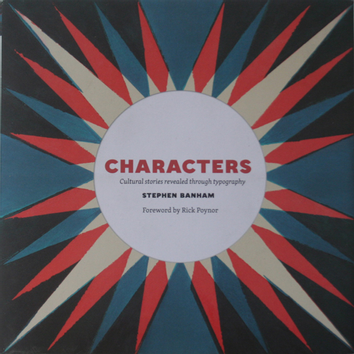
ImprintMy blog Blue Pencil has become infamous for no-holds-barred critiques of books. This is not a Blue Pencil takedown. Instead, this is a welcome opportunity to praise a book that is exemplary in nearly all respects. The book in question is “Characters: Cultural Stories Revealed through Typography” by Stephen Banham (Port Melbourne: Thames & Hudson Australia Pty. Ltd., 2011), published in association with the State Library of Victoria. It is a book about signage in Melbourne, Australia.

Signage and vernacular lettering has fascinated artists and photographers for decades. Although most famous for “Let Us Now Praise Famous Men” (1941), his Depression-era collaboration with author James Agee, Walker Evans recorded American signs and advertising from the 1920s until his death in 1975. His friend Ben Shahn also took an interest in vernacular lettering and during his time at the Farm Security Administration in the 1930s he photographed examples of it throughout the American South. Decades later, he eloquently expressed the passion that letters can evoke in “Love and Joy about Letters”: “Letters are quantities, and spaces are quantities, and only the eye and the hand can measure them. As in the ear and the sensibilities of the poet sounds and syllables and pauses are quantities, so in both cases are the balancing and forward movement of these quantities only a matter of skill and feeling and art.” Lee Friedlander, a photographer in the Walker Evans tradition, focused “on the everyday presence of the written word in the random letters, words, signs, slogans and outcries” that dot the American landscape.

In recent years graphic designers have joined in with a series of monographs on signs and vernacular lettering. Both “Signs of the Times” (1996) by advertising type director Klaus Schmidt and “Designage” (1998) by the Anglo-American graphic designer Arnold Schwartzman are collections of photographs accumulated over decades during travels throughout the world. In contrast to the gorgeous photography of Evans, Friedlander, Schmidt and Schwartzman there are the down and dirty Polaroid snapshots of Ed Fella on display in “Edward Fella: Letters on America” (2000) by Lorraine Wild, Lucy Bates and Lewis Blackwell. Slimmer counterparts to these expansive texts are my own essay “Looking for Letters in New York: A Tale of Surprise and Dismay” (2006) and “Signs of New Orleans” (2008), Tom Varisco’s beautiful and, in the aftermath of Hurricane Katrina, poignant survey of his native city.

Finally, there is “Signs: Lettering in the Environment” (2003) by Phil Baines and Catherine Dixon, a comprehensive look at signs in terms of their lettering and typographic styles, materials, purposes and placements.

At first glance “Characters” looks a lot like these other books. But closer examination reveals a book with much more depth. “Characters” is more than a cool collection of images, an occasion to wallow in nostalgia for the past ― a time before the Internet, computers, franchises and chain stores, international corporations and globalization; a time before Helvetica. It is a collection of stories about signs that go beyond the aesthetics of color, design and type to reveal the cultural, social and economic changes that have happened in Melbourne over the course of a century. Banham, owner of Letterbox, a “type studio” in Melbourne, has researched the history of how the signs were conceived, designed and manufactured; what has happened to them over the intervening years; and what they have meant to different generations of Melbournians. Thus, “Characters” is a book about place as well as about time.

The signage and public lettering in ”Characters” is familiar to anyone who has looked at any of the books mentioned above, been on one of my “type tours,” or perused the many Flickr sites dedicated to urban “typography”: neon signs (lots of them), Art Deco inscriptions, quirky letters that function as architecture, amusing vernacular forms, street and transportation signage, hidden letters, uncoverings (Banham’s term for ghost signs) and so on. This is the world of 20th century Melbourne, of the city as it once was.

Melbourne, the second most populous city in Australia, was founded in 1835. Thanks to the Victorian Gold Rush that began in 1851, it was the richest city in the world by the 1880s. Its growth slowed dramatically after the Australian banking crisis of 1893, though it remained Australia’s financial hub until the 1970s. From 1901 until the completion of Canberra in 1927, Melbourne was the capital of Australia. Many of the signs in “Characters” reflect the city’s past manufacturing power and political importance: MacRobertson’s White City, Allen’s Sweets, Slade Knitwear, Pelaco, Nylex Plastics, Newspaper House and the 888 Monument. Others are a reminder of its changing ethnic makeup: a scrawled tale of a malfunctioning toilet on the wall of a North Melbourne apartment building, the “Aqua Profonda” warning at the Fitzroy swimming pool, the neon signage of Borsari’s Corner (hailing cycling champion Nino Borsari, the King of Carlton Street), and the alphabetical facade of Leo’s Spaghetti Bar.

Each of the chapters in “Characters” is devoted to a single sign or example of urban lettering. Banham provides the cultural, social, economic and, sometimes, political background of each one, describing its origins, life and, in most instances, decay and death. He tells these tales with admirable brevity and some wit, yet without forsaking important historical facts and contextual information. The misspelled “Aqua Profonda” warning ― the pool manager confused Latin with Italian ― at the Fitzroy swimming pool was added to the English “Danger Deep Water” after an influx of Italian immigrants to Melbourne following World War II. The White City, a collection of thirteen buildings devoted to the manufacture of confectionary products overseen by an enormous “MacRobertson’s” neon sign, embodied the “total designed system.” Skyline Sam, the little stick figure representing the Skyline chain of drive-in theatres, was “one of Australia’s first home-grown graphic identities.” The Temperance & General (T&G) and Manchester Unity (MU) Buildings, built in 1928 and 1932 respectively, showcased “the virtues of collective strength and reliability” embodied by the modern insurance industry. And so on.

Among the best stories in “Characters” are those that deal with loss, a common subject in books about signage. This is because Banham manages to balance regret and outrage with the realization that change is inevitable and an awareness that nostalgia can be debilitating. The nine-page chapter on the dismantling of Allen’s Sweet’s sign in 1987 ― which includes a fabulous close-up of a large S, a sequence showing the different parts of the sign as they blinked on and off, a drawing explaining each layer (the Allen’s Sweets base message, the sky rocket overlay, the Kool Mints overlay and the Anticol [Cough Drops] overlay) of the neon sign, and a timeline of its history from the 1930s on ― provides Banham with a chance to reflect on the difficulties involved in preserving the signs of businesses that no longer exist. “The preservation debate around the Allen’s sign typifies the complexity of custody―the neon company owns the sign, the advertiser leases it, the sites are owned by developers and while many arms of government see merit in their preservation,” he writes, “they are often hamstrung by bureaucratic processes and politics.… And then there are the ever-shifting definitions of what is historical and what is not.” In the chapter on the Nylex sign, Banham reminds us that preserving old signs can be expensive. He quotes the current owners of the building as saying, “We’d dearly love to turn it on, but we can’t afford the costs [estimated at AU$20,000–30,000 per year].” One sign that was saved was “Little Audrey,” a girl skipping rope originally made for Skipping Girl Vinegar in 1936 and saved from destruction in 2009 through an appeal led by the National Trust (Victoria) and the Heritage Council of Victoria. However, another “girl,” made for the St. Moritz Skating Rink in 1939, was removed from its site and is now in storage in the “dungeons” of the St. Kilda Historical Society.

Despite Banham’s understanding of the obstacles involved in saving urban lettering, he does not hide his anger over instances of unwarranted destruction, though it is often cloaked in understatement. “Real estate development can be unkind to signage” is the opening sentence of “A is for apartment, B is for butchering,” a chapter about the brutal severing of “Dominion House” by balconies in the building’s conversion to apartments. Of the beautiful Art Deco signage of J.L. Callanan Chemists he observes that it “still exists on the original façade, preserved under a brutal metal hoarding.”

Rather than dwell on the signs lost, Banham ends “Characters” with several chapters focused on what has been recovered and saved. The reappearance of old painted signs ― called ghost signs in the United States, but “uncoverings” by Banham ― elicit excitement. “Reintroduced into a contemporary environment, these uncoverings offer a rich reading of an area and the lives of the inhabitants, perhaps indicating the lower social status of areas now gentrified, the aspirations of emerging lifestyles and technologies, or directions to a place long gone from the public consciousness,” Banham says. “But above all, uncoverings highlight the ephemeral nature of signage, advertising and corporate identity. Design is not just seen as part of our environment, but is part of us. This precarious lifespan reflects our own human anxieties of ageing, decline and demise.” But uncoverings pale next to the miraculous survival of the bright red script Astoria Taxis sign, rescued from demolition the day the building it rested on was taken down and then, nine years later, pulled from a fire at the nascent Gange Taxi Museum. Singed and blackened, the sign is lovingly reproduced over the course of four consecutive pages.

Illuminated signs are at the core of “Characters.” Nineteen of the tales Banham tells have to do with neon or light bulb signs, most of them huge structures on the tops of buildings. Collectively, they define Melbourne. He describes the current skyline as a “logo constellation.” And interspersed throughout the chapters of “Characters,” Banham inserts several reminiscences from signmakers about erecting signs as well as stories about finding odd things ― such as airplanes and musical instruments ― amid rooftop signage. Here is Nevin Phillips of Delta Neon remembering the experience of installing a Ford Falcon with Don Fraser on a 100-foot tower outside the Ford factory in Broadmeadows: “So we’re both on the top of this bloody great tower, that when you climbed up in it, if you shook it, it kept going for about five minutes before it stopped. We put this revolving Falcon, a great big thing, lowering it down. It was beaut. But the moment the air from the [helicopter] blades hit the top of the tower, the Falcon started to spin erratically. Nearly knocked us off. We both flattened ourselves and crawled down inside the tower.” These interventions, along with photographs such as the MacRobertson’s sign with a tiny figure silhouetted next to the final s, remind the reader that many of the letterforms profiled in “Characters” are enormous structures whose installation required engineering ingenuity and physical derring-do. They have far more heft than letters on paper or screen.

The stories in “Characters” are short but often smart, eloquent, funny and poignant. Banham stresses the importance many of the signs have to Melbournians, not just to graphic designers and typographers, as part of the city’s cultural identity and visual history. “This book reveals how the life of a city can be viewed through its letterforms,” he writes at the outset, “and more specifically, the most public of its typography, its signage. However, this lens could be focused on any city, in any country, anywhere in the world. The places, experiences and stories related here are unique to Melbourne, Australia, but the “way of seeing” signs is as universal as the human appeal of storytelling.” Much of what Banham has to say should resonate with residents of other cities on other continents who are dismayed at how the relentless pace of modernization and globalization has increasingly stripped places of their identity, their uniqueness and their personality.

At the outset of this review I described “Characters” as near perfect. (After all, it has a detailed bibliography.) But it lacks one thing ― a map of Melbourne, something that those not from Australia could use to visualize the topography of the city’s typography: the location of the Yarra River, the Eastern District, Flinders Street and other places cited by Banham. A map would deepen the appreciation of a well-written paragraph such as this one: “Now reduced to its static form, the Elsternwick Hotel skysign joins the other two significant Victoria Bitter signs on the same thoroughfare. The largest of the three sits on top of Richmond’s Barrett Burston silos, alongside the renowned Nylex sign. A third sign looms large over the intersection of Toorak and Punt Roads, provocatively extolling the virtues of alcohol consumption to its neighbour across the road, the local Anglican church.” The only other complaint about the book is that the running heads are extremely tiny. Overall the design of “Characters,” by Banham’s studio Letterbox, is excellent as is the quality of images. Alongside excellent archival photographs, drawings and newspaper clippings are contemporary photographs by his colleague at Letterbox, Lan Huang.

Several months ago I wrote an excoriating review of “Just My Type” by Simon Garfield for Imprint. I condemned it for its snotty putdowns, imperious pronouncements and lack of typographic knowledge. The book has since been defended by many on the grounds that its lighthearted, witty style has made the esoteric topic of typography accessible to the masses. My response is to ask people to read “Characters.” Banham’s stories are as engrossing and amusing as any in “Just My Type,” yet at the same time they are more informative (as well as factually correct) and more probing. Banham is critical without being snotty. And he raises knotty questions about the preservation of signage and other “typographic” remnants of our built environment. “Characters” is an enjoyable ― and reliable ― portal to the world of letters and type for a general audience as well as for committed typomaniacs. It is just my type of book.

Bibliography:

  • “Signs: Lettering in the Environment” by Phil Baines and Catherine Dixon (London: Laurence King/HarperCollins, 2003)
  • “Lettering in Architecture” by Alan Bartram (London: Lund Humphries, 1975)
  • Walker Evans: Signs” with an essay by Andrei Codrescu (Los Angeles: Getty Publications, 1998)
  • “Letters from the People” by Lee Friedlander (New York: Distributed Art Publishers, 1993)
  • “Lettering for Architects and Designers” by Milner Gray and Ronald Armstrong (London: B.T. Batsford, 1962)
  • “Lettering on Buildings” by Nicolete Gray (London: The Architectural Press, 1960)
  • “Words & Buildings: The Art and Practice of Architectural Graphics” by Jock Kinneir (New York: Whitney Library of Design/Watson-Guptill, 1980)
  • “Signs of the Times” by Klaus Schmidt (New York: Amphoto, 1996
  • “Designage: The Art of the Decorative Sign” by Arnold Schwartzman (San Francisco: Chronicle Books, 1998)
  • “Looking for Letters in New York: A Tale of Surprise and Dismay” by Paul Shaw in “Letters from New York 2: A Book of Lettering and Related Arts” (New York: Society of Scribes, Ltd., 2006)
  • “Love and Joy about Letters” by Ben Shahn (New York: Grossman Publishers, 1963)
  • “Signs of New Orleans” by Tom Varisco et al (New Orleans: Tom Varisco Designs, 2008)
  • “Edward Fella: Letters on America” by Lorraine Wild, Lucy Bates and Lewis Blackwell (New York: Princeton Architectural Press, 2000)
  • Among the many websites devoted to urban lettering and signage New York Neon by Thomas Rinaldi is worth singling out since it covers a topic that parallels much of the content of Characters. Rinaldi has also written a book on the subject that is scheduled for publication later this year.

Copyright F+W Media Inc. 2011.

Salon is proud to feature content from Imprint, the fastest-growing design community on the web. Brought to you by Print magazine, America’s oldest and most trusted design voice, Imprint features some of the biggest names in the industry covering visual culture from every angle. Imprint advances and expands the design conversation, providing fresh daily content to the community (and now to salon.com!), sparking conversation, competition, criticism, and passion among its members.

Evaluating exciting new typefaces

A look at three eye-catching fonts developed by graduates of the Type@Cooper program

  • more
    • All Share Services

Evaluating exciting new typefaces
This article originally appeared on Imprint.

Cooper Union and the Type Directors Club teamed up in the fall of 2010 to sponsor Type@Cooper (known informally as CooperType), the first postgraduate certificate program in type design offered in the United States. The extended program*, coordinated by Cara Di Edwardo and led by Jesse Ragan and Alexander Tochilovsky, covers a wide range of topics: techniques, technology, aesthetics and personal expression, history, and theory. It includes workshops, taught by industry professionals, on broad pen calligraphy (Karen Charatan), drawn lettering (Ken Barber and Richard Lipton), Python programming (Ben Kiel), experimental letter design (Mark Jamra), font development tools (Andy Clymer) and more. They are supplemented by a series of guest lectures. Among the lecturers in the past year have been Matthew Carter, Christian Schwartz, John Downer, Roger Black and Mike Daines. The goal of the program is to enable students to have the skills to create a professional-quality digital typeface. Naturally, the final project, the result of 162 course hours over three terms, is an original typeface. The work of the first class to complete the슠Type@Cooper program was exhibited this fall at the Type Directors Club.

Although eighteen students were admitted into the Type@Cooper program, only eleven completed it. They come from a wide range of backgrounds. Several are in the midst of career changes. The students (and the names of their typefaces) are Aaron Carámbula (Marais), CJ Dunn (Range), Cristóbal Henestrosa (Vanitas Serif), Thomas Jockin (Garcon), Becky Johnson (Dagmar), Annica Lydenberg (Barker), Mark McCormick (Alfonso), Liz Meyer (Harper), Juan Carlos Pagan (Mica), Nick Sherman (Ozwig) and Jesse Vega (Ariia). (A sampling of the typefaces can be found on Facebook here. The faces are the direct result of two courses taught by Jesse Ragan: Designing an Original Typeface and Advanced Typeface Design, the latter focused on multiple-style families, interpolation, language support, kerning and workflow automation. All of the typefaces show remarkable professionalism. They are not grunge fonts or “experimental” designs in the early Emigre vein but full-fledged typefaces of the kind designers expect from established foundries. As a requirement for the certificate all of the typefaces have multiple weights, though none have fully developed families yet. (According to the students, all of the fonts still have various hiccups that need to be―and will be―ironed out before any are made available to the public.)

Three of the typefaces on display at the Type Directors Club especially caught my attention. They were Marais, Dagmar and Alfonso. Here is a closer look at each of them, examining their strengths and shortcomings. (Reminder: These are works in progress and inevitably they are imperfect.)

Carambula, a graphic designer at Objective Subject, a branding and interactive studio, began Marais as a sketch in a Type@Cooper workshop conducted by Hannes Famira. It is a faceted slab serif that is at its best the heavier it gets. Not surprisingly, Carambula says that the font began with “a single ultra black ‘k’ so heavy that the thin strokes collapsed under the weight of the thicks and the slab serifs swelled from the overstuffing.” The resulting design has many of the key features that distinguish Marais: a chunky overall appearance, as if the letter was roughly hewn from a quarry; a chiseled slab foot serif which is single-sided to open up the letter’s lower counter; and a rhomboid slab head serif that gives the letter a dimensional look. It is this dimensional aspect of the ascending lowercase letters that originally captivated me when I first saw Marais. The letters are like optical illusions: flat one minute and then three-dimensional the next. Carambula says that the rhomboid head serifs came from an attempt to inject some blackletter DNA into a roman typeface.

Marais Ultra

Essentially Marais Ultra can be viewed as a contemporary Cooper Black. (In terms of color, Marais Ultra and Marais Black seem to bracket Cooper Black.) Despite beginning with an ultra k Carambula did not design Marais Ultra first. Instead, he began with the medium weight as a means of developing control characters that would allow him to realistically determine the limits of the weight and proportions of his typeface. From there he went back to the ultra weight and eventually to the regular and black weights. The italics―but only medium and ultra so far―came later.

Marais Regular, the lightest member of the family, is rugged and has the color of a Venetian Oldstyle face. The features that made the ultra k so wonderful have been carried over, but the single foot serif does not seem necessary at this weight given the openness of the counters. In the medium italic―which, despite its name, seems to be the same weight as the regular (a glitch common to fonts in progress)―the dimensional head serifs of the ascenders have given way to simple bent stems that follow the m, n, p and r of the regular roman. The result is a livelier appearance than that of Marais Ultra Italic. But I prefer the latter’s sparkling solidity. It is reminiscent of Hermann Zapf’s often-overlooked Kompakt, a heavy, sloping companion to Palatino.

Marais features

Like a number of typefaces over the past twenty years, Marais reveals the influence of W.A. Dwiggins’ M-formula theory as developed in his experimental Newsface (aka Hingham). This is most evident in the asymmetrical counters of the round letters. This helps to tie letters that lack serifs such as c, e and o to the rest of the font. The exception is the s which remains curiously “flat.” It might benefit from some additional faceting. A similar situation occurs with some of the rounded numerals, though they are beautiful and very harmonious on their own. These are very minor criticisms. Marais, especially in the ultra weight, is a very assured and muscular face that should get out in the world. It would add some welcome crunch to advertising.

Marais Medium Italic


Becky Johnson trained as an herbalist before working as a jewelry deisgner and, more recently, shifting to a career in graphic design. Dagmar is her first typeface. It is the culmination of her decades-long love of letters. “I have had an intimate relationship with letter forms for as long as I can remember,” she says. “I would draw them over and over as a child and look at them formally, as objects. When I learned to read, I understood that type was a visual manifestation of language, but I continued to have an interest in the letter forms themselves.” Johnson’s obsession with letterforms was channeled into Dagmar, a simple, unassuming typeface. She was inspired, she says, by typefaces for signage and the early work of the Dutch type designer Gerard Unger.

Dagmar Medium

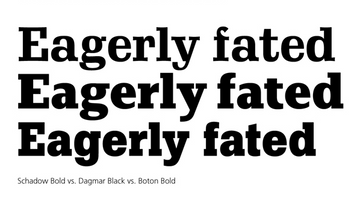
Dagmar can best be described as a humanist slab serif. Although she cites Unger as an influence, I see traces of the work of his compatriot Peter Matthias Noordzij, designer of PMN Caecilia. The humanist quality of Dagmar is obvious in the form of the key letters a and g, both of which are two-story in form but it is also present in the openness of the round letters a, c and e (but less so for s) and in the slight stroke contrast found throughout the font. The long shadow of Adrian Frutiger surely lies behind the open round letters. The subtle stroke contrast separates Dagmar from PMN Caecilia, Serifa, Boton, Calvert and most modern slab serifs. Instead, it links the font to contemporary text faces such as Scala and Whitman as well as the older Candida (Jakob Erbar, 1936) and Schadow (Georg Trump, 1938). Dagmar is quieter than these types, but not as retiring as PMN Caecilia. It has a contented appearance, even in the black weight.

Dagmar Black

So far Johnson has only completed the medium and black weights and an italic that matches the former. The italic shows growing pains. Johnson has tried to create a “true” italic, complete with cursive a, f, and g as well as exit strokes for many letters. It is not working yet. The a feels too plump, the f looks like a fish out of water, the g is struggling to fit in and the diagonal letters (k, v, w, x, y, and z) seem to be at odds with the arched letters (h, m, n). Dagmar might be better served with a more oblique companion rather than a true italic.

However, it is not the italic that makes Dagmar worthy of attention but the roman, especially the black weight. Dagmar Black manages to be severe yet friendly, powerful yet readable. The key to this balancing act is the careful application of curves that soften its demeanor without making it flabby. One instance is the use of bracketed serifs in C, G, S, c and s (and related numerals) but nowhere else. Introducing similar curves into the legs of K, R, and k might provide a good bridge between these round letters and the rest of the font. As it is they feel too stiff. Other than the absence at the moment of parentheses, brackets and braces (still to be designed), this tiny criticism is all that I can level at Dagmar Black.

Dagmar comparison


Although it was the first weight designed, Dagmar Medium is not quite as successful as its heftier sibling. The stiffness of K, R, and k is more evident, the bracketed terminals of C et al are more obtrusive, and the round capitals feel a trifle too narrow. Nevertheless, it is a very good first effort. Johnson’s goal of creating a typeface “fit for information, lists, and editorial purposes” has nearly been achieved. She says she plans to fine-tune the design and release it commercially once all of the bugs have been worked out.

Mark McCormick, creative director at Crunch Fitness, began his career as an illustrator. Drawing letters “just for fun” in his spare time led him to enroll in the CooperType program. At the time McCormick was not yet obsessed with type. That has changed. “I probably couldn’t have picked Centaur out in a lineup,” he says, but now he has developed an appreciation for the classic text faces. This new-found appreciation is behind his typeface Alfonso.

Alfonso Regular

McCormick’s intent was “to make a face that is technically sound enough to be read at small sizes (for the learned typophile), while retaining the illustrative quality that will keep it interesting when it’s huge (for the ignorant illustrator).” He wanted something sturdy but graceful or, as he phrased it, “a solid drumbeat with a couple guitar solos.” The one thing he did not want Alfonso to be was trendy. “I like the thought of a schooled viewer having no idea when it was created,” he remarks. I think that McCormick has largely achieved these goals.

Alfonso looks like a typeface from the beginning of the 20th century (or possibly from the 1970s when Edwardian designs were once again in fashion). There are hints of Windsor, Stanhope, Genzsch Antiqua and Plantin in the slightly splayed M, of Minister and Stanhope in the overlapping strokes at the apex of A), of ITC Isbell in the open counters of B and R, and of Genzsch Antiqua, DeVinne, Romana and Laureate (1901) in its sturdy bracketed serifs and general weight. But as familiar as Alfonso feels, in totality it looks like none of these other faces. It is absolutely original.

Alfonso comparisons

Alfonso is, at heart, at 19th century oldstyle face. Its lowercase has the structure of an oldstyle and its serifs are bracketed with beaks at the heads of lowercase stems. But its capitals have fairly uniform widths and the curved strokes on many letters end in ball terminals, features more commonly associated with “modern” style faces. The bracketed serifs are so sturdy they nearly resemble bell-bottoms. This, coupled with a low stroke contrast and tall x-height, gives Alfonso, even in its regular weight, an untrendy dark appearance. This is offset somewhat by its large counters. Those of B, P and R are open and those of X, h, m, and n are enhanced by single-sided foot serifs on some strokes. The M is splayed to the same effect. These letters are what distinguishes Alfonso visually. Two other notable letters are A with its overlapping apex and K with a gap between its stem, arm and leg. (Oddly enough, k does not follow K’s lead in this respect.)

The capitals are the most polished aspect of Alfonso. Only the A and J feel out of sync. The angled apex of A disrupts the tranquility of the cap line and the descending J too long, especially compared to the Q. The J is alone among the capitals in having a ball terminal, but it is widely echoed in the lowercase. The single-serif legs of h, m and n take away from the sturdy, tree-trunk aspect of the font established by the capitals. Although they were presumably created to open the counters, it is not clear―look at the m―that they are needed.

In Alfonso Black, the only other weight completed at the moment, the counters of B, P and R are closed as is the gap in K between its stem, leg and arm. The ball terminal on the J feels more at home at this weight. And the single-serif legs on h, m and n are clearly necessary―a similar feature has been applied to the x (following X) at this weight. This makes the black more homogenous overall.

Alfonso Italic reminds me of the ITC faces of the 1970s in its slickness. This is not a criticism. The letters have the well-crafted, almost voluptuous curves that defined many of ITC Bookman, ITC Cheltenham et al. The one letter that feels a bit pinchy in this respect is the g―but this is a notoriously difficult letter to design in the two-story form. The rest of the lowercase has a pleasing rolling rhythm.

Alfonso Italic

Although I have focused attention on Marais, Dagmar and Alfonso, these are not necessarily the “best” faces produced by the Type@Cooper students. These are simply the ones that appealed to me the most, the fonts that I liked viscerally. Several others match or possibly surpass these three in terms of craftsmanship and all of the fonts are certainly worthy efforts. The Type@Cooper program has proven itself as a serious alternative to the more established type design programs at the University of Reading and the Koninklijke Academie van Beeldende Kunsten (KABK) in The Hague. Kudos to Jesse Ragan, Sasha Tochilovsky, Cara Di Edwardo and the roster of guest teachers and lecturers.

Copyright F+W Media Inc. 2011.


Salon is proud to feature content from Imprint, the fastest-growing design community on the web. Brought to you by Print magazine, America’s oldest and most trusted design voice, Imprint features some of the biggest names in the industry covering visual culture from every angle. Imprint advances and expands the design conversation, providing fresh daily content to the community (and now to salon.com!), sparking conversation, competition, criticism, and passion among its members.

Continue Reading Close

The tricky art of letter-spacing

A cool new game grades your character placement prowess. How good are its assessments?

  • more
    • All Share Services

The tricky art of letter-spacing

ImprintThe art of spacing is one of the most difficult aspects of working with letters. But anyone who works with letters extensively knows that good spacing is often more important than good letters. In “Lettering as a Work of Art,” the essay that prefaces “Treasury of Alphabets and Lettering” (1966 but originally Meisterbuch der Schrift, 1952), Jan Tschichold says, “Good lettering demands three things: — (1) Good letters. A beautiful letter form must be selected which is appropriate to the purpose it is to serve and to the lettering technique to be used. — (2) Good design in all details. This calls for well balanced and sensitive letter spacing and word spacing which takes the letter spacing into account. — (3) A good layout. An harmonious and logical arrangement of lines is essential. None of these three demands can be neglected. Good lettering requires as much skill as good painting or good sculpture.” He goes on to demonstrate “good and bad letters” and how to properly space capitals and lowercase letters. “Letter spacing should not be mechanically equal but must achieve equal optical space. The letters must be separated by even and adequate white areas,” he writes. Easier said than done. Some of the samples of “unsatisfactory” spacing that he shows fit this criteria but do not balance the space between letters with the space inside letters. And it is that balance of the inner and outer that makes for ideal letter-spacing.

Life in Shakespeare’s England (Pelican Books, 1944). Book cover by Jan Tschichold. Set in Gill Sans.

Science News 14 (Penguin Books, 1945). Set in Perpetua. These two covers by Tschichold exemplify his view that capitals should be spaced with “even and adequate white areas” between letters that match the space inside them.

But, as Tschichold shows, the letters of the Roman alphabet pose problems for anyone hoping to achieve such perfection. They are not only variable structurally but they differ greatly from style to style, from typeface to typeface. Thus, there are letter combinations that are inherently awkward if not fiendishly difficult to space properly. Especially in metal type where letters are constrained by their bodies. But this age-old limitation disappeared years ago with the advent of phototype and its successor digital type. Today, the only restriction on good spacing in type is the design of the letter itself.

Whereas hand-letterers can alter and manipulate individual letters to improve the spacing of a word or line, designers working with type have to make do with forms they are given — unless they want to become like Herb Lubalin and his colleagues, subtly cutting off parts of letters, redrawing them, butting letters together and doing whatever it took to achieve good spacing, even in an era that stressed “tight but not touching” spacing.

Bücher aus dem Insel-Verlag. Poster by Jan Tschichold for Insel-Verlag (1926). Hand-lettered.

Catalogue cover for Uhertype (a phototypesetting company) by Jan Tschichold (1933). Set in Tschichold’s sans serif that mimicked Gill Sans. These two early designs by Tschichold show a different attitude toward the letterspacing of capitals. One reason is that these are advertising items, not books.

However, what Lubalin would have considered good spacing would not have passed muster with Tschichold since his work focused on the space between letters not a balance between that and counters. The difference between Tschichold and Lubalin is that the former’s view of good letter-spacing was influenced by calligraphy and book typography and the latter’s was determined by the demands of advertising design. For text typography the balance between inner and outer space is essential to achieving an even color to a page of text which, in turn, makes the experience of reading smoother. Although Tschichold addressed lettering for display in “Treasury of Alphabets and Lettering,” his notion of display was colored by classical inscriptions on monuments and architecture. Lubalin accepted holes created by counters in his work because he was more interested in the massing of text to provide a visual punch that would attract viewers and turn them into readers. The holes created patterns that enlivened the headlines or short blocks of text found in advertising and graphic design. Lubalin’s design philosophy did not translate well to books and other lengthy texts, but it worked well for advertisements, posters, book jackets and packaging.

Avant Garde 13. Magazine cover design by Herb Lubalin (1971). Set in ITC Avant-Garde Gothic, which was an outgrowth of the magazine’s logo. This is the epitome of “tight not touching” typography. It is made possible by the use of alternate characters and ligatures as well as some alterations to letters. (See the L in PORTFOLIO and the H in PHOTOGRAPHS.)

All of this discussion about differing philosophies of letter-spacing is a prelude to an analysis of a KernType: A game to practice your kerning that Mark MacKay, an interaction designer, has created for Method of Action, a company that says it is devoted to “peer-to-peer education for people who want to get things done.” KernType is apparently part of their online course Design for Programmers. I learned about KernType a few days when a fellow typography teacher at Parsons School of Design sent me the link. As a lettering artist I figured that the test would be a relative snap, but I discovered otherwise once I tried it out.

The first time I tried KernType I didn’t realize what the “rules” were until I had failed at several of the test words. But even after that my scores were often pathetic. I think I only got four of the ten test words right. However, when I looked at the solutions that MacKay proposed I didn’t feel so bad. I disagreed, sometimes violently, with them. My failed scores began to look like a badge of honor. To see if that really was the case I played the game a second time, paying more attention and trying to achieve perfect scores for each test word. But I failed. This time I only got three right. So I decided to write this blog post to explain the reasoning both behind my kerning decisions and behind my criticism of those made by MacKay. (I also clicked on the button that allows one to share one’s solutions with the world. I will probably regret this since, upon further reflection, some of my solutions are not the best even if I believe them to be better than the those of KernType.)

kern me
This is the opening test phrase intended to introduce the player to how the game is to be played. The player simply drags one or more letters left or right until it looks right. (Or the adjustment can be done by clicking on left and right arrow keys.) What is not explained is that the left and right letters in each word or phrase are fixed in place. The player discovers this once an attempt is made to move either of these letters and a barred circle pops up onscreen. These fixed letters, as will be seen below, are a big problem with KernType.

I moved the e in kern me to keep it from smashing into the r as it appears when one begins the game. Although the game said my solution was fine, it did not match its solution. The player’s solution appears in blue and underneath it can be seen the game’s solution in white. My e was closer to the k than the game’s solution.

If the goal of good letter-spacing is equal space (area not distance) between letters then I believe my solution is better. This notion of what constitutes good kerning is crucial to assessing the quality of the solutions proposed by MacKay and, above all, the value of KernType as a learning tool. This is the extent of KernType’s instructions: “Your mission is simple: achieve pleasant and readable text by distributing the space between letters. Typographers call this activity kerning. Your solution will be compared to typographer’s solution, and you will be given a score depending on how close you nailed it. Good luck!” The game does not provide any criteria for how to recognize good kerning nor does it explain how it arrives at its scores. The only way to compare oneself to it is to look at both solutions simultaneously and see where the white and the blue letters diverge.

1. WAVE
Set in Gotham Black, this is the first test word. (KernType identifies the typeface used, its designer and its date of release. Some of the material is at best problematic and some flat-out wrong.) My score was a below-average 48. The task here is to balance three normally difficult letters (A V and W with diagonal strokes) with a simple one (E). Letters with diagonal strokes are a recurring theme in KernType. Such letters are difficult to space because they are close to their neighbors at the top and very far away at the bottom or vice versa. When opposing diagonals are next to each other it is the worst possible scenario, but when parallel diagonals are neighbors they are easy to space in digital type (though not in metal type). So, WAVE is not as hard as it would seem at first glance. WAV can be spaced well with little trouble but then it has to work with VE.

My solution may be too tight for VE but I contend the game’s solution is too loose―and worse. The standard method of checking even spacing of a word is to isolate three letters at a time and see if the middle one fits comfortably without leaning one way or the other. Where diagonal letters are concerned, though, balancing letters in this manner may not lead to optimum results. In fact, Tschichold’s examples of bad spacing of capitals includes PLANE where he feels LA “feel glued together” because the left leg of A is so close to the L. My kerning probably suffers from the same problem, this time the right stroke of V is visually too close to E since we read across the tops of letters and don’t notice the gap below as much.

There are several ways to isolate triplets to check their spacing. One is to simply squint and focus one’s eyes on three letters at a time. Another is to mask off the surrounding letters with one’s hands or pieces of paper. A more complicated but better approach is to cut out a window in a piece of cardboard or bristol board and place it over the text, moving it as needed to check different triplet sets.

My third solution with a score of 77.

Kern Type’s solution. The space between VE is too large and the A seems to favor the W more than the V.

2. Type
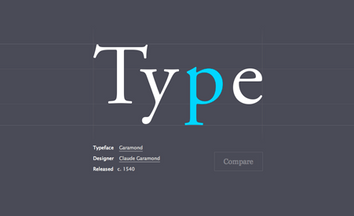
This is set in Garamond, but which Garamond is not specified. It looks like Adobe Garamond to me. KernType says the type was designed by Claude Garamond and released c.1540. This is misleading. The typeface we are kerning is a digital design and was not created by Garamond a half century ago. Adobe Garamond was designed by Robert Slimbach and released by Adobe in 1989. Slimbach based his design on the types of Garamond as seen in printed books and in some surviving matrices at the Plantin-Moretus Museum in Antwerp. But he made subtle changes to adapt Garamond’s type to both digital technology and contemporary design expectations.

I scored a mediocre 59 on this word. The challenge lies in Ty. Not only is there another diagonal stroke letter but T is historically a kerning nightmare due to the space under its arms. In metal type-founders and typographers became used to larger-than-desired spaces between T and following letters, especially h in English words. The only solution for the type-founder was to cast an alternate kerned letter, one which overhangs its body and rests on that of an adjacent letter. For the typographer there was always the option of sawing the offending letters to create a better fit―but that ruined them for other situations. Today, with digital type, there is no longer any reason to accept this situation. Adobe has recognized this and has been including Th ligatures in their Pro fonts.

The kerning solution proposed by MacKay, unlike mine, does not take full advantage of the ability in digital type to maneuver the y under the right arm of the T. His word has too much space between T y and y p (or, it could be argued, they are fine and there is not enough space between p e). But even if my version is better spaced the word looks terrible. This is because the fixed positions of the T and e are too far apart, insuring that the word will be loosely spaced. In this instance―and several others in KernType―the inability to move the rightmost letter means that players are essentially justifying single words and that is not good typography.

My solution. I find it too loose despite the evenness of spacing. This is because the T and e are immovable. I scored 73 on my third attempt as I left more space under the T than before.

Kern Type’s solution. The te combination is too close.

3. holly
This word, set in FF Zine Slab Black Italic (Ole Schäfer, 2001), is the first for which I scored a perfect 100, though my solution did not exactly match that of MacKay. In my version oll are slightly further to the right. I did that to close up the ly space. This space is not as devilish as in most fonts because it is visually “closed up” by the short tail of y that curls to the left just below the baseline.

Heavy letters need to be spaced more tightly than lighter ones. This is because they have smaller counters. As Erik Spiekermann says in “Rhyme and Reason,” “Narrow typefaces need less air (or rather, paper) between words than wide ones, bold typefaces less than light. And this―we’ve already seen it in relation to character fit and letter-spacing―is due to the spaces inside letters.” His maxim is, “The bolder the typeface, the closer the letter-spacing and line spacing.”

My kern of holly. On this third try I only scored 68.

Kern Type’s solution. Note the excess space between ll and ly.

4. Await
Rotis Semi Serif Bold, the hybrid typeface used here, is problematic because its occasional serifs (as in w and i) increase the number of uneven spaces to solve. (I think the font is actually the regular weight of Rotis Semi Serif.) Thus, Aw and ai which would normally be fairly easy to space are now more complicated. I scored 77. MacKay’s solution has wa farther to the right than I do. The result is a tight Aw―partially due to that errant serif―and possibly a loose wa.

My third solution with a score of 92.

Kern Type’s solution. The w is too close to the A.

5. YVESS [cap and small caps]
I am not sure if this is a word or a possessive proper name missing an apostrophe. It is set in Sabon. The release date is incorrectly listed as 1966. Sabon was issued as foundry type by Stempel in 1964 and as both Linotype and Monotype in 1967. This is the only word in the test that is set in caps and small caps. But that makes the problem diagonal letters harder to solve than if it was upper- and lowercase. On the other hand, the loose spacing that is inevitable is appropriate.

I totally bombed out on this one with a score of 2 followed by a score of 17 on another attempt. The trick with this word is to make the YV blend with the ESS. My solutions had the V further under the Y than the one from MacKay. I think the YV was too tight in my first attempt but only because we read across the tops of letters since the space was still overly large. My second attempt increased that space but reduced the sense that, to use Tschichold’s phrase, YV look glued together. KernType’s solution, though, is even more open. Ideally, the second S would not be fixed, allowing the entire word to be stretched out a bit more. That would help the two halves mesh together better.

My third attempt with a score of 37.

Kern Type’s solution with uneven spacing at the left.

6. Roissy
The word is set in Frutiger 55. Frutiger was derived from Roissy, a typeface that Adrian Frutiger designed for signage at Roissy Airport outside of Paris. Roissy was designed in 1974. Frutiger, intended for use in print, was released in 1976. KernType has a release date of 1975, the year the airport opened. Although the date is wrong the choice of Roissy as a test word is a nice nod to Frutiger’s heritage.

The only problem letter is the ubiquitous y. Often R with a diagonal leg is troublesome, but Frutiger has a short one that minimizes any spacing issues, especially with o following it. Despite this I scored a weak 57 on this word. However, MacKay’s solution is inadequate: there is a little too much space between Ro and betweem ss, and way too much between sy.

My third attempt with a score of 50. There may be a hair too much space between ss.

Kern Type’s solution has too much space between sy.

7. Quijote
This is set in Baskerville Italic but which Baskerville is not specified. I have not been able to identify the cut. The link provided leads to Bitstream Baskerville Italic but that face does not look like the one used by KernType. (Look at the Q and e: the former is narrower and has a different juncture for its tail; the latter has a smaller eye.) The release year of 1757 is, as with Garamond, misleading when talking about a digital typeface. This is the only word set in italic in the KernType test. The key to good kerning with such a typeface is to watch the pothooks. If the typeface is too tightly spaced the pothooks will get tangled up. Spacing italic too loosely, on the other hand, negates its cursive quality.

I scored a resounding 100 on this one. But my solution did not match that of KernType’s exactly. We especially differed over the positioning of the t. I think that the game’s kerning leaves too much space between te and too little between ot. This is where looking at triplets (ote) is helpful.

My solution was scored a 100 but does not match that of Kern Type.

Kern Type’s solution has a poor ote triplet.

8. gargantuan
Set in FF Meta Black, this is the first word to have a repetitive letter pair: ga. Actually, from a spacing perspective, gar and gan, count as a repeated triplet. This should make kerning easier, yet this is where I scored an abysmal 0! And lost respect for KernType.

MacKay’s solution is just plain awful. It has huge holes for ga and rg, and overly tight spacing for ar, ant, and uan. It looks like a bad dental job. The problem lies in the ga combination―and that friendly ear on the g. MacKay seems afraid to get let the two letters get too close to each other, yet, given the fixed measure of the word, they have to almost touch if not actually do so. I tried not to crash the two letters together as Lubalin and his cohorts probably would have. (Or, more likely, they would have partially amputated that ear.) Thus my final kerning―even on a second attempt―is not ideal.

The ga space in my solutions is too large, but sometimes smashing letters together is worse. Letters that overlap one another may distract the reader by being read as a unit or clump. And this can be as bad as uneven spacing. In the end the whole point of even spacing is not to please designers but to make reading smoother. So, pick your poison: clumps or holes.

My third solution scored a zero like the others. A badge of honor.

Kern Type’s solution. A disaster.

9. Toronto
KernType says the city is set in Didot but doesn’t say which version. Clicking on the name provides a link to MyFonts and reveals that it is Adrian Frutiger’s Linotype Didot. Its release date was 1991 not 1784 as indicated here. KernType”s date is presumably based on the date that Firmin Didot―who is listed as the typeface’s designer―created the first “modern style” face in the opinion of type historians. But that is not the typeface that Frutiger used as a model for his digital Didot. He used a later design that had a stronger thick/thin contrast and finer hairlines.

T, the old metal type bugaboo, appears here but it is easily solved since the following letter is o. The other tough letter is r. However, there is a repetitive “pair”: or and on. Whoa! Another score of 100!. But my solution, once again, is not exactly that of KernType. My first o is further to the left under the arm of T; second o closer to r; and third o closer to t. MacKay’s ro spacing is more open, but this is a debatable point. Which is more important: reducing the space under T and r or keeping To and ro from visually merging? Even if one accepts KernType on these points, its to looks too open―or maybe, its or, on and nt are too tight. There are always two perspectives on what is wrong with a trio of letters that are not evenly kerned.

10. Xylophone
This word―a mainstay of children’s alphabets―is allegedly set in Syntax. But clicking on its name indicates that it is actually Linotype Syntax, Hans Eduard Meier’s 2000 redesign of his 1968 metal face. The release date in KernType does have the proper date but the name of the typeface should match.

With this word we return to the annoying diagonal stroke letters. They are countered by several similar letter combinations in which round strokes meet vertical ones: lo nearly equals ho and ne, while op does equal on and ph. Given these advantages my score was an embarrassing 53. But I think it was better than KernType’s solution. It was not perfect―a little nudging was still needed to make the round/straight combinations look identical. I tried again, this time working from right to left instead of left to right, and hit the jackpot: a perfect score of 100. But my second solution still does not match that of KernType. In my opinion, KernType has too much space between Xy and yl―and ne seems a tad looser than its round/straight counterparts.

KernType is a wonderful idea for teaching typography students and others about good letter-spacing, but in practice it needs much work. It is not just that some of its solutions are faulty or are open to debate. There are no explanations for its solutions, no discussion about the problems that each word and its letter combinations pose, and no overall notion of what constitutes good spacing. Adding these would make KernType a useful product instead of just a bar game for type geeks.

My solution scored 100 but, again, I believe it is better than that of Kern Type.

Kern Type’s solution is weak for the triplet Xyl.

KernType is a wonderful idea for teaching typography students and others about good letterspacing, but in practice it needs much work. It is not just that some of its solutions are faulty or are open to debate. There are no explanations for its solutions, no discussion about the problems that each word and its letter combinations pose, and no overall notion of what constitutes good spacing. Adding these would make KernType a useful product instead of just a bar game for type geeks.

Copyright F+W Media Inc. 2011.


Salon is proud to feature content from Imprint, the fastest-growing design community on the web. Brought to you by Print magazine, America’s oldest and most trusted design voice, Imprint features some of the biggest names in the industry covering visual culture from every angle. Imprint advances and expands the design conversation, providing fresh daily content to the community (and now to salon.com!), sparking conversation, competition, criticism, and passion among its members.

Continue Reading Close

A problematic new typography book

This history of letter design looks appealing, but it's full of factual errors and snotty put-downs

  • more
    • All Share Services

A problematic new typography book

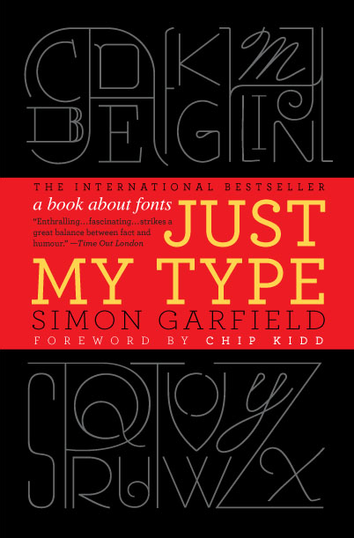
This is the second time I have tried to write a review of “Just My Type.” It is a frustrating book — warm and friendly on the surface but obnoxious underneath. The first time, I methodically tore it to pieces in my blue-pencil style, pointing out its deficiencies in niggling detail. When I was done, I felt satisfied but also uncomfortable. Did Simon Garfield really deserve such a bashing? After all, the book is full of fascinating stories and odd trivia about type, and the author has a charming, breezy style that makes each bit of typographic arcana easy to swallow. Is it really that bad?

Yes, it is. But articulating what it is exactly that enrages me about “JMT” is difficult. This is a book that the uninitiated will find enthralling and entertaining. But those who actually know something about type design and typography — two related subjects that Garfield frequently mixes up — will find it maddening. The factual mistakes are grounds for complaint, but on their own they are not enough to get upset about. Instead, it’s Garfield’s style that is the problem.

Garfield flits about from one topic to the next like a nervous hummingbird, without settling long enough to give any a proper telling. Instead, he regales us with witticisms (“And then there are tattoos: nothing says Menace quite like a word written in Old English”), snotty put-downs (“And calligraphy is virtually gone, a craft Prince Charles is said to be keen on, hanging on grimly behind glass on the qualification certificates of quantity surveyors and chiropractors”), and imperious (if dubious) pronouncements (“Cooper Black looks best from afar”). Even when these are utter nonsense, they are still enjoyable — so much so that they blind us to the fact that the stories frequently come up short.

Some are simply inaccurate. Garfield analyzes the use of Cooper Black on the cover of “Pet Sounds,” the 1966 Beach Boys album, to explain one difference between legibility and readability: the impact of size. His point is correct, but his example is not. Although the title of “Pet Sounds” is set in Cooper Black, the song titles — his example of how Cooper Black is “unreadable” at small sizes — are not. They are set in Clarendon. Elsewhere there is an account of the type designer Cyrus Highsmith’s attempt to get through an entire day in New York City without seeing Helvetica. It’s one of the best stories in “JMT.” Unfortunately, it’s not true. Highsmith has never lived in New York City, and his day without Helvetica was strictly a thought experiment. “I think if someone did it totally for real,” he told me, “it would end up with them naked, being chased by the police.”


Other anecdotes omit a crucial detail. The battle between Transport and MOT Serif for the right to be the official typeface of Britain’s motorways is framed as a referendum on legibility, yet Garfield does not make it clear which of several factors was decisive in the outcome: serif vs. sans serif, all capitals vs. upper- and lowercase, different theories of letterspacing, or the presence of symbols and pictograms. Although he calls them “beautifully wrought,” he never tells us the details of David Kindersley’s theories on the optical spacing of letters. Garfield says of MOT Serif “that it didn’t look as if it would withstand the increasingly scientific rigors of the road research labs.” Yet it won the duel — and lost the war. MOT Serif was determined to be more legible, but Transport was chosen over it on aesthetic grounds. Rather than parse the ramifications of this decision, Garfield rushes off to discuss subsequent type designs by Margaret Calvert, one of the creators of Transport. He never bothers to describe MOT Serif and how much it deviated from the traditional letters that Kindersley carved on gravestones.

(In detailing Garfield’s missteps in his account of the competition, I almost made a similar mistake of missing the bigger picture: that the competition wasn’t between two typefaces but between two signage systems. It was MOT Serif set in all caps and letterspaced according to Kindersley’s optical theories versus Kinneir and Calvert’s Transport set in upper- and lowercase letters, letterspaced their way and laid out with differing arrows and pictograms. What probably won the competition for Transport was not its aesthetic superiority — even though I agree that MOT Serif is damn ugly — but the overall design that Kinneir and Calvert presented. This story was more about typography than about type design.)


In

In “Road Akzidenz,” the chapter about the competition between MOT Serif (above) and Transport (below), Garfield misleadingly calls Transport a “lower-case sans serif” in the caption. The role the differing layouts played in the testing is not noted. (Photograph from the Cardozo Kindersley Workshop.)

Still other set pieces seem to miss the point entirely. Take, for instance, the chapter entitled “Pirates and Clones,” which is devoted to a subject that has long stirred passions among type designers. But Garfield leaves out important information from several of his vignettes. For instance, in profiling Hermann Zapf, one of the most vocal critics of pirated typefaces, he never mentions the two designs (Palatino and Optima) at the heart of Zapf’s complaints. In a different vein, he tells us how Segoe UI “caused widespread disquiet in design circles” because of its “close relationship to Frutiger” but does not say what, if anything, happened as a result of this outrage. He shows us a (small) sample of Segoe UI, but without a comparable one of Frutiger, so we cannot easily form our own conclusions as to the relationship between the two fonts.

Nor does Garfield provide a framework for us to make such a judgment. He never gives a definition for a pirated or a cloned typeface. And he does not adequately describe the legal status of typefaces and how they fit into the worlds of copyright and moral rights. “The alphabet as a free-for-all is an appealing concept, not least for lawmakers who fear the restriction of free speech,” he says, before concluding the sentence with “(and the complex possibilities of distinguishing one lower-case ‘g’ from another).” Here in a nutshell is the problem with Garfield’s writing. The first part of the sentence makes an important point, but one which needs some explanation. Instead of giving us that explanation, we get a witty parenthetical comment about how hard it is to tell letters apart. This is a legitimate concern, but it was not the primary one behind the opposition in the United States Congress to granting copyright status to typefaces. The arguments both for and against are missing from Garfield’s chapter.

Third, Garfield fails to provide an adequate summary of the history of type piracy (which can be traced back to the 1470s), the various ways in which technological advances over the centuries have made such piracy easier and easier, and the attempts, often doomed, to protect typefaces from copying. Instead we get a flawed mention of electrotyping, scattered references to type foundries and type designers in the past who have been upset by others copying their typefaces, and snippets of two speeches Zapf gave in the 1970s on type piracy.

In the end, the point of the chapter — that typefaces deserve protection — is lost amidst a welter of individual stories told in a confusing and haphazard sequence. (I still don’t understand the point of Matthew Carter’s Elvin Jones/Buddy Rich story vis-à-vis pirated typefaces.) It is a point worth making. Those outside the insular world of type design — and that includes many in the design professions as well as everyday users of fonts — need to understand why typefaces should be protected and why, with a few exceptions, they have not been. Using stories of individual typefaces to tell this bigger story is fine, but these case studies need to be presented clearly, properly and in the right sequence. A discussion of Segoe UI needs to explain how it differs from Myriad and TheSans, two other fonts that have been accused of being copies of Frutiger. And the discussion should be linked, more directly than Garfield has done, to the debate over Arial. And all of this needs a broader context that takes into account the formation of the Association Typographique Internationale (ATypI), the failed push for an international copyright law applied to typefaces, the United States Copyright Act of 1976, the debate over whether software is copyrightable, and the 1998 court case involving Adobe, Emigre and Southern Software. This may seem like a long, complex story, but in the right hands, it can be told clearly and succinctly. Certainly it can be told in the same amount of space that Garfield devotes to horror stories of abused typefaces and outraged designers. Garfield opted to entertain his readers. I wish he had chosen to inform them instead.

Garfield not only often misses the significance of his stories; he also fails to coherently gather the larger themes, including the relative popularity of particular typefaces, the appropriate uses of typefaces, legibility versus readability, the creative rights of type designers, typefaces and national identity, the role of type in society, and the tension between tradition and experimentation in type design and typography. For instance, the popularity/unpopularity issue shows up variously in “We Don’t Serve Your Type,” “Can a Font Make Me Popular?,” “Futura vs Verdana,” “What Is It About the Swiss?,” “Gotham Is Go,” and “The Worst Fonts in the World.” Legibility versus readability is present not only in the chapter of that name but in “Baskerville Is Dead (Long Live Baskerville),” “Road Akzidenz,” “Tunnel Visions,” “Frutiger,” “Can a Font Be German, or Jewish?,” and “Breaking the Rules.”

Garfield could have been more accurate in his facts, more cognizant of what really matters in a story, and more aware of the overarching themes that tie his stories together and still have produced a fun read. It would have been work, and he might have had to tone down his flamboyant writing, but it could have been done. “Just My Type” should have been a wonderful book. Instead it is a maddening disappointment.

Copyright F+W Media Inc. 2011.

Salon is proud to feature content from Imprint, the fastest-growing design community on the web. Brought to you by Print magazine, America’s oldest and most trusted design voice, Imprint features some of the biggest names in the industry covering visual culture from every angle. Imprint advances and expands the design conversation, providing fresh daily content to the community (and now to salon.com!), sparking conversation, competition, criticism, and passion among its members.

Continue Reading Close

Lessons from a Milan type master

A renowned letterpress printer talks about his influences and inspirations as we explore his studio

  • more
    • All Share Services

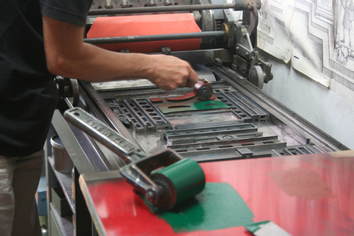
Lessons from a Milan type masterLucio Passerini hand-inking Art Nouveau wood type

I spent the first weekend of July as the houseguest of Lucio Passerini, Milanese woodcut artist and letterpress printer. On the morning of July 2 we took a leisurely walk a mile or so to his studio, Il Buon Tempo on Via Longhi. The weather was sunny but cool, unusual for Milano in the summer, making the walk very pleasant. Lucio’s studio is hidden at the back of an apartment building courtyard. The atmosphere is very quiet, an island of peace in the midst of a busy city.


 Lucio Passerini in his studio.

Lucio Passerini in his studio. All photographs by Paul Shaw.


Lucio Passerini and Alta Price at the Albion handpress

Lucio Passerini and Alta Price at the Albion handpress


Type, tools, and materials in Lucio Passerini's studio

Type, tools, and materials in Lucio Passerini’s studio


A copy of The Triumphal Arch by Albrecht Dürer next to the Vandercook printing press.

A copy of The Triumphal Arch by Albrecht Dürer next to the Vandercook printing press.

The studio is composed of two high-ceilinged rooms. The front room, where the printing presses are, has a skylight at the top, helping to flood it with welcome light. Lucio has two presses, an Albion handpress (or torchio in Italian) and an American Vandercook proofing press, the workhorse of modern letterpress printing. The second room has his store of type, which includes a newly acquired bank of Art Nouveau wood type from a former Catholic printing school for orphans. The walls of both rooms are festooned with examples of Lucio’s work as a woodcut artist. But on the wall next to the Vandercook he has pasted a reproduction of Albrecht Dürer’s enormous “Triumphal Arch” of 1515, a tour de force composed of 192 separate blocks — an homage to one of the greatest woodcut artists ever.

Lucio, the author of “Xilografia, i materiali, le tecniche, la storia della stampa a rilievo” (1991), stumbled into printing books by accident. In printing images cut into wood and linoleum he found that he sometimes would fold the paper in half, and then even in half again. And that meant that he had, unwittingly, created pages for a book. His first book was made in December 1982 as a small Christmas gift for his friends. It was “Poesia per una mosca” [Poetry for a Fly] by Leonardo Sinisgalli.

Lucio’s books since are like that first one, booklets: “libretti” rather than “libri.” They are small in size and page count, existing principally as vehicles for poetry and imagery. Sometimes the illustrations are his, but often they are the works of other artists, including on occasion calligraphers such as Anna Ronchi. The books of Il Buon Tempo exist outside the world of commercial publishing. Of them, Lucio says, “Questi libri non son strumenti per la divulgazione di un contenuto testuale o figurativo ma, piuttosto, l’espressione di una visione personale — dell’arte, della poesia, della tipografia — da condividere in una cerchia ridotta di ‘complici’.” [These books are not instruments for the dispersion of textual or figurative content, but, rather, are for the expression of a personal vision -- of art, of poetry, of typography -- to share with a small circle of accomplices.] Lucio focuses on doing all of the production work by hand, using quality materials, and collaborating with likeminded people, whether they are poets, artists, calligraphers or even other letterpress printers.

“L’atto di stampare e pubblicare un testo o una immagine conserva una ritualità ,” Lucio writes, “un po’ solenne che proietta sull’oggetto libro un’aura speciale. Avere la possibilità di controllare tutte le parti di questo processo, sia ideative sia pratiche, offre il privilegio di giocare con la forma del libro.” [The act of printing and publishing a text or image preserves rituality, a little solemnity that projects onto the object a special aura. To have the possibility of controlling all of the parts of this process, whether creative or practical, offers the privilege of playing with the form of the book.] Among the poets that he has published are Ezra Pound, Emily Dickinson, William Carlos Williams, Marina Tsvetaeva and Torquato Tasso. But the books of his that most speak to me are those with his own abstract illustrations and typographic designs such as “Atlante Piccolo” (1996), “Typo” (2007) and “Talete” (2010). These, and other works, can be found in the catalogue published last year in conjuncton with a retrospective exhibition of Il Buon Tempo at the Biblioteca Vallcelliana in Rome. It is titled “Il Buon Tempo: Le edizioni del torchio privato di Lucio Passerini, qui per la prima volta raccolte in volume e illustrate.”

Lucio has honed his typographic skills from working with Alessandro Zanella of Ampersand Press and others. His 2006 meeting with Silvio Antiga and Sandro Berra of the Tipoteca Italiana Fondazione led to his acquisition of an Albion handpress, one made c.1870 by Norberto Arbizzoni in Monza, and to a new passion for wood type. The Art Nouveau wood type he purchased from the orphanage school was first used, with illustrations by Fabrizio Parachini, in “Suono di nulla” by Kengiro Azuma (2010). The book only used the lowercase, though. During our morning visit Lucio and I became engrossed instead in the beauty of the capitals, figures and punctuation.


Lucio Passerini hand-inking Art Nouveau wood type

Lucio Passerini hand-inking Art Nouveau wood type

I pulled out a B — the first letter of my wife’s name — and asked Lucio if we could print up a sample as a gift for her. He readily agreed and that started us down a path of printing that culminated in something for this blog. Rather than start up the inking mechanism on the Vandercook, Lucio preferred to use hand rollers to ink the single letter. We proofed it and then combined it with a sinuous question mark, not with any meaning in mind but simply because the two forms balanced each other beautifully. Then, pawing through the capitals, we decided to print the A in honor of Alta Price, my colleague in the Legacy of Letters tours, who had just called to say she was on her way over to visit the studio. We paired the A with a lovely, open-ended 4 as a nod to her activities as an artist/papermaker. She was delighted by it when she arrived.


Lucio Passerini printing with the Vandercook

Lucio Passerini printing with the Vandercook”

As toothsome as the Art Nouveau wood type was, the highlight of the visit to Il Buon Tempo was another wood type, a thick commercial script. As soon as Lucio brought it out I was captivated. It is an angled body script, meaning that the body of the type (the blocks) are cut diagonally. This allows the script to have a proper slope without being shoehorned into a vertical rectangular shape like most types. However, it also requires the typographer/printer to have triangular pieces to use at the beginning and end of words or lines so that lock-up can be easily accomplished. This particular script had blunt entry and exit strokes in order to minimize breakage. But most exciting of all, it had several specially kerned letters, most of them not standard.


Print set in wood type and locked-up for printing

Print set in wood type and locked-up for printing


Printing controls on a Vandercook Universal proof press

Printing controls on a Vandercook Universal proof press

Since I have been working on a book about script typefaces for the past two years, this typeface immediately grabbed my attention. I have become especially fascinated by the various methods that foundries used to cast script types so that they would appear “natural” and here was a chance to see one such approach in action. I asked Lucio to print a word using a kern and he picked up a P combined with an r. With the magazine in the back of my mind, that quickly led me to suggest “Print” as the word. After we printed “Print,” Lucio set “Trip.” When I asked him why, he pointed to the side of the Vandercook where the two options were “Print” and “Trip”! I had thought of the two words as a description of my visit to Italy — a “print trip.” Once having printed “Print” we had to do “imprint” for the magazine’s blog. And thus I had a great excuse to write about Il Buon Tempo and Lucio Passerini.


ImPrint set in script wood type and printed at Il Buon Tempo

ImPrint set in script wood type and printed at Il Buon Tempo

Copyright F+W Media Inc. 2011.

Salon is proud to feature content from Imprint, the fastest-growing design community on the web. Brought to you by Print magazine, America’s oldest and most trusted design voice, Imprint features some of the biggest names in the industry covering visual culture from every angle. Imprint advances and expands the design conversation, providing fresh daily content to the community (and now to salon.com!), sparking conversation, competition, criticism, and passion among its members.

Continue Reading Close

New fonts from a legendary designer

We talk to a famed type director about what inspires his work and take a look at his latest typefaces

  • more
    • All Share Services

New fonts from a legendary designer


Akira Kobayash

This year marks the 10th anniversary of Akira Kobayashi’s tenure as type director at Linotype. Born in Tokyo in 1960, he studied graphic design at Musashino Art University. Kobayashi began his career in type design at Sha-Ken Co., Ltd., a manufacturer of phototypesetting machines just at the cusp of the digital age. In the late 1980s he left Sha-Ken to study English and calligraphy in England in further his knowledge of Latin letters. Upon his return to Japan, he worked for Jiyu-Kobo and then TypeBank. At the latter he put his newfound knowledge to good use, creating 17 Latin typefaces to accompany Japanese fonts. In 1997 Kobayashi became a freelance designer. His work was immediately recognized by the international type design community with awards for  ITC Woodland (1997), FF Clifford (1998), ITC Japanese Garden (1999) and Conrad (2000). Since joining Linotype in 2001, he has worked on the redesign of many of the company’s prime legacy typefaces by Adrian Frutiger, Hermann Zapf, Aldo Novarese, Georg Trump and others. Now he has returned to designing original faces with the release of Akko Pro and Akko Pro Rounded. Akko Pro and Akko Rounded Pro are available from Linotype and Fonts.com.

What follows is an interview with Akira Kobayashi and a review of Akko Pro and Akko Pro Rounded.

What induced you to enter the type industry?

When I was an elementary school student, I learned Japanese calligraphy. I actually won prizes in competitions. I also loved to paint watercolor pictures and posters for in-school campaigns. Drawing posters requires certain skills like layout and lettering techniques. I don’t think I knew the word “lettering” back then, but I loved to make posters because I felt I was doing something useful with my pictures. Posters for an elementary school pupil usually consisted of two elements: a graphic image like schoolchildren crossing a road and a speeding car, and a message like “Watch out for traffic!” One day, I realized that a poster with big, good-looking lettering was far more attractive and effective than others. That excitement led me to study more about letterforms. To start drawing a poster I would collect Kanji symbols required for the slogan, usually cut out from newspaper headlines. That is how I learned so-called “lettering.” Later I bought a guidebook on Latin alphabet lettering. One of my favorite Western types was Cooper Black. I was in an art circle in my high school and I still remember a poster for the group using Cooper Black in white on a bright red background.

Why did you take time off to study calligraphy and English? Whom did you study with?

Designing a single Japanese font back in the 1980s usually took a couple of years and several skilled designers. I was involved in several Japanese font projects. I gradually improved my skill at drawing lines with a pointed brush. Eventually I was able to draw a dozen very fine lines in one millimeter.

At Sha-Ken I occasionally designed Latin characters and Arabic numerals, and I felt that I needed to learn more about Latin alphabets. Then I realized that I had to have a better handle on the English language because the books available to me on the Latin alphabet were almost always written in English. I also knew that if I was not very familiar with the Western alphabet, I could not know if the characters I drew would be acceptable to a Western reader.

There were a couple of books on Western type design in the design department. Among them I found a small book titled “About Alphabets” by Hermann Zapf. It took me six months to finish reading it. Afterwards I had a strong urge to practice Western calligraphy. Zapf mentioned that he started with [Edward] Johnston’s “Writing and Illuminating and Lettering,” so I followed his footsteps. I ordered a paperback copy of the book through a bookshop overseas, and I started to teach myself calligraphy.

Later I left Sha-Ken and went to London, and enrolled in an evening calligraphy course at the London College of Printing (now London College of Communication). As I had never been to a foreign country before, everything was a completely new experience to me. I read books on typography and the history of type — to me it was a great surprise that an ordinary library had more than a dozen books on typography. I also met a number of designers and craftspeople there and learned a lot from them. Annie Moring taught me calligraphy at LCP, Sally Bower took me to one of the Letter Exchange meetings, and at the meeting I met David Holgate who later taught me to carve roman caps on stone.

How did you become the typographic director at Linotype, now part of Monotype Imaging?

I was lucky enough to win the grand prize in two international type design contests. The first was the U&lc Type Design Competition (1998); the second was Linotype’s Third International Digital Type Design Contest (2000). In December 2000 I received an email from Otmar Hoefer, marketing director at Linotype, inviting me to join the company. I must say that it took me a couple of months to make the decision, for I did not speak German at all, and my second son was born that summer. At the first job interview at Linotype in February 2001, Otmar told me that Linotype was planning a project with Hermann Zapf, which turned out to be Optima Nova, and they were looking for a type designer who could control the aesthetic quality of the production for them. As an admirer of Hermann Zapf, the offer was simply irresistible.

Why, for your first new design in nearly a decade, did you decide to design a sans serif typeface?

Our marketing research showed that we should develop a new sans with very open counters and a tall x-height, a sans with a “tech” look, such as the Eurostile Candy family I designed in 2008 and the DIN Next I did the following year. They were so successful that it was quite reasonable to design an original type in that direction.

The Eurostile Candy family is a kind of spinoff from the Eurostile Next project. I liked its simple form, open counters, and general roundness. The DIN Next family has two variations, sans and rounded. For the DIN Next project, I wanted to create the rounded version because the original drawings made by the Deutsches Institut für Normung (the German Institute for Industrial Standards) simply looked very cool. The DIN Next sans version also has slightly rounded edges. This rounding-off of the corners was my solution for making the DIN design friendlier to the eye. I did not want it to appear too sterile.

So, when I was asked to design a new typeface, I immediately thought to blend elements of what I had designed to date: the Eurostile Candy and the DIN Next, plus some ingredients from my earlier designs back in the ’90s, ITC Woodland (1997) and TX Lithium (1999).

ITC Woodland’s heavy weight is as black as Cooper Black. For over a decade, I have been thinking about how I can design my own interpretation of Cooper in a sans serif, without being too similar. Of course, none of the individual letters exactly matches Cooper. I wanted to design a display type that is massive yet somewhat friendly. With TX Lithium, I searched for a new form of the “tech” look, and with Akko I wanted to develop it further but in a sans form. All of these influences came together in Akko.


How did the rounded version of Akko come about?

In fact it was the other way around. I actually started by drawing the rounded characters, and the “standard” sans variation was a byproduct. I have always had a weakness for round sans, maybe because I grew up in Japan. When I was a schoolboy, hand-drawn round sans serif letters were commonly used as the “default” choice for public signs. Hand-painted messages like “Keep Off” or “Staff Only” were usually drawn in a round sans style in Japan — probably because Kanji characters with rounded edges are easier to draw than squared endings.

– - – - – - – - – -

Akko Pro and Akko Rounded Pro Review


Akko Pro and Akko Rounded Pro reflect two current trends: squarish sans serifs and sans serifs with softened features. A quick online search came up with Klavika (2004), Etelka (2005), PF Beau Sans Pro (2006), Sentico Sans DT (2008), Gesta (2009), Sone (2009), Great Escape (2010) and Vinkel (2010) in the first category; and Cashback (2006), CR2 (2006), Houschka Rounded (2008), Sommet Rounded (2008), Tame (2009), Apex Rounded (2010), and Museo Sans Rounded (2011) in the second one. Both of these trends suggest a quasi-return to the 1970s, the decade that gave us both the techno fonts of Letraset and the soft, friendly types from ITC. Of course, that was also the period that produced VAG Rounded, the granddaddy of many of these new typefaces.

Despite this crowded field, both Akko Pro and Akko Rounded Pro manage to avoid appearing as clones of existing fonts. Kobayashi has somehow carved out a distinct niche of his own. Of the many influences that he cited in the interview, only DIN and Eurostile seem obvious to me. I also see some letters with features that hark back to Gill Sans and FF Dax.

For the most part, I am not enamored of either squarish or rounded sans serifs but I have to admit that Akko Pro and Akko Rounded Pro are among the best fonts in their genres. Certainly, Akko Rounded Pro is heads above the weird Eurostile Candy.

Akko Pro has a tall x-height and a narrow profile. It is a monoweight face with some obvious weight adjustments at the crotches of v, w, et al. The round letters are closer to rounded rectangles. Most of them pleasing but the and Q, although consistent, are a bit jarring. Following the lead of Gill Sans and FF Dax, x-height letters with bowls have no crotches where the bowl would normally meet the stem. The joins are fairly horizontal which avoids a dark spot in letters such as band h. These features suggest that Akko Pro might be usable for signage, a notion that is supported by the presence of a hooked l and the inclusion of directional arrows in the font’s glyph set.

The quality of Akko Pro varies from weight to weight within the family. It seems a bit scrawny in the thin and light weights but becomes friendlier and less egotistical as it gets heavier. The regular and medium weights are the most satisfying. Here the subtle modulation of stroke weight takes hold without being obtrusive, enlivening the design.

Although Akko Pro has a repetitive look, Kobayashi has actually mixed a variety of character widths to achieve visual harmony in the design. This is why the with a short vertex — in the manner of Gill Sans — is jarring. The large open counter that is created is immediately noticeable in a word. It seems to serve no purpose in narrowing the to more closely match the width of the majority of characters. Even the extremely wide seems to fit better.


There are a number of odd characters in Akko Pro whose presence seems to stem from notions of book types that are not applicable to this style of design. For instance, there are ch and ck ligatures, a feature of German types derived from blackletter which serves no purpose other than a reduction in keystrokes. But this is not as substantial a benefit as one gained in the days of hand composition. The extra curve needed to join the to the and throws the balance of the ligature out of whack. Even more peculiar is the presence of quaint ct and st ligatures, characters that never had any practical purpose in type but which have become trendy in the age of OpenType. In Akko Pro they seem to actually worsen letterspacing. It is not even clear that the f ligatures in the font — with the exception of the ff – are really necessary given the narrow design of the f. Kobayashi would have done better to include an alternate f and t without a crossbar on the left side of the stem. These would solve kerning problems and be in keeping with the overall look of Akko Pro. Another option would have been to design capital ligatures such as HE, ND, TH, TT, etc. that can aid fitting text to a narrow measure.


The inclusion of old style figures in Akko Pro is another nod to book practice, but something which has become de rigueur today. Smartly, there are two 1s, one with a serif for tabular purposes and one without for all other situations.

The same comments made about Akko Pro apply to Akko Rounded Pro. The latter’s rounded stroke endings and corners give it the friendlier look that Kobayashi was seeking. An unanticipated aspect of the roundness is that the stroke junctures in the two lighter weights are visibly thickened so that there is the sense of letters that have been weathered or worn down. The medium and bold weights are reminiscent not of Cooper Black but of early 20th century “publicity” faces such as Block and Berliner Grotesk.

Akko Pro and Akko Rounded Pro should find a ready use as display and advertising faces, and may even prove suitable for wayfinding systems.

Copyright F+W Media Inc. 2011.

Salon is proud to feature content from Imprint, the fastest-growing design community on the web. Brought to you by Print magazine, America’s oldest and most trusted design voice, Imprint features some of the biggest names in the industry covering visual culture from every angle. Imprint advances and expands the design conversation, providing fresh daily content to the community (and now to salon.com!), sparking conversation, competition, criticism, and passion among its members.

Continue Reading Close

Page 1 of 2 in Paul Shaw