Paulina Borsook
Not home for the holidays
Coming of age in the kitchen of a Canadian commune.
In 1969, when I was 15 years old, I ran away to Canada. I know that in today’s harsh climate of ’60s bashing and family piety, I am supposed to say that this was a bad decision and an error of my youth. It wasn’t and it wasn’t.
What’s rarely remembered or recounted about the ’60s is that many of us, particularly during the last two years of that decade, were filled with paranoia, despair and a scary sense that the United States was blowing apart. Thomas Pynchon’s “Vineland” is about the only thing I’ve ever read that gets that feeling of end times and desperation right: the military transports and Nixon’s election and the body bags and questions about just who was an agent provocateur and whether there was strychnine in those tabs of acid.
Suffice it to say, I left home for motivations both personal and political. I did not like where this country was going and I had come to the end of the line in my own trajectory: Goodbye application to Radcliffe; goodbye to all I had loved. It was time to go and try something else, somewhere else, somewhere more benign.
I ended up at a free university and urban commune called Rochdale, named after the famous 19th century English workers cooperative. The people I crashed with there were almost cinematically perfect: a fellow who had been Joni Mitchell’s manager, back when she was a starving folkie in Toronto (his wife was off making underground films in San Francisco — I wasn’t exactly sure what this meant, but it sounded lovely); a lanky, sardonic draft dodger from backwoods Pennsylvania by way of Florida’s then-hippie enclave Coconut Grove; a former speed freak from the Maritimes; a sweet guy from a small town in Ontario who, not very many years later, would die of Lou Gehrig’s disease; and some others I can’t recall. Gentle souls all.
I don’t know why we decided to have an American Thanksgiving, but I assume it had something to do with a desire to reclaim the good things that America could be, and to assert the fond tribal connection we felt with one another.
I decided to take on the cooking of the turkey, although I had almost never cooked anything beyond scrambled eggs. I had no role models, either — my mother hated cooking and was lousy at it. Even more important, I had always been a total spaz, with no grounding in the real world whatsoever: I had lousy handwriting, couldn’t type and had no athletic ability or sense of balance or coordination. I couldn’t draw or sing or knit or really do anything with my hands. I was so frustrated with my lack of hand-eye coordination that I used to have dreams about cutting off my hands.
But I figured that since I had been a decent chemistry student and could read and follow directions, I would venture to make the main course for the holiday. Given my appalling lack of experience, I can’t imagine where I got the courage to try; but then, this was the first time in my life that I’d felt like a whole human being, not just the academic performance machine who skipped two grades to the delight of her parents.
So I cooked the bird, and it came out fine. What’s more, I had somewhere in my childhood encountered an interesting stuffing that involved nuts and dried apricots, and I managed to reconstruct a decent simulacrum simply by checking out other recipes along the same lines and intuiting what I might do to arrive at a similar outcome.
It was an amazing experience. I learned from it that the preparing of food could be a sensory experience (slathering that turkey skin with butter!), that shopping for ingredients, particularly in the terrific ethnic markets of Toronto, was fun, and akin to assembling tubes of paint for a painting. I learned that cooking food could be a sensual experience (the smells and sounds of sautéeing butter and almonds), that making a meal for folks you liked and cared about was a way of expressing pleasure in their company and winning their affections. I learned that sharing a meal was a way for peers and co-equals to enjoy one another.
I learned that figuring out how to make the imaginative leap from food you thought about eating to food you actually cooked involved a kind of artistic fulfillment — a way to make manifest something you previously carried around solely in your head.
I had been the sort of girl nerd who scored high on objective tests but could never figure out how to put on makeup or do my hair or sew. But it turned out I could cook. I had at last found an outlet for my physical nature that didn’t involve swimming, horses or necessarily, in any direct sense, boys.
I remained a spaz, though — there was no crossover from one kind of dexterity to another. I have never cast off the entirely inadvertent slapstick physical comedy routines. People who meet me to this day are surprised that I can cook — for I still can’t draw a straight line with a ruler, can’t fold a towel so it has right angles, can’t parallel park when I’m tired.
Now, almost 30 years later, if I were to re-create that Thanksgiving dinner in San Francisco, I am sure it would taste far better than what I cooked up in the communal kitchen on the 19th floor of that International Style building in downtown Toronto.
I could use a free-range turkey — humanely raised and organically fed in the Sierra foothills. I might be able to purchase biodynamically farmed apricots imported (perhaps) from the foothills of the Himalayas under fair-trade practices, or almonds from heirloom varietals grown only in certain orchards on select hectares in the Sacramento Valley. The bread crumbs would probably come from an artisan bakery that routinely carries four kinds of baguettes, the butter from happy cows living on family farms in West Marin, cows whose existence not only helps preserve the Bay Area’s greenbelt but provides a healthy livelihood for people in recovery.
But as we all know, there’s a special sweetness to the first time, particularly when it works out so well. And that Thanksgiving remains the only one, perhaps, where I truly gave thanks, and knew what I was thankful for.
Virgin stuffing
The best kind, for first-timers and seasoned pros alike.
Make a stock, using:
1 turkey neck
1 cup water
1/2 teaspoon salt
2 peppercorns
1/2 bay leaf
1 sprig parsley
Simmer for one hour, covered.
Meanwhile, sauté half a pound of coarsely chopped mushrooms in butter over low heat for at least half an hour and up to 45 minutes. Stir from time to time. The point is to shrivel the mushrooms until they are black and gnarly and reminiscent of dried mushrooms. They will have an incredible concentration of flavor, and border on crispy.
Continue Reading CloseRevenge of the chocolate zucchini bread
To get back at my ex-husband, I had to use the dessert he loved most.
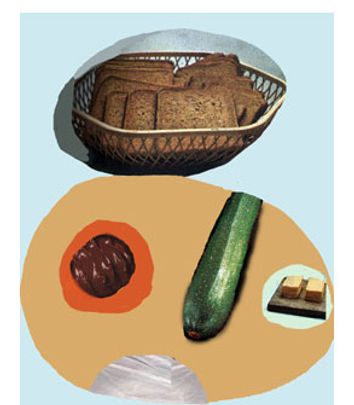
First, the Wesson Oil Ideal Housewife of the 1950s stats for the Famous Chocolate Zucchini Bread: Of all the recipes I’ve ever invented, this is the one I am asked for most often. The Famous Chocolate Zucchini Bread freezes well, slices thinly, lasts a long time unrefrigerated, is a sneaky way of getting vegetables into children and appeals to the dessert-shy. Production requires no golden hands. It is an excellent way to get rid of excess homegrown or neighbor-donated zucchini, after you have tired of caponata or batter-fried blossoms.
Continue Reading CloseThe Famous Chocolate Zucchini Bread
It's guaranteed to please -- when it's fresh, that is.
The Famous Chocolate Zucchini Bread
2 medium-large zucchini
2 eggs
1/2 cup butter
2/3 cup sugar
1 teaspoon vanilla
2/3 cup flour
2/3 cup unsweetened cocoa
1/4 teaspoon salt
2/3 teaspoon baking soda
1/3 teaspoon nutmeg
1/3 teaspoon cinnamon
2/3 cup chocolate chips
Steam medium-large zucchini until mushy. Purie in blender (i.e. do not strain using Foley food mill.) Cool to at least room temperature (cooling can be speeded up by placing purie in freezer for about 20 minutes, covered.) Set aside.
Separate eggs: Beat whites until fluffy, yolks until lemony. Set aside.
Cream together butter with sugar. Beat in egg yolks and vanilla until very smooth. Set mixture aside.
Sift together flour, unsweetened cocoa, salt, baking soda, nutmeg and cinnamon.
Mix dry ingredients into butter mixture. Fold in cool zucchini purie. Stir in chocolate chips. Fold in egg whites.
Bake in greased, floured loaf pan at 350 degrees for one hour, until bread stands away slightly from edges of pan.
Paulina Borsook to Eric Raymond: Don’t you Kakutani me!
The author of "Cyberselfish" takes issue with Raymond's screed defending libertarian geek culture.
TO: Eric Raymond
FROM: Paulina Borsook
RE: ABENDS in The Program You Compiled on 6/28/00
Eric — Thanks for the great work at such short notice. Alas, there were some bugs you obviously didn’t have time to patch, so here’s a quick and dirty list of the ones most apparent by inspection. Cheers!
1) There seems to have been a subject-object confusion going on. My name is not Michiko Kakutani, I do not work for the New York Times, I have never written for the New York Times and I was just as much subjected to her critical gaze as you were. I am sure she would be as puzzled as I am that you equate her ideas and writing with mine.
Continue Reading CloseNo sex please, we're geeks
They've got money, power and huge hard drives, so why aren't Silicon Valley's finest getting any?
Jan. 12, 2000
#if !defined(EROS)
It’s been observed that the Victorian era’s astounding progress in engineering, communications and global capitalism is a tribute to what harnessing sexuality to commerce can do. The same might be said about Silicon Valley, where no sleep, no life and the residue of the valley’s founding Puritanism (military/aerospace and semiconductor fabrication were not party-hearty industries) drive the information economy.
Continue Reading ClosePage 1 of 2 in Paulina Borsook