Peter L'Official

Rapper’s delight

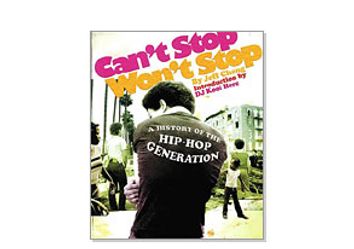
Jeff Chang's remarkable history tells the story of hip-hop, the most important music (and youth) movement of our time.

  • more
    • All Share Services

Rapper's delight

Charlie Ahearn, famed writer-director of the 1982 old-school hip-hop film classic “Wild Style,” broke my heart about a quarter of the way through Jeff Chang’s “Can’t Stop Won’t Stop: A History of the Hip-Hop Generation.” Asked about the double-edged impact of the Sugar Hill Gang’s 1979 chart-topping, crossover hit “Rapper’s Delight” on break dancing and DJ culture in the clubs, he observes, “Nobody was dancing. Period! Rap became the focal point. MCs were onstage and people were looking at them.” The song, apart from enlivening the then-waning Bronx club scene, helped cast the DJ down from his heretofore prominent position as ruler, sole controller and cold-rocker of the party. The days of kids decked out in denim cut-sleeves sporting well-manicured ‘fros at clubs “gettin’ they dance on” were done. Dancers became spectators, DJs cut records for profit, and silver-tongued Bronx kids rhymed over those records, enacting the culture’s transition from DJ-dominated live performance to the more formulaic, highly marketable, studio-ensconced iteration dominated by the rapper. This leads to Ahearn’s heart-stopper: “This is 1980. In other words, hip-hop is dead by 1980. It’s true.”

Now, hip-hop’s death has been decried so many times that it’s become nearly a theme of the music itself (and not just every time Puffy re-reinvents the remix). But I was born in 1980. As a matter of fact, I was born in New York City, and have lived the greater part of my life in the Bronx, the internationally known and locally respected birthplace of hip-hop. It’s a lil’ badge of honor that I enjoy carrying around, and a fact that almost assuredly annoys friends and others alike due to my constant and often public claim to that heritage. My favorite music came from where I came from. It’s a neat and simple bit of history that I keep close to my heart — nothing more, considering I came rather late to hip-hop block-party consciousness, being blissfully pre-pubescent for its glory days — and it’s kept so close that I can’t help but feel concern for the culture that’s grown up, out, around and away from the two turntables and a microphone that helped start it. And no matter how many times hip-hop has “died,” it’s still troubling to hear from one of its elder statesmen that the music you grew up listening to was dead before you knew it existed.

But baby — and I’m addressing hip-hop directly here — I love you, as 50 Cent so playfully rapped once, “like a fat kid loves cake.” And after completing Chang’s epic endeavor (546 pages including appendices, indexes, notes and the obligatory shout-outs), I can tell that he does too.

Yet it’s not just the music that he loves, because hip-hop isn’t just about dope beats and rhymes, or at least it shouldn’t be. In some strange and I suppose logically impossible way, Hip-Hop in the grand, elevated, generational sense is “bigger than hip-hop,” in the words of the duo dead prez (a group so — undeservedly — under the mainstream radar that they don’t even get capital letters). I know what you’re saying, how can a thing be bigger than itself? I’ll attempt to answer that with simple stoner logic: What if the thing is not the thing you thought it was in the first place? (Can I get a Keanu? “Whoa!” Thanks!)

Hip-hop in its purest sense offers both a means to decide whether you should cop that bangin’ new mix tape from the cat on the corner, and a forum to decide whether you think Colin Powell’s a punk for copping to the neocon playbook and selling us on those WMD. Hip-hop was born in the Bronx, yes, but it has been reborn countless times — to borrow Secretary of Defense and hype-man extraordinaire D. Rummy’s words — north, south, east and west of there, too.

Like it or not, hip-hop’s been co-opted by our media monopolies as both dominant mode and signifier of youth/outsider/disenfranchised culture. Having transcended its branding as a niche market of music, it has come to stand for — and brand — urban culture itself. (Referring to the seminal West Coast rap group N.W.A.’s meteoric rise to the top of Billboard’s charts in the 1990s, Chang slyly writes, “Apparently lots of suburbanites and whites were down with a ‘Niggaz 4 Life’ program,” keenly identifying the music’s potential to both identify and define a lifestyle.) Hip-hop has become both universal aesthetic and adjective, from the Dirty South to South Africa, with its spirit manifesting itself in the unlikeliest of places, often in more unfamiliar guises.

Holler if you hear me. Allen Iverson is hip-hop, sure. But if you’ve ever watched the elegant, world-class French striker Thierry Henry celebrate after scoring a wonder goal, you’d know he’s hip-hop, too — and not merely because he’s friends with San Antonio Spurs guard Tony Parker and once sat next to Spike Lee and Jay-Z at a Knicks game. Same goes for the kids chilling out in Tokyo’s Harajuku district, sporting Nike sneaker styles that hip-hop heads in America would absolutely bug out over. Though he would no doubt protest, Stanley Crouch is a little bit hip-hop, too. Just ask critic Dale Peck.

Chang, a freelance hip-hop journalist with a background in ethnic studies and a decade-long investment in the art form (which includes co-founding an influential indie hip-hop label that helped launch acts like DJ Shadow and Blackalicious), approaches the palimpsest of hip-hop pedagogically. Which is to say, his scope is operatic, sprawling, and concerns itself with the people, places and politics that drove hip-hop from its infancy — at a party thrown by DJ Kool Herc’s sister on 1520 Sedgwick Avenue in the Bronx — to its now-ubiquitous and rather decadent cacophonic pimping of your TV, radio, cellphone and, of course, your ride. He writes, “My own feeling is that the idea of the Hip-Hop Generation brings together time and race, place and polyculturalism, hot beats and hybridity. It describes the turn from politics to culture, the process of entropy and reconstruction. It captures the collective hopes and nightmares, ambitions and failures of those who would otherwise be described as ‘post-this’ or ‘post-that.’”

What hip-hop provides — from Chang’s perspective, and that of the downtrodden denizens of Rio’s favelas and Paris’ banlieues, marginalized and impoverished much like the South Bronx population of the 1970s — is a way to look at the world. And that’s exactly what “Can’t Stop Won’t Stop” does: It looks at the world through the words, eyes and deeds of the culture’s true, oft-forgotten architects and revolutionaries over the past three and a half decades. Chang isn’t interested in rap’s big, boldfaced names and endlessly echoing voices as touchstones for his narrative. While he pays homage to founding fathers Grandmaster Flash, Afrika Bambaataa and Kool Herc (who writes the book’s introduction) among many others, Chang grounds his copious research with those whose stories have been overlooked, co-opted or abandoned: the street gangs of 1960s-70s Bronx, the b-boys (break dancers) whose loose-limbed poppin’ and lockin’ became novelty once the MC grabbed the mike, and the graffiti artists whose brief brush with art world fame came, then went, with Jean-Michel Basquiat and Keith Haring. These are but some of the heretofore ignored to whom Chang gives voice. There’s nary a Diddy in sight.

It is what Chang calls “the politics of abandonment” that seemingly drove him to write the book, and which accounts for the seething menace — masked by cool understatement — he shows when dealing with real-life villains such as megalomaniacal urban builder Robert Moses, or pretty much anyone involved with the LAPD. A boombox Boethius, Chang employs a central metaphor not of a wheel, but instead, a loop — of history, of a sample, of cassette tape — around which he structures and organizes the book.

Chang begins his tale temporally in 1968, a time when youth and revolution seemed poised to seize the world by storm. But in the South Bronx, gang culture — fueled by the influx of heroin and the mass exodus of whites to the suburbs made possible by Moses’ destructive monstrosity, the Cross-Bronx Expressway — took root, and street violence became the reality. After years of Nixon’s and city officials’ policy of “benign neglect” had taken its toll, the raging fires that razed communities and made the Bronx the nation’s symbol for urban failure, the gangs themselves declared a stunning truce in 1971. That’s when people like Herc, Flash, and Bambaataa (himself a member of a gang, then leader of the Zulu Nation) stepped in. The creative energy they unleashed in a seven-mile radius from the Bronx’s Crotona Park in the late ’70s rather fittingly “sampled” the same rebellious, avant-garde spirit of a decade before.

As Chang writes, in making his most trenchant point: “They were about unleashing youth style as an expression of the soul, unmediated by corporate money, unauthorized by the powerful and protected and enclosed by almost monastic rites, codes, and orders. They sprung from kids who had been born into the shadows of the baby boom generation, who never grew up expecting the whole world to be watching. What TV camera would ever capture their struggles and dreams? They were invisible.

“But invisibility was its own kind of reward; it meant you had to answer to no one except the others who shared your condition. It meant you became obsessed with showing and proving, distinguishing yourself and your originality above the crowd.”

That these kids “never grew up expecting the world to be watching” perhaps accounts in part for why modern hip-hop has seemingly lost its way in comparison to the vibrant folk art it once was; today, everybody expects the world to be watching.

Regardless of hip-hop’s inspirational woes today, it is this cyclical progression of events that forms Chang’s loop, repeated in Los Angeles between the late ’80s and early ’90s, culminating in the post-Rodney King verdict riots, the 1992 Watts peace treaty, and a similar flowering of creativity, leading to hip-hop’s eventual entry into the mainstream.

Chang’s narrative ends, rather unfortunately, in the year 2000 at a demonstration at the Democratic convention, with fists raised defiantly in the air in front of the Ronald Reagan State Building. It’s a conclusion, necessarily so I suppose, that completes the revolutionary loop from 1968, but so much has happened in these past years that I felt cheated to have taken such a remarkably detailed ride through history, then to be forced to get off earlier than I expected. It’s a rather evasive and jarring ending to an otherwise comprehensively researched and well-written history.

The history of hip-hop music in many ways still mirrors the history told by rapper Common in “I Used to Love H.E.R.,” a single from his 1994 classic “Resurrection.” Employing a trope, well, common to the genre, Common raps as if hip-hop is a girl he grew up with. (The very fact that I’m citing Common will perhaps out my current musical allegiances with regards to the gangsta/poet, thug/backpacker debate, which Chang addresses intelligently in his book.)

I met this girl, when I was ten years old
And what I loved most she had so much soul
She was old school, when I was just a shorty
Never knew throughout my life she would be there for me
On the regular …

And later …

I might’ve failed to mention that the shit was creative
But once the man got you well he altered the native
Told her if she got an energetic gimmick
That she could make money, and she did it like a dummy
Now I see her in commercials, she’s universal
She used to only swing it with the inner-city circle
Now she be in the burbs lickin rock and dressin hip
And on some dumb shit, when she comes to the city
Talkin about poppin’ glocks servin’ rocks and hittin’ switches
Now she’s a gangsta rollin with gangsta bitches
Always smokin blunts and gettin drunk
Tellin me sad stories, now she only fucks with the funk
Stressin how hardcore and real she is
She was really the realest, before she got into showbiz

All that is generally still true, and the cycle has repeated itself since then in some form or another — and this rap is only 11 years old. (Some might remember that Common and Ice Cube didn’t exactly see eye to eye after this song was released, since Cube thought himself obliquely referenced here — so excuse me for one sec … Cube, I ain’t got nuthin’ but love for ya baby!) So Chang’s loop theory seems to hold water — especially when put in context of a comment made by the Source magazine’s co-founder and CEO David Mays in 1993: “This isn’t a niche market, or just an ethnic market … Hip-hop is like rock and roll twenty-five years ago. It’s a music-driven lifestyle being lived by an entire generation of young people now … This market is dying to be marketed to.”

In the wake of 50 Cent and the Game’s exquisitely timed “beef” (and 50′s first-week sales massacre of all Billboard chart rivals), Mays’ words might seem funny or prophetic, despite the fact that the threat of someone dying has become the marketing ploy. (Chang pays particular attention to Mays and the other co-founder of the Source, Ray “Benzino” Scott, both of whom have stakes in the music business and thus have more conflict-of-interest issues with the magazine than Dick Cheney has with Halliburton.) Who knows if we’re truly at the nadir of Chang’s loop, but if we are, then there’s nowhere to go but up.

“Can’t Stop Won’t Stop” reads like a history textbook — albeit one of the cooler history textbooks you could find — and that’s a good thing. It is essentially a people’s history, a sociological text that delves deep into the racial and economic climates of the times that produced hip-hop culture. Of course, Chang gets to supplement his sociology with the occasional critical consideration of the lyrical stylings of a Rakim or an Ice Cube, but for the most part the focus is on cold, hard, often political fact, which is what makes it both fascinating and important. Chuck D, the famous Public Enemy frontman, was renowned for saying that hip-hop was black America’s CNN. Given that CNN is now devoted to hard-hitting, 24-hour coverage of the Michael Jackson trial, that seems a less flattering comparison. But using that same analogy, perhaps Jeff Chang is hip-hop America’s Howard Zinn.

Tolkien’s cosmological vision

Before Frodo and Sam, there were Beren and Luthien. A case for revisiting "The Silmarillion."

  • more
    • All Share Services

Tolkien's cosmological vision

In the last dread days of disco-dûr, in the midst of the Seventh Age — known in perhaps a more familiar tongue as “the Nineteen Seventsies” — there emerged from the House of Houghton Mifflin, and later from that of Ballan-tine, a great book of which much was expected, though few but the most ardent of devotees could wholly comprehend it. It has, in the Tolkienian spirit, valiantly returned.

“The Silmarillion,” J.R.R. Tolkien’s fantastically complex, comprehensive and, yes, uneven mythological narrative was his life’s work — the underlying structural legend of the world into which young Frodo Baggins would later walk, many millennia hence, on his arduous journey to cast the One Ring into the fires of Mount Doom. Its narrative principally concerns the time before “The Lord of the Rings,” from the genesis of Eä and Arda (the universe and Earth, in Tolkien’s legendarium) to the creation of Middle Earth and its denizens — the divine, the Elvish, and the human, with nary a hobbit in sight.

“The Silmarillion” was published and edited by Tolkien’s son Christopher, four years after the Oxford don’s death in 1973, to largely negative critical reaction (The word “genesis” earlier was not idly chosen — Tolkien’s creation myth approaches both the tone and the style of the Bible and could be thought of as a “Bible of Middle Earth” of sorts, though Tolkien would certainly have stressed a distinction.) Its legacy is troubled, though for a time, quite like the One Ring, it passed from the minds of men (apologies — the temptation to drift into legend language is impossible to resist sometimes).

Now a new generation, armed with extravagantly appendixed, extended editions of Peter Jackson’s trilogy of films on DVD, has the opportunity to contend with its knotted and besotted history. The professor’s pre-magnum opus has been re-released, bound in a gorgeously illustrated, and pleasantly weighty, hardcover edition that sits comfortably in your lap, just as all grand fairy tales should.

By virtue of aesthetics alone, this new volume of “The Silmarillion” should bring a great many more readers into fuller appreciation of not only the book but also Tolkien’s universe at large. Exquisitely illustrated by Ted Naismith, who worked on Robert Foster’s “Complete Guide to Middle Earth,” this new edition is the model of what a 21st century, ancient cosmological text should look like, if that makes any sense. I feel almost silly for saying it, but it’s a really pretty book: From the typescript to the spacious layout — not to mention the extremely useful appendixes of genealogical tables, notes on Elvish pronunciation, indexes of names, and linguistic elements of Tolkien’s two Elvish tongues — the publishers have done well to give Tolkien’s saga a tangible feeling of the momentous mythological history its author meant it to be.

But what exactly did Tolkien mean for us to make of “The Silmarillion”? And what the heck is a Silmarillion anyway? (I promise it’s not just the name of a late-’70s progressive rock band.) The answers to those questions are conveniently found in a 1951 letter — included in this volume — which Tolkien wrote to his friend Milton Waldman, an editor at the publishing house then known simply as Collins. Christopher Tolkien explains that this lengthy letter was the result of his father’s working out difficulties that arose over his insistence that “The Silmarillion” and “The Lord of the Rings” be published in “conjunction or in connexion … as one long Saga of the Jewels and the Rings.”

“The Silmarillion” as published is a compendium of five works: the “Ainulindalë,” a cosmological myth that recounts the creation of the universe by Eru Ilúvatar (God) and the music of the (angelic) Ainur; the “Valaquenta,” a comparatively brief description of the Valar and Maiar, supernatural beings; the “Quenta Silmarillion,” or “Silmarillion” proper, which forms the bulk of the collection and recounts the fall of the most gifted kindred of Elves whose fate is tied to the Silmarilli, or Silmarils — jewels into which was imprisoned the light of the world; the “Akallabêth,” concerning the downfall of the Númenóreans — the Kings of Men — and the destruction of their Atlantean island Númenor; and finally “Of the Rings of Power and the Third Age,” which takes us from the forging of the One Ring through more familiar territory — the passing of the Ringbearers into the Undying Lands at the end of the “Rings” epic.

Tolkien began work on “The Silmarillion” as early as 1917 when, as a British officer stationed in France during World War I, he was laid up in a military field hospital with trench fever. What began as a language lover’s way to entertain himself by inventing creatures (Elves) who spoke invented languages (Quenya and Sindarin, derived from Finnish and Welsh), became a way for Tolkien to bestow upon his beloved England a mythology all its own. (For more on the life of Tolkien, please refer to Salon’s own Andrew O’Hehir and his magisterial treatise on Tolkien’s treatment by intellectuals.)

Tolkien wrote in the letter to Waldman, “I was from early days grieved by the poverty of my own beloved country: it had no stories of its own (bound up with its tongue and soil), not of the quality that I sought, and found (as an ingredient) in legends of other lands. There was Greek, and Celtic, and Romance, Germanic, Scandinavian, and Finnish (which greatly affected me); but nothing English … Of course there was and is all the Arthurian world, but powerful as it is, it is imperfectly naturalized, associated with the soil of Britain but not with English; and does not replace what I felt to be missing.” E.M. Forster had similar feelings, expressed in “Howards End”: “Why has not England a great mythology? Our folklore has never advanced beyond daintiness, and the greater melodies about our countryside have all issued through the pipes of Greece. Deep and true as the native imagination can be, it seems to have failed here.”

What Tolkien gave us in “The Silmarillion” and “The Lord of the Rings” is an amalgam of myth, fairy story, heroic legend and still yet another element, truth. He explains, “I believe that legends and myths are largely made of ‘truth’, and indeed present aspects of it that can only be received in this mode; and long ago certain truths and modes of this kind were discovered and must always reappear.” Perhaps that is why Tolkien’s myths feel so familiar in their foreignness: They tap into a collective, unconscious sense of loss — loss of the once oral tradition of storytelling and mythmaking — rekindled in “The Silmarillion” with the epitaphs and purposefully grandiloquent speech of gods, Elves, and Men (believe me, I’d say Women too, but Tolkien so rarely did) in a time before religion (as we know it — mythmaking was itself a form of religion).

For a work that according to his son became for the elder Tolkien “the vehicle and depository of his profoundest reflections,” it is especially sad that “The Silmarillion” was deemed largely impenetrable, even by many Tolkien fans, upon its release in 1977. The extravagantly stylized language, a seeming overabundance of genealogical history, and a lack of deeply crafted characterization were cited as its major faults. (Claims of impenetrability did little to damage the book’s sales, though. “The Silmarillion” sold over a million copies that year, soaring to the top of the New York Times bestseller list, and it continues to make a positive impression on its publishers’ balance sheets today, both in the United States and the United Kingdom. It’s a book that everyone wanted but seemingly no one wanted to read all the way through.)

Negative reactions were, alas, nothing new to Tolkien’s works of fantasy. In 1956, modernist critic Edmund Wilson famously scoffed at “The Lord of the Rings,” calling it “juvenile trash.” In 1961, Philip Toynbee prematurely celebrated the fact that Tolkien’s “childish” books “have passed into a merciful oblivion.” In a sense, “The Silmarillion” drew criticism for not being trashy or juvenile enough.

A review in the September 1977 issue of the Economist was so virulently dismissive of “The Silmarillion” that it required a seemingly palliative preface directed at Tolkien enthusiasts, acknowledging that those readers would “have little sympathy with the ‘curmudgeonly’ note of the following article by one of our reviewers.” (The editors then revealed that they published the review “in the interests of provoking further disagreement between those who live outside the Tolkien world and those inside it.”)

The great chasm between those wholly taken with Tolkien and those who avoid his works of fantasy like a medieval plague has always been as unbridgeable as, say, the abyss at Khazad-dûm into which Gandalf and the fiery Balrog fall. Yet much of the criticism originally directed at “The Silmarillion” singles out Tolkien’s liberal sampling of European lore as well as his reluctance to flesh out his characters beyond their heroic (or villainous) archetypes. But isn’t the creation of archetypes the greater part of what mythmaking is all about? I am no Oxford medievalist, but it seems to me that creating enduring types to which succeeding generations can attach new significance is a success, not a failure.

John Gardner — the author of “Grendel,” and who, like Tolkien, was a noted professor of medieval literature and a scholar of ancient languages — reviewed “The Silmarillion” for the New York Times upon its release in 1977. He wrote, “If ‘The Hobbit’ is a lesser work than the Ring trilogy because it lacks the trilogy’s high seriousness, the collection that makes up ‘The Silmarillion’ stands below the trilogy because much of it contains only high seriousness; that is, here Tolkien cares much more about the meaning and coherence of his myth than he does about these glories of the trilogy: rich characterization, imagistic brilliance, powerfully imagined and detailed sense of place, and thrilling adventure.” A lover of languages, Gardner had none for his fellow scholar: “Tolkien’s language is the same phony Prince Valiant language of the worst Everyman translations and modernizations.”

These are fair criticisms, if a bit stuffy — but to be fair, Gardner’s review is not wholly damning; he does have (tempered) praise for “the total vision, the eccentric heroism of Tolkien’s attempt,” which is certainly a large part of its importance. While I agree with Gardner that “The Silmarillion,” and its forest of names denser than Fangorn, might not make for the simplest reading immediately after finishing the last bit of your Longbottom Leaf, I do think that there is something more primal, more vital — and more pagan than papal — to its appeal. (Yes, Tolkien was a Christian, but the myths he imagined here are intended as fundamentally pre-Christian.)

Sure, there are certain interminable portions that read much like those sections in the Bible where W begat X, who begat Y and Z, and some stories are given inexplicably short shrift. But that only reminds me of something else Gardner said (though not in that Times review): “Reading the Bible straight through is at least 70 percent discipline, like learning Latin. But the good parts are, of course, simply amazing. God is an extremely uneven writer, but when he’s good, nobody can touch him.” The same is true for Tolkien and “The Silmarillion” (and no, I’m not comparing Tolkien to any manner of Supreme Being, though the most fervent of Tolkienians might wish me to).

Despite its complexity, “The Silmarillion” has at its core the simple, cyclical story of a fall — a great fall, with many smaller ones within. Tolkien himself said, “There cannot be any ‘story’ without a fall — all stories are ultimately about the fall — at least not for human minds as we know them and have them.” Its story arc is one suffused with loss and bereavement, tracking the gradual darkening of the original light of the world; things are created, then marred or destroyed, then are re-created, but with less luster — lights shine with less brilliance, men act with less virtue — as things grow further away from their original perfection. The one bright thought that remains with the reader throughout is the comforting knowledge that the time of “The Lord of the Rings” is still to come.

It’s not a complete downer though. “The Ainulindalë” offers many beautiful moments — the idea that the world was created out of themes given to the Ainur by Eru, out of which they made “a great music … of endless interchanging melodies woven into harmony that passed beyond hearing into the depths and into the heights … and the music and echo of the music went out into the Void, and it was not void” — and others more sinister.

Here appears Tolkien’s great villain, Melkor, later called Morgoth. The most powerful (power was always close kin to evil in Tolkien’s world) of the Ainur — the fallen Angel greedy for glory — Melkor began singing his own song, clashing with the harmony of the other Ainur, thinking himself greater than the rest. Eru responds by laying down the ultimate corrective: “And thou, Melkor, shalt see that no theme may be played that hath not its uttermost source in me, nor can any alter the music in my despite. For he that attempteth this shall prove but mine instrument in the devising of things more wonderful, which he himself hath not imagined.”

Tolkien’s greatest gifts to us in “The Silmarillion” are his villains. Melkor/Morgoth, who ever opposes the immortal Valar, sets forth the cyclical making and unmaking of the world by destroying the beacons of light that the Valar construct to illuminate the world for the coming of Elves and Men. The most dramatic scene of bold destruction comes in “The Silmarillion” proper, when Morgoth and the monstrous, never sated spider Ungoliant — in my view the vilest, most sickening, and best-named character in the book — poison and kill the Two Trees of Valinor that had lit the world before the coming of the Sun and the Moon, while also stealing the Silmarils and darkening the world again.

Thus the epic is set forth. The Noldor Elves — the central figures of Tolkien’s tale and those in whom we might recognize a bit of the author in their “love of words,” who “sought ever to find names more fit for all things that they knew or imagined” — are doomed to desire possession of the Silmarils.

“The Silmarillion’s” most fully realized and emotionally invested fairy tale is the story of Beren and Lúthien. Beren (which if it isn’t, should be Elvish for “badass”) is an outlaw wanderer (a man) who falls in love with the Elf Lúthien Tinûviel — “the most beautiful of all the Children of Ilúvatar” — after watching her dance and sing alone in woods lit by moonlight. She returns his love, but the two are parted by Lúthien’s father, King Thingol, who challenges Beren to win the hand of his daughter with a task he knows will seal the man’s doom: “Bring to me in your hand a Silmaril from Morgoth’s crown; and then, if she will, Lúthien may set her hand in yours.” Beren responds, laughing, “It is for little price … do Elven-kings sell their daughters: for gems and things made by craft. But if this be your will, Thingol, I will perform it. And when we meet again my hand shall hold a Silmaril from the Iron Crown; for you have not looked the last upon Beren son of Barahir.” (I told you he was a badass.) It is an incredible story, long, exquisitely detailed, and poignant, so I am loath to give away its truly gripping ending, but I may already have said too much. (The story is invested with even more meaning by the knowledge that Tolkien had “Beren” inscribed on his headstone and “Lúthien” on that of the love of his life, Edith Bratt.)

Had I but world enough and time, I’d tell you about the unluckiest man in the book, Túrin Turambar, whose life resembles that of Oedipus and other doomed figures, and of Dior, one of Tolkien’s few “multicultural” heroes (being part Man, part Elf, and part Maia — a lesser Ainur), the Elf-on-Elf crimes that forever doom the Noldor, and of the origin of the Orcs (corrupted Elves in a sense, bred in envy and mockery of them, and perhaps the vilest deed of Morgoth, for they hate all, but hate their creator most for birthing them), but I don’t, so I’ll leave those for you to discover.

As is often the case, the greatest pleasures are the small ones: Reading a familiar description or seeing a familiar place name will, for the Tolkien fan, set off a flood of memories of what will come to pass in later “years.” And of course, revisiting “The Lord of the Rings” becomes all the richer with all of this new-old knowledge, throwing various elements of the story into fuller light. (When Aragorn recounts the love story of Beren and Lúthien to his enthralled hobbit band on Weathertop before the Nazgûl attack, you realize how close their tale is to his and Arwen’s.)

Reading Tolkien’s “Silmarillion” is like looking at a frayed and faded picture of your grandfather and all of a sudden recognizing why your nose is shaped just the way it is. “The Silmarillion” is both profoundly satisfying and profoundly warming, even despite those who think its prose cold and unfeeling. It answers — at least for Tolkien fans always desirous of more — the fundamental question, why? If Tolkien knew (and he probably did) why the sky is blue, the answer would be in “The Silmarillion.”

“The Silmarillion” is a special work because it offers what few other books of Tolkien’s do: a true beginning, a fresh start. It is the beginning, of all things. For those willing to surrender themselves to his bookish universe, watch the films, or at least make a valiant attempt at penetrating the veil of scholarly geekdom surrounding most Tolkieniana, the opportunity exists here to start from scratch, from the One, Eru, “who in Arda is called Ilúvatar.” Both the Tolkien arriviste and the scholar — for once on a level playing field — are presented with the clean slate of creation time where myth can be made and remade within the mind of the reader. A final word is always difficult, so perhaps it’s best to leave you with the Oxford philologist’s opening lines in his letter to Milton Waldman, lines that are quintessential Tolkien:

“My dear Milton, you asked for a brief sketch of my stuff that is connected with my imaginary world. It is difficult to say anything without saying too much: the attempt to say a few words opens a floodgate of excitement, the egoist and artist at once desires to say how the stuff has grown, what it is like, and what (he thinks) he means or is trying to represent by it all. I shall inflict some of this on you; but I will append a mere resume of its contents: which is (may be) all that you want or will have use or time for.”

Continue Reading Close

Dark side of a sea dog

Legendary rogue John Hawkyns roamed the high seas for Queen Elizabeth, defeating the Spanish Armada, adventuring in the West Indies -- and pioneering the nefarious trade that would send millions of Africans into slavery.

  • more
    • All Share Services

Dark side of a sea dog

There’s a certain spirit to the epigraph Nick Hazlewood chooses for his pointed historical biography, “The Queen’s Slave Trader,” that cuts right to the diseased heart of the matter at hand. He quotes John Keats’ “Lines Written on 29 May, the Anniversary of Charles’s Restoration, on Hearing the Bells Ringing.” Keats writes, “Infatuate Britons, will you still proclaim/ His memory, your direst, foulest shame?”

The “memory” in question for Hazlewood — a freelance journalist whose previous book, “Savage: The Life and Times of Jemmy Button,” dealt with the tragic life of a South American native brought to England as an “exotic” on Charles Darwin’s Beagle — is that of John Hawkyns (or Hawkins, as others have spelled it). A contemporary and likely older relation of Sir Francis Drake, Hawkyns was a hero of the 1588 defense of England against the Spanish Armada, and a notorious pirate-merchant who, through violence, intimidation and sheer audacity, challenged the Spanish stranglehold on the Caribbean colonies. He was the kind of man who, in an angry letter to the royal treasurer of a town in what is now Colombia, could level a well-placed threat with ice-cold aplomb, writing, “seeing as [the town] had sent him to his supper [i.e., had sent a letter refusing to trade with him], he would in the morning bring them as good a breakfast.” Before I bring your Patrick O’Brian-infused blood to an excited simmer at the prospect of enjoying another rousing seaborne epic, there is something far more sinister to consider regarding the Pirate Hawkyns. He was also the first Englishman to trade in slaves.

If the name sounds familiar, and you’re not by chance a British naval history scholar, perhaps you’ve — like me — entertained an almost unhealthy infatuation with Bob Marley and the Wailers at some point in your life. In the 1972 song “You Can’t Blame the Youth,” Wailer Peter Tosh mellifluously delivers a ringing reggae indictment of Christopher Columbus, Marco Polo, Capt. Henry Morgan (overlooking his rather poor rum), and Hazlewood’s pirate subject. Tosh sings, “You teach the youths about the Pirate Hawkyns/ And you said he was a very great man. But you can’t blame the youth/ You can’t fool the youth.”

The gist of Tosh’s lyric in many ways represents Hazlewood’s project; that is, writing against history’s largely favorable treatment of Hawkyns, and by extension that bane of the historian’s existence: other historians. He writes, “Criticism of [Hawkyns'] role in the slave trade has been repeatedly rebutted by his biographers, who have argued that the use of hindsight and modern political perspective is morally and politically anachronistic. For four and a half centuries Anglophile historians have preferred to see John Hawkyns as a bold sea rover, a romantic figure with a salt-encrusted beard and the bulldog spirit coursing through his veins.”

The proverbial ship has sailed on that conception. Hazlewood cites one ludicrously dim view in particular: “James Williamson, Hawkyns’ most scholarly biographer, claimed that Africans should have been grateful for the help they were given to escape ‘bloody and capricious tyrannies to which the negroes were subject in Africa.’” Believe it or not, there are still more amnesiacs and apologists willing to give Hawkyns such a pass.

Hazlewood’s piercing pen has another purpose in mind as well, a more supremely regal prey in his sights. To wit, Hazlewood seeks to sully the immaculate aura about England’s Virgin Queen, Elizabeth I, with the stain of having condoned the “trafficking in human souls.” His intention is to demonstrate a direct and personal connection between her throne and Hawkyns’ slave ships. Hazlewood wants to remember, not forget, and to hold history’s leaders accountable for their actions. Those seem like reasonable aims in any respect.

In doing so, Hazlewood meticulously details the brutal and briny time in which his story takes place, with all its grand historical contexts and tautly knotted cultural subtexts. The history he recounts is important, primarily because slavery did change the world. Millions of people were deracinated. Whole economies and empires were birthed and borne on the backs of kidnapped Africans. The development of the African continent itself was irreparably arrested as a result of the stolen legacies of its strongest people. So we are still dealing with the dreadful aftermath even today.

What emerges from Hazlewood’s account are the massive implications of the choices made by history’s actors, and the stunning simplicity with which they seemingly made them. It’s the kind of stuff that sends Hollywood executives on frantic searches for Russell Crowe’s phone number. This was a time when Portugal and Spain didn’t merely rule the seas, but divided them among themselves — at the pope’s behest — in the Treaty of Tordesillas. To think that a north-south line could be drawn through the Atlantic Ocean, “somewhere between the forty-first and forty-fourth meridian,” and that just two neighboring nations could divide possession of everything east or west of that line seems remarkable today. Or does it?

Regardless, this is marvelous contextual material for Hazlewood to work with, and he does not often disappoint in sketching the significance of the times. These grand themes make for an attractive backdrop, but the not-so-hidden subtext of both Hawkyns’ and Elizabeth’s world that Hazlewood gradually reveals as central to many of his characters’ daily lives quickly becomes the most fascinating one to consider.

The religious wars between Protestants and Catholics that cleft many men from their fellow countrymen were brought, wholesale, out onto the high seas and to the New World. Hawkyns’ men angered Spain’s crusading conquistadors by defacing or destroying as many Catholic symbols as they could swing their swords at. In minutely describing the ethic of the sea — his sailors’ daily lives — he makes apparent their religious devotion, bordering at times on fanaticism. Recalcitrant worshipers onboard were occasionally beaten with a rope “thicker than four fingers,” and the crew indulged their sense of humor — and hateful disdain — on dull stretches of sailing with a game called “Reverend Fathers,” which involved the men facetiously taking on names like Shaven Friar, Friar Lust or even Friar Fuc, “by which they meant one who went with women.”

This cruel camaraderie by no means meant that the religious antagonism aboard Hawkyns’ ships was shared by all the men. In fact, Hazlewood makes a point to explain how even in this extremely intimate environment, men were split religiously between younger men, who had known “nothing more than Protestantism,” and older men, who “had lived through an uncertain and violent era in which England’s official religion had switched between Catholic and Protestant with each change of monarch.” Hawkyns’ character best embodies this schism. He was ambivalent — not in most of the decisions and declarations he made — but he always kept his own religious convictions frustratingly close to the chest.

Hawkyns made three voyages to the New World along a triangular trade route: He left his native Plymouth, England, for the Canary Islands and Cape Verde Islands, stopping to pirate and pillage along the way, until reaching the coast of Western Africa, where he and his men performed their vile slave-hunting deeds. Once their “cargo” was loaded, they set out for the island formerly known as Hispaniola, and modern-day Cuba, Mexico and Florida to ply their trade, under show of force, if necessary — and it often was. Disaster on Hawkyns’ last voyage necessitated his abandoning a group of his sailors in Mexico, which meant unspeakable horrors were ahead for his men, left to defend themselves against hostile Indians and the more hostile, medievally “inquisitive” Spanish. The description of the Inquisition in the New World is Hazlewood’s most fully realized spectacle, albeit a macabre one that might make Goya cringe. I am almost afraid to admit it, but Hazlewood’s description of the abominable torture that one prisoner, Thomas Goodal, is subjected to is terribly compelling, though excruciating to read.

These were momentous times that, were an Elizabethan writing this tale, might call for grandiloquent prose. But Hazlewood handles his pen with a certain journalistic grace and reserve, and an Englishman’s ironic distance, that only further clarifies the importance of the events he chronicles. He excels at illustrating instances of high drama — duels and plots against pale-faced monarchs in particular — and is especially good at exposing the sick hypocrisy that existed at the core of not merely the men who sold slaves, but especially those who made a production out of being “forced” to buy at the butt of a gun, but then happily relieved him of his human cargo. Hazlewood has a flair for the telling detail — some sailors, sensitive to the virulent anti-Catholicism onboard the ships, would tie knotted strings to represent rosary beads — and his characterizations are crisp and, at times, cutting.

Hazlewood’s straightforward style occasionally drags, more so when he’s telling Hawkyns’ back story. Growing up in hardscrabble Plymouth as the son of a wealthy businessman — despite Hawkyns’ having murdered a man before the age of 20 — was not quite the same as growing up in the South Bronx, shall we say. The author’s narration is occasionally awkward when he inserts thoughts into Hawkyns’ head, even if they’re sufficiently dastardly ones. Saying that a brutal profiteer such as Hawkyns, standing on the deck of his ship after a bloody battle and hearing “the groans of the wounded and dying, may have wondered at the human costs incurred in the pursuit of slave trading,” sounds a discordant note in an otherwise evenhanded account.

There are parts that lend themselves, almost too willingly, to screen adaptation, as when Hazlewood makes the rounds of Hawkyns’ ships, listing the men and their rough-and-tumble stories in a manner not far removed from those weak Olympic-athlete segments NBC makes its audience suffer through. But Hazlewood redeems himself with perhaps his most precious detail: Hawkyns carried with him a six-piece orchestra for his and his officers’ entertainment.

In attempting to prove that “John Hawkyns was very much the queen’s personal slave trader,” Hazlewood makes a compelling case. Queen Elizabeth exists throughout the narrative as a shadowy, almost translucent figure, and not merely because of her pallid complexion. It seems that, with her consent, Hawkyns began an enterprise that would transform England into the biggest slave-trading nation on earth, once her colonies had been established in North America. The numbers are always staggering: Between 10 and 20 million slaves were estimated to have been transported across the seas, and one-third perished along the way. That’s why Hazlewood has focused his figurative spyglass on Hawkyns — it is this ignominious legacy, as opposed to that of the scurvy sea dog, that should be remembered.

Perhaps it is best to turn to the words of a man who dealt with Hawkyns personally, Miguel de Castellanos, the recipient of Hawkyns’ letter-borne threat: “There is not one of you that knoweth John Hawkyns. He is suche a manne as that any manne taulking with him hath no power to deny him anything he dothe request.”

People grudgingly respected, and rightly feared, a pirate then. Though the lightness of Johnny Depp’s Captain Jack Sparrow in “Pirates of the Caribbean” was thoroughly enjoyable, perhaps we mythologize them a bit too much now.

Continue Reading Close

“And It Don’t Stop” edited by Raquel Cepeda

Does hip-hop journalism live up to the music's most vibrant promise -- or just rehash its crass, Benjamin-istic cliches? A new anthology makes the case for hip-hop writing.

  • more
    • All Share Services

I can hear him, his voice pregnant with that inimitable timbre — a mixture of seductively syncopated cadence and bass, the perfect distillation of raw rhythm, charisma and rage — as clearly as if I were listening through stereo headphones.

Tupac Shakur, accused of assaulting the filmmaking brothers Allen and Albert Hughes during a music video shoot, waits outside of a Los Angeles County Municipal courtroom for the plaintiffs to exit the room. They do, and almost instantly, one of the brothers boldly calls him a female dog in the diminutive. Sharp words are exchanged, egos are puffed along with chests, and the Hughes brothers’ Nation of Islam security steps in to separate the warring parties. Pac responds accordingly, as only he can: “You gon’ need muthafuckin’ Farrakhan to calm me down! You got that? Farrakhan! You bean-pie-slingin’, bow-tie-wearing bitches. You wear bow ties, remember that!” The sheriff’s department then enters the fray, separating all antagonists. Pac acknowledges their arrival: “Officers. I’m glad you arrived. These men were trying to attack me! Can you believe that? They tried to attack me with the Nation of Islam. Those are Farrakhan’s boys, you know. I’m so glad you’re here. I have full confidence in the law’s ability to handle the situation.”

This moment is captured by dream hampton in her profile of Shakur titled “Hell-Raiser,” itself one of the standout pieces assembled by editor Raquel Cepeda in the new compilation “And It Don’t Stop: The Best American Hip-Hop Journalism of the Last 25 Years.” It is representative not only of Tupac’s remarkable persona, but also of the book’s ambitious project as a whole. At its best, “And It Don’t Stop” is a collection of hip-hop’s most vital moments — a historical documentation of the music’s evolution and the journalism that evolved along with that music. Nelson George, one of the pioneers of hip-hop journalism and author of such works as “Hip-Hop America” and “Post-Soul Nation,” writes in his foreword that the book serves as a record “not merely of artists and their records, but also a window into the popular dialogue that hip-hop has made possible.”

Cepeda, former editor in chief of Russell Simmons’ Oneworld and contributor to the Source, Vibe, the Village Voice and GQ, has her own agenda in compiling hip-hop journalism’s first chronicle. In her introduction, she writes, “Twenty-five years after the release of Sugarhill Gang’s ‘Rapper’s Delight,’ the first Billboard-charted rap single — but certainly not the first rap record — there is even an argument to be made for hip-hop writing’s adoption as a sixth element of the culture — behind deejaying, emceeing, dancing, graffiti, and fashion — due to its critical role in archiving and reporting the history, present, and undoubtedly the future of hip-hop. It would also be fair to say hip-hop journalism is, in fact, an extension of rap music.” It is an argument that aspires to place great journalism on the level of art — more specifically, on the level of the artists who produce hip-hop music. An elevation of hip-hop journalism to such artistic heights, however, would (and should) subject it to the same critique to which much of contemporary hip-hop is now subject: Like the music itself, hip-hop journalism has a penchant for crass commercialism, imaginative stagnation and sometimes even profound anti-intellectualism. Cepeda’s project seems to want to identify a canon of rap journalism, thereby insulating the better examples while leaving the sea of shiny but shallow prose pretenders — the literary wankstas, if you will — to fend for themselves.

Sally Baines’ 1981 article “Physical Graffiti” — the first ever published on break dancing in the Village Voice, and the first piece in the collection — captures the oft-ignored early component of hip-hop, “breaking.” What is startling here is both how vital and vibrant this aspect was to the burgeoning culture, and how far out of focus it had fallen in hip-hop’s modern, mainstream iteration, only to be recently resurrected — as an old-school novelty of sorts — in Missy Elliott music videos and elsewhere. Baines writes beautifully about her B Boys, “the Puerto Rican and black teenagers who invent and endlessly elaborate this exquisite, heady blend of dancing, acrobatics, and martial spectacle. Breaking is a way of using your body to inscribe your identity on streets and trains, in parks and high school gyms. It is a physical version of two favorite modes of street rhetoric: the taunt and the boast.”

Steven Hager’s 1982 piece on Afrika Bambaataa and the Zulu Nation is significant for its documentation of two revolutionary cultural moments in hip-hop history: the rise of the DJ and the innovations of scratching and sampling as the foundations of the music, and the DJ’s subsequent fall (or more appropriately, fade-out), having been eclipsed by the charismatic frontman, the MC. Part of the fun of these early articles is to listen to hip-hop’s forefathers — and their chroniclers — wax poetic on their intentions and expectations for the music. Bambaataa says, “In the future, I just hope all my groups keep pimping … See, George Clinton took the music of James Brown and Sly and the Family Stone and made a whole funk empire out of it. That’s what I’m trying to do with rap.” Hager follows, wondering, “Who knows? In another five years, hip-hop could be considered the most significant artistic achievement of the decade.” Say word.

Divided into three sections — ’80s, ’90s, and from 2000 onward — the book’s early articles are concerned with documenting and defining the emerging youth culture’s “fresh” yet disparate elements. There are many priceless moments: David Hershkovits on hip-hop in Europe, Bill Adler at Sal Abbatiello’s Disco Fever in the South Bronx, and Nelson George’s profile of rap mogul Russell Simmons, mouth-wateringly titled “Rappin’ With Russell: Eddie Murphying the Flak-Catchers.” But as hip-hop defined and distilled its components, so did hip-hop writing, keeping pace with the rapidly developing culture, and becoming — for better or worse — a unique brand of journalism. Along the way, the articles offer countless opportunities not only to revisit forgotten frozen personal, public and political moments, but also to make connections between past and present, to see precursors and progenitors and gauge their impact on hip-hop’s modern age.

Selwyn Seyfu Hinds and Hilton Als bring welcome measures of historicism, personal experience and eloquent, essayistic grace to their pieces on the Fugees’ Haitian homecoming and the state of soul music, respectively. Charles Aaron’s essay, “What the White Boy Means When He Says ‘Yo,’” deserves to be read by all devotees — and detractors — of hip-hop, if merely for his reformulation of W.E.B. Du Bois’ construction “double consciousness,” which suggests blacks in America are “always looking at one’s self through the eyes of others.” In Aaron’s hands, this becomes “double unconsciousness,” a description of the white hip-hopper’s “failing to look at oneself through the eyes of others, the myth that if you, as an individual, don’t behave in an actively racist fashion, then you’re not shaped by racism.” And yes, there’s an article on Sean “Puff Daddy” Combs (love him or hate him, any such book would be incomplete without him).

Cepeda highlights a particular shift, discernible in both the focus and the language of the hip-hop writing in the 1990s: “On the one hand, the journalism of the era moved away from just documenting the phenomenon to a mode of critique, exploring hard-hitting issues that ranged from politics, censorship, misogyny, economics, class, gender, religion and spirituality, to other sociopolitical issues,” she writes. Notably, she does not fail to mention the “cross section of the journalism [that] sadly followed some of the artists down the Benjamin-paved road toward mainstreaming.” Cepeda is both shrewd and caustic in her appraisal of the perils of contemporary hip-hop journalism, observing that “today, coverage has more to do with staying relevant than an inherent zeal to critically document the genre,” a problem compounded by the fact that “the music now bumping from your Jeeps sounds, for the most part, like one seamless jingle for Mercedes Benz Fashion Week.”

What is occasionally problematic about this collection, however, is that the most essential service many essays and articles provide — the elucidation of a particular moment in time — sometimes remains the only valuable part of the essay, the rest composed of either lax language and prosaic prose or a blurring of the line between celebrity profile and celebrity reverence. Greg Tate’s 1996 “Diatribe” against the perceived disappearance of “progressive hip-hop” (A Tribe Called Quest, De La Soul, etc.), while intelligently argued, is frustrating to read with all that slanguage that sounds infinitely better spoken (over a beat?) than written. The word “aiight” should rarely appear in print, apart from in song lyrics. Emil Wilbekin’s profile of Mary J. Blige sounds a slightly false note as a concluding piece; Ta-Nehisi Coates’ brilliantly studied and stated piece, “Keepin’ It Unreal: $elling the Myth of Black Male Violence Long Past Its Expiration Date,” would have made a more thoughtful finale.

The book truly finds its center with the landmark profiles of Tupac and the Notorious B.I.G., by hampton and Cheo Hodari Coker, respectively. Hampton’s portrait is essestial reading for anyone wishing to better understand the enigma of Shakur’s life. (For those who believe that the definitive book on his life has not yet been written, perhaps this is a start.) Yet there is no moment more chilling or heart-rending than when Coker asks B.I.G. “where he wanted to be in life.” The thoughtful, lovable thug called Biggie responds — on what would turn out to be “his last night on earth” — “I think there are a lot more lessons that I need to learn. There are a lot more things I need to experience, a lot more places I need to go before I can finally say, ‘Okay, I had my days.’ A lot more shit have to go down, ’cause I want a lot more.”

Pop culture critic Touré states in his contribution, “To be a great MC you must have a hypnotizing flow — a cadence and delivery that get inside the drum and bass patterns and create their own rhythm line.” About this, he is absolutely correct, and the same is true of the hip-hop writer: Self-assurance and cool confidence, lyrical acumen and creative delivery are the hallmark of every good hip-hop journalist. Like all great writers, a hip-hop writer also needs that touch of the ineffable, that talent to sense the elegance and significance of every moment, from the earth-shattering to the quietly confessional. And like all the best rappers, the finest hip-hop journalists, at their very essence, are supremely gifted storytellers.

Continue Reading Close

Mother of all home movies

Jonathan Caouette explains how he captured his turbulent childhood and his mentally ill mother in his documentary "Tarnation" -- which he created on his computer for $218.

  • more
    • All Share Services

Mother of all home movies

Jonathan Caouette’s autobiographical “Tarnation” unfolds with the vigor of hallucinatory thought — a hyperchaotic collage of Caouette’s own gauzily saturated Super-8 footage, family snapshots, amateur short films and clips of ’80s television, set to a moody, haunting soundtrack of ambient music. It’s earning accolades, and not simply because the film was edited entirely using Apple’s iMovie editing suite — standard system software included on most Macs — which accounts for its much-publicized (before postproduction) budget of about $218.

Caouette, born in 1972 in Texas, began documenting his daily life at age 11 by interviewing family members, filming confessional-style monologues and making short films, all to escape the dysfunction surrounding him. His mother, LeBlanc, a childhood beauty queen, underwent frequent shock therapy after she was diagnosed with a a mental condition in her youth, which the film suggests doomed her to a life of numerous hospitalizations, physical abuse and mental instability, and left Caouette to grow up mostly with his grandparents. Caouette himself was later diagnosed with depersonalization disorder — an affliction characterized by feelings of detachment from one’s own body or thoughts.

In 2003 LeBlanc overdosed on lithium in Texas — which we learn of in real time, on-camera, along with her director son — while Caouette was living in New York, forcing him not only home again, but also to examine his difficult past.

The story of “Tarnation’s” provenance is almost as amazing. In its earliest stages, Caouette’s collected footage served as experimental fodder for flashback sequences for a fictional short film the director was making. Then the loosely archived material became part of an audition tape Caouette submitted for a part in John Cameron Mitchell’s “Hedwig and the Angry Inch.” An impressed Mitchell encouraged Caouette to collate his archived material into a film, and passed him on to Gus Van Sant, who signed on, along with Mitchell, as an executive producer. Caouette completed the final 88-minute version just in time for it to show at the 2004 Sundance Film Festival. The film opens this week in New York, and will play in more cities in the weeks to come.

Salon spoke with Caouette as he prepared for the film’s showing this week at the New York Film Festival.

First, how is your mother doing now?

Thanks for asking. She’s actually doing OK now. I had to take her back to Texas, though. It was about a year and a half of an experiment having her live with me and my boyfriend here in New York. It didn’t work, so I had to take her back home.

That was gracious of your boyfriend.

He’s got an infinite capacity for compassion, and I’ve never met anybody like him. It’s a daunting thing to ask of anyone, any couple, gay or straight, to have a mother living with them, never mind a mother with a mental illness. We’ve been together for about seven years without any bumps and bruises, and that’s kind of a miracle in New York.

Does your mother know about the New York premiere?

She does, she does. She’s ecstatic. Neither she nor I ever really knew that this would be my way of — that the real McCoy of footage was sitting under my nose.

At times, it’s truly painful to watch –

It still is kind of tough for me to watch sometimes. I cringe at certain parts even though I’ve seen it about a hundred times by now.

How has it been to get feedback from people you’ve never met but who now know you, from watching the film, more intimately than they might know their own friends?

It’s strange, and it’s bizarre, and really beautiful, because I never realized how accessible the film could be to people, and I think the real testament to that was at the Roger Ebert film festival in Illinois. I thought it was just going to be a bunch of kids hanging out, because it’s a college town, and I walked into the auditorium, and it was like 70 percent women in their 80s. I thought that they were going to walk out. I had no idea what would happen, but lo and behold, they came up afterward, and without even saying a word just began a dialogue about things going on in their own personal lives, people that were in their lives that they knew had suffered from mental illness — some of them had even overdosed on lithium like my mother — and it was just really great to begin a conversation with somebody like that without any B.S.

Is there any lingering regret that you might have exposed yourself too much in revealing your own bouts with mental illness?

No, not really. At the beginning I was petrified that I was going to be exploiting both me and my mother. The first time I came out to her and showed her the movie was in front of an audience of about 500 people. I was pondering what it was exactly that I was doing and then she saw it and I finally realized that it’s OK. It was a great story to get out there. I was petrified to sell the film more than anything. I was really scared that the distributors were going to pick the film up and apply it with a label, as a sort of “found art” and position me as a “director,” director being in quotes, and that ultimately I would be the one exploited. But thank god that people get it, and they understand the whole thing. I know it’s not a popcorn movie by any means, but it is a story that people really do get and that’s a good thing. A validation that our society still is capable of being empathetic.

Some of the scenes in the film featuring your mother, when she’s displaying her illness — particularly the scene where she performs a stream-of-consciousness monologue, clearly unable to restrain herself or maintain her attention span — make for difficult viewing. People leaving the theater might question your judgment in showing her in that state, that maybe you’re exploiting her.

People have sort of said that, but I never really thought it did. Really, for the record, my mother and I are actually having a really good time in that scene, and I just think that the context of where it’s played makes it a lot darker and possibly exploitative, but again I really don’t think it is. It’s really an expression of what mania was like — a manic state — or mental illness in general. I just think Hollywood directors candy-coat — any directors — candy-coat mental illness. They tend to bring the idea to audiences based on what they think they’re going to understand, and sort of deconstruct it from the human condition without showing its real effects.

The footage of you from when you were 11, filming yourself in stark close-up portraying a mannered, melodramatic mother suffering a violent relationship early on in the film is really remarkable to watch.

Thank you. It’s pretty crazy — you know, when I did that I was basically imitating my mother.

Really?

Kind of — she’s not really a hard, Texas diva like that. It was sort of an impromptu monologue that was definitely in relation to some experiences that my mother was going through at the time with her failed second marriage.

I’m willing to bet that your film contains the only theatrical version — featuring members of your high school drama society — of David Lynch’s “Blue Velvet.”

Yeah — a musical. That was crazy as well.

Speaking of Lynch, it’s apparent that his work has affected you.

Yeah, I’m highly inspired by Lynch. One of my dreams would be to direct something of his, though I know it would never happen — it’s a highly delusional dream. But he wrote this amazing screenplay called “Ronnie Rocket” that’s been shelved for about 20 years now, and it’s kind of a sequel to “Eraserhead.” It’s about this detective who goes into a place called “the inner city” to figure out why the electricity has gone in reverse.

I’d love to do it, but I know he’ll do it someday.

I was particularly struck with how self-aware you were of your sexuality at such an early age, especially with the manner in which it is conveyed: your young voice, quietly declaring, “I’m gay and I’ve always known I’m gay,” so intimately that it sounds like it was taken from an answering machine message.

Me too. I was essentially out of the closet, basically at 12, and I was constantly engaging myself in dangerous situations, like hanging out with random, really bizarre sorts of art fags and pedophiles, going to these gay teen clubs and getting into a lot of trouble. But thankfully, acknowledging my sexuality has never really been an issue for me.

Can you describe your experience growing up gay in red-state Texas?

Red-state Texas. [Laughs]. Well, I don’t recommend it. The minute that you do know that you’re gay, get the hell out because you will endure a lifetime of hell. I ended up actually, inevitably, dropping out of high school because, in my formative years, it was just hell on earth — it was absurd. The most out-to-lunch, backward, homophobic, racist people I have known — but that’s not everybody, of course, just many I met. But in general, if you’re gay, or an artist, and/or both, get out and find somewhere else to live.

Much attention has been given to the film’s minuscule budget and the fact that you edited “Tarnation” on iMovie. What are the implications for other young filmmakers as a result of your success?

Some of the footage was shot with a Sony Handycam, a Hi-8 camera, that I had. At the end of the day, if there’s anything to take away from this film it’s that it should absolutely inspire people that never felt like they had a voice to get out there and make a film. If you have access to a camera, a computer and a firewire, you’re good to go.

The film also shows how integral a part technology plays in facilitating people’s understanding of not only mental illness but disease and illness in general. I’m speaking particularly of the scene where you turn to the Internet to learn more about your mother’s condition, immediately after you learned of her lithium overdose. That must have been excruciatingly difficult, to read a cold, clinical description of her condition, yet not be able to speak with her.

It was horrible being on the phone with the nurse at the ICU and just realizing what it was that had happened, because I didn’t know if she had suffered a massive stroke or what. And at the same time, I was reading all of this frightening stuff about her condition — I was completely destroyed that weekend. Then I had to get on an airplane and fly down to Texas, and I hate flying, so the whole experience was horrible. But thank god she came out of it, eventually.

Do you have any hopes for what sort of change your film might help precipitate, either in the world of documentary or in people’s understanding of mental illness?

People are calling it a whole new genre of film and that’s really cool, that’s really cool to know. But I don’t know if I consciously executed it like that. I wasn’t trying to do anything like that, but I really just hope that the film can inspire understanding in people, to see and not look past the “crazy person on the street.” Mentally ill people suffer. They suffer. What they go through is hell.

Continue Reading Close