Philip Weiss

The Clementi family’s compassion

Instead of the predictable thanks or celebration, a hopeful message

  • more
    • All Share Services

The Clementi family’s compassionJoseph Clementi, left, comforts his wife Jane Clementi, after the couple opened up a symposium on use and misuse of social media at Rutgers University, Nov. 14, 2011, in Piscataway, N.J. (Credit: AP)
This post first appeared on Mondoweiss.

I’m on a misanthropic kick. I think that people are selfish and mean. I believe the truth of the Colonel Sherburn chapter in Huck Finn, that humanity is vicious and cowardly and easily swayed. And our religions are outmoded and encode the worst impulses in tribal society.

Well, below is the statement made yesterday by Joe Clementi, father of the late Tyler Clementi, after the conviction of his son’s former roommate Dharun Ravi in the hate-crime spying case at Rutgers that caused his son to commit suicide in 2010.

The statement on behalf of the Clementi family contains no thanks to the jury, no celebration of the conviction. In its crucial paragraphs, you will see that Joe Clementi steps outside his family’s pain and puts himself in the shoes of other young Dharun Ravis who will see other gay people, and hate them:

Just a word about personal responsibility.

To our college, high school and even middle-school youngsters, I would say this: You’re going to meet a lot of people in your lifetime. Some of these people you may not like. But just because you don’t like them, does not mean you have to work against them. When you see somebody doing something wrong, tell them, “That’s not right. Stop it.”

You can make the world a better place. The change you want to see in the world begins with you.

I sense that the Clementis want to forgive Dharun Ravi, and they seek some statement/action from him that will allow them to do so.

Also in this statement is the Clementis’ own dedication to a purpose. Like the Corrie family that built a foundation out of the loss of their daughter in a politically-charged crime nine years ago– for which there has been no accountability from the Israeli government or the American government– the Clementis are taking this evidence of the worst of humanity and trying to change social mores for the internet age:

We have come to understand that the criminal law is only one way of addressing these problems and that there are other ways that are better, particularly when it comes to changing the values and behavior of young people in [the] important areas of respect, privacy, responsibility in a digital world.

As you know, our lives have taken a new turn, and we’re on a mission to address these issues in an affirmative way through the Tyler Clementi Foundation, which we have set up in memory of our son. We hope that the media attention will not fade and that positive efforts on these important issues will be acknowledged.

I’m focused on the worst of humanity these days. But there sure are some exceptions.

How 9/11 saved my life

It forced me out of the ghetto of high-end journalism and into the movement to change Jewish life

  • more
    • All Share Services

How 9/11 saved my life

(This article first appeared in Mondoweiss.)

Later I learned that one of the planes had gone right over me. I wonder if I noticed it at the time. I was working outside that day in the Hudson Valley. I was already disaffected enough from mainstream journalism that I worked now and then as a laborer for a friend. We were putting sheathing on a house. When the announcer on the radio said a second plane had hit and started playing weird music, we went inside and turned on the TV. “I’ll go fight them,” I said to Dave.

The journalism I remember most from those days were the shocking bits, Arundhati Roy’s stunning piece in the Guardian about America as a terrorist power and Susan Sontag’s piece in the New Yorker about the terrorists being courageous. I remember them because Roy was right, somewhat anyway, and Sontag was blacklisted. It was the first sign that things were going to get ugly journalistically too. Not only the Patriot Act and Guantánamo but — the New Yorker and New York Times and Washington Post were turning into war ponies.

My own journalism before that seems trivial to me. I have boxes of it in the basement, the pages moldy and fused and from someone else’s life. I had looked for deep meaning in my work and not found it. A friend and I had once written to Harrison Salisbury at the New York Times and said, What do we have to do to get a story like the Pentagon Papers. He wrote back and said Patience.

9/11 changed everything for me. It empowered the neoconservatives and brought the Iraq War, and the Iraq War forced me to reexamine my decision as a young person to avoid Jewish subjects and indeed to skirt Marty Peretz’s whole agenda, Israel, at the institutions he and I were engaged with. I went to Israel and Palestine at last, a month before I turned 50. I threw myself into Jewish history with the knowledge that American history and Jewish history were now deeply intertwined, and that many of the things I had personally witnessed, success culture in New York and journalistic culture, were about the Jewish rise in American life. 9/11 built Mondoweiss and brought me in touch with great people, many Jewish, whose values I could admire. The arrogance that making over $100,000 a year for glossy publications printing lies that Charlize Theron has told you can produce in someone began to ebb. And now people with names like Seham, or Ahmed, or Anand or Antony or Idrees or Ali, were no longer strange to me.

I would like to think that the positive changes I experienced in the last 10 years will be ones America will experience too. That our arrogance will end, that we will be forced to respect other cultural norms, that the neoliberal belief that history ended with the creation of Tom Friedman’s mustache has been shattered. We are in history. It has been a terrible 10 years to make such a lesson, and the destruction of countless lives. Look at Afghanistan (a war I supported, wrongly), rendition, Islamophobia, Iraq, Dick Cheney, look at the people dropping from the upper floors — why it never ends. But maybe it will end.

A few weeks back at the 92nd Street Y, the Dutch-Moroccan writer Abdelkader Benali said that the Arab spring was only possible because of 9/11. That Islamophobia in the West after 9/11 sent educated progressive Muslims in Western cities back home, and they wanted to reclaim home. So they decided to change it and lacked the fear that people who lived there had of the leaders. I believe these convulsions have softened nationalism, and that by coming home I am helping to change Jewish life in much the same way. And that we are all part of an international movement to change this country. That September was a long time ago, and we will have our American spring.

Continue Reading Close

Why is America so afraid?

The Egyptian revolution threatens an American-imposed order of Arabophobia and false choices

  • more
    • All Share Services

Why is America so afraid?

This originally appeared at MondoWeiss

I’m as thrilled as anyone by what I see in the Cairo streets, but when I turn on American television I see only grim faces. Robert Gibbs looked frightened during his delayed press briefing yesterday afternoon; he didn’t know what to say. Obama’s comments last night were equivocal and opaque: I’m with Mubarak, for now. This is his 9/11 — the day Arabs blindsided a president.

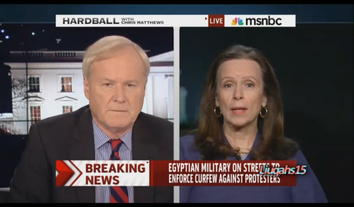
I thought this is what he wanted for the Arab world: democracy! But the market dropped, and the cable shows are filled with mistrust of the Arab street. Our talking heads can’t stop talking about the Islamists. Chris Matthews cried out against the Muslim Brotherhood and shouted, Who is our guy here? — as if the U.S. can play a hand on the streets. While his guest Marc Ginsberg, a former ambassador to Morocco whose work seems to be dedicated to finding the few good Arabs out there, said that forces outside Egypt are funding the revolt — a grotesque statement, given the homegrown flavor of everything we have seen in the streets; and when Matthews pressed him, Ginsberg said, Hamas… Iran.

Matthews’s other interpreter was Howard Fineman. Why aren’t there more Arab-Americans on U.S. television? I give PBS credit for gathering Mary-Jane Deeb and Samer Shehata (along with the inevitable Steven Cook of CFR) to speak of the real political demands of the protesters (and not galloping Islamism!)– but when CNN aired Mona Eltahawy saying that the protesters are not violent, the moderator stomped on her and said, what about those burning vehicles?

As if eastern Europe changed without similar destruction.

So racism against Arabs is shutting down the American mind once again. And all my friends must turn to Al Jazeera English to get the soul of the story: that these events are electrifying to Arabs everywhere, a heroic mobilization. And not only to Arabs. When ElBaradei says, I salute the youth for overturning a pharaonic power, lovers of human freedom everywhere must be thrilled. We are seeing a dictator dissolve before our eyes. These are the events we cherished in history books; let us embrace the Egyptian movement.

Why is America so afraid?

Because we are seeing a giant leap in Arab power, in which the people of the largest Arab nation demand that they be allowed to fulfill their potential. This change portends a huge shift in the balance of power in the region. For the U.S. has played only a negative role in the Egyptian advance, supplying the teargas, and it seems inevitable that Egypt will cease to be a client state to the U.S. And thereby threaten the order of the last 30 years.

Whatever government replaces the current one in Egypt, it will not serve American interests, which have been largely defined by Israel, the American-Israeli “imperium,” as Helena Cobban put it. Since the 1970s (as Joel Beinin shows here), Egypt has been the lynchpin of a US strategy of supporting Israel. The special relationship with Israel has steered our foreign policy, encouraged the destruction and occupation of Iraq, and even fed American Islamophobia. Key to preserving this order has been our ironclad support for the Arab dictatorships in Jordan, Egypt, Tunisia and elsewhere– by providing the policy with a “moderate Arab” seal. Hey Egypt was a bulwark against the Islamists, and Egypt was crucial to the peace process, as all the correspondents tell us on American TV.

The danger to America and Israel is that the Egyptian revolution will destroy this false choice of secular dictator-or-crazy Islamists by showing that Arabs are smart articulate people who can handle real democracy if they get to make it themselves. And when they get it, they are likely to strip the mask off the peace process. On Al Jazeera English, there is much talk about the Palestinians. One commentator said that the “humiliation” of the Palestinians is feeding the Egyptian revolt. (I will never forget how Egyptian construction workers put down their tools to stand and applaud the Code Pink buses as we left El Arish for Gaza in June 2009.) And in his beautiful statement calling on Mubarak to serve his country by leaving, ElBaradei said that a government that heeds the people’s will would turn soon to the Palestinian issue.

This is the great fear, in Israel and in Washington, too: that revolution in Egypt will reveal the despotism of the existing order for the Palestinian people, who have seen their rights and properties and security and water taken from them during the peace process that Egypt has helped sustain.

The grimness on the faces of American Establishment figures reflects the greatest threat to authority, the crumbling of an existing order. Support for Israel has defined order in this region for decades and steered our support for dictators. Ever since Truman defied the State Department in 1947-48, we have been committed to maintaining a Jewish state in the Middle East despite local opposition. This has required great American expenditure, and probably cost Bobby Kennedy his life, but it has been an order. That order has required lip service to Arab democracy, but hey, Mubarak is better than those Islamists.

Now that true Arab democracy is finally coming on stage, that moral structure falls apart. I say morals, because support for Israel has always had a moral rationale. The American establishment felt good about our support for Israel because it seemed like the right thing: We had helped to solve the age-old Jewish Question of Europe. We had ended Jewish persecution. Israel was the answer to Never again! If you doubt that this is the moral calculus of our policy, step into the Center for Jewish History in New York this month. There must be four or five exhibits that touch on Jewish persecution in the Middle East and Europe. The destruction of Italian Jews. The destruction of Berlin businesses that provided the finest linens, photography, interiors… The persecution of Moroccan Jews. It never ends, along with an exhibit dedicated to the “miracle” of Israel’s creation with American Jewish support.

Thus the Jewish community has hunkered down in an anachronistic identity– secure in the completely-contradictory knowledge that the American power structure will support Israel.

All this is changing in Egypt. An Arab liberation story is forcing itself into world consciousness. “The vast, vast majority of protesters are peaceful people, mostly middle class, and they are showing great solidarity. People are still defending the Egyptian Museum,” Issandr El-Amrani reports, inspiringly. There is bound to be great suffering in Egypt, we pray for a smooth transition, but if the Egyptians are only left to handle their own affairs, who doubts that the polity that will emerge from this chaos will be more responsive to human rights, and will strike a blow against the fetters of anti-Arab racism that have chained the American mind.

Philip Weiss is the co-editor of “ The Goldstone Report: The Legacy of the Landmark Investigation of the Gaza Conflict .”

Continue Reading Close

The road to Jerusalem runs through Tunis and Cairo

America didn't see democracy coming to the Arab world because it didn't want to see it

  • more
    • All Share Services

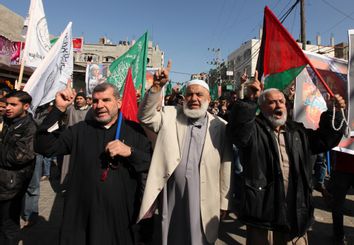
The road to Jerusalem runs through Tunis and CairoHamas supporters attend a protest in Jabalya refugee camp in the northern Gaza Strip January 28, 2011, in the wake of documents released by Al Jazeera showing Palestinian officials offering big concessions in negotiations during past rounds of peace talks with Israel. The Palestinian officials have accused Qatar, the Gulf emirate where Al Jazeera is based, of standing behind a "smear campaign" designed to undermine Abbas. Qatar has ties to Hamas, the Islamist group which seized the Gaza Strip from Abbas's Authority in 2007. REUTERS/Mohammed Salem (GAZA - Tags: POLITICS CIVIL UNREST)(Credit: Reuters)

This originally appeared at Mondoweiss

The neoconservatives told us that the road to Jerusalem lay through Baghdad. They meant that invading Iraq and installing a democracy there would lead to peace in Israel and Palestine. The way they imagined that peace was a neocolonial landgrab: a greater Israel with portions of the West Bank amalgamated by Jordan. Still, that is what they believed– that creating democracy in Iraq would lead to a peace in Palestine.

These ideas are in smithereens today. The Palestine Papers have revealed that the peace process was a Trojan horse for Israeli expansionism and that even the American client in the West Bank could not accept a future state without Ariel and Ma’ale Adunim, the long fingers of Jewish territory.

And the lessons of Iraq and Tunisia and Egypt are that you don’t install democracy anywhere; no, democracy must arise from the people themselves, you damage the processes of establishing popular will by seeking to impose such a system. The western democratic revolutions also arose from within.

The lesson of Tunisia and Egypt for American foreign policy is that the United States is the most conservative force in the world, in this region. It didn’t see democracy coming because it didn’t want to see it coming to the Arab world and to the palaces we supported. And when democracy did come, the U.S. creditably reversed field in Tunisia, but has stuck by its dictator in Egypt.

Barack Obama’s failure to honor the Egyptian protesters in his State of the Union speech Tuesday night, and Joe Biden’s cold negativity toward them last night (they’re not up against a dictator, we can’t encourage them, this is not the awakening of eastern Europe) reveal the unwavering influence of the Israel lobby in our public life, and how conservative that influence is. The administration’s statements reveal that it prefers stability in Egypt, no matter the cost to civil rights and human rights there, to freedom for Arab people. And why? Because Egyptian stability preserves the Israeli status quo, in which Israel gets to imprison West Bank protesters without a peep from the U.S. government and gets to destroy civilians in Gaza again without a peep from the alleged change-agent in the White House.

Thankfully, P.J. Crowley was forced to reveal the policy yesterday by Shihab Rattansi of Al Jazeera, when he admitted that the difference between the administration’s response to Tunisia and Egypt stems from the fact that Egypt has a peace deal with Israel and has come to terms with Israel’s existence, a model to the region. And this line is echoed all over the American news, when they say that Egypt is helping the “peace process,” a process that has produced only suffering and dispossession for Palestinians.

The hole in the bottom of the world here is the fear that Arabs have not accepted Israel’s existence. They didn’t accept it in 1947 in New York, and they didn’t accept it in 1967 in Khartoum. They always warned that its presence would create instability in the region, and the State Department said it would radicalize Israel’s neighbors, and 60 years on this is more true than ever. The Arab Peace initiative of 2002 was a great gesture of realism: the Arab states did accept Israel’s existence, on the ’67 lines. But nothing has come of this incredible shift, and Brian Baird tells us that leading American congressmen, tucked in at night by the Israel lobby, didn’t even know about the Arab Peace Initiative, and Israel scoffed at the offer because it had American power behind it.

Now in Tunisia and Egypt, the Arab street has taken the neocons at their word and said, Yes we want democracy, and we will get it. And Arab youth has taken facebook and twitter and done more with these tools than Americans have done, and said we want free speech and social freedom.

And when they get it– if not this year then within ten years, the internet is too dynamic a force, along with Assange and Al Jazeera– when they get it, they will expose the power of the Israel lobby so that even Chris Matthews will have to address the contradictions. For we will be seen to have only one policy, the preservation of a Jewish state, even if that means Jim Crow and apartheid and stamping out democratic movements everywhere and tolerating a prison for 1.5 million innocent people in Gaza. I waffle about the two state-solution more than anyone, I actually imagined that partition might preserve tranquility, but when democracy comes to Cairo the pressure on Jerusalem to allow equal rights for all citizens will be massive. And the claim that Israel is the only democracy in the Middle East will have completely dissolved.

You see the pressure on Jerusalem beginning in earnest now, from new quarters. You see it in Admiral Mullen’s awareness that Americans will come home in wheelchairs until Palestinians have freedom, in Senator Rand Paul’s call for cuts in military aid to Israel.

That pressure must come to bear soon on the Democratic Party. It is the natural home for the recognition of minority rights and the self-determination of formerly-oppressed people. How sad that even Russ Feingold can scarcely talk about Obama’s war when he speaks out to a progressive audience, and can’t even talk about Palestine. Pathetic.

What we see in Cairo is the destruction of American racist attitudes. A year or so back a Jewish friend said to me that if Jews could take on the Israel lobby and reform American foreign policy, it would be a model for human rights leadership across the world. And I agreed; and we are working at it.

But that was an elitist conceit. The moral leadership in the region is coming not from any American movement in our imperfect democracy, no, we are the most conservative country in the world right now; it is coming from the streets in Tunisia and Egypt.

Philip Weiss is the co-editor of “

The Goldstone Report: The Legacy of the Landmark Investigation of the Gaza Conflict

.”

Continue Reading Close

To walk in Palestinian shoes is to experience actual persecution

The Palestinian experience is not the experience of animals or terrorists. It is a human experience

  • more
    • All Share Services

This piece originally appeared at Mondoweiss:

Two thoughts on the meaning of the Israeli violence.

There is, of course, a big effort in the Western press now to make the flotilla members into violent people, provocateurs, engaged by cool Israeli commandos. I must tell you my one actual experience of this dynamic.

In January, I attended a demonstration against the occupation in the West Bank village of al-Masara. I wrote about it here: “An English politician watches Israeli soldiers lose control at a peaceful demonstration and vows to bear witness.”

The headline sums it up. About 100 demonstrators, Israelis and Palestinians and internationals, marched toward an illegal settlement (Efrat) and the confiscatory wall. They were stopped by a line of Israeli soldiers, some of whom were young and obviously nervous, standing at a line of concertina wire. The demonstrators shouted at the Israeli soldiers. I saw fear on a couple of the young men’s faces. And before you knew it the Israeli soldiers were pushing people back forcefully, even dragging them, and then firing stun grenades at us.

I don’t know if you’ve ever seen a stun grenade go off, but it’s pretty terrifying, the first time, when a soldier hurls a black cylinder and it explodes; you think it’s live. And I have seen reports that these grenades were used on board the boat.

The soldiers ran the demonstrators a half mile back into the village amid mayhem. The lesson of the experience was the one that English politician took away — Catharine Arakelian, a candidate for Parliament, whom I met — that the Israelis had turned a nonviolent demonstration into an out-of-control situation.

So when people say that flotilla passengers tried to lynch the Israeli soldiers, or started the violence, I find that extremely doubtful.

I saw the way that Israel turns to violence as a tool, outside its own borders.

The second thought I have is also from that trip to the Middle East.

When I was in Egypt with the Gaza Freedom March last December, blocked by the Egyptians from entering Gaza, an older member of the group said to me, “When you express solidarity with Palestinians, you will find that you have Palestinian experiences, and you will experience their bitterness.”

He meant that if you walked a ways in the Palestinians’ shoes, you’d experience actual persecution. You’d find that governments and authorities dole out to you some of what the Palestinians experience — from actual violence to being silenced. And so you’d understand the Palestinian experience — and try to hurry back into your privileged life.

This seems to me the lesson of the Turkish boat, and also of Emily Henochowicz, the 21-year-old Cooper Union student who was blinded by Israeli soldiers in a protest of the flotilla raid, whose face is now having to be reconstructed. All these people have now had doled out to them some of the violence and abuse — and lies — that has been the Palestinian experience since 1948.

Of course it makes their courage all the more impressive.

But more important, it shows that the Palestinian experience under fearful Israeli rule is not the experience of animals or terrorists. It is a human experience. It could be you.

Continue Reading Close

American mandate in Palestine is coming to an end, and about time

For 62 years, the U.S. government has signed off on every action Israel has taken, no matter how destructive

  • more
    • All Share Services

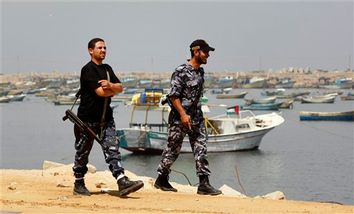
American mandate in Palestine is coming to an end, and about timeHamas security officers patrol on Gaza's seaport, Tuesday, June 1, 2010. Palestinians in Gaza declared a general strike and a day of wrath following Israel's deadly naval raid on an aid flotilla bound for the blockaded Gaza Strip on Monday. (AP Photo/Hatem Moussa)(Credit: AP)

This was originally published at Mondoweiss:

My wife, who pays very little attention to these issues, said this morning, “I think we should all get on boats and go over there.” She looks on Israel/Palestine as complicated, but this one’s easy. “People should keep going and going and going.” Do you know about the underlying conditions? I tested her. “Gaza.”

I have to believe that her human response to the besieged and humiliated people of Gaza is widely-shared today, around the world. And this is a challenge above all to American governance.

The Ottoman Empire, the Turks, controlled Palestine for hundreds of years. This was followed by the British Mandate of 1922-1948; and the British established a Jewish homeland in Palestine but walked away from the Mandate because Jewish terrorism in the wake of the Holocaust was too much for them to deal with. Since 1948 we have been under the American mandate, more or less. Everything that Israel has done since Suez the Americans have signed off on, dispossession, colonization, and so forth.

Today the Turks are leading the international moral challenge to Israel, on an issue that should be easy for anyone to judge. Hillary Clinton is in a panic. Read this say-nothing State Department statement. Obama is as stymied as he was during the Gaza slaughter– which is when the Turks assumed their leadership role. But Obama’s Democratic base is not in any doubt about the right and wrong of this one, c.f., my wife.

Another Obama supporter, Steve Walt challenged the lobby last night, to say, What crosses your line? The International Crisis Group also condemned the attack. And how illuminating, that in that key interval yesterday when North American Jews were called upon to speak out, J Street and Americans for Peace Now failed the challenge and– though both groups said the blockade of Gaza must end, for which I congratulate them– both failed to condemn Israeli actions in international waters. It was a test of leadership. JVP and Naomi Klein didn’t fail. Klein said, We have very few facts from last night, but that didn’t stop her from condemning the “carnage.” And Amira Hass on Democracy Now today said the action represents an abandonment of “common sense” in Israeli society regarding the occupation and the military actions undertaken to protect it.

The tide has turned. A new global generation demands new leaders.

Continue Reading Close

Page 1 of 2 in Philip Weiss